A Few Thoughts on The Catcher in the Rye

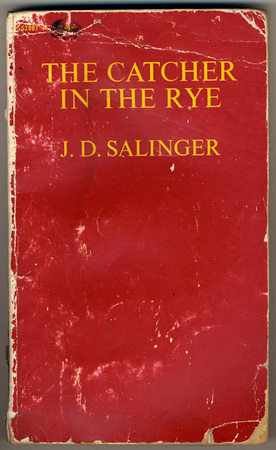
J.D. Salinger’s The Catcher in the Rye is a great read. It’s also a great way for a reader to measure how he or she has changed over the years. Like many (very, very many) readers, I cut my literary teeth on The Catcher in the Rye. I was probably 15 when I first read the book and I sympathized wholly with Holden Caulfield. Like most teens, I was selfish and insular and thought that I was special and unique in my alienation. I was also pretty sure the world was filled with phonies and fakes, and I was determined not to become one of them when I grew up. I must’ve read it three or four times in high school, maybe more.

I was in college, maybe 19 or 20 when I read the book again. Oddly, or perhaps not oddly, I had converted (or masked) my cynicism–always an unearned pose of world-weariness for a teen–into a resolute idealism (the earnestness of which was always undercut by a generational infection of irony, of course). I could now peer into Catcher‘s great irony; I could see that Holden was a big phony too, maybe the biggest in the novel, that he was as cruel as anyone else in the book, and that his obsession with the innocence of youth was not a virtue but a sort of blindness, an ideological defense mechanism rooted in adolescent wish fulfillment. In fact, as an undergrad I begin to see the underlying themes of pedophilia that permeated Salinger’s work. They were minor and covert, to be sure, but also a bit unsettling. I’m sure I read at least twice in college, once for an English class and once on my own. I might’ve read it more than twice.

I read the book again in my mid-twenties, inspired perhaps by Will Smith’s monologue in the film adaptation of John Guare’s play Six Degrees of Separation. Here’s the monologue, where Smith’s character (who, spoiler, turns out to be a big phony) tries to explain why so many psychos and killers find justification for their mad agendas in Catcher:

At this point, I was detached enough from my own teen years to be somewhat disturbed by Holden’s behavior. I found him arrogant and clueless and largely unsympathetic. It was the end of the novel in particular that pointed toward psychopathic tendencies: Holden’s wish to “catch” all the kids who will “fall” from innocence, purity, spontaneity, whatever–this looked more to me now like a symptom of narcissistic personality disorder than the mark of tragic hero. I haven’t read the book since then.

Now that Salinger’s dead, like many fans, I’m excited. I’m excited to see what’s been stacking up in Salinger’s retreat in Cornish all these years. Given the inscrutability of later work like Seymour: An Introduction and the fact that Salinger wrote solely for his own pleasure in later years, it’s difficult to even imagine what the unpublished work will look like–if we even get to see it. In any case, it seems unlikely that any posthumous work of Salinger’s will ever penetrate the national literary consciousness (and conscience) the way Catcher has. I have a stack of galleys by my bed that measures close to four feet, but I think I’m going to put aside some time to see how Catcher measures up after all these years–or, rather, how I measure up to it.

Jane Bites Back — Michael Thomas Ford

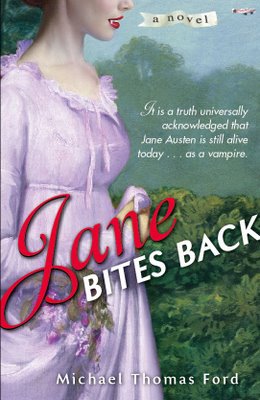
In Michael Thomas Ford’s novel Jane Bites Back, Jane Austen (you know, the Jane Austen) is an incognito vampire/bookstore clerk in upstate New York. Poor Jane is trying to get a new novel published (under a pseudonym, of course), but she suffers scores of rejection letters for her new work. Even worse is the horror of the Jane Austen industry, which, under the auspices of public domain laws, clutters Jane’s own bookshop with awful books that, like, don’t “get” the Austen oeuvre (in the climactic scene of the book’s opening chapter, Vampire Jane gets some measure of revenge by consuming the boorish author of an execrable volume entitled Waiting for Mr. Darcy). Of course, there’s got to be a plot, so Jane does get an offer for a book deal, one that’s complicated by accusations of plagiarism and other woes. To make matters worse, her old lover Lord Byron shows up (yeah, Byron, duh. How else would Jane Austen catch the vampirism?) There are other ghosts of literary past who show up, too, but why spoil surprises?

Jane Bites Back reveres its subject, Jane Austen, even as it blatantly cashes in on the very trend that it satirizes. The book’s program shouldn’t be confused with the absurdity behind Sense and Sensibility and Seamonsters (which we liked) or the wackiness of Pride and Prejudice and Zombies (which we didn’t like), but it does adhere to the same sense of fun. Ford seems to delight in corny, over the top passages, and we’ll take it for granted that his literary tongue is in his cheek when he writes a paragraph like:

When his hand cupped her breasts she gasped, and when his mouth touched her skin she felt her knees buckle. He caught her, sweeping her up in his arms and carrying her to the bed. He placed her atop the sheets and stepped back. She watched through half-closed eyes as he removed his clothes. His chest was lean, his skin pale as milk. When stepped from his trousers she glanced briefly at his manhood before looking away.

His “manhood”?! Jeez, we hope this is parody. In any case, we were laughing. (Sidenote: How does this stack up against the sex scenes in the Twilight books? Are there sex scenes in the Twilight books? What Biblioklept reader will even admit to having read Twilight?)

Ford’s style is, on the whole, redolent with the tropes of YA fiction–not that Jane Bites Back is necessarily YA–but there’s not a challenging sentence in the book, which may or may not be a compliment for the writer. Clear, lucid writing is difficult to do. Still, we tend to value ambiguity around here; being perplexed and furious is a good reaction from time to time. Jane Bites Back reads with an anonymous speed that’s not particularly invigorating.

If we were really feeling adventurous today, we might wax heavy on the all the implications, meta- and otherwise, of a book that purports to criticize the Austen fad while at the same time indulging in it…but we’re not feeling up to it. There’s also a neat Venn diagram in all of this: vampires, Jane Austen, feminism (yeah, there are feminist themes here. Did we forget to mention them? Sorry). Suffice to say that any reader whose ears perk up at the notion of “Jane Austen + vampires” will not be disappointed in this book.

Jane Bites Back is new from Ballantine Books.

Nazi Literature in the Americas — Roberto Bolaño

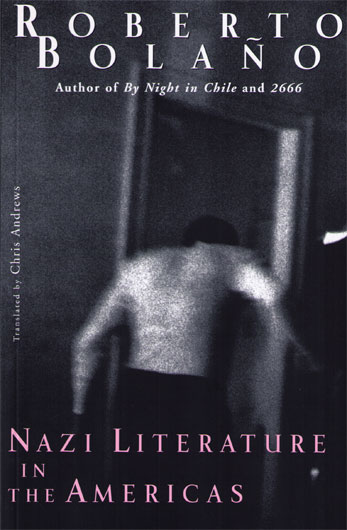
I was talking with a friend last weekend about Roberto Bolaño and he remarked that many of the early slim novels from this remarkable writer tend to read like sketches for his masterwork 2666. This is a more than fair assessment and also one that shouldn’t–and doesn’t–detract from enjoying these books. But it’s difficult to read the nightmare-rant of By Night in Chile or the paranoiac dread invested in the tales in Last Evenings on Earth without recalling the layered themes of violence and art that underpin 2666. Bolaño’s fake-encyclopedia, Nazi Literature in the Americas is perhaps, by its very nature, the sketchiest of these sketches, yet that term, “sketch” — well it’s just plain wrong here. While most of the book’s entries are marked by brevity, none are undercooked. Rather–and I hate that I’m about to crib from critic Francisco Goldman’s blurb on the back of the book, but he’s spot on–the book is a “key cosmology to Bolaño’s literary universe.” In short, Nazi Literature in the Americas helps to confirm that, like J.R.R. Tolkien, Bolaño was a writer with a fully-realized universe at his disposal, one with its own heroes and villains, histories and myths, and yes, like Tolkien, its own literature.

Nazi Literature in the Americas is a stunning, ugly, highly-enjoyable, and often hilarious book. It details the exploits, both literary and non-, of over two dozen fictional writers from North, Central, and South America. While few of the writers are actually practicing Nazis, all are right-wingers and most are crazy failures. Big surprise that Bolaño would write about crazy, failed writers, right? And that is the central paradox of the book: while the writers here are anti-Semites and fascists and neo-Nazis who represent the worst in human values and ethics, they also darkly mirror Bolaño himself, or at least his fictional stand-ins. For example, the (anti-)heroes Ignacio Zubieta and Jesús Fernández-Gómez are Colombian writers who side first with the fascists and then the Nazis, yet they come across as doubles for the Mexican lefty poets Ulises Lima and Arturo Belano, the (anti-)heroes of The Savage Detectives. The pair pops up a few times in the course of the book as well, most notably in the section on Daniela de Montecriesto, who was a minor character in 2666.

She’s not the only character to traverse Bolaño books. The final chapter of Nazi Literature, its longest, tells the story of Ramírez Hoffman, the aviator-poet-serial killer whose story is extended in the novella Distant Star. Hoffman’s entry, besides being the longest, is also the only written in the first-person. The narrator is even identified as “Bolaño.”

At times the reader will find himself sympathizing with Bolaño’s monsters. The sci-fi writer Gustavo Border says: “I have been tormented, spat on, and deceived so often–the only way I could go on living and writing was to find spiritual refuge in an ideal place.” Bolaño immediately cuts the pathos with humor; Border ends his sad comment: “In a way, I’m like a woman trapped in a man’s body.” Elsewhere, what’s most shocking is not how much sympathy Bolaño evokes, but how interesting the literature he describes sounds. Take Segundo José Heredia’s Saturnalia, for instance:

Saturnalia, the story of two young friends who in the course of a week-long journey through France are confronted with the most horrendous acts they have ever witnessed, without being able to tell for sure whether or not they are dreaming. The novel includes scenes of rape, sexual and workplace sadism, incest, impaling, and human sacrifice in prisons crowded to the physical limit; there are convoluted murder plots in the tradition of Conan Doyle, colorful and realistic descriptions of every Paris neighborhood, and, incidentally, one of the most vivid and spine-chilling female characters in Venezuelan literature since 1950: Elisenda, the enemy of the two young men.

It sounds horrific but I’d love to read it. It also sounds like a Bolaño novel, with its nightmare violence, prisons, and detective plots.

In one telling aside, one of Bolaño’s writers realizes that “literature . . . is a surreptitious form of violence.” Bolaño’s oeuvre seems to work from this thesis, or perhaps work to enact this thesis. If the writers of of Nazi Literature are villains, they are also sympathetic in their villainy, not for their racist viewpoints, which are subtly but repeatedly mocked and condemned, but rather for the fact that as writers and artists they have no hope; like Oedipus they are fated to violence. Like Bolaño himself, they both channel and engender violence. Their failure, of course, is to seek to regulate or otherwise give meaning to that violence via ideology and dogma. Tellingly, Bolaño investigates–and perhaps corrects–this failure in his opus 2666 which resists easy answers and scapegoats.

And so to return to our point of entry: Nazi Literature in the Americas will probably be enjoyed most by those who’ve trucked through 2666 or some of Bolaño’s other works. It’s a quick, propulsive read, and while quite funny–and at times scary–it’s most fascinating as a document that further fleshes out the Bolañoverse. Highly recommended.

The Spare Room — Helen Garner

We’ve all had house guests who stay too long. But what happens when a house guest who overstays her welcome is dying? What if you invited her there hoping to prove in yourself some measure of humanity, humility, maybe even heroism, by taking good care of her? What if you found her irritating? Grating? Self-absorbed? What if  she didn’t seem to even notice what a great caretaker you were? What if she didn’t seem to appreciate your prowess as a host? What if she outright ignored the disease that was killing her, just refused to even mention it, denying you any hope of closure? Worst of all would be the shame that compounded all of these feelings about the dying house guest, the sense that you are wrong, inhuman, cowardly, right? Helen Garner’s novella The Spare Room (new in trade paperback from Picador) tackles these questions and the emotional turmoil behind them in measured, spare prose making a compelling and rewarding read.

Little irks me more in journalism than a book review (or any media review, really) that seeks to intertwine the personal dramas of the reviewer. I am about to do just that right now, gentle reader, so you are forewarned. Stop reading now if you wish and know that Biblioklept recommends The Spare Room. It’s a marvelous piece of writing, one that gives proof to the cliché “brutally honest.”

Reading The Spare Room I could not help but identify with its narrator, an Australian woman in her 60s named Helen who takes care of her free-wheeling, slightly daffy, cancer-infested friend Nicola. I am not an Australian woman in my 60s, but, like Helen, I know what it is like to live with and care for a person whom you love who also happens to be dying. From the time I was 12 years old, my maternal grandmother Mama Dot lived with my family. The doctors, prognosticating wise men all, gave Mama Dot just a year or two to live and my folks wanted her to spend that time with us. She was very sick, and, as if to prove the verity of certain stereotypes about Southern women,  she was also very stubborn–mulishly so (the woman could hold a grudge). She went on to live another 10 years with my parents, during which time both my brother and myself of course left the house (but always came back to visit). I loved her very, very much and, perhaps as a result of that love, fought with her constantly and fiercely about any little thing. Unlike the narrator Helen, who bottles up her irritation with Nicola (particularly her fury at her friend’s pursuit of quackish cures), I found it easier to confront my grandmother about her faults in illness–her lapses of memory and judgment, her lack of cooperation, her unbearable slowness. I could even be mean. But like Helen, I always felt bad about it too. What makes The Spare Room such an affecting, gripping read is Garner’s honesty, her ability to capture the negative, selfish feelings that we all must feel when comforting the sick.

Narratives about the dying often disengage the emotional turmoil of the caretaker by applying a veneer of sentimentality, morality, or even whimsy. Garner handles her subject matter with a realism that denies sentimentality and faces the ugliness of death head on. Her narrator is compassionate toward her friend but it’s always clear that the book is not about Nicola–it’s about how Helen reacts to Nicola. It’s about what it means to be selfish at the very moment you are trying to be selfless. It’s about how hard it is to get past your flaws as a human being. Take the book’s humor, for instance: The Spare Room is frequently hilarious, yet the humor never seeks transcendence or escape. When Helen seems to mutter to her audience, “God bless morphine” at the beginning of a chapter, she isn’t drolly avoiding her friend’s pain–she’s thankful that the drug has given both of them a night’s sleep. Similarly, her observation that the “station was a seven-minute walk from my house, twenty if you had cancer,” reveals that Helen’s selfishness is wrapped in minute details, details that compound in the narrative and build tension toward its awful final sentence (a final sentence that I won’t spoil by revealing here, dear reader).

The Spare Room is a tightly-compressed novella that one might read in an afternoon or two, yet the book will undoubtedly stay with most readers for a long time to come. We might not all be like Helen (and, thankfully, not all of our patients are as trying as Nicola) but there is certainly bound to be some measure of her in even the best of us. Garner has captured here some of that rage against the dying of the light that Dylan Thomas encouraged of us, and she’s revealed that that rage, falling impotent against illimitable death, might end up aimed at those we love dearest–as well as ourselves. Highly recommended.

In Praise of the Novella

How long is a novella? Longer than a short story and shorter than a novel. Sure. Yet this answer doesn’t seem satisfactory. Is Melville’s Bartleby a novella or just a really, really long short story? I’m pretty sure Melville’s Billy Budd and Benito Cereno are both novellas. What about Kafka’s The Metamorphosis? The edition we read last week clocked in at a slim 40 pages. Steinbeck‘s Of Mice and Men and The Pearl–at about 100 pages each, these seem in novella territory. Conrad’s Heart of Darkness, that’s a novella, right? What about García Marquez’s Chronicle of a Death Foretold? James Joyce’s The Deador is it “The Dead”?–is collected in Dubliners but it also gets published as a novella. So which is it? Short story, novella–or both?

The Dead has recently been republished by Melville House as part of their Art of the Novella series. They’ve also got a series called The Art of the Contemporary Novella which we’re just loving over here. Lore Segal’s Lucinella was a treat and Nanni Balestrini’s Sandokan floored us. Melville House was kind enough to send a copy of  A Happy Man by Hansjörg Schertenleib and we’ve thoroughly been enjoying it. Like all of the books in the series it fits neatly in a blazer pocket and is ideal reading at traffic lights and doctor offices. It’s kinda hard to beat that. Praise the novella for its compact nature and ease of readability. Full review forthcoming.

It was the copy of Helen Garner’s The Spare Room, new in trade paperback from Picador, that showed up at Biblioklept World Headquarters this week that kinda sorta prompted this whole post. The book, detailing a three-week visit from a terminally-ill friend is terse and tense and, uh, spare, a perfectly-paced exercise in all the ugliness of being human and having emotions. Ugh. Garner makes great use of the novella as a specific medium here. The book is a sustained internalized encapsulation of a brief period, vivid and funny, but also harsh, as Garner lays bare all those things we think but shouldn’ t say (and think we shouldn’t think). At any greater length her prose might risk veering into navel-gazing territory, but the constraint of the novella provides a control and rhythm that compels (and rewards) reading. Full review forthcoming.

So anyway, here’s an admission: we’ve never read Italo Calvino’s Invisible Cities but all these novellas prompted us to pick up a copy today at our favorite used book store. It’s a novella, right? It’s certainly slim. And choppy. We’ll get to it soon.

Sandokan — Nanni Balestrini

Nanni Balestrini’s novella Sandokan, new in English translation from Melville House, tells the story of the rise of the Camorra crime syndicate in the small, poverty-stricken cities around Naples. Balestrini’s unnamed narrator occupies a fascinating insider-outsider perspective: one one hand, he, unlike many of his peers, does not join the gang, or “clan,” as its called–in fact, their behavior repulses him. On the other hand, he’s a native of the small town where Francesco Schiavone (aka Sandokan), Antonio Bardellino, and their henchman rule mercilessly, an eye-witness to the brutality and inhumanity of organized crime. The narrator is a sensitive young man who delineates clearly how the crime cartel was able to achieve such economic prosperity and power in the 70s, 80s, and 90s, detailing the various rackets the clan imposed upon the town, like stealing elections, peddling drugs, and manipulating the agribusiness that is the main source of income for average Neapolitan peasants. The narrator also explores why these small towns fall so easily into the terror of organized crime. The main reason: boredom stemming from little or nothing to do.

Balestrini’s narrator’s description of the Camorra is systematic, detailing the awful history and brutal practices of the syndicate in spare, concrete terms. His explications of the clan’s violence is not so much thrilling as  it is ugly, as the narrator always shows how “normal people” (his words) are cheated, killed, or otherwise harmed by the Camorra. The narrator’s tone is often journalistic but never clinical; he always shows what’s at stake for the “normal people,” how they are affected by these crimes. At times the narrator is wryly funny, a tone that results in large part from his observation that the townspeople, the people he grew up around, begin to normalize the violence. It becomes part of their daily lives and affects them so directly that it becomes casual, and the sensitive narrator is one of only a few not to bow to it, ignore it, or take part in it–yet the violence and crime is so overwhelming that to live with it is to live with absurdity. Balestrini employs a punctuation-free rhetorical style in Sandokan that captures the breathless energy and frustration of the narrator. While many readers might balk at the lack of commas, periods, or semi-colons, I found the technique quite liberating. It enhances the immediacy of the narrator’s voice, the rushed sense of importance to his tale. It also promotes sustained readings of the text–I read most of Sandokan in three enthralled sittings.

Sandokan has its cinematic twin in the 2008 film Gomorra, directed by Matteo Garrone. The film, like the book, illustrates the affect that crime has on a range of “normal people,” mostly occupants of a housing project outside of Naples. As in Sandokan, the ordinary citizens find that they have no choice but to choose between sides as an absurd, petty gang war ravages their already decimated landscape. Where Balestrini’s punctuation-free rhetoric allows readers closer access to his narrator’s pathos-driven story, Garrone lets his camera wander freely over the grim landscape without ever imposing any clear narrative structure. It is not until the film’s final third that the five disparate stories he tells coalesce, and even then, it remains unclear who is on whose side. What is clear is that the violence and crime is quickly stealing–and killing–another generation.

In an age where violence is sensationalized and glamorized, particularly in gangster films and TV shows (do I really need to list them?), Sandokan and Gomorra both lay bare the Darwinian cost of crime. In both narratives, the violence is mundane and inescapable, meaningless yet awful, and very, very dark. Neither narrative is didactic in the least–or even hopeful, for that matter–but their is an implicit suggestion that if only there were some alternative to the Camorra–libraries, social clubs, movie houses–there might be another prospect for the young people in this area.

I highly recommend both Sandokan and Gomorra. As an end note, I’d love to see more of Nanni Balestrini’s work come into English translation, perhaps via Antony Shugaar and Melville House, who’ve done a lovely job here.

The Brief Wondrous Life of Oscar Wao — Junot Díaz

What better way to initiate a new year (or new decade, really) than to review a book that has been universally praised since its release in 2007? Junot Díaz’s The Brief Wondrous Life of Oscar Wao won the Pulitzer and the National Book Critics Circle Award, as well as topping or placing high on plenty of year-end and decade-end lists. NYT critic Michiko Kakutani gushed that it was “Mario Vargas Llosa meets “Star Trek” meets David Foster Wallace meets Kanye West,” an apt description, we suppose, although it’s more Lord of the Rings than Star Trek, really. The book is, in short, already beloved, and we liked it as well (even if it doesn’t quite stick its ending).

Oscar Wao loosely centers on a fat Dominican-American nerd named Oscar, but really he’s just a complex prop for Díaz to tell the story of the Dominican diaspora during (and after) the brutal regime of Rafael Trujillo. Obese and obsessed with fantasy novels, sci-fi, and role-playing games, Oscar is girl-bane, repellent to the opposite sex–completely the opposite of the male Dominican ideal. In this sense, he doesn’t fit in with his gorgeous mother Belicia or his athletic sister Lola, but that doesn’t stop them from putting him at the center of their lives. Lola’s on-again-off-again boyfriend Yunior narrates the book; he often compares himself to The Watcher, a fitting simile given his ability to infiltrate the psyches of characters and historical figures alike. We might as well go ahead and note that if you didn’t catch the reference to the Marvel Comics character The Watcher, chances are you’ll need to look up many of this book’s myriad allusions to nerd culture. Díaz uses The Lord of the Rings in particular as a template throughout the book, framing large parts of the book’s Trujillo narrative as a good vs evil epic. We particularly enjoyed these parts, which mix self-deprecating humor with the dire seriousness of Trujillo’s inhuman reign. The novel moves freely from the 1940s to the 1990s, measuring the toll of Trujillo’s dictatorship in each of the characters’ lives over four generations. Tellingly, Trujillo is one of the book’s most well-drawn characters, and even if he’s depicted as cartoonishly evil at times, his crimes are treated with utter seriousness. The narrative of Oscar’s mother Beli is also fascinating, particularly in the manner Díaz reveals her story, beginning essentially backwards with her contemporary life in New Jersey and moving as the narrative progresses to her earliest days in the DR. The story of her father Abelard was our favorite section. It comes late in the novel and helps to tie together several missing threads.

How Yunior is privy to all this info nevertheless remains a mystery but his voice engages and sustains the novel throughout, plot holes be damned. Language is the key constituent to Oscar Wao and a pretentious prick of a reviewer might call the novel’s mix of Dominican slang, literary academic jargon, and nerd-speak a dialogic carnival of intermingling voices. But we won’t do that. Suffice to say that the novel’s commanding voice compels and sustains long reading sessions and kept us up late for a few nights last week. The narrative voice of Oscar Wao is so strong and compelling, in fact, that it makes up for the novel’s greatest weakness–the character of Oscar himself, who lacks complexity or detail, especially when contrasted with the other characters in the novel. In a sense, Díaz’s master narrative might be reduced to Oscar’s epic quest to get laid, with a heavy dash of DR history thrown into the mix. But that’s too reductive. Still, as the novel dashes to its epiphanic climax (don’t worry, no big spoilers here), it’s hard to accept–or even understand–Oscar’s heroic metamorphosis. The transformation feels unearned–for either Díaz or Oscar–and it leads to a weak, lazy ending. (Related aside: We can’t help but compare this novel now to Zadie Smith’s White Teeth, another multigenerational/multicultural novel (another dialogic carnival of voices, says the academic prig) that doesn’t really pull off its conclusion. But we liked both books anyway). Recommended.

The Best Books We Abandoned in 2009

It’s an old story. Or maybe it’s just a common story. Anyway, Biblioklept World Headquarters, as one might reasonably expect, is larded with books, bursting at metaphorical seams, etc. Bibliophilia, that terrible disease, drives us to buy new (and old books) with a ridiculous frequency, a frequency that could never match a realistic able-to-be-read-in-the-allotted-time-we-have-to-read matrix. The Biblioklept Mission to review new books ironically compounds this problem. Advance review copies and galleys arrive, solicited or no, with publication dates stamped boldly on publicity sheets, publication dates that remind the reviewer that timeliness matters, that a Serious Editor would get out reviews in a Timely Manner. So. What happens? You know what happens, dear reader: books begun with the best intentions are brushed aside for just a week so that forthcoming novels might be appraised; but rhythm is lost; narrative drops away. We lose the thread. And before you know it, another set of new books crowds the doorstep. The following books were all great, in so far as we got into them, and we will do our best to finish them sometime in the near future.

The Recognitions — William Gaddis

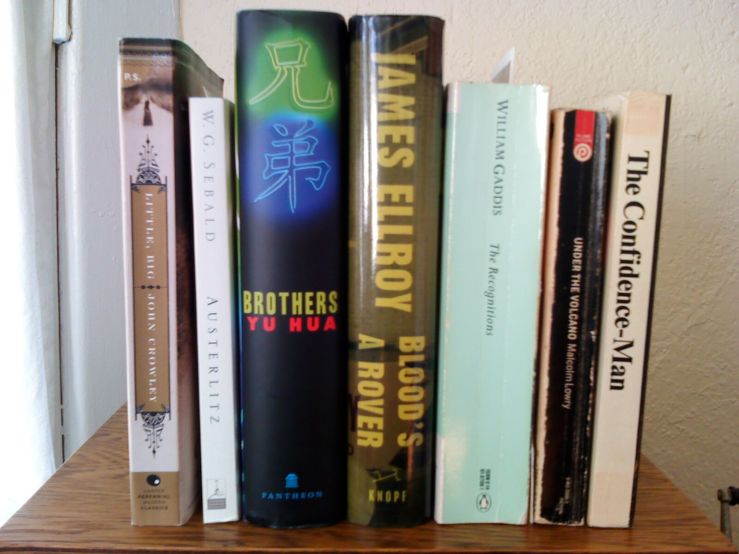
We had the foresight to review the first book of this massive, massive novel. The first chapter is probably the best thing we read all year, but the book seemed to lose some of that initial energy, instead settling into a frustrating and ungenerous rhythm. But there we go, blaming the book, when its difficulty was also very rewarding. It’s embarrassing really. We read 342 of the book’s 956 pages and then turned our attention, for just a second, to a few new paperbacks, and poof! — we lost it.

The Confidence Man — Herman Melville

We got about 50 pages into the Norton annotated edition we found for a dollar at the Friends of the Library sale. And that was that. Will try again in 2010.

Under the Volcano — Malcolm Cowley

We’d been wanting to read this for awhile now, after reading David Foster Wallace cite it as a special kind of book, or a book that needed to be read (or maybe he said it was a book that people needed to be made to read . . . Hang on, was it even Wallace who told us to read it?) Abandoned about 30 pages in.

Little, Big — John Crowley

Little, Big is the one on this list that we’ll take for granted is as good as everyone says it is. We tried to read it with the AV Club’s book club, Wrapped Up In Books, but no. Harold Bloom says it’s one of his favorites, too. We got about 60 pages in, but it wasn’t exactly compelling, and Crowley’s rhetorical style was kinda infuriating in its contrived simplicity. The only book on this list we willingly put down.

Brothers — Yu Hua

We got over 100 pages into this ribald satire, but again, put it down to read a book about the moral panic comic books inspired. Probably the best unsolicited review copy we got this year. We should really go pick it up again . . .

Blood’s A Rover — James Ellroy

We read a 100 pages of Blood’s A Rover and then challenged traditional ethical notions of book reviewery and posted a review. We continued to read and then–viola!–the audiobook version came out. So, depending on how you view these things, we either technically did or did not abandon this fine crime procedural.

Austerlitz — W.G. Sebald

Oh the shame of it all. Stuck 158 pages into Sebald’s 298 page chronicle of the displaced orphan Austerlitz. The bookmark’s still there and everything. We read most of those 158 pages in two afternoon sittings. Then some book or other arrived (two, actually: Lethem’s Chronic City and Fallada’s Every Man Dies Alone). Sebald’s The Rings of Saturn is easily one of our favorite books, but it was divided into, y’know, paragraphs, sections, and chapters. Austerlitz is not–not even paragraphs. There are Sebald’s trademark black and white photos to occasionally break up the text, but otherwise, no, just long, long, chunks of texts that diverge and move through space, time, and voices. And while the book is very good, it also requires sustained concentration. It doesn’t want you cheating on it with another book. It’s quite selfish. But there are still a few days left in the year, and perhaps we’ll finish it one afternoon–although a quick glance over page 158 reveals that we are stuck in the text’s inertia.

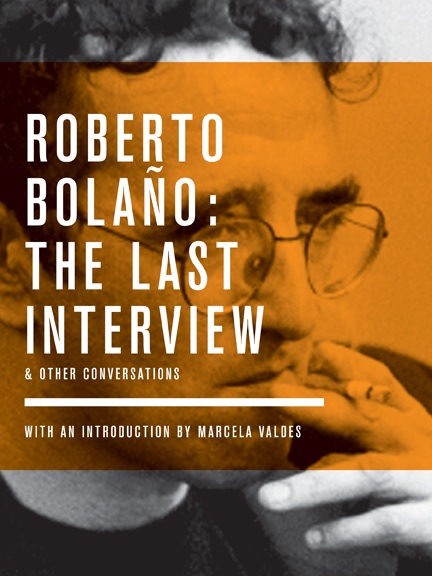
Roberto Bolaño: The Last Interview

I hate reviews that hem and haw too much over context, but I feel that a proper review of Roberto Bolaño: The Last Interview has to begin with some background information. But because I love you, gentle reader, as much as I hate context-driven reviews, here’s the quick version: if you, like me, have found yourself compelled to read everything by Bolaño that you could get your hands on in the the past year or two, then you should buy and read The Last Interview because you will enjoy it. Now for the context:

When Bolaño died at age 50 in 2003, he was only just rising to prominence as a fiction writer, with most of that prominence still restricted to the Spanish-speaking world. Bolaño’s tremendous success has been mostly posthumous and there really aren’t that many interviews with the man. Roberto Bolaño: The Last Interview collects four of them, scattered between 1999 and 2003. Up until now, not all of these interviews were available in English (unless you took the time to put them in a translator program like Babel Fish. Which I did. Quick note: Sybil Perez’s translations here are better than the syntax soup I got via Babel Fish). The book gets its name from Bolaño’s last interview, conducted by Mónica Maristain in a 2003 issue of the Mexican edition of Playboy; that longish interview makes up the bulk of this book. There’s also an essay entitled “Alone Among the Ghosts” by Marcela Valdes, previously published in a 2008 issue of The Nation.

“Alone Among the Ghosts” works as a sort of preface for the interviews, providing a brief overview of Bolaño’s oeuvre and shedding light on his working methods. In particular, “Ghosts” details how Bolaño researched the gruesome crimes at the heart of 2666. The interviews that follow range in tone from flighty (Maristain’s Playboy interview) to intimate (Carmen Boullosa’s inteview in Bomb), but all share one common trait: each interviewer attempts to get Roberto Bolaño to name his place in the canons of Spanish and world literature. The interviews, much like Bolaño’s at-times-esoteric (at least to this English speaker) novel The Savage Detectives, are chock full of literary references to Spanish-language writers, poets, and critics, and each interviewer seems to delight in pushing Bolaño into saying something provocative about other writers. Tom McCartan’s annotations, located in the margins of this extra-wide book, help to enlighten those of us who are unfamiliar with the greater (and lesser) fights and scandals of Latin American literature. In his books, Bolaño often satirized the petty in-fighting between various literary groups, at the same time revealing the paradoxically serious nature of these conflicts. One of the best examples comes from The Savage Detectives–Bolaño’s stand-in Arturo Belano fights a duel with a critic on a beach in an episode that’s both hilarious, pathetic, and slightly horrifying. In the interviews, you get the sense that Bolaño is both provoking literary battles and, at the same time, downplaying them. He’s serious about his aesthetic values but knows that most of the world is not–he knows that most of the world is concerned with more immediate and perhaps weightier concerns like family, sex, and death. It’s on these subjects that Bolaño the interviewee is more poignant and candid–and fun.

There is a sense of creation in these interviews, of Bolaño creating a public self through his answers. It’s at these times that you can almost sense Bolaño writing. On the one hand, it’s a treat to see his voice so fresh and immediate, but on the other hand, in the context of an interview, it lends credence to the notion that he’s resisting presenting an authentic “self” (please put aside all postmodern arguments about authenticity, identity, and textuality for a few moments). Consider his response to his “enemies”:

Every time I read that someone has spoken badly of me I begin to cry, I drag myself across the floor, I scratch myself, I stop writing indefinitely, I lose my appetite, I smoke less, I engage in sport, I go for walks on the edge of the sea, which by the way is less than 30 meters from my house, and I ask the seagulls, whose ancestors ate the fish who ate Ulysses: Why me? Why? I’ve done you no harm.

A lovely passage. Apparent sincerity gives way to hyperbole gives way to healthy habits gives way to literary allusion–and perhaps hints of bathos. I get the sense that Bolaño is pulling a collective leg here, yet, there must be a kernel of truth to the notion that his critics affect him. In any case, the response, in its compelling rhythm and pathetic humor, might fit neatly into one of Bolaño’s books, where the author has often blurred the lines between fact and fiction.

These interviews will no doubt be pored over as “Bolaño Studies” hits academia hard, and would-be Bolaño scholars try to parse out their own narratives against the myriad gaps in Bolaño’s record. For more on the many inconsistencies in Bolaño’s life, check out this story from the The New York Times, which interviews family, friends, and literary associates to tease truth out of some of Bolaño’s grander embellishments. Of course, Bolaño was not solely responsible for all exaggerations. From the interview first published in Turia:

“It’s the typical Latin American tango. In the first book edited for me in Germany, they give me one month in prison; in the second book–seeing that the first one hadn’t sold so well–they raise it to three months; in the third book I’m up to four months, in the fourth it’s five. The way it’s going, I should still be a prisoner now.”

The New York Times article questions whether Bolaño even spent the eight days in a Chilean prison that he claims he did. Whether or not that ruins the authenticity of Bolaño’s short story “Dance Card,” collected in Last Evenings on Earth, is totally up to you of course, dear reader, but I think that self-invention has always been the privilege of the writer. If the interviews collected in The Last Interview reveal a myth-maker creating a self, they are also transparent and humorous in these creations. Highly recommended.

Roberto Bolaño: The Last Interview is now available from Melville House. For a detailed account of the authors mentioned in the interviews, read Tom McCartan’s fantastic series “What Bolaño Read.”

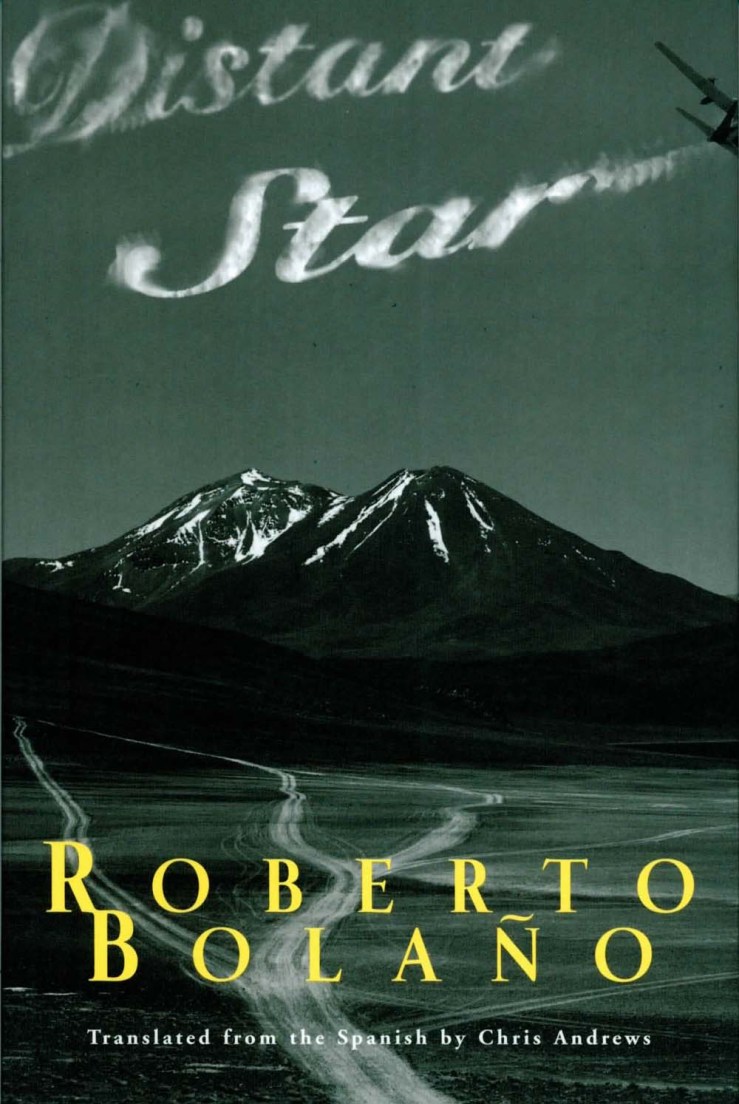
Distant Star — Roberto Bolaño

Roberto Bolaño’s slim novel Distant Star begins a few months prior to Pinochet’s bloody 1973 coup and continues into the mid-nineties, crossing through several countries in the process. The unnamed narrator (presumably the “Arturo B.” mentioned in a brief preface, surely Arturo Belano, Bolaño’s alter-ego) is so busy with the future of Chilean poetry that the violence of the coup–in which scores of students are arrested, killed, or disappeared–takes him by total surprise. He’s obsessed with a quiet and intense poet close to his age named Alberto Ruiz-Tagle, who seems to be, according to all sources prior to the coup, a harbinger of a new age in Chilean writing. Ruiz-Tagle, it turns out, is actually an Air Force officer named Carlos Wieder, who writes his death-obsessed poetry in a WWII Messerschmitt airplane. Wieder’s sky-written poems cause a sensation (however illegible some are), but not one nearly as great as his magnum opus–a multimedia installation cataloging and detailing Wieder’s sadistic, ritualistic murders of students and other dissidents. His art is beyond the pale of even the new military regime, and he’s forced out of the Air Force to live a life under pseudonyms in other countries, much like the other Chilean exiles who populate this book. Bolaño’s narrator, a savage detective, takes great pains to reconstruct the lives of these escaped artists, but as time passes the truth becomes ever-murkier. He writes at one point that “the melancholy folklore of exile” is “made up of stories that, as often as not, are fabrications or pale copies of what really happened.” The narrator’s detective work, aided by old friends, attempts to reconstruct the whereabouts (or fates) of Chile’s exiles, but more often than not the trails lead to a perplexing pastiche of possibilities–not dead ends, but inconclusive answers. The story builds to a tense, sinister, and perhaps incomplete (yet satisfying) climax as a “real” detective–a former cop turned PI–enlists the narrator to track down a man who may or may not be Wieder. And I won’t spoil what happens after that.

I read most of Distant Star over the course of one afternoon, and then re-read most of it again earlier this week. It seems to me that the book is something of a trial-run for Bolaño’s opus, 2666, and when I say that, I don’t mean to diminish Distant Star at all, only to note that, more so than The Savage Detectives or By Night in Chile, this book is markedly horrific and at times profoundly violent. It is, of course, something of a companion piece for By Night in Chile (both, by the way, translated by Chris Andrews). That book is a confession from a critic-priest who had flourished under the right-wing regime; Distant Star gives us the other side of the story. Distant Star is also an investigation (by way of digression, to be sure) into the relationship between power and art and evil, and there’s a coldness at its core that almost hurts. It is both painful and beautiful. This is not the best starting place for Bolaño. I’ll continue to contend that 2666 is a fine and dandy place to jump in, or Last Evenings on Earth, if 900 pages is too much for you, but if you read those and dig them, you’ll want to read Distant Star, and its evil twin By Night in Chile. In some sense, all of Bolaño’s work (at least what I’ve read so far) composes a grand and (in)complete and sweeping collective body, like Faulkner, who provides Distant Star its epigraph: “What star falls unseen?” Highly recommended.

Best Books of 2009

Here are our favorite books published in 2009 (the ones that we read–we can’t read every book, you know). The list includes books new in print after a long time as well as first editions of trade paperbacks. All links are to Biblioklept reviews. The list is more or less chronological, beginning in January of 2009.

The Book of Dead Philosophers — Simon Critchley

Sum — David Eagleman

Chicken with Plums (trade paperback) — Marjane Satrapi

The 2009 PEN/O. Henry Prize Short Stories

Che’s Afterlife: The Legacy of an Image — Michael Casey

Bodies — Susie Orbach

Inherent Vice — Thomas Pynchon

A Better Angel (trade paperback) — Chris Adrian

The City & The City — China Miéville

2666 (trade paperback (yes, yes, putting it on the 2009 list is away of amending the fact that we didn’t finish it until January 2009 and thus didn’t get it on last year’s best of lists)) — Roberto Bolaño

Bicycle Diaries — David Byrne

Asterios Polyp — David Mazzucchelli

The Paris Review Interviews, Vol. IV

Lucinella — Lore Segal

Every Man Dies Alone — Hans Fallada


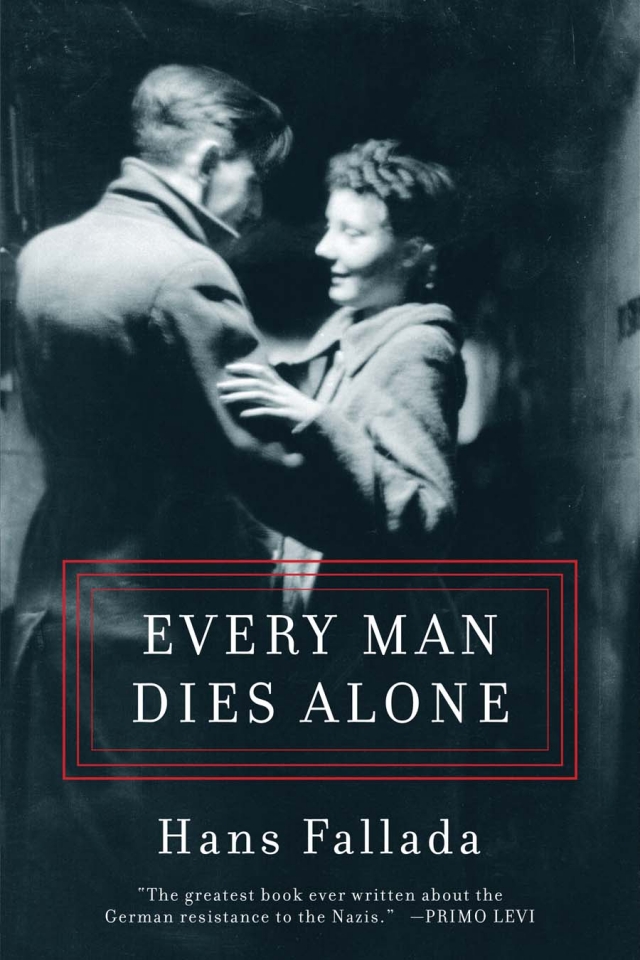
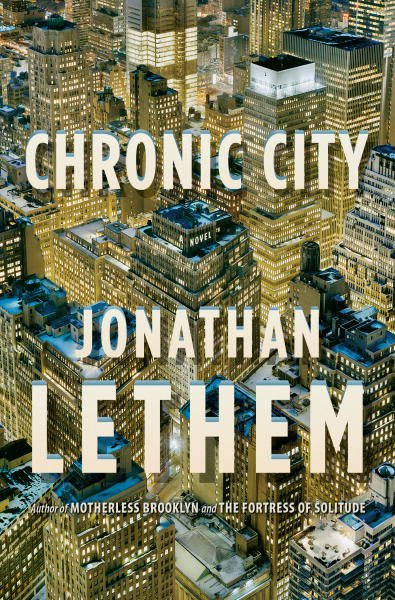
Cormac McCarthy’s Issues of Life and Death, Hans Fallada’s Complex Resistance, and Jonathan Lethem’s Bloodless Prose

In a 1992 interview with The New York Times, Cormac McCarthy famously said that he only cares for writers who  “deal with issues of life and death.” He disses Proust and Henry James, saying “I don’t understand them . . . that’s not literature. A lot of writers who are considered good I consider strange.” Because he has granted so few interviews–and come off so guarded in those he has done–McCarthy’s dictum on “good writers” has perhaps become a bit inflated, elevated from one man’s opinion to a grand litmus test of literary worth. Still, I often find myself putting the books I read under the McCarthy stress-test: do they narrativize the Darwinian drama of life and death? Or are they simply bloodless spectacles of rhetoric, ephemeral social critiques, or faddish forays into solipsism? McCarthy’s targets, Proust and James, arguably do address life and death issues in their works, but when compared to McCarthy’s heroes–Melville, Faulkner, Dostoevsky–the social fictions of Proust and James seem wan, or at least too subtle and overly-coded. The two novels I’m currently working through, Jonathan Lethem’s Chronic City and Hans Fallada’s Every Man Dies Alone, illustrate not just the poles of McCarthy’s dichotomy, but also why many readers (myself included) tend to prefer that their novels address matters of life and death.

Every Man Dies Alone, first published in German in 1947, is available for the first time ever in English, thanks to translator Michael Hoffman (if you’ve read Kafka in English, you’ve probably read Hoffman’s work) and the good folks at Melville House. Fallada’s novel tells the story of German resistance to the Nazi regime, not at an aristocratic or militaristic level (this isn’t Valkyrie), or even a literary or philosophical level, but at the level of every day, ordinary existence. After the death of their son in battle, Otto and Anna Quangel initiate a campaign of resistance to the Nazi party, one that is of course doomed from the outset. The Quangels soon involve Eva Kluge, among others, in their covert resistance cell. Kluge is a letter-carrier who becomes disgusted with the moral implications of the regime; she’s also deeply embittered by the way Nazi rule has systemically destroyed her family. Kluge’s peripatetic job helps to enact Fallada’s major rhetorical gesture, a sweeping busyness that vividly recreates the life of ordinary Germans during the rule of the Third Reich. We might begin in Kluge’s mind as she embarks to deliver a letter, only to find ourselves awash in the thoughts of its recipient a few pages later. Fallada’s omniscient third-person narrator moves freely from one character’s consciousness to another’s, shifting fluidly from the immediacy of present tense to the solidity of past tense. It’s modernism (whatever that means)–Tolstoy without the rich and famous, Joyce without the mythos and erudition, but deeply engaging in its scope. WWII has produced a seemingly endless myriad of narratives, yet Fallada’s tome is the first that I’ve experienced of its kind. Perhaps its subject matter–the lives of ordinary Germans and their unsuccessful attempts to resist the mundane evil all around them–is simply not the stuff that we want from our war stories, and perhaps this is why the book has been absent so long from an English translation. It’s evocative of a world that I had never really considered before: after all, the narrative of WWII is far easier to comprehend if you retain the simplicity of the good guys (the Allies), the bad guys (the Nazis), and the victims (the Jewish population of Europe). Ordinary Germans have only one place in this uncomplicated system, which is why the story of the Quangels and their cohort is so profound (oh, the Quangels are based on the real-life Nazi resisters Otto and Elise Hampel, if you must know). Driven in part by despair, they seek to forge meaning in their lives, even if its at the cost of death, or the horrors of a concentration camp. To return to McCarthy’s caveat, Fallada’s novel is a work that dramatizes life and death against a decidedly unheroic backdrop, a novel that makes its reader repeatedly ask himself whether or not he would be, to use another McCarthyism (from The Road) one of the “good guys.” Great stuff, and so far one of the better novels we’ve read this year. Go get it.

It’s perhaps unfair to lump Lethem’s latest in a review with Fallada, given the historical complexity of Every Man Dies Alone‘s milieu. Still, I’ve been reading my review copies of both novels over this long weekend, trying to catch up, and I find that I would almost always rather pick up Fallada’s book. It compels me, whereas, half way through Chronic City, I still find nothing to care about, no risk, no cost, no guts. No matters of life and death. The novel centers around former-child actor Chase Insteadman, whose directionless existence seems to thematically underpin the book. Chase moves from party to party in a fictitious Manhattan, charming various socialites and keeping boredom (marginally) at bay. He soon hooks up with Perkus Tooth, a marijuana-addicted pop culture critic, whose characteristics will be familiar to pretty much anyone who earned a liberal arts degree in college. Tooth seems to function largely as a mouthpiece for Lethem to espouse various opinions on movies and books and art. It’s a clumsy device as it doesn’t shade the character–it’s simply Lethem couching his cultural criticism in the comfort of a work of fiction. In a particularly telling scene, Perkus picks up a copy of The New York Times and thinks that it feels too light. He looks up at the right-hand corner: “WAR FREE EDITION. Ah yes, he’d heard about this. You could opt out now.” Perkus seems to deliver the line as a criticism, but it’s Lethem who’s opting out. He drops hints of destruction and annihilation and disintegration in the novel–there’s a giant tiger on the loose somewhere in Manhattan; Chase’s fiancée floats estranged in space, stranded on the International Space Station; a crooked mayor is up to dastardly shenanigans–but Lethem protects his characters from it all in an insulating cocoon of marijuana smoke and pop trivia. Their forays into the darkness of Manhattan’s mysteries are meant to play both humorously but also with enough danger to fully invest a reader’s attention (think of Lethem’s more successful sci-noir Gun, with Occasional Music, or his detective thriller Motherless Brooklyn). Instead, the adventures fall flat, collapsing back into Perkus’s apartment, a vortex of (ultimately meaningless) pop culture. While the novel is by no means terrible–it’s well-written, of course–there is simply a tremendous lack of the “life and death” stuff that McCarthy–and other readers–require. In short–and in contrast with Fallada’s Every Man Dies Alone–it does not compel itself to be read. Which is a shame of course. I still think Lethem’s The Fortress of Solitude was one of the finest books of the decade, and I was deeply disappointed in his last novel, You Don’t Love Me Yet. Chronic City is a much finer book than that silly train wreck, but it lacks the urgency of Lethem’s finest works, Fortress and Motherless Brooklyn, which temper a love of popular culture with genuine characters and an affecting plot.

I’ll conclude by returning to Cormac McCarthy, this time to his latest interview (in The Wall Street Journal). He says, on writing novels: “Anything that doesn’t take years of your life and drive you to suicide hardly seems worth doing.” And later: “Creative work is often driven by pain. It may be that if you don’t have something in the back of your head driving you nuts, you may not do anything.” For McCarthy, literature, in its final product–the reader reading the book–is the direct communication of the pain of creation, the awkward and incomplete translation of ideas exchanged from author to audience. Perhaps the pain was too much for Fallada, who died in 1947 of a morphine overdose, but that pain–that spirit–exists in the book. A similar spirit exists in Lethem’s earlier works; I’d love to see him tap into it again in his next venture.

Every Man Dies Alone is now available in hardback from Melville House.

Chronic City is now available in hardback from Double Day.

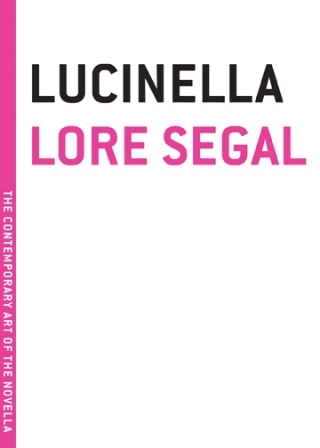
Lucinella — Lore Segal

Lucinella_LoreSegal

The story of a group of poets and critics in the late 60s/early 70s NYC should not be so fun or rewarding. From its first page, Lore Segal’s novella Lucinella invents itself as a scathing satire of writers and would-be writers. Segal’s book paradoxically reveres its subject matter, a back-biting and insular literati; and yet at the same time it exposes their solipsistic, narcissistic, cannibalistic shortcomings. These are not particularly generous people, but they are somehow endearing.

Lucinella takes first-person authority to tell the story–and boy does she take authority, bending reality, reason, and narrative cohesion to fit her whim. Lucinella is a poet (a minor poet, perhaps), and Lucinella is very much a poetic action, an act of creation in thirteen parts. The story begins with our (utra-)self-conscious heroine at the idyllic artists’ retreat Yaddo, where she’s ostensibly trying to compose a poem about a root cellar but really just having a grand ole time with a host of notable intellectuals, the poets and critics who will populate the book. “I will make up an eye here, borrow a nose or two there, and a mustache and something funny someone said and a pea-green sweater, so it’s no use your fitting you keys into my keyholes, to try and figure out who’s who,” Lucinella tells us. No worries, Lucinella, we had no idea who, if anyone, your Betterwheatling and Winterneet and Meyers were based on–heck, it took us a few pages to figure out that your Zeus was, um, y’know, that Zeus.

Segal’s (or Lucinella’s) inventions work within a hyperbolic schema set to slow burn. Describing a fellow poet of greater renown:

This Winterneet walking beside me has walked beside Roethke, breakfasted with Snodgrass and Jarrell–with Auden! Frost is his second cousin; he went to school with Pound, traveled all the way to Ireland once, to have tea with Yeats, and spent the weekend with the Matthew Arnolds. He remembers Keats threw up on his way from anatomy; Winterneet says he admires Wordsworth’s poetry, but couldn’t stand the man.

This is pretty much Lucinella‘s program: plausibly esoteric literary references running amok into sublimely surrealistic sketches. If you don’t like that, take your sense of humor to its doctor. Lucinella’s time at the haven of Yaddo is soon up, and she must return to the monster of Manhattan, where young poet William (despite his too-thin neck) shows up at her doorstep to fall in love and eventually marry her. The two attend every literary party, where they feel alternately bedazzled, thrilled, or–mostly–slighted. William, composer of a never-quite-finished epic about Margery Kempe, takes his snubs especially hard, even when he’s being celebrated (and published). We weren’t there, but it seems that Segal evokes her Manhattanite milieu with painterly (or perhaps cartoonly) accuracy. Really, the infighting intellectuals are reminiscent of poseurs and scenesters of any time and place. Lucinella and William go to parties, throw parties, complain about parties, and throw fits like children when they don’t get invited to parties. It’s all very real and very silly and very funny. In one (literally) fantastic set-piece (okay, the whole book might be a fantasy set-piece), Lucinella meets Old Lucinella and Young Lucinella at a party, giving her an(other) opportunity to critique herself. “There’s old Lucinella, the poet,” says one character. “She hasn’t written much in these last years. Used to be good in a minor way” comes the nonchalant reply. Young Lucinella fares no better, although she does manage an affair with William (don’t worry, Lucinella proper hooks up with Zeus in one of the book’s strangest flights of fancy).

The real seduction, as Lucinella points out at a party (of course), is her attempt to seduce her reader into a trenchant unreality that the poets and critics pretend is reality even as they bemoan the reality that their addiction to unreality is their main reality. Yeah. It’s all a bit surreal, and it all comes to a head quite pointedly twice in the novel. The first unmasking occurs at a symposium where the group holds forth on weighty matters – “Why Read?” – “Why Write?” – “Why Publish?” The house lights come up to reveal our fretting poets addressing an empty hall. Even in 1970, no one cares about reading and writing and publishing. And it’s not just the symposium–when Lucinella hosts a party for her pal Betterwheatling, who’s just published a collection of a criticism, she’s shocked to realize as the party dwindles that, not only has she not read his new book, she’s never read anything he’s written. But that’s not all: “I can tell, with the shock of a certitude, by the set of the line of Betterwheatling’s jaw, by the way his hair falls into his forehead, that Betterwheatling has never read a line I have written either and I flush with pain.” Betterwheatling’s punishment: “I’ll never invite him to another party!” Ahhh . . . the petulance. Oh, all the backstabbing and perceived slighting and posing and posturing leads up to an apocalyptic climax, complete with a proper de-invention of Lucinella. It’s all really great.

If Lucinella is light on plot–which we don’t really think it is, despite its slim build, light weight, and 150 or so pages–it’s big on ideas and even bigger on voice. Lucinella is kinda like that crazy art chick you knew in college who was always working on some project that never quite came to fruition, and her cohorts are just the sort of mad loonies you spend time alternately ducking calls from or hoping to run into at a party (depending on your mood). Her evocation of the youthful excitement and nascent romance of poetry reminds us of some of Roberto Bolaño‘s work, particularly the joyful jocularity of Garcia Madero’s section of The Savage Detectives (Segal’s volume is in no short supply of exclamations points). The book builds to a massive millennial climax, a hodgepodge of social consciousness movements and poetry and block party–a moveable feast of paranoia and art and possibility and good clean fun, and, more than anything else, the death-sentences we impose upon ourselves. But we’re overextending our review. Let’s just say that the book is great, and if you love books that both simultaneously mock and valorize the creative process, you’ll probably dig Lucinella’s metafictional tropes. Highly recommended.

Lucinella is in print again for the first time since the 1970s thanks to indie stronghold Melville House Publishing.

On Cult Books

I finished Lore Segal’s lovely and perplexing 1976 novella Lucinella today. It’s a witty and rewarding little book that deserves its own review, of course, and I’ll post one later this week. Lucinella is new in print again for the first time in a few decades courtesy of the good folks at Melville House Publishing. The jacket and the press release Melville House sent me both trumpet the book as a “cult classic.” I’ve been reading a number of so-called “cult books” lately–William Gaddis’s The Recognitions, Malcolm Lowry’s Under the Volcano, and John Crowley’s Little, Big. But I’m not really sure what a “cult book” might be. It got me to thinking, of course, and before I went to that ersatz oracle of our time (i.e., a Google search), I thought I’d try to define “cult book” in my own terms:

First, to be clear, a cult book is not (necessarily) a book about cults. It’s a book that has a cultish following (i.e., a group of devoted (perhaps obsessive) fans who work to push the work on anyone who will listen to them).

Second, cult books tend to address or include subject matters and issues outside of mainstream tastes (whatever that means). Of course, what’s open to public discourse changes over time, so what was once a cult book, over time, can soon move into mainstream or even canonical tastes. Hence, a large number of books and authors that once might have been cult are no longer cult.

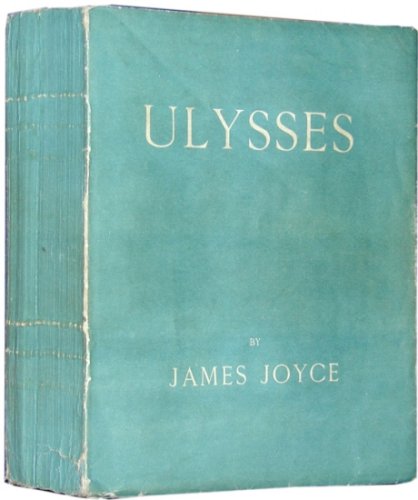
ulysses unrestored copy
First edition of Ulysses

But this doesn’t seem satisfactory: James Joyce’s Ulysses had to be initially smuggled into America; it’s now a canonical standard. William Burroughs’s Naked Lunch faced similar obscenity charges; decades later, Burroughs starred in a Nike ad. Yet, it seems that despite their eventual “mainstreaming” both books have something of a cult status–yet they don’t seem to need a cult the way that Gaddis or Lowry might. But what about Laurence Sterne’s Tristram Shandy? It clearly needs a cult to push it on people in the hopes of it actually being read, despite its canonical status. Which brings us to defining point three:

Third, the cult in question can not be purely academic. Faulkner would probably be a cult author if it weren’t for English professors and teachers with their syllabi and whatnot.

So, what is a cult novel? I have to think that, based on my definitions, cult status is always malleable. Thanks to the internet, readers have greater access to other readers, not to mention an exponentially expanded market of books to access. So I have to think back to high school and college, to those books that friends thrust on me, saying simply, “Read this, you have to,” books that I thrust on others, books that were secreted from hand to hand, clandestinely, until their covers had to be fixed with Duck tape. I think about Hunter S. Thompson’s Fear and Loathing in Las Vegas; anything by Kurt Vonnegut; Sylvia Plath’s The Bell Jar; anything by Charles Bukowski; Tropic of Cancer (or was it Tropic of Capricorn?). Antony Scaduto’s Bob Dylan biography made the rounds in my circle of friends, as did the Led Zep bio, Hammer of the Gods.

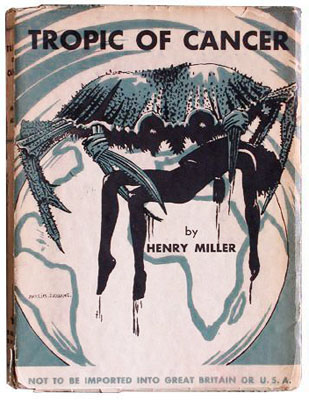
tropic-of-cancer
Note the warning that the book is verboten in the US and UK

There was also a pirate copy of The Anarchist Cookbook that someone had downloaded off of something called the internet (this was 1994 or 1995) and printed on a dot matrix printer. William Burroughs, of course. William Gibson. Anthony Burgess. Philip K. Dick. Cerebus. Aldous Huxley (especially Ape and Essence). Lolita. On the Road. Camus. Kafka. In college: John Barth’s Lost in the Funhouse. J.G. Ballard. Douglas Coupland. David Foster Wallace’s Girl with Curious Hair, a book literally pressed on me my freshman year by a friend who simply could not believe I had never read Wallace. To some embarrassment, I suppose, Irvine Welsh. Thomas Pynchon. Hofstadter’s Gödel, Escher, Bach. After college, a refinement I suppose (grad school ironing out some kinks of course): Blood Meridian. W.G. Sebald. Roberto Bolaño. Jorge Luis Borges. The list goes on; I’m sure I’m forgetting hundreds. (Normally, I’d hyperlink most of these authors and books to Biblioklept posts, but there’s just too many. Interested parties, if they exist, may use the search feature).

My list is pretty expansive I suppose (and it’s truncated to be sure), and I concede that the term “expansive” seems at odds with the term “cult.” It seems that all literature that lasts must first build a cult, and I guess that’s a good thing. Anyway–I eventually did google “cult novels” and here’s a few lists. Plenty of overlap with some of the above citations, and some stuff I didn’t think of as well. Also, stuff that I think is too canonical, but, again, make up your own mind:

The Telegraph‘s 50 Best Cult Books

The Cult’s List (chuckpalahniuk.net)

We like this one from Books and Writers

And of course, we’d love to hear from you, dear reader.


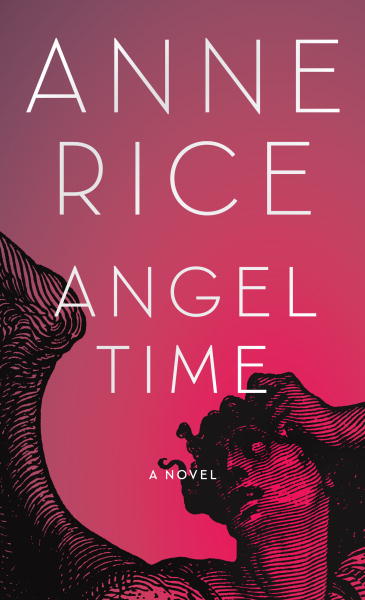
Angel Time — Anne Rice

angel_time

Anne Rice’s newest novel Angel Time continues the one-time Goth queen’s fervent return to Christianity. Angel Time is the story of Toby O’Dare, aka Lucky the Fox, a hit man with a Jesuit education, a dark past, and mad lute-playing skills. At the behest of a wise seraph named Malchiah, O’Dare travels back in time to thirteenth-century England, where, disguised as a monk, he embarks on a mission to save the Jewish population of Norwich. As you might expect with this sort of thing, our killer’s soul is also at stake–redemption, salvation, all that good stuff.

In a longish author’s note, Rice discusses some of the historical basis for her story, noting in particular the story of William of Norwich. From a purely narrative perspective, the plot seems pretty intriguing. We’re suckers for anything medieval, after all. Unfortunately, Angel Time is more Dan Brown than Umberto Eco. While there’s something to be said for the ability to write a real page-turner, Angel Time too-often falls back on leaden exposition and tired phrasing. Rice’s early Lestat novels might have been über-emo drama fests, but they were also wickedly sensual and sometimes alarming in their sexual ambiguity. And Lestat was just all kinds of fun, of course. Toby O’Dare, despite his silly name, is no fun. It’s really Rice’s utter humorlessness about her subject matter which is probably most off-putting of all. Her plot about a time-traveling hit man with an angel on his shoulder is engrossing stuff–so why does it take so long to start? We don’t get to medieval times until over half-way through the book. Perhaps because Angel Time initiates a new series Rice calls Songs of the Seraphim she feels the need to overload the front half with exposition about angels, God, the nature of Heaven, etc. Rice’s didactic tone is at times overbearing here. The metaphysical is best left at least a little mysterious. Similarly, while it’s great to know a hero’s motivations and history, Toby O’Dare’s back-story is so overdetermined as to preclude any real moral dilemma. Sure, he’s sinned, he’s worked as a contract killer–but if a seraph looks into your heart and knows you’re, like, good and stuff, is there any doubt that redemption is not forthcoming?

Perhaps Rice’s next novel in her Seraphim series will leave readers a little more room to breathe–and think. If Rice has left vampires for angels and hell for heaven, is it also necessary that she leave strangeness, wonder, and ambiguity for the stolid certainties of didactic allegory? Maybe we’re being too harsh. There’s undoubtedly an audience out there for Angel Time, and it’s probably fair to say that her work here will challenge audiences more than most books marketed to contemporary Christian audiences. But many of us prefer our literature to pose the challenging questions in ways that make us think. It spoils much of the fun to get all the answers up front.

Angel Time is now available in hardback from Knopf. You can see a trailer for the book here.

The Paris Review Interviews, IV

9780312427443

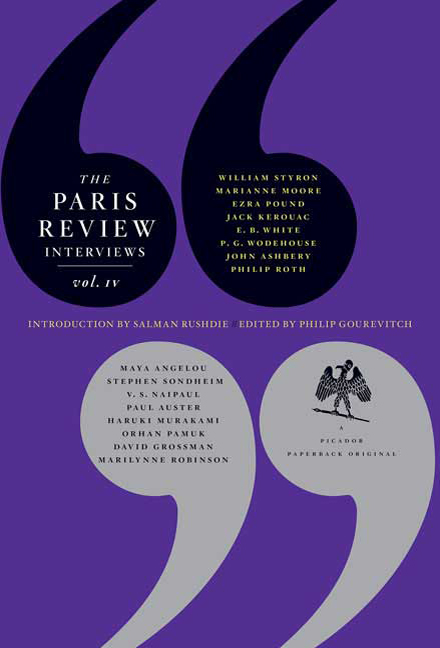
The Paris Review Interviews, IV, new this week from Picador, continues a great tradition of writers discussing their motivations, inspirations, methods, and, inevitably, other writers. Volume IV collects sixteen author interviews and is perhaps a bit heavier on contemporary writers than past volumes have been, showcasing current luminaries like Haruki Murakami, Orhan Pamuk, Paul Aster, and Marilynne Robinson. Although most of the interviews take place after the 1970s (with half in the past two decades), elder statespeople like William Styron, Marianne Moore, and the venerable Ezra Pound are also present.

Pound’s interview from 1962 is paradoxically revealing in its guardedness: one senses that the aged poet is trying to edit as he speaks, to achieve some sort of perfection. It’s a bit sad too, as Pound, holed up in a sort of self-imposed exile in an Italian castle, admits, “I suffer from the cumulative isolation of not having had enough contact–fifteen years of living more with ideas than with persons.” (On a less-serious note, however, he also praises Disney’s 1957 film “Perri, that squirrel film, where you have the values of courage and tenderness asserted in a way that everybody can understand. You have got absolute genius there.”)

As one might expect, Jack Kerouac comes off as the complete opposite, talking about his troubles with editor Malcolm Cowley, problems with poetry and prose, and Neal Cassady. There’s a free-flowing verbosity to Kerouac’s speech, but also an intimacy. It’s really quite beautiful. At one point, he gets one of the two poets interviewing him, Aram Saroyan, to repeat each line of Poem 230 from Mexico City Blues as he reads it aloud (Kerouac claims he wrote the poem “purely on morphine.”) As they recite the poem over several pages, Kerouac steps outside of it every now and then to compliment Saroyan’s reading or to critique a particular line, or simply to explain what he was trying to do with his words. We’re not huge fans of Kerouac’s writing, but after this interview, we wanted to be. (Later in the book, a surprised P.G. Wodehouse on Kerouac: “Jack Kerouac died! Did he?” Interviewer: “Yes.” Wodehouse: “Oh . . . Gosh, they do die off, don’t they?” Yes, they do).

One of the stranger interviews in the books is between James Lipton, of all people, and composer Stephen Sondheim. Although we don’t doubt the literary merit of Sondheim, the interview does seem a little out of place (although we will attest that the interview with Maya Angelou convinced us to give her a little more cred. A little). Elsewhere, E.B. White asserts that “You have to write up, not down” to children, and Haruki Murakami sheds insight into his own methods and passions (he often conceives his protagonist as a twin brother, lost at birth; his favorite director is Aki Kaurismäki; he’s thrilled to be mentioned in the liner notes of Radiohead’s Kid A). Murakami also talks about the writers he loves, admires, and feels insecure around (he’s shy to meet Toni Morrison at a special luncheon).

Of course, Murakami’s not alone–there’s plenty of writers dishing on writers here. When we reviewed Volume III of The Paris Review Interviews last year, we noted that both Evelyn Waugh and Raymond Chandler take the time to dis William Faulkner in their interviews. Volume IV kicks off with William Styron, who kinda sorta disses Faulkner as well, saying that “The Sound and the Fury . . . succeeds in spite of itself. Faulkner often simply stays too damn intense for too long a time.” Or Marianne Moore, on fellow poet Hart Crane: “Hart Crane complains of me? Well, I complain of him.” Ah, writers . . . great to know they can be as petty and self-absorbed as the rest of us. And it’s that humanity that shines through in these interviews. The series’s greatest accomplishment is its ability to reveal the frailties and insecurities of its subjects, but also their true personalities and tastes. Many writers work hard to control how they are perceived; cultivating a persona, one often aloof, academic, or roguish, is perhaps key to a successful writer’s identity. The interviews here are never fawning, nor do they aspire to sensationalism in revealing their subjects. Instead, each works as a neat, detailed, and very engrossing little portrait of a fascinating personality. Highly recommended.

Time – Eva Hoffman

time

Eva Hoffman’s Time, the latest in Picador’s series BIG IDEAS//small books, carefully but playfully examines what time is or might be, how we might measure it, and what it means. Hoffman divides her big idea into four neat chapters, exploring time’s relationship to the human body, mind, culture, and finally, “Time in our Time.” Although the final chapter begins by asking “what kind of social or cultural time do we live in nowadays, and how does this affect the shape of our personal experience?” this question is perhaps at the core of the book, and hence central from its beginning, in Hoffman’s discussion of bodies.

Hoffman’s long essay begins appropriately with a discussion of the human as species, as animal, as a biological entity that must measure the passing of time against itself, against the passing of seasons, and the death of one’s kin. And while Hoffman draws on modern medicine and science in her discussion, citing DNA research and neuroscience, she’s just as likely to search for answers in Shakespeare or Wordsworth. So, while Hoffman brings up current leading scientific research, the heart of the book lies in her ability to temper hard science with what it might actually mean in human terms. For example, Hoffman uses poems by Emily Dickinson (twice) to illustrate the (traumatic) effects that time can toll on the psyche.

This multi-discipline approach has become the hallmark of the BIG IDEAS series, and its exactly what makes the books such a joy to read. Perhaps some might find a discussion of Alzheimer’s disease nestled against a reading of Beckett’s Waiting for Godot to be distasteful, for many of us, the key to finding meaning in big ideas comes not just from the sciences, but also the arts. Hoffman might not have definitive answers for her big questions, but she has plenty of salient, concrete arguments, including a few we’re happy to get behind. After decrying the dissolution of the traditional Spanish siesta, Hoffman writes:

The Protestant ethos driving industrial development was grounded in the ideology of progress and a linear conception of time. It carried traces of the religious belief with which it was originally linked, and an eschatological vision of time in which earthly temporality inevitably moved towards a future where all our efforts would be judged. The work ethic at its height required great discipline of personality, and the sacrifice of presentt pleasures for future goals. It involved a systematic commitment to saving money, so that capital would accumulate, as proof of effort and virtue. The capitalist culture was a culture of the future par excellence; it encouraged its adherents to move through time with a long-term goal in their mind’s eye–or, conversely, with a sense of severe guilt and even sin if they failed to meet their objectives.

Not so in our own, thoroughly disillusioned epoch. After decades of expansion and its spoilages we no longer find ideas of human perfectibility, or even progress, sustainable. Rather, we seem to be driven by being driven. This is, no longer the work ethic but the ethos of conspicuous exertion, and under its aegis we willingly submit ourselves to temporal regimes that would have seemed rigid or even tyrannical by the standards of most other places and periods.

I’m not sure if everyone, at least here in the US, is as completely and savvily attuned to our “disillusioned epoch” as Hoffman suggests–surely many people still believe their drives result from a work ethic, rather than some ideological drive to be “driven.” Still, Hoffman’s salient observation points to the relatively recent exponential change in our relationship to time. She goes on to laundry list YouTube, BlackBerry, and other devices that abridge space and time, and therefore project the illusion of immediacy. Perhaps ironically, Hoffman’s essay contains no mention of Twitter, a program inextricably wed to the most incrementally insignificant accounting of time. While her book is brand new, undoubtedly in the time it took to produce her manuscript Twitter rose from fad to phenomenon; perhaps there just wasn’t time to discuss this new measurement of time. In any case, Time is an appropriate and welcome addition to what’s shaping up to be an enduring and noteworthy series. Recommended.

Time is available now from Picador.