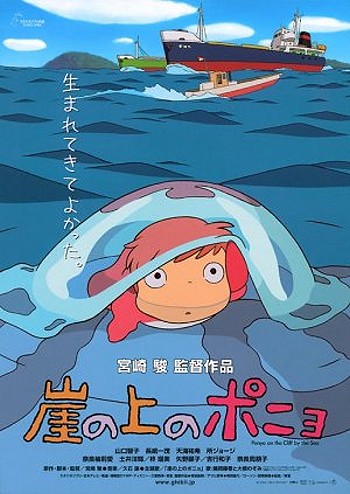
Hayao Miyazaki’s Ponyo on the Cliff by the Sea Reviewed

ponyo

Before Hayao Miyazaki‘s latest opus, Ponyo on the Cliff by the Sea (Gake no Ue no Ponyo) gets Disneyfied this August, interested parties might wish to purloin one of the pirate copies floating around and get a sneak peek. I’m not advocating not going to the movies to see the film–one of the greatest pleasures of Miyazaki’s works is the sensory overload of his stunning visuals–but Disney’s dubbed versions tend to over-explicate Miyazaki’s mysteries, draining his films of some of the unsettling ambiguities that make them so interesting.

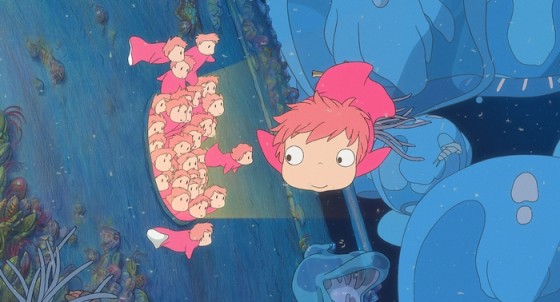
Ponyo tells the story of a little fish-girl (girl-fish?), a mermaid who escapes from her mad-scientist father and meets a boy named Sosuke. After tasting some of Sosuke’s blood, Ponyo begins to morph into a human. However, her transmutation causes bizarre and violent weather, including a giant tsunami resulting in a massive flood; even the moon starts to pull out of orbit. Sosuke and Ponyo navigate this surreal post-flood world, searching for Sosuke’s mother Lisa. The tale of these children is sweet but never maudlin, and like most Miyazaki films, Ponyo taps into sentimentality and pathos without ever becoming mawkish.

ponyo2-560x302

Visually, Miyazaki employs a sketchy, watery style here, painted in beautiful pastels and flashy complimenting brights. The look of this film is a significant departure from the fine detail and rich heaviness of Miyazaki’s masterpiece, Spirited Away (Sen to Chihiro no Kamikakushi), and might disappoint some, but we thought it was both beautiful and fitting. Of course, we were watching a pirated version that someone lovingly and bravely shot in a theater, undoubtedly inferior to the spectacle we expect from the theatrical release.

Perhaps the best critic of the film would be my two-year old daughter, who sat riveted and zombie-eyed throughout the whole film, only diverting her gaze occasionally to clarify some plot point. She loved the movie and talked about it the whole next morning, pretending that she was Ponyo (or, alternately, that someone else was Ponyo). Ponyo has more in common with Miyazaki’s lighter, kid-friendlier films like My Neighbor Totoro and Kiki’s Delivery Service than it does with his epic adventure films like Nausicaa and Princess Mononoke, but it retains enough adventure and glows with enough charm to keep longtime fans and newbies alike invested for all of its ninety minutes. Great good stuff. Here’s the trailer for the US release:


Harry Potter Sex Romp, Part II

First thing’s first: if you’re looking for Harry Potter slash fiction, you’ll have to check out our original Harry Potter Sex Romp post for links, you dirty dawg (you’re weird but you’re welcome). Just like that post a few years ago, this post’s title is really kinda sorta mostly irrelevant to what this post is about. What is it about? I want to take a look at some of the homoerotic tension in the new Harry Potter movie, Harry Potter and the Half-Blood Prince. If you want to find a proper review of the film, with plot summary and insight, shop around. That’s not gonna happen here.

Also, there will be SPOILERS, okay? Fair warning.

INTL_HarryDumbledore (Large)
#1 Stunnas

Okay. So, I saw the new film last night (henceforth HP6). And it was pretty good or whatever. But I noticed a subtext that cracked me up quite a bit, an underlying motif that might be lost on most summer blockbuster audiences. I’m talking about the implicit love between men and boys in this film.

At the beginning of the film, in an apparently insignificant scene, young Harry makes a date with an attractive young girl. However, old man Dumbledore shows up and dashes any hopes for a late sumer romance. Instead of meeting up with this lithe young thing, Harry has to grip hard to Dumbledore’s stiff arm to be apparated away to meet Horace Slughorn, an old potions master. Dumbledore uses Harry as fresh young bait for Slughorn, who has something the old wizard needs–a key memory about the development of Tom Riddle–Voldemort–a former protégé of Horace’s (lots of mentors and mentees here). Much of the narrative’s conflict revolves around the task Dumbledore has given Harry; it’s almost as if Dumbledore is pimping out the young wizard. These multiple man-boy relationships are doubled darkly in the failing bond between Snape and emo Draco.

In contrast, heterosexual relationships between the teens are treated with a lightness and even frivolity that codes such romances as ephemeral, or perhaps even inessential. Although the film solidifies the groundwork for the long-term relationships between the series’ principals (Harry-Ginny/Ron-Hermione), the real love story here is between older men and their young apprentices. HP6 depicts teen romance as silly without coloring any of its fragility with pathos. What the film really argues for is a sort of Greek or Platonic ideal of love; that love exists as a conduit for wisdom, passed from an older, experienced man to a younger boy in exchange for some of that youth’s beauty and vitality. Although moments of teenage adventure punctuate the film, the real scope of heroic encounters are shared between older men and their attendant lads (particularly Dumbledore and Harry, although even Snape, through the annotations of his old textbook, manages to plant part of himself into Harry).

The film reaches its climax with a lot of phallic wand waving and a bit of indecision over who gets to shoot off at whom. The climactic scene encodes the strange aggressions and series of shifting allegiances between the male wizards present. Dumbledore becomes the tragic figure; his death allows for Harry’s maturation, enacting a definitive arc in Harry’s Oedipal complex, where Dumbledore is both father figure and secret sex object. The weight of this tragedy initiates Harry into the adult world and adult responsibilities.

So why bother to write about this? No reason really, and I’m sure plenty of readers will find my analysis insupportable, silly, offensive, or just plain wrong. That’s fine. I guess I mostly find it remarkable that this motif should prevail so heavily in a summer blockbuster. There was also a whole drug motif going on–so many of the film’s plot development hinge on the ingestion of mind-altering substances–so maybe I just like the idea that the film is kinda sorta subversive.

Perdido Street Station/The City & The City — China Miéville

perdido_street_station_us

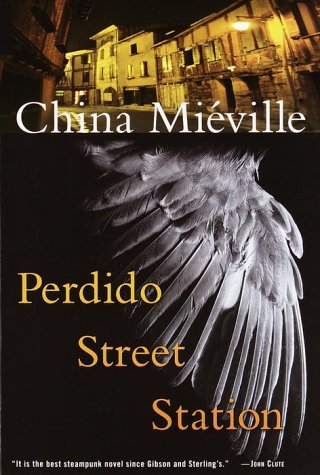
Despite being a bit too long, I enjoyed listening to Random House’s new audiobook recording of China Miéville‘s second novel, Perdido Street Station, read by John Lee. Perdido Street Station is Miéville’s first novel set in the steampunk world of Bas-Lag, a strange world populated by plenty of bizarre races and even more bizarre “Remades,” persons who have been forced (or in some instances have chosen) to restructure their biological makeup to perform (very) specific jobs. This sci-fi adventure story centers around protagonist Isaac Van der Grimnebulin, an overweight renegade scientist trying to perfect a new technology he calls “crisis energy.” Isaac is trying to help a Garuda named Yagherak who, as a form of punishment, has had his marvelous wings cut off. To this end, Isaac experiments with a strange caterpillar that feeds off of an hallucinogenic drug called “dreamshit.” Unfortunately, the caterpillar turns into a giant dream-feeding, brainsucking moth that, along with its relatives, terrorizes the city at night. Isaac tries to stop the moths and save his girlfriend, an artist with a bug’s head. Lots of picaresque adventuring ensues.

Miéville’s Bas-Lag world is finely detailed and richly imagined, and will no doubt appeal to anyone who digs H.P. Lovecraft or William Gibson. Miéville certainly has a handle on both of his many concepts (artificial intelligence, the nature of bodies, difference and (literal) alienation), and his story unfolds with the thrilling clip one expects from pulp fiction. Still, the book felt overwritten to me. Miéville never settles on just one adjective if two (or three) come to mind, and he’s in love with adverbs (oh the adverbs in this book! Is there a sentence without one?). And while exposition of a sort is certainly necessary in a novel about such a profoundly strange world, I think that Miéville would get a bigger payoff if he trusted his reader a bit more. Perdido Street Station feels rhetorically claustrophobic, as if Miéville is afraid to let his reader imagine even a little of Bas-Leg for him or herself. It’s a bit selfish, really. On the whole though, a great read (or listen, in this case), and it intrigued us enough to go straight into Miéville’s latest book, The City & The City (also newly released this summer from Random house, also read by John Lee).

the city and the city

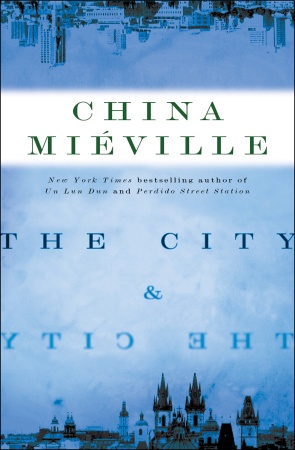
The City & The City combines noir detective fiction with one of science fiction’s greatest gambits, namely, positing something utterly implausible, unimaginable, and then making it ordinary. In The City & The City, two cities, Beszel and Ul Qoma, occupy the exact same geographic space, yet their citizens are trained from birth to “unsee” and “unhear” all aspects of the other city. Inspector Tyador Borlu is drawn into the mysterious death of a beautiful young woman (is there an older trope? Edgar Allan Poe even wrote an essay on why and how you should use beautiful yong dead girls in your literature). His investigation leads him into crossing the border between the cities, an impossible border, of course, and yet the genius of the book here is that, through Borlu’s narration, the reader doesn’t experience this bordercrossing (and its attendant “unseeing”) as satirical or even ridiculous; rather, we witness the uncanny alienation of double consciousness. Miéville, a Marxist, is working in part from some of Althusser‘s ideas, and he’s not afraid to namedrop Foucault or Žižek. Thankfully, however, Miéville not only knows his theorists, he knows enough not to let theory get in the way of a Chandleresque murder mystery that explores themes of surveillance, alterity, and what it means to see someone seeing you seeing them seeing you (seeing them seeing you . . .). Great stuff.

By Night in Chile – Roberto Bolaño

bynightchile

Toward the end of the 130 page monologue that is Roberto Bolaño’s novella By Night in Chile, narrator Father Sebastián Urrutia Lacroix claims that “An individual is no match for history.” His statement neatly encapsulates (what might be) the dominant theme of By Night in Chile, namely an individual person’s capacity and ability to correctly–and sanely–somehow measure, attest to, confront, and witness the horror and brutality of history. In this case, Bolaño’s narrator, a Catholic priest–and conservative literary critic (and, of course, failed poet)–Father Urrutia, via a sweeping deathbed confession of sorts, recounts his life story, leading inexorably to Pinochet’s coup and its attendant subsequent draconian reforms and abuses. While it would be a mistake to reduce Bolaño’s rich novella to one conflict, I think the root of Urrutia’s struggle emanates from his inability to come to terms with his role as an intellectual (let alone an artist, critic, or priest) complicit somehow in Pinochet’s crimes. Throughout the book, from the very beginning, Urrutia blames his inner turmoil on a “wizened youth” (I don’t want to spoil this antagonist’s identity, but puzzling out that paradoxical appellation provides a major clue), a kind of idealist who stands apart from the dying priest, mocking and taunting him. After his claim that “An individual is no match for history,” Urrutia avers that “The wizened youth has always been alone, and I have always been on history’s side.” For Urrutia, this is of paramount importance, not just as a Catholic priest (which, it must be pointed out, is a role he doesn’t seem particularly suited for) but also as a literary critic and intellectual: Urrutia wants to systematize and critique history, to be “on the right side of history,” to quote Barack Obama. And yet his own attempt to narrativize his own life ironizes and critiques this very possibility at every turn–he is a sham, a charlatan, motivated and prompted by fear and even hate.

And on that attempt to narrativize a life: I would call By Night in Chile an anti-bildungsroman. Although Urrutia relates a life story, the free flow of psychic impressions that characterizes his telling slip and sail and rock and crash throughout years and over decades, often flowing backwards and forwards, sometimes spending pages on what could only be considered inconsequential minutiae, while at times glossing over the profoundest events with little more than a word or two. It is often what Urrutia does not remark upon that characterizes what is of the greatest importance in this work, and this is a testament to the power of Bolaño’s writing, to his command of voice. In one of the greatest performances of the novel, Urrutia describes the time right before, during, and after Pinochet’s coup. The passage is less than four pages, and for every contemporary action of immediate consequence, Urrutia seems to provide twice as many examples of his retreat into the past: ” . . . the first anti-Allende march was organized, with people banging pots and pans, and I read Aeschylus and Sophocles and Euripides, all the tragedies, and Alkaios of Mytilene and Aesop and Hesiod and Herodotus . . . .” Urrutia doesn’t bother to scrutinize or analyze the visceral reality of history in the making around him, regressing instead to the comfort of established philosophical tradition–the history of Herodotus in favor of the chaos, anarchy, and brutality happening around him. He’s really quite a terrible priest, and as an intellectual he refuses to be engaged. Confident that he will always be “on history’s side,” he refuses to actively even try come to terms with history until he’s dying. And thus we get the narrative of By Night in Chile.

This reckoning with the past takes the form of a long monologue but, as those familiar with Bolaño will attest, there are plenty of other voices here, stories nested within stories like Russian dolls. The force and vitality of Urrutia’s speech is astonishing; one envisions the monologue as a single immediate and discrete exhalation, a stream of memory, the living wail of a dying man. Bolaño’s rhetorical style here conveys this ironic energy. He employs long (very, very long) sentences, sometimes going on for several pages, and often uses little or no transitions between what should be major shifts of space and time. There are plenty of references to writers, of course, many obscure, and more motifs and leitmotifs than I can work out here (or elsewhere, to be honest). I’m going to go out on a limb and suggest that the book is probably even more intense in the original Spanish, although I think Chris Andrews has done a brilliant job translating here, just as he did in Last Evenings on Earth. And since I’ve brought up that book, I’m going to make another suggestion: if you’ve yet to read Bolaño, you should, and Last Evenings of Earth (or 2666 if nearly a thousand pages doesn’t seem too daunting)is probably the best place to start–which is kind of another way of saying that By Night in Chile is not the best entry point to Bolaño–at least not for anyone intimately familiar with Latin American history. It’s not that By Night is particularly challenging or hard to read. However, I think that this particular book will probably be better enjoyed with more context. As Rodrigo Fresán points out in his essay “The Savage Detective,” (published in the March 2007 issue of The Believer), By Night in Chile could be (should be?) read as part of one cohesive book along with Amulet and Distant Star. (I will read these once I get my grubby little fingers on them). Indeed, as many critics have pointed out, Bolaño’s works seem to coalesce into one great work, a secret universe parallel to Tolkien’s Middle Earth or Proust’s France. Urrutia’s voice enriches this universe, but one must have something of a foothold on Bolaño’s themes in order to appreciate the complex ironies of By Night in Chile. Or maybe not. Maybe this is a great entry point to Bolaño. Either way, great book. Highly recommended.

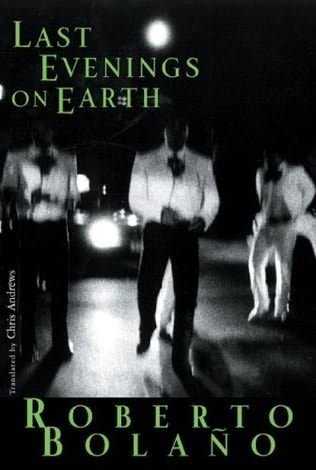
Last Evenings on Earth — Roberto Bolaño

Lasteveningswiki

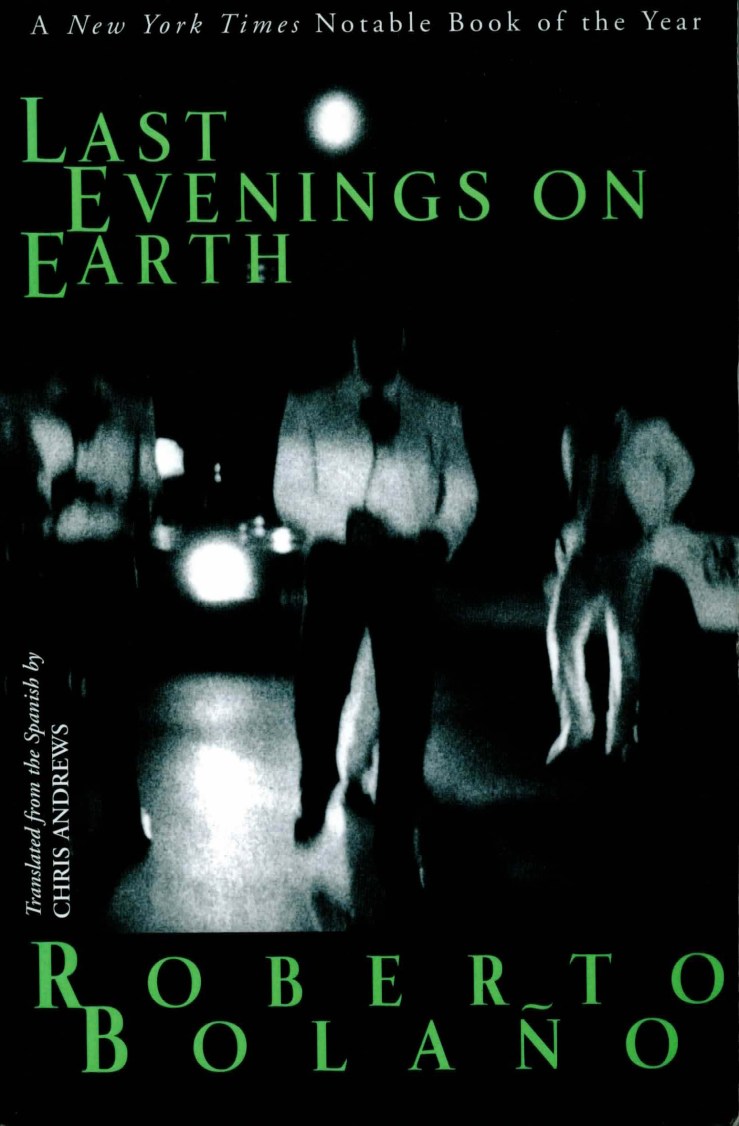
Although the fourteen stories in Roberto Bolaño‘s superb collection Last Evenings on Earth are the result of collating and translating two previously published volumes, Llamadas telefónicas and Putas asesinas–and therefore ostensibly have nothing to do with each other (other than being the work of a singularly gifted author)–I couldn’t help reading them, especially towards the end of the book, as a strange, fragmented novel. Beyond Bolaño’s inimitable style (more on that in a moment), the collection is unified by its protagonists, or protagonist, really, who really must be a stand-in for Bolaño himself. Tenets of New Criticism be damned! It’s impossible not to read Bolaño into these stories, whether his narrators or protagonists are young teens or middle-aged men, petulant sons or struggling writers. Scratch that last one. They’re all struggling writers; in fact, just about everyone in this book is a struggling writer, or an exile, or a vagabond, or on the run, or so enamored and wound up in Big Romantic Ideals that they make plenty of foolish decisions (one of my favorite things about this book is how easily Bolaño posits and then ironizes and the tears apart Big Romantic Ideals at the very same time he makes you feel wistful and nostalgic for those days when you believed in them yourself). Bolaño uses a character named only “B” for most of these stories; elsewhere, (anti-)hero (and obvious Bolaño stand-in) Arturo Belano of The Savage Detectives is revealed to be a narrator. In other stories the young male protagonist is simply not identified by any name, yet all of these characters are so fully realized, so psychologically real, that they must contain at least some part of Bolaño.

And these protatgonists are so very, very real, almost frighteningly so, like “B” in “A Literary Adventure,” whose paranoia over receiving a career jump-starting review from a writer–“A,” of course, who B has actually mocked in his book–poisons any enjoyment B might have had with his new success. B’s slow descent into a mild madness is perfectly drawn, the sort of thing you might see in your own life, the sort of anxiety that many of us feel but cannot communicate or explain because of the silly shame of it all. In “Last Evenings on Earth,” B (the same B? Must be) takes a vacation to Acapulco with his father. Bolaño’s rhetoric in this tale is masterful: he draws each scene with a reportorial, even terse distance, noting the smallest of actions, but leaving the analytical connections up to his reader. Even though B sees his holiday with his dad heading toward “disaster,” toward “the price they must pay for existing,” he cannot process what this disaster is, or what paying this price means. The story builds to a thick, nervous dread, made all the more anxious by the strange suspicion that no, things are actually fine, we’re all just being paranoid here. (Not true!)

That ebb and flow between dread and release, fear and humor, ironic detachment and romantic idealism works throughout each of the stories, even ones not specifically about B (or Belano, or, let’s be honest maybe, Bolaño). “Anne Moore’s Life” is an incredible (yet thoroughly credible) portrait. The story is both journalistic and personal; Anne’s life is at once banal and bizarre–like anyone’s life, perhaps, but not. “Mauricio (“The Eye”) Silva” relates the story of another Chilean exile (did I forget to mention that, in a way, this whole book is about Chilean exiles, that if Last Evenings on Earth is a fragmented novel, then it tells the fragmented story of these artists and activists fleeing from Pinochet’s coup? If I forgot to mention that, I suppose I didn’t want to over-politicize my review, or suggest that one had to have some contextual knowledge of the Chilean diaspora in order to enjoy this book, because I don’t think you have to–but where were we? “The Eye,” right), the titular Mauricio (AKA “The Eye”), a photographer whose travels take him to the depths of depravity in the poorest parts of India. What parts of India? Well, the narrator never finds a specific answer, because those don’t really exist in Bolaño’s universe. All claims are under suspicion. Things may or may not have happened, and if they did happen, they might have happened in myriad ways. But how is it then that Bolaño is never murky? How can a writer who posits so many possibilities, whose characters repeatedly aver that they don’t really remember exactly the way things happened (if they even happened at all), how can such a writer be at the same time so sharp and exacting? It’s one of Bolaño’s great gifts of course and we’re lucky to share in it.

It would be hard–impossible really–to pick the best story from the collection. They’re all great, they all demand to be reread, and they made me want to read more Roberto Bolaño. But if I had to pick one as a starting point, if I had to foist one on a friend, I suppose it would be “Enrique Martín,” the story of a failed poet that made me laugh out loud several times and then almost cry. Arturo Belano narrates this story with a wry, acerbic, deadpan humor that veers at times into unexpected and affecting poignancy. Poor Enrique only wants Belano’s respect, or at least Belano to read his poems with a modicum of dignity–a fact that Bolaño shares with his readers while still keeping his narrator in the dark. As the story plunges to its tragic end, Belano finally sees what the reader has already cottoned onto: our individual choices in relations to others might be far more impactful than we realize, and human empathy is in sorry supply in this world. “Life is mysterious as well as vulgar,” Belano nonchalantly suggests in the middle of the story, but Bolaño goes to exacting pains to show us that there can be a saving beauty and humor in all that strange visceral ugliness. One of the best stories I’ve ever read in one of the best collections I’ve ever read. Very highly recommended.

The Spectacle of Michael Jackson’s Body

For the next few weeks, thousands, hundreds of thousands, possibly millions will remember, laud, argue over, and grieve Michael Jackson. His death, like his life, was utterly mediated–broadcast live on national television, Twittered, Facebooked. We were able to follow the accretion of details and speculations (facts?) in real time, as the status of Jackson’s body was updated (he was dead, he was rushed to the hospital, he was in a coma, no, he was dead). His death even precipitated a rush of other celebrity death notices, hoaxes that mutated across the internet. That Jackson’s death should precipitate so much confusion and rumor is commensurate with his strange life.

Jackson was probably the first person in the world to live a truly mediated life. From the age of eleven, Jackson’s image, voice, and dancing body became the communal property of the modern (industrialist, capitalist) world. Written roughly the same time as young MJ’s rise to national prominence, Guy Debord’s The Society of the Spectacle opens with the following salvo: “In societies where modern conditions of production prevail, all of life presents itself as an immense accumulation of spectacles. Everything that was directly lived has moved away into a representation.” What was Michael Jackson’s life but a series of transmogrified spectacular representations? Not only did we hear the development of modern music through his records, or watch fashions change through his bizarre styles, but, most significantly, we saw in Jackson a mapping of spectacle culture on to the very body itself. Like his character who mutates in the iconic “Thriller” video, or the faces at the end of his “Black or White” video, Michael Jackson’s body slowly morphed before our collective eyes, mediated in print and video, discussed and mocked and puzzled over. A full accounting of Jackson’s eccentricities is neither necessary or possible here, but it’s worth pointing out that the man’s level of estrangement was of such an acute degree that, beyond attempting to remap the world (turn it into a Neverland) and reconfigure the flow of time (an attempt to reach an imaginary past), he remapped his whole body.

While he wasn’t the first celebrity whose body became a site of/for spectacle culture (Marilyn Monroe springs immediately to mind), Jackson’s corpus is undoubtedly the signal symbol of the mediated American Dream, the most hyperbolic example how the human body might mediate consumerist desires. As Debord also pointed out in Society, “The spectacle is not a collection of images, but a social relation among people, mediated by images.” The death of Michael Jackson is precisely not the death of Michael Jackson’s body, which will continue to live on, like one of the “Thriller” zombies, a spectacle absorbed and batted about by the spectacle culture. It will continue to exist as a rarefied nostalgic currency, for if we grieve the death of Michael Jackson, what precisely are we grieving if not a spectacular reflection of our own (mediated) development? Michael Jackson’s body (of work) will always be resuscitated as a nostalgic marker for at least three generations of Americans (and the rest of the world, really). I do not believe that most of us mourn the death of Michael Jackson; instead, we continue to participate in his spectacle (or, rather, the spectacle of him) as a means of prolonging our own vitality and placating our own sense of self. It is not the loss of Jackson that we might acutely feel but instead a demarcation upon our own mortal bodies, for if a changeling like Jackson cannot escape bodily death, what hope do we have? At the same time, paradoxically, participating in the spectacle of the death of Michael Jackson’s body partially alleviates (even as it subtly calls attention to) these anxieties. By affording Jackson (the illusion) of a certain immortality, we retain our own developmental, life-long investments in his spectacle, and, in turn, hope to secure our own bodies against the ravages of age, disease, decay, accident, gravity.

But what are the long-term costs of maintaining such grand illusions? As our society becomes increasingly mediated, are we arcing toward a more democratic and enriching series of personal connections, or are we fragmenting and disassociating into solipsism and self-reflexivity? Or, to return to Jackson, does his music represent personal connection and the transmission and articulation of genuine sentiment, or is it simply the glamorous reduction of crass popular culture? Is it possible to feel genuine empathy toward Jackson? Or has the spectacle of Michael Jackson’s body infiltrated our culture to the point at which any real, unmediated human response to his passing become an impossibility, an articulated fiction masking narcissistic nostalgia? Although these are not intended as rhetorical questions, I don’t suppose there are simple answers for them either. Ultimately, I think as long as our spectacle society exists, Michael Jackson’s body will continue to exist. And probably, as our culture ages–and this is scary–it will become a relic or monument to a simpler time.

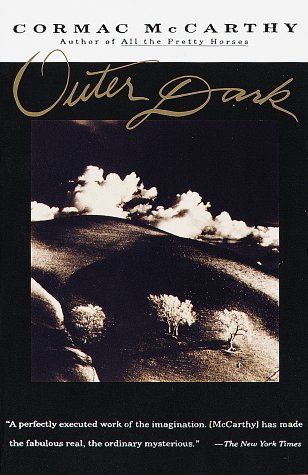
Outer Dark — Cormac McCarthy

outerdark

In Cormac McCarthy‘s second novel, Outer Dark, set in the backwoods and dust roads of turn-of-the-century Appalachia, Culla Holme hunts his sister Rinthy, who has abandoned the pair’s shack to find her newborn baby. Culla has precipitated this journey by abandoning the infant in the woods to die; a wandering tinker finds the poor child and absconds with it. As Rinthy and Culla independently scour the bleak countryside on their respective quests, a band of killers led by a Luciferian figure roams the wilderness, wreaking violence and horror wherever they go.

In a recent interview with the AV Club, critic Harold Bloom noted that Cormac McCarthy “tends to carry his influences on the surface,” pointing out that McCarthy’s major influence, William Faulkner, tends to proliferate throughout McCarthy’s early work to such an extent that those works (The Orchard Keeper, Outer Dark, Child of God, Suttree) suffer to a certain degree. Indeed, it’s hard not to read Outer Dark without the Faulkner comparison invading one’s perception. It’s not just McCarthy’s Appalachian milieu, populated with Southern Gothicisms, hideous grotesques, rural poverty, incest, and a general queasiness. It’s also McCarthy’s Faulknerian rhetoric, his elliptical syntax, his dense, obscure diction, his bricks of winding language that seem to obfuscate and resist easy interpretation. Like Faulkner, McCarthy’s language in Outer Dark functions as a dare to the reader, a challenge to venture to the limits of what words might mean when compounded. And while the results are sometimes (literally) startling, they often strain, if not outright break, the basic contract between writer and reader: at times, all cognitive sense is lost in the word labyrinth. Take the following sentence that ends the first chapter, where Culla looks back on the infant he has just abandoned:

It howled execration upon the dim camarine world of its nativity wail on wail while lay there gibbering with palsied jawhasps, his hands putting back the night like some witless paraclete beleaguered with all limbo’s clamor.

A “paraclete” is someone who offers comfort, an advocate. I’m thinking that the “jawhasps” must be a twisted mouth. No idea what “camarine” means. But it’s not just the obscure diction here: the whole action is obscure (how does one go about “putting back the night”?). This confusing passage is hardly an isolated incident in Outer Dark; instead McCarthy repeatedly employs long, dense, nearly unintelligible sentences, constructions that defy the reader’s ability to visualize the words he or she is being asked to decode. This unfortunate tendency alienates the reader in ways that are no doubt intentional, yet ultimately unproductive. More often than not, McCarthy’s long twisting hydras of obscurantism are not so much moving or thought-provoking as they are laughably ridiculous, and while his vocabulary is surely immense, it’s hard enough to get through such abstract sentences without having to run to a dictionary every other word.

Readers of mid-period, or even more recent McCarthy works will no doubt recognize this complaint, so it’s important to note that we’re not talking about the density and alienating syntax of Blood Meridian, the philosophical pontificating of The Border Trilogy, or the occasional run-to-a-thesaurus word choice one can find in The Road. No, Outer Dark is full-blown Faulkner-aping (Faulkner at his worst, I should add); over-written, ungenerous, and just generally hard to get into, especially the early part of the novel which is particularly guilty of these crimes. Which is a shame, because once one penetrates the wordy exterior of the first few chapters, there’s actually a pretty good novel there. While no one could accuse Outer Dark of having a tight, gripping plot, the intertwined tales of Culla and Rinthy–and the band of outlaws–gives McCarthy an excellent venue to showcase his biggest strength in the novel–the dialogue.

Spare and terse, the strange, strained conversations between McCarthy’s Appalachian grotesques are often funny, usually tense, and always awkward. Culla and Rinthy are outcasts who don’t quite understand the extent of their estrangement from the dominant social order. They frequently encounter fellow outcasts, often freaks of a mystical persuasion, like the witchy old woman who frightens Rinthy, or the old snake-trapper who freaks out Culla (a task not easily achieved). The dialogue between McCarthy’s characters reads with authenticity and intensity, and the author gets far more mileage out of the gaps in conversation, the elisions, the omissions–what is not said, what cannot be said. These odd characters culminate in the trio of outlaws who terrorize the fringes of Outer Dark. Their ominous black-clad leader prefigures many of McCarthy’s later antagonists, like the Judge of Blood Meridian or Chigurh in No Country for Old Men, but he pales in comparison to the former’s eloquent anarchy and the latter’s bloody intensity. McCarthy doesn’t really seem to know what to do with him, to tell the truth. Still, fans of Chigurh and the Judge will find the roots of those characters in this unnamed villain, and will probably have some interest in McCarthy’s evolution of this type.Indeed, it’s tracking this progression of themes and types throughout McCarthy’s body of work that was of the greatest interest to me, and in turn, I suspect that Outer Dark is probably going to be of greatest interest to those who’ve been reading McCarthy more or less chronologically backwards (like I have). It’s certainly not the starting place for this gifted author, and while its early dense prose will certainly provoke a few mournful groans, the end of the book redeems the bog of language at its outset.

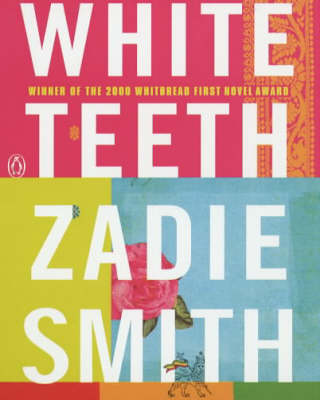
White Teeth, Perdido Street Station, and Last Evenings on Earth

white teeth

And so well with the help of Jenny Sterlin’s narration and my handy-dandy portable mp3-playing device, I finally made it through Zadie Smith‘s 2000 novel White Teeth, and, having digested all of it, am now fit to declare it hilarious in places, larded with moments of intensely brilliant prose, wildly ambitious, and ultimately hollow, overstuffed with flat characters who, despite Smith’s best efforts, do not manage to earn the Big Important Climax she shoves them toward. Smith succeeds in communicating the multicultural problematics of late-twentieth-century London, but her massive scope (the audiobook is 23 hours and my unfinished paperback runs to nearly 500 pages) is just too massive. Smith seems to think that loads of concrete detail will automatically conjure emotional force, but what we get instead verges on soap opera at times–more bathos than pathos.It doesn’t help reader expectations of course that White Teeth was wildly overpraised after its debut. While White Teeth‘s attempt to reconcile the personal traumas of a postcolonial world with the demands of family, tradition, and personal worth is admirable, its aim exceeds its grasp, and the end disappoints. Still, I enjoyed it as an audiobook–Jenny Sterlin mugs enthusiastically through the various accents and argots of a melting pot London, and Smith’s concrete emphasis on detail makes it an ideal listen for a few summer afternoons of gardening or housework. Not the Great Book we’ve been told it is, but a fine listen nonetheless.

perdido_street_station_us

Summer is, of course, a great time for audiobooks, and I’m thrilled that China Miéville‘s breakthrough second novel Perdido Street Station is finally available on mp3. I’ve been wanting to read Miéville for quite some time now, but the length of his dystopian tomes has made it difficult until now (I am a very busy, important man, with busy, important things to do). Perdido Street Station, set in a bizarre, gross world of humans, Re-mades, and other sundry races, is weird fiction at its finest (so far)–a great hybrid of Charles Dickens and PK Dick, HP Lovecraft and JG Ballard. It trawls the line between real and surreal, art and science, grime and enlightenment, in lovely, if dense prose, that could never be mistaken as genre fiction. Great stuff, so far.

lastevenings

Also great stuff, so far, is Roberto Bolaño‘s collection of short stories, Last Evenings on Earth. I read the first three tales in succession last night, unable to put the book down although it was well-past my well-established “you must go to bed now or your toddler daughter will wreak havoc on you in the AM” bedtime. The first three stories are about, get this, (big surprise if you’ve read Bolaño), writers–good, bad, indifferent writers, failed, semi-failed, miserable writers. Sad writers, mad writers. The opener “Sensini” tells the story of an epistolary relationship between a young writer and an aging, uncelebrated writer. It’s sad yet measured in its pathos, and it earns its happy ending by loading that ending with the seed of potential disaster. The next story, “Henri Simon Leprince,” is the hilarious (and sad) tale of a miserable writer, a hack who teams up with the Resistance in WWII France. Despite his best intentions, he’s roundly despised by all those he helps. And he’s a terrible writer. The third story, “Enrique Martín,” literally made me laugh out loud, several times, to the point of tears. Narrated by Arturo Belano, Bolaño’s literary stand-in, it tells the desperate story of the titular failed poet, a would-be artist and sometime UFO hunter who slowly watches his dreams disintegrate.

All of Bolaño’s stories so far have extended past the mad force of his own strong voice(s) and implanted themselves into my mind, reaching into my own past; his characters, in hashing out their strange young lives (from a bit of distance, now) repeatedly evoked my own youthful memories, stuff I hadn’t thought about in years. There’s a sad brilliance under all of Bolaño’s stuff, like bright noon sun perceived through an ambiguous tear resting on your eye. Reading the beginning of Last Evenings on Earth last night, it occurred to me for the first time that Bolaño had died, and he’d died really young, and there weren’t going to be anymore books from him. But that’s a bummer note to end on. Let’s leave it at this–Last Evenings on Earth is some seriously great stuff.

In the Land of Invented Languages — Arika Okrent

book-cover

Arika Okrent‘s new book In the Land of Invented Languages (released in hard back last month from Spiegel & Grau) confidently traverses the thin line between pop nonfiction and academic linguistics. Subtitled Esperanto Rock Stars, Klingon Poets, Loglan Lovers, and the Mad Dreamers Who Tried to Build a Perfect Language, Okrent’s book delves the weird world of invented languages. While many folks are familiar enough with the idealism behind Esperanto or the sadness behind, ahem, Klingon, what about Lingua Ignota, or Dritok, the chipmunk language? How much do you know about John Wilkins’s 1668 invention “Philosophical Language” (pictured below)?

wilkins1668_sampleOkrent, after explaining her fascination with invented languages, or “conlangs,” more or less uses Wilkins as a starting place, using his massive project as a measuring stick for all the invented languages that followed it. While detailing the history and implementation of Esperanto, Charles Bliss’s language of symbols, and the logical logjammin’ of Lojban, Okrent balances the erudition of complex linguistics with a humorous, human tone. In the Land of Invented Languages is filled with tree diagrams and symbol charts that will not be wholly unfamiliar to those who studied a little linguistics back in college (or even those who, like the Biblioklept, changed their major from linguistics to English when they discovered they’d have to take, gasp!, statistics). These visuals are both fun and stimulating, and help to explicate what can be pretty heady stuff at times.

At its core, Invented Languages is about dreamers and schemers, the kind of idealistic perfectionists who would go to the trouble to invent something as heavy and impossible as a language. As Okrent savvily points out in her introductory chapter, real languages–that is, the natural languages that people really speak and communicate in–are organic and don’t really require rules. They just “happen.” That’s what makes this book so much fun–all the crazy cranks that try to force their perfect philosophical systems onto the world. In the Land of Invented Languages is a rewarding exploration of meaning and language, how language means, and what happens when we try to make meaning. Recommended.

For more info, check out In the Land of Invented Language‘s fun and thorough website.

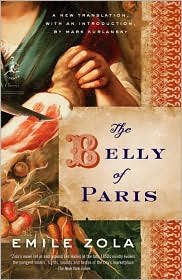
The Belly of Paris – Émile Zola

belly

It’s totally appropriate that food-writer Mark Kurlansky should helm Modern Library Classics’ new translation of Émile Zola’s The Belly of Paris. Not only does he have a keen ear for Zola’s revolutionary naturalism, he also captures the passion at the heart (or gut) of The Belly of Paris–a passion for food. To be clear, Zola’s book is not so much about gourmet preparations (although they’re there, to be sure) as it is about the production and marketing of food, and, more specifically, the ways in which food delineates class lines.

The Belly of Paris is the third of Zola’s twenty-novel naturalist cycle Les Rougon-Macquart, a series of books examining two intertwined families–one rich and respectable, the other poor and disreputable–during the rise of the Industrial Revolution in France. Belly takes Florent Quenu (one of the poor and disreputable) for its protagonist. Quenu, wrongfully accused of a crime, escapes imprisonment on Devil’s Island and attempts to start a new life in Les Halles, the great, sprawling market known as “the belly of Paris.” Readers are treated to lovingly detailed depictions of Les Halles and its produce stands, fish shops, cheese markets, butcheries, both through the eyes of Quenu and many other characters. There are those who work in the great market and their children (who also, of course, work in the market); artists and rabble rousers; the nouveau riche and the would-be revolutionaries.

Zola evokes a lust for life centered around this great belly, even as he dramatizes the sharp disparity between the rich and the poor. While Zola is hardly preachy, his sympathies are clearly with the poor and downtrodden. Like America’s great literary naturalist John Steinbeck, Zola’s major rhetorical gesture is to avoid the romanticism of metaphor in favor of a tightly-drawn Darwinian realism. Like Steinbeck, this means a strong focus not just on the symbolic registry of food–food as communion, for example–but also on the real-world consequences of not having enough food. Put another way, Zola’s not afraid to get his hands dirty, and there’s quite a bit of dirt in Belly. It’s easy even now to see why Zola’s naturalism was something of a minor scandal in its day (this translated into sales for Zola, of course).

Contemporary English-reading audiences will have no difficulties with Zola’s late nineteenth-century France. Kurlansky’s deft translation zips along with vivid intensity, and his detailed endnotes inform the text without intrusion. While Francophiles pining for romantic visions of a pristine Paris will likely be put off by Zola’s gritty visions, lovers of food writing and social fiction alike will undoubtedly enjoy The Belly of Paris. Recommended.

The Belly of Paris is available from Random House’s Modern Library Classics on May 12th, 2009.

Chicken with Plums – Marjane Satrapi

chicken with plums

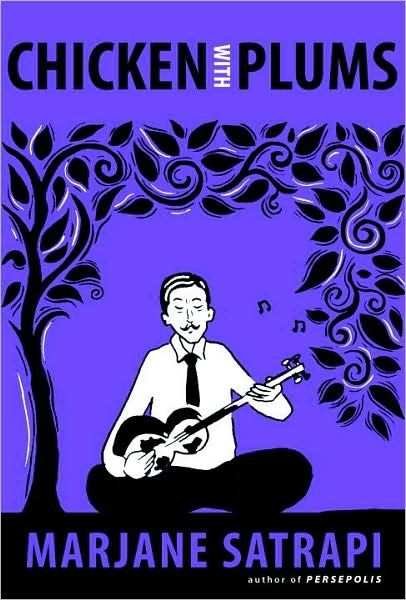
In Chicken with Plums, new in paperback from Pantheon, acclaimed author Marjane Satrapi tells the story of the life and death of her great uncle Nasser Ali, a renowned Iranian tar player who decides to die after his wife destroys his beloved instrument. Satrapi organizes her narrative around Ali’s last eight days alive in November, 1958–from the time he decides to quit eating and not leave his bedroom, to his eventual, somewhat unexplained death. Ali’s life story–and the reasons for his slow suicide–are revealed in a series of dreams, fantasies, flashbacks (and flashbacks within flashbacks!), and even a few flash forwards. Although the context of the recentish 1953 CIA-backed coup informs the plot, Chicken with Plums is far less concerned with Iranian politics than was the book that made her famous, her stunning debut graphic novel, Persepolis. Instead, Chicken plumbs loss and love, art and passion, family and disappointment, and the ways in which the small comforts in life–a favorite meal of say, chicken with plums, or a Sophia Loren flick, ultimately offer no protection against death.

Casual readers to comics often make the error of supposing that the medium is merely words with accompanying pictures. Satrapi’s deft work here might do wonders in correcting this ignorance. There isn’t a wasted panel in Chicken with Plums, and Satrapi commands intense emotion from her thick, black lines. There’s a seamless quality to Chicken with Plums; the text and the pictures, indivisible, add up to more than the sum of their parts. Satrapi knows when to hold back and let her simple black and white images tell the story. There is a certain economy of storytelling that great comic writers can achieve in ways entirely possible in prose, and here Satrapi has surpassed her earlier work in Persepolis, which, while great, often relied heavily on textual exposition. In Chicken with Plums, Satrapi’s evocations of troubled family life, unfulfilled love, the perils of Iranian immigration to California, and Sufi mysticism all blend into a poignant, often-funny, and occasionally devastating portrait that exemplifies the best of the comics medium.

While comparisons to her Persepolis series will undoubtedly hang over all of Satrapi’s work, Chicken with Plums is a wonderful successor, and in some senses, a more achieved work. Although it doesn’t convey the first-person immediacy of Persepolis, nor that memoir’s dramatic scope, the story of Nasser Ali is intimately detailed and achieves something rare in an age of overstuffed books: it leaves its readers hungry for more. Highly recommended.

Salon published a seven page excerpt from Chicken with Plums when the book was originally published in hardback.

The Ramen King and I — Andy Raskin

ramenking550hshadow

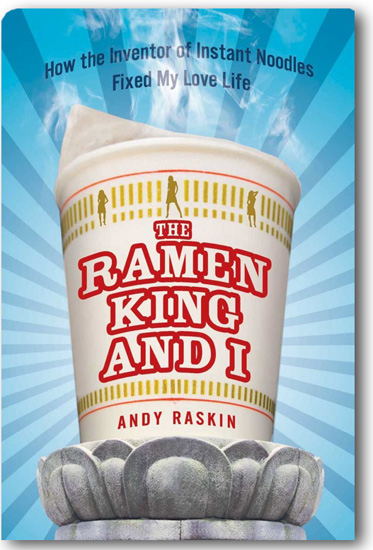
In his new memoir The Ramen King and I, Andy Raskin connects sex, desire, Japanese culture, and instant noodles in an often funny, sometimes poignant, and ultimately redemptive narrative that memoir-enthusiasts (and Japanese food fans) will enjoy. Raskin’s narrative works along several tracks that eventually intertwine. The book begins with Raskin’s obsession over Momofuku Ando, inventor of instant ramen (and gifted inspirational author, to boot), backtracking in time to slowly reveal just how a kid from Long Island got to be so wound up in the writings and philosophy of an ancient Japanese businessman. Raskin balances a straightforward, chronological narrative with intensely personal letters (supposedly) written to Momofuku. These letters often read like diary entries and help to expose the core of Raskin’s dilemma: in short, he’s an emotionally detached womanizer with extreme fears of commitment (in some of the memoir’s skeevier sections, we’re treated to Raskin’s descriptions of making “dates” via Craigslist). Raskin relates his life as a tech and business writer, and his frequent trips to Japan. Eventually, after a chance encounter in a sushi bar, Raskin enters the strange world of ramen, a world that eventually leads him to Momofuku, whose zen writings in turn lead Raskin to a transcendental breakthrough.

Raskin lets his audience get to know Momofuku too, both through the narrative proper and also through short, scattered sections titled “A Very Brief History of Momofuku.” Each part delivers another pithy bit of wisdom from the ramen master (who, strangely enough, invented instant noodles in a wood shack in his back yard). It’s easy to see why Raskin admires Momofuku, especially when we’re treated to a koan like “In a line, you can see the desires of the world” (to clarify, Momofuku is referring to a queue). Raskin’s descriptions actually make readers want to pick up Mr. Ando’s books–who could resist a chapter title like “I Am a Salad Bar Man,” from Momofuku’s collection of food essays Praise the Appetite. Indeed, the best parts of The Ramen King and I center around food and Japanese culture. Raskin is particularly passionate when describing his favorite semi-secret sushi spot (in one of the book’s saddest moments, he’s banned–this only helps to facilitate that redemptive arc, though, folks); the book also shines when Raskin details the rigmarole of the ordering ritual at Ramen Jiro–a Tokyo ramen shop complete with its own shaming ceremonies. Raskin’s evocations of sushi and ramen manga also fascinates. I lived in Tokyo long enough myself to know that the Japanese have comic books about everything, but I must admit I was still surprised by the range of sushi comics Raskin describes. He also takes one of the books major thematic cues from a Japanese game show called Go Forth, where the young hosts blurt out “I wanna _____!” and fill in that blank with a random phrase; they then go attempt to fulfill their task.

On the other hand, the parts of The Ramen King and I which center on Raskin’s relationships with women often drag, or at least blur into each other. Raskin seems to understand his “ex-girl to the next-girl” mentality is detrimental to his mental health, but he’s rarely reflective about it in a meaningful way, and he certainly doesn’t attempt to plumb its roots. However, he often admits as much, pointing out that the details he remembers from relationships–even long term ones–tend to be pretty ephemeral (and, not coincidentally, attached to food). On the whole though, Raskin’s book reads at a quick, easily digestible pace without resorting to the clichés or stock phrasing that often plague memoirs. Sure, the book follows a pretty predictable pattern of fall and redemption, but it does so in a manner that enlightens without being didactic. Memoir fans, foodies, and anyone interested in contemporary Japanese culture will likely enjoy The Ramen King and I. Recommended.

The Ramen King and I is available May 7th, 2009 from Gotham/Penguin.

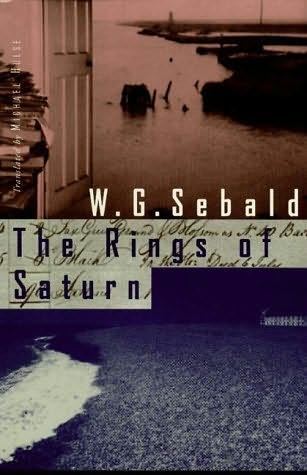
The Rings of Saturn — W.G. Sebald

rings

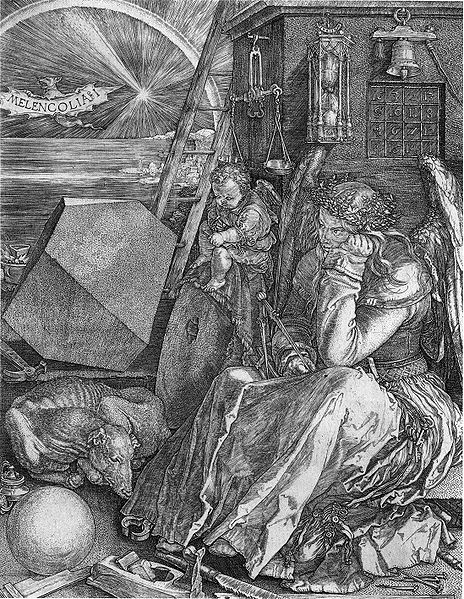
Early on in W.G. Sebald‘s strange and beautiful novel The Rings of Saturn, the erudite narrator (seemingly) offhandedly alludes to Albrecht Dürer’s 1514 engraving Melencolia I. Rings is larded with such references, stuffed to the gills with analysis of history and literature and art (and so much more), but the quick allusion to Melencolia I seems a particularly informative way of interpreting–or at least comprehending–Sebald’s grand, glorious book. Before we begin though, it will be useful to quickly summarize the plot: In 1992, a German intellectual named W.G. Sebald takes a walking tour of the east coast of England. He visits old English manors, the homes of dead writers, decaying seaside resorts, abandoned islands, and many other melancholy spots. In true King Lear style, he wanders the heath a bit. But this walking tour is not the real plot: no, instead, Sebald, in a casual, sometimes wryly humorous, and mostly melancholy tone reflects on the global and historical implications of a host of subjects far too numerous to try to list here. In other words, this is a very smart book about everything.
464px-durer_melancholia_i1

The Rings of Saturn, as its title suggests, is a book about melancholy (Renaissance medical texts identified Saturn with the bodily humor melancholy–black bile–indicated by sluggishness and moroseness, paradoxically paired with an eagerness for action (hence the modern word saturnine)). The melancholy of Rings pervades the whole text and even infiltrates each sentence. Like Dürer’s engraving, Sebald’s text is complexly and richly detailed, overflowing with allusion and symbolic registry that defies simple or easy interpretation. Just as Dürer situates the winged figure of genius at the (slightly off-) center of his image, contemplative yet dreamy, we find Sebald’s narrator to be a flighty genius made forlorn by the world he sees. And yet, just as Dürer’s figure is ultimately ambiguous (is he despondent or merely in the throes of absent fancy? Is he shirking his duty or contemplating a new grand work?) so too does Sebald’s narrator resist any simple interpretation. The narrative bulk of Rings consists of the narrator’s perspectives on history and memory, art and economics, literature and suffering. Like the myriad strange objects that surround the figure of genius in Dürer’s engraving, the connections between the subjects of the narrator’s lessons seem tenuous at first (indeed, several interpretations of Dürer’s piece have argued that it is simply a failed allegorical vision). As the text develops, we begin to see how the narrator’s obsession with, say, Thomas Browne’s skull connects to a biographical account of Joseph Conrad, or early English colonial forays into Imperial China, or reflections on the life cycle of the herring. Like the objects that litter Dürer’s engraving, the narrator’s varied lessons are detailed things, concretizations of history, or art, or literature, or science, and, at the same time–like Dürer’s objects–the narrator’s lessons are also symbols connected to grander abstractions. The work–and joy–of the reader is to link these symbols, these abstractions, into meaning. This is no simple task, but Sebald’s masterful writing ensures that it is a rewarding (and downright fun) adventure.

The flip side to melancholy is the potential energy writhing within its dramatic inertia. The very nature of the narrator’s simple quest–a walking tour–dramatizes this energy; at the same time, the decay and erosion of English coastal life threatens to overwhelm it for good. The narrator’s access to so much human knowledge, both miserable and horrible, attests to the power of history to survive through–but also to paradoxically crush–the living. This paradox of melancholy, dramatized in Dürer’s Melencolia I, is neatly summed up in a line from the first page of The Rings of Saturn (a page I immediately returned to after finishing the book, I must add):

At all events, in retrospect I became preoccupied not only with the unaccustomed sense of freedom but also with the paralysing horror that had come over me at various times when confronted with the traces of destruction, reaching far back into the past, that were evident to me even in that remote place.

In this “remote place,” this forlorn milieu, Sebald’s narrator (Sebald?) again and again uses the lens of history to–again paradoxically–attempt to come to terms with history, both collective and individual.

The result of all this is a wonderful, engaging read, on par with the greatest books I’ve read. Sebald’s command of language, his ability to dip into another’s voice recalls Roberto Bolaño’s great work 2666; Sebald’s narrator, in his will to understand and catalog recalls Ishmael in Melville’s masterpiece Moby-Dick, as does his human sympathy, humor, and sensitivity. At the same time, Sebald’s scope spills out of the conventional borders of what we’ve come to know as the novel. While hardly as dry–or neutral–as a history or science text, Sebald’s narrator’s takes on sericulture, or the life of Joseph Conrad, or the relationship between art museums and the sugar trade of the 18th century all vibrate with an intense truthfulness that informs and engages the reader without ever falling into didactic prattle.

At the end of The Rings of Saturn, Sebald’s narrator returns to Thomas Browne’s skull again–only this time resurrected, a living brain. He discusses at length Browne’s Musaem Clausum, an imaginary library that Browne invented containing texts, artifacts, and relics of every manner of wonder. Sebald’s narrator goes on for pages listing the contents of Musaem Clausum with fervor and passion–the reader realizes that the book, and the narrator, could go on and on, detailing these wonders and their connected histories under more intense scrutiny. Rings replicates both Browne’s Musaem Clausum and Dürer’s engraving, offering readers a tour through myriad marvels–and if the walk is melancholy and strange, it is also profound and beautiful, and very, very rewarding. Very highly recommended.
The 2009 PEN/O. Henry Prize Stories

penab

The short story often gets short shrift. While Hemingway’s “Hills Like White Elephants” is an astounding feat of economy, it’s rarely mentioned in the canon of Hemingway’s masterpieces like For Whom the Bell Tolls. There’s a strong case to be made that Kafka’s little fables are far more perfect than his unfinished novels, and yet The Trial, incomplete as it is, is still considered his finest work. I would take any one of Nathaniel Hawthorne’s Twice-Told Tales over the interminable stuffiness of The Scarlet Letter. There exists, perhaps, a feeling that the short story as art form is incapable of making Grand Gestures or Big Important Statements. Collections that are lauded tend to function (or at least pretend to function) as homogeneous “novels in short story” –which can be great, of course (see Denis Johnson’s inimitable volume Jesus’ Son) — but why should that be? To often, readers dismiss short stories, particularly short stories, as little more than time-fillers, neat little chunks of text to occupy specific moments in time: a subway ride, an term in a waiting room, a spare half-hour. Sometimes we set aside our real Reading Time for those oh-so important novels, so that we might Learn and Grow as a Person (or whatever). And while the tales comprising the 2009 PEN/O. Henry Prize Stories certainly won’t disappoint as time-fillers, they offer so much more than simple leisure reading.

Repeatedly, the stories in this collection explore what is at stake in the human condition, and a sense of loss underpins many (if not most) of the tales. Take the lead story, Graham Joyce’s “An Ordinary Soldier of the Queen,” for instance. This story of a British Army officer who may or may not have been exposed to toxic nerve gas during the first Gulf War unfurls in a realistic, funny, and often affecting voice. Joyce’s tale dips from a military procedural into uncanny, fantastic territory, making the reader question the perception of the narrator, who never wavers in his beliefs about the strange events (namely, meeting a djinn) that are (maybe) happening to him. I thought about “An Ordinary Soldier of the Queen” for days after I read it and I made a colleague read it so that I could force him to discuss it with me. Karen Brown’s “Isobel’s Daughter” also explores loss, communicating the profundity of those everyday tragedies we often look away from. (Brown’s evocation of Tampa, Florida is spot-on, I must add). In “Purple Bamboo Park,” E.V. Slate lets us peer into the life of an old maid in modern China. The story is heartbreaking from the get-go, and yet her protagonist is not a wholly sympathetic character; Slate’s handle on human failure and our investment in mundane adventures is crushing–who knew we could have so much in common with an aging domestic worker? Caitlin Horrocks literalizes loss in “This Is Not Your City,” thrusting her readers into the panic of Russian immigrants whose daughter goes missing. In “The Order of Things,” Judy Troy examines loss and meaning through an affair, concluding that “Feeling came first and though after; that was the order of things,” much to the surprise of her protagonist. And while Paul Theroux’s “Twenty-two Stories” is more playful in both structure and content (it is comprised of twenty-two short short short stories), again we find characters pondering loss and the circumstances of their losses. Theroux’s characters, like those in James Joyce’s Dubliners, repeatedly come to negative epiphanies, whether they lose their faith in God and religion or realize that they were unfit parents. The closing story, Junot Díaz’s “Wildwood” makes me kind of ashamed that I still haven’t read Brief Wondrous Life of Oscar Wao. I will remedy this omission forthwith.

While readers may not love every story collected in The 2009 PEN/O. Henry Prize Stories, it would take a pretty cold automaton to dismiss most of what’s presented here. The project, helmed by editor Laura Furman with jury prize selections by A.S. Byatt, Anthony Doerr, and Tim O’Brien, is really an exploration of how people handle loss and beauty and family and adventure and boredom and all those things that happen in life (and death). And isn’t that what we ask of our literature? Read this book, but give these stories their proper due. They’re more than just time-fillers; each one is a perfectly crafted little world waiting to be explored. Recommended.

The 2009 PEN/O. Henry Prize Stories is available May 5th, 2009 from Anchor Books.

J.G. Ballard Remembered

jgballard

Author J.G. Ballard died of prostate cancer yesterday, at the age of 78. Ballard wrote over a dozen novels and hundreds of short stories. Ballard is probably most famous for his 1984 epic Empire of the Sun, which draws heavily on his childhood experiences during WWII Japanese-occupied Shanghai, but here at the Biblioklept we love his dystopian visions the most. Ballard’s early books like The Drowned World and short-story collection The Terminal Beach extend traditional adventure novels into strange dystopias and bizarre thought experiments. From the get-go, Ballard’s “sci-fi” (if you want to call it that) was less concerned with alien intelligences than it was with our internal and collective psychologies, and how we react to an increasingly mediated world. Hence novels like Crash, where human sexuality melds into technological fetishism, or The Atrocity Exhibition, a fragmented novel exploring the intersection of celebrity and Armageddon. Later novels like Cocaine Nights and Super-Cannes respond to an increasingly paranoid and disconnected world, with a sardonic humor that is ultimately more frightening than soothing. Ballard never sought to alleviate or mock or answer to an increasingly complex and increasingly absurd world–he just dissected it and extrapolated it beyond most of our dim imaginations.

Ballard belongs to a select counter-tradition of writers and artists, fitting neatly between William Burroughs and William Gibson. Like his strange brothers Philip K. Dick and Thomas Disch, Ballard will always have a place in the avant-garde sci-fi cannon, and it’s likely that that place will only grow. Ballard was still writing up to his death, and his last novel Kingdom Come, a book that detailed the descent of consumerism into a type of fascism was as relevant as ever. Indeed, Ballard was far ahead of his time; as our world catches up to his visions, we will surely find an increasing relevancy in his body of work. He will be missed.

The Penelopiad – Margaret Atwood

thepenelopiad

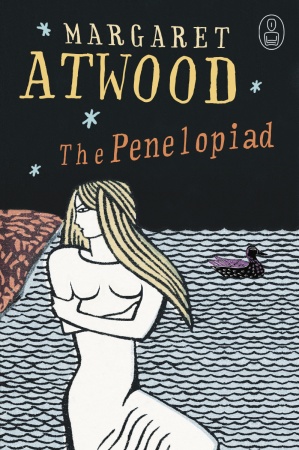
The Odyssey has long been my go-to example for phallocentric literature in the high school classes I teach. The story of wily Odysseus and his crew wandering the high seas for a decade after the Trojan War prototypifies a literature of masculine fantasy full of adventure, intrigue, and romance. While Odysseus explores the world, bedding nymphs and witches and having every kind of adventure with his boys, his wife Penelope is at home, faithful and chaste, raising kid Telemachus and keeping the would-be usurpers at bay. In short, the story of Odysseus licenses an entire tradition of phallocentric literature wherein the clever protagonist is able to duck familial and social duty and have a great adventure in the process. Think of Huck lighting out for the territory. Same deal. Not that there’s anything wrong with that. But as Margaret Atwood saliently demonstrates in The Penelopiad, her reworking of The Odyssey, there’s always another side to that story of masculine escape–and a price to that adventure, as well.

As its title suggests, The Penelopiad tells the story from the perspective of Penelope, a plain but clever girl, who–like Odysseus–must learn to live by her wits. Atwood, working from several myths, details Penelope’s divine parentage (she’s half-naiad), and her upbringing as a young maid in her father’s home. In an early key scene, Penelope’s father supposedly (the details are fuzzy, she admits) tries to murder her by drowning her, after learning that she will weave his shroud. This infanticide echoes the story of Oedipus, and also serves as a dominant motif throughout the story (it’s also twinned with a motif of eating meat–Penelope remarks at one point that she is just “meat” to be eaten). As the story progresses, young, shy Penelope slowly transforms from a naive gal with a chip on her shoulder about her preternaturally beautiful cousin, Helen, into a woman as wily as Odysseus himself. Atwood treats us to Penelope’s inner thoughts on all sorts of subjects, and even though Penelope claims to love Odysseus, it’s repeatedly clear how angry she is at not only him, but also her son.

While Penelope’s story is dominant, Atwood is very concerned with Penelope’s twelve maids, orphaned servants slain by Odysseus and Telemachus after Odysseus’ return. The maids serve as a chorus, interjecting their voice in short chapters written in a variety of styles, ranging from epic poetry to sea shanties to short skits. One of the most fascinating choral sections plays as an anthropological seminar, in which Atwood’s maids suggest that the real story of Odysseus and Penelope is in fact the displacement of a matriarchy by a wandering warrior. There’s also an inspired court scene where Odysseus is tried for killing the suitors, and the maids sue for justice.

Ultimately, Atwood paints the maids, poor orphans and slaves, as the real victims in this ancient tale. While Penelope complains that she is treated as “meat,” Atwood makes it clear that it’s really the maids who are treated as mere flesh to be consumed–slaves forced to clean, bodies subjected to repeated rapes. And while Penelope repeatedly expresses sorrow and dismay for the murder of the maids, complaining that their deaths were a result of tragic miscommunication, the maids have a different story to tell–one that ironizes much of what Penelope has to say. As the story progresses, we are frequently reminded by Penelope herself that she is a liar and storyteller on par with Odysseus and because of this insight we begin to realize that there might be something to some of the slanderous rumors she’s been protesting in her narrative. It would’ve been simple for Atwood to give Penelope a straightforward and strong voice, a voice that communicated the virtue classically identified with Penelope along with a feminist slant of insight. Instead, Atwood’s Penelope is far more complex and human, gossipy and spiteful, sympathetic and ripe for contempt. The Penelopiad ironizes not only The Odyssey (and the phallocentric literary tradition after it), but also itself; its a book that complicates our notions of history, memory, and identity, and it does so in ways both playful and profound. Highly recommended.

Che’s Afterlife: The Legacy of an Image — Michael Casey

ches-afterlife

I have a memory–a surprisingly distinct one, considering the circumstances–I was about nineteen, a sophomore in college, hanging out at a friend’s house, listening to records and going through his books. He had a large red book, a Che Guevara reader that I recognized not by the name (which I’d never heard pronounced) but rather by the iconic image of the Argentine Marxist revolutionary. Of course, I didn’t know that Che was an Argentine Marxist revolutionary at the time–I just knew the image. “Is this any good?” I asked my friend, thumbing through the thick, stiff volume. “No idea,” he replied. “Who is this guy, anyway?” My friend smiled at me — “You don’t know who Che Guevara is? Neither do I.” This admission speaks volumes to Che’s legacy, a legacy of image over substance, form over idea, iconography over doctrine–a legacy thoroughly and playfully covered in Michael Casey’s intriguing new study, Che’s Afterlife.

guerrilleroheroico
Guerrillero Heroico -- Alberto Korda

Casey’s book begins in the back of a tuk tuk in Bangkok, where the author sees two images juxtaposed: the iconic photograph of Che by Alberto Korda next to a picture of Rambo–the Communist revolutionary and the all-American defender of the capitalist way of life. In Che’s Afterlife, Casey follows this strange juxtaposition across the globe, from the moment Korda captures the image while on assignment recording Jean Paul Sartre and Simone de Beauvoir’s 1960 trip to Cuba, to the image’s rallying explosion across the Western world, to its modern implications in Chavez’s Venezuela and its infamy among Cuban Republicans in Miami. The global ride is packed with fascinating historical characters, artists, and writers, but at its heart is the central paradox of how a Communist firebrand became a capitalist brand. “It’s impossible to overlook the irony,” Casey writes, “the commoditization of an anticapitalist rebel who opposed all that his hyper-commercialized image now represents.”

reagan-che

Che’s Afterlife is not so much another Che Guevara biography as it is an exploration of the power of imagery and media in a global world. Casey works from sources like Andy Warhol and Susan Sontag, along with contemporary political and economic analysts to explore how and why the “the Korda image remains a powerful indicator of rebellion and resistance.” I saw myself in the book time and again, not in any of the political ideologies, but rather as one of the many “young Americans [who] know [Che] only as a T-shirt logo.” Casey’s study is well-researched, well-written, and lots of fun, a book more at home under the cultural studies rubric than biography or history. Recommended.

Che’s Afterlife: The Legacy of an Image by Michael Casey is available April 7th, 2009 from Vintage.