“Who Needs Poets?” — Jorge Luis Borges

“Who Needs Poets?”

by

Jorge Luis Borges


The poet’s trade, the writer’s trade, is a strange one. Chesterton said: “Only one thing is needful–everything.” To a writer this everything is more than an encompassing word; it is literal. It stands for the chief, for the essential, human experiences. For example, a writer needs loneliness, and he gets his share of it. He needs love, and he gets shared and also unshared love. He needs friendship. In fact, he needs the universe. To be a writer is, in a sense, to be day-dreamer–to be living a kind of double life.

I published my first book, Fervor de Buenos Aires way back in 1923. This book was not in praise of Buenos Aires; rather, I tried to express the way I felt about my city. I know that I then stood in need of many things, for though at home I lived in a literary atmosphere–my father was a man of letters–still, that was not enough. I needed something more, which I eventually found in friendships and in literary conversation.

What a great university should give a young writer is precisely that: conversation, discussion, the art of agreeing, and, what is perhaps most important, the art of disagreeing. Out of all this, the moment may come when the young writer feels he can make his emotions into poetry. He should begin, of course, by imitating the writers he likes. This is the way the writer becomes himself through losing himself–that strange way of double living, of living in reality as much as one can and at the same time of living in that other reality, the one he has to create, the reality of his dreams.

This is the essential aim of the writing program at Columbia University’s School of the Arts. I am speaking in behalf of the many young men and women at Columbia who are striving to be writers, who have not yet discovered the sound of their own voices. I have recently spent two weeks here, lecturing before eager student writers. I can see what these workshops mean to them; I can see how important they are for the advancement of literature. In my own land, no such opportunities are given to young people.

Let us think of the still nameless poets, still nameless writers, who should be brought together and kept together. I am sure it is our duty to help these future benefactors to attain that final discovery of themselves which makes for great literature. Literature is not a mere juggling of words; what matters is what is left unsaid, or what may be read between the lines. Were it not for this deep inner feeling, literature would be no more than a game, and we all know that it can be much more than that.

We all have the pleasures of the reader, but the writer has also the pleasure and the task of writing. This is not only a strange but a rewarding experience. We owe all young writers the opportunity of getting together, of agreeing or disagreeing, and finally of achieving the craft of writing.


This essay, adapted from a lecture Borges delivered at Columbia University’s School of the Arts, was published in the 8 May 1971 issue of The New York Times
“hist whist” — e.e. cummings

“hist whist”

by

e.e. cummings


hist      whist
little ghostthings
tip-toe
twinkle-toe
little twitchy
witches and tingling
goblins
hob-a-nob     hob-a-nob
little hoppy happy
toad in tweeds
tweeds
little itchy mousies
with scuttling
eyes    rustle and run     and
hidehidehide
whisk
whisk     look out for the old woman
with the wart on her nose
what she’ll do to yer
nobody knows
for she knows the devil     ooch
the devil     ouch
the devil
ach     the great
green
dancing
devil
devil
devil
devil
        wheeEEE

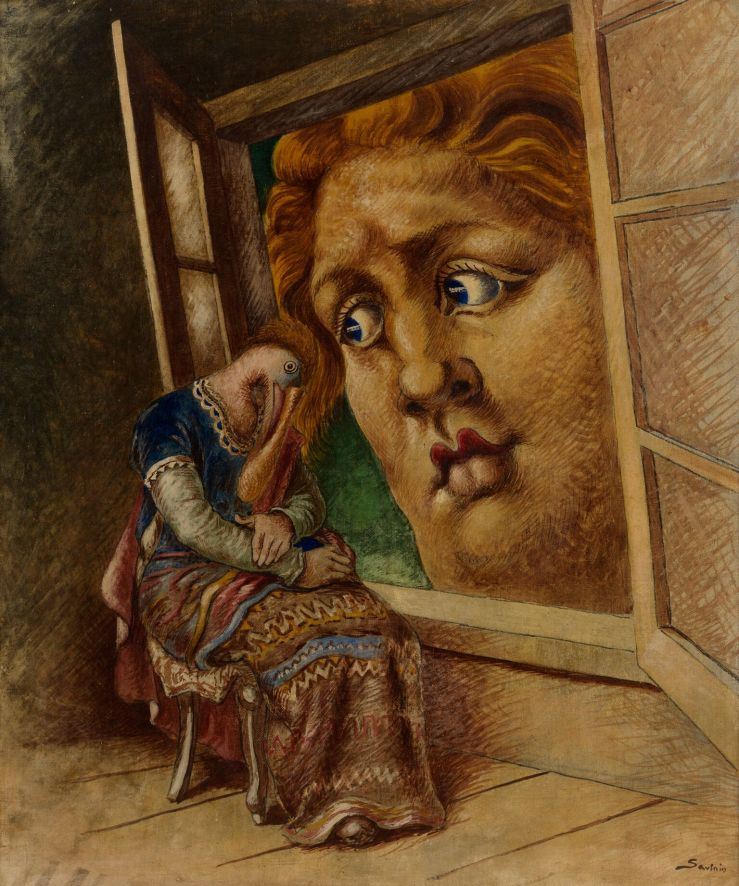
The Annunciation — Alberto Savinio

The Annunciation, 1932 by Alberto Savinio (1891–1952)

Read a new Lydia Davis story, “How He Changed over Time”

“How He Changed over Time” is a new Lydia Davis story in the fall issue of VQR. 

Here are the first two paragraphs:

He used to play the violin, but then, as his fingers thickened and lost some of their agility, he became frustrated by trying to play, and then bored by it. He put the violin away in its case for good, had the case removed to a storeroom, and, instead, invited others in to play for him and his family in the evenings. In time, this playing by others, too, wearied him with its incessant sound and he no longer invited musicians into his home or willingly listened to any music, except, perhaps, at long intervals, from a distance, a patriotic march.

He used to provide what was needed in the way of food, equipment, and guides for parties of men to go off exploring. They would bring him not only reports of what they had seen but also handsome artifacts, such as feathered tribal headdresses and small handmade axes and other tools. These he would display in his roomy front hall, and visitors waiting for a private audience would pass the time studying the artifacts and learning about the indigenous tribes of the country. He had had exactly this in mind, to educate the public, when he directed that the artifacts be displayed thus on the walls and in cabinets. But then he tired of the artifacts and lost interest in what they signaled of other cultures, and no longer cared about educating the public. He had everything in the front hall taken off the walls and out of the house and sold to a museum. The bare walls, a relief to his eyes, were then to be painted gold. He no longer sent parties of men out to explore the wilderness, for he no longer had any interest in other landscapes or the wildlife or primitive peoples that inhabited them. Geography now confused him.

Read the rest of the “story” (really, it’s something closer to a poetic (and critical) essay on Thomas Jefferson). 

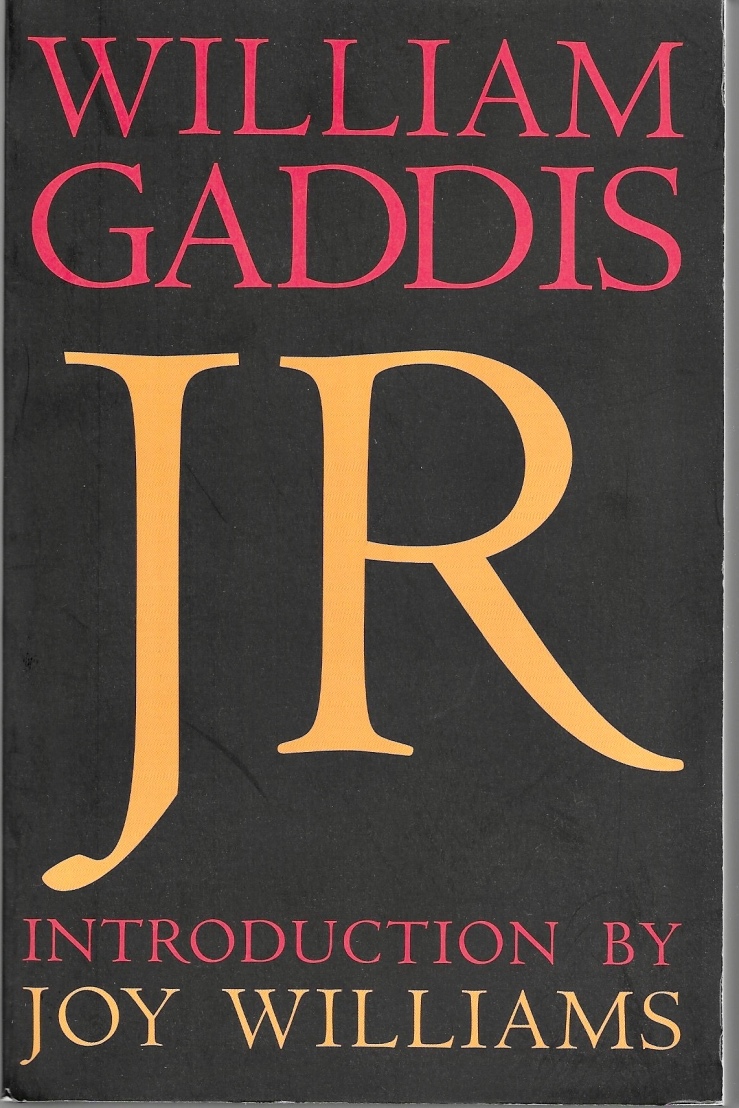
Joy Williams on William Gaddis’s novel J R

The Paris Review has published Joy Williams’s introduction to NYRB’s forthcoming edition of William Gaddis’s masterpiece satire of American capitalism, J R. Williams’s review is heavy on citation from Gaddis’s letters, William Gass’s essay “Mr. Gaddis and His Goddamn Books,” and J R itself. I like this bit:

In 1956, nineteen years before the publication of this second novel, Mr. Gaddis wrote a registered letter to himself to protect his idea for it from copyright infringement:

In very brief it is this; a young boy, ten or eleven or so years of age ‘goes into business’ and makes a business fortune by developing and following through the basically very simple procedures needed to assemble extensive financial interests, to build a ‘big business’ in a system of comparative free enterprise employing the numerous (again basically simply encouragements (as tax benefits &c) which are so prominent in the business world of America today …

This boy (named here ‘J.R’) employs as a ‘front man’ to handle matters, the press &c, a young man innocent in matters of money and business whose name (which I got in a dream) is Bast. Other characters include Bast’s two aunts, the heads of companies which JR takes over, his board of directors, figures in a syndicate which fights his company for control in a stockholder’s battle, charity heads to whom his company gives money, &c.

This book is projected as essentially a satire on business and money matters as they occur and are handled here in America today; and on the people who handle them; it is also a morality study of a straightforward boy reared in our culture, of a young man with an artist’s conscience, and of the figures who surround them in such a competitive and material economy as ours. The book just now is provisionally entitled ‘SENSATION’ and ‘J.R.’

What a surprisingly unpromising précis!

I hope to have something forthcoming on this new edition of J R. In the meantime, here’s a link to the last thing I wrote about it, back in 2016, and this excerpt from that thing:

Only a handful of novels are so perfectly simultaneously comic and tragic. Moby-Dick? Yes. Gravity’s Rainbow? Absolutely. (G R and J R, a duo published two years apart, spiritual twins, massive American novels that maybe America hardly deserves (or, rather: theses novels were/are totally the critique America deserves). I guess maybe what I’m saying is J  R is the Great American Novel to Come (The Recognitions is perhaps overpraised and certainly not Gaddis’s best novel; J R is. The zeitgeist has been caught up to J R, the culture should (will) catch up).

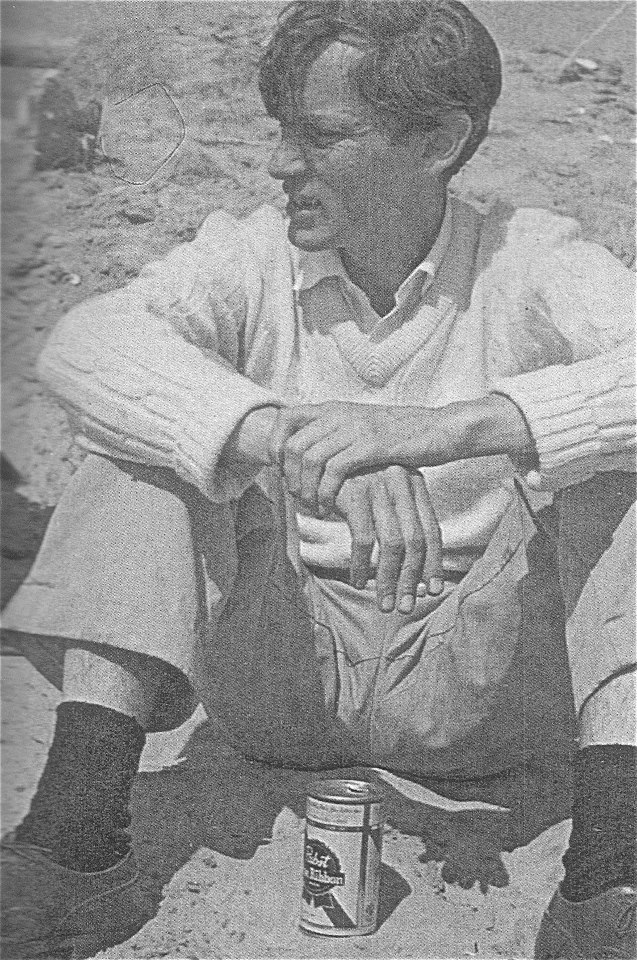
And here is my favorite picture of Gaddis:

gaddis-beach-pbr

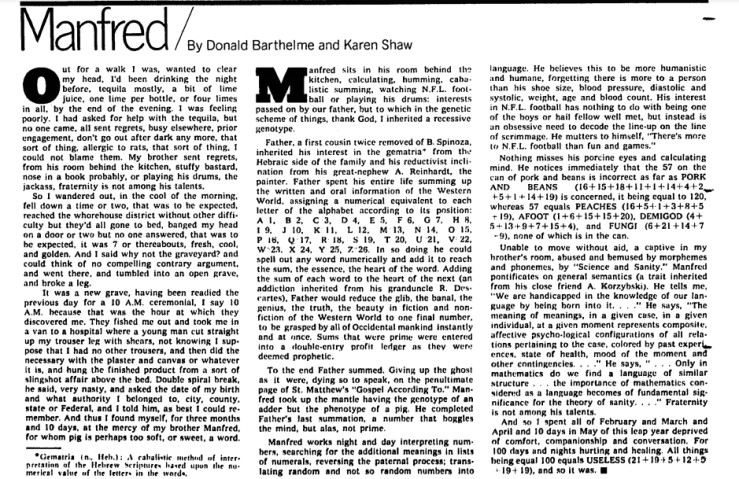
Donald Barthelme’s short-story contest

In 1976, Donald Barthelme oversaw a short-story contest in The New York Times. He wrote the first three paragraphs of an untitled story and asked readers “to provide the terrifying middle and the subtle, incomparably beautiful ending.” The winner, judged by Barthelme, was to receive a $250 prize and have their story published in the Times. That winner ended up being visual artist Karen Shaw, who applied an artistic process she termed “summantics” to the story.

The New York Times repeated the contest in 1996, this time with Nicholson Baker as the lead author.


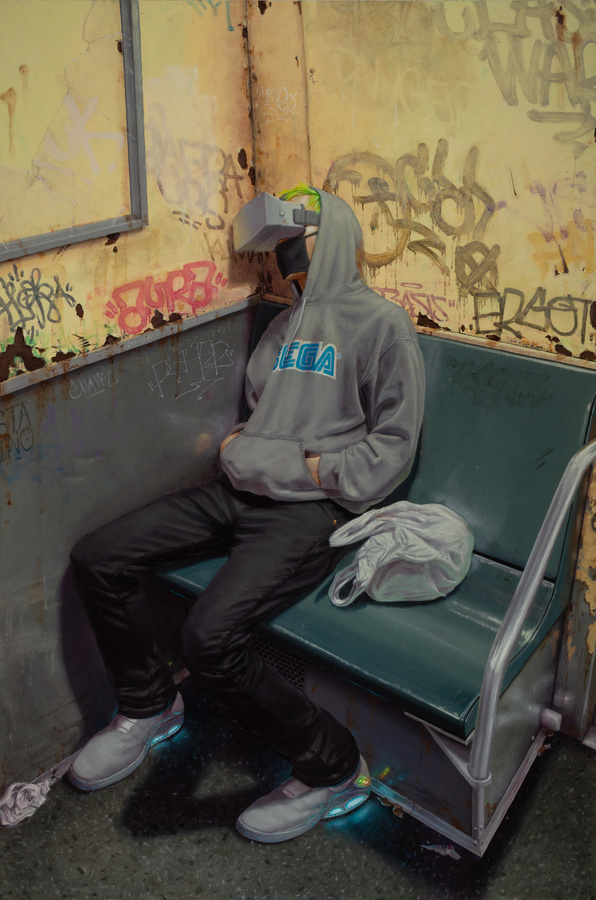
Flux Capacitor — Taylor Schultek

Flux Capacitor, 2020 by Taylor Schultek (b. 1990)

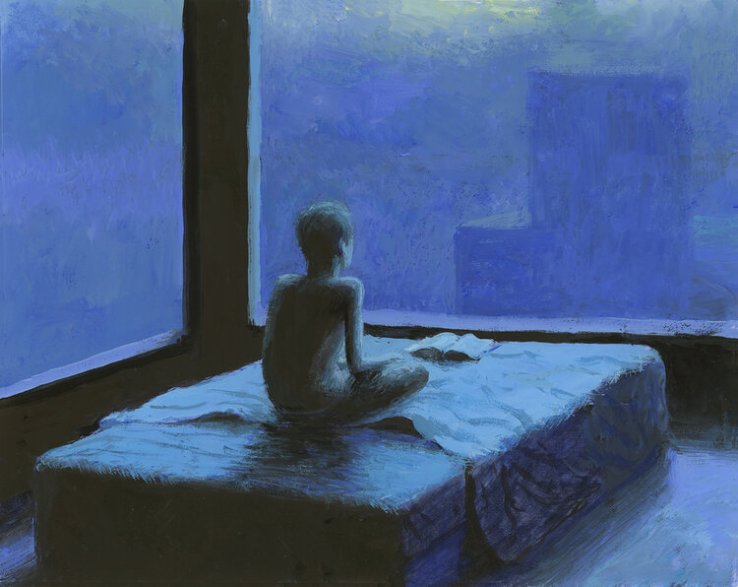
Study for Night Reading — Aron Wiesenfeld

Study for Night Reading, 2020 by Aron Wiesenfeld (b. 1972)

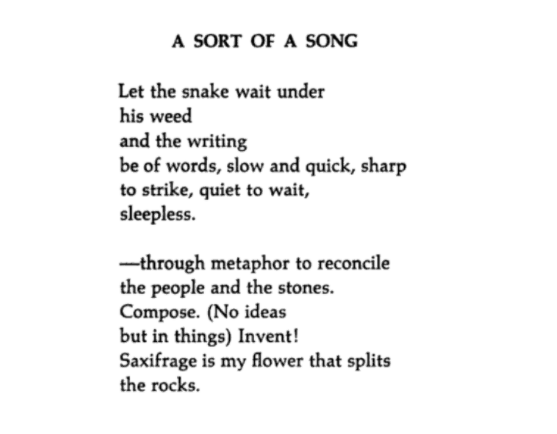
“A Sort of Song” — William Carlos Williams

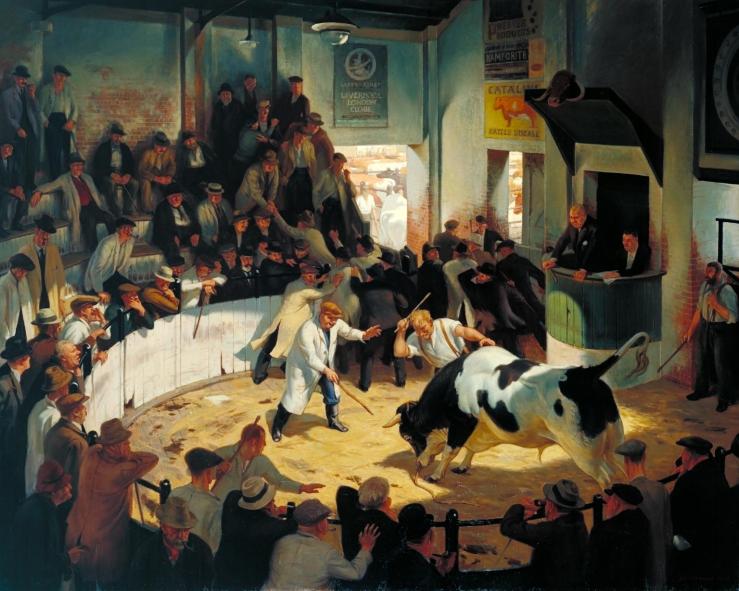
Commotion in the Cattle Ring — James Bateman

Commotion in the Cattle Ring, 1935 by James Bateman (1893–1959)

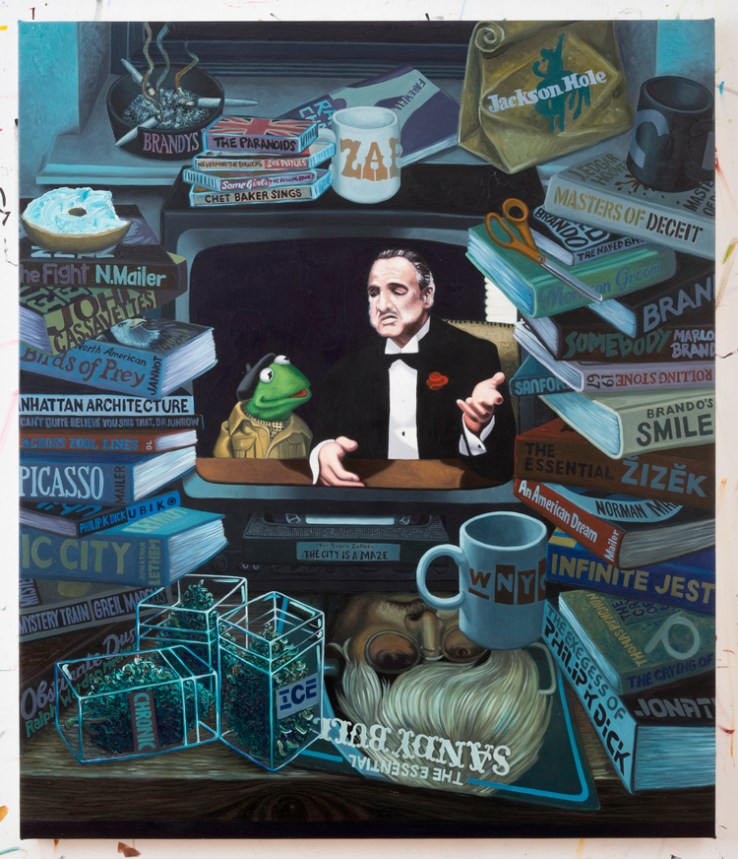
Perkus Tooth Still Life (Chronic City) — Tom Sanford

Perkus Tooth Still Life (Chronic City), 2016 by by Tom Sanford (b. 1975)

“What do we make of the Mr. Bones voice, the minstrel voice, as employed in Berryman’s most successful work, much of it written during the high period of the civil rights movement?” | Rick Moody on John Berryman

What do we make of the Mr. Bones voice, the minstrel voice, as employed in Berryman’s most successful work, much of it written during the high period of the civil rights movement? What do we make of Henry’s agonized dream life in our own times of crisis? And what of the author? And why is the Poetry Foundation assigning a review of Berryman’s letters, today, when they could instead review a new volume by an African American poet?

There is, it is fair to say, a stomach churning that goes with this assignment. Should I not properly imagine that I, a middle-aged white writer of privilege, am, however inadvertently, being conscripted into this review such that I might avoid rocking the boat on a now-contested figure of 20th-century confessional literature when some helping of opprobrium appears more than justifiable? Let me be plain. In the present context, it is impossible to read Berryman’s magnum opus without the keenest discontent about the use of dialect. Berryman’s conduct as a man, as a father, as a husband, as a professor, as indicated in his work and in his biography, is very often difficult to bear witness to, even at a 50-year remove. The tide has shifted so dramatically in 2020 that it is hard to know why it is a public service to review the volume at hand.

These are the third and fourth paragraphs of Rick Moody’s essay “Unspeakably Miserable For the Most Part,” published this week at the Poetry Foundation. Ostensibly a review of the new collection The Selected Letters of John Berryman (edited by Philip Coleman and Calista McRae), Moody’s essay continues for another dozen paragraphs.

MMXX — Martin Wittfooth

MMXX, 2020 by Martin Wittfooth (b. 1981)

Black Hole — Ian Cumberland

Black Hole, 2016 by Ian Cumberland (b. 1983)

Cormac McCarthy’s Cinematic Trash

The above is an unsigned New York Times article published on 8 Nov. 1998.

Cormac’s Trash was released in 1999.

In a 2001 interview, producer Mylène Moreno suggests that the short film did not violate McCarthy’s privacy:

AC: You’re also showing the short “Cormac’s Trash,” that you produced and your husband Rafe Greenlee wrote and directed, about how the obsessed fans of the elusive, reclusive El Paso resident/writer Cormac McCarthy try to smoke him out, one even going so far as to go through his trash. How did that project come about?

MM: From the moment we arrived, Cormac’s presence loomed very large. There was always a lot of buzz about him. We lived near him and were always aware of his presence in the neighborhood, though we never saw him. He was Rafe’s favorite author. The film explores Cormac’s relationship to El Paso’s artists and its literary community. As a lawyer, Rafe was interested in privacy issues, and he takes the position in the film that he’s not going to cross the line — even though the film reveals that others probably have. He was careful about revealing the sorts of things found in Cormac’s trash. He didn’t show all of what was in there.

I think we should leave Cormac’s trash alone.

Blog about some recent reading

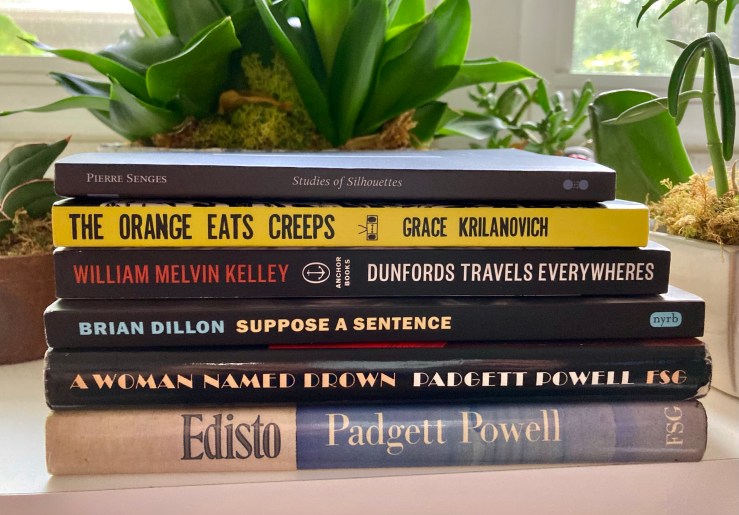
From the bottom of the stack to the top:

I read most of Padgett Powell’s 1984 debut Edisto in a few sittings, settling down easily into its rich evocation of a strange childhood in the changing Southern Sea Islands. I’d always been ambivalent about Powell, struggling and failing to finish some of his later novels (Mrs. Hollingsworth’s Men; The Interrogative Mood), but Edisto captured me from its opening lines. The story takes two simple tacks–it’s a coming of age tale as well as a stranger-comes-to-town riff. Powell’s sentences are lively and invigorating; they show refinement without the wearing-down of being overworked. The book is fresh, vital.

So when I finished Edisto, I thought I’d go for some more early Padgett. On Friday I picked up his second novel, A Woman Named Drown, started it that afternoon, and put it down 70 pages later the following afternoon. There wasn’t a single sentence that made me want to read the next sentence. Worse, it was turning into an ugly slog, a kind of attempt to refine Harry Crews’s dirty south into something closer to grimy eloquence. I like gross stuff, but this wasn’t my particular flavor.

In between, I took another palate cleansing essay from Brian Dillon’s collection Suppose a Sentence. Dillon’s collection of essays is perfect for resetting a reader’s mood between texts. Each essay reflects, sometimes obliquely, sometimes more directly on a single sentence from a range of authors. Good stuff.

I am working on a full review of William Melvin Kelley’s cult classic Dunfords Travels Everywheres. I have misused the phrase “cult classic” in the preceding sentence Dunfords has been long out of print, almost impossible to find, and largely unheralded for the past few decades. However, new editions from Anchor are rectifying this problem. The book is weird, a bit shaggy, funny and perplexing. More thoughts to come.

When I put down Powell’s A Woman Named Drown I picked up Grace Krilanovich’s novel The Orange Eats Creeps. I bought Orange back in July, pulling it out based on its spine (Two Dollar Radio, a small press I admire) and its title (c’mon!). The Steve Erickson blurb sealed the deal. I’m really digging Orange right now. It’s a novel about Slutty Teenage Hobo Vampire Junkies (the narrators term) bumming around and sucking blood and drugs in the Pacific Northwest. It reminds me a lot of Kathryn Bigelow’s film Near Dark, Tim Hunter’s film River’s Edge, and Harmony Korine’s film Gummo. There’s also a healthy dose of Twin Peaks in here, as well as the abject contours of Charles Burns’s Black Hole.

I’ve also been using Pierre Senges’s Studies of Silhouettes (English translation by Jacob Siefring) as literary palate cleansers, opening the book at random to read Senges’s strange riffs on Kafka’s leads. As Siefring’s blurb puts it, “Each of the texts in this work proceed from the fragments and cryptic beginnings found scattered throughout the notebooks Max Brod took possession of after Kafka’s death.” The results are sometimes very funny, sometimes profound, sometimes both. I hope to have a fuller review down the line.

Midas — Adam Miller

Midas, 2020 by Adam Miller (b. 1979)