Sunday Comix

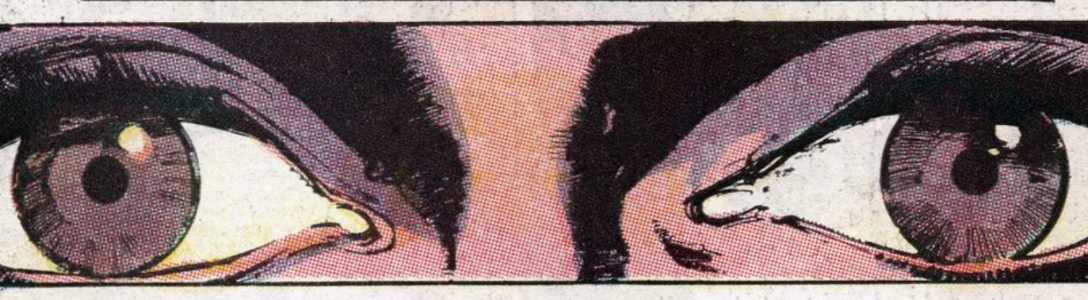
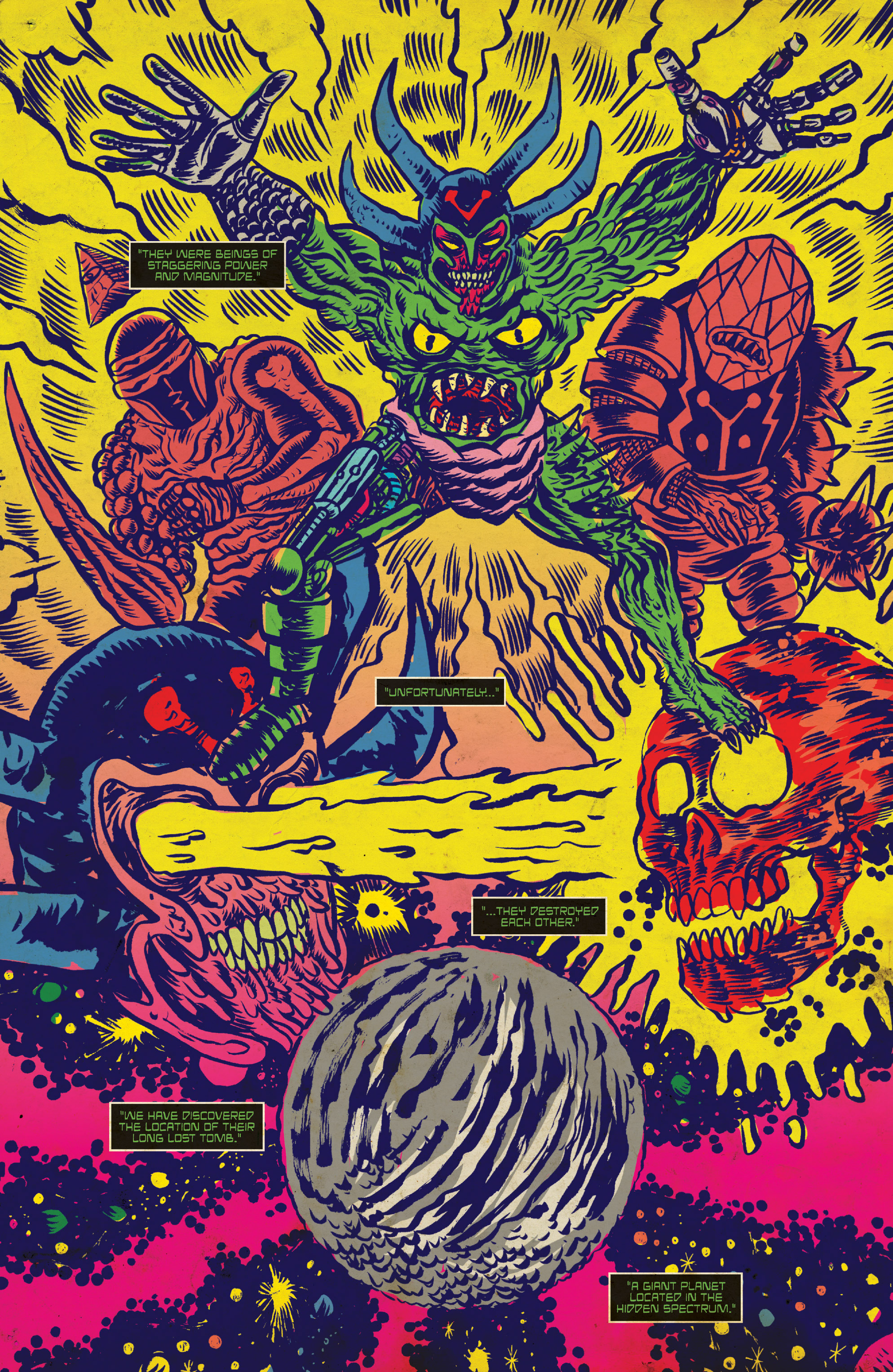
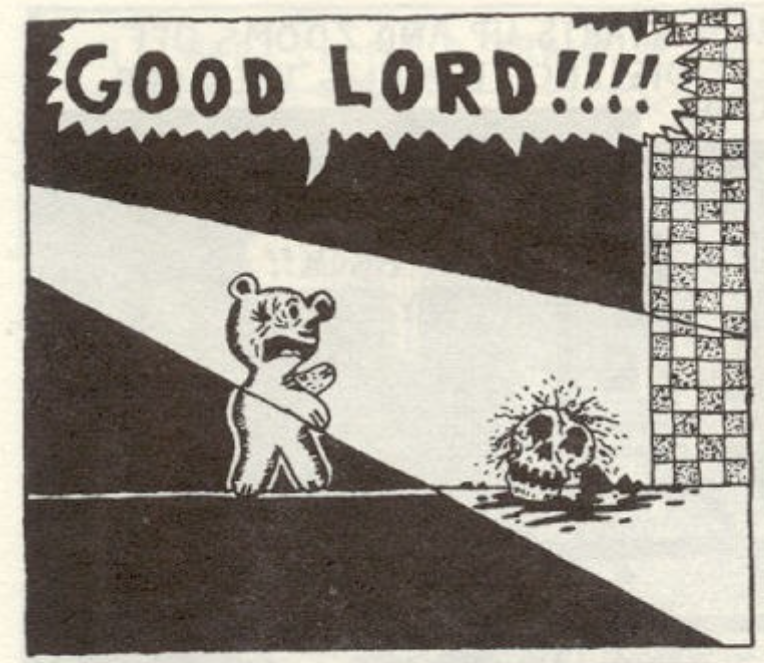
From “The Spawn of Cokethulhu” by Chris Statler, Cocaine Comix #2, 1981.

“The Story to End All Stories” — Philip K. Dick

“The Story to End All Stories”

by

Philip K. Dick


In a hydrogen war ravaged society the nubile young women go down to a futuristic zoo and have sexual intercourse with various deformed and non-human life forms in the cages. In this particular account a woman who has been patched together out of the damaged bodies of several women has intercourse with an alien female, there in the cage, and later on the woman, by means of futuristic science, conceives. The infant is born, and she and the female in the cage fight over it to see who gets it. The human young woman wins, and promptly eats the offspring, hair, teeth, toes and all. Just after she has finished she discovers that the offspring is God.

“The Charm of 5:30” — David Berman

“The Charm of 5:30”

by

David Berman


It’s too nice a day to read a novel set in England.

We’re within inches of the perfect distance from the sun,

the sky is blueberries and cream,

and the wind is as warm as air from a tire.

Even the headstones in the graveyard

           seem to stand up and say “Hello! My name is…”

It’s enough to be sitting here on my porch,

thinking about Kermit Roosevelt,

following the course of an ant,

or walking out into the yard with a cordless phone

           to find out she is going to be there tonight.

On a day like today, what looks like bad news in the distance

turns out to be something on my contact, carports and

white courtesy phones are spontaneously reappreciated

           and random “okay”s ring through the backyards.

This morning I discovered the red tints in cola

                     when I held a glass of it up to the light

and found an expensive flashlight in the pocket of a winter coat

                     I was packing away for summer.

It all reminds me of that moment when you take off your

sunglasses after a long drive and realize it’s earlier

and lighter out than you had accounted for.

You know what I’m talking about,

and that’s the kind of fellowship that’s taking place in town, out in

the public spaces. You won’t overhear anyone using the words

“dramaturgy” or “state inspection” today. We’re too busy getting along.

It occurs to me that the laws are in the regions and the regions are

in the laws, and it feels good to say this, something that I’m almost

sure is true, outside under the sun.

Then to say it again, around friends, in the resonant voice of a

nineteenth-century senator, just for a lark.

There’s a shy looking fellow on the courthouse steps, holding up

a placard that says “But, I kinda liked Clinton.” His head turns slowly

as a beautiful girl walks by, holding a refrigerated bottle up against

her flushed cheek.

She smiles at me and I allow myself to imagine her walking into

town to buy lotion at a brick pharmacy.

When she gets home she’ll apply it with great lingering care

before moving into her parlor to play 78 records and drink gin-and-tonics

beside her homemade altar to James Madison.

In a town of this size, it’s certainly possible that I’ll be invited over

one night.

In fact I’ll bet you something.

Somewhere in the future I am remembering today. I’ll bet you

I’m remembering how I walked into the park at five thirty,

my favorite time of day, and how I found two cold pitchers

of just poured beer, sitting there on the bench.

I am remembering how my friend Chip showed up

with a catcher’s mask hanging from his belt and how I said

great to see you, sit down, have a beer, how are you,

and how he turned to me with the sunset reflecting off his

contacts and said, wonderful, how are you.

Paul Kirchner’s The Bus 3 (Book acquired, early May 2025)

Paul Kirchner’s surreal cult classic strip The Bus has another sequel. The Bus 3 is new from Tanibis Editions, which published The Bus 2 a decade ago along with a collection of the original Bus strips.

From my review of The Bus 2:

Paul Kirchner’s cult classic comic strip The Bus originally ran in Heavy Metal from 1979-1985. The (anti-)story of “a hapless commuter and a demonic bus” (as Kichner put it himself in a recent memoir at The Boston Globe), The Bus, at its finest moments, transcends our expectations for what a comic strip can and should do. Sure, Kirchner delivers the set-ups, gags, japes, and jests we expect from a cartoon—but more often than not The Bus surpasses the confines of its form and medium. Its protagonist The Commuter is an allegorical everyman, a passenger tripping through an absurd world. Kirchner’s strip often shows us ways to see that absurd world—which is of course our own absurd world—with fresh eyes.

Here is the first strip in The Bus 3:

More thoughts to come.

“Titian Paints a Sick Man” — Roberto Bolaño

“Titian Paints a Sick Man”

by

Roberto Bolaño

translated by Natasha Wimmer


At the Uffizi, in Florence, is this odd painting by Titian. For a while, no one knew who the artist was. First the work was attributed to Leonardo and then to Sebastiano del Piombo. Though there’s still no absolute proof, today the critics are inclined to credit it to Titian. In the painting we see a man, still young, with long dark curly hair and a beard and mustache perhaps slightly tinged with red, who, as he poses, gazes off toward the right, probably toward a window that we can’t see, but still a window that somehow one imagines is closed, yet with curtains open or parted enough to allow a yellow light to filter into the room, a light that in time will become indistinguishable from the varnish on the painting.

1

The young man’s face is beautiful and deeply thoughtful. He’s looking toward the window, if he’s looking anywhere, though probably all he sees is what’s happening inside his head. But he’s not contemplating escape. Perhaps Titian told him to turn like that, to turn his face into the light, and the young man is simply obeying him. At the same time, one might say that all the time in the world stretches out before him. By this I don’t mean that the young man thinks he’s immortal. On the contrary. The young man knows that life renews itself and that the art of renewal is often death. Intelligence is visible in his face and his eyes, and his lips are turned down in an expression of sadness, or maybe it’s something else, maybe apathy, none of which excludes the possibility that at some point he might feel himself to be master of all the time in the world, because true as it is that man is a creature of time, theoretically (or artistically, if I can put it that way) time is also a creature of man.

2

In fact, in this painting, time — sketched in invisible strokes — is a kitten perched on the young man’s hands, his gloved hands, or rather his gloved right hand which rests on a book: and this right hand is the perfect measure of the sick man, more than his coat with a fur collar, more than his loose shirt, perhaps of silk, more than his pose for the painter and for posterity (or fragile memory), which the book promises or sells. I don’t know where his left hand is.

How would a medieval painter have painted this sick man? How would a non-figurative artist of the twentieth century have painted this sick man? Probably howling or wailing in fear. Judged under the eye of an incomprehensible God or trapped in the labyrinth of an incomprehensible society. But Titian gives him to us, the spectators of the future, clothed in the garb of compassion and understanding. That young man might be God or he might be me. The laughter of a few drunks might be my laughter or my poem. That sweet Virgin is my friend. That sad-faced Virgin is the long march of my people. The boy who runs with his eyes closed through a lonely garden is us.

From Between Parentheses.

Three books acquired, 23 May 2025

I pretty much will pick up any hardback Alasdair Gray book at this point, so I was happy to come across a pristine used copy of Mavis Belfrage last Friday. From The Complete Review’s review:

 Strong, dark stuff, and well-presented. There are no happy ends here, but it reads true-to-life, and there is a certain satisfaction to the collection. The volume, artfully designed by Gray, is also aesthetically pleasing. Recommended.

I also picked up a copy of Octavia Butler’s Dawn, which my wife promptly snapped up when I got home. And the nice dude who works at the bookstore that I always chat with sold me on Brazilian author Mário de Andrade’s 1928 novel Macunaíma (in a new translation by Katrina Dodson).

I have this Gray line printed out and taped to a mirror in my office:

“On the Job,” a very short story by Diane Williams

“On the Job”

by

Diane Williams


He looked like a man whose leader has failed him time after time, as he asked the seller awkward questions—not hostile. He was looking for a better belt buckle.

The seller said, You ought to buy yourself something beautiful! Why not this?

He paid for the buckle, which he felt was brighter and stronger than he was. His sense of sight and smell were diminishing.

He could only crudely draw something on his life and just fill it in—say a horse.

“Can I see that?” he said, “What is that?”

It was a baby porringer.

At the close of the day, the seller counted her money, went to the bank—the next step. She hates to push items she doesn’t approve of, especially in this small town, five days a week, where everything she says contains the mystery of health and salvation that preserves her customers from hurt or peril.

That much was settled, as the customer entered his home, approached his wife, and considered his chances. Hadn’t his wife been daily smacked across the mouth with lipstick and cut above the eyes with mascara?

She had an enormous bosom that anyone could feel leaping forward to afford pleasure. She was gabbing and her husband—the customer—was like a whole horse who’d fallen out of its stall—a horse that could not ever get out of its neck-high stall on its own, but then his front legs—their whole length—went over the top edge of the gate, and the customer made a suitable adjustment to get his equilibrium well outside of the stall.

“It’s so cute,” he said to his wife, “when you saw me, how excited you got.”

His wife liked him so much and she had a sweet face and the customer thought he was being perfectly insincere.

He went on talking—it was a mixed type of thing—he was lonely and he was trying to get his sheer delight out of the way.

A Scene on Mont Salève, Switzerland, after a Drinking Session — Jens Juel

A Scene on Mont Salève, Switzerland, after a Drinking Session, 1778 by Jens Juel (1745–1802)

Laura Vazquez’s novel The Endless Week (Book acquired, 24 May 2025)

Laura Vazquez’s novel The Endless Week is forthcoming this Fall in the US in English translation by Alex Niemi from publisher Dorothy. The Dorothy Project’s (enticing) description:

From the 2023 winner of the Prix Goncourt for poetry comes a debut novel unlike any other, a lyrical anti-epic about the beauty, violence, trauma, and absurdity of the internet age.

Like Beckett’s novels or Kafka’s stranger tales, The Endless Week is a work outside of time, as if novels had never existed and Laura Vazquez has suddenly invented one. And yet it could not be more contemporary, as startling and constantly new as the scrolling hyper-mediated reality it chronicles. Its characters are Salim, a young poet, and his sister Sara, who rarely leave home except virtually; their father, who is falling apart; and their grandmother, who is dying. To save their grandmother, Salim and Sara set out in search of their long-lost mother, accompanied by Salim’s online friend Jonathan, though their real quest is through the landscape of language and suffering that saturates both the real world and the virtual. The Endless Week is sharp and ever-shifting, at turns hilarious, tender, satirical, and terrifying. Not much happens, yet every moment is compulsively engaging. It is a major work by one of the most fearlessly original writers of our time.

“Not much happens, yet every moment is compulsively engaging” — I am the kind of sicko who will lap that up, maybe. I’ve had almost entirely hits with everything Dorothy has put out; even the misses were a thousand percent more interesting than most of the midlist stuff that comes through the house. Anyway.

Mass-market Monday | Muriel Spark’s Memento Mori

Memento Mori, 1954, Muriel Spark. Avon Bard (1978). No cover artist or designer credited. 191 pages.

From David Lodge’s 2010 reappraisal of the novel in The Guardian:

The fiction of the 50s was dominated by a new wave of social realism, represented by novels such as Lucky JimSaturday Night and Sunday Morning, and Room at the Top, whose originality lay in tone and attitude rather than technique. Typically they were narrated in the first person or in free indirect style, articulating the consciousness of a single character, usually a young man, whose rather ordinary but well observed life revealed new tensions and fault-lines in postwar British society. An unsympathetic character in Memento Mori called Eric has evidently written two dispiriting works of this kind. Memento Mori itself was an utterly different and virtually unprecedented kind of novel. It is a short book, but it has a huge cast of characters, to nearly all of whose minds the reader is given access. The speed and abruptness with which the narrative switches from one point of view to another, managed and commented on by an impersonal but intrusive narrator, is a distinguishing feature of nearly all Spark’s fiction, and it violated the aesthetic rules not only of the neorealist novel, but also of the modernist novel from Henry James to Virginia Woolf. Spark was a postmodernist writer before that term was known to literary criticism. She took the convention of the omniscient author familiar in classic 19th-century novels and applied it in a new, speeded-up, throwaway style to a complex plot of a kind excluded from modern literary fiction – in this case involving blackmail and intrigues over wills, multiple deaths and discoveries of secret scandals, almost a parodic update of a Victorian sensation novel. And she added to the mix an element of the uncanny, through which the existence of a transcendent, eternal and immaterial reality impinges on the lives of her ageing characters, reminding them of their mortality.

Sunday Comix

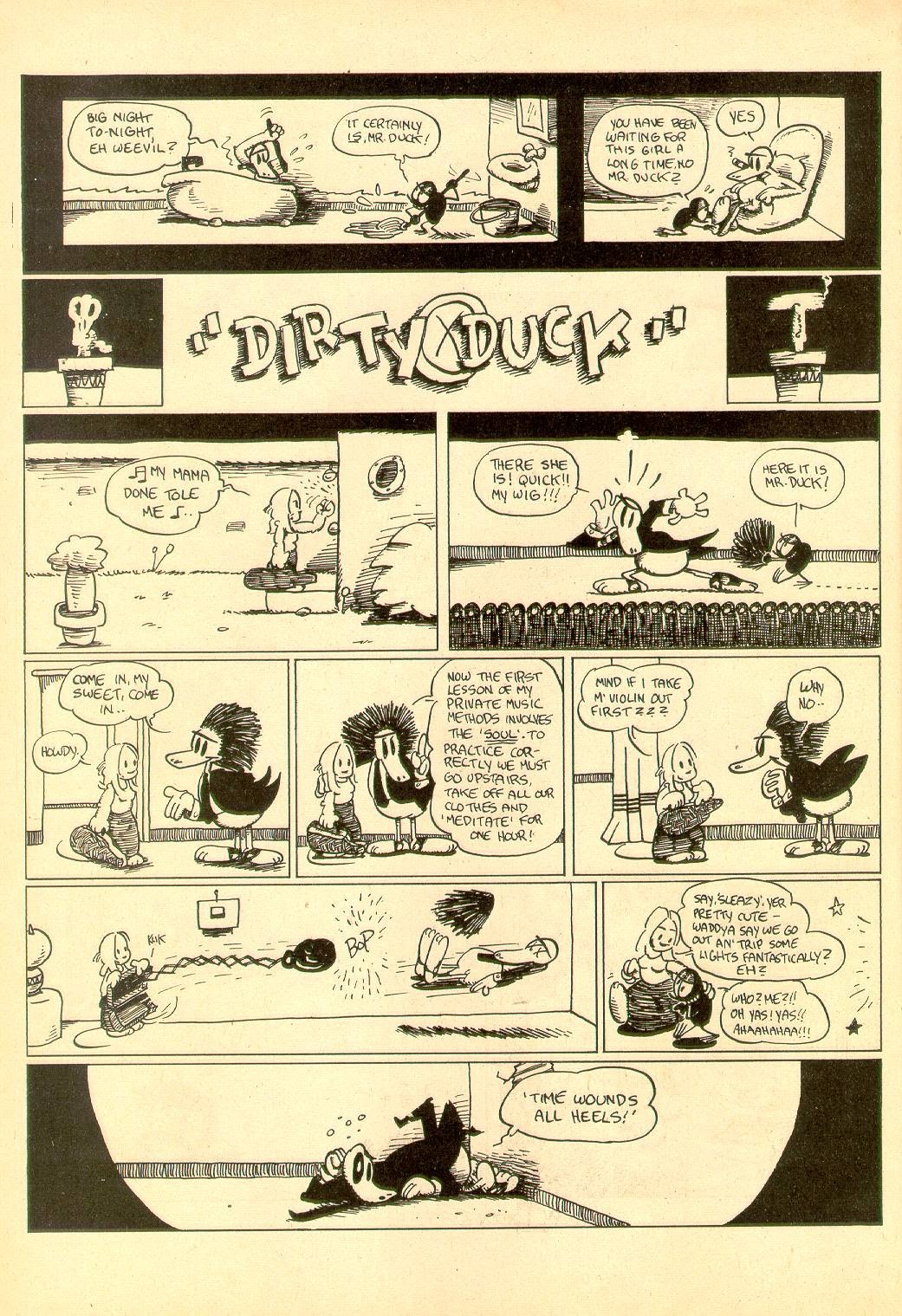
From “Mister Machine” by Jack Kirby, 2001: A Space Odyssey #10, 1977.

Untitled — Rita Kernn-Larsen

Untitled, c. 1930s by Rita Kernn-Larsen (1904–1998)

Benito Pérez Galdós’ Miaow (Book acquired, mid May 2025)

Benito Pérez Galdós’ 1888 novel Miaow is forthcoming in English translation this summer by Margaret Jull Costa, via NYRB. Their blurb:

Ramón Villaamil has been a loyal civil servant his whole life, but a change in government leaves him out of a job and still two months short of qualifying for his pension. Initially optimistic that he’ll be able to find work and pull his family out of their financial straits, he spends his days visiting the administration, pestering his ex-colleagues to put in a good word for him, and begging his friends in high places for money. At home, Villaamil’s wife, daughter, and sister-in-law—whose feline appearances earn them the nickname “the Miaows”—are unimpressed by Villaamil’s failures, and the only joy left in Villaamil’s life is his young grandson Luis. When Luis’s disgraced father, the handsome and dastardly Víctor Cadalso, reappears in their lives with promises of easing their financial burdens, Villaamil has no choice but to allow him back into their midst, even as he knows there is nothing pure about Víctor’s intentions and his return might spell their ruin.

Benito Pérez Galdós’s satire of middle-class life bears comparison with the novels of Charles Dickens and Honoré de Balzac, serving up a scathing critique of the hypocrisy and corruption of nineteenth-century Spanish society and the dehumanizing rituals of work. Margaret Jull Costa’s new translation brings out the tragedy, the comedy, and the vitality of Pérez Galdós’s prose.

“Dogleg” — Kay Ryan

“Dogleg”

by

Kay Ryan


Birds' legs
do of course
all dogleg
giving them
that bounce.
But these are
not normal odds
around the house.
Only two of 
the dog's legs
dogleg and 
two of the cat's.
Fifty-fifty: that's
as bad as it 
gets usually,
despite the 
fear you feel
when life has
angled brutally.

The Death of the Poacher — Xiao Guo Hui

The Death of the Poacher, 2023 by Xiao Guo Hui (b. 1969)

And another Moby-Dick

Herman Melville’s 1851 novel Moby-Dick is probably my favorite book.

***

Years ago at an awful dinner party a man I didn’t know asked me What do you do?, by which he meant how I made money to live, or, maybe charitably, if I had a specific profession. When I told him it had something to do with literature and college students he followed up with a question no stranger should aim at another stranger-

-So what’s your favorite book then?

-Moby-Dick is my favorite book, I offered, this being my somewhat standard answer then.

-Oh no, I mean, what’s your real favorite booknot just the one you say to impress people?

Okay Gravity’s Rainbow is my favorite book.

-I haven’t read that one yet but I like Tom Clancy too. 

***

A dear friend at our house this weekend, under truly awful circumstances, circumstances that have no bearing on this riff, claimed to have counted “eighteen copies” of Moby-Dick around the house. As far as I could tell, there are only about thirteen, including a children’s pop up version and three comic book adaptations (I don’t know how he would’ve found the comic adaptations, as they are slim and I think in drawer or box). He asked for one; I offered him the UC Press edition illustrated by Barry Moser, the one I’d used the last time I reread Moby-Dick. He opted instead for the most recent Norton Critical Edition, which a rep sent me a few years ago.

***

The last time I reread Moby-Dick I used the UC Press edition illustrated by Barry Moser. This was in 2021. I ended up writing forty riffs on the novel, likely trying the patience of any regular readers of this blog.

***

If you’re not up for forty riffs, I wrote a very short riff on this very long book back in 2013.

***

The two preceding notes are my way of saying: Moby-Dick is probably my favorite novel; it’s fantastic and I’ve written about it in both short and long form, and I think anyone can read it and should–it’s funny, sad, thrilling, captivating, meditative, beguiling, baffling–a thing larger than its own frame, certainly larger than its author and his era. And so now–

***

I have another Moby-Dick. This one is designed and illustrated by Dmitry Samarov. It’s about 650 pages, and is a pleasing, squarish shape that rests easy in the hands (a contrast to the coffin-shaped Norton Critical Editions). The pages are not too bright (I hate bright white pages) nor too crisp; the spine is not so rigid that one seeks to break it before setting about the business of checking into the Spouter Inn. It is a very readable copy — relaxed, not too heavy and not too cramped, no precious footnotes. And there are Samarov’s sketches.

***

***

Rifling (or is it riffling? I can never remember) through this edition today, reading a few passages aloud even, just to feel myself go a little crazy and then get a small relief from that craze, the dominant sense I got from Samarov’s accompanying sketches is something like this: Someone riffing along to Ishmael’s ghost-voice, not competing with it nor trying to turn the mechanics of its verbs and nouns and adjectives into a mimetic representation of action or thought. I think the drawings, as a body, rather approximate something like an aesthetic ear tuned to Ishmael’s wail: scratchy ink lines tangle into and out of shapes in a discourse with the narrative. Others tuned to the voice might on any given page jot down a note or circle a phrase or even, dare, dream of a crowded footnote; Samarov offers a sketch. His love for the novel comes through.

***

If you haven’t read Moby-Dick, you should. Samarov’s edition is a worthy entry into the fold. Check it out.


Summer reading list for 2025

Whether you’re longing by the pool of despair, rending your garments on satanic shores or enjoying the longer daylight hours in your favorite reading spite, eh, spot, these 15 titles—new and old—threaten to deliver the perfect summer escape.

Photo by Bethany Laird on Unsplash; fuck AI forever

“Tidewater Tales by Night” by Roberto Barth – The beloved Chilean-American returns with a multigenerational saga set in coastal Maryland where magical realism meets environmental activism. Barth’s first climate fiction novel explores how one family confronts rising sea levels while uncovering long-buried secrets–and bodies.

“The Last Orgasm of BetaBlocker 9” by Philip K. Roth – Following his success with “The Martian’s Mistress” and “Project Heil Marty,” PKR delivers another paranoid science-noir-thriller-cum-horny-shenanigans. This time, the story follows programmer Dick Gentle, who discovers that an AI system has developed consciousness—and has been secretly influencing global events for years. Or is Gentle simply another shadow on the wall of cyber-Plato’s cave?

“Hurricane Season 2” by Fernanda Melchor – Melchor, who captivated readers with “Hurricane Season,” powerfully explores family bonds tested by natural disasters. When a Cat 5 hurricane forces incestuous siblings to shelter together in their childhood home, long-suppressed tensions emerge alongside unexpected reconciliations. There is also a witch.

“The Coroner’s Apparatus” by Curly Dick Jenkins– Jenkins spins a haunting, genre-blending tale that follows a disbanded 1970s rock group reuniting for one final Southwest tour—only to be lured into a nightmarish canyon town where ancient cannibalistic rituals and unspeakable violence await beneath the stage lights.

“Nightshade Market” by Mingy Bull Lee – The author of “Pacman Out/Er/Zone” delivers a feverish, cut-up chronicle of a washed-up rock junkie’s descent into a hallucinatory desert underworld, where cryptic transmissions, reanimated flesh, and a chrome-plated dildo left behind by a vanished medic blur the line between performance and ritual dismemberment. It’s the feel-good hit of the summer!

“Fur and Longing and Lost Wages” by Rum Anne Direy – In this scorched-earth fever dream, a narcotized travel writer stumbles into a solstice rave at a crumbling Nevada timeshare, where a kangaroo in mirrored shades deals mescaline, the pool is full of lizards, and no one’s allowed to leave until the missing dildo turns up or the moon explodes.

“Moby-Dick” by Herman Melville – Mostly whale facts.

“My Gyrations” by Knut Hamsun – In this baffling late-period novel, the Nobel laureate behind Hunger blends climate grief with domestic farce, as a brooding wildlife photographer obsessed with a possibly extinct bird returns home to his bustling Nordic household—where his jazz-loving wife, precocious children, and an endless stream of sentient gyres threaten to derail his quest for ecological and emotional clarity.

“The Rainmaker” by Percival Everett – Everett’s satirical genius turns to a novelization of the 1997 American legal drama film “The Rainmaker” written and directed by Francis Ford Coppola, based on John Grisham’s 1995 novel of the same name, and starring Matt Damon, Claire Danes, Jon Voight, Mary Kay Place, Mickey Rourke, Danny DeVito, Danny Glover, Roy Scheider, Virginia Madsen, and Teresa Wright (in her final film role).

“Salt and Honey” by Delia Owens – A humble badger monk discovers he is the reincarnation of a forgotten war-god, destined to wield the ancient Spoon of Light against the armies of Moldor the Vile.

“Tres Leches” by Françoise Sagan – This slim 1954 novel, written when Sagan was just 18, captures the drama of preheating the oven to 350°F, oiling and flouring a 13×9-inch metal pan and setting it aside, whisking together cake flour, baking powder, and salt in a medium bowl and setting it aside, placing the butter into the bowl of a stand mixer, beating on medium speed with the paddle attachment until fluffy, about one minute, reducing the speed to low and gradually adding the sugar, mixing for another minute, scraping down the sides of the bowl as needed, adding eggs one at a time, mixing well after each addition, stirring in vanilla extract, gradually adding the flour mixture in three batches, mixing until just combined, transferring the batter to the prepared pan and spreading it evenly, baking for 20-25 minutes, or until lightly golden and the cake reaches an internal temperature of 200°F, cooling the cake for 30 minutes on a cooling rack, once cooled, poking the top with a skewer or fork and allowing it to cool completely before preparing the glaze, whisking together evaporated milk, sweetened condensed milk, and half-and-half in a measuring cup, then pouring the glaze over the cake, refrigerating overnight, whipping heavy cream, sugar, and vanilla in a stand mixer on low until stiff peaks form, increasing the speed to medium and whipping until thick, spreading the topping over the cake and refrigerating until ready to serve.

“Gravity’s Rainbow” by Thomas Pynchon – Mostly dicks and rockets.

“Dannellon’s Whine” by Roy Bradboy – Dannellon is new in town and wants to party–but will anyone want to party with her? Bradboy’s spiritual sequel to “Portnoy’s Complaint” addresses female sexual frustration in the nascent twenty-first century in a way that nobody, I mean fucking nobody, not even you, you sicko, would want to read.

“Call Me By Your Name, Ishmael” by André AcimanAciman’s slim and thoroughly unnecessary and decidedly undelightful retelling of “Moby-Dick” focuses on drawing out Chapter 94, “A Squeeze of the Hand” for like 140 pages. 

“Atonement” by Ian McEwan – The metafictional twist at the end is a cheap parlor trick. But hey, it’s a real novel.