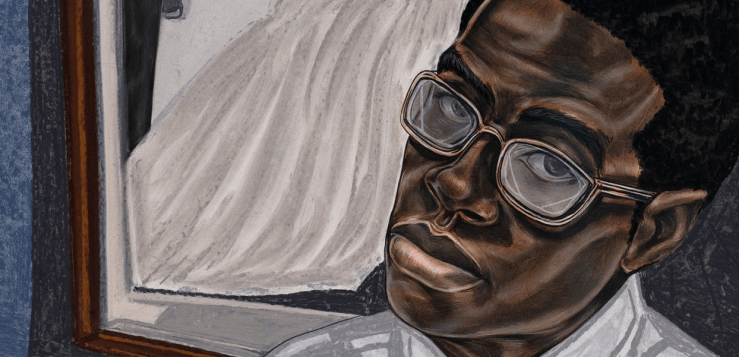
Wheeled Through to Kind Measure, 2018 by Lynette Yiadom-Boakye (b. 1977)

Wheeled Through to Kind Measure, 2018 by Lynette Yiadom-Boakye (b. 1977)
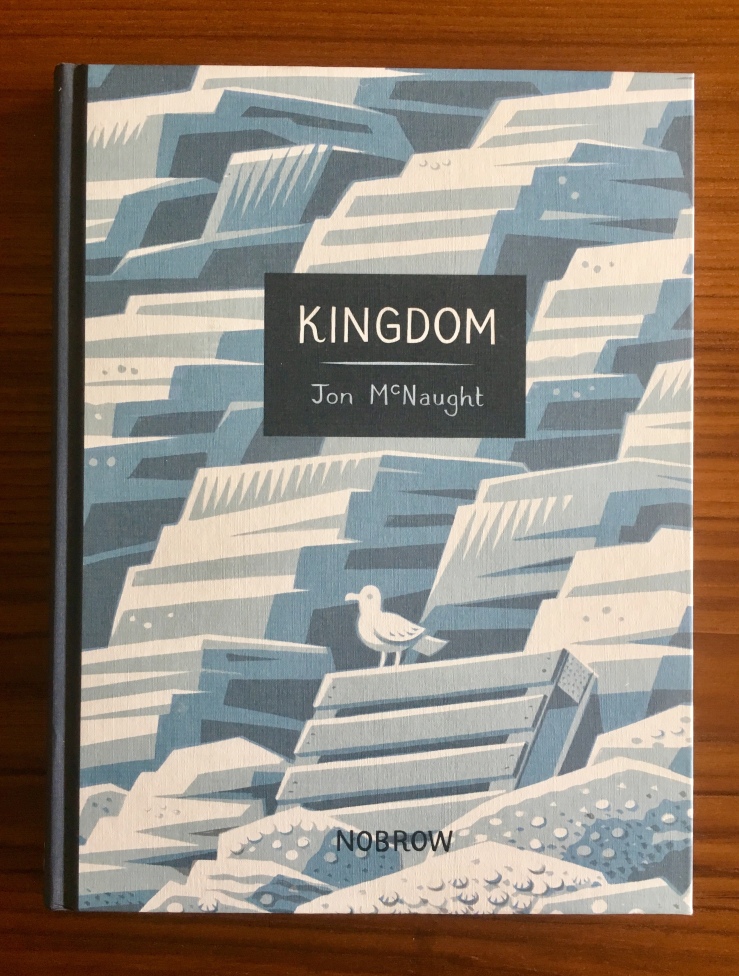
I got a physical copy of Jon McNaught’s latest graphic novel Kingdom last week. Here is publisher Nobrow’s blurb for the book, which will serve as a rough plot summary:
A family sets off for a long weekend at a caravan park on the British coast. We follow them through the familiar landscapes of a summer holiday: motorway service stations, windswept cliffs, dilapidated museums and tourist giftshops. In this atmospheric and contemplative work, Jon McNaught explores the rhythms of nature, the passing of time, and the beauty and boredom of a summer holiday.
A few weeks ago, I’d been sent a digital reader’s copy of Kingdom to review for The Comics Journal, so I’d already read it, but getting a physical copy was like reading it anew. Nobrow’s books are, in general, lovely. They look lovely, are large and colorful and printed on rich thick paper. They smell great too.
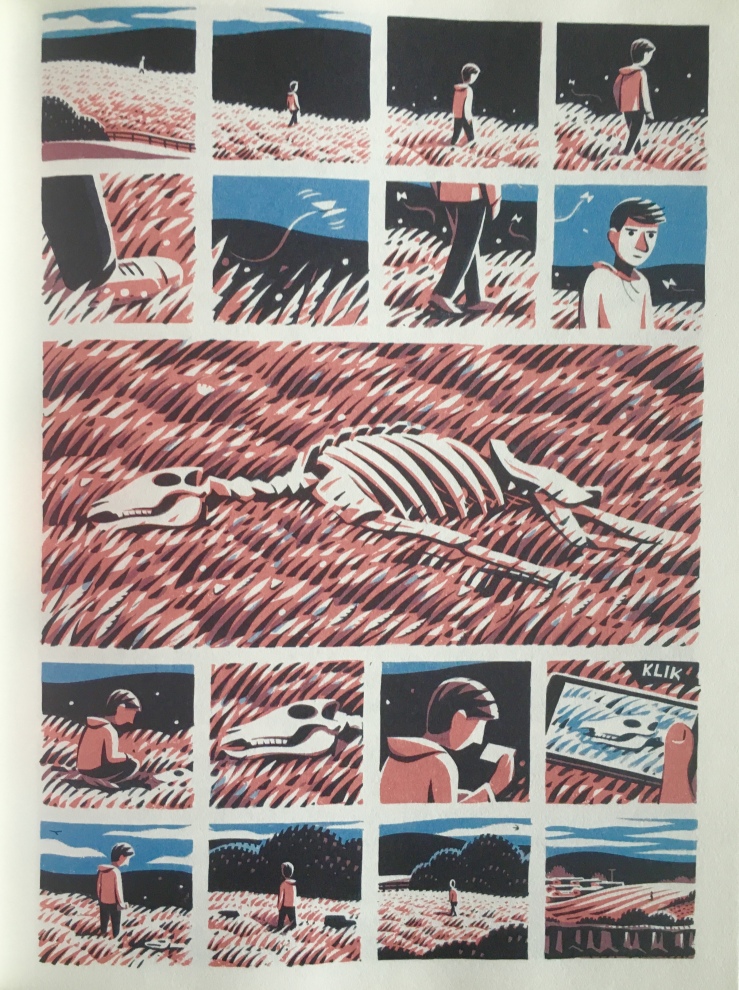
Reading Kingdom in print was a much more pleasurable aesthetic experience than reading it on an iPad. The story was the same, of course, but my eyes went across it differently, working with my fingers, lingering, moving backwards and forwards, shuffling pages. The feeling of the story came across stronger, somehow, than it did on a screen–McNaught’s themes of boredom, nature, and our ways of seeing nature resonated more when I could rub my hands on the pages themselves. I do not have a simple explanation for this. There’s an intangibility I’m pointing toward, but one that has to do with tangibility of course: reading as a tactile process.
I’m not a Luddite. I like ebooks, and I generally like to have an ebook of any novel that I’m reading so that I can read it late at night. (Digital copies also make quoting at length for reviews much easier). But I find that screens dampen or mute or hinder something of the aesthetic experience in reading highly-visual narratives, like comics and poetry.
That last phrase, “comics and poetry”—I think that that’s what McNaught does by the way. His comics are visual poems, moods, feelings, evocations of time and space bounded not in words but in sounds, not in symbols and signs but in the objects themselves. The feeling of feeling of his comics is hard to pin down: tranquil and soothing with tinges of melancholy, gentle touches of pleasant boredom, waves of recognition: recognition of spirit, of impulse, of fellow feeling: etc. We see his characters seeing the world, being in the world, and seeing themselves seeing and being in the world. And we also see them mediating that world—on screens.
 I liked Kingdom the first time I read it on a screen. I loved it the second time I read it on paper. Full review soon at The Comics Journal.

School of Beauty, School of Culture, 2012 by Kerry James Marshall (b. 1955)

Twins, 2011 by Falk Gernergross (b. 1973)
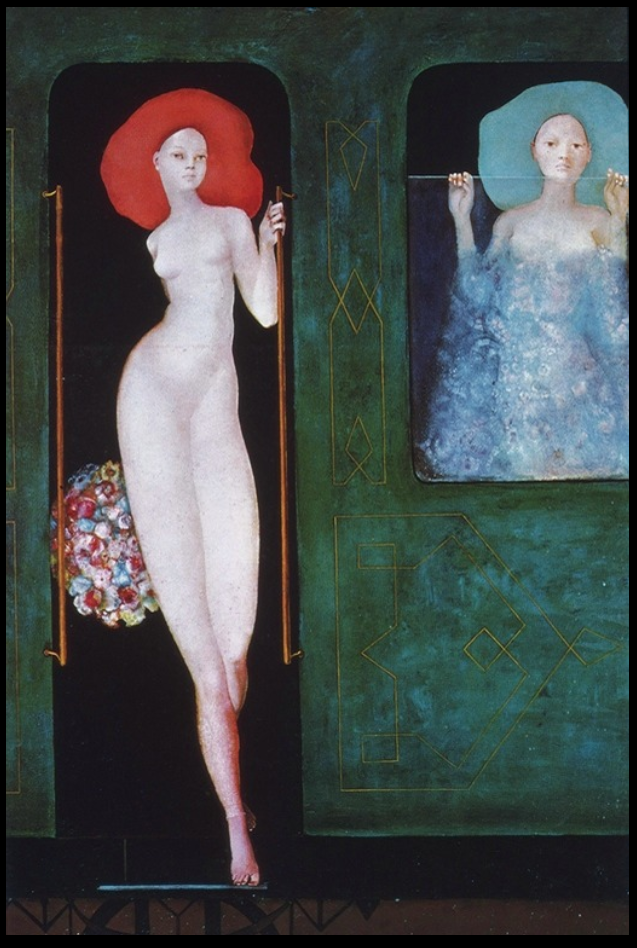
Vesper-Express, 1966 by Leonor Fini (1908-1996)

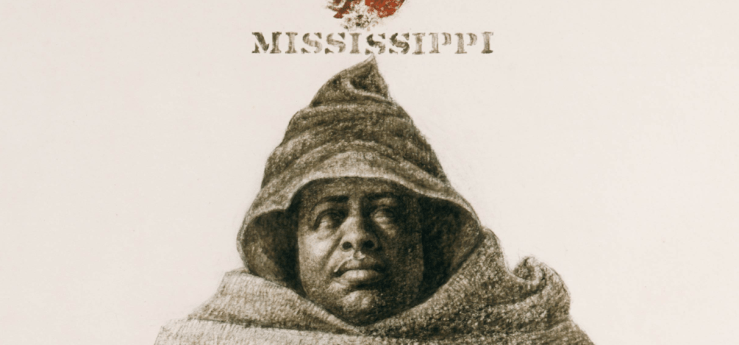
Mississippi, 1972 by Charles White (1918-1979)
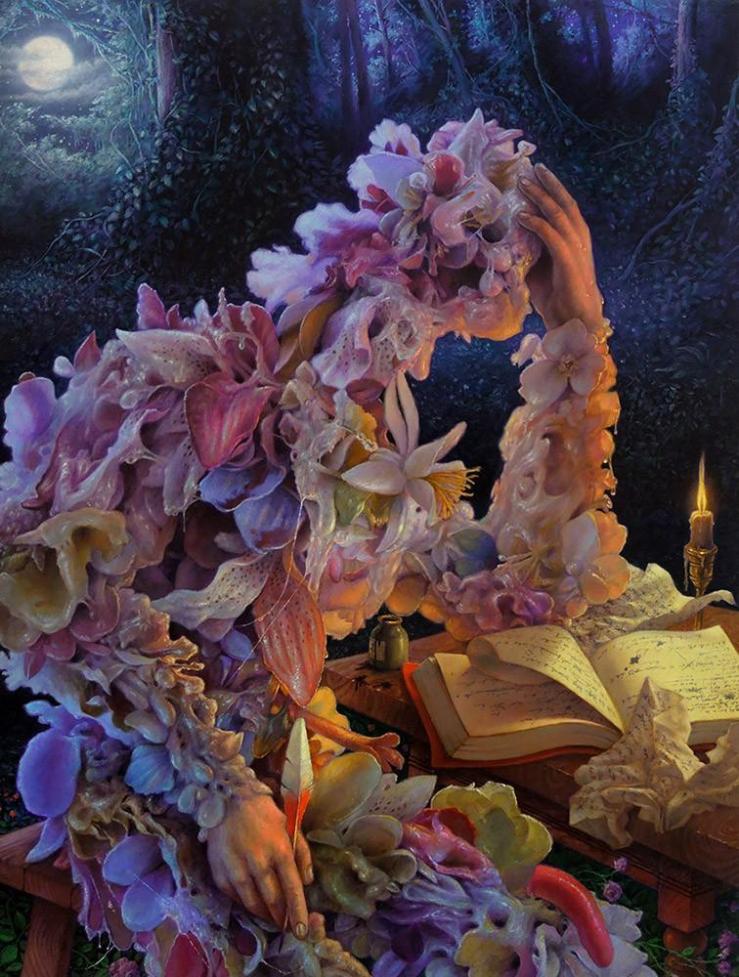
Big Dreamer with Failed Poetry by Adrian Cox (b. 1988)
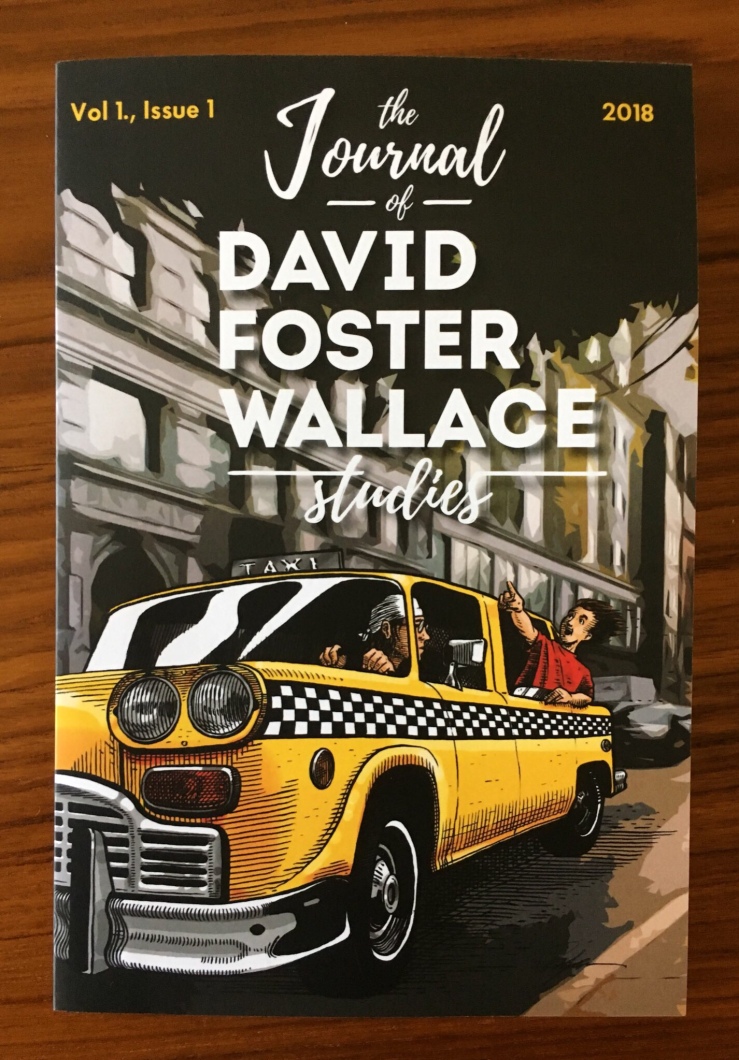
The Journal of David Foster Wallace Studies is a peer-reviewed academic journal devoted to the work of David Foster Wallace. The Journal is published by the DFW Society.
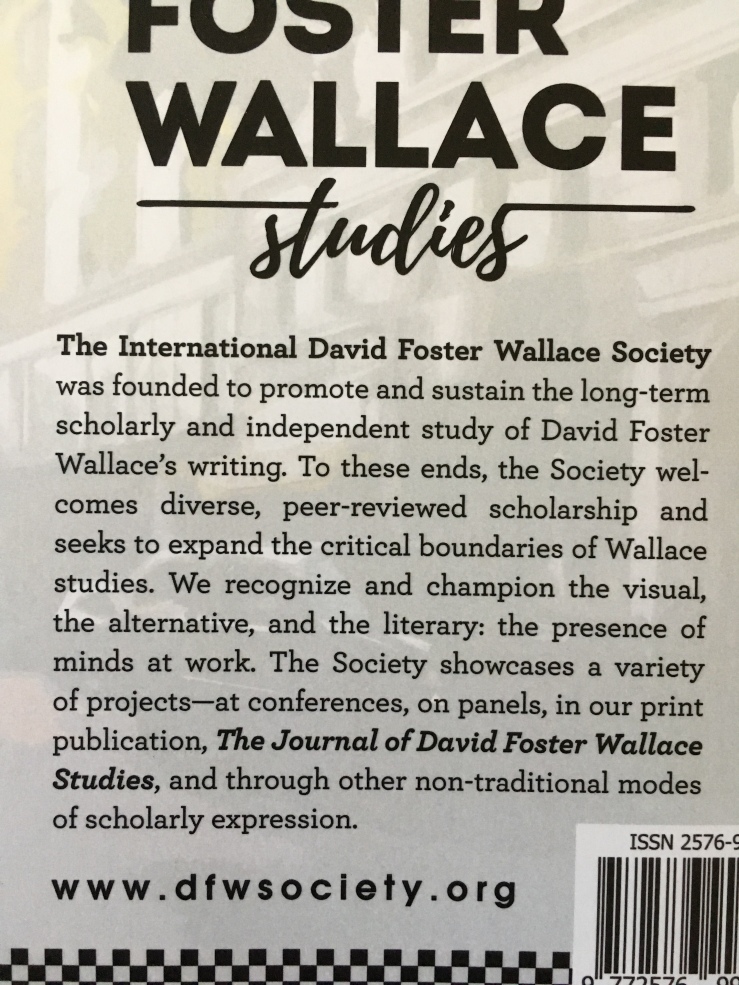
Here is the table of contents for Vol. 1, issue 1;

I enjoyed Nash’s essay on boredom and attention in The Pale King, and found Saylor’s piece on race in Wallace’s fiction—focusing on Wallace’s whiteness within the context of his overall project of literary empathy–especially interesting.
I’m glad to see the journal finally in print after a few years of chatter about its creation. Perhaps there might be a future article or two that takes on the current wave of anti-Wallace think pieces that have been floating around lately.

Aeschylus and Socrates, 1975 by Eduardo Paolozzi (1924–2005)

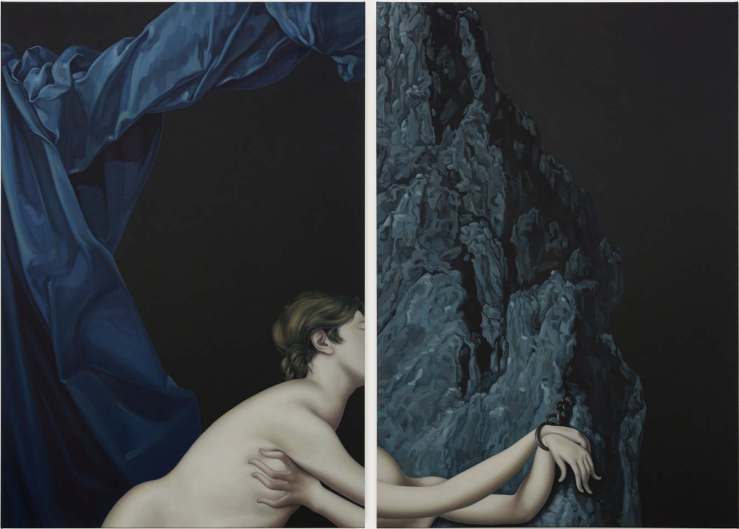
In Mid-world, 2017 by Jesse Mockrin (b. 1981)

Encounter (detail), 1959 by Remedios Varo (1908-1963)
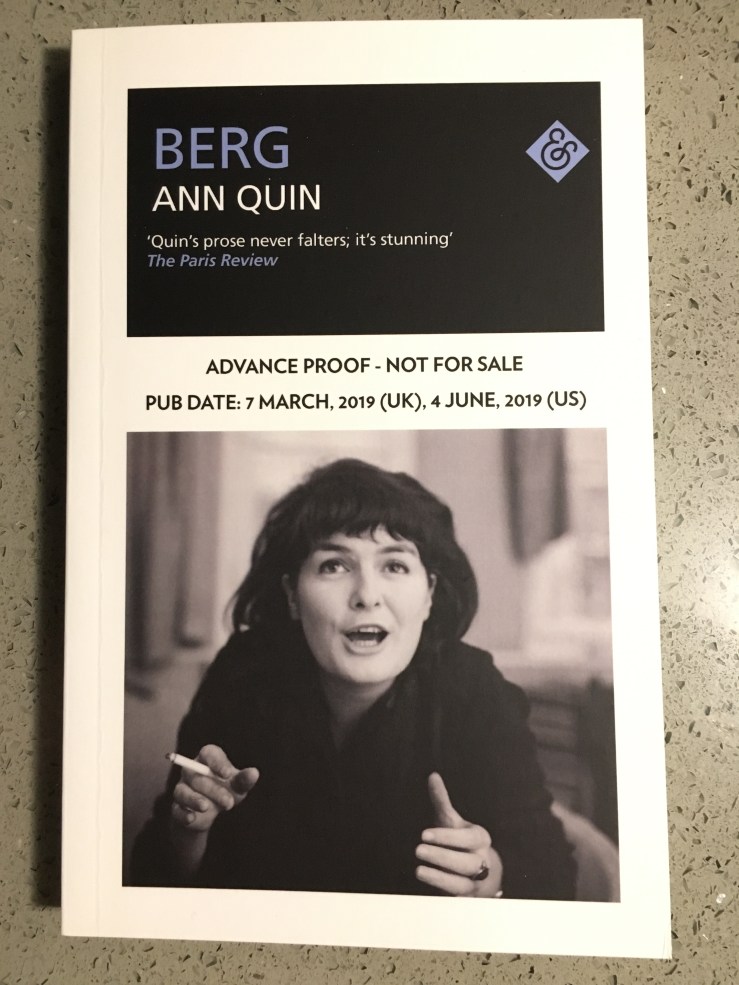
Ann Quin’s 1964 novel, Berg, is in print again from And Other Stories. I’m psyched for this one—Quin is a writer I’ve wanted to read for a while now. Here is And Other Stories’ blurb:
‘A man called Berg, who changed his name to Greb, came to a seaside town intending to kill his father . . .’
So begins Ann Quin’s madcap frolic with sinister undertones, a debut ‘so staggeringly superior to most you’ll never forget it’ (The Guardian). Alistair Berg hears where his father, who has been absent from his life since his infancy, is living. Without revealing his identity, Berg takes a room next to the one where his father and father’s mistress are lodging and he starts to plot his father’s elimination. Seduction and violence follow, though not quite as Berg intends, with Quin lending the proceedings a delightful absurdist humour.
Anarchic, heady, dark, Berg is Quin’s masterpiece, a classic of post-war avant-garde British writing, and now finally back in print after much demand.
Here are the first four paragraphs:
A man called Berg, who changed his name to Greb, came to a seaside town intending to kill his father . .
Window blurred by out of season spray. Above the sea, overlooking the town, a body rolls upon a creaking bed: fish without fins, flat-headed, white-scaled, bound by a corridor room—dimensions rarely touched by the sun—Alistair Berg, hair-restorer, curled webbed toes, strung between heart and clock, nibbles in the half light, and laughter from the dance hall opposite. Shall I go there again, select another one? A dozen would hardly satisfy; consolation in masturbation, pornographic pictures hanging from branches of the brain. WANTED one downy, lighthearted singing bird to lay, and forget the rest. A week spent in an alien town, yet no further progress—the old man not even approached, and after all these years, the promises, plans, the imaginative pursuit as static as a dream of yesterday. The clean blade of a knife slicing up the partition that divides me from them. Oh yes I have seen you with her—she who shares your life now, fondles you, laughs or cries because of you. Meeting on the stairs, at first the hostile looks, third day: acknowledgment. A new lodger, let’s show him the best side. Good morning, nice day. Good afternoon, cold today. His arm linked with hers. As they passed Berg nodded, vaguely smiled, cultivating that mysterious air of one pretending he wishes to remain detached, anonymous. Afterwards their laughter bounced back, broke up the walls, split his door; still later the partition vibrated, while he paced the narrow strip of carpet between wardrobe and bed, occasionally glimpsing the reflection of a thin arch that had chosen to represent his mouth. Rummaging under the mattress Berg pulled out the beer-stained piece of newspaper, peered at the small photograph.
Oh it’s him Aly, no mistaking your poor father. How my heart turned, fancy after all this time, and not a word, and there he is, as though risen from the dead. That Woman next to him Aly, who do you suppose she is?
He had noticed the arm clinging round the fragile shoulders; his father’s mistress, or just a friend? hardly when—well when the photo showed their relationship to be of quite an affectionate nature. Now he knew. It hadn’t taken long to inveigle his way into the same house, take a room right next to theirs. Yes he had been lucky, everything had fallen into place. No hardship surely now in accepting that events in consequence, in their persistent role of chance and order, should slow down?
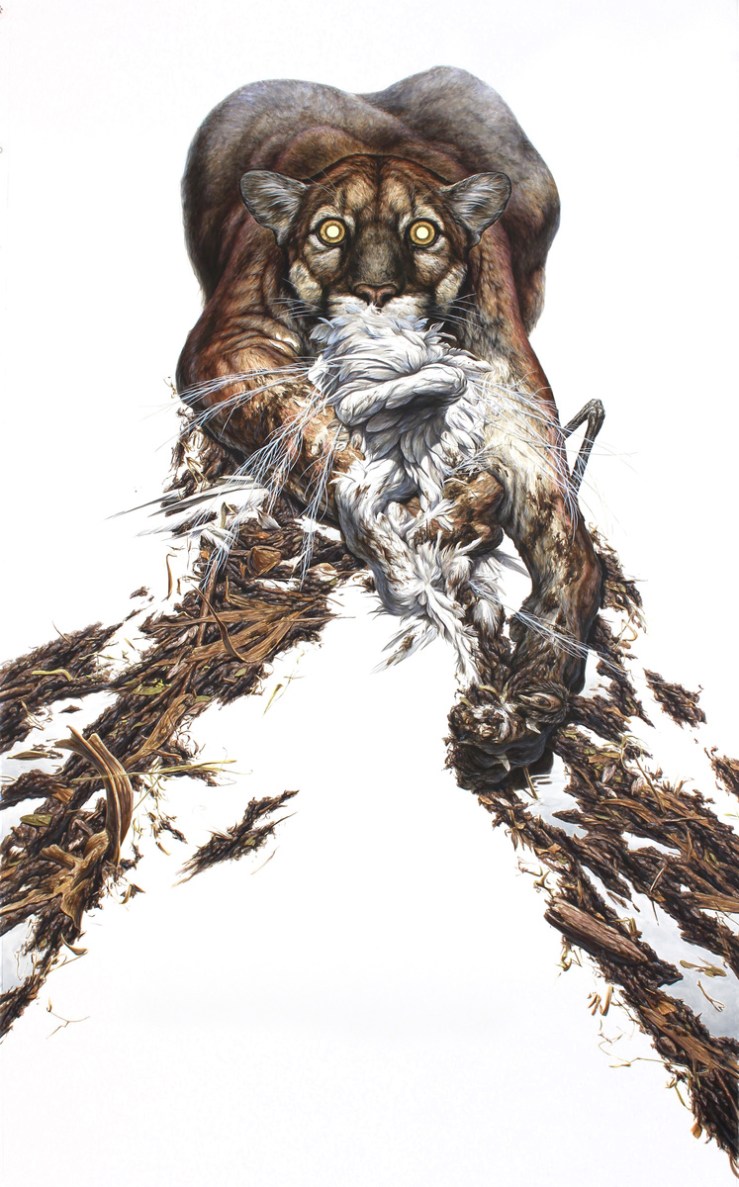
Dredger, 2017 by George Boorujy.
February, 18th.–A walk, yesterday afternoon, with the children; a bright, and rather cold day, breezy from the north and westward. There has been a good deal of soaking rain lately, and it has, in great measure, cleared hills and plains of snow, only it may be seen lying in spots, and on each side of stone-walls, in a pretty broad streak. The grass is brown and withered, and yet, scattered all amongst it, on close inspection, one finds a greenness;–little shrubs that have kept green under all the severity of winter, and seem to need no change to fit them for midsummer. In the woods we see stones covered with moss that retains likewise a most lively green. Where the trees are dense, the snow still lies under them. On the sides of the mountains, some miles off, the black pines and the white snow among them together produce a gray effect. The little streams are most interesting objects at this time; some that have an existence only at this season,–Mississippis of the moment,–yet glide and tumble along as if they were perennial. The familiar ones seem strange by their breadth and volume; their little waterfalls set off by glaciers on a small scale. The sun has by this time force enough to make sheltered nooks in the angles of woods, or on banks, warm and comfortable. The lake is still of adamantine substance, but all round the borders there is a watery margin, altogether strewed or covered with thin and broken ice, so that I could not venture on it with the children. A chickadee was calling in the woods yesterday,–the only small bird I have taken note of yet; but crows have been cawing in the woods for a week past, though not in very great numbers.