Scrubwoman, Astor Library — John French Sloan

scrubwoman2bastor2blibrary

Scrubwoman, Astor Library, 1911 by John French Sloan

Floor Polisher — Pyotr Konchalovsky

floor-polisher-1946

Floor Polisher, 1946 by Pyotr Konchalovsky (1876–1956)

Eternal Mopping — Edith Vonnegut

DG-029-EdithVonnegut-EternalMopping_je

Eternal Mopping by Edith Vonnegut (b. 1949)

A Man with a Broom — Vincent van Gogh

a-man-with-a-broom-18811

A Man with a Broom, 1881 by Vincent van Gogh (1843-1890)

New Broom — Tim Mara

New Broom 1987 by Tim Mara 1948-1997

New Broom, 1987 by Tim Mara (1948–1997)

Girl Cleaning — François Barraud

6e2394512497b94a3d06d68e221c2a94

Girl Cleaning, 1933 by François Barraud (1899–1934)

“Slang in America,” an essay by Walt Whitman

“Slang in America”

by

Walt Whitman


View’d freely, the English language is the accretion and growth of every dialect, race, and range of time, and is both the free and compacted composition of all. From this point of view, it stands for Language in the largest sense, and is really the greatest of studies. It involves so much; is indeed a sort of universal absorber, combiner, and conqueror. The scope of its etymologies is the scope not only of man and civilization, but the history of Nature in all departments, and of the organic Universe, brought up to date; for all are comprehended in words, and their backgrounds. This is when words become vitaliz’d, and stand for things, as they unerringly and soon come to do, in the mind that enters on their study with fitting spirit, grasp, and appreciation.

Slang, profoundly consider’d, is the lawless germinal element, below all words and sentences, and behind all poetry, and proves a certain perennial rankness and protestantism in speech. As the United States inherit by far their most precious possession—the language they talk and write—from the Old World, under and out of its feudal institutes, I will allow myself to borrow a simile even of those forms farthest removed from American Democracy. Considering Language then as some mighty potentate, into the majestic audience-hall of the monarch ever enters a personage like one of Shakspere’s clowns, and takes position there, and plays a part even in the stateliest ceremonies. Such is Slang, or indirection, an attempt of common humanity to escape from bald literalism, and express itself illimitably, which in highest walks produces poets and poems, and doubtless in pre-historic times gave the start to, and perfected, the whole immense tangle of the old mythologies. For, curious as it may appear, it is strictly the same impulse-source, the same thing. Slang, too, is the wholesome fermentation or eructation of those processes eternally active in language, by which froth and specks are thrown up, mostly to pass away; though occasionally to settle and permanently crystallize.

To make it plainer, it is certain that many of the oldest and solidest words we use, were originally generated from the daring and license of slang. In the processes of word-formation, myriads die, but here and there the attempt attracts superior meanings, becomes valuable and indispensable, and lives forever. Thus the term right means literally only straight. Wrong primarily meant twisted, distorted. Integrity meant oneness. Spirit meant breath, or flame. A supercilious person was one who rais’d his eyebrows. To insult was to leap against. If you influenced a man, you but flow’d into him. The Hebrew word which is translated prophesy meant to bubble up and pour forth as a fountain. The enthusiast bubbles up with the Spirit of God within him, and it pours forth from him like a fountain. The word prophecy is misunderstood. Many suppose that it is limited to mere prediction; that is but the lesser portion of prophecy. The greater work is to reveal God. Every true religious enthusiast is a prophet. Continue reading ““Slang in America,” an essay by Walt Whitman”

Heat Death — Jeremy Geddes

heat-death2000

Screenshot 2017-11-06 at 8.19.01 PMScreenshot 2017-11-06 at 8.19.24 PM

Heat Death, 2008 by Jeremy Geddes (b. 1974)

Asparagus — Adriaen Coorte

800px-adriaen_coorte_-_still_life_with_asparagus

Asparagus, 1697 by Adriaen Coorte (ca. 1665–1707)

Madness — Odilon Redon

madness-1883

Madness, 1883 by Odilon Redon (1840-1916)

Interior with Young Woman from Behind — Vilhelm Hammershøi

interior-with-young-woman-from-behind-1904

Interior with Young Woman from Behind, 1904 by Vilhelm Hammershøi (1864-1916)

“Horses,” a short story by Stephen Crane

“Horses”

by

Stephen Crane


Richardson pulled up his horse, and looked back over the trail where the crimson serape of his servant flamed amid the dusk of the mesquit. The hills in the west were carved into peaks, and were painted the most profound blue. Above them the sky was of that marvellous tone of green—like still, sun-shot water—which people denounce in pictures.

José was muffled deep in his blanket, and his great toppling sombrero was drawn low over his brow. He shadowed his master along the dimming trail in the fashion of an assassin. A cold wind of the impending night swept over the wilderness of mesquit.

“Man,” said Richardson in lame Mexican as the servant drew near, “I want eat! I want sleep! Understand—no? Quickly! Understand?”

“Si, señor,” said José, nodding. He stretched one arm out of his blanket and pointed a yellow finger into the gloom. “Over there, small village. Si, señor.”

They rode forward again. Once the American’s horse shied and breathed quiveringly at something which he saw or imagined in the darkness, and the rider drew a steady, patient rein, and leaned over to speak tenderly as if he were addressing a frightened woman. The sky had faded to white over the mountains, and the plain was a vast, pointless ocean of black.

Suddenly some low houses appeared squatting amid the bushes. The horsemen rode into a hollow until the houses rose against the sombre sundown sky, and then up a small hillock, causing these habitations to sink like boats in the sea of shadow.

A beam of red firelight fell across the trail. Richardson sat sleepily on his horse while his servant quarrelled with somebody—a mere voice in the gloom—over the price of bed and board. The houses about him were for the most part like tombs in their whiteness and silence, but there were scudding black figures that seemed interested in his arrival. Continue reading ““Horses,” a short story by Stephen Crane”

The Knucklebone Player — Frederic Leighton

aalq001773_600x

The Knucklebone Player, 1867 by Frederic Leighton (1830-1896)

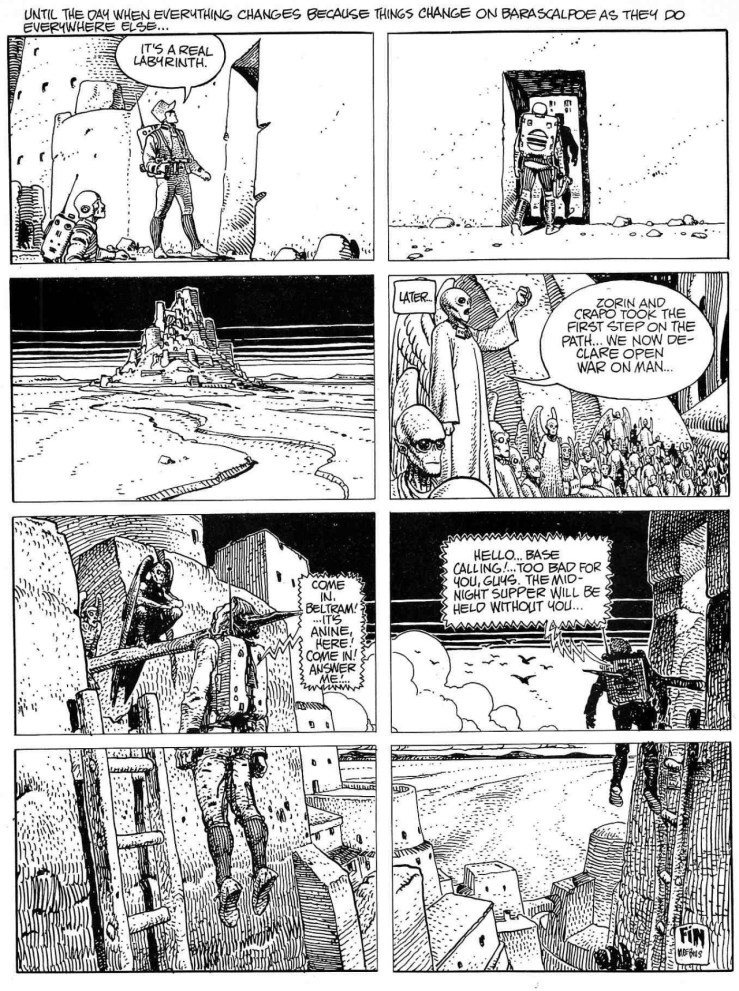
A page from Paul Kirchner’s Dope Rider

img_8368

From “Dope Rider in ‘Meanwhile Back at the Ranch'” by Paul Kirchner. Originally published in High Times #5, Aug.-Sept. 1975. Republished in Awaiting the Collapse, Tanibis Editions.


St. Michael and the Dragon — Roderick Mead

1974-122-6_1a

St. Michael and the Dragon, 1939 by Roderick Mead (1900-1971)

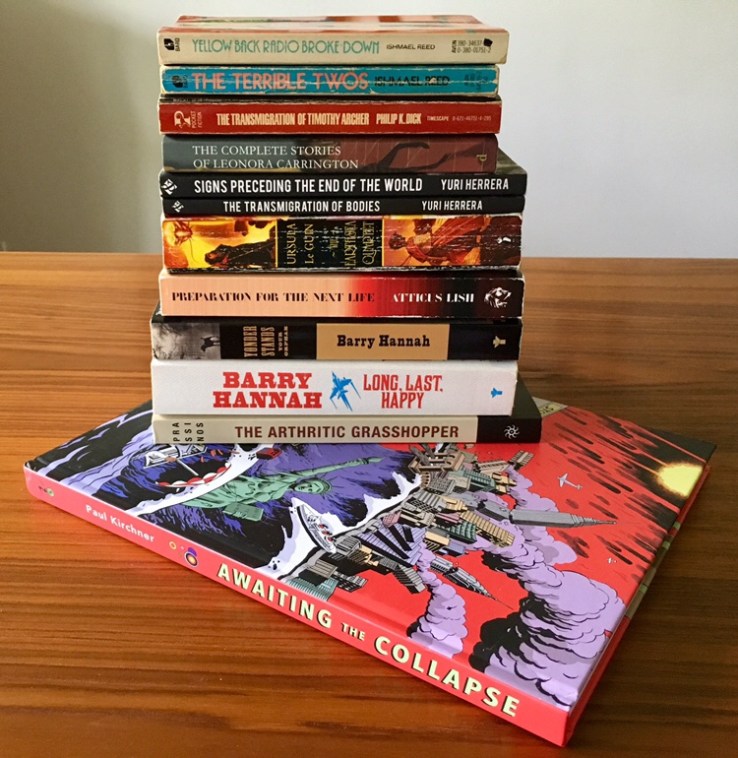
Paul Kirchner’s Awaiting the Collapse (Book acquired, 2 Nov. 2017)

Awaiting the Collapse collects some of the finest and most surreal comix from Paul Kirchner, from the 1970s up through this decade. The book is big and bold and gorgeous. Here’s the back cover:

Awaiting the Collapse is new in hardback from Tanibis Editions, the same good people who brought us hardback editions of The Bus (which I reviewed here), and The Bus 2 (which I reviewed here). A large portion of Collapse features Kirchner’s surreal western Dope Rider strips, which have been hard to find on the internet. It also collects the covers that Kirchner did for Screw magazine, as well as dozens of other one-offs and vignettes, comix in different modes, moods, and manners.

The collection ends with a nice long essay (including numerous photographs, strips, and illustrations) by Kirchner called “Sex, Drugs & Public Transportation: My Strange Trip Through Comics.” I haven’t gotten to it yet because I’m trying to restrain myself from gobbling the collection up all at once.

Here’s Tanibis’s blurb:

This third collaboration between French publishing house Tanibis and comic book artist Paul Kirchner is a collection of the artist’s works, most of them initially published in counter-culture magazines in the 1970s and the 1980s and some dating from his return to comics in the 2010s.

Roughly a third of the stories star Dope Rider, the pot-smoking skeleton whose psychedelic adventures take him through colorful vistas equally reminiscent of Sergio Leone’s spaghetti western films and of the surrealistic paintings of René Magritte and Salvador Dalí. These stories were originally drawn for the marijuana-themed magazine High Times but were also for Kirchner an excuse to create his very own brand of visual poetry.

An other third of the book is a miscellaneous collection of comics whose stories range from the loony (the sextraterrestrial invasion of Earth in “They Came from Uranus”) to the satirical (“Critical mass of cool”) and the outright subversive (if you ever wondered what games toys play at night, read “Dolls at Midnight”).

This book also features a broad selection of the covers Kirchner made for the pornographic tabloid Screw in the 1970s.

Awaiting the Collapse finally contains a previously unpublished essay by Paul Kirchner about his career and his influences, which helps put in perspective the works published in this book.

I promise I’ll have a review of Awaiting the Collapse up soon; for now, let me just underline my enthusiasm—it’s weird and wonderful and gorgeous stuff.

November First — Andrew Wyeth


andrew-wyeth-november-first

November First, 1950 by Andrew Wyeth (1917-2009)