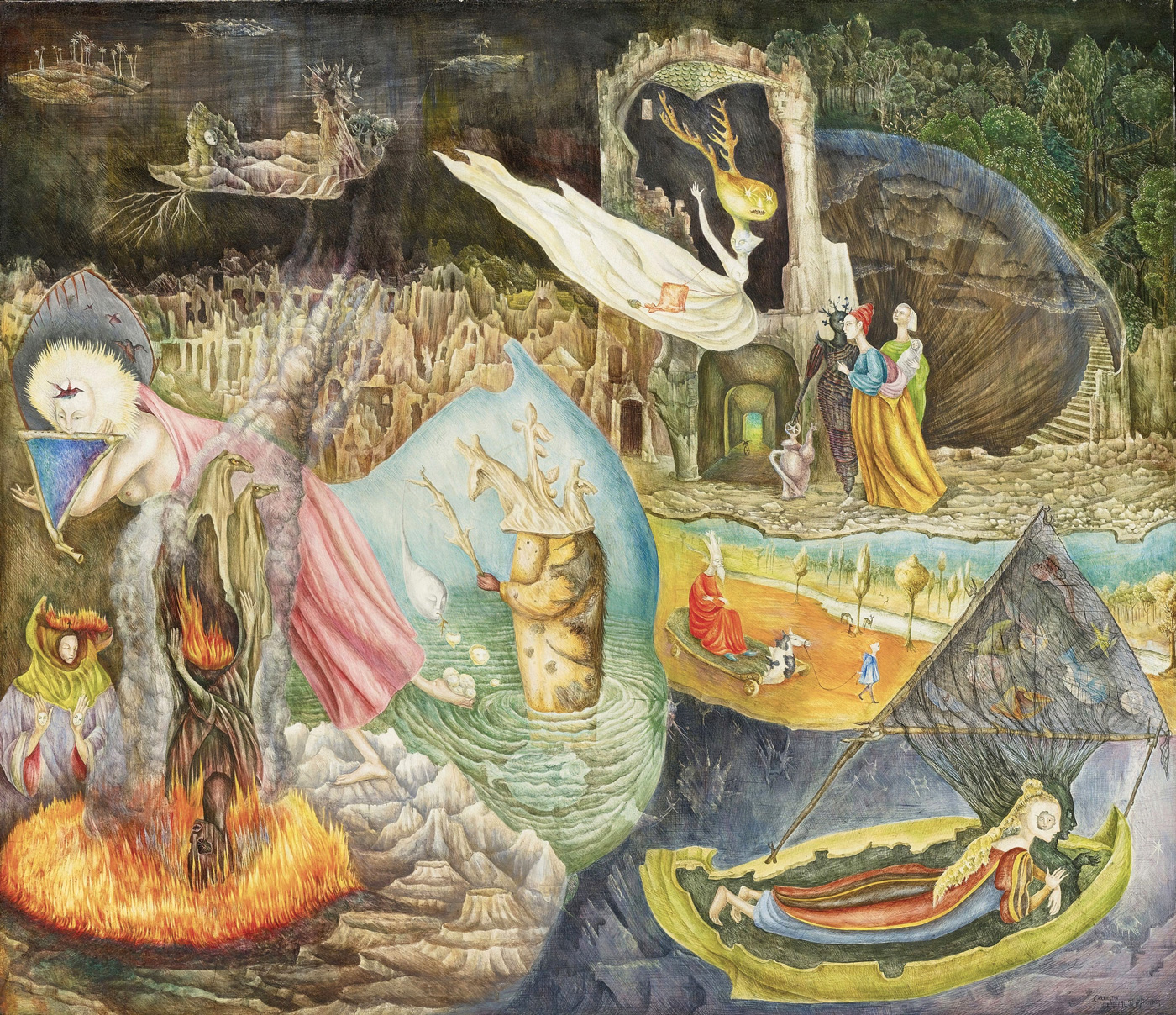
Illustration for “The Snake King” — Luděk Maňásek

Luděk Maňásek’s illustration for “The Snake King.” From Jaroslav Tichý’s Persian Fairy Tales, Hamlyn, 1970. (English translations in the collection are by Jane Carruth).

Portrait of Neal Cassady — Carolyn Cassady

Portrait of Neal Cassady, 1952 by Carolyn Cassady (1923-2013)

In the Cradle of Frederick the Great — Adolf Wölfli


In the Cradle of Frederick the Great, 1917 by Adolf Wölfli (1864-1930)

Mass-market Monday | Philip K. Dick’s Solar Lottery

Solar Lottery, Philip K. Dick. Ace Books, first edition, second printing (1959). Cover art by Ed Valigursky. 188 pages.

Here is a summary from this edition’s first page:

WINNER TAKE THE WORLD!

By the summer of 2203, Ted Benteley managed to break away from his old Industrial Hill oath and was free at last to offer himself in new bondage to Quizmaster Verrick. Of course, like everyone else on Earth, Ted held a ticket on the great lottery that could suddenly make him the next quizmaster with the whole world as his possession, but he could hardly figure on that one chance in six billion!

What Bentley didn’t realize when he went to swear himself forever to Verrick was that the lottery was about to take a wilder turn than ever before, one that would make Benteley himself the deciding factor in a power game of truly cosmic proportions!

Philip K. Dick’s first-published novel, Solar Lottery (1955) is hardly his finest work (even as it points to his later themes). Neither is Ed Valigursky’s pulp fiction cover especially creative, at least when compared with the dozens of covers that came after. But I figured today’s solar eclipse made Solar Lottery a nice pick for an inaugural series where I kinda sorta go through all the mass-market paperbacks I can’t seem to get rid of and post something about them. Many if not most of the mass-market paperbacks I own were, at least on their first go around, marketed in genre ghettos, assuring that they actually got cool art and interesting designs—even if Valigursky’s hammy space dude cover can’t match, say, the Cronenberg vibes of Edward Soyka’s cover for Collier’s 1992 reprint, it’s still more interesting and human than the handsome, sterile series of PKD reprints Mariner Books did in the 2010s which seemed to scream, No, this isn’t really sci-fi, this is literature!

Posted in Art

The William Gaddis Centenary roundtable on “Para-Academic Venues for Discussing Gaddis” I took part in last summer is up now at Electronic Book Review (as well as other Gaddis stuff too)

Last August, I took part in one of Electronic Book Review’s “Gaddis Centenary” roundtables. Our discussion was on “Para-Academic Venues for Discussing Gaddis,” and that conversation is live on EBR now.

I really enjoyed talking with the other invitees, although I felt a bit out of my league. The roundtable included Victoria Harding, who managed the Gaddis listserv, as well as WilliamGaddis.org; novelist and critic Jeff Bursey;  book vlogger Chris Via of Leaf by Leaf; Chad Post, host of the Two Month Review podcast and founder of Open Letter Books; and moderator Ali Chetwynd.

I think we talked for a little over an hour, and while William Gaddis, his novels, and how we share ideas about him online (and elsewhere) was the focus, the conversation went to many other places: William Vollmann, Antoine Volodine, a fuck you to Jonathan Franzen, and the revelation of Evan Dara’s true identity (okay not really that last one).

There was also an underlying sense with most of the roundtable that the internet of yore as a means of deep conversation is slipping away; Chad summed it up neatly at one point, stating that “One of the disadvantages I see with everything right now, with the blog, podcasts, and so on, is being able to reach people, because the standard mechanisms have been screwed with for so long: it used to be that Google Reader and RSS feeds were a way to keeping aware of what was coming out. You could put something up and you’d have as much space as you wanted to, you could do whatever you wanted…”

There are also lots of new pieces up at the Gaddis Centenary page beyond our fun little roundtable, including a write-up by Mark Madigan of Gaddis’s 1979 lecture “On the Theme of Failure in Contemporary Literature” at St. Michael’s College in Vermont. Madigan’s piece shares John Puleio’s photograph of Gaddis and links to Vermont Public Radio’s audio recording of the lecture., which I enjoyed listening to this afternoon as I pulled weeds from my garden.

William Gaddis at St Michael’s College, November, 1979. Photograph by John Puleio.


Illustration from The Green Man — Gail E. Haley

Illustration from The Green Man, 1979 by Gail E. Haley (b. 1939)

Rhinoceros — James Ensor

Rhinoceros, James Ensor (1860-1949)

RIP John Barth

img_4537

RIP John Barth, 1930-2024

John Barth died yesterday at the age of 93. Between 1956 and 2011, he published thirteen novels and four short story collections. He also published a quartet of nonfiction books—his “Friday” books—that collected the many essays, introductions, lectures, and other pieces he wrote in his life time. The title of the last collection of nonfiction, 2022’s Postscripts (or Just Desserts): Some Final Scribblings, consciously pointed to the end of his road.

Barth will most likely be remembered for the novels and stories he published in the 1960s and 1970s, when he began practicing the metaficitonal arts. Critics and reviewers have alternately accused Barth of being a fabulist, an anti-novelist, a black humorist, a goddamn nihilist (or at least a creator of nihilist fiction), but most predominately, as a postmodernist.

Barth’s run from 1960-1972 is particularly impressive: The Sot-Weed FactorGiles Goat-BoyLost in the Funhouse, and Chimera. In these works, Barth helped to create a new postmodernist tradition in U.S. fiction. Like most postmodern practitioners of his era, he was ambivalent and perhaps suspicious of the term postmodern. But Barth’s 1967 essay “The Literature of Exhaustion”, oft-cited as a postmodernist manifesto, called for a new literature in the face of “the used-upness of certain forms or exhaustion of certain possibilities,” which he cheerfully noted was “by no means necessarily a cause for despair.” (It’s a fine read, but not really a manifesto so much as a love letter to his hero Jorge Luis Borges.)

Many readers have interpreted “The Literature of Exhaustion” as a rebuke to realist fiction; Barth’s first two novels, The Floating Opera (1956) and The End of the Road (1958) are thus surprisingly realistic, at least for the reader who finds himself coming to them after, say, the metafictional fireworks of Lost in the Funhouse or Chimera (that reader was me, reader). 1960’s The Sot-Weed Factor marked a massive shift for Barth–in tone, complexity, structure, themes, and, quite frankly, length.

Interestingly, Barth claimed in his introduction to the 1987 reprint of Giles Goat-Boy that he regarded his first three novels “as a loose trilogy,” noting that in producing The Sot-Weed Factor,

I had put something behind me and moved into new narrative country. Just what that movement was, I couldn’t quite have said; today it might be described as the passage made by a number of American writers from the Black Humor of the Fifties to the Fabulism of the Sixties. For four years, writing Sot-Weed, I’d been more or less immersed in the sometimes fantastical documents of U.S. colonial history: in the origins of “America,” including the origins of our literature. This immersion, together with the suggestion by some literary critics that that novel was a reorchestration of the ancient myth of the Wandering Hero, led me to reexamine that myth closely: the origins not of a particular culture but of culture itself; not of a particular literature, but of the very notion of narrative adventure, especially adventure of a transcendental, life-changing and culture-changing sort.

Barth above offers a concise description of the trajectory of the next few decades of his writing.

In my memory, I’m most fond of The Sot-Weed Factor, a sprawling satire of American colonialism and storytelling itself, simultaneously rich and bloated. In my memory, I think of it as a companion to and forerunner of Pynchon’s masterpiece Mason & Dixon. Revisiting my review earlier today—composed nearly thirteen years ago—I see that I was quite unkind to the novel at times, describing it at one point as “the literary equivalent of a very bright writer jacking off to his own research.” Ah well. I was no doubt exhausted by the assy-turvy thing’s 800 pages.

Giles Goat-Boy (1966) is also very long—Barth would go on to write many long novels—and I think it’s probably the consensus favorite of Barth acolytes. Barth described Giles Goat-Boy as “the adventures of a young man sired by a giant computer upon a hapless but compliant librarian and raised in the experimental goat-barns of a universal university, divided ideologically into East and West Campuses.” Like The Sot-Weed Factor, Giles Goat-Boy is a parodic picaresque of displaced identity. It’s in Giles Goat-Boy that Barth begins his life-long practice of metafiction.

Barth’s metafiction evinces in more bite-sized doses in the collection Lost in the Funhouse (1966). This was the first Barth I read, sometime in the 1990s, and I suspect many readers found their way to it the same way I did, via David Foster Wallace; specifically, through Wallace’s novella Westward the Course of Empire Takes Its Way, an intertextual response to FunhouseLost in the Funhouse is the perfect starting place for anyone interested in Barth’s metafictional postmodernism (and it might also be the last stop for some readers).

I think the next one I read was Chimera (1972), a book that daunted me so much when I was younger that I broke into sweats reading it. Revisiting a few years ago I found it far funnier, sillier, and comprehensible than I would have thought. At the outset of Chimera, Barth inserts himself as a somewhat-feckless genie who appears before Scheherazade and Dunyazade and, in a wonderful time-loop conceit, gives Scheherazade the “1001 Nights” gambit of story-telling-as-a-method-to-stave-off-rape-and-murder. Barth inserts himself into a frame tale around a frame tale around a frame tale. A reread of Chimera’s initial frame tale reveals realistic autofictional tinges into Barth’s metafictional gambit. The Genie–Barth–laments that “At one time…people in his country had been fond of reading; currently, however, the only readers of artful fiction were critics, other writers, and unwilling students who, left to themselves, preferred music and pictures to words.” Barth’s Genie has writer’s block, but he’s unsure “if his difficulty might be owing to his own limitations, his age and stage and personal vicissitudes; how much to the general decline of letters in his time and place; and how much to the other crises with which his country (and, so he alleged, the very species) was beset.” Modernist existential despair was never really exhausted, right? It just found new forms.

I’ll admit that I didn’t read much of Barth’s post-1970’s work, aside from the occasional essay or short story. I didn’t make any kind of dent into the near-800 pages 1979’s LETTERS (in fairness, I find even short epistolary novels tedious), and the last one I took a crack at was 1987’s The Tidewater Tales, making it somewhere farther into its near-700 pages before turning my poor attention elsewhere.

Like many readers, Barth’s 1960s and 1970s was a gateway drug for me to postmodernist writers like William Gaddis, Thomas Pynchon, William Gass, and Robert Coover. Most of that generation of American postmodernists are gone, but I like to think that their stories will go on. I’ll leave it with the opening piece from Lost in the Funhouse, “Frame-Tale.” The story never ends.

I couldn’t think of anything worth saying in literature that can’t be said in 806 pages | John Barth on The Recognitions

Q: Do you find some such qualities in a neglected novel, William Gaddis’ The Recognitions?

Barth: I know that book only by sight. 950 pages: longer than The Sot-Weed Factor. Somebody asked me to review the new reprint of it, but I said I couldn’t think of anything worth saying in literature that can’t be said in 806 pages.

John Barth’s brief description of Donald Barthelme’s so-called postmodernist dinners

1fa8c7cbf8dc977653f7750905725da4
Photograph from “The Postmodernists Dinner,” 1983 by Jill Krementz (b. 1940)

In John Barth’s 1989 New York Times eulogy for Donald Barthelme, Barth gives a brief description of two so-called postmodernist dinners, both of which I’ve written on this blog before.

…though [Barthelme] tsked at the critical tendency to group certain writers against certain others ”as if we were football teams” – praising these as the true ”post-contemporaries” or whatever, and consigning those to some outer darkness of the passe – he freely acknowledged his admiration for such of his ”teammates,” in those critics’ view, as Robert Coover, Stanley Elkin, William Gaddis, William Gass, John Hawkes, Thomas Pynchon and Kurt Vonnegut, among others. A few springs ago, he and his wife, Marion, presided over a memorable Greenwich Village dinner party for most of these and their companions (together with his agent, Lynn Nesbit, whom Donald called ”the mother of postmodernism”). In 1988, on the occasion of John Hawkes’s academic retirement, Robert Coover impresarioed a more formal reunion of that team, complete with readings and symposia, at Brown University. Donald’s throat cancer had by then already announced itself – another, elsewhere, would be the death of him – but he gave one more of his perfectly antitheatrical virtuoso readings.

More on the first dinner here.

More on the second dinner here.

You don’t consciously see yourself as John Barth, the postmodernist?

Q: You don’t consciously see yourself as John Barth, the postmodernist?

JOHN BARTH: Oh no, no, and the term now has become so stretched out of shape. I did a good deal of reading on the subject for a postmodernist conference in Stuttgart back in 1991, and I think I had a fairly solid grasp of the term then. At the time, there seemed to be a general agreement that, whatever postmodernism was, it was made in America and studied in Europe. At my end, I would say the definitions advanced by such European intellectuals as Jean Baudrillard and Jean- Francois Lyotard have only a kind of a grand overlap with what I think I mean when I am talking about it.g about it. They apply the term to disciplines and fields other than art-their thoughts about postmodern science, for instance, are very interesting-but when the subject is postmodern American fiction, things get murkier. So often we’re told, “You know, it’s Coover, Pynchon, Barth, and Barthelme,” but that’s just pointing at writers. Perhaps that’s all you can do. It led me to say once, “If postmodern is what I am, then postmodernism is whatever I do.” You get a bit wary about these terms. When The Floating Opera came out, Leslie Fiedler called it “provincial American existentialism.” With End of the Road, I was most often described as a black humorist, and with The Sot-Weed Factor, Giles Goat-Boy, and Lost in the Funhouse, I became a fabulist. Bill Gass resists the term “postmodernist,” and I understand his resistance. But we need common words to talk about anything. “Impressionism” is a very useful term which helps describe the achievements of a number of important artists. But when you begin to look at individual impressionist painters, the term becomes less meaningful. You find yourself contemplating a group of artists who probably have as many differences as similarities. I recall a wonderful old philosophy professor of mine who used to talk about the difference between the synthetic temperament and the analytical temperament. With the synthetic, the similarities between things are more impressive than the differences; with the analytical, the differences are more impressive than the similarities. We need them both; you can’t do without either. In that context, once you’ve come up with some criteria that describe what has been going on in a certain type of fiction composed during the sixties, seventies, eighties, and nineties, I think the differences among Donald Barthelme, Angela Carter, and Italo Calvino are probably more interesting than the similarities.

From an interview with Barth conducted by Charlie Reilly in the journal Contemporary Literature, Vol. 41, No. 4 (Winter, 2000).

“Good-bye to the Fruits” — John Barth

“Good-bye to the Fruits”

by

John Barth

I agreed to die, stipulating only that I first be permitted to rebehold and bid good-bye to those of Earth’s fruits that I had particularly enjoyed in my not-extraordinary lifetime.
What I had in mind, in the first instance, was such literal items as apples and oranges. Of the former, the variety called Golden Delicious had long been my favorite, especially those with a blush of rose on their fetchingly speckled yellow-green cheeks. Of the latter–but then, there’s no comparing apples to oranges, is there, nor either of those to black plums: truly incomparable, in my opinion, on the rare occasions when one found them neither under- nor overripe. Good-bye to all three, alas; likewise to bananas, whether sliced transversely atop unsweetened breakfast cereal, split longitudinally under scoops of frozen yogurt, barbecued in foil with chutney, or blended with lime juice, rum, and Cointreau into frozen daiquiris on a Chesapeake August late afternoon.
Lime juice, yes: Farewell, dear zesty limes, squeezed into gins-and-tonics before stirring and over bluefish filets before grilling; adieu too to your citric cousins the lemons, particularly those with the thinnest of skins, always the most juiceful, without whose piquance one could scarcely imagine fresh seafood, and whose literal zest was such a challenge for us kitchen-copilots to scrape a half-tablespoonsworth of without getting the bitter white underpeel as well. Adieu to black seedless grapes for eating with ripe cheeses and to all the nobler stocks for vinting, except maybe Chardonnay. I happened not to share the American yuppie thirst for Chardonnay; too over-flavored for my palate. Give me a plain light dry Chablis any time instead of Chardonnay, if you can find so simple a thing on our restaurant wine-lists these days. And whatever happened to soft dry reds that don’t cost an arm and a leg on the one hand, so to speak, or, on the other, taste of iron and acetic acid? But this was no time for such cavils: Good-bye, blessed fruit of the vineyard, a dinner without which was like a day without et cetera. Good-bye to the fruits of those other vines, in particular the strawberry, if berries are properly to be called fruits, the tomato, and the only melon I would really miss, our local cantaloupe. Good-bye to that most sexual of fruits, the guava; to peaches, plantains (fried), pomegranates, and papayas; to the fruits of pineapple field and coconut tree, if nuts are fruits and coconuts nuts, and of whatever it is that kiwis grow on. As for pears, I had always thought them better canned than fresh, as Hemingway’s Nick Adams says of apricots in the story “Big Two-Hearted River”–but I couldn’t see kissing a can good-bye, so I guessed that just about did the fruits (I myself preferred my apricots sun-dried rather than either fresh or canned).

Read the rest of “Goodbye to the Fruits” — and two other John Barth shorts — in the Spring ’94 issue of Conjunctions.

Posted in Art

Study of Patin — Félicien Rops

Study of Patin — Félicien Rops (1833–1898)

“Hell,” a cold tale by Virgilio Piñera

“Hell”

by

Virgilio Piñera

translated by Mark Schaffer


When we are children, hell is nothing more than the devil’s name on our parent’s lips. Later, this notion becomes more complicated, and we toss in our beds through the interminable nights of adolescence, trying to extinguish the flames that burn us — the flames of imagination! Still later, when we no longer look in the mirror because our faces have begun to resemble that of the devil, the notion of hell is reduced to an intellectual fear, and in order to escape so much anguish, we attempt to describe it. Now, in old age, hell is so close at hand that we accept it as a necessary evil and even show our anxiety about suffering it. Even later (and now we’re in its flames), while we burn, we begin to see that perhaps we could adjust. After a thousand years, a somber-faced devil asks us if we’re still suffering. We tell him that there is far more routine than suffering. At last, the day arrives when we are free to leave, but we emphatically refuse the offer, for who gives up a cherished habit?

April comes like an idiot, babbling and strewing flowers | Edna St. Vincent Millay

spring

Crucifixion — Ivan Milev

Crucifixion, 1923 by Ivan Milev (1897–1927)

Plagiarism

Summer of ’99

In the summer of 1799, John Cummings, a 23-year old American sailor, crewed on a ship to France.

The Mountebank’s Nefarious Influence

Stationed there, he witnessed a mountebank pretending to swallow knives in a circus near Havre de-Grace.

An Astonishing Claim

The sailors returned to the ship after the show was over; most had had too much to drink that night.

While discussing the events of the night, particularly the knife-swallowing Frenchman, he made an astonishing claim.

Under the alcohol influence, he claimed to possess the same knife-swallowing skill.

He swallowed four knives with no obvious ill effect, although only three of the four knives were seen again.

He washed the knives down with more alcohol.

His Movements

The next morning, his bowel movements were uneventful.

However, he passed one of the knives in his stool.

Moreover, he passed two more knives in his stool the next day.

The fourth and final knife never made its way out of his bowels and also did not prove to be of any inconvenience for him.

On Not Practicing His Skill

Over the next six years, the young man did not practice this skill again.

In Boston

Six years later he was stationed in Boston.

While drinking in a gathering of sailors, he boasted about his former knife-swallowing skills.

His current shipmates did not believe his story and under the influence of grog he began again, he demanded a knife be brought to him to swallow.

He swallowed it instantly.

Throughout the evening he swallowed five more knives.

Obligations

The following morning, word had spread about his tactics the previous night.

Many visited him during the day, and he was obliged to swallow eight more!

The Tally

The tally of the total knives he had swallowed now stood at fourteen!

First Admission

He was admitted to Charleston Hospital with abdominal pain.

After a few days the knives had all passed safely through and his symptoms resolved, just in time for him to sail back with his ship to France.

Pressed on to the HMS Isis

His next ship was the Betty of Philadelphia. Early in the voyage back from France to the USA she was stopped by the Royal Navy and he was impressed into service aboard HMS Isis.

Drunk Once Again

On 4 December 1805, drunk once again, he swallowed his final twenty knives and two days later he reported to the ship’s surgeon, Benjamin Lara.

His Treatments

He was given castor oil and enemas of thick water-gruel, and opium for the pain.

When the symptoms continued, a dose of 30 or 40 drops of sulphuric acid daily was tried in an attempt to dissolve the iron.

Finally he was given murinated tincture of iron, but this made his pain worse.

When the Knives Dropped

After remaining on the sick list for three months he felt the knives drop into his bowel and felt much relieved and was discharged back to light duties.

Summer, Fall, and Winter, 1806-1807

In June 1806, he vomited one side of a knife handle.

In November and again the following February he passed more pieces.

Dr. Lara Kept Informed

Although Lara was transferred off HMS Isis in November 1806 his successor, Mr Peter Kelly, kept him informed of the patient’s progress.

Discharge

He continued to pass pieces of iron and knife handles; each ejection was accompanied by considerable pain and in one instance the vomiting of two pounds of blood. He was finally discharged from the ship, as unfit, in June 1807.

Disbelief

After leaving HMS Isis, he traveled immediately to London and presented himself to Guy’s Hospital for treatment. His admitting physician, Dr. Babbington, did not believe his story and discharged him after a few days.

Readmission and Deterioration

He was readmitted in August, however, his condition much deteriorated. Examining the patient with Sir Astley Cooper, Babbington asked for the opinion of the surgeon Mr Lucas.

What Dr. Lucas Found

Lucas performed a rectal examination and felt one of the knives in the rectum.

Under the Care of Dr. Curry

Although he was again discharged on 28 October 1807, Cummings was readmitted in September 1808, this time under the care of Dr. Curry.

He was given more acid, mucilage and opium but slowly deteriorated, suffering bouts of pain and indigestion and having difficulty eating.

Incurable

Over the course of three and a half years, he consulted several doctors and was admitted to the hospital on numerous occasions.

During this period, he vomited and defecated many knife fragments.

In his final moments, he was sent home and was deemed “incurable” by the doctors.

His Death

He finally died in March 1809 in a state of extreme emaciation.