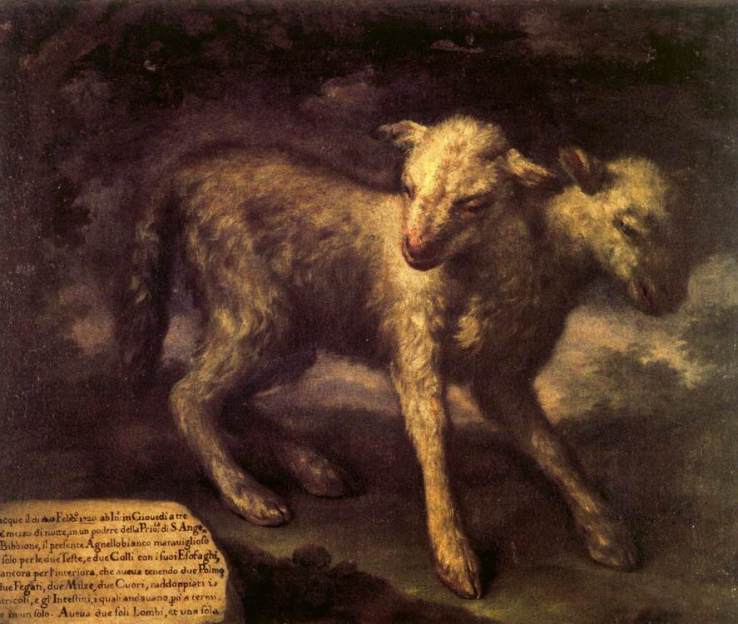
Two-Headed Lamb — Bartolomeo Bimbi

medici6

Heroes

The Bard, from Gray — William Blake

The Bard, from Gray ?1809 by William Blake 1757-1827

Three Books

Last week on Three Books, I featured three books I kinda sorta maybe plan to read in 2016. Here are three more:

Slow Learner by Thomas Pynchon. First edition hardback by Little, Brown (1984). Jacket design by Fred Marcellino. I’ve only read “Entropy” from this collection so far. (I actually tried to use it in my Intro American Lit class—it’s in The Norton Anthology of American Literature, Vol. E, somehow—and no, it didn’t go over well, but hey).

The Weight of Things by Marianne Fritz; English translation by Adrian Nathan West. First edition trade paperback from Dorothy (2015). Cover art is Anonymous by Hella van ‘t Hof. Book design by Danielle Dutton. I started this as the chaser to Ishmael Reed’s The Free-Lance Pallbearers—proved to be a false start (went on a Le Guin jag instead). Feels like a one-sitting read.

The Easy Chain by Evan Dara. First edition trade paperback from Aurora (2008). Cover and design by Todd Michael Bushman. Does anyone want to read The Easy Chain with me?

Pear with Insects — Justus Juncker

juncker

A beautiful/bloody scene from Lady Snowblood: Love Song of Vengeance

The Offspring of a Murderous Love — Eric Fischl

the-offspring-of-a-murderous-love

Good or bad codes/good or bad deaths (Lucia Berlin)

While the staff members think in terms of good or bad codes – how well everyone did what they were supposed to do, whether the patient responded or not – I think in terms of good or bad deaths.

Bad deaths are ones with the manager of a hotel as next of kin, or the cleaning woman who found the stroke victim two weeks later, dying of dehydration. Really bad deaths are when there are several children and in-laws I have called in from somewhere inconvenient and none of them seem to know each other or the dying parent at all. There is nothing to say. They keep talking about arrangements, about having to make arrangements, about who will make arrangements.

Gypsies are good deaths. I think so. . .  the nurses don’t and security guards don’t. There are always dozens of them demanding to be with the dying person, to kiss them and hug them, unplugging and screwing up the TVs and monitors and assorted apparatus. The best thing about gypsy deaths is they never make their kids keep quiet. The adults wail and cry and sob but all the children continue to run around, playing and laughing, without being told they should be sad or respectful.

Good deaths seem to be coincidentally good Codes – the patient responds miraculously to all the life-giving treatment and then just quietly passes away.

From Lucia Berlin’s short story “Emergency Room Notebook, 1977.”

Appalachian (Detail) — George Boorujy

download (1)

Flowers of Evil — Rene Magritte

flowers-of-evil-19461

Sebald/Purdy/Baxter (Books acquired, 1.05.2016)

img_1288

László Hunyadi on the Bier — Viktor Madarász

2hunyadi

“All art constantly aspires towards the condition of music”

Head of the Flea — W. Lens Aldous

flea

Twelfth Night — Pieter Brueghel the Younger

twelfth

One gets put in a drawer which says Thomas Bernhard, a follower of Thomas Bernhard, etc. (W.G. Sebald)

Michael Silverblatt: It seems to me that this book is truly the first to pay extended stylistic respects to the writer who, it’s been said, has been your mentor and model, Thomas Bernhard. I wondered, was it after three books that one felt comfortable in creating a work that could be compared to the writing of a master and a mentor?

W.G. Sebald: Yes, I was always, as it were, tempted to declare openly from quite early on my great debt of gratitude to Thomas Bernhard. But I was also conscious of the fact that one oughtn’t to do that too openly, because then immediately one gets put in a drawer which says Thomas Bernhard, a follower of Thomas Bernhard, etc., and these labels never go away. Once one has them they stay with one. But nevertheless, it was necessary for me eventually to acknowledge his constant presence, as it were, by my side. What Thomas Bernhard did to postwar fiction writing in the German language was to bring to it a new radicality which didn’t exist before, which wasn’t compromised in any sense. Much of German prose fiction writing, of the fifties certainly, but of the sixties and seventies also, is severely compromised, morally compromised, and because of that, aesthetically frequently insufficient. And Thomas Bernhard was in quite a different league because he occupied a position which was absolute. Which had to do with the fact that he was mortally ill since late adolescence and knew that any day the knock could come at the door. And so he took the liberty which other writers shied away from taking. And what he achieved, I think, was also to move away from the standard pattern of the standard novel. He only tells you in his books what he heard from others. So he invented, as it were, a kind of periscopic form of narrative. You’re always sure that what he tells you is related, at one remove, at two removes, at two or three. That appealed to me very much, because this notion of the omniscient narrator who pushes around the flats on the stage of the novel, you know, cranks things up on page three and moves them along on page four and one sees him constantly working behind the scenes, is something that I think one can’t do very easily any longer. So Bernhard, single-handedly I think, invented a new form of narrating which appealed to me from the start.

From W.G. Sebald’s December 2001 interview with Michael Silverblatt; republished in The Emergence of Memory: Conversations with W.G. Sebald (Lynne Sharon Schwartz ed.).

The King Drinks — Jacob Jordaens

beankin