Lydia Davis on using found materials in her stories

INTERVIEWER

More and more you seem to use found materials in your stories.

DAVIS

Back in the early eighties, I realized that you could write a story that was really just a narration of something that had happened to you, and change it slightly, without having really to fictionalize it. In a way, that’s found ­material. I think it’s hard to draw the line and say that something isn’t found material. Because if a friend of mine tells me a story or a dream, I guess that’s found material. If I get an e-mail that lends itself to a good story, that’s found material. But then if I notice the cornmeal making little condensations, is that found material? It’s my own, I’m not using text, but I am using a situation that exists. I’m not making it up. I find what happens in reality very interesting and I don’t find a great need to make up things, but I do like retelling stories that are told to me.

INTERVIEWER

The last time I was here you mentioned that you jot things down on scraps of paper. What happens to those scraps?

DAVIS

They pile up in my study. And then I use them. Sometimes when I’m just sort of tidying up, I go through them and type them onto the computer and then either do something with them right away or else I just leave them there for later. When I travel, I carry around a notebook with me. I use notebooks a lot because my brain tends to live in the moment. I’m always afraid of forgetting something.

From the Spring 2015 issue of Paris Review. Lydia Davis’s full interview is now online. She discusses her fiction and translation, recalls taking Grace Paley’s writing class when she was 19, and trying to run away from school after reading Walden.

Topless William T. Vollmann

029367

William T. Vollmann photographed by Ken Miller during the, uh, adventures chronicled in Butterfly Stories. (Photo via).

Coffee and Donut — Ralph Goings

coffee-and-donut-2005

School’s Out

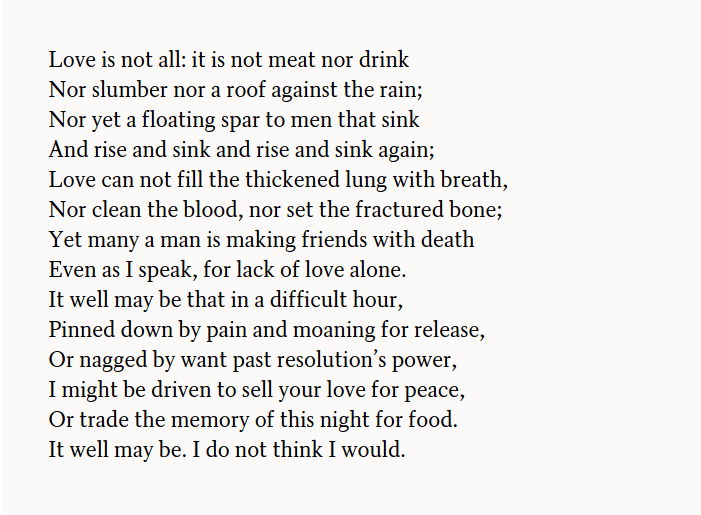
“Love is not all” — Edna St. Vincent Millay

Screenshot 2015-05-04 at 7.33.58 PM

Read “Gandalf Goes West,” a short story by Chris Power

“Gandalf Goes West”

by

Chris Power


HAL STANDS IN FRONT OF THE SCREEN. On the screen the words GANDALF GOES EAST.


GO EAST, types Hal.


The cursor flashes.


BILBO GOES EAST, the screen says.


The cursor flashes.


Another line of text appears: GANDALF GOES WEST, it says.


Hal clenches his hands once, twice. He cannot progress in the game without Gandalf. GO WEST, he types.


The cursor flashes.


BILBO GOES WEST, the screen says.


Ben comes into the room and walks over to Hal. He reads the words on the screen from top to bottom:


GANDALF GOES EAST


GO EAST


BILBO GOES EAST


GANDALF GOES WEST


GO WEST


BILBO GOES WEST


GANDALF GOES EAST


Hal turns to Ben. How are you? Hal says.


Ben stares at the screen.


Stay, says Ben.

Read the rest of Chris Power’s short story “Gandalf Goes West” at The White Review.

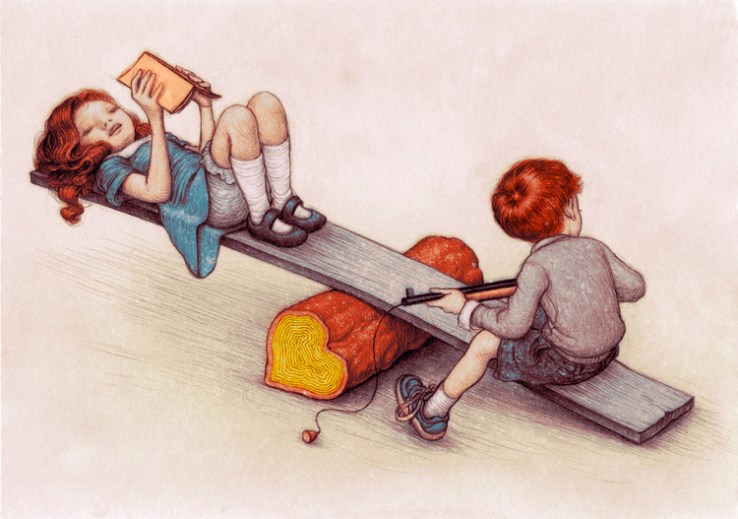
See-Saw — James Jean

seesaw-web

No Zen-type One, always rather Two (Infinite Jest)

How many sub-rosa twins are there, out there, really? What if heredity, instead of linear, is branching? What if it’s not arousal that’s so finitely circumscribed? What if in fact there were ever only like two really distinct individual people walking around back there in history’s mist? That all difference descends from this difference? The whole and the partial. The damaged and the intact. The deformed and the paralyzingly beautiful. The insane and the attendant. The hidden and the blindingly open. The performer and the audience. No Zen-type One, always rather Two, one upside-down in a convex lens.

A passage from David Foster Wallace’s novel Infinite Jest. Thoughts are Joelle Van Dyne’s for those keeping score. The riff reminds me of all the binaries in Gravity’s Rainbow, but maybe only because I just read Gravity’s Rainbow.

Antaeus Setting Down Dante and Virgil in the Last Circle of Hell — William Blake

514484

tekh(s): weaving; building (first, with wood).

IMG_6502

From Joseph T. Shipley’s The Origin of English Words: A Discursive Dictionary of Indo-European Roots.

The Sirens — Gustave Moreau

Madame Psychosis’ Downer-Lit Hour Reading List (Infinite Jest)

Like for months in the spring semester of Y.D.P.A.H. she referred to her own program as ‘Madame’s Downer-Lit Hour’ and read depressing book after depressing book — Good Morning, Midnight and Maggie: A Girl of the Streets and Giovanni’s Roomand Under the Volcanoplus a truly ghastly Bret Ellis period during Lent — in a monotone, really slowly, night after night.

From David Foster Wallace’s Infinite Jest (hyperlinks are my attempt at oblique (non)annotation and obviously not part of the original text).

Gemini — Mikalojus Ciurlionis

Faust was an actual person (From Ishmael Reed’s novel Mumbo Jumbo)

…Faust was an actual person. Somewhere between 1510 and 1540 this “wandering conjurer and medical quack” made his travels about the southwest German Empire, telling people his knowledge of “secret things.” I always puzzled over why such a legend was so basic to the Western mind; but I’ve thought about it and now I think I know the answer. Can’t you imagine this man traveling about with his bad herbs, love philters, physicks and potions, charms, overcharging the peasants but dazzling them with his badly constructed Greek and sometimes labeling his “wonder cures” with gibberish titles like “Polyunsaturated 99½% pure.” Hocus-pocus. He makes a living and can always get a free night’s lodging at an inn with his ability to prescribe cures and tell fortunes, that is, predict the future. You see he travels about the Empire and is able to serve as a kind of national radio for people in the locales. Well 1 day while he is leeching people, cutting hair or raising the dead who only have diseases which give the manifestations of death, something really works. He knows that he’s a bokor adept at card tricks, but something really works. He tries it again and it works. He continues to repeat this performance and each time it works. The peasants begin to look upon him as a supernatural being and he encourages the tales about him, that he heals the sick and performs marvels. He becomes wealthy with his ability to do The Work. Royalty visits him. He is a counselor to the king. He lives in a castle. Peasants whisper, a Black man, a very bearded devil himself visits him. That strange coach they saw, the 1 with the eyes as decorations drawn to his castle by wild-looking black horses. They say that he has made a pact with the devil because he invites the Africans who work in various cities throughout the Empire to his castle. There were 1000s in Europe at the time: blackamoors who worked as butlers, coachmen, footmen, pint-sized page boys; and conjurors whom only the depraved consulted. The villagers hear “Arabian” music, drums coming from the place but as soon as the series of meetings begin it all comes to a halt. Rumors circulate that Faust is dead. The village whispers that the Black men have collected. That is the nagging notion of Western man. China had rocketry, Africa iron furnaces, but he didn’t know when to stop with his newly found Work. That’s the basic wound. He will create fancy systems 13 letters long to convince himself he doesn’t have this wound. What is the wound? Someone will even call it guilt. But guilt implies a conscience. Is Faust capable of charity? No it isn’t guilt but the knowledge in his heart that he is a bokor. A charlatan who has sent 1000000s to the churchyard with his charlatan panaceas. Western man doesn’t know the difference between a houngan and a bokor. He once knew this difference but the knowledge was lost when the Atonists crushed the opposition. When they converted a Roman emperor and began rampaging and book-burning. His sorcery, white magic, his bokorism will improve. Soon he will be able to annihilate 1000000s by pushing a button. I do not believe that a Yellow or Black hand will push this button but a robot-like descendant of Faust the quack will. The dreaded bokor, a humbug who doesn’t know when to stop. 

From Ishmael Reed’s novel Mumbo Jumbo.

Madame Roulin Rocking the Cradle (A Lullaby) — Vincent Van Gogh