
June 9th.–Cleaning the attic to-day, here at the Wayside, the woman found an immense snake, flat and outrageously fierce, thrusting out its tongue. Ellen, the cook, killed it. She called it an adder, but it appears to have been a striped snake. It seems a fiend, haunting the house. On further inquiry, the snake is described as plaided with brown and black.
Author: Biblioklept
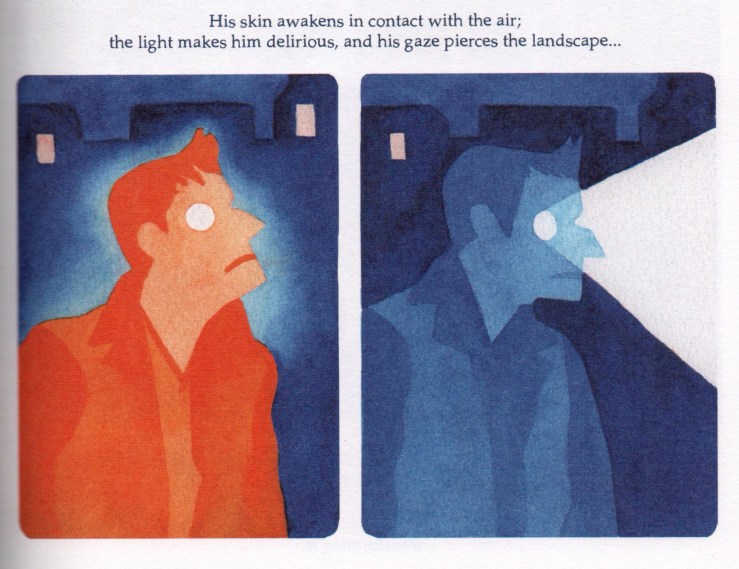
His skin awakens in contact with the air — Victor Hussenot
“It’s almost sexual” | Brian Wilson talks about the theremin in “Good Vibrations”
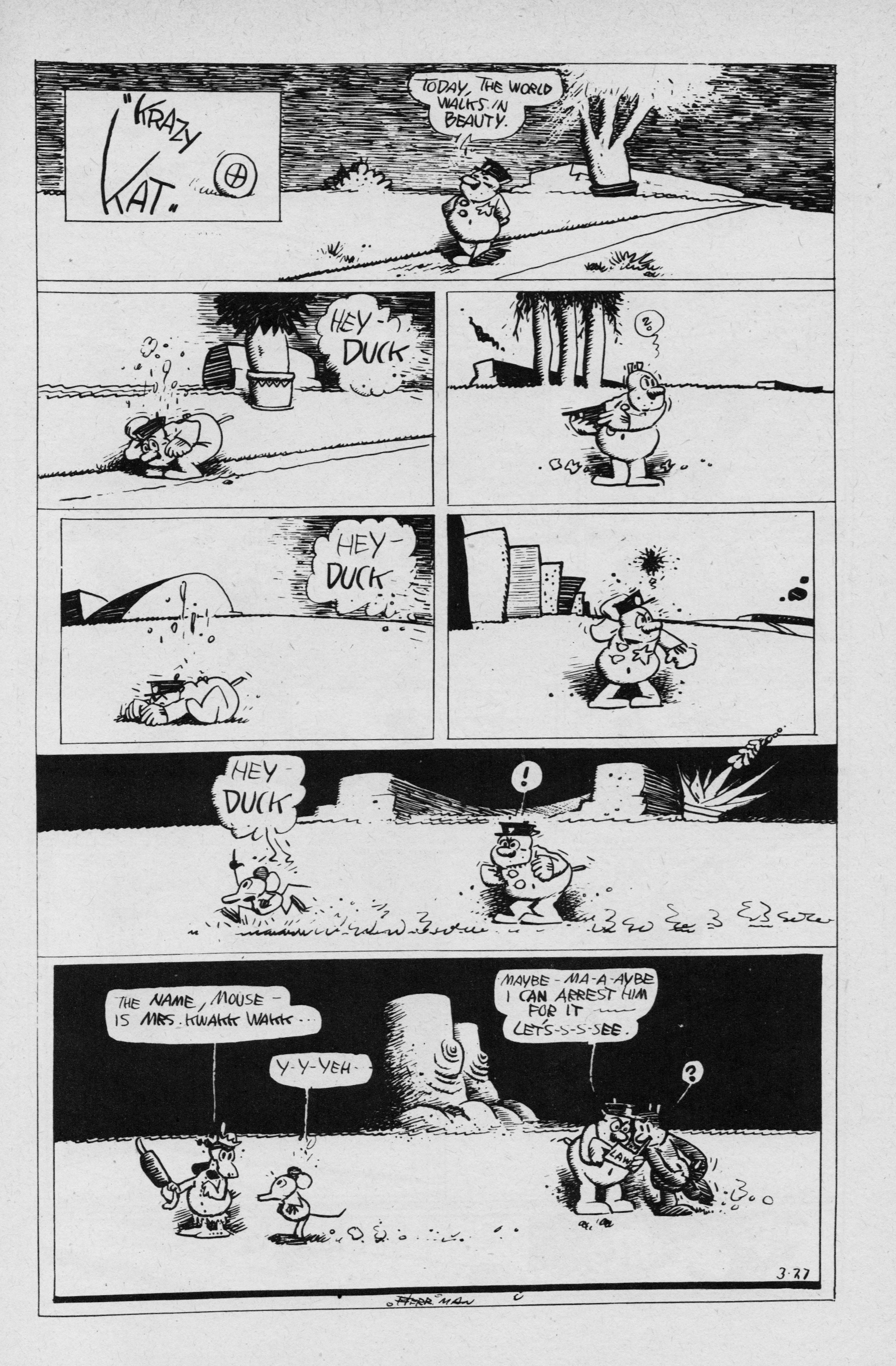
Hey — Duck (Krazy Kat)
A U.S.A. that would die for the so-called perfect Entertainment (Infinite Jest)
The sky of U.S.A.’s desert was clotted with blue stars. Now it was deep at night. Only above the U.S.A. city was the sky blank of stars; its color was pearly and blank. Marathe shrugged. ‘Perhaps in you is the sense that citizens of Canada are not involved in the real root of the threat.’
Steeply shook the head in seeming annoyance. ‘What’s that supposed to mean?’ he said. The lurid wig of him slipped when he moved the head with any abrupt force.
The first way Marathe betrayed anything of emotion was to smooth rather too fussily at the blanket on his lap. ‘It is meaning that it will not of finality be Québecers making this kick to l’aine des Etats Unis. Look: the facts of the situation speak loudly. What is known. This is a U.S.A. production, this Entertainment cartridge. Made by an American man in the U.S.A. The appetite for the appeal of it: this also is U.S.A. The U.S.A. drive for spectation, which your culture teaches. This I was saying: this is why choosing is everything. When I say to you choose with great care in loving and you make ridicule it is why I look and say: can I believe this man is saying this thing of ridicule?’ Marathe leaned slightly forward on his stumps, leaving the machine pistol to use both his hands in saying. Steeply could tell this was important to Marathe; he really believed it.
Marathe made small emphatic circles and cuts in the air while he spoke: ‘These facts of situation, which speak so loudly of your Bureau’s fear of this samizdat: now is what has happened when a people choose nothing over themselves to love, each one. A U.S.A. that would die — and let its children die, each one — for the so-called perfect Entertainment, this film. Who would die for this chance to be fed this death of pleasure with spoons, in their warm homes, alone, unmoving: Hugh Steeply, in complete seriousness as a citizen of your neighbor I say to you: forget for a moment the Entertainment, and think instead about a U.S.A. where such a thing could be possible enough for your Office to fear: can such a U.S.A. hope to survive for a much longer time? To survive as a nation of peoples? To much less exercise dominion over other nations of other peoples? If these are other peoples who still know what it is to choose? who will die for something larger? who will sacrifice the warm home, the loved woman at home, their legs, their life even, for something more than their own wishes of sentiment? who would choose not to die for pleasure, alone?’
From David Foster Wallace’s novel Infinite Jest.
Silent Interior — Carlos Schwabe

The Straw Manikin — Francisco Goya

The artist must not become a storyteller (Balthus)
…the artist must not become a storyteller. The anecdote should not exist in painting. A picture or subject imposes itself, and it alone knows how profound and vertiginous it is. Nothing happens in a picture, it simply is; it exists by essence or does not exist at all. Baudelaire said a poem is there before it is there. Otherwise, it would be akin to something narrative, something inflected, willed into being by the artist. A picture or poem escapes these contingencies, with terrifying freedom and fiercely self-sufficient violence. In this sense, the artists is a mere link in a chain that began long ago. At Lascaux, for example, and even before Lascaux. There is no hierarchy, and Chardin is not better than Lascaux. All these creative connections belong to the same earthly song, from the ancient source of the world that I know nothing about, but which sends me a few messages by flashes of sun—or starlight. The artist constantly seeks to rediscover the illuminating fire, the hearth where sparks are made.
From Balthus’ memoir Vanished Splendors.
No One Is Thirsty (Perry Bible Fellowship)

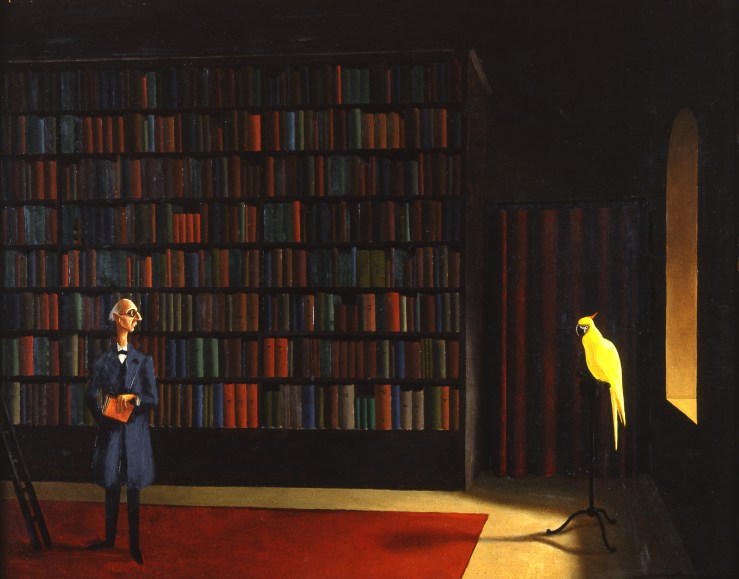
Library — Franz Sedlacek
The Pool of Tears — Arthur Rackham

The Bus — Paul Kirchner

Birthday — Dorothea Tanning

Fehérlófia
View into Infinity — Ferdinand Hodler

Watch Guilty as Charged, a documentary about Harry Crews
Lady Butts — Hans Holbein the Younger


