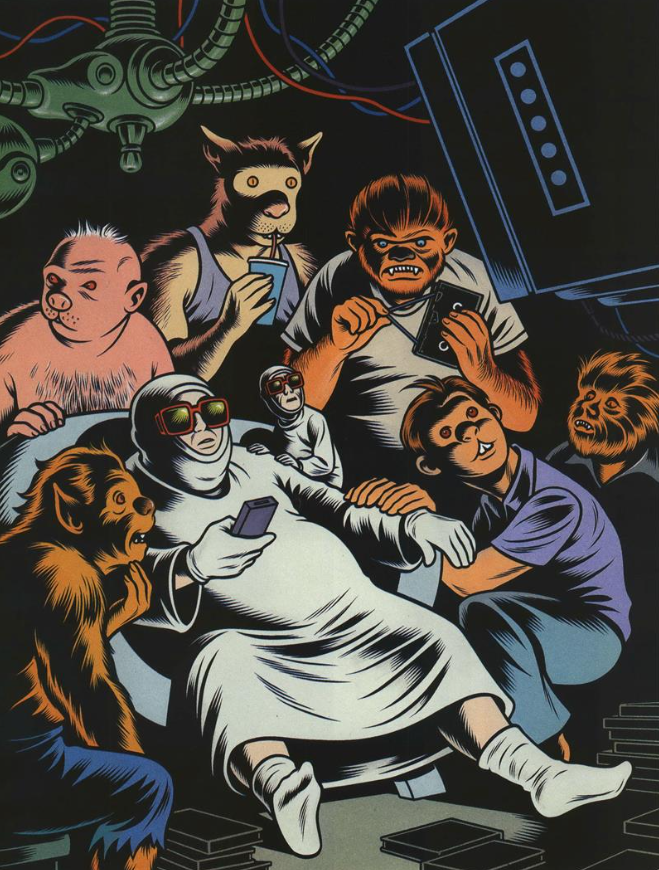
From Sorcerer, 1977. Directed by William Friedkin. Cinematography by Dick Bush & John M. Stephens. Stills via Film Grab.
RIP William Friedkin, 1935-2023.


From Sorcerer, 1977. Directed by William Friedkin. Cinematography by Dick Bush & John M. Stephens. Stills via Film Grab.
RIP William Friedkin, 1935-2023.

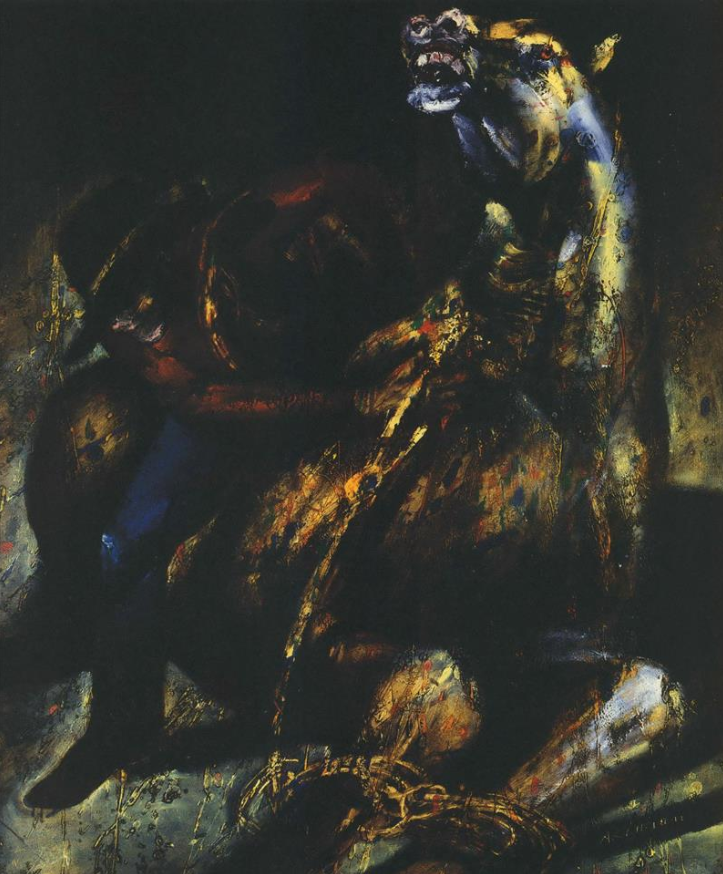
Gosfield Street Murder, 1942 by James Boswell (1906-1971)
“Slow Grounder”
by
Hob Broun
from
Cardinal Numbers

Up or down, in motion or asleep and half asleep, Speed has the same musical questions that slosh in his head. How could you play twelve years in the majors and end up like this? Did you go stupid on purpose? Where is the curly wife birdfeeding you popcorn tinged with lipstick? And the little girls begging to stand on your big feet to be danced in circles? The Barca-lounger? The riding mower? The tropical aquarium? Going, going, all long gone.
So now Speed has transistor radios in his place, on sills and ledges, hanging by wrist straps from bedpost and cabinet knob, on top of the fridge and the toilet tank. They have silver aerials that always point up. They have leather casings that snap over the top like overalls; or go naked in turquoise Jap plastic. Below, their countable speaker dots and on top a grid of numbers make super dominoes. Very advanced. Dominoes from Outer Space.
But even playing all together so Lurtsema downstairs spears his ceiling with a mop handle, they can’t drown out Speed’s musical questions. What happened to the four-bedroom house with skylight and sundeck? To the Chrysler New Yorker with gray velour upholstery Kimmie called mouseskin, chanting it at her sister and bouncing?
Back in Dakota, when he was still Russell and a boy, there’d been Gramp in his chair. Gramp clicking his plates on the stem of a cold pipe. Gramp in full expectation, bird gun across his knees, and sooner or later the door would suck open on a winter-crazed redskin come to take, and let him reach for one potato or lump of coal, Gramp would blast him back across the frozen porch.
You were supposed to be on guard, block the plate. But Speed had his chest protector on backwards, or something. Now he’s getting the razz. The hotfoot and the horselaugh. “This bum,” and he can see his picture coming down in delis and barbershops. Bumhood like something he could pass over wire so the guys duck out when he calls. “Going south for the tarpon, Speed. Keep in touch.” Even his roomie four years with the Sox saying, “I’m kind of extended now, Speed. Maybe you could put it in a letter,” then hanging up before he can get the address. And what had him extended was a thing called Bob’s Bag-O-Salad, three of them opened around Philadelphia there, the shaved lettuce and carrots, so on, in a special plastic bag you could eat out of, then throw away, and the dressing faucets, your choice of ten. People were flocking to the greens, trying to ward off cancer.
Back in Dakota one year when he was visiting for Christmas, the wind had come down off the Canadian plains to swirl snow and dirt into what they called a “snirt” storm. It clattered against the house. Mom said, “Hardly recognize you in those clothes.” Pop said, warily lifting his present, “Is it something to eat?” Pop had been three years at the Colorado School of Mines. As a cook. It was still snirting the next day and the day after that. “That dog can’t but hardly see,” Pop said. Perry Como sang about mistletoe and Mom sniffled. Speed went to the cellar. He put his hands in the bin of seed potatoes. Things can live in the dark, he thought, and didn’t feel any better.
Speed gets out his fourteen gum cards, still shiny. Twelve full seasons, plus the one in front when they sent him down to Asheville for seasoning, and the one in back when they said you’re not in our plans for this year. But we could let you be a batting coach in the Bean Dip League. He remembers the Fargo girl who sent pictures of herself on a horse, or in her band uniform. “Carry me up there and hit the big one.” And the one night he puts her in his pocket Fuentes throws a no-hitter. Sandi, with a heart over the i. He thinks about pictures as a residue of time. “Adams led the club last year in RBIs.”
Back in tenth grade in Dakota, geometry had calmed him down. Nothing he knew was so pure as those angles and arcs. Not even the hiss of a fastball inside the four points of a diamond. He made figures with compass and ruler and colored them in. Numbers might be a trick, but he could understand the laws of shape.
It’s almost dark outside, so Speed turns some radios on. The sound is tight, a pressure leak, but Speed hears his questions the same. And what they want is the clacking logic of one domino tipping the next one as it falls and the next and the next and the next. But all he can remember is what the things were, not why or where they went. From the couch to the John to the bed is the only geometry left. The lines don’t really meet, okay.
Noticing the buzzer, he can tell its been going some time behind his radios. Getting up, he feels light, light as paper, when the door sucks open on a man with silver eyes, skin with a rubbery shine, and where the ears ought to be, holes in a circle like the mouthpart of a telephone.
He says, “Bless my stars.”
Speed says come on in, but the shape of the doorframe seems to make him nervous. He tries to smile and it’s like something he had to learn in a hurry.
Nodding to the radios: “You’re a listener.”
Speed shrugs a little. Those eyes are really terrible.
“So you’re ready to go, then?”
Speed doesn’t say, “I don’t care if I never come back.” He sings it.
“Really very nice there.” The man gestures vaguely, impatiently. “All the lines meet. It’s very forgiving.”
Speed really wants him to come in now, but the man says he needs to run a couple or errands first.
“My vehicle’s parked on the roof. Wait here.”
Okay. In the kitchen Speed empties a can of Hormel chili into a pan. Hearing the traffic report is nice. He breaks two eggs into the pot, stirs. It doesn’t require a look to know there are bits of shell in there. But so why take them out?
What the mass culture really reflects…is the American bewilderment in the face of the world we live in. We do not seem to want to know that we are in the world, that we are subject to the same catastrophes, vices, joys, and follies which have baffled and afflicted mankind for ages. And this has everything to do, of course, with what was expected of America: which expectation, so generally disappointed, reveals something we do not want to know about sad human nature, reveals something we do not want to know about the intricacies and inequities of any social structure, reveals, in sum, something we do not want to know about ourselves. The American way of life has failed—to make people happier or to make them better. We do not want to admit this, and we do not admit it. We persist in believing that the empty and criminal among our children are the result of some miscalculation in the formula (which can be corrected); that the bottomless and aimless hostility which makes our cities among the most dangerous in the world is created, and felt, by a handful of aberrants; that the lack, yawning everywhere in this country, of passionate conviction, of personal authority, proves only our rather appealing tendency to be gregarious and democratic. We are very cruelly trapped between what we would like to be and what we actually are. And we cannot possibly become what we would like to be until we are willing to ask ourselves just why the lives we lead on this continent are mainly so empty, so tame, and so ugly.
This is a job for the creative artist—who does not really have much to do with mass culture, no matter how many of us may be interviewed on TV. Perhaps life is not the black, unutterably beautiful, mysterious, and lonely thing the creative artist tends to think of it as being; but it is certainly not the sunlit playpen in which so many Americans lose first their identities and then their minds.
I feel very strongly, though, that this amorphous people are in desperate search for something which will help them to re-establish their connection with themselves, and with one another. This can only begin to happen as the truth begins to be told. We are in the middle of an immense metamorphosis here, a metamorphosis which will, it is devoutly to be hoped, rob us of our myths and give us our history, which will destroy our attitudes and give us back our personalities. The mass culture, in the meantime, can only reflect our chaos: and perhaps we had better remember that this chaos contains life—and a great transforming energy.
From James Baldwin’s 1959 essay “Mass Culture and the Creative Artist: Some Personal Notes,” collected in The Cross of Redemption.
[Ed. note–the elision in the first sentence of this excerpt is mine; I chose to remove a parenthetical aside that Baldwin makes to Archibald MacLeish’s 1958 play J.B. Here is the first line in full: “What the mass culture really reflects (as is the case with a “serious” play like J.B.) is the American bewilderment in the face of the world we live in.”]

In the autumn, I went with my mother to visit Mario, who was now living in a small town near Clermont-Ferrand. He was teaching in a boarding school. He had become great friends with the school’s headmaster and his wife. He said that they were extraordinary people, very sophisticated and honest, the kind of people you could only find in France. In his small room he had a coal stove. From his window you could see the countryside covered in snow. Mario wrote long letters to Chiaromonte and Cafi in Paris. He translated Herodotus and fiddled with the stove. Under his jacket, he wore a dark turtleneck sweater that the headmaster’s wife had made for him. To thank her, he’d given her a sewing basket. Everyone in the town knew him. He stopped and chatted with everyone and he was asked by all to come home with them and drink “le vin blanc.”
My mother said, “How French he’s become!”
In the evenings, he played cards with the headmaster and his wife. He listened to their conversations and discussed educational methods with them. They also spoke a long time about whether or not there had been enough onion in the soup served at dinner.
“How patient he’s become!” my mother said. “How patient he is with these people. With us he never had any patience. Whenever he was home, he thought we were all so boring. These people seem even more boring than we are!”
And she said, “He’s patient with them only because they’re French!”
From Natalia Ginzburg’s 1963 memoir Lessico famigliare, in translation (under the title Family Lexicon) by Jenny McPhee.
My parents had five children. We now live in different cities, some of us in foreign countries, and we don’t write to each other often. When we do meet up we can be indifferent or distracted. But for us it takes just one word. It takes one word, one sentence, one of the old ones from our childhood, heard and repeated countless times. All it takes is for one of us to say “We haven’t come to Bergamo on a military campaign,” or “Sulfuric acid stinks of fart,” and we immediately fall back into our old relationships, our childhood, our youth, all inextricably linked to those words and phrases. If my siblings and I were to find ourselves in a dark cave or among millions of people, just one of those phrases or words would immediately allow us to recognize each other. Those phrases are our Latin, the dictionary of our past, they’re like Egyptian or Assyro-Babylonian hieroglyphics, evidence of a vital core that has ceased to exist but that lives on in its texts, saved from the fury of the waters, the corrosion of time. Those phrases are the basis of our family unity and will persist as long as we are in the world, re-created and revived in disparate places on the earth whenever one of us says, “Most eminent Signor Lipmann,” and we immediately hear my father’s impatient voice ringing in our ears: “Enough of that story! I’ve heard it far too many times already!”
From Natalia Ginzburg’s 1963 memoir Lessico famigliare, in translation (under the title Family Lexicon) by Jenny McPhee.
I love this book so far, and this passage may come as close as anything to an early thesis for what Ginzburg is doing. I suppose, too, I deeply identify with this idea, this notion of phrases, saying, quips, in jokes, etc., as the psychological basis of familial identification.

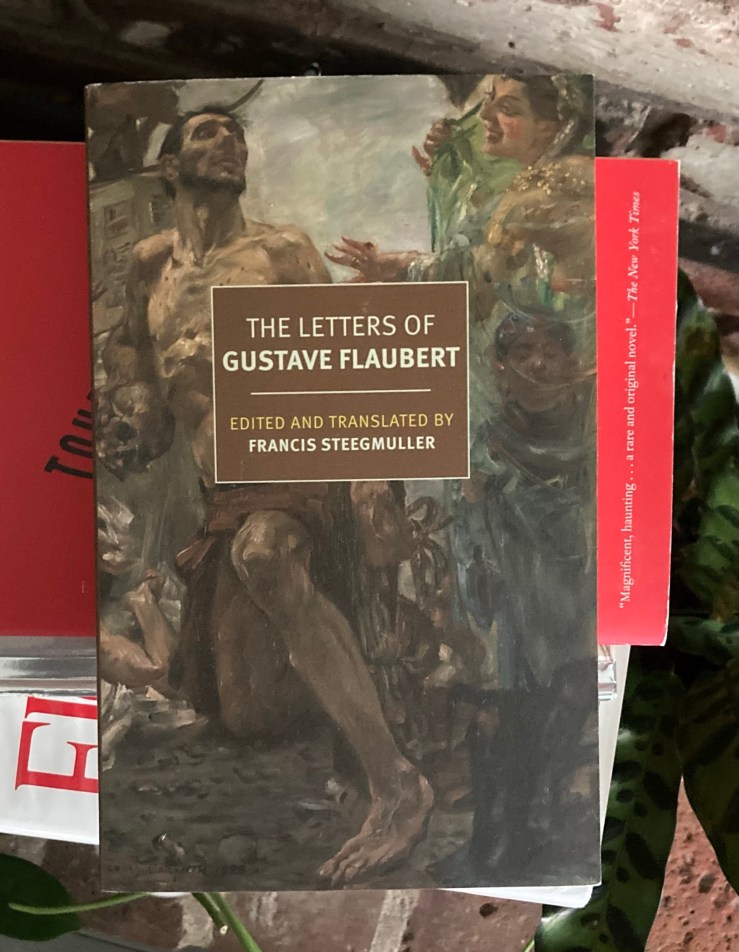
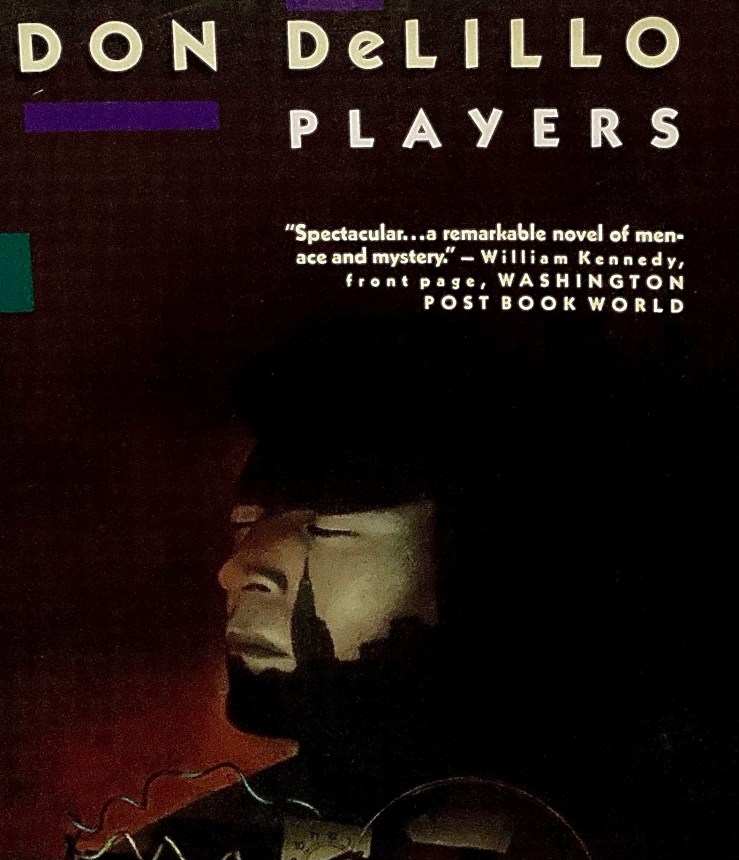
I went to the bookstore today looking for a copy of Katherine Burdekin’s dystopian 1937 novel Swastika Night. I was unsuccessful there, but while browsing the scifi and fantasy section, I came across three books that I couldn’t resist.
The first was an unread hardcover first edition of John M. Ford’s 1983 novel The Dragon Waiting. This book was only on my radar because Slate republished a 2019 article on Ford by Isaac Butler and a friend sent me the link (his message was simply “?”). From Butler’s article:
The Dragon Waiting is an unfolding cabinet of wonders. Over a decade before George R.R. Martin wrote A Song of Ice and Fire, Ford created an alternate-history retelling of the Wars of the Roses, filled with palace intrigue, dark magic, and more Shakespeare references than are dreamt of in our philosophy. The Dragon Waiting provokes that rare thrill that one gets from the work of Gene Wolfe, or John Crowley, or Ursula Le Guin. A dazzling intellect ensorcells the reader, entertaining with one hand, opening new doors with another.
Wolfe blurbed the back cover of the copy I bought, by the way.
Maybe Crowley was in my subconscious too; while searching for Swastika Night under the Cs (it was first published under the pseudonym “Murray Constantine”), I came across a cheap hardcover copy of Crowley’s 1976 novel Beasts. I’d read Little, Big years ago, enjoyed it, but gone no further. (There were no copies of Little, Big in Crowley’s placarded section, all though I did find three copies in the “General Fiction” section, away from the beautiful weird scifi fantasy ghetto.)
I’ve long been a sucker for the mass market Avon Bard Latin American writers series, so I couldn’t pass up the copy of Julio Cortazar’s Hopscotch (translated by Gregory Rabassa). It sat upon a miscellaneous, dusty stack of outcasts in the middle of the “D” aisle in the scifi fantasy ghetto, waiting for me.

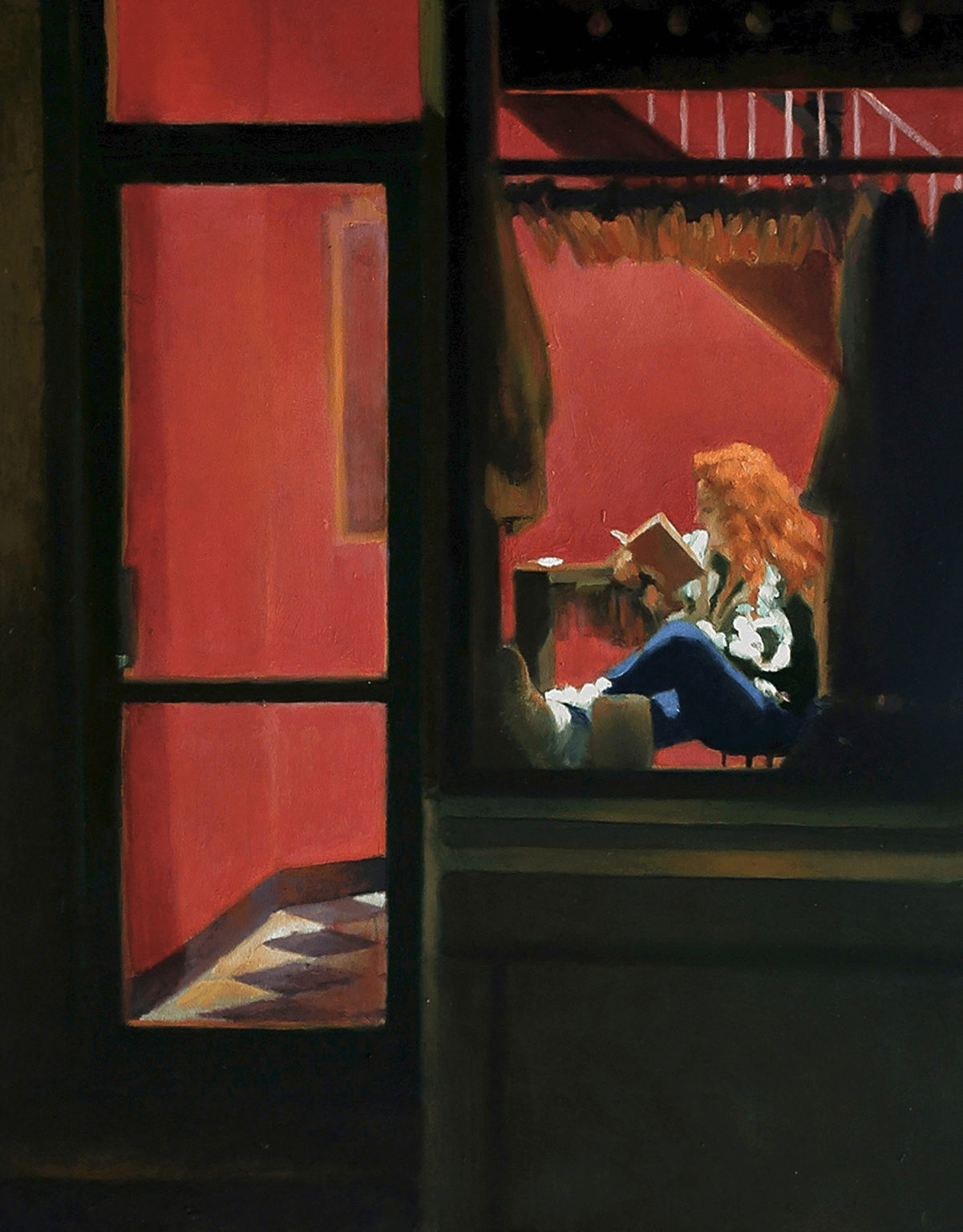
Reclining Nude Reading, 1943 by Felice Casorati (1883–1963)
“Nervous”
by
Robert Walser
translated by Christopher Middleton
I am a little worn out, raddled, squashed, downtrodden, shot full of holes. Mortars have mortared me to bits. I am a little crumbly, decaying, yes, yes. I am sinking and drying up a little. I am a bit scalded and scorched, yes, yes. That’s what it does to you. That’s life. I am not old, not in the least, certainly I am not eighty, by no means, but I am not sixteen any more either. Quite definitely I am a bit old and used up. That’s what it does to you. I am decaying a little, and I am crumbling, peeling a little. That’s life. Am I a little bit over the hill? Hmm! Maybe. But that doesn’t make me eighty, not by a long way. I am very tough, I can vouch for that. I am no longer young, but I am not old yet, definitely not. I am aging, fading a little, but that doesn’t matter; I am not yet altogether old, though I am probably a little nervous and over the hill. It’s natural that one should crumble a bit with the passage of time, but that doesn’t matter. I am not very nervous, to be sure, I just have a few grouches. Sometimes I am a bit weird and grouchy, but that doesn’t mean I am altogether lost, I hope. I don’t propose to hope that I am lost, for I repeat, I am uncommonly hard and tough. I am holding out and holding on. I am fairly fearless. But nervous I am, a little, undoubtedly I am, very probably I am, possibly I am a little nervous. I hope that I am a little nervous. No, I don’t hope so, one doesn’t hope for such things, but I am afraid so, yes, afraid so. Fear is more appropriate here than hope, no doubt about it. But I certainly am not fear-stricken, that I might be nervous, quite definitely not. I have grouches, but I am not afraid of the grouches. They inspire me with no fear at all. “You are nervous,” someone might tell me, and I would reply cold-bloodedly, “My dear sir, I know that quite well, I know that I am a little worn out and nervous.” And I would smile, very nobly and coolly, while saying this, which would perhaps annoy the other person a little. A person who refrains from getting annoyed is not yet lost. If I do not get annoyed about my nerves, then undoubtedly I still have good nerves, it’s clear as daylight, and illuminating. It dawns on me that I have grouches, that I am a little nervous, but it dawns on me in equal measure that I am cold-blooded, which makes me uncommonly glad, and that I am blithe in spirit, although I am aging a little, crumbling and fading, which is quite natural and something I therefore understand very well. “You are nervous,” someone might come up to me and say. “Yes, I am uncommonly nervous,” would be my reply, and secretly I would laugh at the big lie. “We are all a little nervous,” I would perhaps say, and laugh at the big truth. If a person can still laugh, he is not yet entirely nervous; if a person can accept a truth, he is not yet entirely nervous; anyone who can keep calm when he hears of some distress is not yet entirely nervous. Or if someone came up to me and said: “Oh, you are totally nervous,” then quite simply I would reply in nice polite terms: “Oh, I am totally nervous, I know I am.” And the matter would be closed. Grouches, grouches, one must have them, and one must have the courage to live with them. That’s the nicest way to live. Nobody should be afraid of his little bit of weirdness. Fear is altogether foolish. “You are very nervous!” “Yes, come by all means and calmly tell me so! Thank you!”
That, or something like it, is what I’d say, having my gentle and courteous bit of fun. Let man be courteous, warm, and kind, and if someone tells him he’s totally nervous, still there’s no need at all for him to believe it.

The Cinema, 1939 by James Boswell (1906-1971)

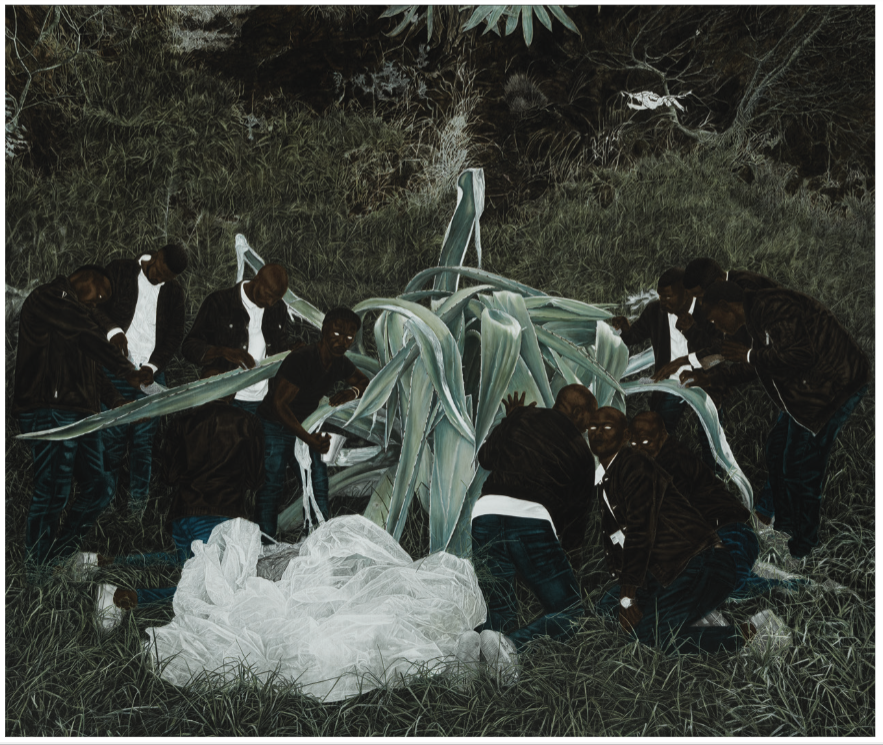
Double Door, 1976 by Lois Dodd (b. 1927)