Some books acquired, 17 April 2026

This past Friday, after some spring semester-is-almost-over-time-to-clean-out-the-office-and-take-all-the-plants-home cleaning, I converted some of the review copies, old anthologies, and textbooks in my office I’d crammed into a box into bookstore credit.

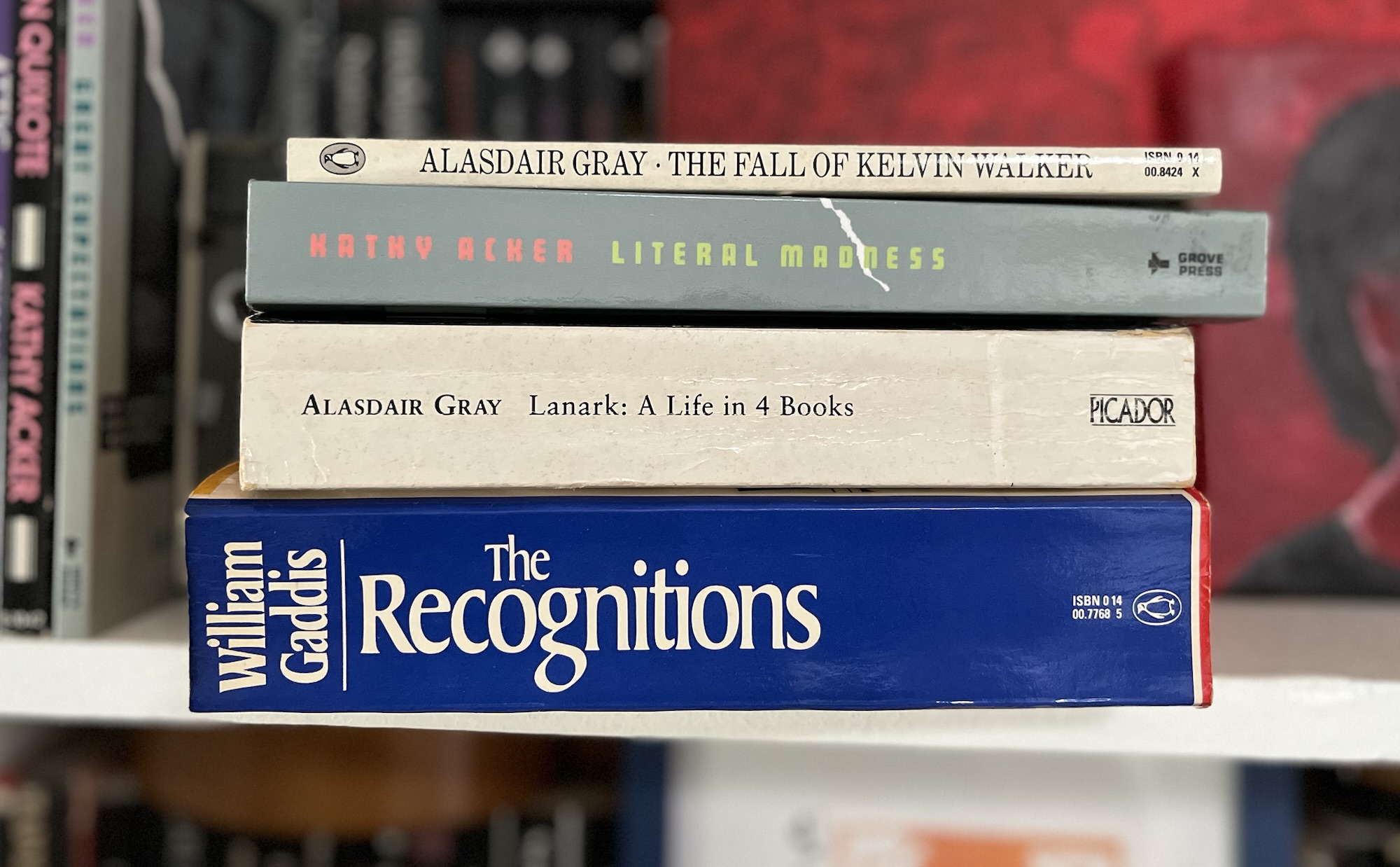
I didn’t intend to pick up anything while browsing, but I couldn’t resist a second copy of William Gaddis’s The Recognitions. I’d never come across the 1985 Penguin Books edition before, and it matches nicely with the edition 1985 Penguin reissue of J R that I found on a dollar shelf in Atlanta a few years ago. This 1985 edition of The Recognitions is a bit stiff in the hand; I’m glad I first read it in the ’93 Penguin Classics edition (with the William Gass introduction that everyone should absolutely skip until after they’ve read The Recognitions for the first time).

I also hit an unshelved seam of Alasdair Gray novels, just sitting in a stack on the floor in the sci-fi section, and picked up The Fall of Kelvin Walker, which I’d never heard of, and a third copy of Lanark. I lent the first copy of Lanark I owned and read to someone who never returned it. I have doubles now, but as a wise man proclaimed, “Triples makes it safe. Triples is best.”

Near the Gray novels, also unshelved, was a copy of Literal Madness, which collects three Kathy Acker novels: Kathy Goes to Haiti, My Death My Life by Pier Paolo Pasolini, and Florida. 

It is probably a terrible compulsion to crowd my shelves with duplicates of novels I’ve read several times already. There’s a part of me that imagines I will one day have a small bookselling space with a very specific inventory of titles I will ultimately refuse to part with, and which my children will not-so-reluctantly have to throw away after my demise. I also imagine being able to hand one to a friend, suggest they read it without any anxiety over its return. (If you are reading this, Lanarkklept, the book is now yours, has been for years. I hope you read it.)

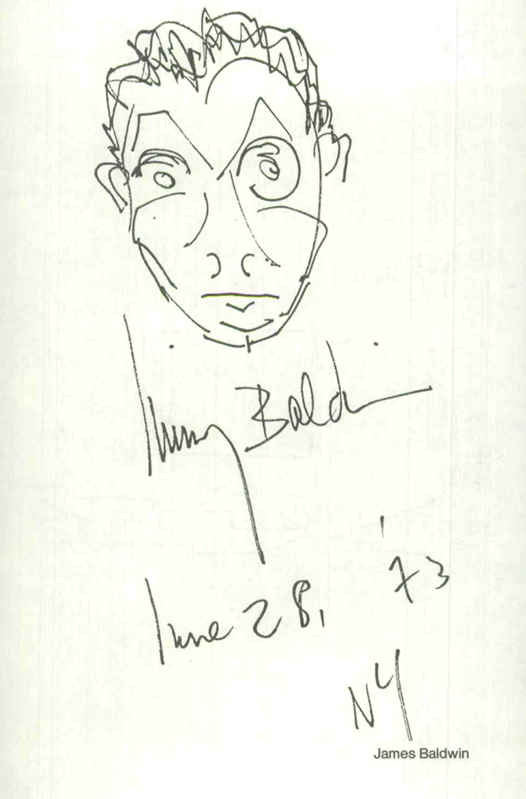
Self-Portrait — James Baldwin

Self-Portrait, 1974 by James Baldwin (1924-1987).

First published in the Paris Review as an excerpt from Burt Britton’s Self Portraits.

Read “The Boy Scout,” a very short story by David Ohle

“The Boy Scout”

by

David Ohle


The boy scout guides his wooden pedal car up the dirt road and parks it, in the shade of my turkey oak, without ceremony. The little car has tin-can headlights and a false grille. He approaches the steps and begins to climb, a box of rice cookies under one of his frail arms. It is a mystery how he crossed the bottoms in this handmade vehicle, how he avoided sinking in the soft mud ruts and being stung by the wasps in the sumac along the ditch-bank. Twice the boy scout drops the box of cookies, backsteps to the ground, recovers it, and climbs up again. He knocks gently, the sound is as though his knuckles are made of hard rubber. I open the door and allow him in. He sits on the sofa with yellow eyes and looks at my feet and says nothing. I offer him a bowl of soy soup, which he declines, casting his glances on the floor. His face is ageless and simple, with precocious whiskers on the jaw.

I build an oak fire in the woodstove and he warms his hands against the evening chill setting in. In the firelight I first become aware of the suggestion of a seam running down the front of him, over the nose from the khaki tip of the hat, across the lips and chin, into the neckerchief. He seems in the odd light to have been stitched together out of two unmatched bolts of cloth. His eyes are like coat buttons, the fists like ripe tomatoes. He smells of sodden laundry. Crickets bump against the tower window screens. The stink of pinesap and legustrum. The clack of crows in the sky.

I take a cold chicken wing from the refrigerator and offer it to him. His head pivots, the lips emerge tubelike from the face. He says no. At least he has finally spoken. We don’t want to sit here too long on the brink of conversation, like wax figures behind plexiglas. Coffee? Does he want coffee? Cola? I move around the living room mechanically, under an odd influence from this boy scout, as though he were a planet and I his satellite, he earth and I moon. Threads of black yarn drape his forehead under the scout hat, a mockery of hair. He has a sewn-on eyebrow above one eye and nothing above the other one, and a faded disk of scar on the chin. I talk about the weather and he listens without comment.

I ask him about a point of scout lore, and although his mouth opens and the dry tongue quivers, he says nothing. When he moves, which he seldom does, there is a faintly audible rasp, as though his joints are dry of lubricant. I ask him if I might sample one of his cookies. He indicates no. I have to buy or not buy without tasting. I give him the required amount in National coupons. I eat one of the cookies, which have no taste and little consistency. I remember myself as a boy scout, driving my pedal car intricately through alleyways in the city, eating bruised fruit when I found it at the backs of government markets. In the rear compartment of the pedal car I kept a change of khakis and extra shoes. If night came on me I’d throw out my bag and sleep wherever I was. I’ve seen tumbleweed, or something similar, blowing past the house recently. A wild pig comes every night and snufiles around for any garbage I might throw down. I consider dropping something heavy on him from the roof, breaking the spine, dressing him out, cooking him over a fire pit. The boy scout has been here several days now. I’ve noticed a spider’s thread from his shoulder to the windowsill. Two days ago he began an extended smile which has not yet broken. When the wind occasionally blows outside, the shiplap siding of the house gets to wailing in a high-pitched tone. The wind sock is full to the south, the awnings flapping. The fire in the stove belly has died hours ago, the sun’s last yellow angle is narrowing on the tower walls. The old clock is ticking on the mantel. The evening wears on. I rebuild the fire as the night cools and wear my flannel robe and long johns. Before dawn I see an orange light in the pines, someone walking with a lamp, Morning again.

An icicle has formed where the bathroom faucet dripped. The sun has come up in a haze. The boy scout is sleeping on the sofa.

The wind sock is deflated and the day is warming up toward noon.

By mid-afternoon I am perspiring in the humidity, wiping myself with a handkerchief. The boy scout remains dry and still.

A slow drizzle now, hanging on three days. On the fourth day I see an egg of sun above the tree line. A katydid is dead at the bottom of my teacup. Overnight the weather turns cold again, and the drizzle becomes a wet snow. My mouth is sour, my toothbrush worn down to the plastic. It will be nice to chew salty pork meat, sometime, whenever I can kill the pig. I should raise the awnings before the snow collects and breaks through the rotted canvas.

The wind sock is frozen stiff, pointing south. I see the pig outside, standing in the white. He pisses and leaves a yellow circle on the snow crust. The pedal car is gone, tracks of the wooden wheels leading off down the road. The awnings are frozen and won’t go up.

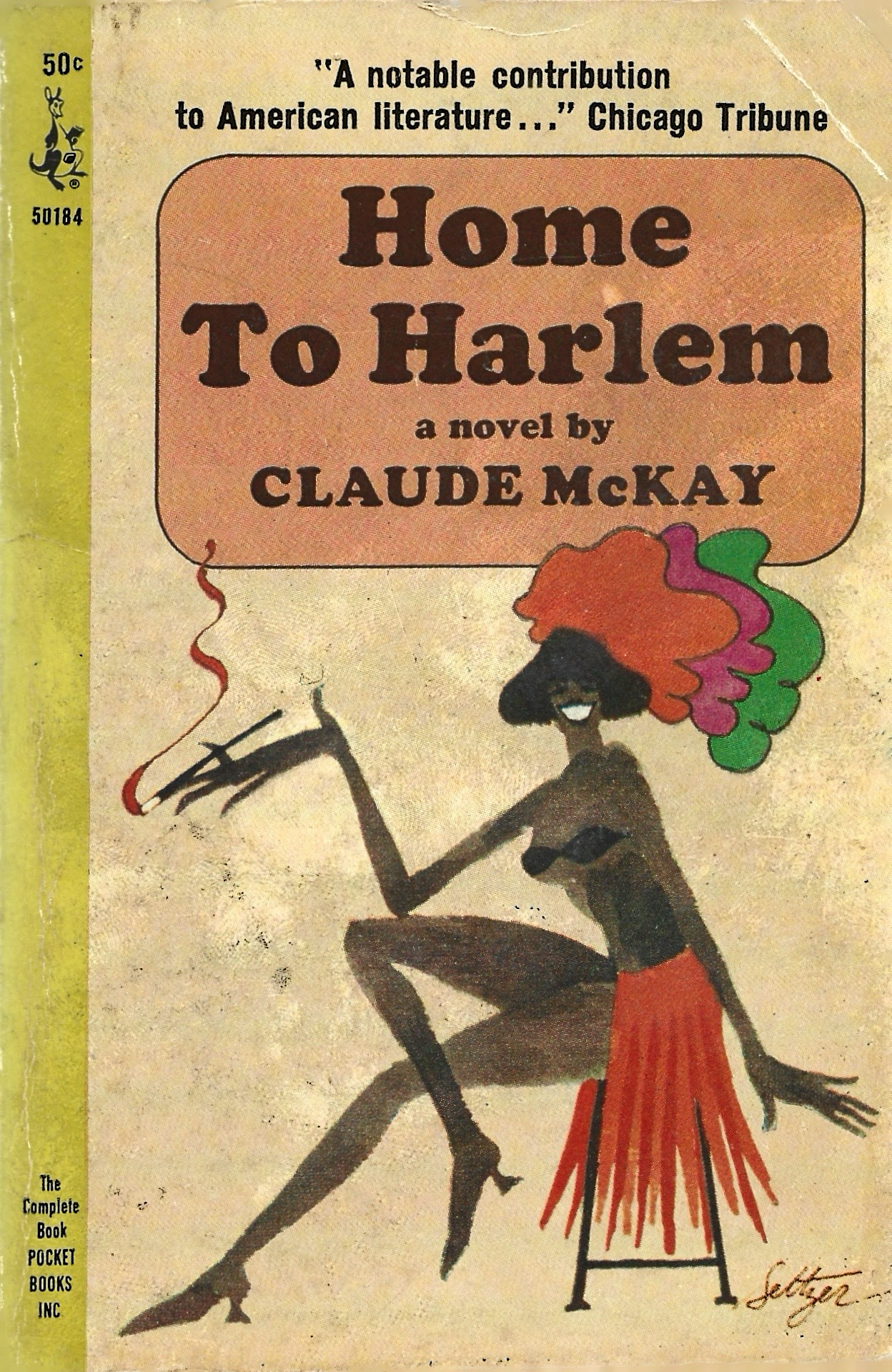
Mass-market Monday | Claude McKay’s Home to Harlem

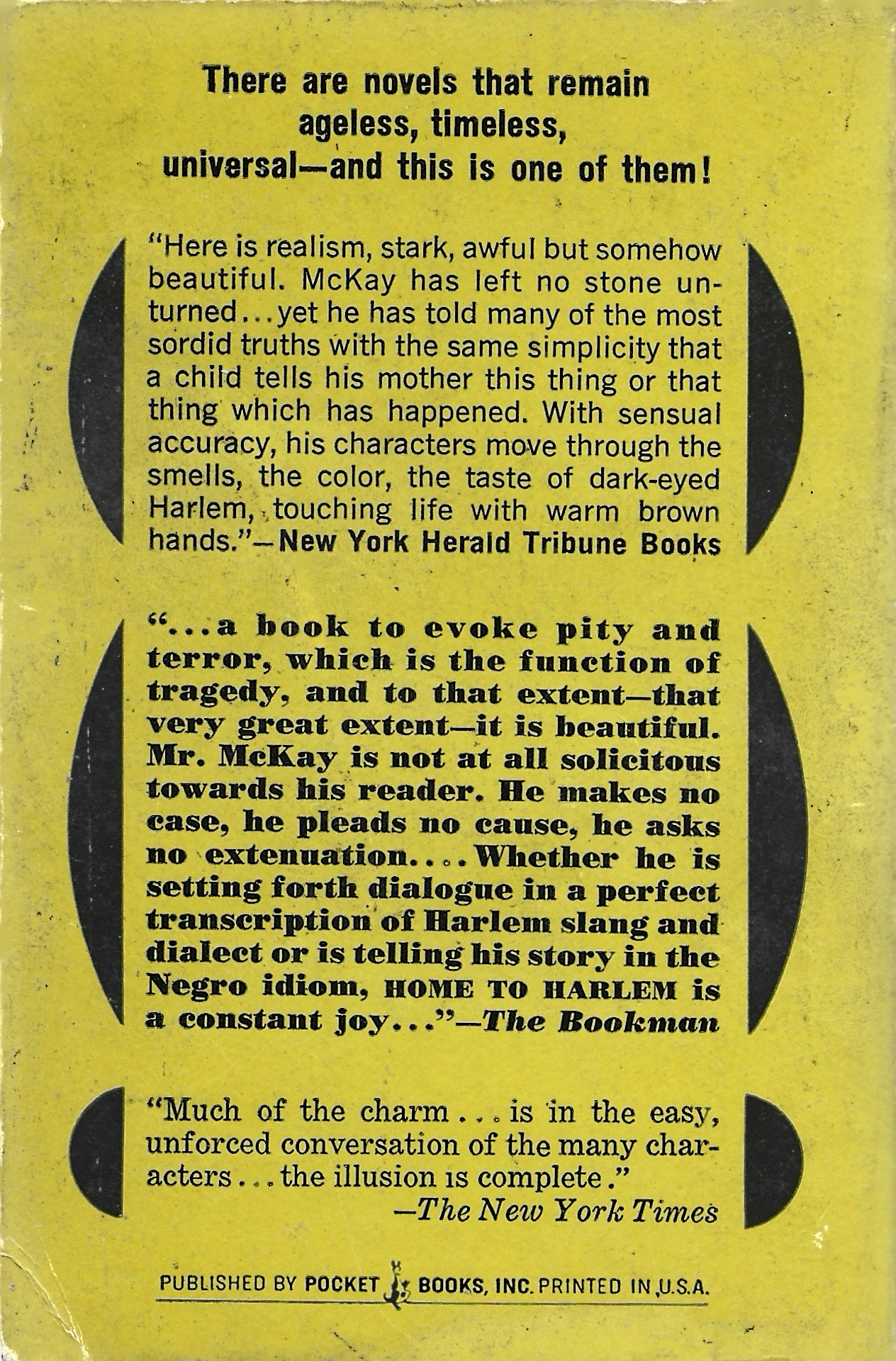
Home to Harlem, Claude McKay, 1928. Pocket Cardinal Editions (1956). No cover artist or designer credited. 180 pages.

The cover art, while unattributed inside the book, is likely the work of Isadore Seltzer. McKay’s first novel is now in the public domain and available online.

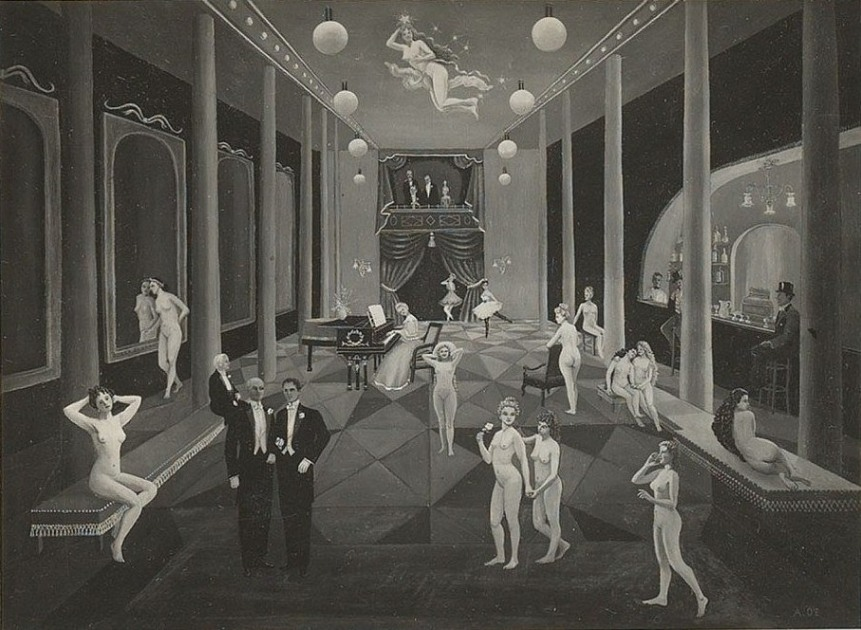
Untitled — Suzanne Van Damme

Untitled, 1947 by Suzanne Van Damme (1901-1986)

Sunday Comix

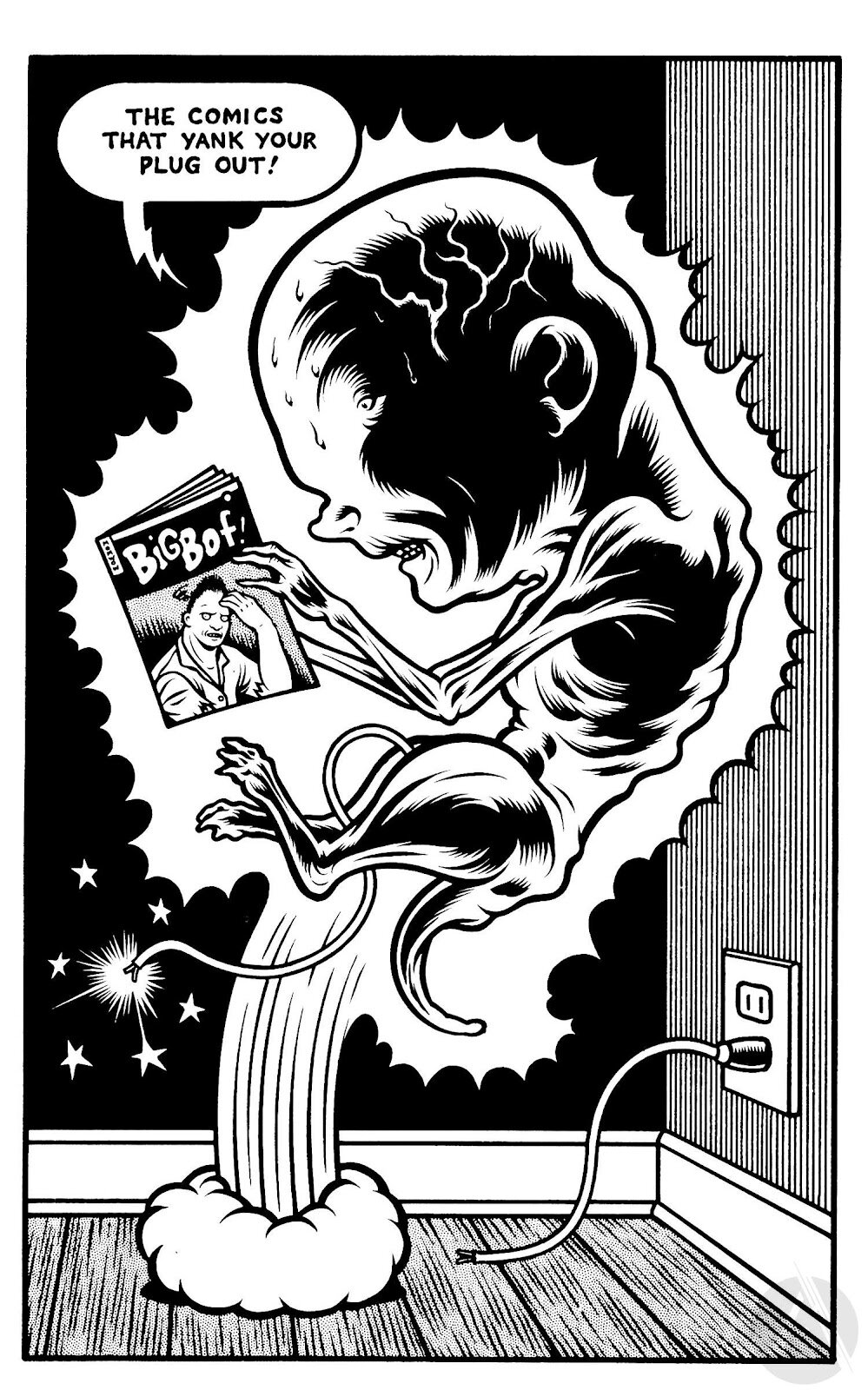
A page by Charles Burns from BLAB! no. 2, Summer 1987, Monte Comix Productions.

Ever since I started keeping my diary of remorse, my remorse has evaporated | Nancy Lemann

February 10, 2022

Ever since I started keeping my diary of remorse, my remorse has evaporated. The answer to a personality problem or spiritual malaise is to keep a diary of it because then the quantity you are quantifying seems to disappear. Therefore I should go on to keep a diary of other troubling quantities. Such as Diary of Lassitude, Lack of Motivation, Failure to Act, etc.

The lockdowns start and stop and then I go back and forth to my odd and unlikely hometown. I see that my interest in my volunteer job (of monitoring justice in the New Orleans criminal courts) is largely prurient. For this I should have remorse but don’t. When I get my docket in the morning I compare it to all the other dockets, pining that they are more exciting. Judge DeBoes has murders, rapes, and kidnappings on his docket today, not to mention a case of False Personation (???), Malfeasance in Office, and False Imprisonment, but I am not assigned to his courtroom. My consolation however is that today I am in the courtroom of the piping mad personality-ridden Judge Hollingsworth.

The defendants in New Orleans always have names like:

Jockward Jones
Curry Carter
Stokes Meilleur
King Malveaux
Narvelle Perrin
Bingo Fox
Margaret Lemmonier

And the judges have names like that too.

Talk about a vanished world. The grandiose criminal court building. The old-time bars and cafés amid the greenery.

From “Diary of Remorse.” Published in Paris Review, no. 241, Sept. 2022.

Initiation — F. Scott Hess

Initiation, 1999 by F. Scott Hess (b. 1955)

Sunday Comix

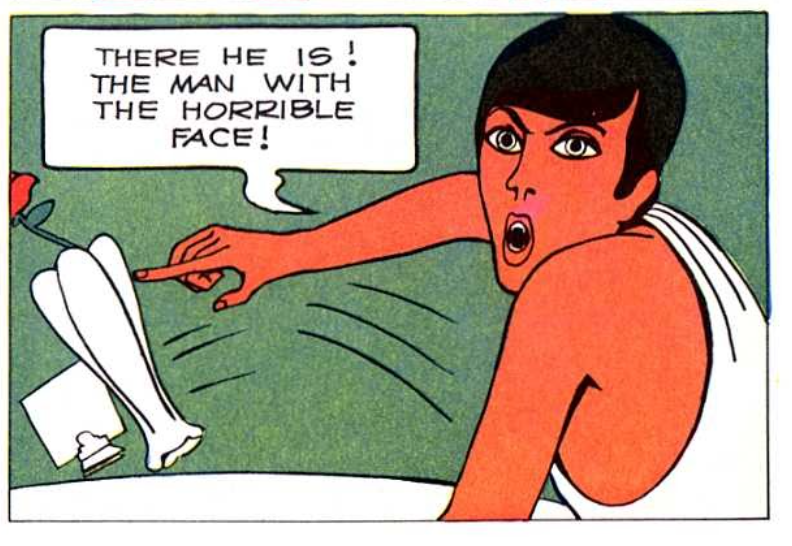
A panel from The Adventures of Jodelle by Guy Peellaert (art) and Pierre Bartier (script), Le Terrain Vague, 1966. English translation by Richard Seaver, Grove Press, 1967. Reprinted by Fantagraphics, 2013.

Dear Jane — Robin F. Williams

Dear Jane, 2024 by Robin F. Williams (b. 1984)

“0,” a poem by David Berman

“0”

by

David Berman

first published in Caliban #8, 1990


On the very first day Jah gave light,
and on the second he made the sun and the stars.
It wasn’t long before things were jumping out of the river.

Later there were some wars, mostly soft and bloodless,
with snow falling on the sleeping tanks
and pieces of field glued to their wheels.

No longer all right to eat our young,
we made the Empire State Building and threw things off it,
then drank sidecars and Harvey Wallbangers until 1961.

People were heard to say that the world doesn’t care,
that the walls don’t listen, and the stars only shine on us
because we’re in the way of their light,

but the world continued to spin on its sturdy axis,
and underneath the Christmas trees the trains still ran on time,
while people united in sexual congress let pride feed.

Sunday Comix

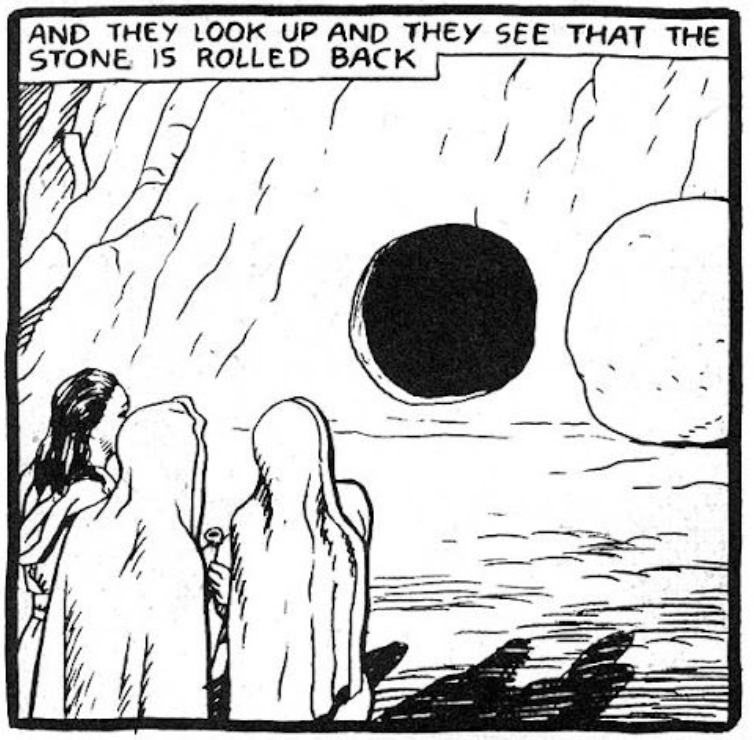
From “Mark 14:53-16:20” by Chester Brown. Published in Yummy Fur #14, January 1989, Vortex Comics.

“The Resurrection Morning,” an Easter story by Winifred Holtby

“The Resurrection Morning”

by

Winifred Holtby


When Mr Barrow died, none of us knew quite what to say to Mrs Barrow. ‘Deepest sympathy in your loss’ perhaps was best, because you can sympathise with fortune as well as with misfortune, and loss may be good riddance of bad rubbish.

Not that Mr Barrow was exactly bad rubbish. The obituary notices called him a ‘prominent citizen of Kingsport,’ and he had been a town councillor and a sidesman at St Agatha’s Church, and left a tidy sum invested in War Loan and corporation stock. A pious man, the vicar of St Agatha’s called him, and sent a cross two feet by one, particularly handsome. Mrs Barrow, however, was not pious. After ten years of married life she had abandoned her belief in God. Her husband could insist upon her attending church, but he could not prevent her from sitting down whenever the rest of the congregation stood up, even during the Creeds. What he said to her after the services we never knew; but Mrs Barrow told me that if the Almighty was such that He could appreciate her husband, Mr Barrow was welcome to Him.

I watched her at the funeral. She was over seventy, a worn-out little woman in her new black. But she held her chin up and her hymn book in both hands, and sang with the perfect confidence of stalwart incredulity:

‘On the resurrection morning

Soul and body meet again . . .’

Of course there was no Resurrection Morning, and there was no God, and Mr Barrow was safely hammered down into his grand mahogany coffin with brass handles. Continue reading ““The Resurrection Morning,” an Easter story by Winifred Holtby” →

“Pieces (III)” — Katherine Dunn

“Pieces (III)”

by

Katherine Dunn

from the collection

Near Flesh


It was a numb, starless night in the jungle. They were dug in when the attack came, but Davey’s partner in the foxhole was killed by the first rattle of fire. When the small man in the black pajamas slipped into the hole, Davey knifed him and kicked him and then stood on the corpse, listening, waiting for more. At the first seep of dawn Davey sliced off the enemy’s right ear and buttoned it into his breast pocket. Then he dragged his buddy’s body back to the unit. Davey was eighteen at the time.

Later, back home, Davey’s mother found the ear wrapped in tinfoil in his drawer. She threw it out and screamed at him. He was drinking a lot and getting into fights, so it wasn’t just the ear that set her off.

After a while his war dreams sifted away and left only the one dream of the ear. The earless one wanted something from him. This was the message. Davey read about Eastern religions until he understood that the earless one couldn’t go to his heaven with a piece missing. He would wander the dreamscape forever.

Davey felt bad about it but other things were happening—heroin and politics and motorcycles and women. There were sojourns in the Veterans Hospital to sober up and read. There was some college time, several jobs. Sometimes he wouldn’t dream at all. Other times the earless one was with him every night for weeks. During one of those sieges he went to a refugee temple and asked the priest how to make amends. The priest said Davey would have to figure that out for himself.

He was thirty-three then. He worked clearing trails in the steep, wooded parks. The crew chief was a pacifist who’d spent the war in jail. The two became friends. Davey usually worked hard but mornings after a bender he’d flop in a grassy clearing and sleep. The chief understood and didn’t bother him.

One morning Davey took his sharpest ax and drifted away from the rest of the crew. He spread his left hand out on a tree stump. Breathing carefully he lifted the ax and cut off the smallest finger.

Lifting it, he offered it to the earless one. “Fair trade, man,” he said. “Peace, man.” He tossed the finger into the brush.

At the hospital he tried to explain why he was so happy. But the crew chief told the admitting nurse it was an accident on the job, that the wounded man was in shock, delirious. He whispered harshly into Davey’s ear, “Shut the fuck up. Workers’ comp won’t pay for spiritual atonement.” Davey shut up, but he couldn’t stop grinning.

Sunday Comix

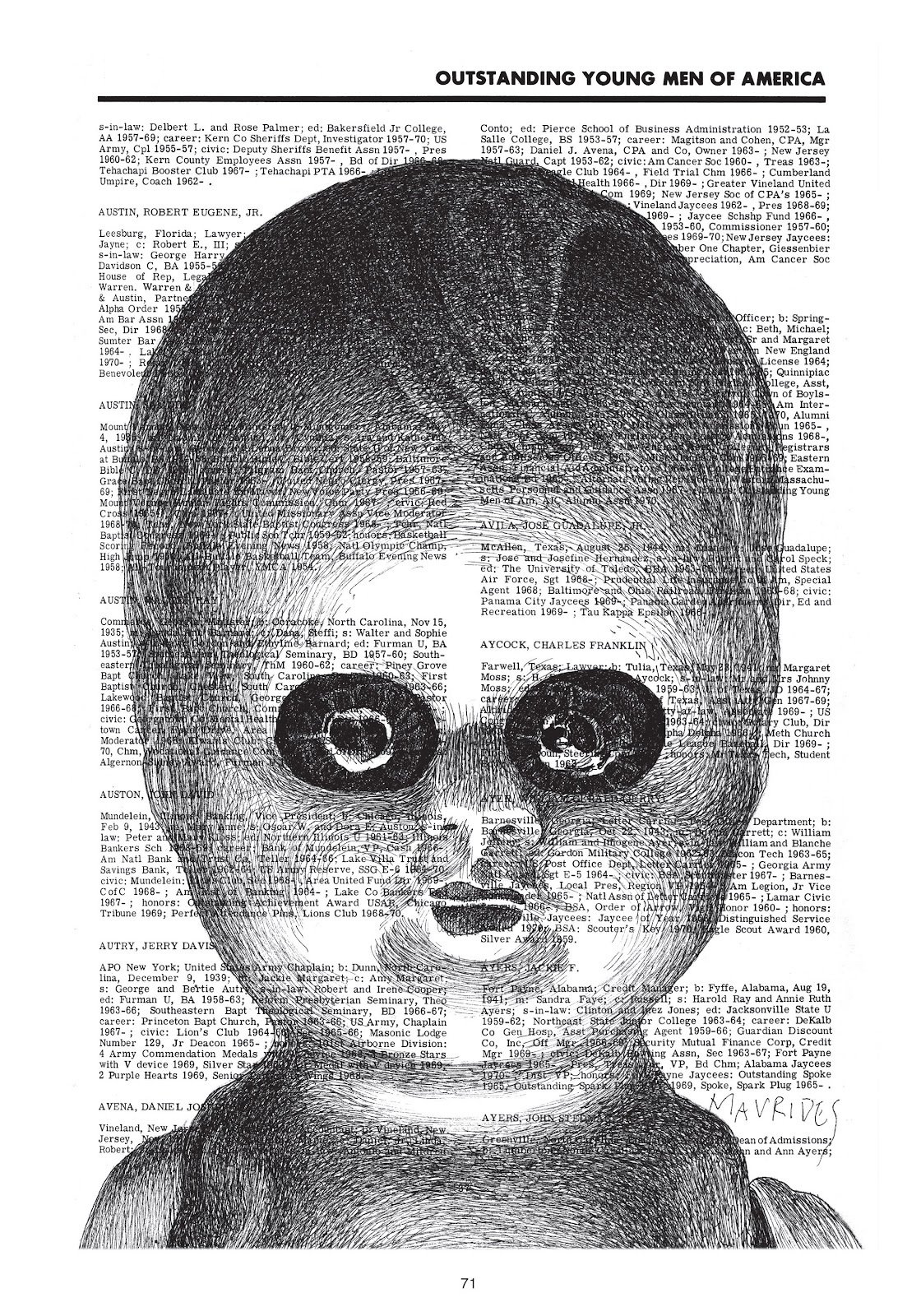
From “Outstanding Young Men of America” by Paul Mavrides. Published in Zap Comix #16, Feb. 2016, Fantagraphics.

Brodsky/Crumley (Books acquired, 17 Mar. 2026)

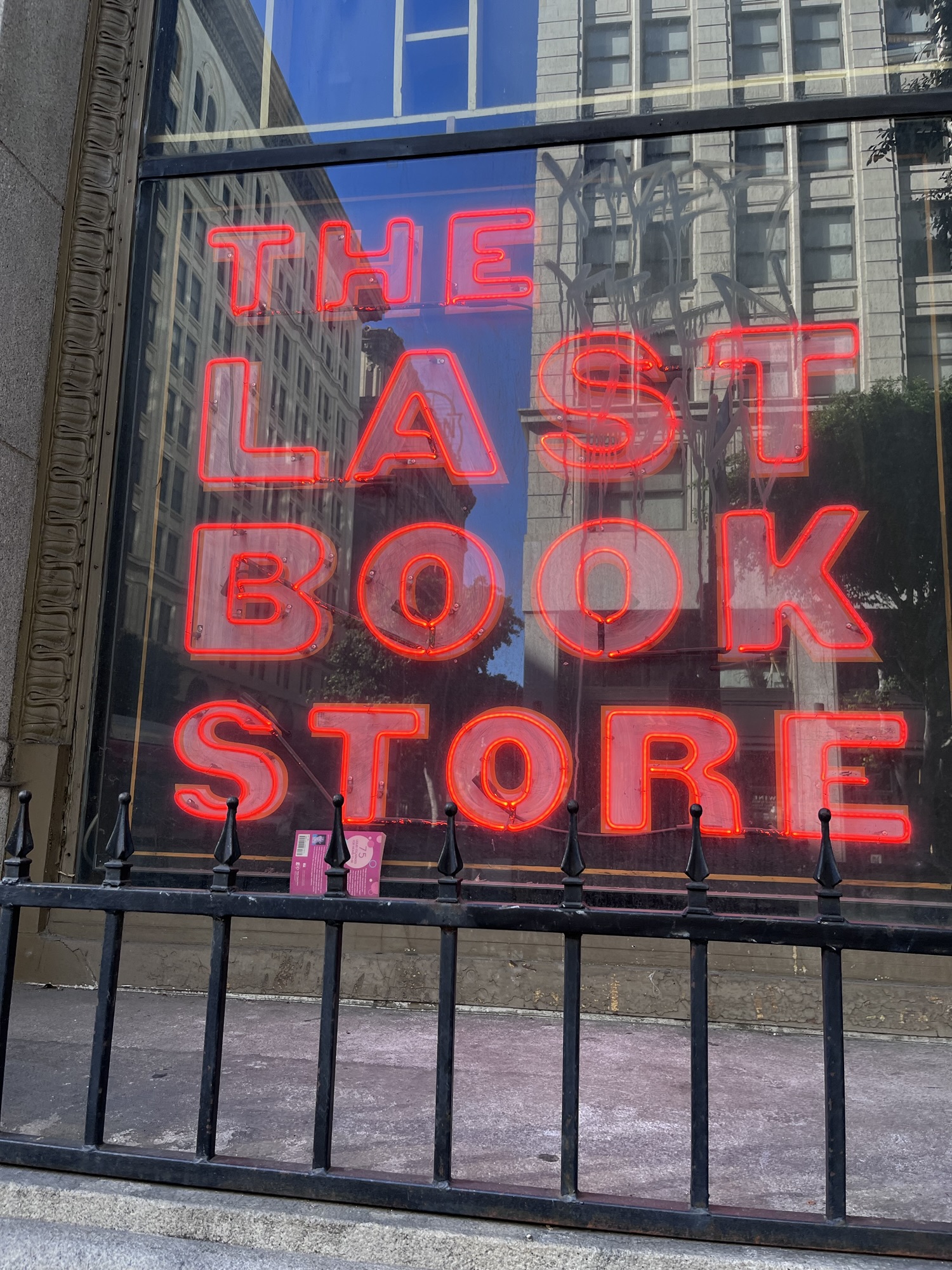
We — that is, my family of four — split a nice spring break between heatwaved Los Angeles and more temperate Santa Barbara last week. I managed to squeeze in a visit to The Last Bookstore, which I hadn’t visited since 2017.

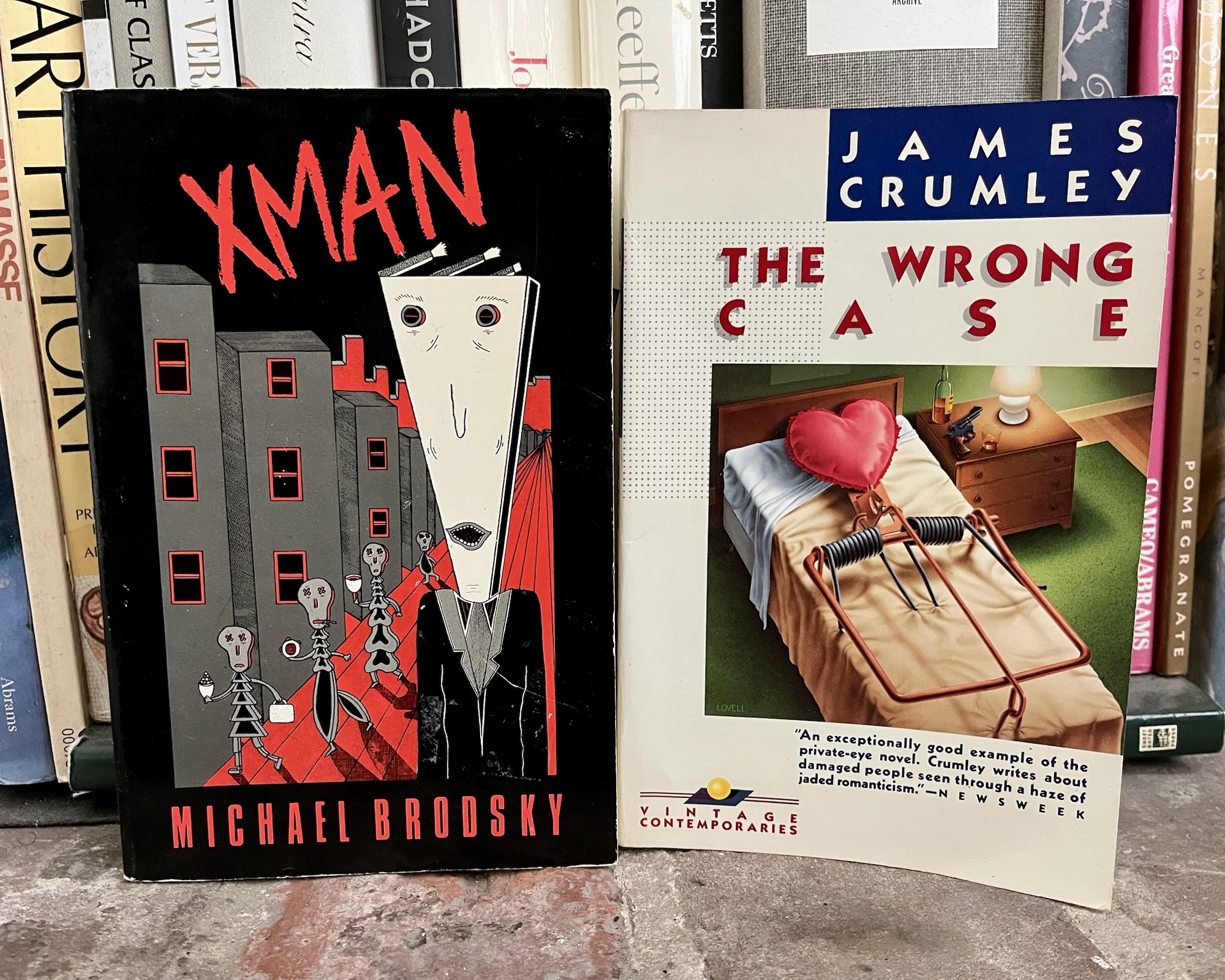
I keep a little list of books and authors to search for; one of these is the long-out-of-print 1987 cult novel Xman by Michael Brodsky. I found it about two minutes in, under “B” (duh) in gen fic for the steep steep price of five U.S. dollars. I also picked up another James Crumely novel, part of the Vintage Contemporaries series.

We — that is my son and I — also visited Skylight Books (after an unexpected pilgrimage to the Figure 8 wall on Sunset — the mural from the cover of that Elliott Smith record — we were just walking by it and my son who is a Fan lost his shit). Skylight Books is very very cool, with a great selection of comix, art books, zines, &c., but I failed to pick anything up, mostly because I was hungry and cranky.

We also visited LACMA, where I was disappointed that the many of the paintings I had seen on my previous visit were not currently on display (including Georges de la Tour’s Magdalen with Smoking Flame which knocked my socks off when I saw it up close all those years ago).

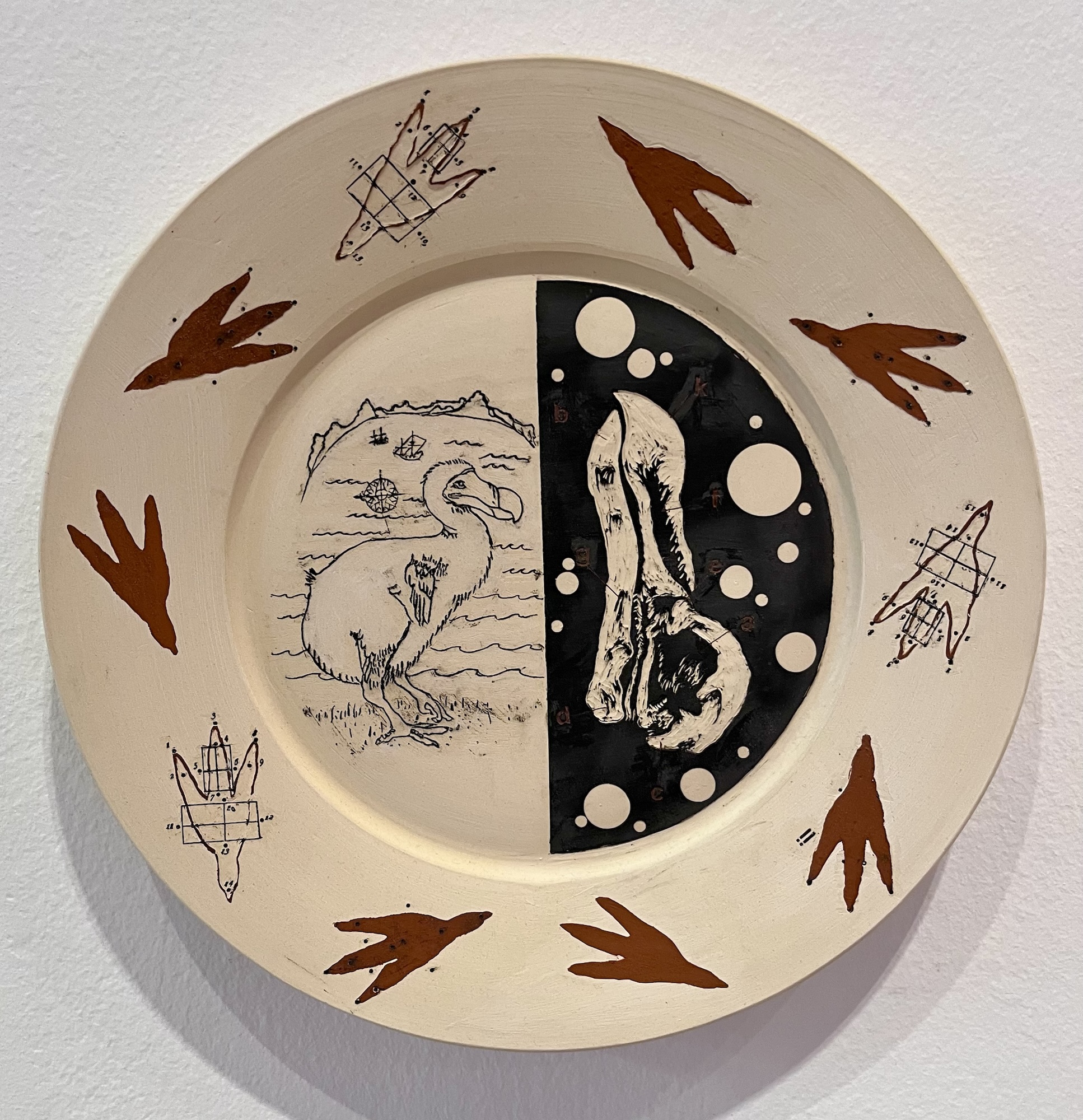
There was a cool exhibit by the contemporary artist Tavares Strachan. One of the segment of the exhibit is a series of painted plates, several of which depict extinct species. I couldn’t help think of Thomas Pynchon’s riff on the poor dodo in Gravity’s Rainbow when I saw this plate:

“The Question,” a very short story by Stuart Dybek

“The Question”

by

Stuart Dybek


A mime is climbing stairs. He climbs reluctantly, each leaden step an act of resignation, which may explain why, despite his effort, he’s not ascending. He no more wants to reach the top than a man mounting another kind of stage—a platform where an executioner stands waiting with an ax.

Or perhaps the executioner is seated in a portable director’s chair, puffing through a slit in his hood the cigarette meant for the condemned while stropping the blade of a guillotine that has just failed the cabbage test.

Or perhaps the stairs lead to a hangman tying a knot with the care that his wife expended just that morning braiding their daughter’s hair.

The mime climbs and climbs, but cannot conquer the three-step flight that peaks in the space reserved for him in the mercy seat.

Or perhaps … but wait!

There’s been an error in interpretation. The mime isn’t climbing. All along he’s been marching in place. Still, from his body language, not to mention the look engraved on his face, it’s clear that misinterpretation is not to be confused with a stay of execution.

Okay, then the mime is marching—marching down a buzzing, fluorescent corridor in the bowels of a prison, toward a gurney for an operation that requires only an anesthesiologist and a chaplain.

He is marched at dawn across a deserted square to a send-up of pigeons, and takes his place against the riddled wall that faces an unshaven, disheveled firing squad. Their hungover master of ceremonies, a captain, smelling of women, stands sipping menudo from a Dunkin’ Donuts coffee cup, sheepishly aware that he has just smoked the cigarette prop. Instead of a sword, the captain raises a blood-red parasol that theatrically pops open. Instead of a sidearm to deliver the coup de grâce, he’s holstered a cell phone that is carrying on its own nonstop, one-way, outraged conversation. As for the blindfold, well, each member of the audience seems to be wearing it. On further inspection, each soldier in the firing squad is wearing one, too. And yet, despite the disordered proceedings, and just before the Ready, aim, etc., command, the captain remembers to ask, “Any last words?”