Ezra Pound’s ABC of Reading, hardly short on strong opinions, contains a fantastic chapter on Chaucer, who Pound submits is superior in some ways to Shakespeare. A taste—
Sloth is the root of much bad opinion. It is at times difficult for the author to retain his speech within decorous bounds.
I once heard a man, how has some standing as writer and whom Mr. Yeats was wont to defend, assert that Chaucer’s language wasn’t English, and that one ought not to use it as basis of discussion, ETC. Such was the depth of London in 1910.
Anyone who is too lazy to master the comparatively small glossary necessary to understand Chaucer deserves to be shut out from the reading of good books for ever.
As to the relative merits of Chaucer and Shakespeare, English opinion has been bamboozled for centuries by a love of the stage, the glamour of the theatre, the love of bombastic rhetoric and of sentimentalizing over actors and actresses; these, plus the national laziness and unwillingness to make the least effort, have completely obscured values. People even read translations of Chaucer into a curious compost, which is not modern language but which uses a vocabulary comprehended of sapheads
Wat se the kennath
Chaucer had a deeper knowledge of life than Shakespeare.
Let the reader contradict that after reading both authors, if he chooses to do so.
Happy Mother’s Day! Sure, it’s a marketing scam, but we all love moms, right?
Fascinating moms populate literary fiction, and there’s no shortage of great baddies, evil stepmothers, and distant headcases in our favorite literature—but we thought we’d focus instead on some of the moms that seem to be, you know, really great moms.
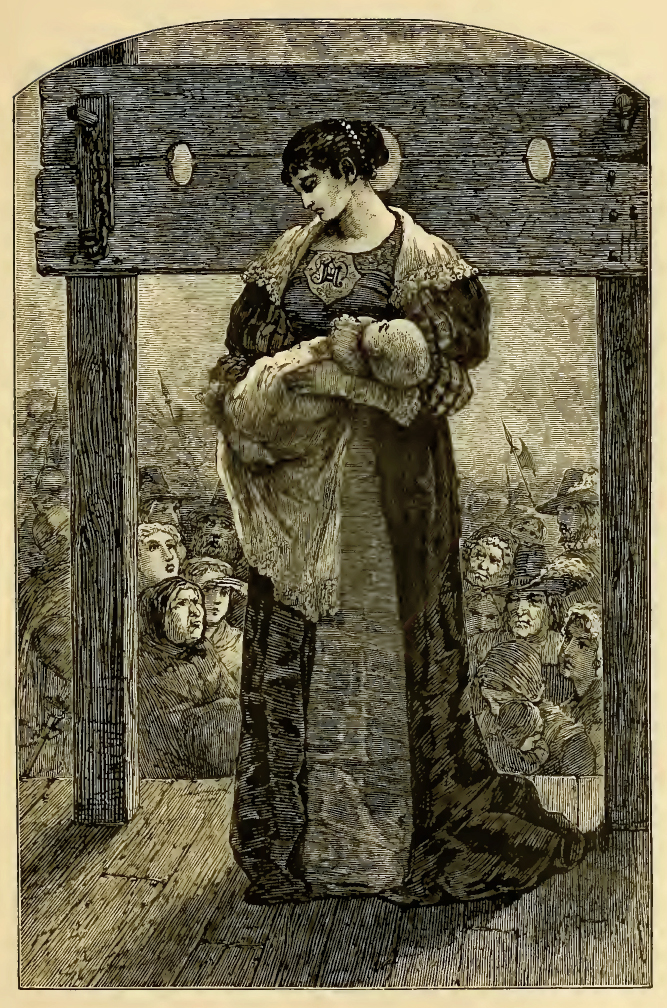
"Hester Prynne & Pearl before the stocks", an illustration by Mary Hallock Foote from an 1878 edition of The Scarlet Letter
1. Hester Prynne, The Scarlet Letter (Nathaniel Hawthorne)
Hester Prynne is a bundle of contradictions—sin and salvation, radical freedom and reactionary repression, hope and despair—all bound to a deeply patriarchal society that had to control women’s bodies at all turns. Fortunately, there’s no analog for the Puritans’ judgmental, shame-based behavior in our own society (har har). Hester and her daughter Pearl, living in a cottage outside of Boston, are outside the dominant social order. It’s a form of punishment that paradoxically frees the pair, allowing Pearl to grow into a kind of nature spirit—impish and willful, to be sure, but also artistic and able to express herself. Although Pearl is the human doubling of Hester’s titular letter, she’s ultimately no badge of shame, but rather a treasure in her mother’s eyes.
2. Penelope, The Odyssey (Homer et al.)
Patient Penelope weaving and unweaving her husband’s shroud—is she the faithful wife, waiting for Odysseus who’s having adventures asea? Or is she cunningly keeping her son safely alive from the predatory suitors who would certainly want to get him out of the way ASAP. Penelope is an extraordinary and ambiguous figure, but one thing is clear: she loves her son Telemachus.
3. Molly Bloom, Ulysses (James Joyce)
Speaking of Penelope . . . Molly might not be the most faithful wife, but damn if she isn’t a hot mama.
4. Ma Joad, The Grapes of Wrath (John Steinbeck)
Ma Joad never gets a first name in Grapes—she’s an elemental matriarchal force that keeps the family together against every kind of pain. The final scene of this novel is utterly amazing. When Rose of Sharon’s daughter dies in childbirth, Ma Joad directs the mother to nurse a man dying from hunger. All the while, a flood of epic proportions looms. Ma Joad’s determination to live transcends Darwinian impulses here; against the backdrop of infanticide, economic and social genocide, and natural disaster, she still directs her family to a loving, Emersonian course of action.
5. Grendel’s mother, Grendel (John Gardner)
In John Gardner’s fabulous retelling of the Beowulf saga from Grendel’s POV, we find a deeply alienated young man who, try as he might, cannot communicate with the plants and animals around him. Grendel should be a thing of nature, but he is a thinking thing, a thing with a conscience, a soul. He can understand men but they cannot understand him. In one of the book’s saddest conceits, Grendel cannot communicate through speech with his mother, who in many senses seems a creature apart from him. Gardner here dramatizes the radical alienation that all children must feel at some point for their mothers, an alterity grounded in the paradox that, hey, your mom gave birth to you—you came out of her, metaphorically, sure, but also, like, really. Even though Mama Grendel can’t speak to her son, she protects and lovingly cares for him, splitting a few skulls here and there in the process. Motherhood is tough.
2. Of a tree without mentioning the name of the tree (larch, pine, etc.) so that the reader will not mistake it for the description of some other kind of tree.
3. Try some object in the classroom.
4. Describe the light and shadow on the school-room clock or some other object.
5. If it can be done without breach of the peace, the pupil could write descriptions of some other pupil. The author suggests that the pupil should not describe the instructor, otherwise the description might become a vehicle of emotion, and subject to more complicated rules of composition than the class is ready to cope with.
In all these descriptions the test would be accuracy and vividness, the pupil receiving the other’s paper would be the gauge. He would recognize or not recognize the object or person described.
Rodolfo Agricola in an edition dating from fifteen hundred and something says one writes: ut doceat, ut moveat, ut delectet, to teach, to move or to delight.
A great deal of bad criticism is due to men not seeing which of these three motives underlies a given composition.
The converse processes, not considered by the pious teachers of antiquity, would be to obscure, to bamboozle or mislead, and to bore.
The reader or auditor is at liberty to remain passive and submit to these operations if he so choose.
A sample of Roberto Bolaño’s short essay “Translation Is an Anvil” (from New Directions’ forthcoming Between Parentheses, a collection of Bolaño’s essays, newspaper columns, and other ephemera)——
How to recognize a work of art? How to separate it, even if just for a moment, from its critical apparatus, its exegetes, its tireless plagiarizers, its belittlers, its final lonely fate? Easy. Let it be translated. Let its translator be far from brilliant. Rip pages from it at random. Leave it lying in an attic. If after all of this a kid comes along and reads it, and after reading makes it his own, and is faithful to it (or unfaithful, whichever) and reinterprets it and accompanies it on its voyage to the edge, and both are enriched and the kid adds an ounce of value to its original value, then we have something before us, a machine or a book, capable of speaking to all human beings; not a plowed field but a mountain, not the image of a dark forest but the dark forest, not a flock of birds but the Nightingale.
And what’s romance? Usually, a nice little tale where you have everything As You Like It, where rain never wets your jacket and gnats never bite your nose and it’s always daisy- time. As You Like It and Forest Lovers, etc. Morte D’Arthur.
Hawthorne obviously isn’t this kind of romanticist: though nobody has muddy boots in The Scarlet Letter, either.
But there is more to it. The Scarlet Letter isn’t a pleasant, pretty romance. It is a sort of parable, an earthly story with a hellish meaning.
All the time there is this split in the American art and art- consciousness. On the top it is as nice as pie, goody-goody and lovey-dovey. Like Hawthorne being such a blue-eyed darling, in life, and Longfellow and the rest such sucking- doves. Hawthorne’s wife said she ‘never saw him in time’, which doesn’t mean she saw him too late. But always in the ‘frail effulgence of eternity’.
Serpents they were. Look at the inner meaning of their art and see what demons they were.
You must look through the surface of American art, and see the inner diabolism of the symbolic meaning. Otherwise it is all mere childishness.
That blue-eyed darling Nathaniel knew disagreeable things in his inner soul. He was careful to send them out in disguise.
Always the same. The deliberate consciousness of Americans so fair and smooth-spoken, and the under-consciousness so devilish. Destroy! destroy! destroy! hums the under-consciousness. Love and produce! Love and produce! cackles the upper consciousness. And the world hears only the Love-and- produce cackle. Refuses to hear the hum of destruction under- neath. Until such time as it will have to hear.
The American has got to destroy. It is his destiny. It is his destiny to destroy the whole corpus of the white psyche, the white consciousness. And he’s got to do it secretly. As the growing of a dragon-fly inside a chrysalis or cocoon destroys the larva grub, secretly.
Though many a dragon-fly never gets out of the chrysalis case: dies inside. As America might.
So the secret chrysalis of The Scarlet Letter, diabolically destroying the old psyche inside.
Be good! Be good! warbles Nathaniel. Be good, and never sin! Be sure your sins will find you out..
So convincingly that his wife never saw him ‘as in time’.
Then listen to the diabolic undertone of The Scarlet Letter.
AVC: In 20,000 years, could it be our culture that’s discovered in a cave somewhere?
WH: In 20,000 years, there will be significant things in the environment that will be preserved, like certain dams. Like Vajont Dam near Longarone [Italy], where there was this catastrophic event almost 50 years ago now. An incredibly massive landslide came down into the lake. The entire lake, over 50 billion cubic meters, shot up into the air in a tsunami of 700 feet that came down in this gorge and wiped out the town of Longarone. I have studied the place over and over. I do my pilgrimages to the place. At its base, [the dam] is something like a hundred feet thick. The steel-reinforced concrete. The whole thing is about 180 meters at its highest, and it withstood the landslide coming into it. It’s still intact, and most of it will be intact hundreds of thousands of years from now. So in the future, when people are looking for the Neanderthals of the 21st century, they will see our traces standing in open air. They will see the sarcophagus of Chernobyl, which is going to be built over it now. It will be there in 20,000 years. They won’t have to search in a cave.

 Biblioklept