Roberto Bolaño on Blood Meridian

A slice of Roberto Bolaño’s review of Cormac McCarthy’s Blood Meridian (from New Directions’ forthcoming Between Parentheses, a collection of Bolaño’s essays, newspaper columns, and other ephemera)——

Blood Meridian is also a novel about place, about the landscape of Texas and Chihuahua and Sonora; a kind of anti-pastoral novel in which the landscape looms in its leading role, imposingly—truly the new world, silent and paradigmatic and hideous, with room for everything except human beings. It could be said that the landscape of Blood Meridian is a landscape out of de Sade, a thirsty and indifferent landscape ruled by strange laws involving pain and anesthesia, laws by which time often manifests itself.

Sally Potter and Tilda Swinton Discuss Their Film Orlando

Who’s Afraid of Kathy Acker? (Film Trailer)

“Now I Was a Great Squid God” — A Weird Passage from Jonathan Littell’s Weird Novel, The Kindly Ones

I’ve been listening to  an audiobook of Jonathan Littell’s strange novel about an SS officer, The Kindly Ones, and this passage made me dig out my paperback copy in order to share the weirdness—

Finally I dozed off and had a strange, striking dream. Now I was a great Squid God, and I was ruling over a beautiful walled city of water and white stone. The center, especially, was all water, and tall buildings rose up all around. My city was peopled with humans who worshipped me. I had delegated part of my power and authority to one of them, my Servant. But one day I decided I wanted all these humans out of my city, at least for a while. The order went out, propagated by my Servant, and immediately droves of humans started fleeing out the gates of the city, to wait in hovels and shantytowns out in the desert beyond the walls. But they didn’t leave fast enough to my liking, and I began to thrash violently, churning back up the water of the center with my tentacles, then coiling them back and bearing down on swarms of terrible humans, lashing out and roaring with my terrible voice: Out! Out! Out!” My Servant ran frantically about, commanded, guided, prompted the sluggish, and in this way the city emptied out. But in the buildings closest to the walls and farthest from the water where I was giving vent to my divine rage, some groups of humans were not heeding my commands. These were foreigners, not really aware of my existence, of my power over this city. They had heard the evacuation orders, but thought them ridiculous and were ignoring them. My Servant had gone to see these groups one after another, to convince them diplomatically to leave: such as this conference of Finnish officers, who protested that they had rented teh hotel and conference room and paid in advance, and wouldn’t leave just like that. With them, my Servant had to lie skillfully, explaining for instance that there was an alert, a grave security problem, and that they had to evacuate for their own safety. I found this deeply humiliating, since the real reason was my Will; they were supposed to leave just because I wanted it, not because they were coaxed. My rage increased. I thrashed about and roared more violently than ever, sending great waves crashing through the city.

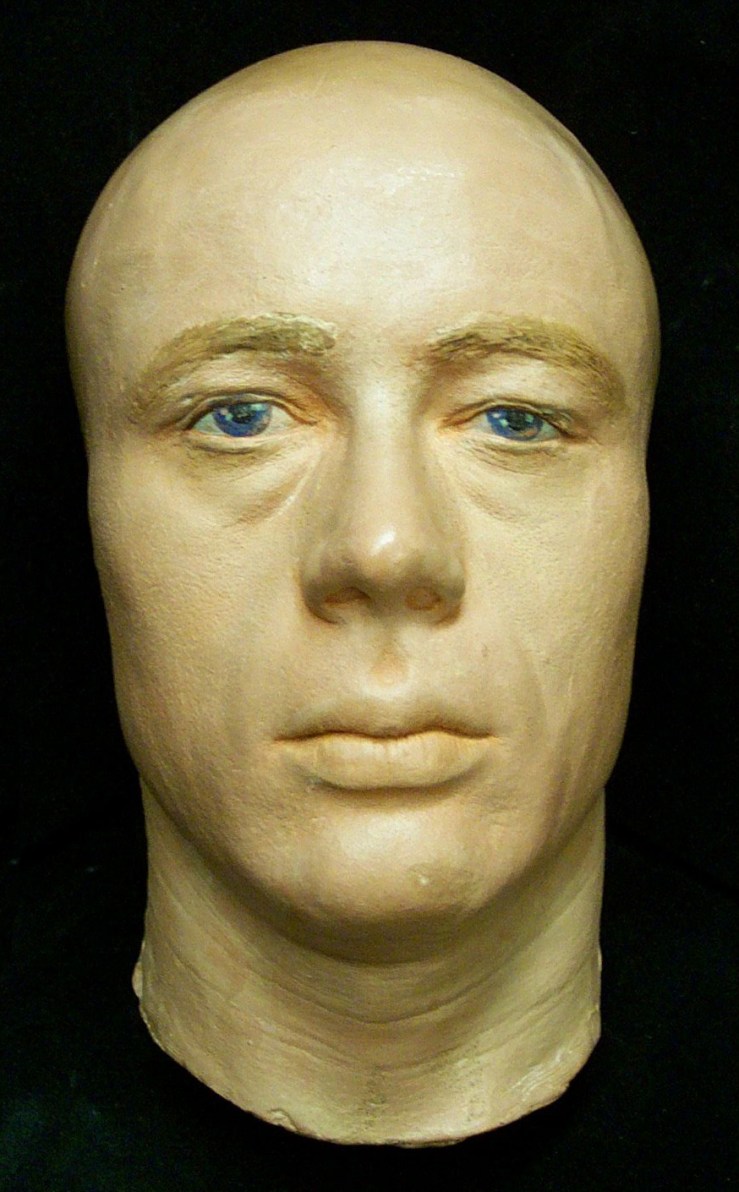
James Dean’s Death Mask

“After Reading a Child’s Guide to Modern Physics” — W.H. Auden

“After Reading a Child’s Guide to Modern Physics” by W. H. Auden—

If all a top physicist knows
About the Truth be true,
Then, for all the so-and-so’s,
Futility and grime,
Our common world contains,
We have a better time
Than the Greater Nebulae do,
Or the atoms in our brains.

Marriage is rarely bliss
But, surely it would be worse
As particles to pelt
At thousands of miles per sec
About a universe
Wherein a lover’s kiss
Would either not be felt
Or break the loved one’s neck.

Though the face at which I stare
While shaving it be cruel
For, year after year, it repels
An ageing suitor, it has,
Thank God, sufficient mass
To be altogether there,
Not an indeterminate gruel
Which is partly somewhere else.

Our eyes prefer to suppose
That a habitable place
Has a geocentric view,
That architects enclose
A quiet Euclidian space:
Exploded myths – but who
Could feel at home astraddle
An ever expanding saddle?

This passion of our kind
For the process of finding out
Is a fact one can hardly doubt,
But I would rejoice in it more
If I knew more clearly what
We wanted the knowledge for,
Felt certain still that the mind
Is free to know or not.

It has chosen once, it seems,
And whether our concern
For magnitude’s extremes
Really become a creature
Who comes in a median size,
Or politicizing Nature
Be altogether wise,
Is something we shall learn.

J.R.R. Tolkien, In His Own Words (1968 BBC Documentary)

From the BBC series In Their Own Words: British Authors. Fantastic 1968 documentary: Tolkien walks about Oxford, shares insights on his work, looks at trees, and contemplates his love of beer. Great stuff.

“Toolin’ Around” — Barry Hannah’s Tuscaloosa

Barry Hannah takes John Oliver Hodges on a tour of Tuscaloosa and shows him the shack where he wrote Ray; he also shares some wild stories from his alcoholic past. Read more at the Oxford American.

We Peruse the Latest Issue of Oxford American: Barry Hannah, Eudora Welty, Black Republicans, and Fried Green Tomatoes

The spring issue of Oxford American is out now, sporting a Barry Hannah cover. In addition to a review of Hannah’s Long, Last, Happy: New and Collected  Stories, the issue features eight pages of remembrances by Hannah’s students, fans, and friends (along with pictures, of course). In fact, John Oliver Hodges’s review of Long, Last, Happy is really a memoir itself. Here’s an anecdote he shares—

Barry called me his amanuensis, and as such I heard him talk a bit about his feelings on fathers and sons and beautiful women, heartache, football, stool softener, and Krystal hamburgers. On the day that Ole Miss beat Gainesville, 31-30, it happened that we were in Tuscaloosa. To celebrate the win, we drove around the town in his silver Chrysler, his pistol in its holster under the seat. He gave me the grand tour, and as I drove, I videotaped him talking beside me, drinking a Budweiser tallboy (a rare treat to lessen the abiding pain), and smoking a USA, his brand. As we approached the green shack by the tracks where he wrote Ray, he said, “It was probably the saddest time in my life.”

(Quick editorial note: I’m glad that Hannah and Hodges could celebrate Ole Miss’s narrow victory, but Tebow and the Gators did go on to win every other game of the season, including the SEC Championship and the BCS title bowl. So there).

In addition to the Hannah stuff, there’s a great essay on fried green tomatoes, a look at what it means to be a black Republican, an appreciation of Southern hip-hop, stories and poems, and a series of letters by Eudora Welty, including her hilarious application to The New Yorker. Good stuff.

While I’m shilling for Oxford American, I might as well point out that they’re hosting a Summit for Ambitious Writers this June. It’s on top of a freaking mountain! Biblioklept fave Wells Tower will be there. Sounds cool.

“The Ego Is the Enemy of Imagination” — David Milch on Writing

“I Rarely Remember a Book About Which I Have Had Such Violent Arguments” — W.H. Auden Reviews J.R.R. Tolkien

From the Oh, This Exists? Department — W.H. Auden’s 1956 New York Times review of J.R.R. Tolkien’s The Return of the King. It’s a fantastic review that defends Tolkien’s literary authenticity against his many haters, using Erich Auerbach’s groundbreaking work Mimesis as a central arguing point. Here’s Auden’s intro, but again, I recommend reading the whole review—

In “The Return of the King,” Frodo Baggins fulfills his Quest, the realm of Sauron is ended forever, the Third Age is over and J. R. R. Tolkien’s trilogy “The Lord of the Rings” complete. I rarely remember a book about which I have had such violent arguments. Nobody seems to have a moderate opinion: either, like myself, people find it a masterpiece of its genre or they cannot abide it, and among the hostile there are some, I must confess, for whose literary judgment I have great respect. A few of these may have been put off by the first forty pages of the first chapter of the first volume in which the daily life of the hobbits is described; this is light comedy and light comedy is not Mr. Tolkien’s forte. In most cases, however, the objection must go far deeper. I can only suppose that some people object to Heroic Quests and Imaginary Worlds on principle; such, they feel, cannot be anything but light “escapist” reading. That a man like Mr. Tolkien, the English philologist who teaches at Oxford, should lavish such incredible pains upon a genre which is, for them, trifling by definition, is, therefore, very shocking.

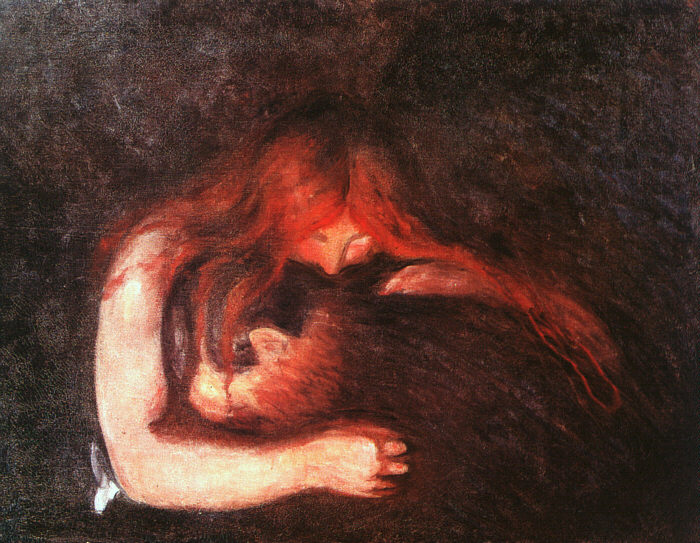
Vampire — Edvard Munch

“Good Luck Editing This” — Outtakes from David Foster Wallace’s ZDF Interview

Cormac McCarthy and Werner Herzog on Science Friday (In Case You Missed It (Like We Did))

Cormac McCarthy and Werner Herzog, along with physicist Lawrence Krauss on NPR’s Science Friday with Ira Flatow, in case you missed it. Which I did.

Public Library: American Commons — Robert Dawson’s Images of American Libraries

Check out Robert Dawson’s images of American libraries at Places. Evocative and even poignant in an age when libraries are under threat in this country, Dawson’s images remind us that libraries are, on one hand a monument to our culture and civilization, and, on the other hand, often the outposts of that civilization.
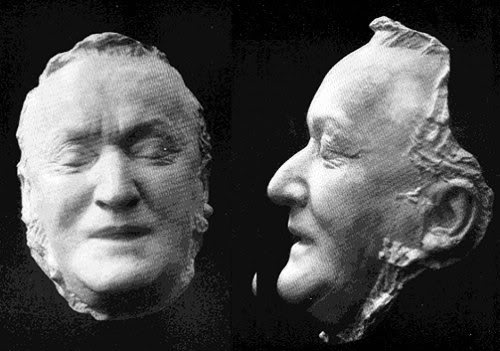
Wagner’s Death Mask

RIP Sidney Lumet

Sidney Lumet, who directed dozens of classic films, including 12 Angry Men, Dog Day Afternoon, Serpico, and Network, has died at the age of 86. We are big fans of his fine films, including the last film he made, 2007’s underappreciated Before the Devil Knows You’re Dead (heck, we even liked his totally unnecessary remake of Gloria). Here’s Lumet talking about 12 Angry Men