“Twain Is the Day, Melville the Night” — Roberto Bolaño on U.S. Writers

The following excerpt comes from Raul Schenardi’s 2003 interview with Roberto Bolaño, conducted at the Turin Book Fair just months before the author’s death. The interview is written in Italian (although I’m not sure if it was conducted in Italian). The translation work is the result of two programs (Google Translate and Babel Fish) and a few dictionaries; I also used this Spanish translation as a second source for comparison.

. . .  in all Latin American writers is an influence that comes from two main lines of the American novel, Melville and Twain. [The Savage] Detectives no doubt owes much to Mark Twain. Belano and Lima are a transposition of Huckleberry Finn and Tom Sawyer. It’s a novel that follows the constant movement of the Mississippi. . . . I also read a lot of Melville, which fascinates me. Indeed, I flirt with the belief that I have a greater debt to Melville than Twain, but unfortunately I owe more to Mark Twain. Melville is an apocalyptic author. Twain is the day, Melville  the night — and always much more impressive at night. In regard to modern American literature, I know it poorly. I know just up to the generation previous to Bellow. I have read enough of Updike, but do not know why; surely it was a masochistic act, as each page Updike brings me to the edge of hysteria. Mailer I like better than Updike, but I think as a writer, a prose writer, Updike is more solid. The last American writers I’ve read thoroughly and I know well are those of the “Lost Generation,” Hemingway, Faulkner, Scott Fitzgerald, Thomas Wolff.

“Therefore Good and Ill Are One”

“Therefore good and ill are one.” Heraclitus, Fragment 57

“There’s nothing either good nor bad, but thinking makes it so.” Shakespeare, Hamlet, II, ii

“Well, um, you know, something’s neither good nor bad but thinking makes it so, I suppose, as Shakespeare said.” Donald Rumsfeld

Power, Lies, and Batman — Slavoj Žižek on WikiLeaks

“Good Manners in the Age of WikiLeaks” is a new essay by philosophical muckraker Slavoj Žižek at The London Review of Books. In his intro (below), he points out why Christopher Nolan’s The Dark Knight (which we hated) is the signal film of 21st century politics and culture (thanks to A Piece of Monologue for the link) —

In one of the diplomatic cables released by WikiLeaks Putin and Medvedev are compared to Batman and Robin. It’s a useful analogy: isn’t Julian Assange, WikiLeaks’s organiser, a real-life counterpart to the Joker in Christopher Nolan’s The Dark Knight? In the film, the district attorney, Harvey Dent, an obsessive vigilante who is corrupted and himself commits murders, is killed by Batman. Batman and his friend police commissioner Gordon realise that the city’s morale would suffer if Dent’s murders were made public, so plot to preserve his image by holding Batman responsible for the killings. The film’s take-home message is that lying is necessary to sustain public morale: only a lie can redeem us. No wonder the only figure of truth in the film is the Joker, its supreme villain. He makes it clear that his attacks on Gotham City will stop when Batman takes off his mask and reveals his true identity; to prevent this disclosure and protect Batman, Dent tells the press that he is Batman – another lie. In order to entrap the Joker, Gordon fakes his own death – yet another lie.

The Joker wants to disclose the truth beneath the mask, convinced that this will destroy the social order. What shall we call him? A terrorist? The Dark Knight is effectively a new version of those classic westerns Fort Apache and The Man Who Shot Liberty Valance, which show that, in order to civilise the Wild West, the lie has to be elevated into truth: civilisation, in other words, must be grounded on a lie. The film has been extraordinarily popular. The question is why, at this precise moment, is there this renewed need for a lie to maintain the social system?

“She Dealt Her Pretty Words Like Blades” — Joyce Carol Oates on Emily Dickinson

JPL Hosts a Graphic Novel Workshop for Parents and Kids

For localish readers: Jacksonville Public Library will host a graphic novel workshop for parents and kids this Saturday. Info:

“Every Story Is a Showing Up” — David Milch on Writing

“We’ve Gotten Used to Death” — A Passage from Roberto Bolaño’s 2666

From Roberto Bolaño’s 2666, “The Part About Fate, pages 266-267:

“We’ve gotten used to death,” he heard the young man say.

“It’s always been that way,” said the white-haired man, “always.”

In the nineteenth century, toward the middle or the end of the nineteenth century, said the white-haired man, society tended to filter death through the fabric of words. Reading news stories from back then you might get the idea that there was hardly any crime, or that a single murder could throw a whole country into tumult. We didn’t want death in the home, or in our dreams and fantasies, and yet it was a fact that terrible crimes were committed, mutilations, all kinds of rape, even serial killings. Of course, most of the serial killers were never caught. Take the most famous case of the day. No one knew who Jack the Ripper was. Everything was passed through the filter of words, everything trimmed to fit our fear. What does a child do when he’s afraid? He closes his eyes. What does a child do when he’s about to be raped and murdered? He closes his eyes. And he screams, too, but first he closes his eyes. Words served that purpose. And the funny thing is, the archetypes of human madness and cruelty weren’t invented by the men of our day but by our forebears. The Greeks, you might say, invented evil, the Greeks saw the evil inside us all, but testimonies or proofs of this evil no longer move us. They strike us as futile, senseless. You could say the same about madness. It was the Greeks who showed us the range of possibilities and yet now they mean nothing to us. Everything changes, you say. Of course everything changes, but not the archetypes of crime, not any more than human nature changes. Maybe it’s because polite society was so small back then. I’m talking about the nineteenth century, eighteenth century, seventeenth century. No doubt about it, society was small. Most human beings existed on the outer fringes of society. In the seventeenth century, for example, at least twenty percent of the merchandise on every slave ship died. By that I mean the dark-skinned people who were being transported for sale, to Virginia, say. And that didn’t get anyone upset or make headlines in the Virginia papers or make anyone go out and call for the ship captain to be hanged. But if a plantation owner went crazy and killed his neighbor and then went galloping back home, dismounted, and promptly killed his wife, two deaths in total, Virginia society spent the next six months in fear, and the legend of the murderer on horseback might linger for generations. Or look at the French. During the Paris Commune of 1871, thousands of people were killed and no one batted an eye. Around the same time a knife sharpener killed his wife and his elderly mother and then he was shot and killed by the police. The story didn’t just make all the French newspapers, it was written up in papers across Europe, and even got a mention in the New York Examiner. How come? The ones killed in the Commune weren’t part of society, the dark-skinned people who died on the ship weren’t part of society, whereas the woman killed in a French provincial capital and the murderer on horseback in Virginia were. What happened to them could be written, you might say, it was legible. That said, words back then were mostly used in the art of avoidance, not of revelation. Maybe they revealed something all the same. I couldn’t tell you.

Thomas Paine’s Death Mask

Eugene Mirman Talks with Wesley Stace About Charles Jessold, Considered as a Murderer

The Best Book Cover of 2011 (So Far)

“It’s Always a Metaphor” — Walton Ford Talks About His Art

“A Nation of Cowards” — Ta-Nehisi Coates on the New Mark Twain Edit

At The AtlanticTa-Nehisi Coates weighs in on the new edit of Mark Twain’s The Adventures of Huckleberry Finn that replaces the word “nigger” with “slave”–

I’m obviously not Mark Twain, but having written a book, I can only imagine how hard Twain worked. I would be incensed if someone went through my book and took out all the “niggers” or “bitches” or “motherfuckers.” It’s really just a hair short of some stranger, in their preening ignorance, putting their hands on your kid.

[. . .] the invocation of nigger by Twain is not a moral failing. But because of our needs, Twain isn’t good enough. Because we can’t handle the story of who we were, and evidently who we are, Twain must be summoned up from the dead and, all against himself, submitted before the edits of amateurs.This is our system of fast-food education laid bare: Children are roaming the halls singing “Sexy Bitch,” while their neo-Confederate parents are plotting to chop the penis off Michelangelo’s David, and clamoring for Gatsby and Daisy to be reunited.

“The Acceptance of What Is Miraculous in the Everyday” — David Milch on the Illusion of Separateness

“He Had Three Sizes” (An Ozark Folktale)

“He Had Three Sizes,” an Ozark folktale from Vance Randolph’s indispensable collection, Pissing in the Snow & Other Ozark Folktales

Told by Bob Wyrick, Eureka Springs, Ark., March, 1950. He heard it near Green Forest, Ark., about 1900.

One time a young fellow was going to marry a girl up on Panther Creek, but they hadn’t done no screwing yet. The girl seen him taking a leak out behind the barn, so then she begun to holler that the wedding will have to be called off. “You’re a-carrying more than I can take,” she says, “that thing is too big for a little girl like me!” But the young fellow just laughed. “I’ve got three of ’em,” says he. “One is lady size, another’n is whore size, and the third is mare size. I always use the mare size to piss with.”

So the girl says all right, and they got married right away. The first night she tried the lady size, and everything went fine. The second night she latched onto the whore size, and that was wonderful, too. The third night she called for the mare size, and it was the best of all. Him and her both had a good time, and you’d think they would live happy ever after.

About three weeks after the wedding, the girl woke up one morning, and she just laid there and yawned. “Honey,” she says, “fetch me one of the garters that is hanging on the chair.” The young fellow just grinned at her. “You ain’t got no stockings on,” says he. “What do you want with a garter?” The girl yawned again, and snuggled up against him. “I just thought of something,” she says. “If we can tie all three of them pricks together, maybe I could get some good fucking for a change!”

William Burroughs Shows Off His Weapons

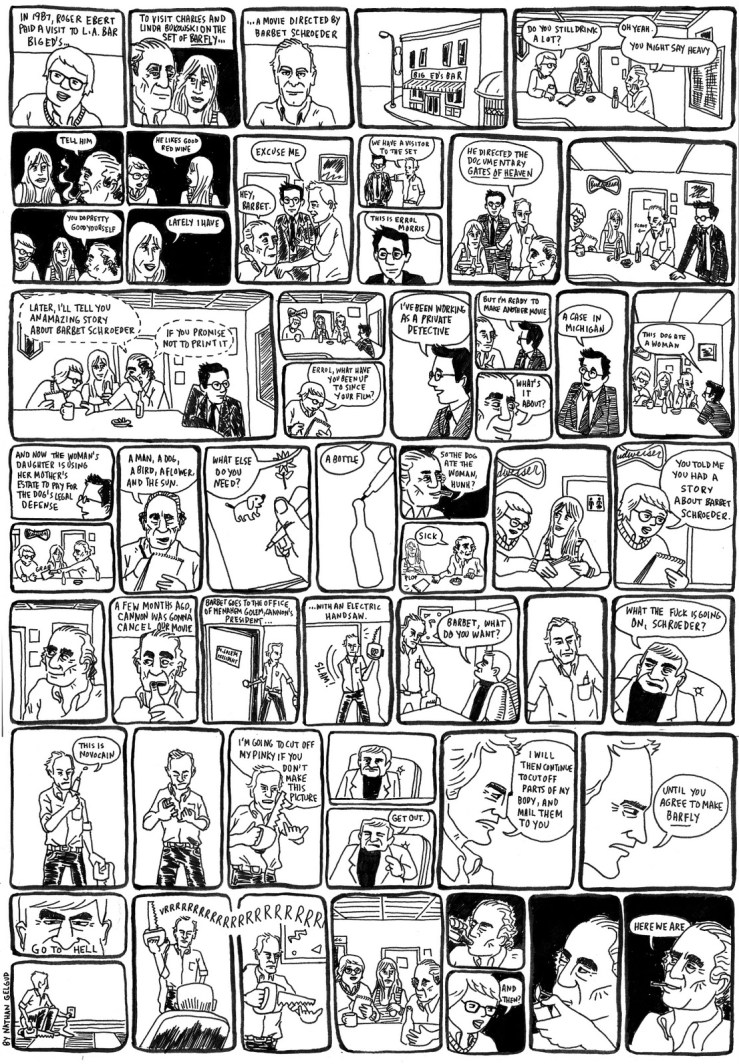
Charles Bukowski + Roger Ebert + Errol Morris

I don’t know the name of this comic strip by Nathan Gelgud. Barfly was kind of terrible. This is a good story though–

“Guadalupe in the Promised Land” — Sam Shepard

“Guadalupe in the Promised Land” — a very short story by Sam Shepard.

Guadalupe hit the skids and fishtailed into a ditch, crawled out of the wreck bleeding from the neck, saw the moon, laid his head in a mud puddle, said “Todo el Mundo” three times and snuffed out. Him and Manolete got together after that and Manolete told him it wasn’t enough just to be a man. The thing was to shoot for sainthood. He said he almost hit it. A saint of the cape. Jackson Pollock joined them and told Manolete he was full of shit. A man was good enough. That was harder than sainthood. There’s too many saints anyway. Guadalupe didn’t know what to think. He ran into Jimmy Dean and Jimmy just looked confused. Marilyn Monroe had no opinion. Brecht kept talking about Germany and shame. Satchmo kept wiping his sweat and shuffling. Janis wanted more. Crazy Horse said: “Fight and die young.” Brian Jones just played the harpoon. Dylan Thomas said “Rage.” Jimi Hendrix said “Slide.” Big Bopper said “What?” Johnny Ace said “Shoot.” And Davey Moore said “Take it all on.” That made sense to Guadalupe. And with that he lay down for a nice long rest.

(From Micro Fiction, edited by Jerome Stern).