The Minimum Number of Books in Harvard’s Libraries That Are Bound in Human Flesh (and Other Fun Facts from Harper’s Index)

The following citations are culled from a search of Harper’s Index that used the term “literature.” (If it’s not obvious, the numbers before each datum are the month and year that Harper’s originally published the datum in its Index)–

5/84    Percentage of Americans who say they never read books: 45

Percentage of these who can’t read: 13

12/87  Number of direct-mail solicitations sent to Henry David Thoreau at Walden Pond this year: 90

4/87   Copies of Gabriel García Márquez’s new book burned by the Chilean government last November: 15,000

2/88   Exclamation points in Tom Wolfe’s The Bonfire of the Vanities: 2,343

10/90   Number of years George Bush has been citing Bonfire of the Vanities as an example of his pleasure reading: 2

11/90   Number of Georgia third-graders Representative Newt Gingrich paid $2 for every book they read last summer: 282

3/91   Percentage of American households in which no books were bought last year: 60

12/92   Chances that an attempt to ban or restrict access to school materials or books last’ year was successful: 2 in 5

6/94   Amount Random House lost on the 29 of its books included on the 1993 New York Times Notable Books list: $698,000

11/95   Estimated number of books banned since 1965 in Indonesia: 2,000

3/95   Amount for which a Mississippi man attempted to sue “the Bible” last year, citing it as “oppressive hearsay”: $45,000,000

5/95   Tons of remaindered books destroyed in the United States each year: 250,000

5/95   Number of Shakespeare’s thirty-seven plays quoted on the Senate floor last year by Robert Byrd: 37

9/95   Percentage of Americans who own at least five Bibles: 27

9/95   Number of California library books of modern American poetry from which pages have been reported stolen this year: 250

1/00   Estimated temperature of Hell, according to two Spanish physicists ‘ interpretation of the Bible: 832° F

Estimated temperature of Heaven: 448°F

3/00  Number of Playboy centerfold models since 1959 whose bios claimed their favorite book was by Ayn Rand: 12

9/00   Ratio of the number of copies of The Great Gatsby sold each month in the U.S. to the number sold in the author’s lifetime: 5:3

9/03   Estimated acres of forest Henry David Thoreau burned down in 1844 trying to cook fish he had caught for dinner: 300

6/04   Minimum number of the brand names mentioned in James Joyce’s Ulysses that are still extant: 28

Number of the brand holders that are sponsoring Dublin’s centennial Bloomsday celebration this month: 2

9/06   Minimum number of books in Harvard’s libraries that are bound in human flesh: 2

Heroes of 2010 — Antoine “Bed Intruder” Dodson

Books of 2010 — Noteworthy, Notorious, and Neglected

Biblioklept already busted out our Best Books of 2010 list, selecting ten of our favorite novels of the year. Such limitations help to generate lists, which internet folks love to circulate–you know the ritual–but those limitations can also prohibit a discussion of some of the other important books of 2010. So, without further ado–

Jonathan Franzen’s Freedom has, for some reason, topped all kinds of year-end lists already, and been hailed by writers, critics, and readers as book of the year, decade, and even century. We pretty much hated it, saying–

Franzen is deeply intelligent, even wise, and his analysis of the past decade is perhaps brilliant. It’s also incredibly easy to read, but this is mostly because it requires so little thought from the reader. Franzen has done all the thinking for you. The book has a clear vision, a mission even, but it lacks urgency and immediacy; it is flaccid, flabby, overlong. It moans where it should howl.

Still, we felt the need to defend Franzen when he caught flak for, gasp!, getting attention. Other writers had to work hard to get noticed, including Tao Lin, whose novel Richard Yates we found baffling. Lin smartly hijacked Franzen’s Time cover, parlaying it into the kind of media attention a young novelist needs in this decade to get noticed.

David Shields also garnered a lot of attention after publishing his ridiculous “manifesto” Reality Hunger, a book that cobbled together citations from superior writers to make a point that Henry Miller made over half a century ago and every novelist worth his salt has always known: great writers steal. Although Shields’s points about copyright laws and who can “own” stories are salient in world two point oh, his call for the death of the novel is absurd and offensive.

Lee Rourke’s brilliant début novel The Canal is as good an answer as any to Shields–The Canal is a thoroughly modern reconsideration of existentialism in the post-9/11 world, a new kind of novel in the nascent tradition of Tom McCarthy’s The Remainder (of course, as McCarthy–and David Shields–would point out, these novels are “plugging into” other novels). Similarly, Adam Langer’s witty novel The Thieves of Manhattan pointed to the ways that novels can still be meaningful; Thieves jauntily riffs on adventure and mystery genre fictions, squaring them against a parody of literary fiction and the hermetic world that produces it.

Langer’s novel tracks the quick rise and fall of more than one literary star; Yann Martel might have felt such a falling sensation in 2010–Beatrice and Virgil, his follow-up to the wildly successful book club classic Life of Pi, received mostly scathing reviews. He’ll have to console himself with the piles of money that Ang Lee’s film adaptation of Life of Pi will likely generate. In our review of Beatrice and Virgil we declared the book “a page turner, engaging, propulsive, and quite easy to read. It injects the philosophical and artistic concerns of literary fiction into the frame and pacing of a book designed for broader audiences.” We think too many folks mistook Martel’s aims for something higher.

Martel wasn’t the only big name writer whose 2010 novel found critical disfavor. Don DeLillo’s Point Omega was met with a mix of critical shrugs and outright dismissals, with very few champions. We seemed to like it better than most. In our review we said that “Point Omega takes an oblique, subtle, and unnerving tackle at themes of time, perception, family, and, ultimately, personal apocalypse. It’s not a particularly fun book nor does it yield any direct answers, but it’s also a rewarding, engaging, and often challenging read.”

DeLillo’s friend Paul Auster also received mixed reviews for his novel Sunset Park. We loved Auster’s winding syntax and his keen observations on high and middle culture, but found his take on twentysomethings in Brooklyn unrealistic and perhaps a bit pandering (Picador’s updated version of his Collected Prose that came out this year was a far more satisfying read).

The worst novel we read in 2010 though was quite easily Justin Cronin’s The Passage, a calculated attempt to make money, not literature. We have no problem with writers making money, of course–we don’t even mind writers ripping off other writers’ ideas to make money–but Cronin’s book is a shallow, sprawling laundry list of clichés and stolen-set pieces, a failed synthesis of post-apocalypse tropes, and a naked grab at commercial appeal. It seems to have been written expressly to be sold as a series of franchise movies. Because of Cronin’s earlier literary fictions, many critics mistook The Passage for a work of literature; indeed, many praised it. They were wrong.

Of course, our targeting of The Passage feels like backlash of some kind, common to both the internet and the book world. If we’re hating on Cronin for his overexposure, it might be because we feel that there are a host of neglected and overlooked books out there. We put two on our Best Books list: Imre Kertész’s The Union Jack and Nanni Balestrini’s Sandokan are both novellas in translation, not the sort of thing that usually tops critics’ year end lists (let alone get read by the public). We could add Yoko Ogawa’s bizarre, slim novel Hotel Iris to the list. Available for the first time in English this year, Ogawa’s novel is effectively a reverse-Lolita, a David Lynchian-riff on BDSM in a small Japanese coastal town. Not for everyone, but strange, disturbing stuff.

Critics also seemed to roundly ignore the full publication of Ralph Ellison’s second, unfinished novel, Three Days Before the Shooting . . . , which we wrote about twice (here and here) but never managed to finish, which doesn’t really matter because he didn’t finish it either. A much shortened version of the novel was published as Juneteenth in the ’90s to mixed reviews, but it seems strange that this version, collecting all of Ellison’s manuscripts and notes, should go so unremarked upon (still, it’s a big long sucker of a book; perhaps someone out there is still unpacking it all).

So what did we miss? What other books of 2010 remain thus-far neglected? What books did you love? Hate? Let us know.

Heroes of 2010 — Insane Clown Posse

2010 was a banner year for the much maligned Detroit duo Insane Clown Posse. They hosted their annual Gathering (with only minimal rock throwing), released their revisionist Western epic, Big Money Rustlas, and even sponsored an inspired toy drive this Christmas. It’s the release of their single “Miracles,” however, that puts them on our “Heroes” list.  Pure motherfucking magic. (We wrote about ICP’s problematic place in postmodernity here and here).

Jonathan Franzen on Underappreciated Books

Vodpod videos no longer available.

Jonathan Franzen on Overrated Books

Vodpod videos no longer available.

Heroes of 2010 — Tom McCarthy

We loved Tom McCarthy’s novel C. We also loved how willing he was to do the author-junket thing, and how open he was about his novel’s literary sources.

Heroes of 2010 — T.I.

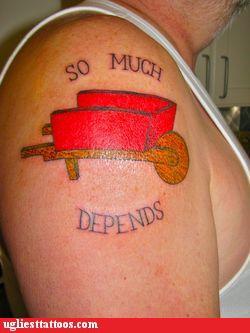
So Much Depends on the Hideous William Carlos Williams Tattoo

(Via).

“Furniture” — Jonathan Lethem

In The Novelist’s Lexicon (new from Columbia University Press), over 70 prominent writers (including Rick Moody, A. S. Byatt, Etgar Keret, Annie Proulx, Elif Shafak, Colum McCann, and Tariq Ali) choose a single word as an inroad to discuss their work. Here’s Jonathan Lethem on furniture–

However appalling to consider, however tedious to enact, every novel requires furniture, whether it is to be named or unnamed, for the characters will be unable to remain in standing positions for the duration of the story. For that matter, when night falls—whether it is depicted or occurs between chapters—characters must be permitted to sleep in beds, to rinse their faces in sinks, to glance into mirrors, and so on. (It is widely believed that after Borges, mirrors are forbidden as symbols in novels. However, it is cruel to deny the characters in a novel sight of their own faces; hence mirrors must be provided.) These rules apply no matter how tangential the novel’s commitment to so-called realism, no matter how avant-garde or capricious, no matter how revolutionary or bourgeois. Furniture may be explicit or implicit, visible or invisible; may bear the duty of conveying social and economic detail or be merely cursorily functional; may be stolen or purchased, borrowed, destroyed, replaced; may be sprinkled with crumbs of food or splashed with drink; may remain immaculate; may be transformed into artworks by aspiring bohemians; may be inherited by characters from uncles who die before the action of the novel begins; may reward careful inspection of the cushions and seams for loose change that has fallen from pockets; may be collapsible, portable; may even be dragged into the house from the beach where it properly belongs—but, in any event, it must absolutely exist. Anything less is cruelty.


A Typographic Anatomy Lesson

“Crash of ’69” — David Foster Wallace

“Crash of ’69” is a short story by David Foster Wallace. It was originally published in the New York-based literary quarterly Between C & D in winter of 1989. Between C & D published their journal on dot matrix paper and distributed it in plastic bags–not exactly the best way to preserve something.

CRASH OF ‘69 by David Foster Wallace

KARRIER

It’s great. I’m always wrong. It’s great.
Ask anybody except my agent if it’s great. He’ll be in checks and Weejuns, pointing binoculars at narrow horses hung with satin as they’re led toward their boxes. Mr. Diggs will say it’s great. He holds his racing form a certain way. He folds both sides together, to compare possibilities.
He’ll say So what about Rusty Hull in the Fourth, kid.
And I’ll say A winner, so sure a thing it’s almost boring, money in the account of our choice, Mr. Diggs.
He’ll put the forms side by side and feel the square of hair on his chin and say So then what about Siberian Saber-Toothed Crotch-Cricket, Karrier? Does Siberian Saber-Toothed Crotch- Cricket have a chance here in the Fourth?
I’ll say Mr. Diggs sir, no way. As in no chance. As in I feel in my chest, bowels the absence of even one slim snowball’s chance for Siberian Saber-Toothed Crotch-Cricket.
The form trembles a certain way in his hands as he trains the glasses on a certain horse, from here a tiny hull atop legs.
But are you sure Karrier.
I feel it, Mr. D. It’s that feeling, with the tight hide and velvet lips. That no-way certainty.

THE WOMAN WHO’S GOING TO BE HIS LOVER

I’ll take Father’s arm and we’ll take our constitutional together through the dawning halls of the Federal Reserve, to the sound of the click of my heels and the squeak of his chair, as the fire in the East window yellows. He says We can’t live like this, child. A whole nation has lost the cool side of the pillow. First thing every morning I taste in my mouth the human potential for evil.

His neck’s slow tic sends his head around over his shoulder. It has ceased to be great. The only brilliance he sees is over his shoulder, now.

Continue reading ““Crash of ’69” — David Foster Wallace”

Check Out This Amazing Fore-edge Painting


“The Joycelin Shrager Story” — Tom Disch

From The Paris Review’s vaults, “The Joycelin Shrager Story” by Tom Disch–

When people asked what he did, Donald Long’s standard riposte was, “I’m a mechanic of the dream.” Meaning, he was a projectionist. Actually few people had to ask, since Donald had been around since the first black-and-white flickerings of the Movement early in the fifties. With the money he earned at the Europa he produced Footage, first as a quarterly and then bi-monthly. For years it was their only magazine, but gradually as success changed the Movement into the Underground, Footage was supplemented and then supplanted by newer, more commercially oriented magazines. Donald Long’s reputation as the Rhadamanthys of the underground film was undiminished, and possibly enhanced, by reason of this failure, but there was one consequence to be regretted—he had to continue full-time at the Europa, from one in the afternoon till the early evening, six days a week.

Continue reading ““The Joycelin Shrager Story” — Tom Disch”

Victor Hugo’s Death Mask

“Searching for Suttree” — Wes Morgan Photographs Cormac McCarthy’s Knoxville

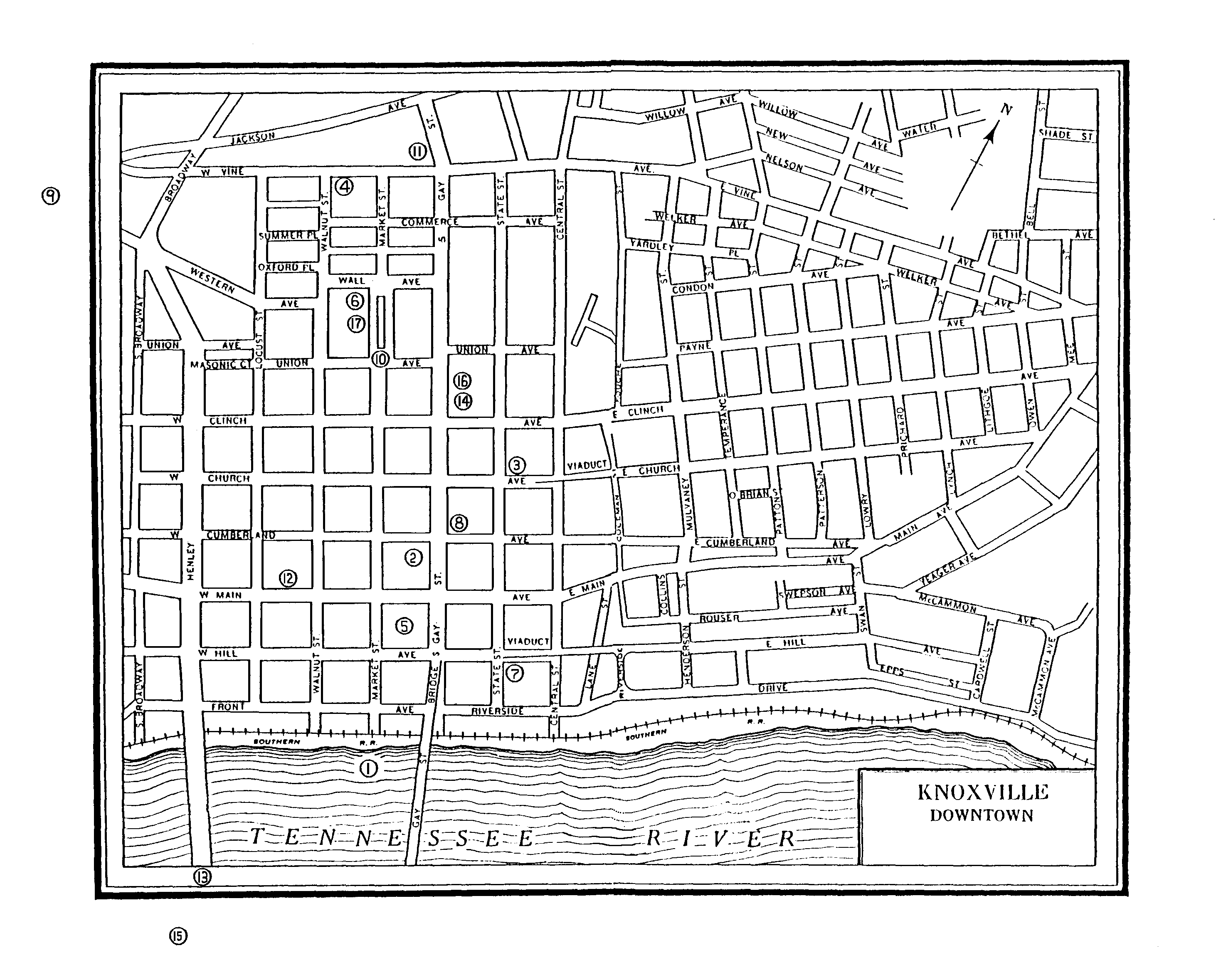
University of Tennessee professor Wes Morgan has documented some of the key locations in Cormac McCarthy’s novel Suttree. A few samples, but check out his website for more–

"Suttree's Home" (#1 on the map) -- This photograph is taken looking east from the Henley Street Bridge. It shows the Gay Street Bridge in the background with Volunteer Landing at the center. It is on this left bank of the Tennessee River, about where Volunteer Landing is located, that Suttree docked his houseboat. The suicide (p. 9) jumped from the Gay Street Bridge and the "...edge of the railroad" (p. 10) mentioned can be seen to the left of the parking lot. First Creek (p. 115) enters the Tennessee River on the left just above the docked riverboat.
The Huddle -- "They came down the steep street and turned in two by two." (p. 72) The Huddle, now vacant, was located at 219 Cumberland Avenue just a few yards east of Gay Street. The location had previously been occupied by a cab company before The Huddle opened in 1952 or 1953. Its mention in the text in 1951 is an anachronism
Ragpicker's Home -- The ragpicker's "...dark cavern beneath the vaulted concrete...." (p. 11) where "Water ran from a clay drain tile and went down a stone gully" (p. 421). The ragpicker's home under the south end of the Henley Street Bridge

Russell Hoban on What Inspired Riddley Walker

At The Guardian, Russell Hoban writes about how a viewing of The Legend of St. Eustace at Canterbury Cathedral inspired his post-apocalyptic classic Riddley Walker. The anecdote will be familiar to anyone who’s reread the introduction to Riddley Walker, but Hoban’s essay still interesting. From his essay–

The first time I stood in Canterbury Cathedral and tilted my head back to look up, up, up to that numinous fan-vaulting I felt the uprush past me of all the centuries of prayer, of hope and fear and yearning, yearning for answers and, if possible, salvation.

Breathing in this atmosphere I made my way through the nave to those stone steps trodden by successive waves of pilgrims, some with beads, some with cameras. Up those worn- down steps, past the place where the remembered blood of Thomas Becket seethes on the stones, to the north aisle where on one wall remains the faint earth-green tracery ofThe Legend of St Eustace. Facing it on the opposite wall is Professor Tristram’s reconstruction of the 15th-century painting.

Whatever talent I have for writing lies in being friends with my head: I know its vagaries, its twists and turns, its hobo journeys in fast freights, riding the blinds to unknown destinations. Sometimes I get thrown off the train in the middle of nowhere; sometimes I get to the Big Rock Candy Mountain. If you Google for Eustace you’ll find that he has no official standing among the beatified. Perhaps his legend turned up on the back of some Middle-Ages cornflakes box and grew from there. Being thus non-factual, Eustace is quite at home in a work of fiction. According to the legend he was a general in the Roman army to begin with, but one day hunting in the forest, he saw a little crucified Jesus between the antlers of a stag, as vividly shown in the 15th-century painting by Pisanello.