Florida Panther — George Boorujy

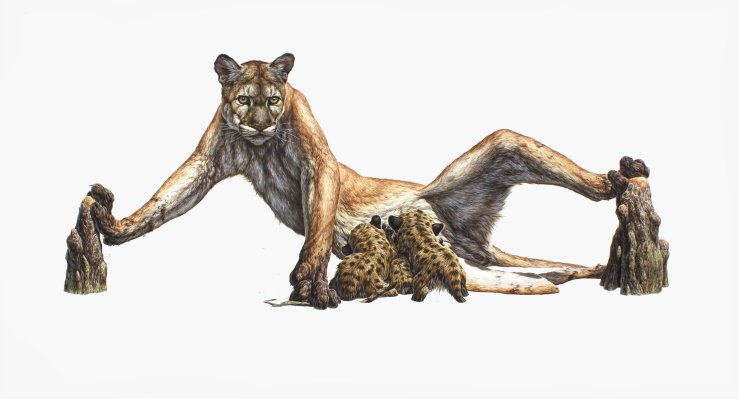
Florida Panther, 2020 by George Boorujy

A Blood Meridian Christmas

Cormac McCarthy’s seminal anti-Western Blood Meridian isn’t exactly known for visions of peace on earth and good will to man. Still, there’s a strange scene in the book’s final third that subtly recalls (and somehow inverts) the Christmas story. The scene takes place at the end of Chapter 15. The Kid, erstwhile protagonist of Blood Meridian, has just reunited with the rampaging Glanton gang after getting lost in the desert and, in a vision-quest of sorts, has witnessed “a lone tree burning on the desert” (a scene I once argued was the novel’s moral core).

Glanton’s marauders, tired and hungry, find temporary refuge from the winter cold in the town of Santa Cruz where they are fed by Mexicans and then permitted to stay the night in a barn. McCarthy offers a date at the beginning of the chapter — December 5th — and it’s reasonable to assume, based on the narrative action, that the night the gang spends in the manger is probably Christmas Eve. Here is the scene, which picks up as the gang — “they” — are led into the manger by a boy–

The shed held a mare with a suckling colt and the boy would would have put her out but they called to him to leave her. They carried straw from a stall and pitched it down and he held the lamp for them while they spread their bedding. The barn smelled of clay and straw and manure and in the soiled yellow light of the lamp their breath rolled smoking through the cold. When they had arranged their blankets the boy lowered the lamp and stepped into the yard and pulled the door shut behind, leaving them in profound and absolute darkness.

No one moved. In that cold stable the shutting of the door may have evoked in some hearts other hostels and not of their choosing. The mare sniffed uneasily and the young colt stepped about. Then one by one they began to divest themselves of their outer clothes, the hide slickers and raw wool serapes and vests, and one by one they propagated about themselves a great crackling of sparks and each man was seen to wear a shroud of palest fire. Their arms aloft pulling at their clothes were luminous and each obscure soul was enveloped in audible shapes of light as if it had always been so. The mare at the far end of the stable snorted and shied at this luminosity in beings so endarkened and the little horse turned and hid his face in the web of his dam’s flank.

The “shroud of palest fire” made of sparks is a strange image that seems almost supernatural upon first reading. The phenomena that McCarthy is describing is simply visible static electricity, which is not uncommon in a cold, dry atmosphere–particularly if one is removing wool clothing. Still, the imagery invests the men with a kind of profound, bizarre significance that is not easily explainable. It is almost as if these savage men, naked in the dark, are forced to wear something of their soul on the outside. Tellingly, this spectacle upsets both the mare and her colt, substitutions for Mary and Christ child, which makes sense. After all, these brutes are not wise men.

[Ed. note–Biblioklept first ran a version of this post in 2010. I’m currently rereading Blood Meridian and the strange rare pockets of peace and goodness stand out to me more–the woman who tends the kid’s gunshot wound early in the novel, the cattle drovers who feed him and give him a Green River knife—and maybe even the weirdo hermit who offers him shelter. I’ll look for more moments of peace in all the violence.]

“The Answer” — Jim Carroll

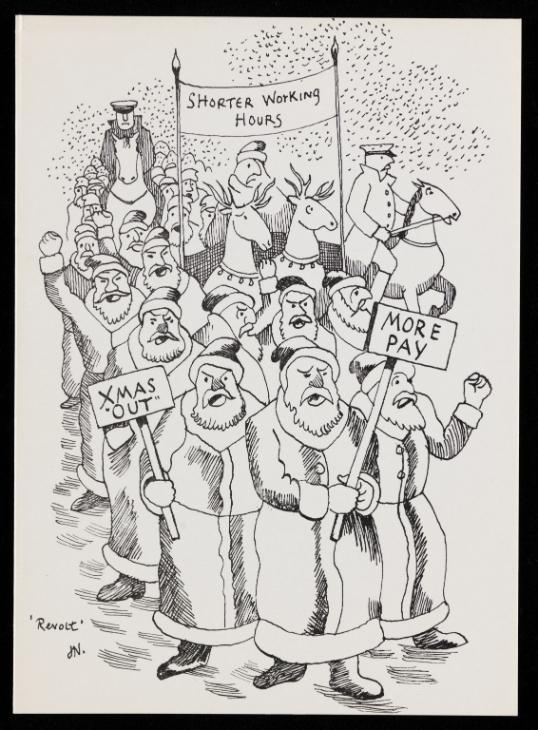
Revolt — John Nash

Revolt, 1969 by John Nash (1893-1977)

Christmas etymologies

A selection from

Christmas in Ritual and Tradition, Christian and Pagan (1912)

by

Clement A. Miles


The names given to the feast by different European peoples throw a certain amount of light on its history. Let us take five of them—ChristmasWeihnachtNoëlCalendas, and Yule—and see what they suggest.

I. The English Christmas and its Dutch equivalent Kerstmisse, plainly point to the ecclesiastical side of the festival; the German Weihnacht (sacred night) is vaguer, and might well be either pagan or Christian; in point of fact it seems to be Christian, since it does not appear till the year 1000, when the Faith was well established in Germany. Christmas and Weihnacht, then, may stand for the distinctively Christian festival, the history of which we may now briefly study. Continue reading “Christmas etymologies”

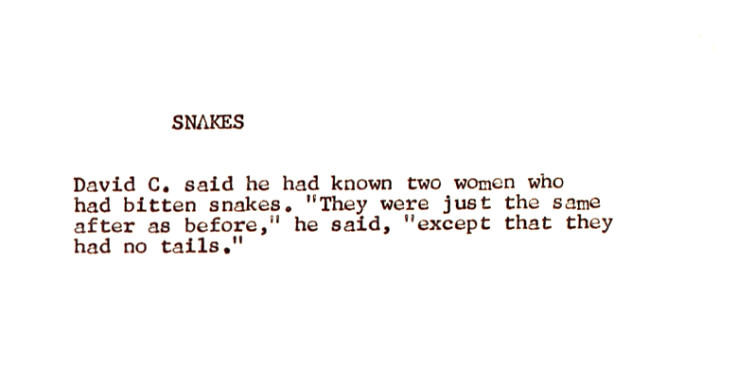
“Snakes” — Tom Clark

Reverb — Mark Tansey

Reverb, 2017 by Mark Tansey (b. 1949)

Read “A Man and Some Others,” a tale by Stephen Crane

“A Man and Some Others”

by

Stephen Crane


I

Dark mesquit spread from horizon to horizon. There was no house or horseman from which a mind could evolve a city or a crowd. The world was declared to be a desert and unpeopled. Sometimes, however, on days when no heat-mist arose, a blue shape, dun, of the substance of a specter’s veil, appeared in the southwest, and a pondering sheep-herder might remember that there were mountains.

In the silence of these plains the sudden and childish banging of a tin pan could have made an iron-nerved man leap into the air. The sky was ever flawless; the manoeuvring of clouds was an unknown pageant; but at times a sheep-herder could see, miles away, the long, white streamers of dust rising from the feet of another’s flock, and the interest became intense.

Bill was arduously cooking his dinner, bending over the fire and toiling like a blacksmith. A movement, a flash of strange colour, perhaps, off in the bushes, caused him suddenly to turn his head. Presently he arose, and, shading his eyes with his hand, stood motionless and gazing. He perceived at last a Mexican sheep-herder winding through the brush toward his camp.

“Hello!” shouted Bill.

The Mexican made no answer, but came steadily forward until he was within some twenty yards. There he paused, and, folding his arms, drew himself up in the manner affected by the villain in the play. His serape muffled the lower part of his face, and his great sombrero shaded his brow. Being unexpected and also silent, he had something of the quality of an apparition; moreover, it was clearly his intention to be mystic and sinister. Continue reading “Read “A Man and Some Others,” a tale by Stephen Crane”

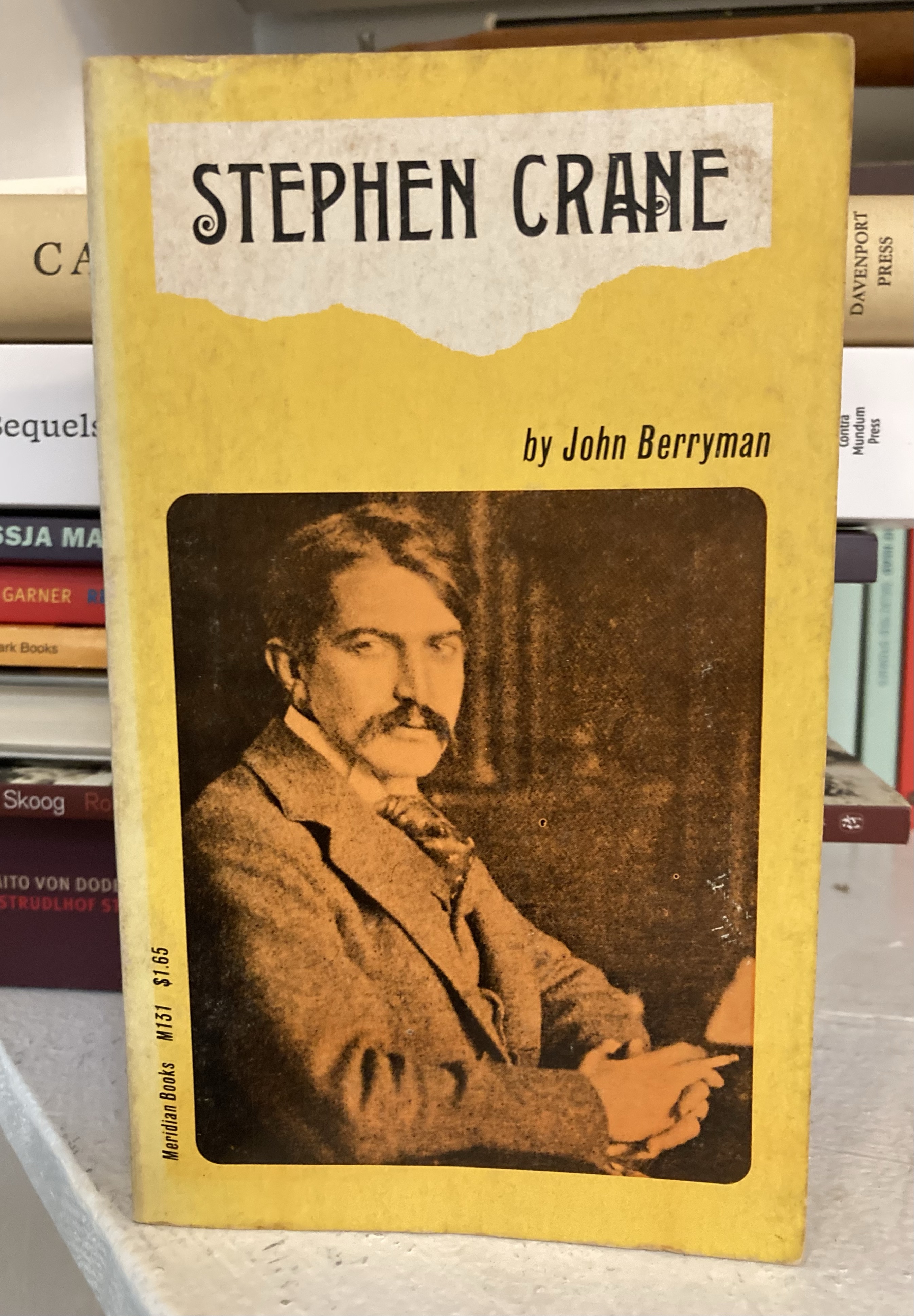
John Berryman’s Stephen Crane biography (Book acquired, 9 Dec. 2021)

I’ve been casually looking for a copy of John Berryman’s 1950 biography of Stephen Crane for a few years now. Berryman is one of my favorite poets and Crane is one of my favorite short story writers. A write up of Paul Auster’s new Crane bio led me to reread some Crane favorites over the past few weeks, which in turn made me look a bit harder for Berryman’s Stephen Crane. The used bookstore I frequent has something like two and a half million books; I had been looking for the Crane bio in three sections: with Crane’s fiction, in biographies, and in literary criticism. This week I grabbed a stool and searched through the overstock above the Crane section and found what I’d been looking for.

As he points out in his preface, Berryman’s approach is a mix of biography and critical appraisal. Berryman claims that very little was written about Crane’s fiction (apart from The Red Badge of Courage) after his death, and that his (Crane’s) reputation was essentially invisible apart from “the war book” until later modernists took to championing him (much like earlier modernists recovered Herman Melville).

After the preface, I couldn’t help but read some of the section on composing “The Open Boat”; it’s a favorite of mine, I live in Jacksonville, where the story originates, and I use it in the classroom every semester. I also dipped into the penultimate chapter, “Crane’s Art,” which includes this nugget:

…Crane has been dead half a century, academic interest has avoided him as both peculiar and undocumented, and some of his work is still decidedly alive. This is long enough.

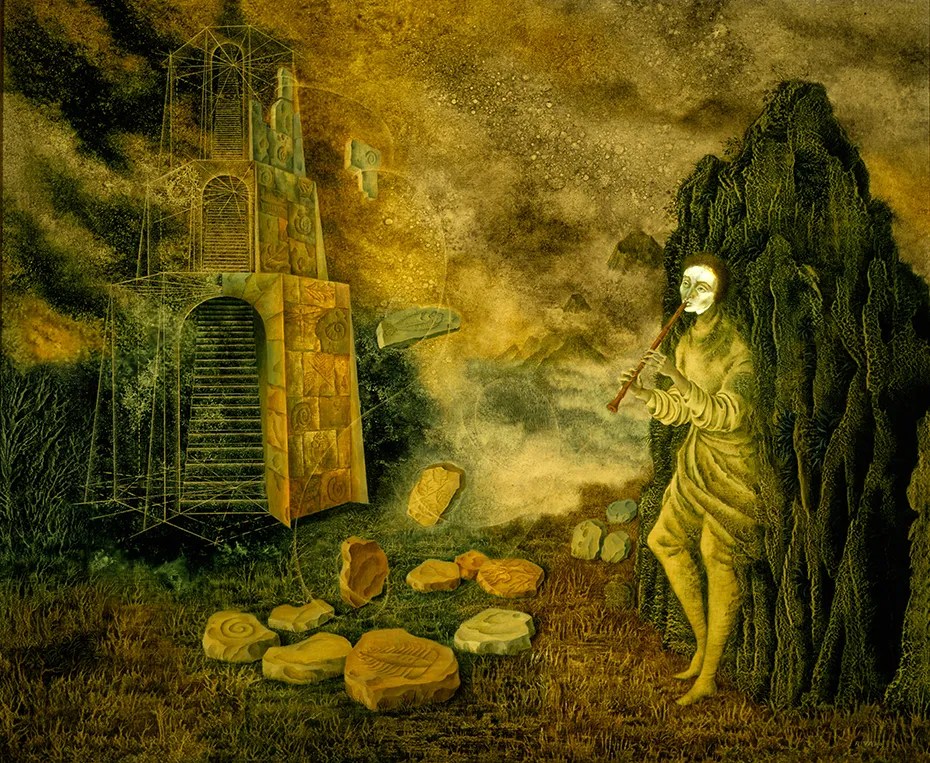
The Flautist — Remedios Varo

The Flautist, 1948 by Remedios Varo (1908-1963)

“Sugar” — Gertrude Stein

“Sugar”

by

Gertrude Stein


A violent luck and a whole sample and even then quiet.

Water is squeezing, water is almost squeezing on lard. Water, water is a mountain and it is selected and it is so practical that there is no use in money. A mind under is exact and so it is necessary to have a mouth and eye glasses.

A question of sudden rises and more time than awfulness is so easy and shady. There is precisely that noise.

A peck a small piece not privately overseen, not at all not a slice, not at all crestfallen and open, not at all mounting and chaining and evenly surpassing, all the bidding comes to tea.

A separation is not tightly in worsted and sauce, it is so kept well and sectionally.

Put it in the stew, put it to shame. A little slight shadow and a solid fine furnace.

The teasing is tender and trying and thoughtful.

The line which sets sprinkling to be a remedy is beside the best cold.

A puzzle, a monster puzzle, a heavy choking, a neglected Tuesday.

Wet crossing and a likeness, any likeness, a likeness has blisters, it has that and teeth, it has the staggering blindly and a little green, any little green is ordinary.

One, two and one, two, nine, second and five and that.

A blaze, a search in between, a cow, only any wet place, only this tune.

Cut a gas jet uglier and then pierce pierce in between the next and negligence. Choose the rate to pay and pet pet very much. A collection of all around, a signal poison, a lack of languor and more hurts at ease.

A white bird, a colored mine, a mixed orange, a dog.

Cuddling comes in continuing a change.

A piece of separate outstanding rushing is so blind with open delicacy.

A canoe is orderly. A period is solemn. A cow is accepted.

A nice old chain is widening, it is absent, it is laid by.

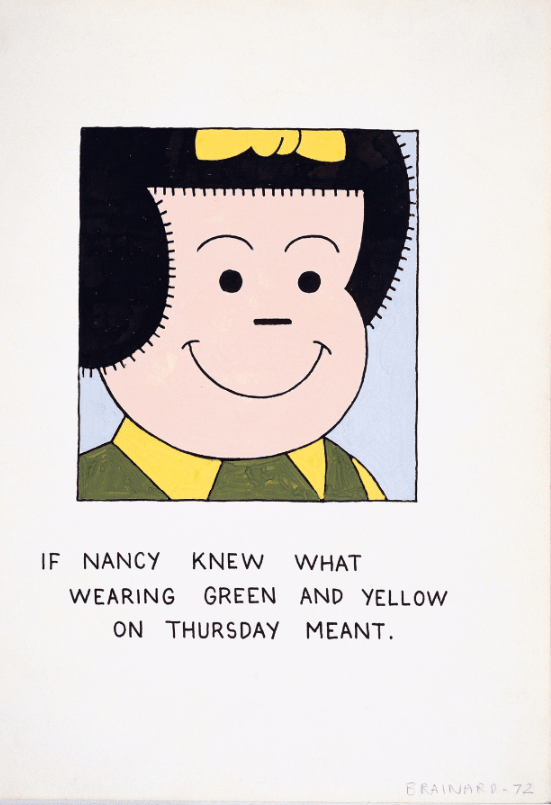
If Nancy Knew What Wearing Green and Yellow on Thursday Meant — Joe Brainard

If Nancy Knew What Wearing Green and Yellow on Thursday Meant, 1972 by Joe Brainard (1942– 1994) 

Illustration from The Holy Terrors — Jean Cocteau

Illustration from The Holy Terrors, c. 1929 by Jean Cocteau (1889–1963)

Donald Barthelme’s “The Indian Uprising,” but just the punctuation

. . , . . . . ” ? ” , , – . . ” . ” , . . . , . , , , , – . . . ” ‘ ‘ ‘ ? ” ” ? ” ” . ” ” , ” . ” , , , . ” ” ? ” ” , ” , ” . ” , , , : ? ? – . , , , , . , , , ( ) , , . , , ; ; – ; – – & , , , , , # ; – – ; , – ; ; ; ; ; , , ; – – ; , , ; . . , . . . , , , , , . . . ” , ” , ” , , , , , . , , , . . . . ” . . . , – . , , , , . , – . – . ” , ” . ” . ” , , , , , , . ” , ” . , . , – , , , . . . . , , , . – . . – – . ” , ” . ” , ” . . . , . . ( , ! ! ) . . . . . , , . . , . . , , . , , , , , , , , , . ” ? ” . ” , ” . ” . . ” ” ? ” ” , ” . ” . . . . . ” ‘ , . , , , : ” ? ” . . , . . . ” , , , . ‘ . ” . ” . ( ) , , , , . ” . ” ? ” ‘ . ” , ” . ” . , , . ” , , , , . . , . ” , ” , ” ? ” ” , ” . , , ” . . , , , # , , , , , , . , ” . , ” # . , ” , ” , , , , , , . , ” . , ” . , ” . , ” , , . . ” . , , , . – – . , . ” ! ! ” , , . . . . , , . – – , . , , , . . . , , , , , , , , . , – . . . . , . . . ! . ‘ , . – , ‘ , ? , , ‘ , ? . ( ‘ ) , ( ‘ ) . , ! , . , , , , , . . & . ” ? ” ” , ! ” . . ” ? ” , , – – , . . , , . . ” , ” . , . ” . . ” ( , ) , , , .


Donald Barthelme’s “The Indian Uprising,” but it’s just the punctuation.

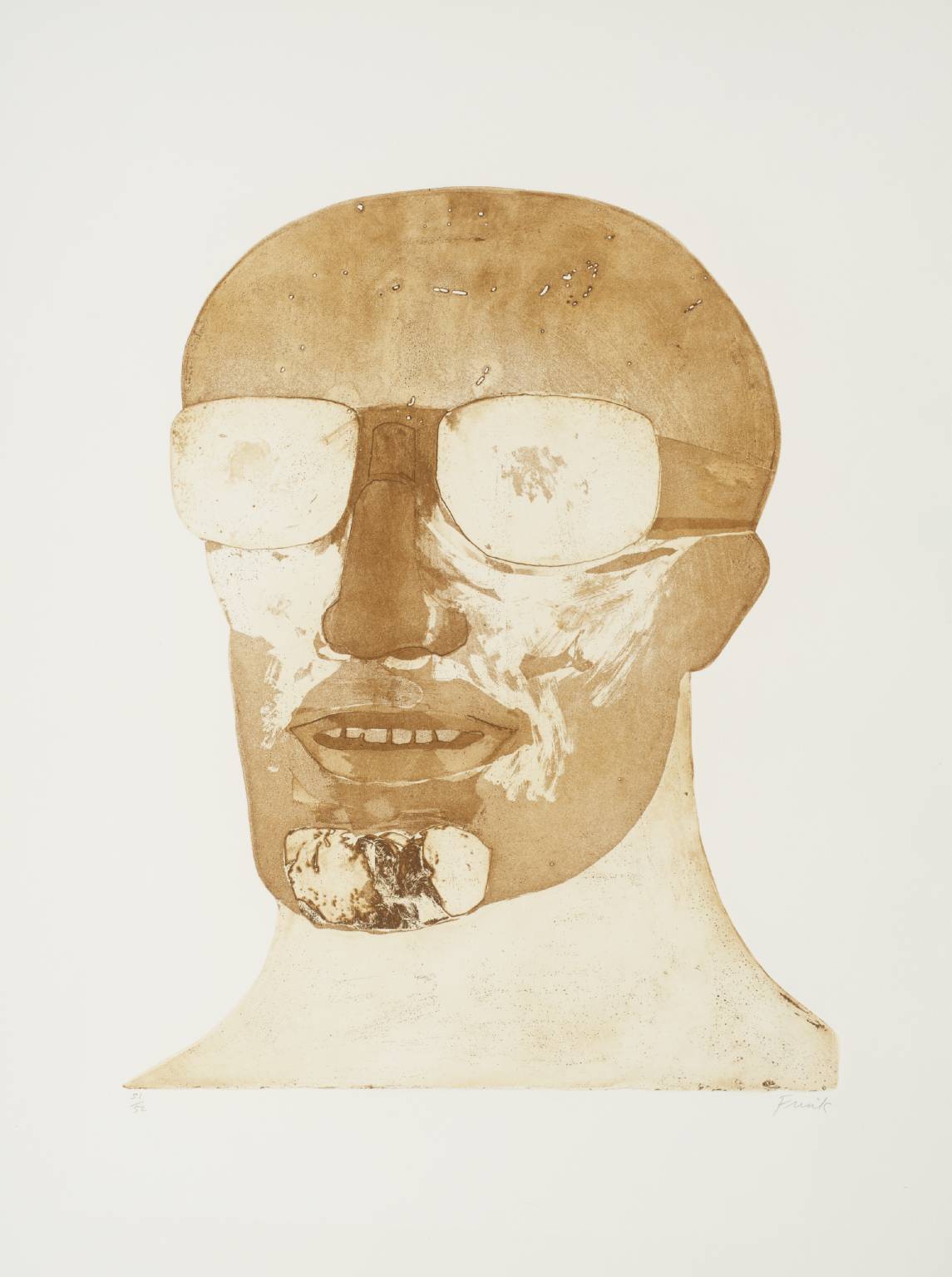
Goggled Head — Elisabeth Frink

Goggled Head, 1973 by Elisabeth Frink (1930-1993)

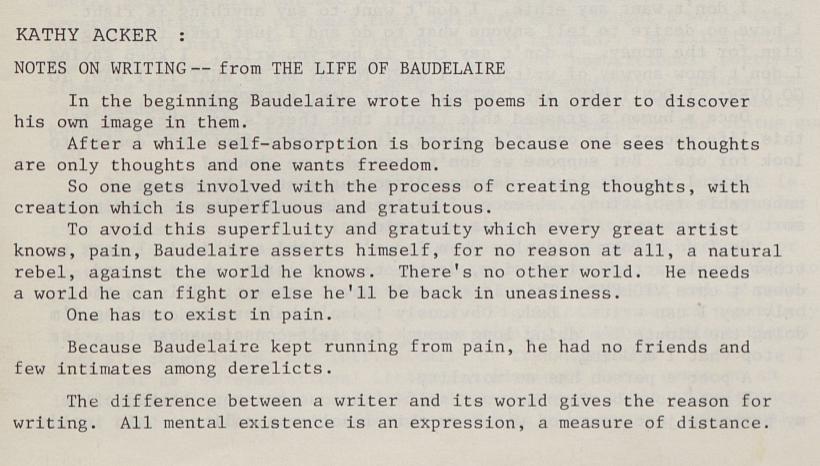
Baudelaire kept running from pain | Kathy Acker

Posted in Art

Elizabeth Taylor’s Mrs Palfrey at the Claremont (Book acquired, late Nov. 2021)

NYRB is reprinting the last novel of Elizabeth Taylor (not that one, the other one), Mrs Palfrey at the Claremont. NYRB’s blurb:

On a rainy Sunday afternoon in January, the recently widowed Mrs. Palfrey moves to the Claremont Hotel in South Kensington. “If it’s not nice, I needn’t stay,” she promises herself, as she settles into this haven for the genteel and the decayed. “Three elderly widows and one old man . . . who seemed to dislike female company and seldom got any other kind” serve for her fellow residents, and there is the staff, too, and they are one and all lonely. What is Mrs. Palfrey to do with herself now that she has all the time in the world? Go for a walk. Go to a museum. Go to the end of the block. Well, she does have her grandson who works at the British Museum, and he is sure to visit any day.

Mrs. Palfrey prides herself on having always known “the right thing to do,” but in this new situation she discovers that resource is much reduced. Before she knows it, in fact, she tries something else.

Elizabeth Taylor’s final and most popular novel is as unsparing as it is, ultimately, heartbreaking.