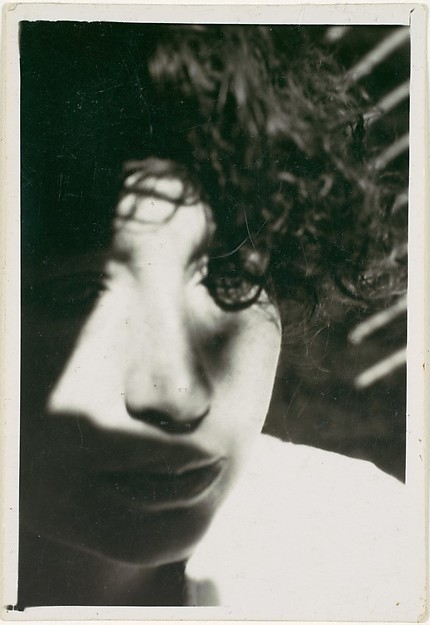
Nude — Edward Weston

hb_2005-100-142

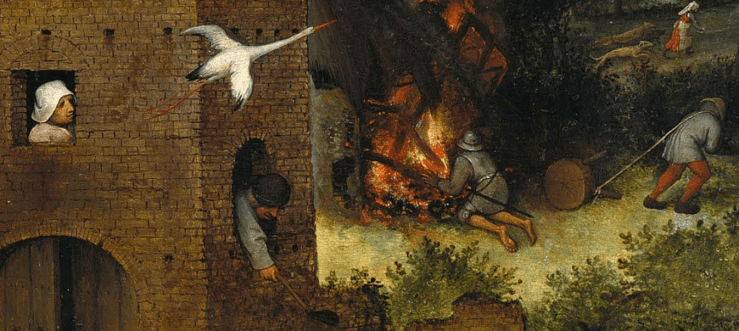
Netherlandish Proverbs (detail) — Pieter Bruegel the Elder

Screenshot 2016-06-26 at 11.12.14 AM

Catrina — Nicolae Tonitza

catrina

Americana — Charles Sheeler

hb_1992-24-8

Netherlandish Proverbs (detail) — Pieter Bruegel the Elder

Screenshot 2016-06-26 at 11.08.51 AM

Nude on Checked Cloth (detail) — Egon Schiele

Screenshot 2016-07-02 at 3.46.10 PM

Lethe — Romaine Brooks

12

It Is Very Hot Here — Walasse Ting

9039448995_df0dab7525_b

Netherlandish Proverbs (detail) — Pieter Bruegel the Elder

Screenshot 2016-06-26 at 11.05.53 AM

Illustration for Oscar Wilde’s “The Happy Prince” — James Hill

The Happy Prince

James Hill’s illustration for “The Happy Prince” by Oscar Wilde. From The Short Stories of Oscar Wilde, Heritage Press, 1968.


“The Happy Prince”

by

Oscar Wilde


High above the city, on a tall column, stood the statue of the Happy Prince. He was gilded all over with thin leaves of fine gold, for eyes he had two bright sapphires, and a large red ruby glowed on his sword-hilt.

He was very much admired indeed. “He is as beautiful as a weathercock,” remarked one of the Town Councillors who wished to gain a reputation for having artistic tastes; “only not quite so useful,” he added, fearing lest people should think him unpractical, which he really was not.

“Why can’t you be like the Happy Prince?” asked a sensible mother of her little boy who was crying for the moon. “The Happy Prince never dreams of crying for anything.”

“I am glad there is some one in the world who is quite happy,” muttered a disappointed man as he gazed at the wonderful statue.

“He looks just like an angel,” said the Charity Children as they came out of the cathedral in their bright scarlet cloaks and their clean white pinafores.

“How do you know?” said the Mathematical Master, “you have never seen one.”

“Ah! but we have, in our dreams,” answered the children; and the Mathematical Master frowned and looked very severe, for he did not approve of children dreaming.

One night there flew over the city a little Swallow. His friends had gone away to Egypt six weeks before, but he had stayed behind, for he was in love with the most beautiful Reed. He had met her early in the spring as he was flying down the river after a big yellow moth, and had been so attracted by her slender waist that he had stopped to talk to her.
Continue reading “Illustration for Oscar Wilde’s “The Happy Prince” — James Hill”

Escape from New York film poster — Kilian Eng

tumblr_o9shqqz7pm1qbluruo4_1280

Soap Bubbles — Berenice Abbott

dp134076

La Baronne Emile D’Erlanger — Romaine Brooks

cf24d84ec93029ab64616fb578a8b01f

Three Books

img_2987

Grendel by John Gardner. First edition hardback by Knopf (Borzoi imprint), 1971. No designer credited, but the jacket illustration is almost certainly by Emil Antonucci, whose line drawings head each chapter. The blurb on the back, by the way, is from a William H. Gass review of Gardner’s second novel The Wreckage of Agathon, which I have not read.

I usually only do scans of the fronts of books in these Three Books posts, but the clothbound book under the jacket of this edition of Grendel is too lovely not to share (it could also have fit into my three purple books post a while back):

img_2988

img_2990

Mules & Men by Zora Neale Hurston. 1978 trade paperback by Indiana University Press. No designer credited, but the cover illustration is almost certainly by Miguel Covarrubias, whose illustrations accompany the text. Mules & Men is not stuffy catalog of folklore, but rather Hurston’s own synthesis of the tales she collected (and improved upon, if not outright invented in some cases) primarily in Florida in the early 1930s. A sample tale: How the snake got poison:

Well, when God made de snake he put him in de bushes to ornament de ground. But things didn’t suit de snake so one day he got on de ladder and went up to see God. “Good mawnin’, God.” “How do you do, Snake?” “Ah ain’t so many, God, you put me down there on my belly in de dust and everything trods upon me and kills off my generations. Ah ain’t got no kind of protection at all.”

God looked off towards immensity and thought about de subject for awhile, then he said, “Ah didn’t mean for nothin’ to be stompin’ you snakes lak dat. You got to have some kind of a protection. Here, take dis poison and put it in yo’ mouf and when they tromps on you, protect yo’ self. “

So de snake took de poison in his mouf and went on back.

So after awhile all de other varmints went up to God.

“Good evenin’, God.”

“How you makin’ it, varmints?”

“God, please do somethin’ ’bout dat snake. He’ layin’ in de bushes there wid poison in his mouf and he’s strikin’ everything dat shakes de bush. He’s killin’ up our generations. Wese skeered to walk de earth.”

So God sent for de snake and tole him:

“Snake, when Ah give you dat poison, Ah didn’t mean for you to be hittin’ and killin’ everything dat shake de bush. I give you dat poison and tole you to protect yo’self when they tromples on you. But you killin’ everything dat moves. Ah didn’t mean for you to do dat.”

De snake say, “Lawd, you know Ah’m down here in de dust. Ah ain’t got no claws to fight wid, and Ah ain’t got no feets to git me out de way. All Ah kin see is feets comin’ to tromple me. Ah can’t tell who my enemy is and who is my friend. You gimme dis protection in my mouf and Ah uses it.”

God thought it over for a while then he says:

“Well, snake, I don’t want yo’ generations all stomped out and I don’t want you killin’ everything else dat moves. Here take dis bell and tie it to yo’ tail. When you hear feets comin’ you ring yo’ bell and if it’s yo’ friend, he’ll be keerful. If it’s yo’ enemy, it’s you and him.”

So dat’s how de snake got his poison and dat’s how come he got rattles.

Biddy, biddy, bend my story is end.

Turn loose de rooster and hold de hen.

img_2989

By Night in Chile by Roberto Bolaño. English translation by Chris Andrews. Trade paperback by New Directions, 2003. Cover design by Semadar Megged, who adapted a photograph by Kurt Beals. The orange in the cover doesn’t seem so vibrant in the scan I did. It’s as orange as the other two books. Oh well. The prose is vibrant, electric orange.

I wrote about By Night in Chile here.

Netherlandish Proverbs (detail) — Pieter Bruegel the Elder

Screenshot 2016-06-26 at 11.02.50 AM.png