Category: Books
The Blue Room — Suzanne Valadon

Yellow Spectrum — Frantisek Kupka

Polish Girl — Tamara de Lempicka

There Was and There Was Not (Book Acquired Some Time in Late October, 2014)
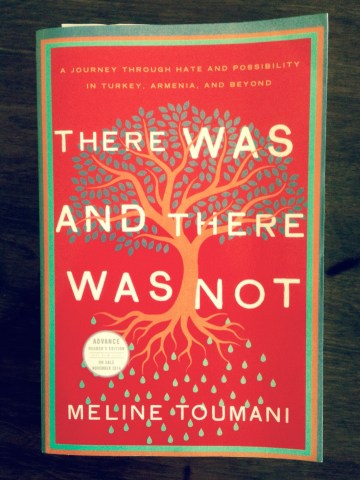
There Was and There Was Not by Maline Toumani. Forthcoming from Metropolitan. Their blurb:
A young Armenian-American goes to Turkey in a “love thine enemy” experiment that becomes a transformative reflection on how we use—and abuse—our personal histories
Meline Toumani grew up in a close-knit Armenian community in New Jersey where Turkish restaurants were shunned and products made in Turkey were boycotted. The source of this enmity was the Armenian genocide of 1915 at the hands of the Ottoman Turkish government, and Turkey’s refusal to acknowledge it. A century onward, Armenian and Turkish lobbies spend hundreds of millions of dollars to convince governments, courts and scholars of their clashing versions of history.
Frustrated by her community’s all-consuming campaigns for genocide recognition, Toumani leaves a promising job at The New York Timesand moves to Istanbul. Instead of demonizing Turks, she sets out to understand them, and in a series of extraordinary encounters over the course of four years, she tries to talk about the Armenian issue, finding her way into conversations that are taboo and sometimes illegal. Along the way, we get a snapshot of Turkish society in the throes of change, and an intimate portrait of a writer coming to terms with the issues that drove her halfway across the world.
In this far-reaching quest, told with eloquence and power, Toumani probes universal questions: how to belong to a community without conforming to it, how to acknowledge a tragedy without exploiting it, and most importantly how to remember a genocide without perpetuating the kind of hatred that gave rise to it in the first place
Blossom (Detail) — Rustam Qbic

Stephen Collins’s Allegorical Fable The Gigantic Beard That Was Evil Reviewed
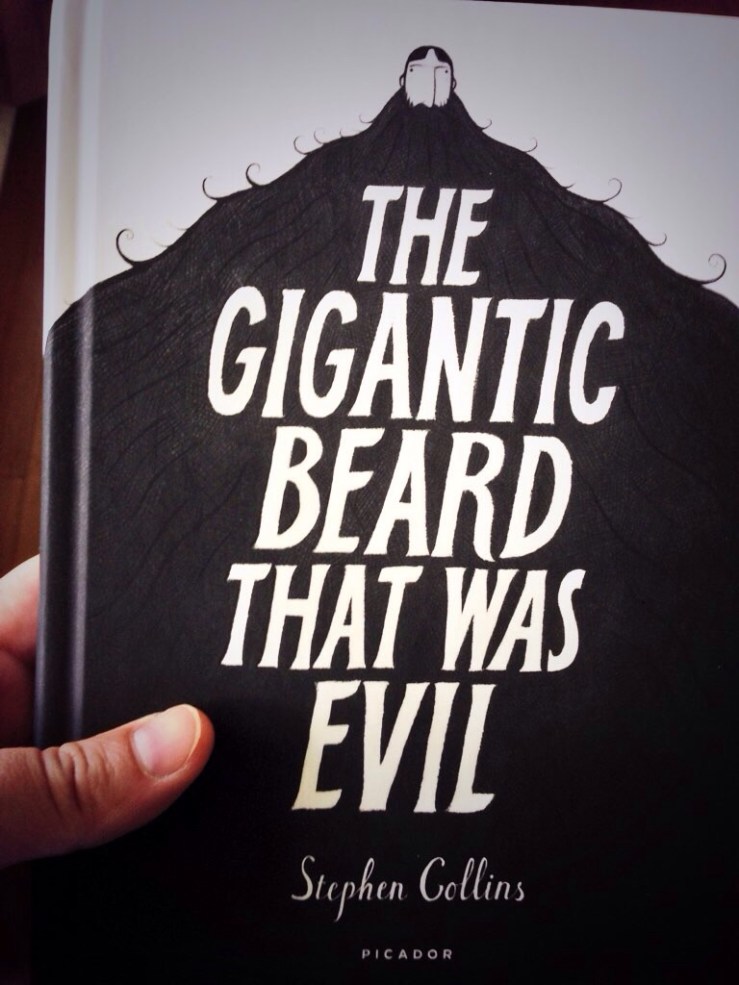
Stephen Collins’s début graphic novel The Gigantic Beard That Was Evil tells the story of Dave, an especially average (forgive the oxymoron) guy in the neat-and-tidy island of Here, a place where conformity rules and difference is unthinkable. Dave fits like a cog into his tidy world until a beard erupts from his face, severing him from society.
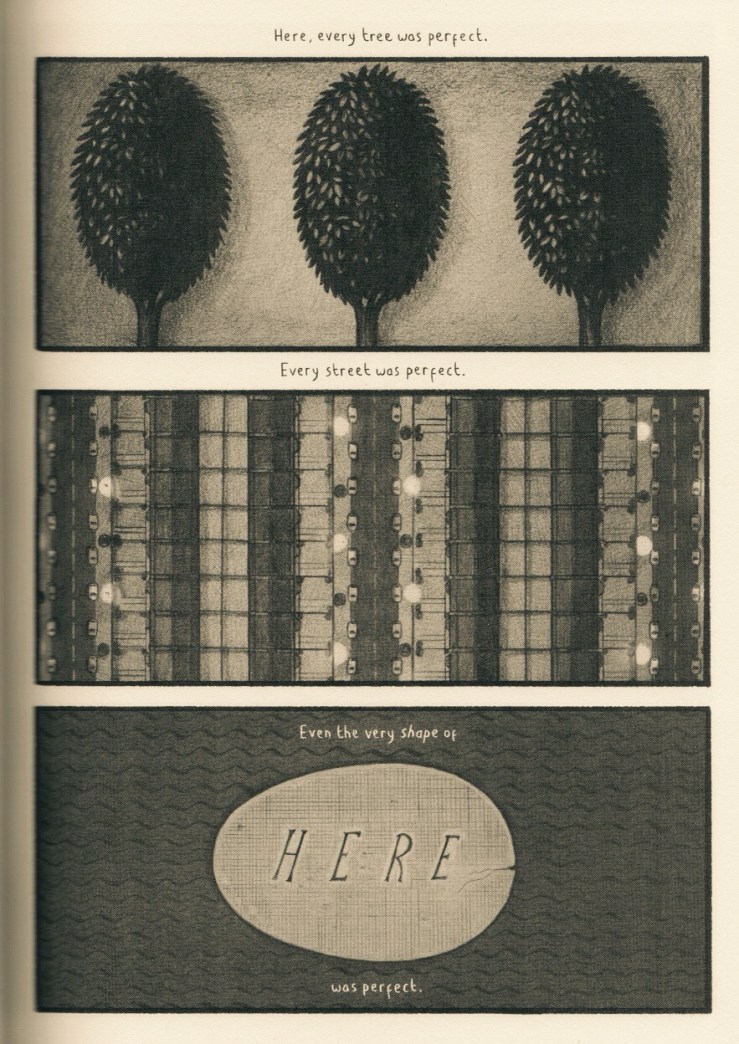
Despite its neat and tidy contours, an omnipresent dread of otherness gestates in the egg-shaped isle of Here. That dread manifests in the fabled land of There. Dave’s psyche is haunted by There; its very existence threatens both body and mind. Collins renders this anxiety in a remarkable series of panels that concretize Dave’s nightmare of otherness:
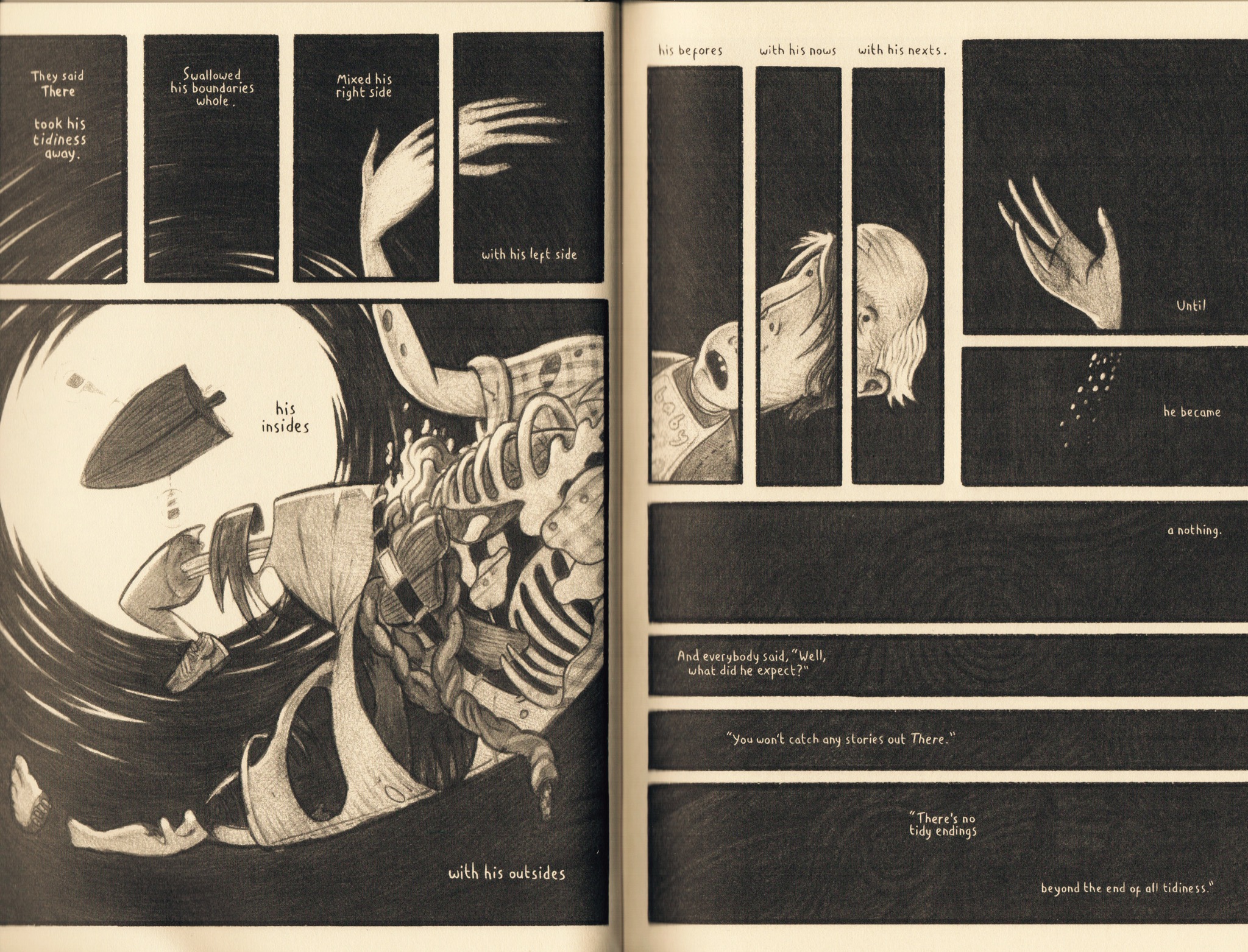
Dave’s nightmare highlights his subconscious realization that there cannot be a Here without a There. The realization leaves him abject, torn, and destabilized, even before his beard appears. When the first hairs do arrive, Dave’s interior existential crisis spills outward, his messy difference oozing out to disrupt and upset the tidy normalcy of Here.
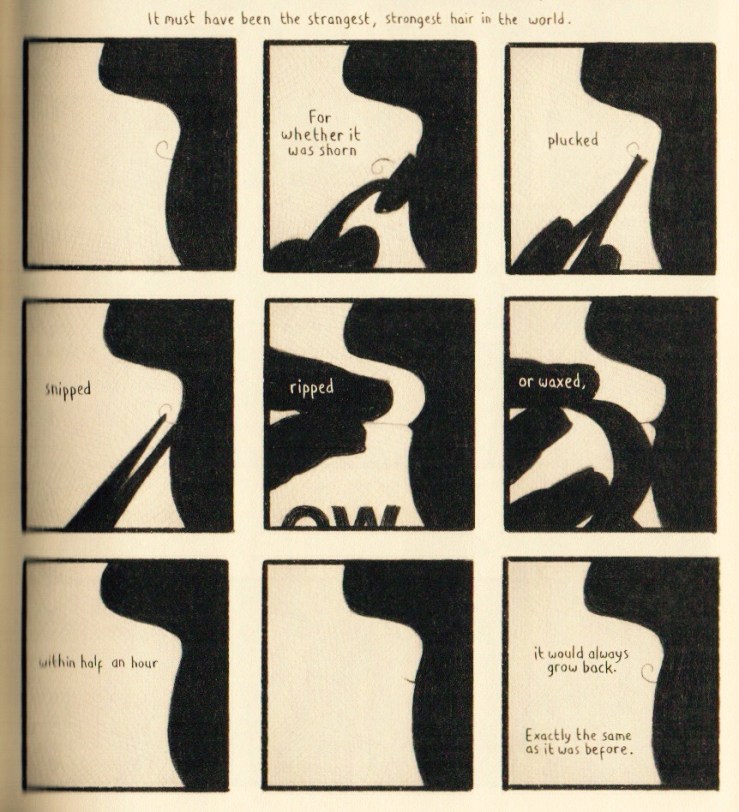
Poor Dave.
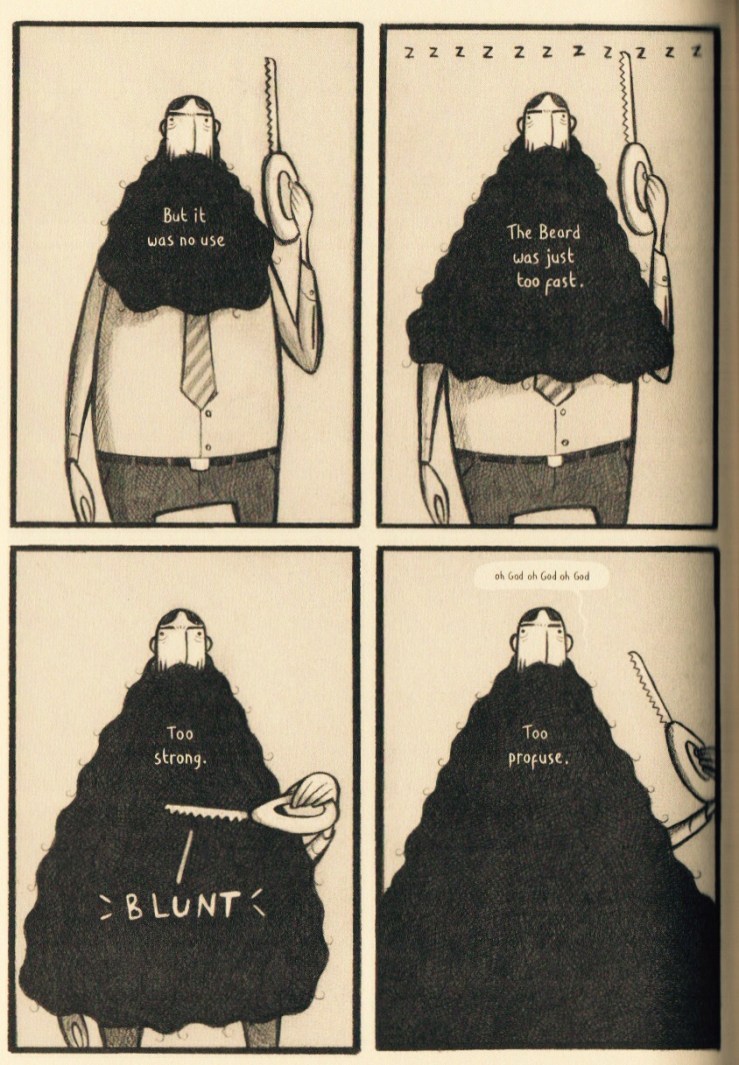
The beard quickly becomes a national emergency requiring enormous resources. Police, military, the media, and eventually the entire society become entangled in the crisis. United against a common foe, the citizens of Here are nevertheless distracted, letting their grooming habits slip. Things become less tidy. In their battle against the beard, they overlook the greater war on weird.
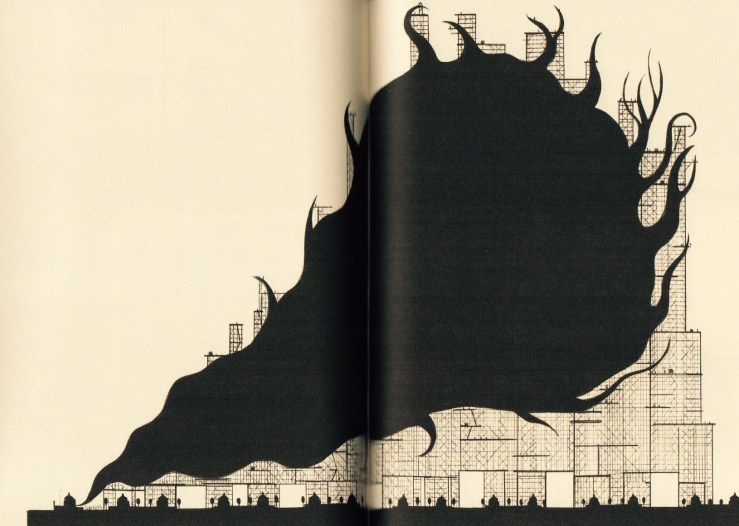
The Gigantic Beard That Was Evil is an allegorical fable. Collins attacks conformity and fear of otherness, but also depicts just how complex and horrifying otherness can be. While the island of Here is clearly a stand-in for England, Collins’s satire of xenophobia and the dangers of groupthink will resonate pretty much everywhere. All kinds of 21st-century anxieties writhe under the text: fear of immigration, the collapse of cultural homogeneity, ecological devastation—the end of a particular way of life. The angry mob castigating poor Dave call him a terrorist, but they are the authors of their own terror.
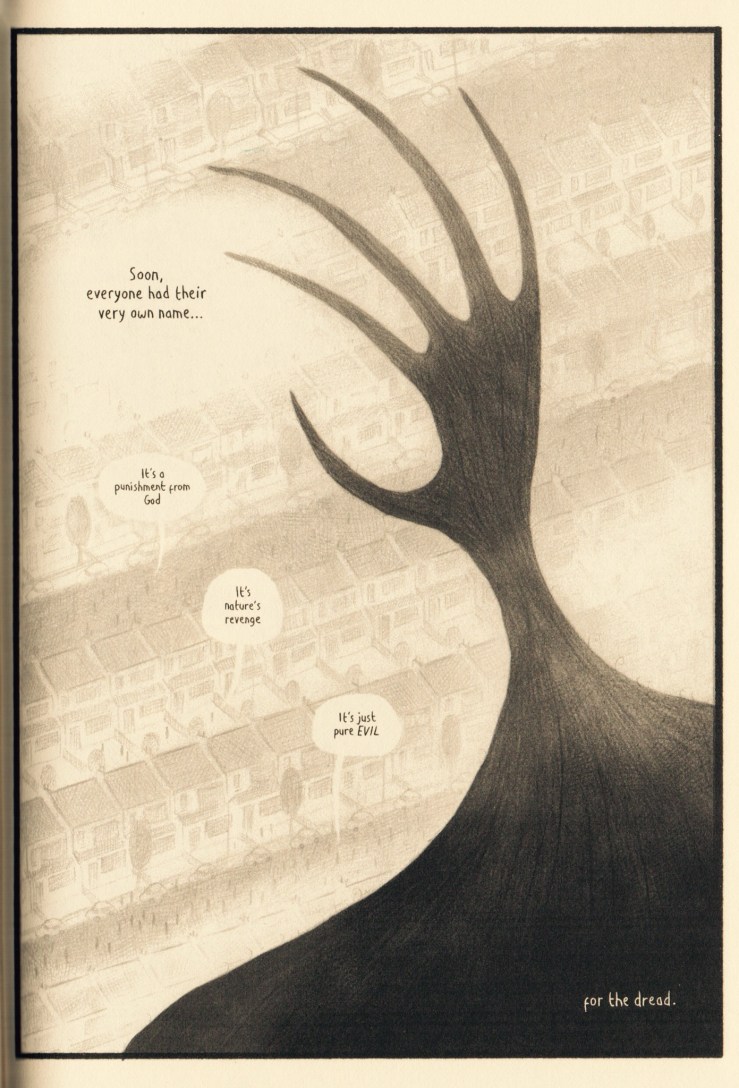
In an unexpected and rewarding fourth act, Collins examines the aftermath of what comes to be known as “The Beard Event.” The Untidiness that happened while the citizens of Here were distracted dealing with Dave becomes the new normal. Fits of nonconformity inevitably become trends, then commodities.
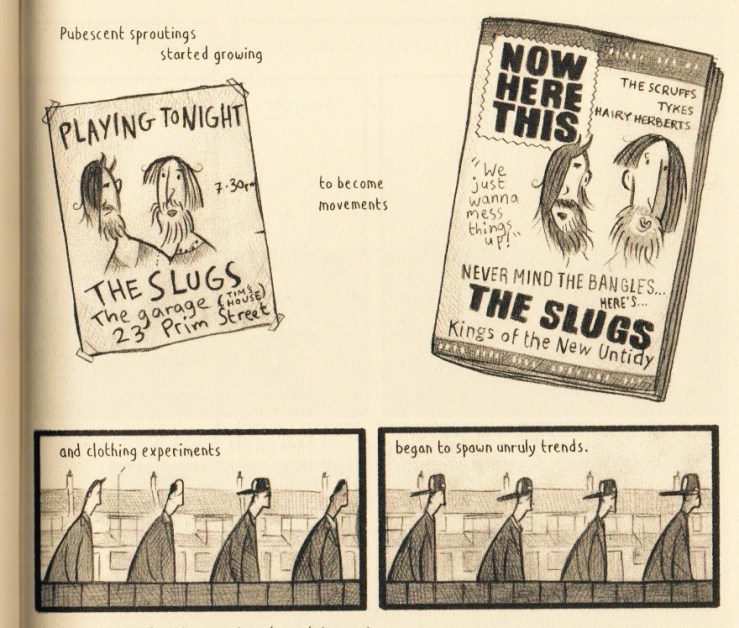
The Beard Event eventually becomes “A story many times retold and resold,” complete with its own museum (enter through the gift shop). Collins offers a clear depiction of difference—how it’s first feared, then resisted and attacked, and eventually absorbed and recycled.
I’ve tried to offer enough of Collin’s words and art to convey a sense of his simple but refined style. His lines are often gentle and always precise, his subtle shading all the color this tale needs. The Gigantic Beard That Was Evil succeeds visually on the strength of Collins’s pacing and panel design. Collins seamlessly integrates his prose into the panels, moving the story along in a lilt of rhymes and non-rhymes evocative of Edward Gorey or Roald Dahl. Collins nimbly avoids the potential pitfalls of preachiness or meaningless absurdity here, leading to a confident and convincing début. I look forward to more. Great stuff.
The Gigantic Beard That Was Evil is now available in the United States in hardback and ebook from Picador.
Portrait of Zacharie Astruc — Edouard Manet

Cynthia — William Strang

A Grotesque Vignette from Haruki Murakami’s Latest Novel
They spent an hour at an express-train station with the stationmaster, going over the details of the rebuilding project. It was lunchtime, so they ordered in bentos and ate together in the stationmaster’s office. Afterward they chatted over tea. The stationmaster, a friendly, heavyset middle-aged man, told them some fascinating stories about things he’d experienced in his career. Tsukuru loved going to sites and hearing these kinds of stories. The topic turned to lost property, more specifically to the huge amount of lost-and-found items left behind on trains and in stations, and the unusual, strange items among them—the ashes of cremated people, wigs, prosthetic legs, the manuscript of a novel (the stationmaster read a little bit of it and found it dull), a neatly wrapped, bloodstained shirt in a box, a live pit viper, forty color photos of women’s vaginas, a large wooden gong, the kind Buddhist priests strike as they chant sutras …
“Sometimes you’re not sure what to do with them,” the stationmaster said. “A friend of mine who runs another station turned in a Boston bag once that had a dead fetus inside. Thankfully, I’ve never had that kind of experience myself. But once, when I was a stationmaster at another station, someone brought in two fingers preserved in formaldehyde.”
“That’s pretty grotesque,” Tsukuru said.
“Yes, it sure was. Two small fingers floating in liquid, kept in what looked like a small mayonnaise jar, all inside a pretty cloth bag. Looked like a child’s fingers severed at the base. Naturally we contacted the police, since we thought it might be connected to a crime. The police came over immediately and took the jar away.”
The stationmaster drank a sip of tea.
“A week later the same police officer who’d taken the fingers stopped by. He questioned the station employee who’d found the jar in the restroom again. I was present for the questioning. According to the officer, the fingers in the jar weren’t those of a child. The forensics lab determined that they belonged to an adult. The reason they were so small was that they were sixth, vestigial fingers. The officer said that sometimes people have extra fingers. Most of the time the parents want to get rid of the deformity, so they have the fingers amputated when the child’s still a baby, but there are some people who, as adults, still have all six fingers. The ones that were found were an example—the fingers of an adult who had had them surgically removed, then preserved in formaldehyde. The lab estimated the fingers to be those of a man, age mid-twenties to mid-thirties, though they couldn’t tell how long it had been since the fingers had been amputated. I can’t imagine how they’d come to be forgotten, or perhaps thrown away, in the station restroom. But it doesn’t seem that they were connected to any crime. In the end the police kept them, and no one ever came forward to claim them. For all I know, they may still be in a police warehouse somewhere.”
“That’s a weird story,” Tsukuru said. “Why would he keep those sixth fingers until he became an adult and then suddenly decide to amputate them?”
“It’s a mystery. It got me interested in the phenomenon, though, and I started looking into it. The technical term is hyperdactyly, and there have been lots of famous people who’ve had it. It’s unclear whether it’s true or not, but there was some evidence that Hideyoshi Toyotomi, the famous leader of the Sengoku period, had two thumbs. There are plenty of other examples. There was a famous pianist who had the condition, a novelist, an artist, a baseball player. In fiction, Hannibal Lecter of The Silence of the Lambs had six fingers. It’s not all that unusual, and genetically it’s a dominant trait. There are variations among different races, but in general, one out of every five hundred people is born with six fingers. As I said, though, the vast majority of their parents have the extra fingers amputated before their children’s first birthdays, when kids begin to develop fine-motor skills. So we hardly ever run across someone with the condition. It was the same for me. Until that jar was found in the station, I’d never even heard of such a thing.”
From Haruki Murakami’s latest novel Colorless Tsukuru Tazaki and His Years of Pilgrimage.
William Burroughs and His Hatchet-Carved Jack O’ Lantern

“The Haunter of the Dark” — H.P. Lovecraft
“The Haunter of the Dark” by H.P. Lovecraft
Cautious investigators will hesitate to challenge the common belief that Robert Blake was killed by lightning, or by some profound nervous shock derived from an electrical discharge. It is true that the window he faced was unbroken, but Nature has shewn herself capable of many freakish performances. The expression on his face may easily have arisen from some obscure muscular source unrelated to anything he saw, while the entries in his diary are clearly the result of a fantastic imagination aroused by certain local superstitions and by certain old matters he had uncovered. As for the anomalous conditions at the deserted church on Federal Hill—the shrewd analyst is not slow in attributing them to some charlatanry, conscious or unconscious, with at least some of which Blake was secretly connected.
 For after all, the victim was a writer and painter wholly devoted to the field of myth, dream, terror, and superstition, and avid in his quest for scenes and effects of a bizarre, spectral sort. His earlier stay in the city—a visit to a strange old man as deeply given to occult and forbidden lore as he—had ended amidst death and flame, and it must have been some morbid instinct which drew him back from his home in Milwaukee. He may have known of the old stories despite his statements to the contrary in the diary, and his death may have nipped in the bud some stupendous hoax destined to have a literary reflection.
Among those, however, who have examined and correlated all this evidence, there remain several who cling to less rational and commonplace theories. They are inclined to take much of Blake’s diary at its face value, and point significantly to certain facts such as the undoubted genuineness of the old church record, the verified existence of the disliked and unorthodox Starry Wisdom sect prior to 1877, the recorded disappearance of an inquisitive reporter named Edwin M. Lillibridge in 1893, and—above all—the look of monstrous, transfiguring fear on the face of the young writer when he died. It was one of these believers who, moved to fanatical extremes, threw into the bay the curiously angled stone and its strangely adorned metal box found in the old church steeple—the black windowless steeple, and not the tower where Blake’s diary said those things originally were. Though widely censured both officially and unofficially, this man—a reputable physician with a taste for odd folklore—averred that he had rid the earth of something too dangerous to rest upon it. Continue reading ““The Haunter of the Dark” — H.P. Lovecraft”
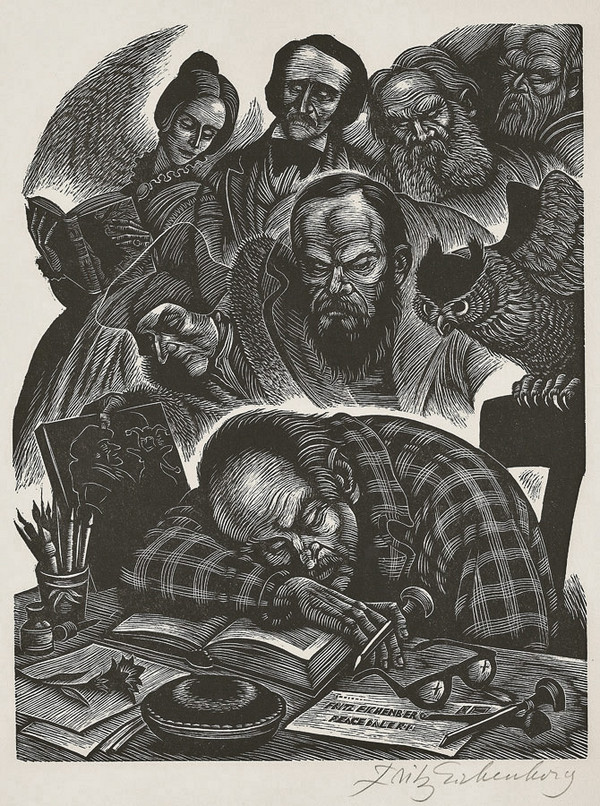
Dream of Reason — Fritz Eichenberg
Madame Gautreau (Study) — John Singer Sargent
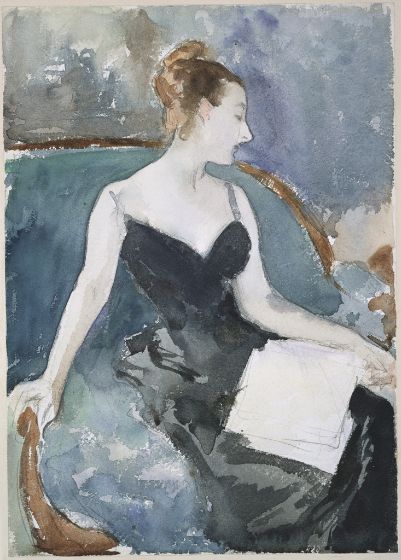
To award someone a prize is no different from pissing on him (Thomas Bernhard)
…to award someone a prize is no different from pissing on him. And to receive a prize is no different from allowing oneself to be pissed on, because one is being paid for it.
From Thomas Bernhard’s novel Wittgenstein’s Nephew.
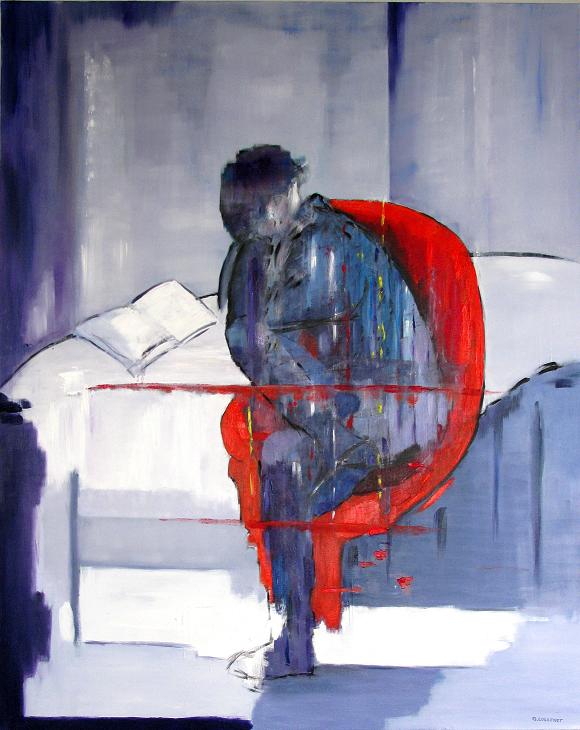
Character Reading — Benoit Colsenet
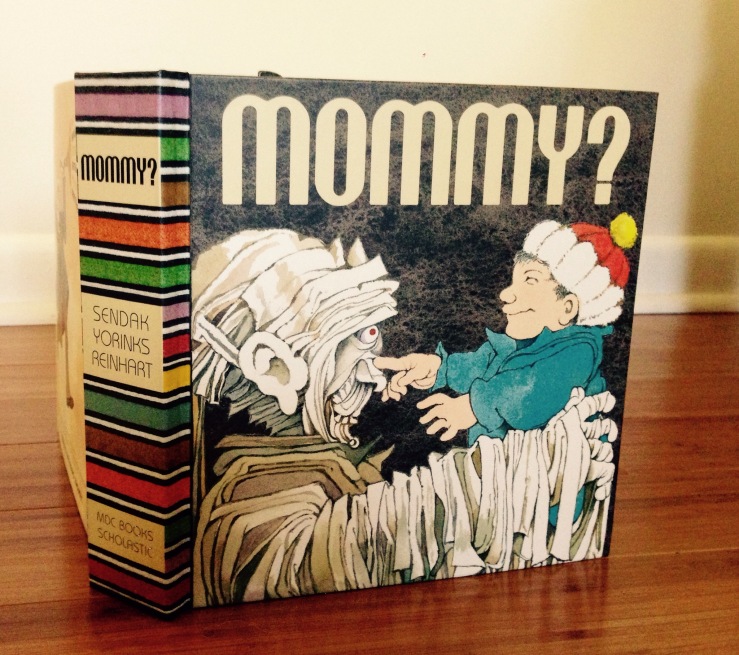
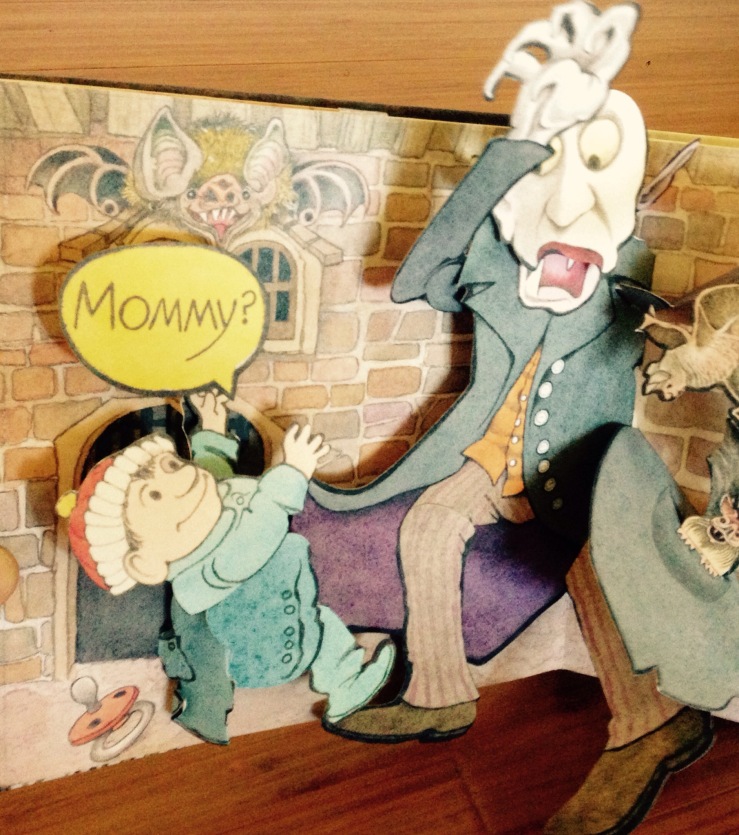
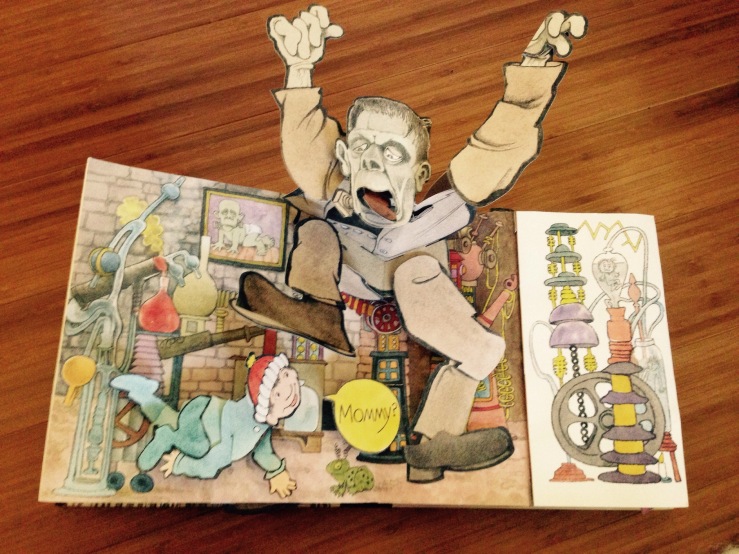
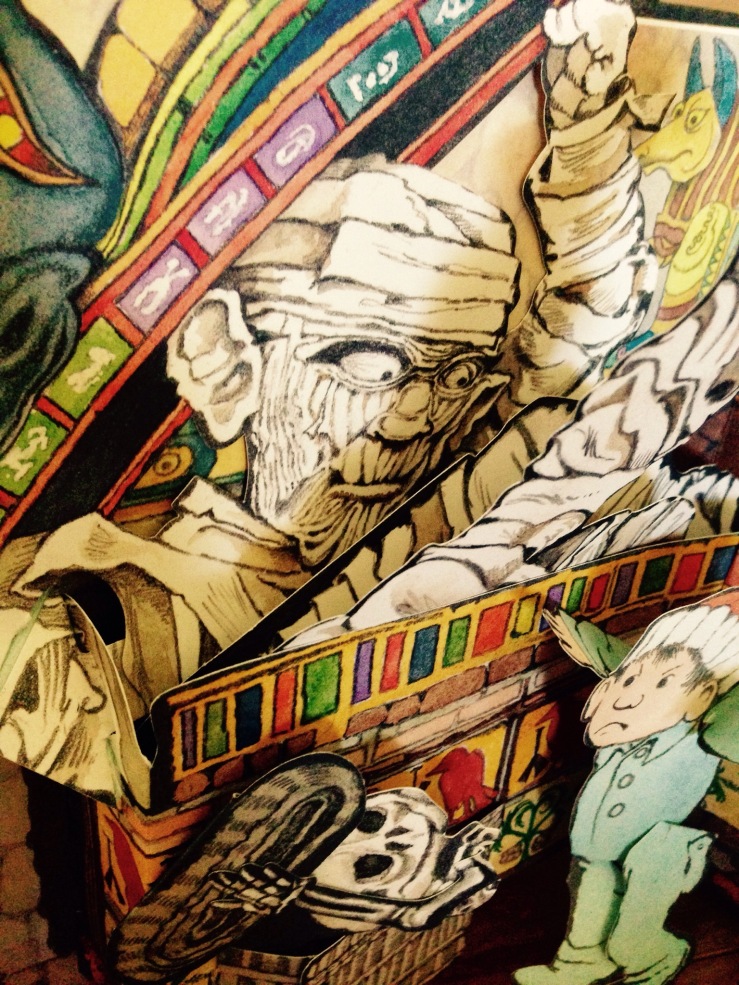
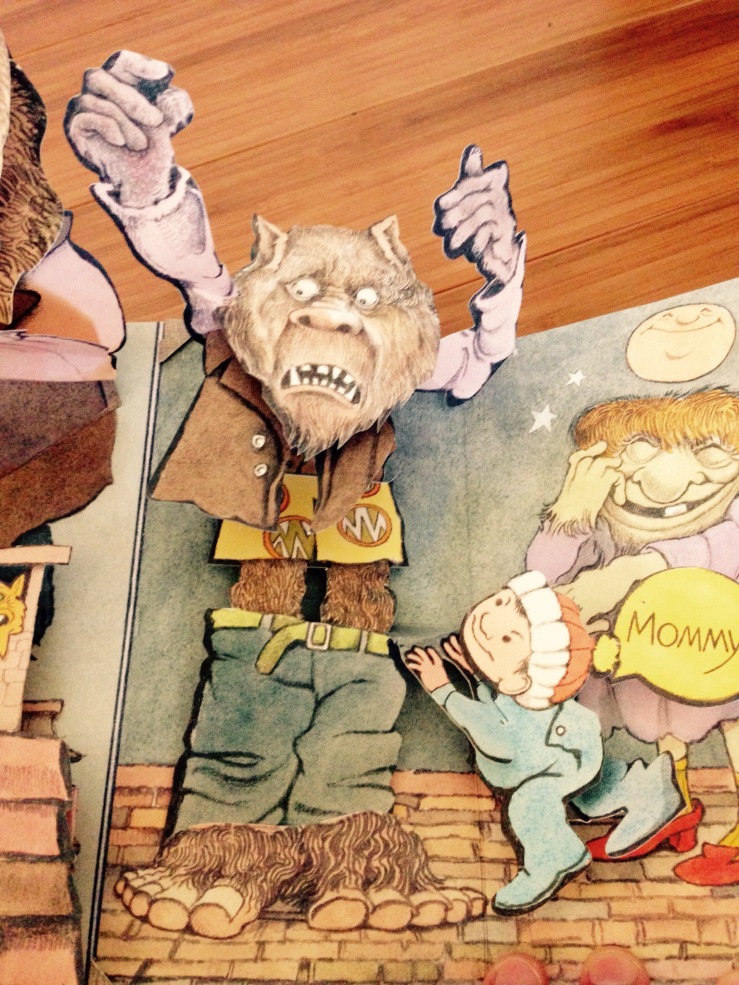
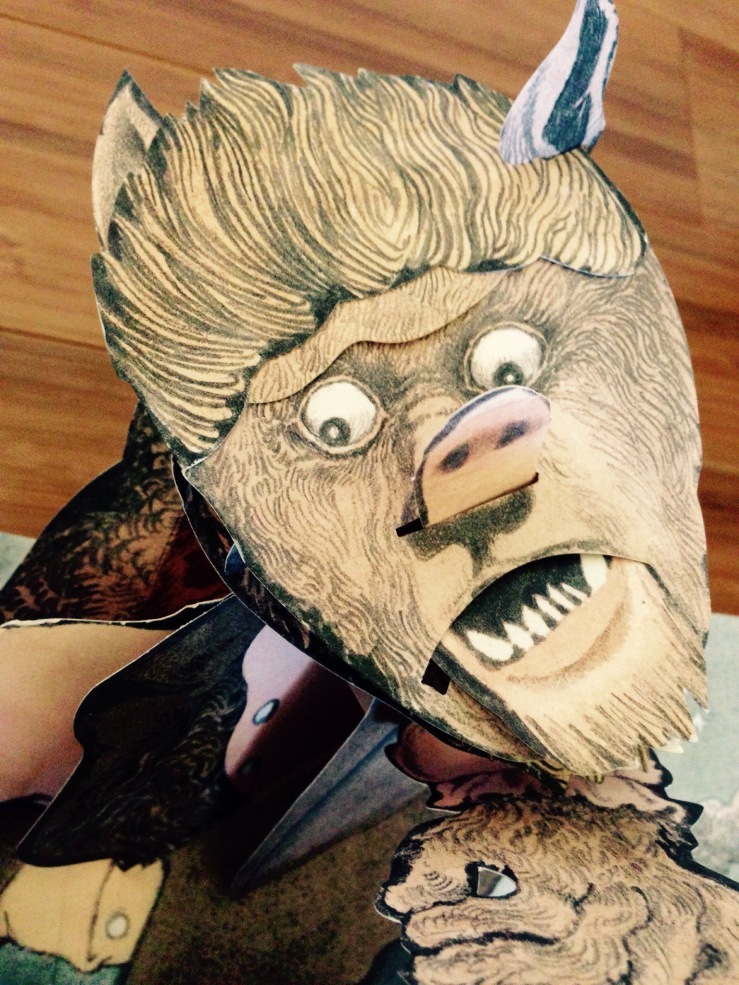
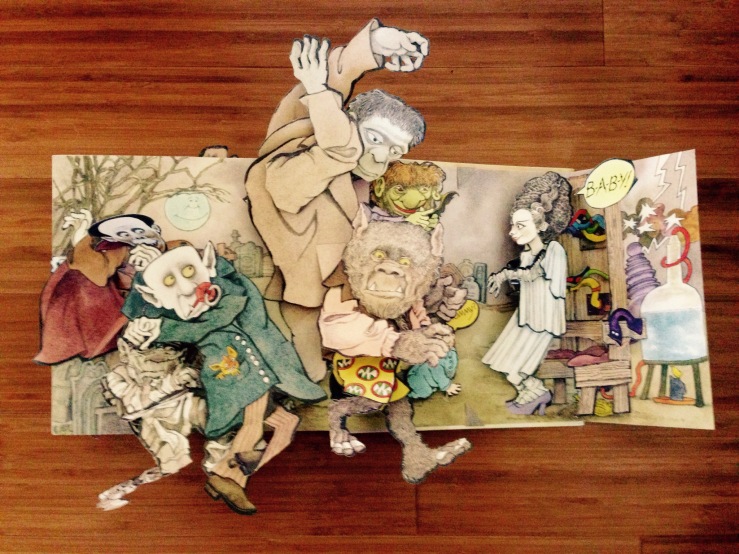
Maurice Sendak’s Pop-Up Book of Monsters (Book Acquired, 10.24.2014)
 Biblioklept