“The Index” — J.G. Ballard

“The Index”

by J.G. Ballard

EDITOR’S NOTE. From abundant internal evidence it seems clear that the text printed below is the index to the unpublished and perhaps suppressed autobiography of a man who may well have been one of the most remarkable figures of the twentieth century. Yet of his existence nothing is publicly known, although his life and work appear to have exerted a profound influence on the events of the past fifty years. Physician and philosopher, man of action and patron of the arts, sometime claimant to the English throne and founder of a new religion, Henry Rhodes Hamilton was evidently the intimate of the greatest men and women of our age. After World War II he founded a new movement of spiritual regener­ation, but private scandal and public concern at his grow­ing megalomania, culminating in his proclamation of himself as a new divinity, seem to have led to his down­fall. Incarcerated within an unspecified government insti­tution, he presumably spent his last years writing his autobiography of which this index is the only surviving fragment.

A substantial mystery still remains. Is it conceivable that all traces of his activities could be erased from our records of the period? Is the suppressed autobiography itself a disguised roman à clef, in which the fictional hero exposes the secret identities of his historical contempo­raries? And what is the true role of the indexer himself, clearly a close friend of the writer, who first suggested that he embark on his autobiography? This ambiguous and shadowy figure has taken the unusual step of index­ing himself into his own index. Perhaps the entire compi­lation is nothing more than a figment of the over­wrought imagination of some deranged lexicographer. Alternatively, the index may be wholly genuine, and the only glimpse we have into a world hidden from us by a gigantic conspiracy, of which Henry Rhodes Hamilton is the greatest victim.

A

Acapulco, 143

Acton, Harold, 142–7, 213

Alcazar, Siege of, 221–5

Alimony, HRH pays, 172, 247, 367, 453

Anaxagoras, 35, 67, 69–78, 481

Apollinaire, 98

Arden, Elizabeth, 189, 194, 376–84

Autobiography of Alice B. Toklas, The (Stein), 112

Avignon, birthplace of HRH, 9–13; childhood holidays, 27; research at Pasteur Institute of Ophthalmology, 101; attempts to restore anti-Papacy, 420–35

B

Bal Musette, Paris, 98

Balliol College, Oxford, 69–75, 231

Beach, Sylvia, 94–7

Berenson, Bernard, conversations with HRH, 134; offer of adoption, 145; loan of Dürer etching, 146; law-suits against HRH, 173–85

Bergman, Ingrid, 197, 134, 267

Biarritz, 123

Blixen, Karen von (Isak Dinesen), letters to HRH, declines marriage proposal, 197

Byron, Lord, 28, 76, 98, 543 Continue reading ““The Index” — J.G. Ballard”

“A Respectable Woman” — Kate Chopin

“A Respectable Woman”

by Kate Chopin

Mrs. Baroda was a little provoked to learn that her husband expected his friend, Gouvernail, up to spend a week or two on the plantation.

They had entertained a good deal during the winter; much of the time had also been passed in New Orleans in various forms of mild dissipation. She was looking forward to a period of unbroken rest, now, and undisturbed tete-a-tete with her husband, when he informed her that Gouvernail was coming up to stay a week or two.

This was a man she had heard much of but never seen. He had been her husband’s college friend; was now a journalist, and in no sense a society man or “a man about town,” which were, perhaps, some of the reasons she had never met him. But she had unconsciously formed an image of him in her mind. She pictured him tall, slim, cynical; with eye-glasses, and his hands in his pockets; and she did not like him. Gouvernail was slim enough, but he wasn’t very tall nor very cynical; neither did he wear eyeglasses nor carry his hands in his pockets. And she rather liked him when he first presented himself.

But why she liked him she could not explain satisfactorily to herself when she partly attempted to do so. She could discover in him none of those brilliant and promising traits which Gaston, her husband, had often assured her that he possessed. On the contrary, he sat rather mute and receptive before her chatty eagerness to make him feel at home and in face of Gaston’s frank and wordy hospitality. His manner was as courteous toward her as the most exacting woman could require; but he made no direct appeal to her approval or even esteem.

Once settled at the plantation he seemed to like to sit upon the wide portico in the shade of one of the big Corinthian pillars, smoking his cigar lazily and listening attentively to Gaston’s experience as a sugar planter.

“This is what I call living,” he would utter with deep satisfaction, as the air that swept across the sugar field caressed him with its warm and scented velvety touch. It pleased him also to get on familiar terms with the big dogs that came about him, rubbing themselves sociably against his legs. He did not care to fish, and displayed no eagerness to go out and kill grosbecs when Gaston proposed doing so. Continue reading ““A Respectable Woman” — Kate Chopin”

Breakfast at Berneval — Pierre-Auguste Renoir

“The main difficulty with the book business” (Donald Barthelme)

The main difficulty with the book business is that a book is two kinds of objects. You have, on the one hand, a thing that a reasonable and prudent man might decide is a book. You have on the other hand an object which looks very much like a book, feels very much like a book, but is in actuality a bucket of peanut butter covered with a thin layer of chocolate sauce. These things are sold in the same way. The latter seems to sell better, for some mysterious reason, than the former. A good example of this that I ran into recently is a book called The First Time, which apparently has to do with accounts of initial sexual experiences of either eminent or reasonably well-known people. This, I would say, is a bucket of peanut butter. Actually, they missed. They should have done a book called The Last Time, which would not only be funnier but more poignant. The idea is copyrighted, by the way. Take notes.

From remarks Donald Barthelme delivered at a 1975 conference at the Library of Congress. Published in Tracy Daugherty’s book Hiding Man: A Biography of Donald Barthelme.

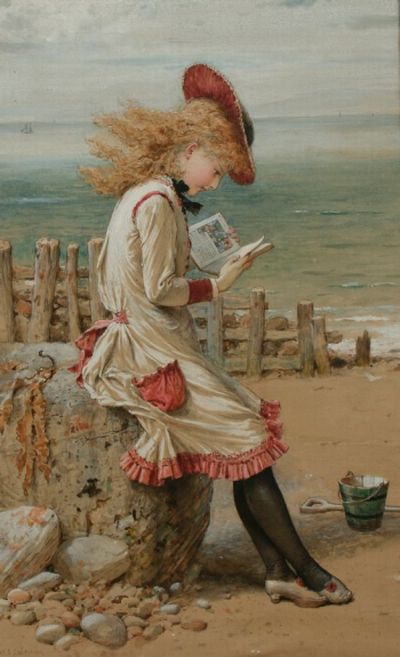
The Beach — Alfred Victor Fournier

beach-scene-660x557

RIP Amiri Baraka

RIP Amiri Baraka, 1934-2014

“An archeological slice. Not much glitter.” (Donald Barthelme)

INTERVIEWER

Which reminds me: Some of your detractors say that you’re merely fashionable.

BARTHELME

Well, the mere has always been a useful category.

INTERVIEWER

That you’re a jackdaw, and your principle of selection is whatever glitters most.

BARTHELME

I weep and tear my hair. And disagree.

INTERVIEWER

Let’s look at a specific jackdaw’s nest, the barricade in “The Indian Uprising.”

BARTHELME

I don’t see anything particularly fashionable. The table made from a hollow-core door may be a 1960s reference but aren’t people still making them?

INTERVIEWER

But your barricade is not intended as straightforward realism; these things are artifacts of a certain culture.

BARTHELME

An archeological slice. Not much glitter.

INTERVIEWER

Won’t it require scholarly annotation in the future?

BARTHELME

I’d say no. If you read The Swiss Family Robinson and you’re reading about what they unpack from the pinnace as they shuttle from ship to shore you don’t need any footnotes, even though there may be four hundred pounds of tallow in the cargo. You have a vague recollection that it’s used to make candles.

Actually I think the jackdaw business is a function of appearing in the New Yorker with some frequency. People read the fiction with after images of Rolls Royces and Rolexes still sizzling in their eyes. Rare is the reviewer who can resist mentioning the magazine’s ads when talking about the fiction. One is gilded by association.

INTERVIEWER

Suppose we turn things around. Suppose I say that when I read that story I’m not at all concerned about whether people made tables from hollow-core doors in the 1960s. Rather, I’m interested in the speaker, who in the metaphorical context of the story is besieged by Comanches.

BARTHELME

Is besieged by very much more than Comanches, but also by Comanches. He’s not meant to be a walking-around person so much as a target, a butt. The arrows of the Comanches but also sensory insult, political insult, there are references to the war there, to race, to torture, jingoism . . . But none of the references in the story were picked at random, and none are used simply as decor. If they seem random it’s probably because the range of reference is rather wide for a short piece—you have Patton and Frank Wedekind and the seventh cavalry coexisting on the same plane—but the crowding is part of the design, is the design.

From Donald Barthelme’s The Paris Review interview.

“Samuel” — Grace Paley

“Samuel”

by Grace Paley

Some boys are very tough. They’re afraid of nothing. They are the ones who climb a wall and take a bow at the top. Not only are they brave on the roof, but they make a lot of noise in the darkest part of the cellar where even the super hates to go. They also jiggle and hop on the platform between the locked doors of the subway cars.

Four boys are jiggling on the swaying platform. Their names are Alfred, Calvin, Samuel, and Tom. The men and women in the cars on either side watch them. They don’t like them to jiggle or jump but don’t want to interfere. Of course some of the men in the cars were once brave boys like these. One of them had ridden the tail of a speeding truck from New York to Rockaway Beach without getting off, without his sore fingers losing hold. Nothing happened to him then or later. He had made a compact with other boys who preferred to watch: starting at Eighth Avenue and Fifteenth Street, he would get to some specified place, maybe Twenty-third and the river, by hopping the tops of the moving trucks. This was hard to do when one truck turned a corner in the wrong direction and the nearest truck was a couple of feet too high. He made three or four starts before succeeding. He had gotten this idea from a film at school called The Romance of Logging. He had finished high school, married a good friend, was in a responsible job, and going to night school.

These two men and others looked at the four boys jumping and jiggling on the platform and thought. It must be fun to ride that way, especially now the weather is nice and we’re out of the tunnel and way high over the Bronx. Then they thought. These kids do seem to be acting sort of stupid. They are little. Then they thought of some of the brave things they had done when they were boys and jiggling didn’t seem so risky.

The ladies in the car became very angry when they looked at the four boys. Most of them brought their brows together and hoped the boys could see their extreme disapproval. One of the ladies wanted to get up and say, be careful you dumb kids, get off that platform or I’ll call a cop. But three of the boys were Negroes and the fourth was something else she couldn’t tell for sure. She was afraid they’d be fresh and laugh at her and embarrass her. She wasn’t afraid they’d hit her, but she was afraid of embarrassment. Another lady thought, their mothers never know where they are. It wasn’t true in this particular case. Their mothers all knew that they had gone to see the missile exhibit on Fourteenth Street.

Out on the platform, whenever the train accelerated, the boys would raise their hands and point them up to the sky to act like rockets going off, then they rat-tat-tatted the shatterproof glass pane like machine guns, although no machine guns had been exhibited.

For some reason known only to the motorman, the train began a sudden slowdown. The lady who was afraid of embarrassment saw the boys jerk forward and backward and grab the swinging guard chains. She had her own boy at home. She stood up with determination and went to the door. She slid it open and said, “You boys will be hurt. You’ll be killed. I’m going to call the conductor if you don’t just go into the next car and sit down and be quiet.”

Two of the boys said, “Yes’m,” and acted as though they were about to go. Two of them blinked their eyes a couple of times and pressed their lips together. The train resumed its speed. The door slid shut, parting the lady and the boys. She leaned against the side door because she had to get off at the next stop.

The boys opened their eyes wide at each other and laughed. The lady  blushed. The boys looked at her and laughed harder. They began to pound each other’s back. Samuel laughed the hardest and pounded Alfred’s back until Alfred coughed and the tears came. Alfred held tight to the chain hook. Samuel pounded him even harder when he saw the tears. He said, “Why you bawling? You a baby, huh?” and laughed. One of the men whose boyhood had been more watchful than brave became angry. He stood up straight and looked at the boys for a couple of seconds. Then he walked in a citizenly way to the end of the car, where he pulled the emergency cord. Almost at once, with a terrible hiss, the pressure of air abandoned the brakes and the wheels were caught and held.

People standing in the most secure places fell forward, then backward. Samuel had let go of his hold on the chain so he could pound Tom as well as Alfred. All the passengers in the cars whipped back and forth, but he pitched only forward and fell head first to be crushed and killed between the cars.

The train had stopped hard, halfway into the station, and the conductor called at once for the trainmen who knew about this kind of death and how to take the body from the wheels and brakes. There was silence except for passengers from the other cars who asked, What happened! What happened! The ladies waited around wondering if he might be an only child. The men recalled other afternoons with very bad endings. The little boys stayed close to each other, leaning and touching shoulders and arms and legs.

When the policeman knocked at the door and told her about it, Samuel’s mother began to scream. She screamed all day and moaned all night, though the doctors tried to quiet her with pills.

Oh, oh, she hopelessly cried. She did not know how she could ever find another boy like that one. However, she was a young woman and she became pregnant. Then for a few months she was hopeful. The child born to her was a boy. They brought him to be seen and nursed. She smiled. But immediately she saw that this baby wasn’t Samuel. She and her husband together have had other children, but never again will a boy exactly like Samuel be known.

In the Library, St James’s Square — Thomas Pole

pole

“The Unexplorer” — Edna St. Vincent Millay

esvm

Queen Katherine’s Dream — Henry Fuseli

hf

Bored?

bored

“Apparently with no surprise” — Emily Dickinson

x

Mouth of Hell — The Master of Catherine of Cleves

Catherine_03

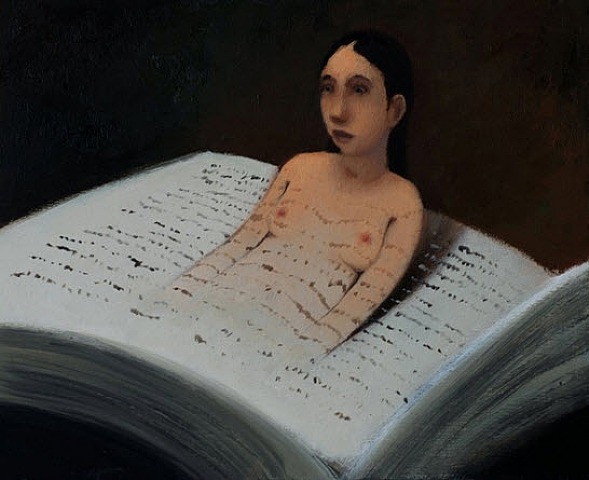
Johannes Hüppi Painting (Woman/Book)

Johannes Huppi  (23)

The Shepherd’s Dream (Paradise Lost) — Henry Fuseli

Jack London’s Dystopian Short Story, “A Curious Fragment”

“A Curious Fragment” by Jack London

[The capitalist, or industrial oligarch, Roger Vanderwater, mentioned in the narrative, has been identified as the ninth in the line of the Vanderwaters that controlled for hundreds of years the cotton factories of the South. This Roger Vanderwater flourished in the last decades of the twenty- sixth century after Christ, which was the fifth century of the terrible industrial oligarchy that was reared upon the ruins of the early Republic. From internal evidences we are convinced that the narrative which follows was not reduced to writing till the twenty- ninth century. Not only was it unlawful to write or print such matter during that period, but the working-class was so illiterate that only in rare instances were its members able to read and write. This was the dark reign of the overman, in whose speech the great mass of the people were characterized as the “herd animals.” All literacy was frowned upon and stamped out. From the statute-books of the times may be instanced that black law that made it a capital offence for any man, no matter of what class, to teach even the alphabet to a member of the working-class. Such stringent limitation of education to the ruling class was necessary if that class was to continue to rule. One result of the foregoing was the development of the professional story-tellers. These story-tellers were paid by the oligarchy, and the tales they told were legendary, mythical, romantic, and harmless. But the spirit of freedom never quite died out, and agitators, under the guise of story-tellers, preached revolt to the slave class. That the following tale was banned by the oligarchs we have proof from the records of the criminal police court of Ashbury, wherein, on January 27, 2734, one John Tourney, found guilty of telling the tale in a boozing-ken of labourers, was sentenced to five years’ penal servitude in the borax mines of the Arizona Desert.—EDITOR’S NOTE.]

Listen, my brothers, and I will tell you a tale of an arm. It was the arm of Tom Dixon, and Tom Dixon was a weaver of the first class in a factory of that hell-hound and master, Roger Vanderwater. This factory was called “Hell’s Bottom”… by the slaves who toiled in it, and I guess they ought to know; and it was situated in Kingsbury, at the other end of the town from Vanderwater’s summer palace. You do not know where Kingsbury is? There are many things, my brothers, that you do not know, and it is sad. It is because you do not know that you are slaves. When I have told you this tale, I should like to form a class among you for the learning of written and printed speech. Our masters read and write and possess many books, and it is because of that that they are our masters, and live in palaces, and do not work. When the toilers learn to read and write—all of them—they will grow strong; then they will use their strength to break their bonds, and there will be no more masters and no more slaves.

Kingsbury, my brothers, is in the old State of Alabama. For three hundred years the Vanderwaters have owned Kingsbury and its slave pens and factories, and slave pens and factories in many other places and States. You have heard of the Vanderwaters—who has not?—but let me tell you things you do not know about them. The first Vanderwater was a slave, even as you and I. Have you got that? He was a slave, and that was over three hundred years ago. His father was a machinist in the slave pen of Alexander Burrell, and his mother was a washerwoman in the same slave pen. There is no doubt about this. I am telling you truth. It is history. It is printed, every word of it, in the history books of our masters, which you cannot read because your masters will not permit you to learn to read. You can understand why they will not permit you to learn to read, when there are such things in the books. They know, and they are very wise. If you did read such things, you might be wanting in respect to your masters, which would be a dangerous thing… to your masters. But I know, for I can read, and I am telling you what I have read with my own eyes in the history books of our masters. Continue reading “Jack London’s Dystopian Short Story, “A Curious Fragment””