WHEN I was a debutante I often went to the zoological garden. I went so often that I was better acquainted with animals than with the young girls of my age. It was to escape from the world that I found myself each day at the zoo. The beast I knew best was a young hyena. She knew me too. She was extremely intelligent; I taught her French and in return she taught me her language. We spent many pleasant hours in this way.
For the first of May my mother had arranged a ball in my honor. For entire nights I suffered: I had always detested balls, above all those given in my own honor.
On the morning of May first, 1934, very early, I went to visit the hyena. “What a mess of shit,” I told her. “I must go to my ball this evening.”
“You’re lucky,” she said. “I would go happily. I do not know how to dance, but after all, I could engage in conversation.”
“There will be many things to eat,” said I. “I have seen wagons loaded entirely with food coming up to the house.”
“And you complain!” replied the hyena with disgust. “As for me, I eat only once a day, and what rubbish they stick me with!”
I had a bold idea; I almost laughed. “You have only to go in my place.”
“We do not look enough alike, otherwise I would gladly go,” said the hyena, a little sad. “Listen,” said I, “in the evening light one does not see very well. If you were disguised a little, no one would notice in the crowd. Besides, we are almost the same size. You are my only friend; I implore you.”
She reflected upon this sentiment. I knew that she wanted to accept. “It is done,” she said suddenly.
It was very early; not many keepers were about. Quickly I opened the cage and in a moment we were in the street. I took a taxi; at the house, everyone was in bed. In my room, I brought out the gown I was supposed to wear that evening. It was a little long, and the hyena walked with difficulty in my high-heeled shoes. I found some gloves to disguise her hands which were too hairy to resemble mine. When the sunlight entered, she strolled around the room several times—walking more or less correctly. We were so very occupied that my mother, who came to tell me good morning, almost opened the door before the hyena could hide herself under my bed. “There is a bad odor in the room,” said my mother, opening the window. “Before this evening you must take a perfumed bath with my new salts.”
“Agreed,” said I. She did not stay long; I believe the odor was too strong for her. “Do not be late for breakfast,” she said, as she left the room.
The greatest difficulty was to find a disguise for the hyena’s face. For hours and hours we sought an answer: she rejected all of my proposals. At last she said, “I think I know a solution. You have a maid?”
“Yes,” I said, perplexed.
“Well, that’s it. You will ring for the maid and when she enters we will throw ourselves upon her and remove her face. I will wear her face this evening in place of my own.”
“That’s not practical,” I said to her.
“She will probably die when she has no more face; someone will surely find the corpse and we will go to prison.”
“I am hungry enough to eat her,” replied the hyena.
“And the bones?”
“Those too,” she said.
“Then it’s settled?”
“Only if you agree to kill her before removing her face. It would be too uncomfortable otherwise.”
“Good; it’s all right with me.” I rang for Marie, the maid, with a certain nervousness. I would not have done it if I did not detest dances so much. When Marie entered I turned to the wall so as not to see. I admit that it was done quickly. A brief cry and it was over. While the hyena ate, I looked out the window. A few minutes later, she said: “I cannot eat anymore; the two feet are left, but if you have a little bag I will eat them later in the day.”
“You will find in the wardrobe a bag embroidered with fleurs de lys. Remove the handkerchiefs inside it and take it.” She did as I indicated.
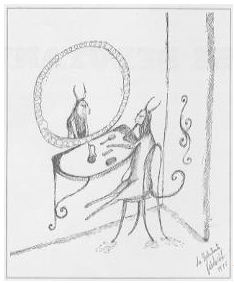
At last she said: “Turn around now and look, because I am beautiful!” Before the mirror, the hyena admired herself in Marie’s face. She had eaten very carefully all around the face so that what was left was just what was needed. “Surely, it’s properly done,” said I.
Toward evening, when the hyena was all dressed, she declared: “I am in a very good mood. I have the impression that I will be a great success this evening.” When the music below had been heard for some time, I said to her: “Go now, and remember not to place yourself at my mother’s side: she will surely know that it is not I. Otherwise I know no one. Good luck.” I embraced her as we parted but she smelled very strong.
Night had fallen. Exhausted by the emotions of the day, I took a book and sat down by the open window. I remember that I was reading Gulliver’s Travels by Jonathan Swift. It was perhaps an hour later that the first sign of misfortune announced itself. A bat entered through the window, emitting little cries. I am terribly afraid of bats, I hid behind a chair, my teeth chattering. Scarcely was I on my knees when the beating of the wings was drowned out by a great commotion at my door. My mother entered, pale with rage. “We were coming to seat ourselves at the table,” she said, “when the thing who was in your place rose and cried: ‘I smell a little strong, eh? Well, as for me, I do not eat cake.’ With these words she removed her face and ate it. A great leap and she disappeared out the window.”
The regret we have for our childhood is not wholly justifiable: so much a man may lay down without fear of public ribaldry; for although we shake our heads over the change, we are not unconscious of the manifold advantages of our new state. What we lose in generous impulse, we more than gain in the habit of generously watching others; and the capacity to enjoy Shakespeare may balance a lost aptitude for playing at soldiers. Terror is gone out of our lives, moreover; we no longer see the devil in the bed-curtains nor lie awake to listen to the wind. We go to school no more; and if we have only exchanged one drudgery for another (which is by no means sure), we are set free for ever from the daily fear of chastisement. And yet a great change has overtaken us; and although we do not enjoy ourselves less, at least we take our pleasure differently. We need pickles nowadays to make Wednesday’s cold mutton please our Friday’s appetite; and I can remember the time when to call it red venison, and tell myself a hunter’s story, would have made it more palatable than the best of sauces. To the grown person, cold mutton is cold mutton all the world over; not all the mythology ever invented by man will make it better or worse to him; the broad fact, the clamant reality, of the mutton carries away before it such seductive figments. But for the child it is still possible to weave an enchantment over eatables; and if he has but read of a dish in a story-book, it will be heavenly manna to him for a week.
If a grown man does not like eating and drinking and exercise, if he is not something positive in his tastes, it means he has a feeble body and should have some medicine; but children may be pure spirits, if they will, and take their enjoyment in a world of moon-shine. Sensation does not count for so much in our first years as afterwards; something of the swaddling numbness of infancy clings about us; we see and touch and hear through a sort of golden mist. Children, for instance, are able enough to see, but they have no great faculty for looking; they do not use their eyes for the pleasure of using them, but for by-ends of their own; and the things I call to mind seeing most vividly, were not beautiful in themselves, but merely interesting or enviable to me as I thought they might be turned to practical account in play. Nor is the sense of touch so clean and poignant in children as it is in a man. If you will turn over your old memories, I think the sensations of this sort you remember will be somewhat vague, and come to not much more than a blunt, general sense of heat on summer days, or a blunt, general sense of wellbeing in bed. And here, of course, you will understand pleasurable sensations; for overmastering pain—the most deadly and tragical element in life, and the true commander of man’s soul and body—alas! pain has its own way with all of us; it breaks in, a rude visitant, upon the fairy garden where the child wanders in a dream, no less surely than it rules upon the field of battle, or sends the immortal war-god whimpering to his father; and innocence, no more than philosophy, can protect us from this sting. As for taste, when we bear in mind the excesses of unmitigated sugar which delight a youthful palate, “it is surely no very cynical asperity” to think taste a character of the maturer growth. Smell and hearing are perhaps more developed; I remember many scents, many voices, and a great deal of spring singing in the woods. But hearing is capable of vast improvement as a means of pleasure; and there is all the world between gaping wonderment at the jargon of birds, and the emotion with which a man listens to articulate music. Continue reading ““Child’s Play” — Robert Louis Stevenson”→
A Philosophy of Walking by Frederic Gros is new in English translation from Verso Books. Their blurb:
In A Philosophy of Walking, Frédéric Gros charts the many different ways we get from A to B—the pilgrimage, the promenade, the protest march, the nature ramble—and shows what it tells us about ourselves.
He draws attention to other thinkers who also saw walking as a central part of their practice, and ponders over things like why Henry David Thoreau entered Walden Woods in pursuit of the wilderness; the reason Rimbaud walked in a fury while Nerval rambled to cure his melancholy. We learn how Rousseau had to walk to think, Nietzsche in order to write, while Kant walked to distract himself from contemplation. Brilliant, erudite and always entertaining, Gros is certain to make you reconsider this everyday activity.
I had hoped to crack into this a bit more over the holidays, but got wrapped up in another Verso book, Balestrini’s Tristano—and also like four other books. More to come.
“The Assassination of John Fitzgerald Kennedy Considered as a Downhill Motor Race” (1966)
1. “The Beach Murders” (1966)
Up until the mid-sixties, Ballard wasn’t able to find a rhetoric to match his ideas. Perhaps this makes sense if we consider that Ballard’s fiction has always been more interested in art, music, film, and biology than literature itself. He still relied on the tropes of magazine pulp fiction and hard-boiled detective stories to frame his tales, and while even the weakest of these tales was better than an episode of The Twilight Zone, they still occupied the same territory. Although Ballard’s earliest stories are distinctly Ballardian–obsessed with time, saturated in surrealism and psychology, shot through with a Cold War era paranoia and its attendant nihilism—it’s not until 1964, in the fragmentary “The Terminal Beach,” and the wry fabulism of “The Drowned Giant,” that Ballard finally merges form and content.
With “The Beach Murders,” Ballard manages to overstuff all of his tropes into a strange burlesque game. Paranoid, breast-obsessed, violent and funny, “The Beach Murders” comprises 26 sections, one for each letter in the English alphabet. And like the alphabet, Ballard’s story can be combined in any number of possibilities. In his introduction to the story, the narrator hints at a solution to the puzzle, before pointing out that any “final answer” will forever remain unclear:
Readers hoping to solve the mystery of the Beach Murders – involving a Romanoff Princess, a CIA agent, two of his Russian counterparts and an American limbo dancer – may care to approach it in the form of the card game with which Quimby, the absconding State Department cipher chief, amused himself in his hideaway on the Costa Blanca. The principal clues have therefore been alphabetized. The correct key might well be a familiar phrase, e. g. PLAYMATE OF THE MONTH, or meaningless, e. g. qwertyuiop… etc. Obviously any number of solutions is possible, and a final answer to the mystery, like the motives and character of Quimby himself, lies forever hidden.
“The Beach Murders” reads like a postmodern update of one of Edgar Allan Poe’s detective stories. Its gestures recall the fragmentation of his hero William Burroughs, as well as the techniques of his American contemporary Donald Barthelme–not to mention the emerging wave of continental deconstruction. It’s also very, very fun. Part of my ideal collection, The Essential Short Stories of J.G. Ballard.
2. “The Day of Forever” (1966)
It’s tempting to give in to biographical criticism when considering the subtle but significant shift in Ballard’s work after the shocking death of his wife Helen in 1964. While themes of loss, sleeplessness, and despair reverberate through many (if not most) of his early stories, they become sharper, more defined after 1964.
“The Day of Forever” is not exactly a great story, especially if you do what I’m doing—that is, read all of his stories chronologically. The story, about a world that has ceased to rotate, feels like a series of sketches that Ballard is using for something bigger (or has left out of something bigger). Taken in the context of his wife’s death, however, the story seems richer, sadder, more personal in its evocations of dreamlessness and loss.
When the story’s protagonist Halliday raids an abandoned gallery for its surrealist images, it’s hard not to intuit Ballard’s own desire to recover the unrecoverable:
In the students’ gallery hung the fading reproductions of a dozen schools of painting, for the most part images of worlds without meaning. However, grouped together in a small alcove Halliday found the surrealists Delvaux, Chirico and Ernst. These strange landscapes, inspired by dreams that his own could no longer echo, filled Halliday with a profound sense of nostalgia. One above all, Delvaux’s The Echo’, which depicted a naked Junoesque woman walking among immaculate ruins under a midnight sky, reminded him of his own recurrent fantasy. The infinite longing contained in the picture, the synthetic time created by the receding images of the woman, belonged to the landscape of his unseen night.
Delvaux’s The Echo
3. “The Impossible Man” (1966)
The theme of recovery surfaces again in “The Impossible Man,” where a young man named Conrad (insert observation here that so many of Ballard’s protagonist’s are nakedly named for writers) is given the chance to walk again after a terrible accident—he’ll receive the limbs of a man who died causing the accident. With its fetishizing of scars, auto accidents, and surgery, “The Impossible Man” points directly toward Ballard’s weirdest works, The Atrocity Exhibition and Crash.
4. “Storm–Bird, Storm–Dreamer” (1966)
“Storm-Bird, Storm-Dreamer” evokes a rich, Gothic world, a swampland where humans battle mutant birds. Here, a strange woman in mourning awaits the return of her lost child (there’s that theme again!) through some avian agency. There are skiffs and pergolas and feathers and shotguns. There is a dwarf. Dark and romantic, the tale’s themes—and the delivery of those themes—recall Ballard’s earlier forays into magical realism, “The Drowned Giant” and 1962’s “The Garden of Time.”
5. “Tomorrow is a Million Years” (1966)
Ballard’s narrator in “Tomorrow is a Million Years” directly invokes Robinson Crusoe and Moby-Dick and alludes to the myth of the Flying Dutchman. Allusion is a fundamental trope of literature—indeed, most literature seems to take literature as its own subject—but Ballard’s allusions, beyond his character names (he christens a character in 1967’s “Cry Hope, Cry Fury!” Melville) tend to skew toward art and music. The allusions to doomed voyages and shipwreck are appropriate here, and Ballard synthesizes them into a tale of madness and hallucination. And, at the risk of spoiling the tale’s shocking ending, I’ll suggest again that Ballard is writing through/to/around/beneath the death of his wife.
6. “The Assassination of John Fitzgerald Kennedy Considered as a Downhill Motor Race” (1966)
Ballard begins “Assassination” with an author’s note:
The assassination of President Kennedy on November 22nd, 1963, raised many questions, not all of which were answered by the Report of the Warren Commission. It is suggested that a less conventional view of the events of that grim day may provide a more satisfactory explanation. In particular Alfred Jarry’s “The Crucifixion Considered as an Uphill Bicycle Race” gives us a useful lead.
Author of the infamous proto-surrealist play Ubu Roi, Alfred Jarry’s pataphysical conceits undoubtedly influenced and engaged Ballard, offering him new ways of writing beyond the constraints of his earlier pulp fiction. Published almost 60 years after Jarry’s death, “Assassination” is just as shocking as the text it’s modeled on, suggesting that the disruptive powers of language that Ballard was beginning to experiment with retain vitality outside of history. It’s worth sharing the opening paragraphs of “Assassination”:
Oswald was the starter.
From his window above the track he opened the race by firing the starting gun. It is believed that the first shot was not properly heard by all the drivers. In the following confusion Oswald fired the gun two more times, but the race was already under way.
Kennedy got off to a bad start.
There was a governor in his car and its speed remained constant at about fifteen miles an hour. However, shortly afterwards, when the governor had been put out of action, the car accelerated rapidly, and continued at high speed along the remainder of the course.
The visiting teams. As befitting the inauguration of the first production car race through the streets of Dallas, both the President and the Vice–President participated. The Vice–President, Johnson, took up his position behind Kennedy on the starting line. The concealed rivalry between the two men was of keen interest to the crowd. Most of them supported the home driver, Johnson.
If “Kennedy got off to a bad start” doesn’t crack you up then it’s likely this story isn’t for you. Ballard’s humor often rests entirely on a kind of moral irony in his earlier stories (you know, like something from the Twilight Zoneseries), but “Assassination” shows a wry constraint, a trust in the reader that probably originated in Ballard’s growing comfort in his own powers. (Later stories like “The Greatest Television Show on Earth” and “The Life and Death of God” advance Ballard’s control of dark humor).
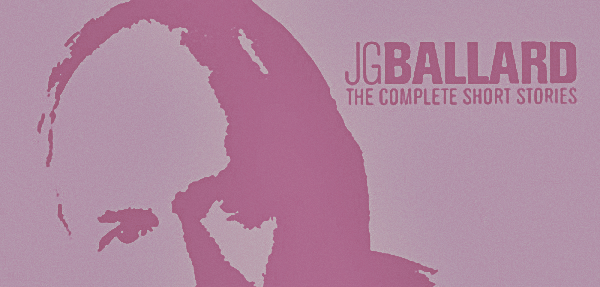
“The Assassination of John Fitzgerald Kennedy Considered as a Downhill Motor Race” was published in The Atrocity Exhibition; for whatever reason, The Complete Short Stories only includes two other stories from that collection (“Why I Want to Fuck Ronald Reagan” and “The Secret History of World War 3,” which wasn’t actually part of the original AE pressing). So maybe Complete is not so complete.
I’m actually almost finished with the book (my Kindle tells me I’m at 72%). I should probably slow down and try to take more notes for these riffs—or just write faster and looser. But the reading becomes far more compelling at this point, as Ballard transcends the limitations of sci-fi pulp and begins to contend with his surrealist forbears. Next time: “Why I Want to Fuck Ronald Reagan”! Another Vermilion Sands story—this one not so bad! Ballard takes on Vietnam! Etc.
In the town of Vladimir lived a young merchant named Ivan Dmitrich Aksionov. He had two shops and a house of his own.
Aksionov was a handsome, fair-haired, curly-headed fellow, full of fun, and very fond of singing. When quite a young man he had been given to drink, and was riotous when he had had too much; but after he married he gave up drinking, except now and then.
One summer Aksionov was going to the Nizhny Fair, and as he bade good-bye to his family, his wife said to him, “Ivan Dmitrich, do not start to-day; I have had a bad dream about you.”
Aksionov laughed, and said, “You are afraid that when I get to the fair I shall go on a spree.”
His wife replied: “I do not know what I am afraid of; all I know is that I had a bad dream. I dreamt you returned from the town, and when you took off your cap I saw that your hair was quite grey.”
Aksionov laughed. “That’s a lucky sign,” said he. “See if I don’t sell out all my goods, and bring you some presents from the fair.”
So he said good-bye to his family, and drove away.
When he had travelled half-way, he met a merchant whom he knew, and they put up at the same inn for the night. They had some tea together, and then went to bed in adjoining rooms.
It was not Aksionov’s habit to sleep late, and, wishing to travel while it was still cool, he aroused his driver before dawn, and told him to put in the horses.
Then he made his way across to the landlord of the inn (who lived in a cottage at the back), paid his bill, and continued his journey.
When he had gone about twenty-five miles, he stopped for the horses to be fed. Aksionov rested awhile in the passage of the inn, then he stepped out into the porch, and, ordering a samovar to be heated, got out his guitar and began to play.
Suddenly a troika drove up with tinkling bells and an official alighted, followed by two soldiers. He came to Aksionov and began to question him, asking him who he was and whence he came. Aksionov answered him fully, and said, “Won’t you have some tea with me?” But the official went on cross-questioning him and asking him. “Where did you spend last night? Were you alone, or with a fellow-merchant? Did you see the other merchant this morning? Why did you leave the inn before dawn?”
Aksionov wondered why he was asked all these questions, but he described all that had happened, and then added, “Why do you cross-question me as if I were a thief or a robber? I am travelling on business of my own, and there is no need to question me.”
Then the official, calling the soldiers, said, “I am the police-officer of this district, and I question you because the merchant with whom you spent last night has been found with his throat cut. We must search your things.”
Last night, between eleven and twelve o’clock, when the Old Year was leaving her final footprints on the borders of Time’s empire, she found herself in possession of a few spare moments, and sat down—of all places in the world—on the steps of our new city-hall. The wintry moonlight showed that she looked weary of body and sad of heart, like many another wayfarer of earth. Her garments, having been exposed to much foul weather and rough usage, were in very ill condition, and, as the hurry of her journey had never before allowed her to take an instant’s rest, her shoes were so worn as to be scarcely worth the mending. But after trudging only a little distance farther this poor Old Year was destined to enjoy a long, long sleep. I forgot to mention that when she seated herself on the steps she deposited by her side a very capacious bandbox in which, as is the custom among travellers of her sex, she carried a great deal of valuable property. Besides this luggage, there was a folio book under her arm very much resembling the annual volume of a newspaper. Placing this volume across her knees and resting her elbows upon it, with her forehead in her hands, the weary, bedraggled, world-worn Old Year heaved a heavy sigh and appeared to be taking no very pleasant retrospect of her past existence.
While she thus awaited the midnight knell that was to summon her to the innumerable sisterhood of departed years, there came a young maiden treading lightsomely on tip-toe along the street from the direction of the railroad dépôt. She was evidently a stranger, and perhaps had come to town by the evening train of cars. There was a smiling cheerfulness in this fair maiden’s face which bespoke her fully confident of a kind reception from the multitude of people with whom she was soon to form acquaintance. Her dress was rather too airy for the season, and was bedizened with fluttering ribbons and other vanities which were likely soon to be rent away by the fierce storms or to fade in the hot sunshine amid which she was to pursue her changeful course. But still she was a wonderfully pleasant-looking figure, and had so much promise and such an indescribable hopefulness in her aspect that hardly anybody could meet her without anticipating some very desirable thing—the consummation of some long-sought good—from her kind offices. A few dismal characters there may be here and there about the world who have so often been trifled with by young maidens as promising as she that they have now ceased to pin any faith upon the skirts of the New Year. But, for my own part, I have great faith in her, and, should I live to see fifty more such, still from each of those successive sisters I shall reckon upon receiving something that will be worth living for. Continue reading “Read “The Sister Years,” Nathaniel Hawthorne’s Allegorical New Year’s Tale”→











 Biblioklept