“A Mother” — James Joyce

“A Mother” by James Joyce

MR HOLOHAN, assistant secretary of the Eire Abu Society, had been walking up and down Dublin for nearly a month, with his hands and pockets full of dirty pieces of paper, arranging about the series of concerts. He had a game leg and for this his friends called him Hoppy Holohan. He walked up and down constantly, stood by the hour at street corners arguing the point and made notes; but in the end it was Mrs. Kearney who arranged everything.

Miss Devlin had become Mrs. Kearney out of spite. She had been educated in a high-class convent, where she had learned French and music. As she was naturally pale and unbending in manner she made few friends at school. When she came to the age of marriage she was sent out to many houses where her playing and ivory manners were much admired. She sat amid the chilly circle of her accomplishments, waiting for some suitor to brave it and offer her a brilliant life. But the young men whom she met were ordinary and she gave them no encouragement, trying to console her romantic desires by eating a great deal of Turkish Delight in secret. However, when she drew near the limit and her friends began to loosen their tongues about her, she silenced them by marrying Mr. Kearney, who was a bootmaker on Ormond Quay.

He was much older than she. His conversation, which was serious, took place at intervals in his great brown beard. After the first year of married life, Mrs. Kearney perceived that such a man would wear better than a romantic person, but she never put her own romantic ideas away. He was sober, thrifty and pious; he went to the altar every first Friday, sometimes with her, oftener by himself. But she never weakened in her religion and was a good wife to him. At some party in a strange house when she lifted her eyebrow ever so slightly he stood up to take his leave and, when his cough troubled him, she put the eider-down quilt over his feet and made a strong rum punch. For his part, he was a model father. By paying a small sum every week into a society, he ensured for both his daughters a dowry of one hundred pounds each when they came to the age of twenty-four. He sent the older daughter, Kathleen, to a good convent, where she learned French and music, and afterward paid her fees at the Academy. Every year in the month of July Mrs. Kearney found occasion to say to some friend:

“My good man is packing us off to Skerries for a few weeks.”

If it was not Skerries it was Howth or Greystones.
Continue reading ““A Mother” — James Joyce”

The Prophetess Anna (Rembrandt’s Mother) — Rembrandt

Selections from One-Star Reviews of Fitzgerald’s The Great Gatsby

[Ed. note: The following citations come from one-star Amazon reviews of F. Scott Fitzgerald’s novel The Great Gatsby. While I think that Gatsby is probably the most overrated book in the American canon, I do think it’s an important book (overrated  ≠ bad). I’ve read it many, many times and used it in the classroom. Some of the selections here are silly, some actually make valid points, all intrigued me. I’ve preserved the reviewers’ unique styles of punctuation and spelling. (More one-star samplers: Orwell’s 1984,  Melville’s Moby-Dick, Joyce’s Ulysses and Markson’s Wittgenstein’s Mistress)].

Gatsby was obviously drunk, or smoking marijuana when he was writing this book, and must have thougth that this book was pretty clever.

Hey everyone! Lookit me! I’m a rich little snot and I can throw a big party in my mansion!

O.K. the first red flag was that this book isn’t part of any series. In my experience if a book isn’t part of a series it probably didn’t turn out too well and the author probably didn’t really know what he was doing. I’m sorry, but if something’s good people want more, you know? Like Fiddle Faddle (5 Stars!) Or Vicodin.

All the characters did was moan about their lives and do stupid things.

It was too “wordy”.

Lets just say that I created my own “Valley of Ashes”, its called a burnt up copy of The Great Gatzby in my dumpster outside my house.

Gatsby is the miz an and daisy is a sliz to the iz ut. Scott Fitzgerald i wish u were alive so i could kill u.

I hated this book with a passion.

The love story was predictable and the characters were obnoxious.

The Great Gatsby is a soap opera with depth.

There are murders, but not very unique ones.

(Nick Carraway; even his >name< is mediocre)

What’s “great” about this Gabsty fellow exactly? Write something about people who work for a living, not this junk.

As anyone who’s read this book knows, it’s a relatively short book.

The language is vulgar and archaic, with words such as “gay” and “excitement” used completely erroneously.

I don’t understand. This book is called the Great Gatsby, but everyone in the book treats Gatsby like he’s regular size.

Maybe it’s a book for an older crowd, I don’t know, but it was a complete waste of my time.

IT IS VERY COMPLICATED TO UNDERSTAND AND THERE ARE A LOT OF CHARACTERS.
I AM STILL READING THE BOOK SO MAYBE IT WILL GET BETTER.

this booke is very stupid, just like all the other secular writers out in the world.

Gatsby is living a seventeen-year-old’s dream whichwould be fine, if he were seventeen rather than thirty, but is total folly at his age.

The secret is: the author was a drunk.

it was so “boring”, that I failed my test on the computer!

So it’s a great story about the Jazz era. It wasn’t that great an era.

There is also plenty of *PREJUDICE* and *RACISM* in this book.

I think a bunch of divorced intellectuals have perpetuated this book through time and perpetrated it upon young adults.

Walking into a room of pseudo-intellectuals and proclaiming “Gatsby sucks!” isn’t the best idea these days, it seems.

This books its for people who stand 1 ft tall.  incredibly small book….it should say so in the title!!!!!!

If I wanted to read about lame, rich, full of themself people going to parties, I’d pick up People magazine.

omg i really had no sympathy for any of the characters, especially Gatsby. honestly, he had it coming. i’m sure a lot of older people will enjoy this book but if your under 21 i’d stay far far away

Mr. Fitzgerald just got lazy and decided to end the book at that.

It’s boring.

It’s futile.

It’s dumb.

I’d give it negative infinity stars if i could.

The plot line resembles an episode of Beverly Hills 90210 (namely “Let’s sit around and whine about being rich. Next we’ll get drunk and call each other names, fight, and run each other over!” SHUT UP ALREADY!)

I think I misunderstood the main point of the book. Since i found there to be none.

If you are rich and money if no object to you then you would see it as a non-fiction story. But if you are like the majority of other people around the United States, then it would be fiction. F. Scott Fitzgerald wrote this “great” novel that everyone proclaims it to be, which by some and sometimes many will tell you the opposite.

Gatsby was a very wealthy man.

Boring! Boring! Boring! Boring! Boring! Boring! Boring! Boring! Boring! Boring! Boring! Boring! Boring! Boring! Boring! Boring! Boring! Boring! Boring! Boring! Boring! Boring! Boring! Boring! Boring! Boring! Boring! Boring! Boring! Boring! Boring! Boring! Boring! Boring! Boring! Boring!

but i have to read it for school so what can you do?

“Sir Arthur Aston had his brains beaten out with his own wooden leg” (Nathaniel Hawthorne)

October 22d.—At a dinner-party at Mr. Holland’s last evening, a gentleman, in instance of Charles Dickens’s unweariability, said that during some theatrical performances in Liverpool he acted in play and farce, spent the rest of the night making speeches, feasting, and drinking at table, and ended at seven o’clock in the morning by jumping leap-frog over the backs of the whole company.

In Moore’s diary he mentions a beautiful Guernsey lily having been given to his wife, and says that the flower was originally from Guernsey. A ship from there had been wrecked on the coast of Japan, having many of the lilies on board, and the next year the flowers appeared,—springing up, I suppose, on the wave-beaten strand.

Wishing to send a letter to a dead man, who may be supposed to have gone to Tophet,—throw it into the fire.

Sir Arthur Aston had his brains beaten out with his own wooden leg, at the storming of Tredagh in Ireland by Cromwell.

In the county of Cheshire, many centuries ago, there lived a half-idiot, named Nixon, who had the gift of prophecy, and made many predictions about places, families, and important public events, since fulfilled. He seems to have fallen into fits of insensibility previous to uttering his prophecies.

The family of Mainwaring (pronounced Mannering), of Bromborough, had an ass’s head for a crest.

“Richard Dawson, being sick of the plague, and perceiving he must die, rose out of his bed and made his grave, and caused his nephew to cast straw into the grave, which was not far from the house, and went and laid him down in the said grave, and caused clothes to be laid upon him, and so departed out of this world. This he did because he was a strong man, and heavier than his said nephew and a serving-wench were able to bury. He died about the 24th of August. Thus was I credibly told he did, 1625.” This was in the township of Malpas, recorded in the parish register.

At Bickley Hall, taken down a few years ago, used to be shown the room where the body of the Earl of Leicester was laid for a whole twelvemonth,—1659 to 1660,—he having been kept unburied all that time, owing to a dispute which of his heirs should pay his funeral expenses.

—Nathaniel Hawthorne’s journal entry of October 22nd, 1853; collected in Passages from the English Note-Books.


“The Wolf” — Guy de Maupassant

“The Wolf” —  Guy de Maupassant

This is what the old Marquis d’Arville told us after St. Hubert’s dinner at the house of the Baron des Ravels.

We had killed a stag that day. The marquis was the only one of the guests who had not taken part in this chase. He never hunted.

During that long repast we had talked about hardly anything but the slaughter of animals. The ladies themselves were interested in bloody and exaggerated tales, and the orators imitated the attacks and the combats of men against beasts, raised their arms, romanced in a thundering voice.

M. d Arville talked well, in a certain flowery, high-sounding, but effective style. He must have told this story frequently, for he told it fluently, never hesitating for words, choosing them with skill to make his description vivid.

Gentlemen, I have never hunted, neither did my father, nor my grandfather, nor my great-grandfather. This last was the son of a man who hunted more than all of you put together. He died in 1764. I will tell you the story of his death.

His name was Jean. He was married, father of that child who became my great-grandfather, and he lived with his younger brother, Francois d’Arville, in our castle in Lorraine, in the midst of the forest.

Francois d’Arville had remained a bachelor for love of the chase.

They both hunted from one end of the year to the other, without stopping and seemingly without fatigue. They loved only hunting, understood nothing else, talked only of that, lived only for that.

They had at heart that one passion, which was terrible and inexorable. It consumed them, had completely absorbed them, leaving room for no other thought.

They had given orders that they should not be interrupted in the chase for any reason whatever. My great-grandfather was born while his father was following a fox, and Jean d’Arville did not stop the chase, but exclaimed: “The deuce! The rascal might have waited till after the view —halloo!” Continue reading ““The Wolf” — Guy de Maupassant”

Portrait of Johannes Wtenbogaert — Rembrandt

Ten Ideas from Nathaniel Hawthorne’s Note-Books

  1. A tree, tall and venerable, to be said by tradition to have been the staff of some famous man, who happened to thrust it into the ground, where it took root.
  2. A fellow without money, having a hundred and seventy miles to go, fastened a chain and padlock to his legs, and lay down to sleep in a field. He was apprehended, and carried gratis to a jail in the town whither he desired to go.
  3. An old volume in a large library,–every one to be afraid to unclasp and open it, because it was said to be a book of magic.
  4. A ghost seen by moonlight; when the moon was out, it would shine and melt through the airy substance of the ghost, as through a cloud.
  5. A scold and a blockhead,–brimstone and wood,–a good match.
  6. To make one’s own reflection in a mirror the subject of a story.
  7. In a dream to wander to some place where may be heard the complaints of all the miserable on earth.
  8. Some common quality or circumstance that should bring together people the most unlike in all other respects, and make a brotherhood and sisterhood of them,–the rich and the proud finding themselves in the same category with the mean and the despised.
  9. A person to consider himself as the prime mover of certain remarkable events, but to discover that his actions have not contributed in the least thereto. Another person to be the cause, without suspecting it.
  10. A person or family long desires some particular good. At last it comes in such profusion as to be the great pest of their lives.

—Notations from Nathaniel Hawthorne’s American Note-Books. (See also: Twenty ideas from Nathaniel Hawthorne’s Note-Books)

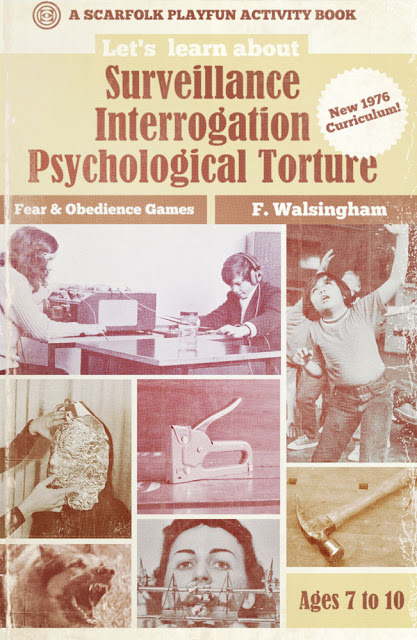
Let’s Learn About Surveillance, Interrogation, and Psychological Torture

surveillancewww-scarfolk-blogspot-com

Getting psyched about our family summer vacation to Scarfolk!

Minerva — Rembrandt

Old Money

Capture

(More Gatsby comics by Kate Beaton at her site Hark, a vagrant).

Hawthorne Anecdote

I was sent for to the police court the other morning, in the case of an American sailor accused of robbing a shipmate at sea. A large room, with a great coal-fire burning on one side, and above it the portrait of Mr. Rushton, deceased, a magistrate of many years’ continuance. A long table, with chairs, and a witness-box. One of the borough magistrates, a merchant of the city, sat at the head of the table, with paper and pen and ink before him; but the real judge was the clerk of the court, whose professional knowledge and experience governed all the proceedings. In the short time while I was waiting, two cases were tried, in the first of which the prisoner was discharged. The second case was of a woman,—a thin, sallow, hard-looking, careworn, rather young woman,—for stealing a pair of slippers out of a shop: The trial occupied five minutes or less, and she was sentenced to twenty-one days’ imprisonment,—whereupon, without speaking, she looked up wildly first into one policeman’s face, then into another’s, at the same time wringing her hands with no theatric gesture, but because her torment took this outward shape,—and was led away. The Yankee sailor was then brought up,—an intelligent, but ruffian-like fellow,—and as the case was out of the jurisdiction of the English magistrates, and as it was not worth while to get him sent over to America for trial, he was forthwith discharged. He stole a comforter.

If mankind were all intellect, they would be continually changing, so that one age would be entirely unlike another. The great conservative is the heart, which remains the same in all ages; so that commonplaces of a thousand years’ standing are as effective as ever.

–From the January 6th, 1854 entry of Nathaniel Hawthorne’s English note-books.

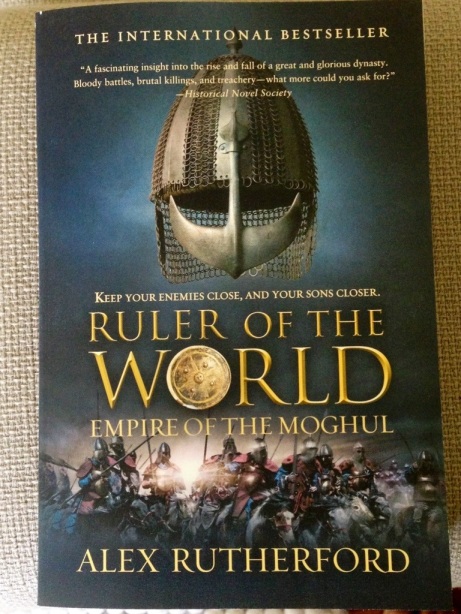
Ruler of the World (Book Acquired, 5.06.2013)

20130506-191048.jpg

Ruler of the World by Alex Rutherford. Pub’s copy:

Alex Rutherford’s internationally bestselling series continues with Ruler of the World, the story of the third great Moghul Emperor, Akbar, leader of a triumphant dynasty which contained the seeds of its own destruction.

Akbar, ruler of a sixth of the world’s people, colossally rich and utterly ruthless, was a contemporary of Elizabeth I, but infinitely more powerful. He extended his empire over much of Asia, skillfully commanding tens of thousands of men, elephants and innovative technology, yet despite the unimaginable bloodshed which resulted his rule was based on universal religious tolerance.

However, Akbar’s homelife was more complicated. He defied family, nobles and mullahs to marry a beautiful Rajput princess, whose people he had conquered; but she hated Akbar and turned Salim, his eldest son, against him. What’s more, as any Moghul prince could inherit his father’s crown and become Emperor, his sons were brought up to be intensely competitive and suspicious of each other: to see each other as rivals for the greatest prize of all. And, as Salim grew to manhood, the relationship between father and son became tainted by rebellion and competition to be the greatest Moghul of them all.


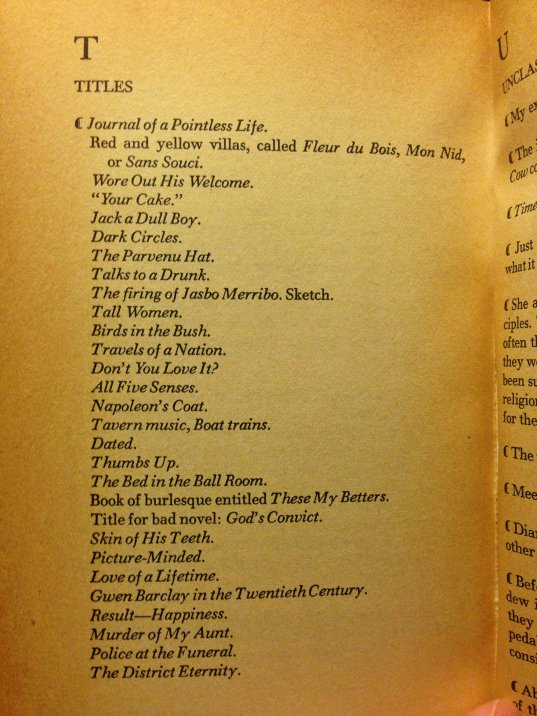
Journal of a Pointless Life, and Other Titles from F. Scott Fitzgerald’s Notebooks

IMG_5729

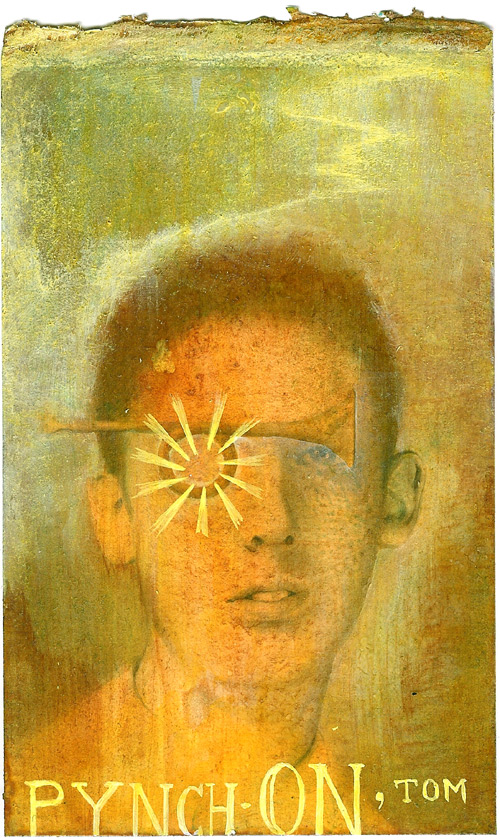
Thomas Pynchon Portrait — James Jean

James Jean does Thomas Pynchon. (Via Hey Oscar Wilde!).

“An Ideal Family” — Katherine Mansfield

“An Ideal Family” by Katherine Mansfield

That evening for the first time in his life, as he pressed through the swing door and descended the three broad steps to the pavement, old Mr. Neave felt he was too old for the spring. Spring—warm, eager, restless—was there, waiting for him in the golden light, ready in front of everybody to run up, to blow in his white beard, to drag sweetly on his arm. And he couldn’t meet her, no; he couldn’t square up once more and stride off, jaunty as a young man. He was tired and, although the late sun was still shining, curiously cold, with a numbed feeling all over. Quite suddenly he hadn’t the energy, he hadn’t the heart to stand this gaiety and bright movement any longer; it confused him. He wanted to stand still, to wave it away with his stick, to say, “Be off with you!” Suddenly it was a terrible effort to greet as usual—tipping his wide-awake with his stick—all the people whom he knew, the friends, acquaintances, shopkeepers, postmen, drivers. But the gay glance that went with the gesture, the kindly twinkle that seemed to say, “I’m a match and more for any of you”—that old Mr. Neave could not manage at all. He stumped along, lifting his knees high as if he were walking through air that had somehow grown heavy and solid like water. And the homeward-looking crowd hurried by, the trams clanked, the light carts clattered, the big swinging cabs bowled along with that reckless, defiant indifference that one knows only in dreams…

It had been a day like other days at the office. Nothing special had happened. Harold hadn’t come back from lunch until close on four. Where had he been? What had he been up to? He wasn’t going to let his father know. Old Mr. Neave had happened to be in the vestibule, saying good-bye to a caller, when Harold sauntered in, perfectly turned out as usual, cool, suave, smiling that peculiar little half-smile that women found so fascinating.

Ah, Harold was too handsome, too handsome by far; that had been the trouble all along. No man had a right to such eyes, such lashes, and such lips; it was uncanny. As for his mother, his sisters, and the servants, it was not too much to say they made a young god of him; they worshipped Harold, they forgave him everything; and he had needed some forgiving ever since the time when he was thirteen and he had stolen his mother’s purse, taken the money, and hidden the purse in the cook’s bedroom. Old Mr. Neave struck sharply with his stick upon the pavement edge. But it wasn’t only his family who spoiled Harold, he reflected, it was everybody; he had only to look and to smile, and down they went before him. So perhaps it wasn’t to be wondered at that he expected the office to carry on the tradition. H’m, h’m! But it couldn’t be done. No business—not even a successful, established, big paying concern—could be played with. A man had either to put his whole heart and soul into it, or it went all to pieces before his eyes… Continue reading ““An Ideal Family” — Katherine Mansfield”

The Rich Man from the Parable — Rembrandt

Kinda Sorta Reading List of Novels from Ezra Pound

I have not written a good novel. I have not written a novel. I don’t expect to write any novels and shall not tell anyone else how to do it until I have.

If you want to study the novel, go, READ the best you can find. All I know about it, I have learned from reading:

Tom Jones, by Fielding.

Tristram Shandy and The Sentimental Journey by Sterne (and I don’t recommend anyone ELSE to try to do another Tristram Shandy).

The novels of Jane Austen and Trollope.

[Note: If you compare the realism of Trollope’s novels with the realism of Robert McAlmon’s stories you will get a fair idea of what a good novelists means by ‘construction’. Trollope depicts a scene or a person, and you can clearly see how he ‘leads up to an effect’.]


Continuing:

The novels of Henry James, AND especially the prefaces to his collected edition; which are the one extant great treatise on novel writing in English.

In French you can form a fairly good ideogram from:

Benjamin Constant’s Adolphe.

The first half of Stendhal’s Rouge et Noir and the first eighty pages of La Chartreuse de Parme.

Madame BovaryL’Education SentimentaleTrois Contes, and the unfinished Brouvard et Pecuchet of FLAUBERT, with Goncourt’s preface to Germinie Lacerteux.


After that you would do well to look at Madox Ford’s A Call.

When you have read Jame’s prefaces and twenty of his other novels, you would do well to read The Sacred Fount.

There for perhaps the first time since about 1300 a writer has been able to deal with a sort of content wherewith Cavalcanti has been ‘concerned’.

You can get a very brilliant cross-light via Donne. I mean the difference and nuances between psychology in Guido, abstract philosophic statement in Guido, the blend in Donne, and again psychology in Henry James, and in all of them the underlying concept of FORM, the structure of the whole work, including its parts.

This is a long way from an A B C. In fact it opens the vistas of post-graduate study.

From Ezra Pound’s ABC of Reading (New Directions).