In Brief — Adam Langer, William H. Gass, David Foster Wallace, and Frank Meeink

I have terrible writer’s block. It’s not that I have nothing to say, it’s just that I can’t seem to say it. Or that I write sentences like the previous one and shudder at their awkward clunky artless awfulness. But I’m gonna press through it, write through it, and share a few thoughts on what I’ve read this week–
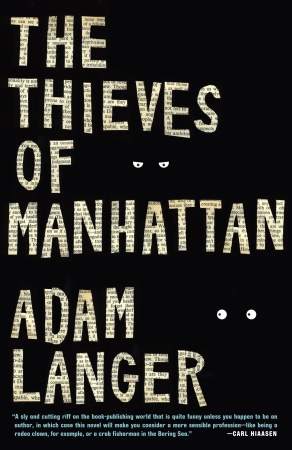
First up: Adam Langer’s new novel, The Thieves of Manhattan, a send-up of the publishing industry that sets its targets directly on the current swath of (faked) memoirs that have done gangbusters for publishers in the past few years. Ian Minot is a broke-assed barista one fuck-up away from an overdue firing, who moves from the Midwest to make it as a writer in the big city. Only he’s not doing so well–in contrast to his gorgeous Romanian girlfriend Anya whose literary star is on the rise. For Minot though, this isn’t the worst–that would be the rampant success of über-poseur Blade Markham, a wanna-be gangsta whose memoir Blade on Blade is a blatant fabrication (albeit a fabrication that no one but savvy schlemiel Minot seems to notice (or, at the least, be bothered by)).  I read the first fifty-odd pages of the Thieves in one sitting–a good sign to be sure. Langer’s Minot’s voice is familiar territory, the boy who loves to mock the literati he would love to be a part of. In one of the signal moves of his patois, the names of famous authors (and characters) regularly replace common nouns–a bed becomes a proust, a full head of hair is a chabon, sex is chinaski and so on. Minot seems to be headed to running his own grift soon with the help of a man he appropriately calls the Confident Man–should be good stuff. Full review forthcoming. The Thieves of Manhattan is available July 13, 2010 from Spiegel & Grau.
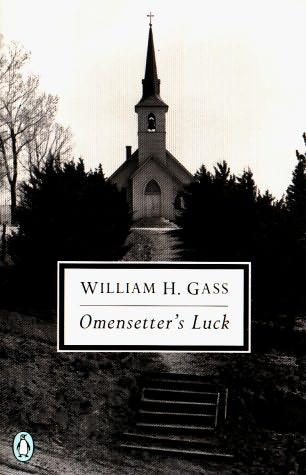
I’ve also been reading William H. Gass’s first novel, Omensetter’s Luck. It’s weird, wonderful, Faulknerish in its loose (but somehow layered and constructed) stream of consciousness. Omensetter’s Luck comprises three sections, each progressively longer; I finished the second one today, and so far the novel seems to dance around a description or accounting of its namesake, Brackett Omensetter who carts his family into the small sleepy town of Gilean, Ohio, and immediately perplexes the townsfolk with his amazing luck. As Frederic Morton put it in his contemporary 1966 New York Times review, “It quickly becomes apparent that as other people have green thumbs, [Omensetter] has a green soul. The cosmos and he live in mysterious congruity.” There’s much to commend and unpack in Gass’s writing here, but the pleasure of his musical rhythm are enough for me now (in my writer’s block, I retreat to aesthetic criticism [shudders]). Besides, do I really have to recommend this novel when David Foster Wallace already did so in his semi-famous list “Five Direly Underappreciated U.S. Novels > 1960”? No, I don’t, that’s right. Here’s Wallace on Omensetter’s Luck: “Gass’ first novel, and his least avant-gardeish, and his best. Basically a religious book. Very sad. Contains the immortal line ‘The body of Our Saviour shat but Our Saviour shat not.’ Bleak but gorgeous, like light through ice.”
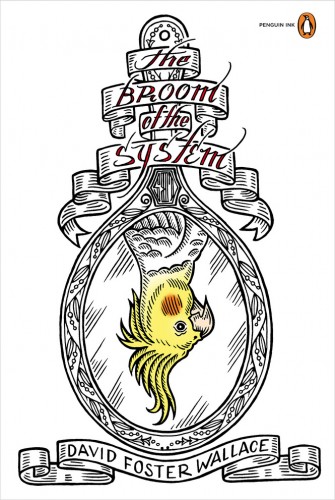
Speaking of Wallace and début novels, Richard Rayner at The Los Angeles Times has reviewed Wallace’s first book The Broom of the System, which is being republished at the end of this month with a cool new cover by tattoo artist Duke Riley. A considered, well-written review, one which prompted me to dig out (okay, bad verb phrase choice; no unearthing involved, my Wallace volumes are neatly aligned together on a shelf in my living room) my copy of Broom. I remember reading a friend’s copy in the burning humidity of a Gainesville summer, in ’98 or ’99, reading the book in long chunks. I tried to read it again after I finishing Infinite Jest but it seemed kinda sorta goofy (albeit purposely, Pynchonesquely goofy). Anyway, Rayner’s review makes a strong case for a re-reading.

And, speaking of Wallace (again), or at least using him as a crutch–I’ve almost finished Autobiography of a Recovering Skinhead by Frank Meeink (“as told to” Jody M. Roy; they’ve sort of got the whole Malcolm X/Alex Haley thing going on there). So, yeah, why the Wallace segue? How to justify it? Well, reading Meeink’s story, the true story of an abused, battered Philadelphia kid who falls into the American neo-Nazi movement and its attendant violent crime and terrorism, who goes to prison and finds redemption and human connection and a new purpose for the nihilistic void of his life, who falls into alcoholism and drug addiction only to be redeemed again–reading Meeink’s story, even knowing its veracity (demonstrable to a point that would satisfy even Langer’s Ian Minot)–I couldn’t help but read his strong, immediate, gritty, and utterly real voice as something not unlike one of the creations in David Foster Wallace’s Brief Interviews with Hideous Men. It’s not just Meeink’s hideousness, his violence, or the grace that he works toward–all constituents of DFW’s collection–it’s that voice, the realness of the volume, surely the book’s greatest asset. Recovering Skinhead is an engrossing read, fascinating in the same way that an infected wound prompts our attention, our paradoxical compulsion and repulsion, but most of all it’s an exhilarating and exhausting performance of voice, of Meeink’s unrelenting, authentic telling of a tale, a telling that any novelist would thrill to channel. Only Meeink’s voice isn’t a novel creation: it’s real. Autobiography of a Recovering Skinhead is available now from Hawthorne Books.

The Kafkaesque Paintings of Tetsuya Ishida

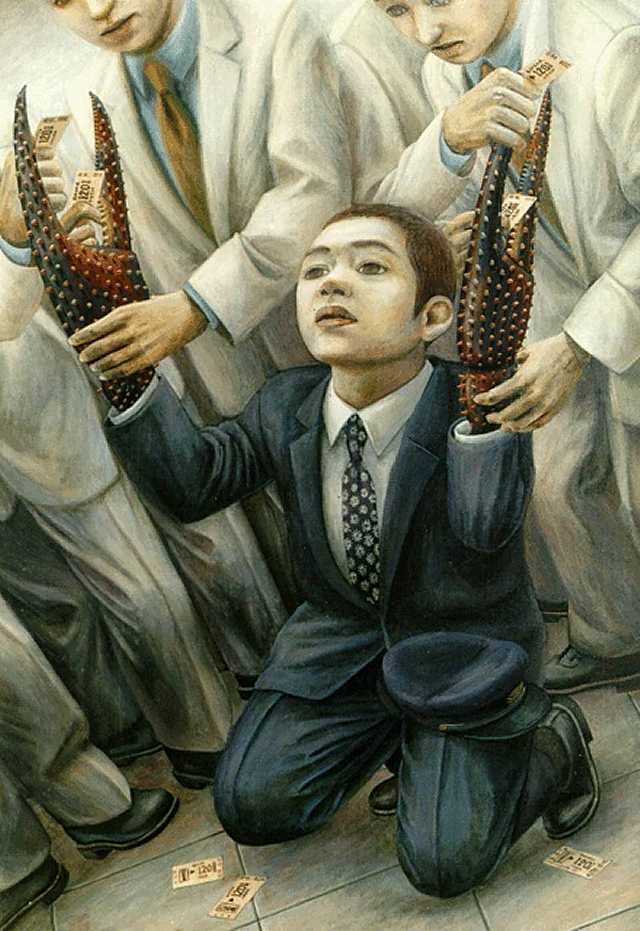
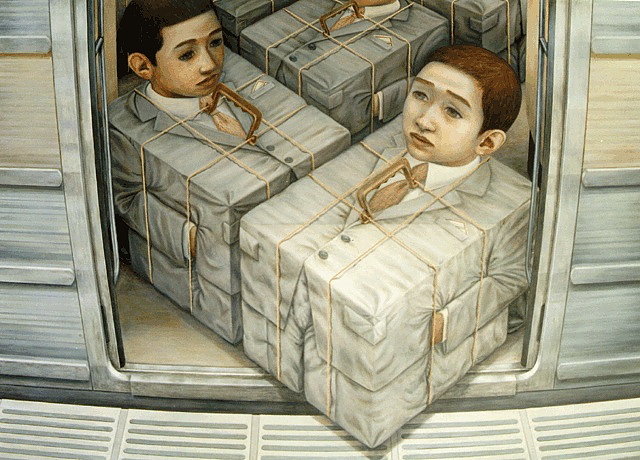
I’m enamored with a set of paintings by Japanese artist Tetsuya Ishida that has floated around the internet lately. (See iterations here, here, and here). Ishida’s paintings depict young, sad Japanese people who have transformed into (or always were?) banal objects or insect-like animals. Ishida’s figures are often constrained into claustrophobic spaces, with pained expressions evincing despair and anxiety. There’s a paradoxical loneliness in his works as well: his protagonists are often surrounded by others who have also metamorphosed into machine-like beings, automatons performing sinister operations on the protagonists.

Ishida’s themes of the salaryman’s despair at the strictures of a modernized, hyper-industrialized society where conformity is prized are distinctly Japanese, but they also resonate beyond that culture. They are Kafkaesque, tapping into the alienation that the individual faces in an increasingly absurd, bureaucratic, mechanized world that turns people into cogs, bugs, things. Ishida was killed when he was hit by a train in 2005–his death was likely a suicide.

In both subject and stylistic execution, Ishida’s work is reminiscent of American artist George Tooker‘s paintings of the alienation and anxieties produced by urban bureaucracy.

Government Bureau -- George Tooker (1956)

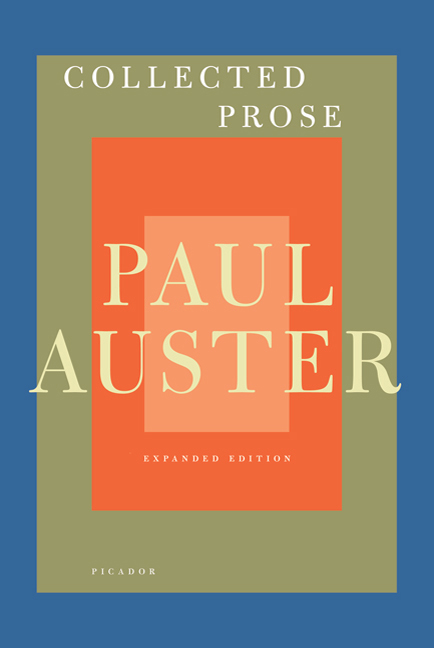
Collected Prose — Paul Auster

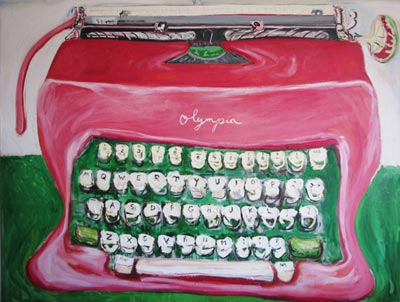
This month, the good folks at Picador are issuing an expanded edition of Paul Auster’s essays, memoirs, prefaces, true stories, anecdotes, and interviews. Inconspicuously titled Collected Prose and running to just under six hundred pages, the volume includes Auster’s début work The Invention of Solitude in its entirety. Solitude is a strange blend of personal memoir, an account of the young writer’s reaction to and relationship with the death (and life) of his father, as well as a philosophical meditation on the absurdity of family, art, and time. Collected Prose also includes the later memoir, Hand to Mouth, a reflective piece on Auster’s early failures as he tries to make it as a writer, including his time in Paris, his marriage to Lydia Davis, his hunger, and his poverty. While Solitude inaugurates many of the experimental structures and postmodern tropes that Auster would be identified with throughout his career as a novelist, the flatter, more direct style of Hand to Mouth is more indicative of the tone of much of Collected Prose. There’s a journalistic directness and keen earnestness to Auster’s essays that perhaps belie his postmodern bona fides. That’s a good thing, allowing Auster to communicate directly about his sometimes challenging subjects to a wider audience. Style aside, both of the book-length memoirs at the front end of Collected Prose neatly delineate the themes that preoccupy much of the rest of the book: art, language, writing, writers, poverty, absurdity, movement, New York City, and so on. And although the book turns away from Auster’s memoirs and true stories in its second half, presenting his essays, editorials, and prefaces, there’s still a sharp sense of Auster in each essay. These are personal essays. Auster writes about his friend Philippe Petite, the French high-wire artist; he writes about the literal hunger artists face, using Knut Hamsun and Franz Kafka as examples; he writes a vindication for Dada daddy Hugo Ball; he writes on over half a dozen relatively obscure poets to let us know why they matter. There are wonderful little moments, like “The Story of My Typewriter,” where Auster exclaims his love for his quiet Olympia (he buys 50 typewriter ribbons fearing the specie’s eventual extinction). The book reprints the Sam Messner paintings that originally accompanied Auster’s text (or, perhaps, vice versa).

Another great moment is the essay “Hawthorne at Home,” which takes a look at a little known piece by Nathaniel Hawthorne called Twenty Days with Julian & Little Bunny. Hawthorne’s piece is more or less a straightforward narrative account of Hawthorne alone with his five-year old son Julian and his pet rabbit for three weeks while wife Sophia visited the Peabodys. While Auster gives the reader a lesson on Hawthorne and his composition of The Scarlet Letter here, the essay focuses on the idyllic charm of a father and son, a rare subject in Hawthorne’s oeuvre. As a bonus, Herman Melville makes a cameo. “Hawthorne at Home” is the sort of essay that makes you want to go read the source material; it sent me hunting for a used copy of American Notebooks.

As one might imagine, Collected Prose is absolutely larded with writers, and lovingly so. Auster does not suffer from the inclination toward meanness that so many critics feel toward their peers, perhaps because he writes foremost from the perspective of an artist. Not that it’s difficult to praise Art Spiegelman (“The Art of Worry”) or pray for Salman Rushdie (um, “A Prayer for Salman Rushdie”) or speak to the genius of Samuel Beckett (“Remembering Beckett on His One Hundredth Birthday”) and Jim Jarmusch (“Night on Earth: New York”)–but Auster illuminates their work in a way that transcends the postmodern concerns of technique, place, and politics, and speaks directly to a certain aesthetic excellence. His love for storytellers extends beyond the pros, of course, evinced in his work with NPR’s National Story Project. He credits wife Siri with coming up with the idea of having NPR listeners write and submit their own original stories, but his enthusiasm for her idea resonates in his warm preface to the eventual book that collected the listeners’ submissions. Auster writes, “I learned that I am not alone in my belief that the more we understand of the world, the more elusive and confounding that world becomes.” The world becomes more “confounding” after the 9/11 attacks, of course, and like so many other writers Auster attempted to somehow measure the tragedy in words. “Random Notes–September 11, 2001–4:00 PM” is a scrap, a fragment, a shell-shocked missive that ends with the haunting words “And so the twenty-first century finally begins.”

It might be misleading to call Collected Prose a good introduction to Paul Auster’s nonfiction–can a work so comprehensive, so massive be a mere starting point?–but it is a great introduction, so there. It’s also a fantastic overview of critical, literary, and artistic theory, written from a deeply personal perspective. Let’s hope that fifteen years from now we’ll have another expanded edition of Auster’s prose; in the meantime, we can look forward to his new novel Sunset Park this November. Highly recommended.

A Very Short Review of a Very Good Book — Tom McCarthy’s C

Finished Tom McCarthy’s newest novel C last night. It doesn’t come out until this autumn–and I’ll post, y’know, a long, detailed review then–but for now–

The book is tremendous. You should start looking forward to it now. Great, great stuff. Loved it. Will read it again. Very highly recommended. You get the idea.

How to Read James Joyce’s Ulysses (and Why You Should Avoid “How-to” Guides Like This One)

Bloomsday, an annual celebration of James Joyce’s Ulysses, is upon us today with more excitement than ever. Even with the festivities, the book’s reputation for density, erudition, and inscrutability still daunts many readers–leading to a glut of guidebooks, summaries, and annotations. Ironically, rather than inviting first-time readers to the text, the sheer volume of these guides to Ulysses can paradoxically repel. Their very existence seems predicated on an intense need, and although some of the guides out there can be helpful, others can get in the way. This need not be. Ulysses deserves its reputation as one the best books in the English language. It generously overflows with insight into the human experience, and it’s very, very funny. And, most importantly, anyone can read it.

Here are a few thoughts on how to read Ulysses, enumerated–because people like lists:

1. Ignore all guides, lists, maps, annotations, summaries, and lectures. You don’t need them; in fact, they could easily weigh down what should be a fun reading experience. Jump right into the text. Don’t worry about getting all the allusions or unpacking all the motifs.

Pretty soon though, you’ll get to the third chapter, known as “Proteus.” It’s admittedly hard to follow. You might want a guide at this point. Or you might just want to give up. (Of course, you might be a genius and totally get what Stephen is thinking about as he wanders the beach. Good for you). If frustration sets in, I suggest skipping the chapter and getting into the rich, earthy consciousness of the book’s hero, Leopold Bloom in chapter four, “Calypso.” It’s great stuff. You can always go back to chapter three later, of course. The real key, at least in my opinion, to reading (and enjoying) Ulysses is getting into Bloom’s head, matching his rhythm and pacing. Do that and you’re golden.

I’ve already advised you, gentle reader, not to follow any guides, so please, ignore the rest of my advice. Quit reading this post and start reading Ulysses.

For those who wish to continue–

2. Choose a suitable copy of the book. The Gabler edition will keep things neat and tidy and it features wide margins for all those clever game-changing annotations you’ll be taking. Several guides, including Harry Blamire’s The New Bloomsday Book align their annotation to the Gabler edition’s pagination.

3. Make a reading schedule and stick to it. The Gabler edition of Ulysses is nearly 700 pages long. That’s a long, long book–but you can read it in just a few weeks. There are eighteen episodes in Ulysses, some longer and more challenging than others, but reading one episode every two days should be no problem. If you can, try to read one episode in one sitting each day. As the book progresses, you’ll find yourself going back to previous chapters to find the figures, motifs, and traces that dance through the book.

4. So you’ve decided you need a guide. First, try to figure out what you want from the guide. Basic plot summary? Analysis? Explication? There’s plenty out there–too much really–so take the time to try to figure out what you want from a guide and then do some browsing and skimming before committing.

The most famous might be Stuart Gilbert’s James Joyce’s Ulysses, a dour book that manages to suck all the fun out of Joyce’s work. In a lecture on Ulysses, Vladimir Nabokov warned “against seeing in Leopold Bloom’s humdrum wanderings and minor adventures on a summer day in Dublin a close parody of the Odyssey,” noting that “it would be a complete waste of time to look for close parallels in every character and every scene in the book.” Nabokov scathingly continued: “One bore, a man called Stuart Gilbert, misled by a tongue-in-cheek list compiled by Joyce himself, found in every chapter the domination of one particular organ . . . but we shall ignore that dull nonsense too.” It’s perhaps too mean to call Gilbert’s guide “nonsense,” but it’s certainly dull. Harry Blamire’s The New Bloomsday Book is a line-by-line annotation that can be quite helpful when Joyce’s stream of consciousness gets a bit muddy; Blamire’s explications maintain a certain analytical neutrality, working mostly to connect the motifs of the book but letting the reader manage meaning. Don Gifford’s Ulysses Annotated is an encyclopedia of minutiae that will get in the way of any first time reader’s enjoyment of the book. Gifford’s notes are interesting but they can distract the reader from the text, and ultimately seem aimed at scholars and fanatics.

Most of the guidebooks I’ve seen for Ulysses share a common problem: they are obtrusive. I think that many readers who want some guidance or insight to aid their reading of Ulysses, rather than moving between books (what a chore!), should listen to some of the fantastic lectures on Joyce that are available. James Heffernan’s lectures for The Teaching Company provide a great overview of the book with some analysis; they are designed to be listened to in tandem with a reading of the book. Frank Delaney has initiated a new series of podcast lectures called re:Joyce; the first lecture indicates a promising series. The best explication I’ve heard though is a series of lectures by Joseph Campbell called Wings of Art. Fantastic stuff, and probably the only guide you really need. It’s unfortunately out of print, but you can find it easily via extralegal means on the internet. Speaking of the internet–there’s obviously a ton of stuff out there. I’ll withhold comment–if you found this post, you can find others, and have undoubtedly already seen many of the maps, schematics, and charts out there.

5. Keep reading. Reread. Add time to that reading schedule you made if you need to. But most of all, have fun. Skip around. If you’re excited about Molly’s famous monologue at the end of the book, go ahead and read it. Again, the point is to enjoy the experience. If you can trick a friend into reading it with you, so much the better. Have at it.

Radio Bloomsday to Feature Jerry Stiller, Bob Odenkirk, Alec Baldwin and More

New York’s WBAI will continue their 32 year tradition of celebrating Bloomsday tomorrow with a live broadcast featuring a host of actors reading aloud from James Joyce’s Ulysses. Readings begin at 7pm and continue until 2am. Performers include Paul Muldoon, Alec Baldwin, Jerry Stiller, Charles Busch, T. Ryder Smith, Bob Dishy, Judy Graubart, Aaron Beall, Amy Stiller, Paul Dooley, Bob Odenkirk, John O’Callaghan, Brian O’Doherty, Kate Valk, Mara McEwin, James Kennedy, Jim Fletcher, Richard Maxwell, Anna Goodman-Herrick, Janet Coleman, David Dozer, Emily Mitchell, and Tara Bahna-James. More at their blog.

In Brief–New Novels by Janelle Brown, Loretta Stinson, and Tracy Winn

In This Is Where We Live, Janelle Brown’s follow-up to her 2008 début All We Ever Wanted Was Everything, an artsy newly wed couple find their dreams and their marriage unraveling when the payments on their adjustable rate mortgage suddenly double. Claudia and Jeremy are happy at the novel’s outset, living comfortably in their Los Angeles bungalow. Her film Spare Parts garners a huge buzz at Sundance and he reforms a new band after the breakup of his old group The Invisible Spot; they envision their new neighborhood as a contemporary counterpart to the Laurel Canyon creative scene of the 1960s. But then their ARM adjusts and Spare Parts flops. Claudia has to take a job teaching (Gasp! Oh, the terror! In a particularly funny scene, she shows The Graduate to her film students and one of them raises her hand to declare that her father was one of the film’s executive producers). The couple soon has to take in a roommate. Complicating matters even more is the return of Aoki, Jeremy’s unstable–and now famous–ex-girlfriend, who manipulates him every chance she gets. Aoki, a cartoonishly unhinged avant-gardiste, serves as a foil to the more grounded figure of Claudia; as Claudia begins to mature into a more pragmatic, adult personality, Aoki’s siren song calls Jeremy to return to chaos. This Is Where We Live is timely, of course, and Brown takes pains to show how these two “creatives” could overlook such meaningful financial details when looking to buy a home. Some will find Brown’s sympathetic vision of the privileged L.A. art scene off-putting or even shallow, but the novel’s core exploration of a troubled young marriage will resonate with many readers. This Is Where We Live is available in hardback from Spiegel & Grau on June 15, 2010.
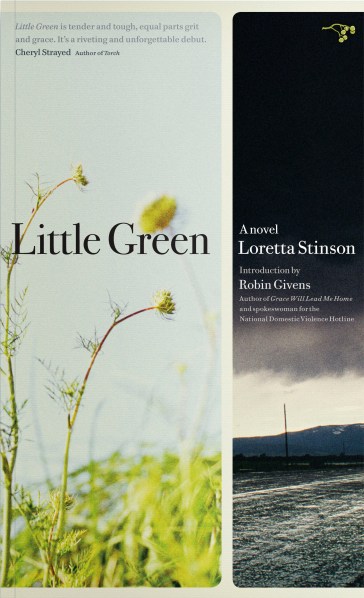
Little Green, Loretta Stinson’s début novel, tells the story of Janie, an orphan who runs away from her stepmother. Life on the road is tough, and Janie has to make money somehow, dancing in strip bars and even bartering for sex when necessary. When she meets a charmer named Paul who is ten years older than her, she feels instantly closer to him–and naturally hits the road again. Hitchhiking is never a good idea though, kids, especially in a loner’s van, and Janie is brutally beaten. She finds herself under the care of the man who owns the last bar she danced at, and in time, under the care of Paul, reiterating one of the novel’s major themes of cyclical violence and female dependence on a man. Paul is a small-time drug dealer whose habits extend beyond weed and acid into heroin and meth. As his drug addiction spirals, he tries to find some control by manipulating Janie; in time, he beats her so terribly that she has to go to the hospital. Janie leaves him but he stalks her wherever she goes, forcing her to find her own strength and self-reliance as the novel reaches its redemptive climax. Paul is probably the most interesting character in Little Green, and although it would be unfair to call Janie a flat character, she spends much of the novel as a victim. In contrast, Paul’s addiction and behaviors are studied with a psychological depth that attempts to understand–without ever rationalizing–his actions. While the novel is hardly sympathetic to him, Stinson resists painting Paul as a static monster; the payoff is a villain far-more frightening because of his authenticity. Authenticity is what keeps Little Green (for the most part) from verging into melodramatic Lifetime movie of the week territory. Stinson’s finely detailed evocation of the Pacific Northwest of the late 1970s explores how attitudes about gender roles, women’s rights, and drugs came to a seething breaking point a decade after the summer of love. Significantly (and sadly), the novel’s depiction of domestic violence reads with a wholly contemporary immediacy. Little Green is new in handsome trade paperback this month from Hawthorne Books, who will donate a portion of sales revenue to the National Domestic Violence Hotline.
Tracy Winn’s debut, Mrs. Somebody Somebody covers over half a century–from Korea to Iraq, in the book’s terms–in the lives of the regular folk of the mining town of Lowell, MA. The book comprises ten stories that can easily stand on their own, but combined together form a novel-in-stories, an evocative portrait of a working-class town under duress. Winn weaves blood lines through generational and political conflicts and re-examines her book’s themes through a variety of perspectives. The result is a layered, detailed reckoning with history and place, class and conflict, drawn in rich, resonant colors. Mrs. Somebody Somebody is new in trade paperback this month from Random House.

The British Library Acquires J.G. Ballard Archive

According to a report in yesterday’s Guardian, the British Library has acquired J.G. Ballard’s archival material, including hand-written manuscripts, drafts, letters, and photos. The British Library will make Ballard’s materials fully accessible to the public. From the article:

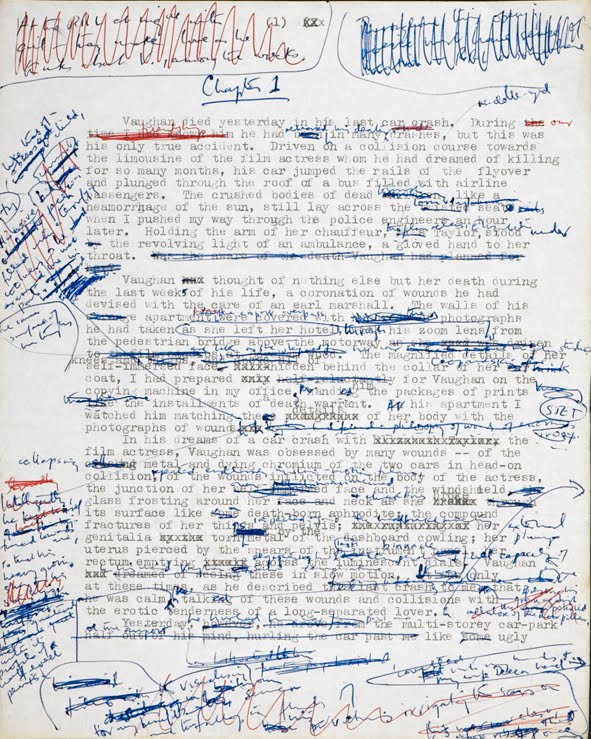
Ballard was a man of routine and, in the first instance, wrote all his work by hand, once saying he could always tell if a novel had been written on a typewriter (and later computer). One of the highlights of the archive is the far from neatly handwritten first 840-page draft of Empire of the Sun, which is a collage of crossings out, revisions, corrections and additions.

After the first draft Ballard would then type it up and ruthlessly go through it again. The second draft of Crash is in the archive and it is even more crazily corrected. Andrews said: “I think some of those individual pages are works of art. There’s a determination and in some cases a violence.” Also in the archive are notepads with headings such as “topics that interest me”, full of his thoughts and ideas for stories and novels, as well as items relating to the Lunghua internment camp of his childhood.

Section from the original Crash manuscript

See more images from the collection here.

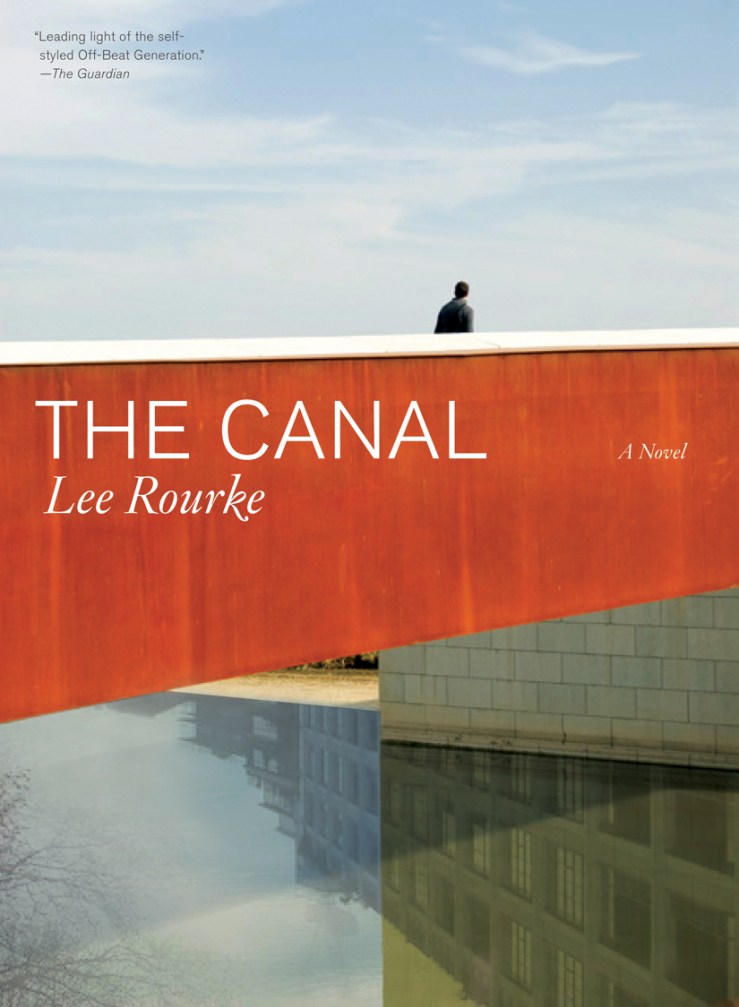
The Canal — Lee Rourke

In Lee Rourke’s début novel The Canal, the unnamed narrator quits his job and begins walking to a canal everyday. Why? Out of boredom. At the titular canal, he watches (and describes in banal detail) the geese, swans, and coots that swim in the filthy water. He also keeps one eye on the drudges who go about emailing and faxing in the office building across from the bench on which he sits each day. A strange, icy young woman soon begins sharing the bench with the narrator; in time, she also shares her morbid secrets with him. Complicating the narrator’s paradise of boredom is a gang of youths who terrorize the area with random violence. The novel’s steady pace escalates to frantic tragedy as the narrator’s bored repose gives over to desperate obsession with his erstwhile bench mate and her horrific past.

The Canal takes boredom as its explicit subject. In the second paragraph of the book, the narrator tells us–

Some people think that boredom is a bad thing, that it should be avoided, that we should fill our lives with other stuff in order to keep it at bay. I don’t. I think boredom is a good thing: it shapes us; it moves us. Boredom is powerful. It should never be avoided. In fact, I think boredom should be embraced. It is the power of everyday boredom that compels people to do things–even if that something is nothing.

The canal seems (at first) the right place for the narrator to embrace his boredom, but it soon becomes a space–a “real” space, as the narrator eventually realizes–of transformation and excitement. This space quickly complicates the narrator’s will toward “nothing,” that pull toward nihilism. He’s keenly interested in the various birds that make the canal their home, and his obsessive derision toward the office workers highlights the fact (a fact he doesn’t seem to see) that his apathy is not as pure as he would like it to be. Rather, his “boredom” is a direct response to the apparent meaninglessness of 21st century life in general and, specifically, life in post-Blair London. His horror and fear at the four hoodied teens from a nearby estate (the English equivalent of an American housing project) who insult and attack him is grounded in a relatively conventional morality, one that belies his enduring belief in his own apathy.

The most dramatic challenge to his philosophy of boredom though is his unnamed female foil. Through cryptic, elliptical dialogues he soon becomes a bizarre confessor to her strange sins. Yet she’s remorseless in her unrepentant nihilism. In one conversation she tells him that “There’s nothing left to believe in anywhere. All is fiction. Somehow, we have to invent our own reality. We have to make the unreal real.” This cheerful little aphorism comes after she reveals her empathy for (and sexual attraction to) the perpetrators of the July 7, 2005 suicide bombings in London. Terrorism, particularly the 7/7 attacks and the 9/11 WTC attacks are a major motif of The Canal; the unnamed narrator obsesses about flight (both of airplanes and birds) and dwells on the image of the planes crashing into the towers. Although he never admits it, it seems that both flight and death are possible forms of escape from the very boredom he claims to embrace. At the same time, the violence of terrorism seems part and parcel of his philosophy of boredom–

“It is obvious to me now that most acts of violence are caused by those who are truly bored. And as our world becomes increasingly boring, as the future progresses into a quagmire of nothingness, our world will become increasingly more violent. It is an impulse that controls us. It is an impulse we cannot control.”

And yet the violent acts of the estate youths shock and disgust the narrator. In one of the book’s most stunning passages, he watches them in horror as they destroy a stolen motor scooter and then cast it into the creek while filming the whole business on a cell phone. The scooter upsets the resting birds and becomes one more piece of detritus clogging up the canal–part of the “quagmire of nothingness,” perhaps. Repeatedly in the novel, the narrator wishes that long-overdue dredges will come along to clean the canal, to restore it, an impulse to control the stochastic violence of life that doubles his horror at the teen gang’s violence. In short, despite what he tells us, the narrator cannot embrace his boredom–although he does wish to name it, recognize it, and perhaps treat it.

This treatment comes in the form of the anti-ingenue he meets with daily by the canal. His obsession with her soon gives way to outright stalking. For a man who claims to embrace boredom, he’s awfully interested in her. The narrator’s stalking feeds into the novel’s deft discourse on surveillance in the 21st-century world, where CCTV, mobile phone cameras, and live pictures of spectacular disaster make people feel alternately safe or horrified (or at least alleviate some of their boredom). The narrator’s relationship with the woman tests the bounds of his devotion to boredom and reveals to both him and the novel’s audience that opting out is not always opting out. Rourke uses a quote from Martin Heidegger – “We are suspended in dread” – as an epigraph to the novel; the narrator must learn how to live in that suspension.

What makes The Canal such a remarkable read is watching the disconnect between the narrator’s would-be solution to life-as-state-of-dread (“embrace boredom”) and his actual responses to the effects of boredom in the world around him (literal and figurative waste, violence). Although he seeks to mitigate the pain of his dread and boredom by submitting to it, the novel repeatedly finds him engaging–and resisting–the cruelty and inhumanity he perceives. While parts of The Canal occasionally seem forced or overdetermined, there is much to commend here and the novel clearly suggests Rourke as a rising talent to watch out for. Recommended.

The Canal is available from Melville House on June 15, 2010.

The Squid and the Whale

Late last year, we wrote about Matt Kish’s project to illustrate Herman Melville’s Moby-Dick, one page at a time. Kish’s work is still going strong (in fact it looks better than ever) and he’s very close to the half way mark. We love this recent piece, an image to accompany page 273 —

...previous to that connexion, the short-warp goes through sundry mystifications too tedious to detail.

Keep it up!

Devoid of Original Content, We Offer Instead These Links

Barbara King has to forget everything she thought she knew about Rick Steves after reviewing his new book Travel as a Political Act at Bookslut. Here’s a taste of her review:

The book is an eye-opener. Steves describes himself as a traveler and “a historian, Christian, husband, parent, carnivore, musician, capitalist, minimalist, member of NORML, and a workaholic.” The marijuana habit (I have discovered) has been headlined for a while now; the reveal here is Steves’s brand of forthright liberalism.

Promising not to “take the edge off” his opinions, Steves embraces geopolitical philosophizing “with the knowledge that good people will respectfully disagree with each other.” Speaking of assumptions, that’s a generous one. Given the mood of a large segment of the American public and Steves’s penchant for pointed passages, anyone care to wager how his fan mail is running?

Ahmad Saidullah reviews Keri Walsh’s compendium The Letters of Sylvia Beach at 3 Quarks Daily. This gives us a chance to plug our own interview with Keri Walsh from last month about the book (See? There’s some original content here after all–even if it’s recycled. Recycling is good, right?)

As part of the new partnership between Salon and McSweeney’s, you can read Nick Hornby’s latest “Stuff I’ve Been Reading” column online. The column has returned to The Believer after a too-long hiatus; it’s easily one of our favorite features in the magazine. It’s also one of the major inspirations for this site.

At The New York Times, Dave Itzkoff uses Kristen Stewart’s reaction shots as a way to review the cultural black hole that was the 2010 MTV Movie Awards. Hilarious.

The New Yorker has begun coverage on their “20 Under 40” collection of writers. The editors on their thought process:

The habit of list-making can seem arbitrary or absurd, leaving the list-makers endlessly open to second-guessing (although to encourage such second-guessing is perhaps the best reason to make lists). Good writing speaks for itself, and it speaks over time; the best writers at work today are the ones our grandchildren and their grandchildren will read. Yet the lure of the list is deeply ingrained. The Ten Commandments, the twelve disciples, the seven deadly sins, the Fantastic Four—they have the appeal of the countable and the contained, even if we suspect that there may have been other, equally compelling commandments, disciples, sins, and superheroes. What we have tried to do, in selecting the writers featured in this issue, is to offer a focussed look at the talent sprouting and blooming around us.

Finally, here’s one of those celebrated writers, Wells Tower, in an interview at a bar:

The Joys of Random Reading

The New York Times published a little piece yesterday on the pleasures of finding–and reading–random books in vacation spots. From the article: “There is fate in the moldy, dog-eared paperbacks found on the shelves and bedside tables of summer guest rooms. When the masterpiece we’ve dutifully brought along stalls five pages in, the accidental bounty of other people’s discarded reading beckons. Like conversations with strangers on a train, these random literary encounters can be unsettling, distracting or life changing.” They ask eight authors, including Wells Tower and Dave Eggers about some of their random reading encounters. Here’s Tower on The Bridges of Madison County:

“The Bridges of Madison County,” by Robert James Waller, found in a beach house in Brooklin, Me. Strenuously unrecommended as a novel, but if you strike every third verb and noun it converts into a superb volume of Mad Libs with which to pass idle hours by the sea.

I’ve picked up many weird books over the years, at guest houses, hostels, and other places I was staying: a cheap novelization of old Annie Oakley magazine serials (at a beach condo); H.G. Wells’s A Short History of the World (at a river house); too some mild shame, sundry trashy V.C. Andrews novels (they must have been my older cousin’s); any Stephen King novel I’ve ever read. Probably the best random reading experience I’ve had though was when staying at a friend’s grandfather’s house in Miami. I stayed in his mother’s old room–she had all kinds of cool books, including John Barth’s slim second novel The End of the Road, which I devoured in one sleepless night. I did not steal it.

Five Favorite Fictional Sons

A son is born to The Biblioklept! To celebrate–and, perhaps to respond to last year’s Father’s Day post, Five Favorite Fictional Fathers–I offer five favorite fictional sons. In the earlier post, I suggested that Western literature holds a certain ambivalence toward fatherhood, one that evinces in one of its most ubiquitous tropes–the hero-as-orphan. These orphan-heroes tend to have father-figures, but their biological dads are usually displaced in some way. So, to set some ground rules for the post, I chose heroes whose narratives are still deeply intertwined with their biological parents–particularly their fathers. Yet in the cases below, parental displacement remains.

1. Telemachus, The Odyssey (Homer)

The original angry young man. And who can blame him, what with dad away (having all the fun, tricking gods and monsters and bagging nymphs) and rude would-be step-dads gobbling up all the goods (and, uh, trying to bang your mom to boot). Although the swineherd Eumaeus was probably more of a dad to Telly-Mack than Odysseus was, there’s something touching about the end of The Odyssey, when the pair slaughter the suitors wholesale.

2. Hamlet, Hamlet (William Shakespeare)

Poor, grieving Hamlet–dad departed–a ghost!–revenge me!–uncle usurping dad’s role (and his promised throne (and banging mom to boot))–wait–I think we’ve hit a theme here. This has to be a theme, right? Kids need guidance, and Hamlet has none. No wonder he goes bonkers.

3. Stephen Dedalus, A Portrait of the Artist as a Young Man and Ulysses (James Joyce)

OK, we’ve definitely hit a theme. Through the sympathetic yet often repulsive figure of Stephen Dedalus, Joyce reworked Telemachus and Hamlet (and Icarus and everything else (hang on, shouldn’t Jesus be on this list?)). Bloom gets too much credit as a father figure. Reread Portrait–Simon looms large enough.

4. Quentin Compson, The Sound and the Fury and Absalom, Absalom! (William Faulkner)

The theme is readily conceded. Compson funnels Hamlet’s neuroses and Dedalus’s intellectual acumen through a channel of Southern alienation. Plus, like Stephen, his dad’s a drunk. Like Hamlet, Quentin is ultimately a tragic figure, but he’s nonetheless a hero, a son who attempts to reconcile the traditions of his father’s world against the shifting dimensions of his own time (or something like that).

5. Hal Incandenza, Infinite Jest (David Foster Wallace)

A tennis champ with a secret marijuana addiction (or, more accurately, an addiction to secret behaviors) cursed with an eidetic memory, Prince Hal is easily one of DFW’s finest inventions. And yes, yes, yes, his relationship with dad James (again, a drunk) repeats the drama of Hamlet–right down to the ghost-demands-revenge scene and its usurping uncle (although Charles Tavis ain’t so bad). So, unwittingly, the theme finds its summation in Hal, a kid anyone would be proud to call son.

Ethical Realism (and Grim Decadence) in Hans Fallada’s Wolf Among Wolves

On the heels of last year’s hugely successful first-time-in-English publication of Every Man Dies Alone, the good folks at Melville House have issued another of Hans Fallada’s epic novels, Wolf Among Wolves. Set during Germany’s 1923 economic collapse, Wolf centers on Wolfgang Pagel, a former soldier and itinerant gambler languishing in the corruption of Weimar Berlin.The beginning of the novel focuses on a single summer day in Berlin; Fallada’s naturalist, realist eye paradoxically puts all the minutiae of this world under a microscope even as it expands to capture a holistic vision of life in morally-decadent, post-war Germany. The effect is both devastating and enlightening. It is epic realism, the condensation of the everyday existence of an alien world. Another paradox–behind Fallada’s omniscient, steady, neutral narrative, so plain and descriptive and frank, there lies another voice, a moral, ethical voice that prompts Pagel to transcend the wolf-eat-wolf world. Indeed, Fallada presents a vision of moral cooperation in a world dominated by self-interest. Here’s a passage describing some of Berlin’s heady post-war decadence:

But the girls were the worst. They strolled about calling, whispering, taking people’s arms, running alongside men, laughing. Some girls exposed their bodies in a way that was revolting. A market of flesh–white flesh bloated with drink, and lean dark flesh which seemed to have been burned up by spirits. But worst of all were the entirely shameless, the almost sexless: the morphine addicts with their contracted pupils, the cocaine sniffers with their white noses, and the cocaine addicts with high-pitched voices and irrepressibly twitching faces. They wriggled, they jiggled their flesh in low-cut or cunningly-slashed blouses, and when they made room for you or went round a corner they picked up their skirts (which, even so, didn’t reach their knees), exhibiting between stockings and drawers a strip of pale flesh and a green or pink garter. They exchanged remarks about passing men, bawled obscenities to each other across the street, and their greedy eyes searched among the slowly drifting crowd for foreigners who might be expected to have foreign currency in their pockets.

Melville House’s edition of Wolf Among Wolves is the first unabridged English translation ever–scholars Thorsten Carstensen and Nicholas Jacobs have restored  passages originally omitted in Philip Owens’s contemporaneous translation.In his insightful afterward, Carstensen addresses why certain passages were not included in Owens’s original translation, pointing out that most omitted passages showed an inclination toward fairy-tale or mythic structures, aesthetics that “contradict the claim to naturalistic representation” one expects in Fallada’s work. By preserving the occasional “almost surreal mode of perception” omitted in the original, Carstensen argues that:

In short, the fully reconstructed text, with its enhanced inconsistency, provides the reader with insight into a literary aesthetics that is unique among the novels of German modernism: Fallada combines realist prose and ethical concerns with a narrative technique that renders ambiguous what is supposedly a semi-documentary representation, shaped by his very own experiences in the country.

We’re eating up Wolf Among Wolves right now, and will have a full review in time); for now, we recommend you pick it up for some good summer reading.