Biblioklept Interviews Melville House’s Dennis Johnson

Dennis Johnson, along with wife Valerie Merians, heads Melville House Publishing, an independent book house putting out some of the best stuff on the market today. They also have a bookstore in Brooklyn that regularly hosts all kinds of neat literary-type events. Melville House is the outgrowth of Johnson’s literary blog MobyLives, an insightful source of reportage on the literary world today. In 2007, the Association of American Publishers awarded Melville House the Miriam Bass Award for Creativity in Independent Publishing and in 2009 The Village Voice declared Melville House “The Best Small Press of the Year.” I talked to Johnson by phone last week and he answered my questions with patience and humor. We discussed how Johnson finds the marvelous books he publishes, translation, novellas, and upcoming releases from Melville House. After the interview he was kind enough to ask me about my own blog and offer me some encouraging words. Just a few days after our talk it was announced that one of Melville House’s recent publications, The Confessions of Noa Weber by Gail Hareven had won the 2010 Best Translated Book Award for fiction.

Biblioklept: I want to begin by congratulating Melville House on Hans Fallada’s novel, Every Man Dies Alone. It’s done really well both critically and commercially. The book is something of a “recovered classic,” published just last year for the first time in English. Can you tell us a little bit about how Melville House came to publish the book?

Dennis Johnson: Well, it was a search it’s a real saga about hunting down that book. I’m always interested in finding material from that part of the world and that time of history because I think a good deal of very good literature was lost between the two wars. And it’s just writing that I like a lot. So a friend of mine, the fashion designer Diane von Furstenberg had family that came through that part of the world at that time and I asked her if she had any recommendations and she told me I should look into Hans Fallada, who I’d never heard of. So I tracked down a couple of his titles that had been translated–because he was a bestselling writer here in the 1930s–and it took a while but I found some of those books which had been out of print for a long time and I really loved them. And then, von Furstenberg told me that his best one had never been translated. That was Every Man Dies Alone. And so we set about going after it and acquiring it. And, at that point, once we’d discovered it, it was pretty easy sailing. But tracking down his stuff that had been translated and finding out more about him was really kind of a fun bit of detective work.

B: Did Michael Hoffman translate it specifically for Melville House?

DJ: Yeah, he did. We hired him to do it.

B: Is that normally how you go about with these works–like Nanni Balestrini’s Sandokan or Imre Kertész’s The Union Jack? Hiring a translator?

DJ: Well, there’s a couple of things you can do. You can find the translator, or you can reprint things that have been translated already, if you think it’s already a good translation–that’s a less expensive way to do a translated book. So for example, with the Fallada, I bought some old translations of his other books and published them simultaneously with the new translation of Every Man. There was, you know, there was no old translation to buy. But two of his other books, two great books, one called The Drinker and one called Little Man, What Now? I thought were pretty well translated so we just bought those old translations. They were out of print, they were available [for publication].

B: It seems like a lot of the books you guys put out are–I don’t know how to put it–recovered classics or cult books or just books that English-reading audiences just aren’t necessarily exposed to. Is that purposeful with Melville House?

DJ: I think we have a fairly mixed list. The names you were citing a minute ago . . . Balestrini, he’s only been translated once, I think, thirty or forty years ago. But he’s a very prominent writer in Italy. And it wasn’t exactly a “discovery,” it was just someone that we thought American audiences should know about. Imre Kertész on the other hand is extremely famous, he’s a Nobel Prize winner and he’s published by Knopf. We were thrilled when he wanted to come to Melville House. So, you know, some of these writers are here, some are not. We publish some well known writers, some very obscure writers. We try to mix it up. You know, there’ s no rule, just good literature.

B: Can you talk a little bit about the Contemporary Art of the Novella series? How did it come about?

DJ: Well, we originally had a series called just the Art of the Novella. It’s classics, many of them translated, classics from around the world, lots of European classics, and some of those are new translations that we did it, some are old translations that we reprinted. And that series did really, really well and people really seemed to love it so we decided that we would do a contemporary version of that series and try to mix it up the same way. And so the new series has new discoveries in it, some old reprints, things from around the world, we’re expanding beyond Europe and Russia, we’ve got a native Japanese author named Banana Yoshimoto in it coming out, we’ve got African writers, South American writers . . . It’s been off to a very good launch. I think we’ve done about fourteen or fifteen books in that series so far and it’s going really well. You know, it’s very hard to publish translation in the United States. It doesn’t . . . it doesn’t sell. It’s hard to keep it in store for a long time. And it’s expensive to do translated books because you have to pay your translator. In the Contemporary series we often use new translations because it’s new work that’s never been translated before and that can get very expensive because you’ve got two authors, you know, you have to pay the author, the translator, and that’s why a lot of people are cutting back on doing translations. But we wanted to keep doing translations and we had to figure out a way to keep doing it and one idea we had was, if we had this series of short novels . . . well, one, they’re just cheaper to do, they cost less to buy from another publisher, they cost less to make because they’re less paper and they cost less to translate because they’re shorter. And you know, you pay by how long. So, it suddenly became a more economical way for us to publish translated books. The booksellers, they like the Contemporary series. They get the whole series and they keep it in the store. So, for example, we’re about to do a deal with a new book store in Fort Greene called Greenlight where they would do a whole wall of these books. Other stores do a spin-rack of these books. And they just keep them. And what usually happens with new books is you just get a few weeks in the bookstore and if it doesn’t sell they return it. And so we would get really creamed on the translated work because it wouldn’t have very long in the store and it’s hard to get publicity for them and then they just didn’t have enough time to sell. But, if they’re taking the whole series and keeping them on display, forever, well, then these books have a real chance of surviving. So there were a lot of good reasons for us to do a Contemporary series. And in the end, the reason was that it allowed us to keep doing really good, serious, translated work.

B: What do you think about “rock star” writers like Haruki Murakami and Roberto Bolaño whose English translations sell very well? Does that help the prospects of translated books at all?

DJ: Well, every year there are one or two books that are translated that do very well. But they’re the exception to the rule. At any given point in the year, you look at the New York Times bestseller list for fiction, there’s almost never a translated book on it. Or if there is, it’s some, you know, Scandinavian murder mystery or something. It’s very rare it’s a serious work of literature. So I would say those writers are the exception to the rule. But it’s certainly does help those of us selling translated fiction to be able to point to those things. It encourages booksellers to give us a chance.

B: Can you tell us a little bit about upcoming titles and authors you’re excited about?

DJ: Well, we’re doing another Fallada–

B: Wolf Among Wolves, right?

DJ: We’re doing Wolf among Wolves in May. And we’re doing the paperback for Every Man Dies Alone at the end of this month, as a matter of fact. So those are two that I’m really excited about. We have some really great nonfiction coming out. We just published a book about North Korea called The Cleanest Race. It’s about understanding North Korea through its propaganda. It’s got a lot of really wild art showing the propaganda posters and movie stills and things. And then we’ve got some novels coming out, one from a young British writer named Lee Rourke. It’s the first novel. It’s called The Canal and I think it’s one of the very best novels we’ve ever published. It’s generating a lot of excitement. We’re doing another one with Kertész next year, which is a big novel called Fiasco. He wrote a trilogy years ago about his experience in the camps. What was he, fifteen or something, when he was sent to Auschwitz-Birkenau, working in a Nazi factory trying to turn coal into gasoline? And he wrote a novel called Fatelessness about that and another one called Kaddish for an Unborn Child. And Knopf published Kaddish and Fatelessness but they never published Fiasco. So we’re really excited about that.

B: Something I enjoy about MobyLives is your perspective as a publisher covering real news about book selling.

DJ: Thanks. It’s a labor of love. If you look at the historic arc of the website, you can see that we became more informed by being a publisher. I wasn’t a publisher when I started it and it was much more general-interest reader kind of thing. I try to get help. I try to make the staff here participate, I think it makes it a little more wide-ranging.

B: So, have you ever stolen a book?

DJ: Sure, yeah. I used to steal a lot of books from my brother. I remember stealing Gore Vidal’s Burr. My big brother’s a lot older than me and he left the house when I was a kid and I remember stealing a lot of his books. So Burr yeah, a novel Vidal wrote about Aaron Burr. Fantastic book. I still have it. He hasn’t asked for it back. I don’t think he knows.
David Shields’s Post-postmodernism

I’m halfway through David Shields’s much buzzed-about manifesto Reality Hunger, and it seems to me that the work is really an attempt at defining post-postmodernism, a term, I should clarify upfront, that he has not employed so far in the book. Shields tells us at the outset that his

intent is to write the ars poetica for a burgeoning group of interrelated (but unconnected) artists in a multitude of forms and media (lyric essay, prose poem, collage novel, visual art, film, television, radio, performance art, rap, stand-up comedy, graffiti) who are breaking larger and larger chunks of “reality” into their work. (Reality, as Nabokov never got tired of reminding us, is the one word that is meaningless without quotation marks.)

Putting “reality” in quotation marks, under suspicion, or ironic scrutiny is one of core moves of postmodernist thought, and Shields relies on his audience to accept this premise, even as he repeatedly attempts to define what it means to break reality into art. The paradox inherent in the self-consciousness of the “burgeoning group” that Shields identifies evinces as a yearning for authenticity coupled with the need for the essential artifice of narrative. In a self-reflexive move that at once engenders and exemplifies the post-postmodern tension between authenticity and art that he is trying to describe, Shields comprises Reality Hunger out of hundreds and hundreds of citations from other authors. These quotations, literary samples, reconfigure into a new synthesis. Shields’s project is at once steeped in ambiguity–are these authors’ citations now his work? Do they simply lend credibility or actually create a new authenticity? Post-postmodernity then must always operate with “reality” under radical scrutiny but also primary privilege. Irony inheres but must be overcome somehow–winking at the audience is not enough. Artifice is necessary but must also be surpassed somehow. Shields’s post-postmodernism (again, I must stress that he does not use this term–he refers instead to an unnamed, organic group, a movement that is not a movement):

A deliberate unartiness: “raw” material, seemingly unprocessed, unfiltered, uncensored, unprofessional . . . Randomness, openness to accident and serendipity, spontaneity; artistic risk, emotional urgency and intensity, reader/viewer participation; an overly literal tone, as if a reporter were viewing a strange culture; plasticity of form, pointillism; criticism as autobiography; self-reflexivity, self-ethnography, anthropological autobiography; a burring (to the point of invisibility) of any distinction between fiction and nonfiction: the lure and blur of the real.

If Shields has possibly described two of his favorite examples throughout the book here, David Foster Wallace and W.G. Sebald, he’s also approached describing Laurence Sterne’s 18th-century (anti-)classic Tristram Shandy (a problematic volume thus-far unmentioned in Reality Hunger Shields cites in section 298).

I can’t help recalling the dreadful film Cloverfield here (again, so far unmentioned by Shields but hardly out of his scope). The film exemplifies the paradox between artificiality and authenticity that Shields sets out to carve-up: a major Hollywood monster-movie (could there be anything more unreal?) that predicates audience response on the “realism” of its medium–namely, the pretense that the entire film is shot on a hand-held digital camera by an amateur witness to the events. The film’s “art” then is to enact a manipulation of “authenticity”–the very “realness” and “rawness” of the document an utter construction. Reality Hunger traffics in whatever problems such a narrative construction might pose to a twenty-first-century audience. Full review when I finish.

The Believer Book Award Editors’ Shortlist Announced

The new issue of The Believer popped up in the mail today (just as I’m finishing up the art issue from way back in November). This issue announces the editors’ short list, full of books I haven’t read. Here’s the list with editors’ comments (from their website):

Christopher Miller, “The Cardboard Universe: A Guide to the World of Phoebus K. Dank” (Harper Perennial)
Miller’s second novel is a delight: an antic encyclopedia, a remarkably sustained (five-hundred-plus-page) riff on the life and work of Philip K. Dick, a Day-Glo Pale Fire, and maybe the best pure comic novel of the year. Dueling annotators pick over the writings of the late Phoebus K. Dank, endlessly drawing and erasing the line between genius and hack.

Percival Everett, “I Am Not Sidney Poitier” (Graywolf)
With more than twenty books to his name, Percival Everett is not only one of the most prolific modern American writers, but one of the most diverse, tackling just about every genre there is, and freely mixing them. He is also one of our best: I Am Not Sidney Poitier is further proof of that. Not Sidney is the name of the modest, unflappable protagonist, who happens to inherit wealth at an early age and winds up spending a lot of time with Ted Turner. Race, class, TBS, the films of Sidney Poitier, and the value of a college education are but some of the themes. It’s also funny as hell.

Mary Robison, “One D.O.A., One on the Way” (Counterpoint)
Eve Broussard is a Hollywood location scout in her post-apocalyptic hometown of New Orleans. Her experience in this profession is matched only by her cynicism. Eve is married to Adam Broussard, who has inherited land and money, is chronically ill, and has an identical (and mostly interchangeable) twin brother, Saunders. With Eve as our guide, we ride shotgun through kudzu-laden landscapes, bourbon-drenched love affairs, and an education in Louisiana gun laws. Robison’s ultraterse “chapters” and deadpan dialogue create a visceral New Orleans, and the effect of a morning-after Southern gothic.

Blake Butler, “Scorch Atlas” (featherproof)
Like the best sur-reality, Butler’s alien world is made from the building blocks of everyday life—rooms filled with hair and “teeth that wouldn’t fit inside a car.” His novels and stories are linguistically twisted dispatches from a half-house, half-body in which the author himself seems to be imprisoned. While he struggles to escape into the outside world, he remains obsessed with what’s at the end of the next abysmal hallway.

Padgett Powell, “The Interrogative Mood” (Ecco)
Padgett Powell’s newest novel is unlike his past novels, and is unlike any novel—every sentence in this 164-page book is a question directed at “you.” Prying, intimate, damning, insulting, inane, and innocent are these inquisitions. What at first might strike as a literary gimmick, impossible to sustain, becomes (as “you” surrender to it) an act of intense private meditation, as well as a flagrantly solipsistic display of your most private self.

David Shields on His New Book Reality Hunger

Here’s David Shields talking about his new book Reality Hunger:

Here’s a review of the book at Times Flow Stemmed.

David Foster Wallace’s Papers, Annotations, and More

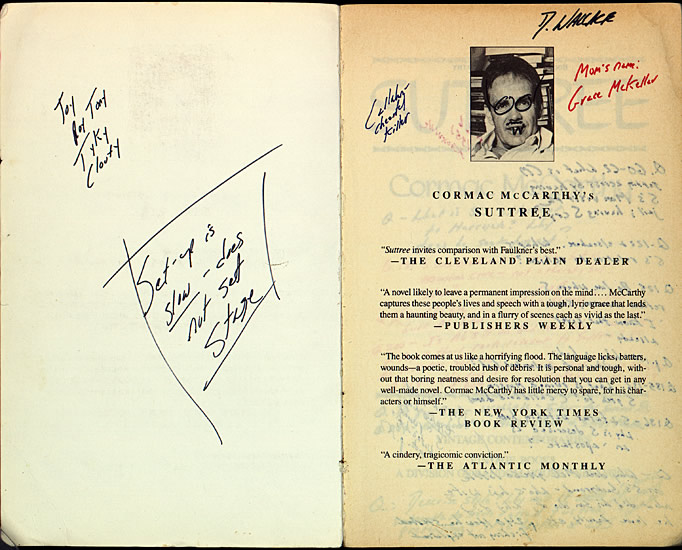
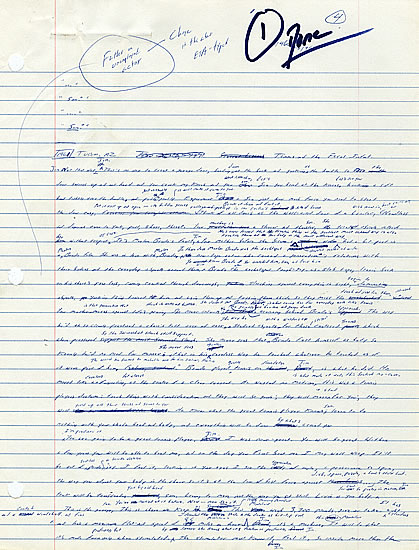
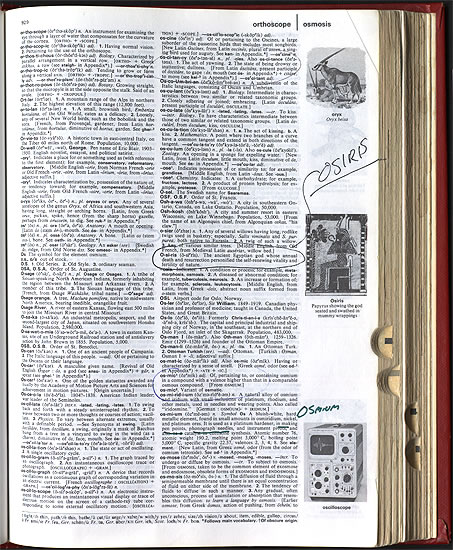
The New York Times and dozens of other sources reported yesterday that the University of Texas acquired David Foster Wallace’s papers, including his personal library. The Harry Ransom Center at UT already has lots of Wallace’s stuff up at their site and it’s frankly astounding. There are handwritten pages from Infinite Jest, images from annotated copies of some of Wallace’s novels, including Cormac McCarthy’s Suttree and Don DeLillo’s Players, and pictures of Wallace’s dictionary with words circled like neroli, cete, and suint. Begin exploring Wallace’s archive here.

First page of a handwritten draft of Infinite Jest
DFW's dictionary
Inside cover of David Foster Wallace's annotated copy of Players by Don DeLillo.
Inside cover of David Foster Wallace's annotated copy of Suttree by Cormac McCarthy.

Poetry After Auschwitz and Yann Martel’s Beatrice and Virgil

Right after WWII, the German philosopher Theodor Adorno famously declared that to write poetry after Auschwitz was barbaric. Adorno later recanted on his knee-jerk reaction, stating that “‘Perennial suffering has as much right to expression as the tortured have to scream… hence it may have been wrong to say that no poem could be written after Auschwitz.” Still, his initial proscription is often invoked as something of an imperative, or at least guiding principle, in 20th and 21st century art. Often stated boldly as “no poetry after Auschwitz,” it’s usually taken to mean that, after the horrors of the Holocaust, art has no valid aesthetic response to history, or perhaps even humanity, at least not in any of its traditional forms. Even more tricky, of course, is just how to represent the Holocaust itself. The severity of the event seems to call for a witnessing limited to facts alone, one devoid of any artifice or metaphor.

Over half a century later authors still wrestle with this issue. I just finished reading Yann Martel’s forthcoming novel Beatrice and Virgil, his follow-up to 2001’s Booker Prize-winning book club favorite, Life of Pi, a novel I’ve never read. (Beatrice and Virgil comes out mid-April and I’ll run a full review then). Very early in the book the protagonist Henry, a successful author, describes the book he is writing, a follow-up to his bestseller. It’s about:

the ways in which that event was represented in stories. Henry had noticed over years of reading books and watching movies how little actual fiction there was about the Holocaust. The usual take on the event was nearly always historical, factual, documentary, anecdotal, testimonial, literal. The archetypal document on the event was the survivor’s memoir, Primo Levi’s If This Is a Man, for instance. Whereas war–to take another cataclysmic human event–was constantly being turned into something else. War was forever being trivialized, that is, made less than it truly is.

After waxing a bit more on artistic representations of war — romantic, epical, comedic, etc. — Henry seems to come about to Adorno’s point (never named in Martel’s text, for what it’s worth):

No such poetic licence was taken with–or given to–the Holocaust. That terrifying event was overwhelmingly represented by a single school: historical realism. The story, always the same story, was always framed by the same dates, set in the same places, featuring the same cast of characters.

Henry concedes a few exceptions to this rule, like Art Spiegelman’s Maus, before wondering:

why this suspicion of imagination, why this resistance to artful metaphor? A work of art works because it is true, not because it is real. Was there not a danger in representing the Holocaust in a way always beholden to factuality? Surely, amidst the texts that related what happened, those vital and necessary diaries, memoirs, and histories, there was a spot for the imagination’s commentary. Other events in history, including horrifying ones, had been treated by artists, and for the greater good.

Henry’s desire to write an artistic account of the Holocaust, or to write about how one writes about the Holocaust–to write a poetry (of sorts) after Auschwitz–does not, significantly, derive from any personal, historical, or cultural impetus. His concern seems, in many ways, an academic’s regard for aesthetic theory, leading him to envision his book as a split between fiction and essay, with the pieces being published in one book at “opposite” ends (i.e., one would have to flip the book upside down and over to access the text on the other side). What Henry fails to see–Henry, not Martel, let’s be clear–is that he has no legitimate response to the Holocaust. When pressed by a gang of editors, along with a bookseller and a critic, to answer the simple question “What is your book about?”, Henry retreats into a series of wonderfully vague literary generalities:

My book is about representations of the Holocaust. The event is gone; we are left with stories about it. My book is about a new choice of stories. With a historical event, we not only have to bear witness, that is, tell what happened and address the needs of ghosts. We also have to interpret and conclude, so that the needs of people today, the children of ghosts, can be addressed. In addition to the knowledge of history, we need the understanding of art.

But just what “the understanding of art” might mean here, Henry is unable to say. His book is shot down, and, thankfully, Martel’s book Beatrice and Virgil manages to be a novel-about-not-being-about-the-Holocaust-but-being-about-the-Holocaust-but-not-really-being-about-the-Holocaust, which is all for the better, really. (Did that sentence make any sense? No? Sorry. I promise to (attempt to) clarify in my full review of Beatrice and Virgil). Otherwise, Henry might have fallen into the sweet lull of what critic Lee Siegel has described as Nice Writing. Here’s an excerpt from Siegel’s 1999 essay Sweet and Low”:

For at least the past decade, American writers have been pouring forth a cascade of horror stories about their condition or the condition of their characters. The Holocaust, ethnic genocide, murder, rape, incest, child abuse, cancer, paralysis, AIDS, fatal car accidents, Alzheimer’s, chronic anorexia: calamities drop from the printer like pearls. These are elemental events of radically different proportions, and the urge to make imaginative sense of them is also elemental. Some contemporary writers treat these subjects strongly and humbly and insightfully, but too many writers engaged in this line of production turn out shallow and distorted work. They seem merely to be responding to a set of opportunities created by a set of social circumstances. In their hands, human suffering goes unimagined, and the imagination goes hungry and deprived.

To return to Adorno’s dictum–no poetry after Auschwitz–the grim spectacle of history should not be fodder for “a set of opportunities created by a set of social circumstances.” Henry, a young French Canadian with no Jewish roots is utterly divorced from any authentic response to the Holocaust. He could write an academic essay on the subject, or a navel-gazing bit of metafiction that dithered over storytelling itself, but he essentially already has an answer to his own question of why there are so few artistic responses to the Holocaust–that to re-imagine or re-interpret or otherwise re-frame the real events of the Holocaust in art is to, at once, open oneself to dramatic possibilities of failure. Failure would derive from the radical inauthenticity of having merely used, rather than illuminated, one of history’s worst horrors (my verb “illuminate” here stands inauthentic, I admit). Henry–and perhaps, implicitly, Martel–eventually manages to respond to the Holocaust in his art, but I’ll save a discussion of that for a full review of Beatrice and Virgil.

“Books in the Age of the iPad” — Craig Mod

In his recent essay, “Books in the Age of the iPad,” Craig Mod distinguishes between “Formless” and “Definite” content:

Formless Content is is unaware of the container. Definite Content embraces the container as a canvas. Formless content is usually only text. Definite content usually has some visual elements along with text. Much of what we consume happens to be Formless. The bulk of printed matter — novels and non-fiction — is Formless.

Mod argues that the rise of e-readers like the Kindle and (presumably) the iPad are harbingers of a new age in reading, where both formless and, now, definite content might be readily (and easily) displayed. He makes a brash judgment:

The convenience of digital text — on demand, lightweight (in file size and physicality), searchable — already far trumps that of traditional printed matter.

Really? On demand? For whom? “On demand” here presupposes a number of conditions, first and foremost, that each person who wishes to enjoy this new medium has the economic means to do so. The projected retail cost of the iPad is currently $500, a price that does not include monthly ISP fees, let alone the prices of e-books and other e-texts. The Kindle retails now for about half the price of the iPad. Although these prices will certainly fall over time, it is difficult to imagine that the “convenience of digital text” will trump equitable access to “traditional printed matter” — particularly for families with multiple children (at least any time soon).

Mod makes some good points about the future of printed, physical books in the age of e-readers (or, the iPad, a device he seems to think will normalize the medium):

I propose the following to be considered whenever we think of printing a book:

  • The Books We Make embrace their physicality — working in concert with the content to illuminate the narrative.
  • The Books We Make are confident in form and usage of material.
  • The Books We Make exploit the advantages of print.
  • The Books We Make are built to last.

The result of this is:

  • The Books We Make will feel whole and solid in the hands.
  • The Books We Make will smell like now forgotten, far away libraries.
  • The Books We Make will be something of which even our children — who have fully embraced all things digital — will understand the worth.
  • The Books We Make will always remind people that the printed book can be a sculpture for thoughts and ideas.

Anything less than this will be stepped over and promptly forgotten in the digital march forward.

Goodbye disposable books.

Hello new canvases.

Books as aesthetic, durable objects — great idea. But books as relics, as things to recall the smell of “now forgotten, far away libraries”? Really? Libraries function as an important space in communities that transcend the mediums of information in those libraries. It’s almost downright scary to posit some kind of project-utopia where a library becomes “digitized.” Also — and again, much of what Mod suggests here is great — but also, who are “our children” who “have fully embraced all things digital”? In the current geopolitical climate, Mod’s line of thinking can only realistically apply to “First World” countries. Even in our own beloved United States, first among the “First World,” we have difficulty feeding all of our children or funding their educations. E-readers like the iPad or Kindle could presumably do much to ameliorate the burgeoning education gap, but recent efforts haven’t gained much momentum or praise.

It’s not that I disagree with (what I perceive to be) Mod’s overall thesis — that the iPad and successive e-readers will revolutionize how we read, access, and store information. I do, however, think that his rosy-toned enthusiasm has led to a number of blind spots in his article. Why should e-readers eliminate libraries? What, exactly, are “disposable books”? Who will have access to these “new canvases,” and in what capacity? Why the implicit presumption that digital storage of media is fail safe, easier than current methods, and more permanent?

Finally, my biggest problem with the piece is the simple assumption that any e-reader could be more comfortable than a paperback book. Mod addresses arguments like mine:

When people lament the loss of the printed book, this — comfort — is usually what they’re talking about. My eyes tire more easily, they say. The batteries run out, the screen is tough to read in sunlight. It doesn’t like bath tubs.

Mod responds to these arguments:

Important to note is that these aren’t complaints about the text losing meaning. Books don’t become harder to understand, or confusing just because they’re digital. It’s mainly issues concerning quality. One inevitable property of the quality argument is that technology is closing the gap (through advancements in screens and batteries) and because of additional features (note taking, bookmarking, searching), will inevitably surpass the comfort level of reading on paper.

While Mod’s point of meaning vs. quality (what I’d refer to as readability) is certainly right, his assumption that technology “will inevitably surpass the comfort level of reading on paper” is wholly unfounded and unsupported. It’s exactly the kind of teleological claim we see too often about technology — that technology always progresses to an inevitable, good, and superior end point. Still, Apple can feel free to send me an iPad and I’ll be sure to test my own assumptions on the issue, and redress them here if need be.

Web Services Book Covers by Stéphane Massa-Bidal

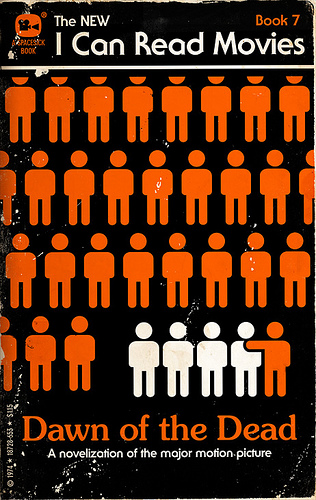
Stéphane Massa-Bidal (aka Hulk4598, aka Rétrofuturs) created these fantastic “book covers” for internet services late last year, so you might’ve already seen them; anyway, they fit nicely into Biblioklept’s Book Covers Week. Massa-Bidal’s images of familiar web two point oh apps masquerading as book covers remind us that book covers are their own special medium, and that we perhaps read the information in book covers in its own special way, regardless of whether the book actually exists or not (or, in this case, exists as something other than a book. See also: Spacesick’s “I Can Read Movies” Series).

On Movie Tie-in Covers

Is there anything worse than a beloved book sporting a movie tie-in cover? (Okay. Maybe Oprah’s blazon is worse).

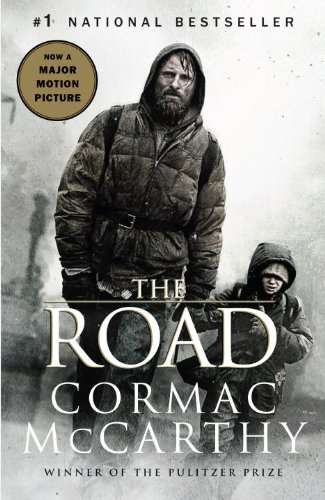
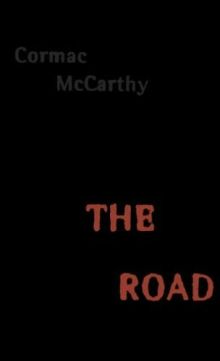
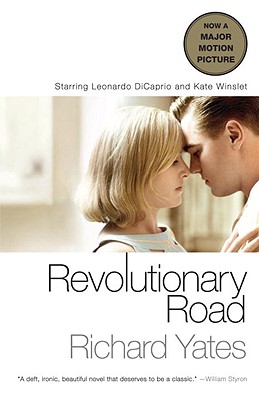
It’s not like the original cover was that great, or that the movie was that bad, but the whole enterprise of slapping grim Viggo Mortensen all over Cormac McCarthy’s The Road doesn’t seem to make much sense (maybe they didn’t realize that the film was going to flop and hoped that it would re-energize book sales). It seems like a slight to any reader new to the book. The austere original cover omits all imagery and thus places McCarthy’s language front and center. Movie tie-ins tend to plaster major Hollywood actors all over the cover, making it difficult for readers to re-frame or re-image the characters that those actors are playing–it’s an egregious intrusion between the writer’s text and the reader. It disrupts visualization. It also tends to look tacky, even when it’s “classy.” Take for example this cover for Richard Yates’s novel Revolutionary Road

I’ve never read the novel, although I’ve often heard it referred to as an under-read or “lost” classic (the film promos made it look dreadfully boring, but there is probably nothing more unfair than judging a book by its movie). Spying its spine, I picked the book up the other day at the bookstore but could not even flick through it. All I could see was Leo and Kate. Then there’s that Big Gold Sticker procliaimng the work is “Now A Major Motion Picture.” The statement, emboldened in all-caps seems set apart in its little golden sphere, but oddly enough there’s a clause that must logically follow it — “Starring Leonardo DiCaprio and Kate Winslet.” The aesthetic logic of the cover though seems to suggest, however ludicrous, that DiCaprio and Winslet actually star in the book. Were I to attempt to read this edition of the book my poor imagination, weakened by years of watery domestic beer and bad television, would not be able to surmount the challenge posed by the cover. Each time I dipped into its pages, surely Yates’s prose, no matter how descriptive or visceral or imagistic, must fall to the glamor of Leo and Kate.
Maybe it’s just me though–I can remember having this problem even in childhood, absolutely hating to read any book that proffered a photograph of a person, especially an actor, masquerading as a character that my imagination was supposed to bring to life. For some reason paintings and other stylized images didn’t –and don’t — offend me in this way.

I suppose that movie tie-in covers help sell books and, ultimately, that’s a good thing, but I can’t think of a single one I’ve ever seen that’s aesthetically pleasing. I’m reminded now of Spacesick’s “I Can Read Movies” Series, which achieves the opposite, turning movies into witty, wonderful book covers. Observe:

Book Covers: Brits vs. Yanks

Thanks to C. Max Magee at The Millions for making Biblioklept’s Book Covers Week so much easier. What can we say, we’re lazy. Here’s his fun post on American book covers versus British editions. And, just to prove that we’re not that lazy, we did two of our own:

The American version of Don DeLillo’s Point Omega, on the left, attempts to capture some of the book’s wistful tone and convey its sense of desert geography and handling of epochal time. But against this background, the book’s vaguely military name enclosed by that infinity loop all sort of looks a bit like like an espionage thriller. We’re not really thrilled about the British cover either–black, white, and gray might look better than the cool blues here–but its energy and sense of disconnection better suit DeLillo’s spare, sad novella than the American cover.

We like both of these covers more than we liked the actual book, but damn if the British cover (on the right) isn’t one of the best editions we’ve ever seen. Someone give the designer a cookie. Or a prize. Or something.

Jacketless Wonders

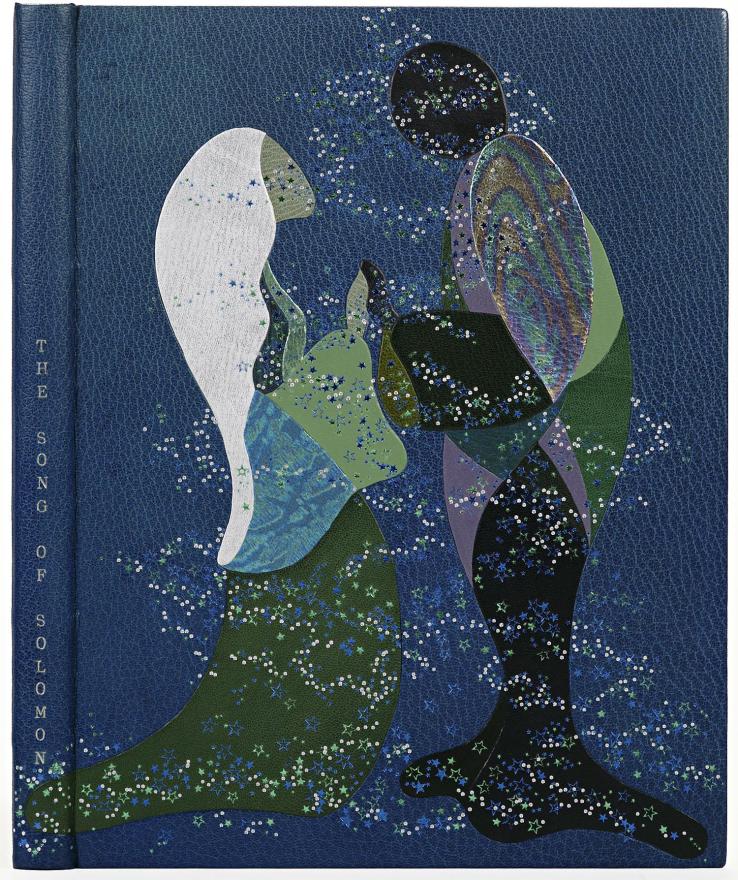
Yesterday we griped about dustjackets and praised books bold enough to go nude. To see some really gorgeous bookbinding, check out this recent gallery from BibliOdyssey. Sample:

'The Song of Solomon' Silverfoil and morocco leather Bound by KT Miura, 1987

David Foster Wallace Audio Archive Now Up

A kindly dude by the name of Ryan Walsh has launched a site called The David Foster Wallace Archive. The site collects in one place the loose mp3s that’ve been floating around the web, and includes the Brief Interviews with Hideous Men audiobook in its entirety. There are also interviews, profiles, eulogies, and more. A good starting place: an (as-yet) unpublished piece about a do-gooding boy detested by all. It’s hilarious.

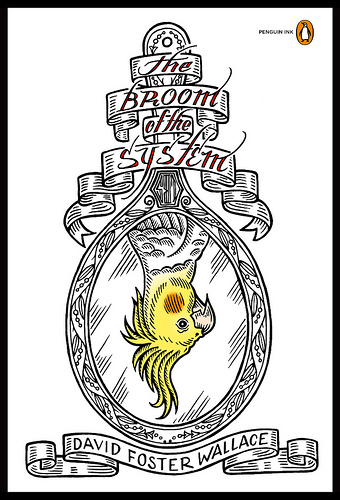
So. It’s kinda sorta Book Covers Week at Biblioklept, and, in keeping with that theme, check out this new cover for Wallace’s debut novel, The Broom of the System. The edition is part of the forthcoming Penguin Ink series and should be available this summer. Art by Duke Riley. We love it.

Why I Dislike Dustjackets

I’m lazy. I let other people do good reporting and then hijack their work. Here’s Dennis Johnson at MobyLives citing a recent Guardian story:

What, exactly, is the point of a dustjacket, asks Peter Robins in this Guardian story. “The clue can’t be in the name: on the shelf, the most dust-prone part of a book is the top, which a jacket doesn’t cover … the jacket remains an unnecessary and vulnerable encumbrance.” And now, he says, “some in the book trade appear to be reaching the same conclusion.”

The Guardian article cites a number of recent books (including Zadie Smith’s latest, Changing My Mind) that forgo jackets in favor of art printed directly on the cover. I wish this trend would normalize in publishing. Dustjackets are annoying. They are ineffective as bookmarks, they tear and curl easily, and they tend to slip off of the book. They make grasping books difficult, especially larger volumes, and I always find myself removing them to read. Because I don’t want to throw away the “cover” of the book, the jacket has hence to languish in some weird droopy unstackable blip in a random corner of my house or office. Again, annoying. I can think immediately of three recentish books which are far more lovable aesthetic objects; all eschew dustjackets.

David Byrne’s Bicycle Diaries is a beautiful cloth-bound volume; the biker-icon, title, and author appear to be embossed but are actually slight depressions. A simple sticker on the back of the book displays retail cost and isbn info. The inside front cover and first page display the blurb and author info that one would usually find on a wrap-around. There’s something wonderfully tactile, warm, and pleasing about the book. It’s also a really good read.

I bought Douglas Coupland’s novel Hey Nostradamus! despite its silly name because I was enamored of its lovely embossed cover. There’s a smooth elegance to the design. The back cover repeats the kneeling figure, leaving room for embossed blurbs. I should really get around to reading it.

McSweeney’s hardcover edition of Chris Adrian’s The Children’s Hospital doesn’t feature anything as fancy as cloth or embossing. No, it’s just a plain old image–a good design, to be sure–but nothing that you wouldn’t expect on a dustjacket. Only there’s no cumbersome dustjacket. McSweeney’s issued the book with a slight wrap-around–more like a bookbelt than a dustjacket–displaying isbn and other info. The peripheral bookbelt was easy to throw away. McSweeney’s has released plenty of beautiful jacketless books, but they also know how to do a jacket right. Several hardback editions of McSweeney’s Quarterly (numbers 13 and 23, for instance) feature “dustjackets” that unfold to reveal short short stories, comics, and paintings. If you’re going to do a dustjacket, make it an aesthetic object worth keeping.

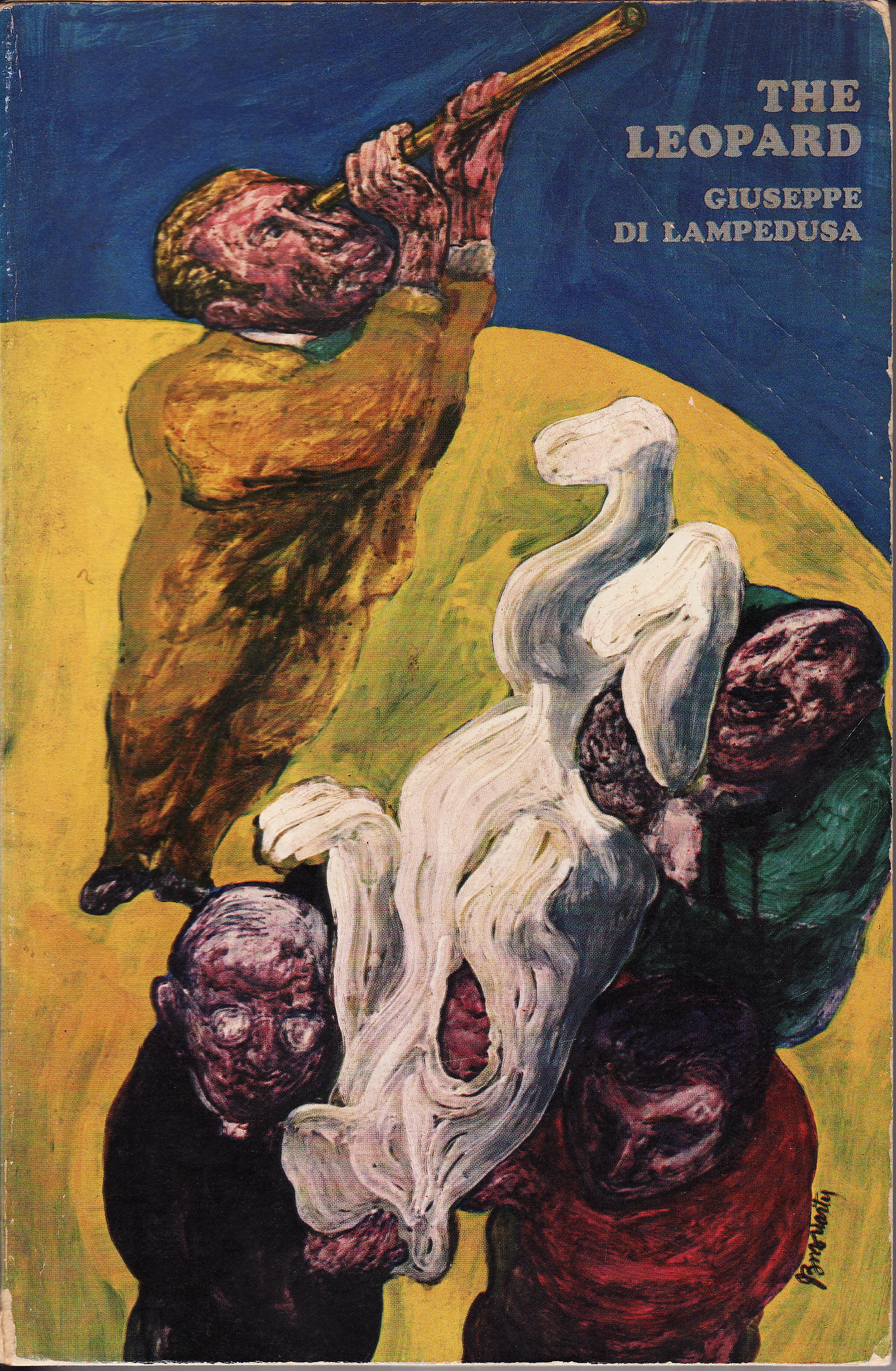
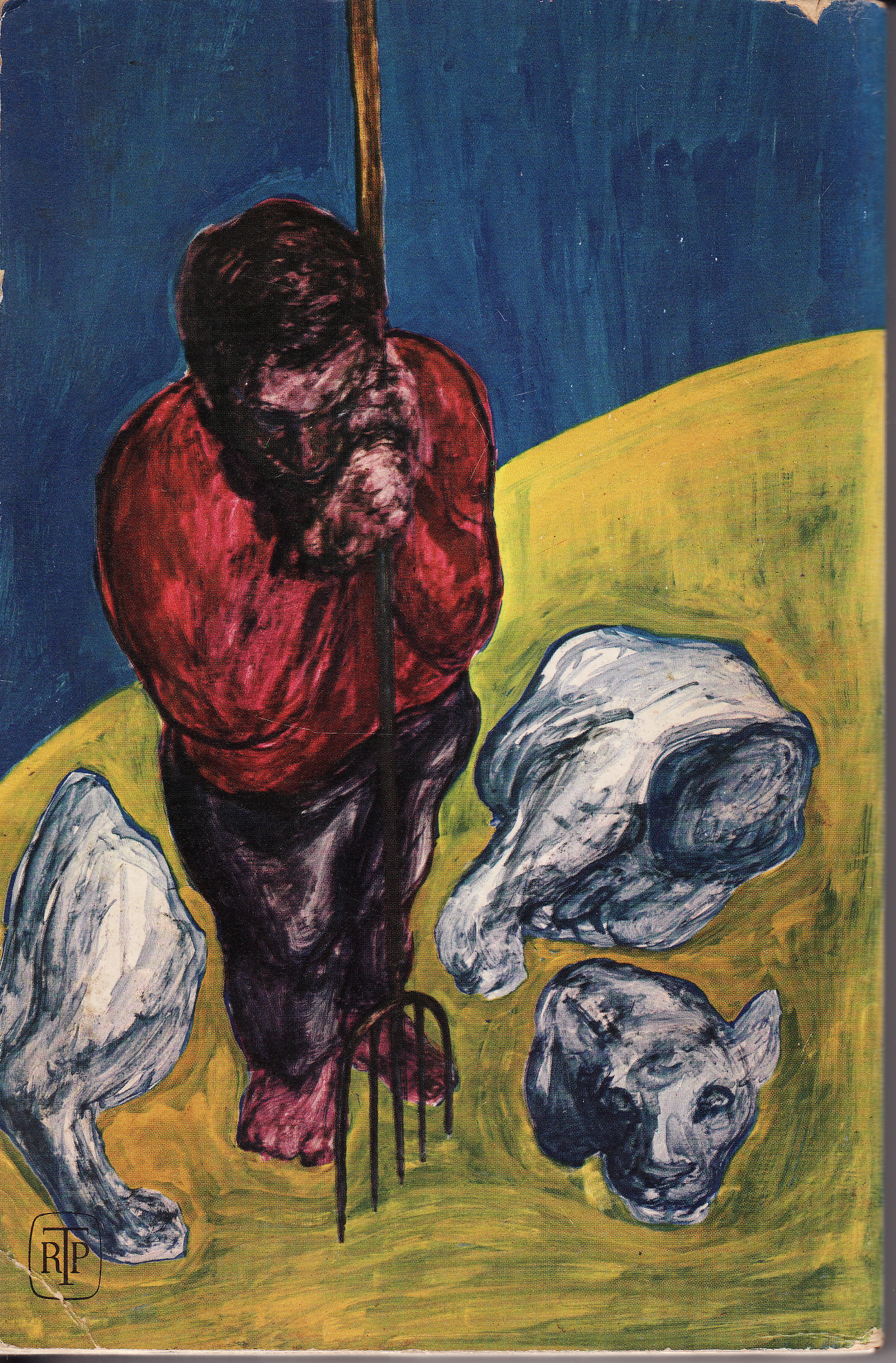
Why Don’t They Make Book Covers Like This Anymore?

Cover design for Giuseppe di Lampedusa’s The Leopard by Jerome Moriarty, 1966 Time Reading Program edition.

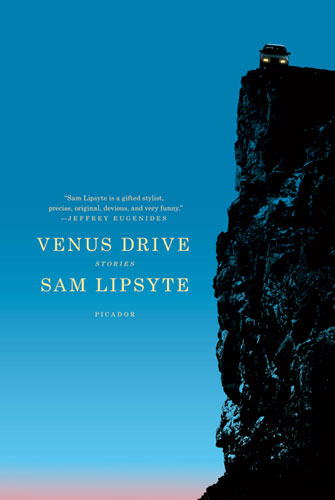
Venus Drive — Sam Lipsyte

Sam Lipsyte’s forthcoming novel The Ask is already poised to be one of the major critical successes of 2010. In concordance with its publication, Picador will print a new trade paperback edition of his short story collection Venus Drive, the first such publication since its original debut from Open City a decade ago.

The thirteen stories in Venus Drive compose a sort of novel-in-stories. The title of the collection takes its name from a banal suburban street mentioned in a few of the stories, and many of the characters seem like iterations of the same type or voice. There are washed up would-be indie rock stars, small-time coke peddlers, and underemployed and overeducated addicts. There are deviants and perverts and outsiders. There are bullies. There are dead or dying mothers, dead or dying sisters. In short, Venus Drive is its own tightly-drawn, tightly-coiled, and highly-compressed world.

As the plot points double and re-double in these stories, so do the themes. “Our culture is afraid of death, and considers it something we must wage battle against,” says Tessa, a pain specialist, a peripheral character in “Cremains.” She continues: “I say, surrender, submit. Go gentle. Terminal means terminal.” Death informs almost all of these stories in some way, and Tessa’s commentary presents the problem with death, or at least the problem these characters have with dealing with death: it’s not easy to go gentle. It goes against our culture and our nature to surrender. If she’s presented as a voice of wisdom, she’s also an ironic character, one of the many would-be authorities Lipsyte’s weirdos and outsiders can’t help but mock. “The Drury Girl,” part-suburban satire and pure pathos, posits a pre-pubescent narrator obsessed with his teenage babysitter; his dad’s cancer plays second fiddle to his lust. Thus the story neatly ties together the overarching themes of Venus Drive, sex and death. Admittedly, these are probably the only real themes of proper literature, but Lipsyte does it so damn well and lays it all out so bare and does so in such humor and grace that it really sticks. It’s good stuff.

That humor is desert-dry, of course, and succeeds so well because his characters are so endearing in their pathetic pathologies. The antiheroes of “Beautiful Game” and “My Life, for Promotional Use Only,” are also-rans in the sordid history of underground rock, addicts approaching washed-up (Are they the same person? Maybe. They have different names, of course. Doesn’t matter). A scene from “Beautiful Game” shows the ambivalence at the core of many of these characters: “At the bank machine, Gary doesn’t check the balance. Better to leave it to the gods. Someday the bank machine will shun him. Why know when?” Gene, the ex-rocker in “My Life, for Promotional Use Only” now suffers the indignities of working for his ex-girlfriend. Everyone in the story is an ex-something, everyone is growing up and leaving art (or is it “Art”?) behind. In a poignant and funny and cruel scene, familiar to many of us, Gene sees some of himself in a waitress:

Rosalie calls over the waitress and they talk for a while about somebody’s new art gallery. The waitress is famous for a piece where she served the Bloody Marys mixed with her menstrual blood. Word had it she overdid the tabasco.

I wait for the moment when our waitress stops being a notorious transgressor of social mores and becomes a waitress again, look for it in her eyes, that sad blink, and order a beer.

Gene, a former “notorious transgressor of social mores” himself feels both sorrow and hate for the waitress. He sees her job as menial and pathetic — just like his own. He doesn’t seem to think much of her art, either. Lipsyte telegraphs so much there with so few words, his sentences clean, spare, precise, and rarely of the compound variety. There’s a truncated, clipped rhythm that Lipsyte builds over the thirteen-story run that helps propel the immediacy of his tales. The stories are short, too; the longest is sixteen pages and most run to eight or ten. Lipsyte’s rhetorical gift is to shine the grubby and, at times, his sentences can feel almost too perfect, too-fussed over–but this (minor) complaint, it must be noted, comes from someone who admires occasional ambiguity or incoherence. Lipsyte removes his own authorial voice and thus achieves lucidity in his characters’ voices; somehow, though — and paradoxically — these voices bear the ghostly trace of his absence. But that seems like a silly conversation, and certainly not one for this post.

Venus Drive reminds me very much of one of my favorite books, Denis Johnson’s Jesus’ Son, which I would also call a novel-in-stories, also a spare and precise collection, also a study of weirdos and addicts and outsiders. Jesus’ Son is something of a standard in creative writing workshops (or at least it used to be) and a sensible teacher would add Venus Drive to her syllabus as well. Finally, like Jesus’ Son, Lipsyte’s book is seething, funny, and poignant, with characters tipped toward some redemption, awful or otherwise, for all their myriad sins. The book might take its name from a geographic location, but the “Venus drive” is also a spiritual inclination toward love and hope. Highly recommended.

Venus Drive is available March 2nd, 2010 in trade paperback from Picador.

Sam Lipsyte Reading from His New Novel, The Ask

You can read the first 20 pages of Sam Lipsyte’s The Ask here.

“Try To Leave Out the Parts That Readers Tend To Skip” and Other Rules for Writing Fiction

Inspired by Elmore Leonard’s “Ten Rules for Writing Fiction,” The Guardian published a collection of various authors’ rules for writing fiction earlier this week. The tone of the responses range from serious to playful to didactic to way-too-specific, with the most common–and obvious–rule being simply to “write.” Authors include Geoff Dyer, Margaret Atwood, Neil Gaiman, Jonathan Franzen, and Roddy Doyle. A few of our favorites:

Elmore Leonard:

3. Never use a verb other than “said” to carry dialogue. The line of dialogue belongs to the character; the verb is the writer sticking his nose in. But “said” is far less intrusive than “grumbled”, “gasped”, “cautioned”, “lied”. I once noticed Mary McCarthy ending a line of dialogue with “she asseverated” and had to stop reading and go to the dictionary.

Margaret Atwood:

5. Do back exercises. Pain is distracting.

Roddy Doyle:

4. Do give the work a name as quickly as possible. Own it, and see it. Dickens knew Bleak House was going to be called Bleak House before he started writing it. The rest must have been easy.

Geoff Dyer:

8. Beware of clichés. Not just the ­clichés that Martin Amis is at war with. There are clichés of response as well as expression. There are clichés of observation and of thought – even of conception. Many novels, even quite a few adequately written ones, are ­clichés of form which conform to clichés of expectation.

Jonathan Franzen

1. The reader is a friend, not an adversary, not a spectator.

8. It’s doubtful that anyone with an internet connection at his workplace is writing good fiction.

Richard Ford:

10. Don’t take any shit if you can ­possibly help it.