William Gibson

Just out of high school, I had a mild obsession with William Gibson’s so-called cyberpunk novels. The first and most famous of these is Neuromancer, an incredibly prescient book that the Wachowski Bros. shamelessly ripped off in The Matrix. Neuromancer is the first in “The Sprawl” trilogy; Count Zero and Mona Lisa Overdrive followed. I borrowed and never returned Neuromancer from Tilford; a few years ago I lent it, along with Burning Chrome, Gibson’s collection of short stories, to a student who in turn never returned them. I read Count Zero and Mona Lisa Overdrive at the same time as my college roommate Jordan. I don’t know who has these books now.

In 1990 Gibson co-authored a book called The Difference Engine with Bruce Sterling. The Difference Engine posits a Victorian England where computers have already been created and are in use. The novel explores the consequences of a technological revolution coming a 100 years early. This book launched what is sometimes called the “steampunk” genre. After TDE, Gibson spent the 90s writing three novels often referred to as “The Bridge” trilogy: the first, Virtual Light, was pretty good (it had a really cool idea about “organic computers”); the second, Idoru, was pretty bad, really; the last, All Tomorrow’s Parties, was downright awful (I couldn’t finish it–I was embarrassed for one of my favorite authors!) At the beginning of the new millenium, technology had caught up to Gibson’s cyberpunk visions, making some of the details of his Bridge trilogy seem outdated or just plain hokey.

I knew our time together was up when I passed on a $4 copy of 2003’s Pattern Recognition at Barnes & Noble a few years ago. Despite his fiction taking a dip, Gibson’s blog, as well as his essays (often published in Wired magazine–check out what is probably his most famous piece, “Disneyland with the Death Penalty”) remain relevant and entertaining. Maybe his forthcoming novel, Spook Country, will prove more entertaining; until then, at least we have the Sprawl Trilogy.

(Check out more William Gibson covers at this gallery)   
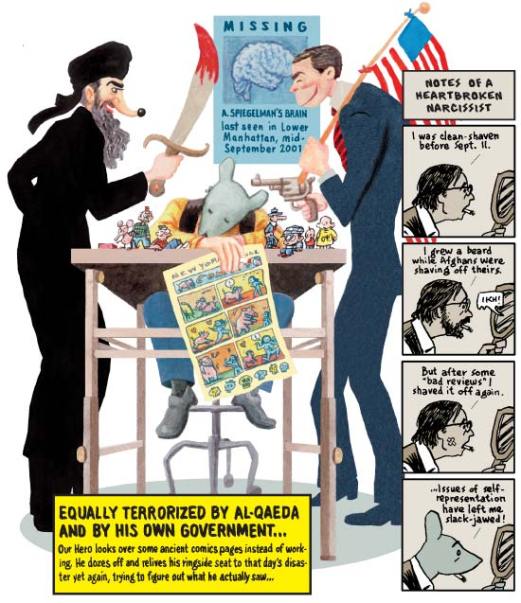
In the Shadow of No Towers–Art Spiegelman

Art Spiegelman’s Maus, released as a graphic novel over twenty years ago, did more to legitimize the comic as an art form than any other work I can think of. It won a Pullitzer Prize Special Award in 1992 (the Pullitzer committee found it hard to classify…perhaps they didn’t want to admit that they were giving a prestigious award to a comic book!), and today Maus is a standard on many college English syllabi.

After Maus, Spiegelman worked for The New Yorker for over ten years, quitting in early 2002 after the September 11th attacks to work on a series of broadsheets entitled In the Shadow of No Towers. These broadsheets were collected in 2004 in an unwieldy 15″ x 10″ book.

spiegelman_02_550×637.jpg

Spiegelman lived in downtown Manhattan, right by the towers; his daughter attended school a few blocks away. He saw the towers collapse in person, fleeing for his life with his family. Spiegelman attempts to capture this raw, unmediated, and very personal experience in In the Shadow of No Towers (Sonic Youth’s 2002 album Murray Street works to the same end–only much more abstractly): the narrative is discontiguous, fluctuating from bitter satire to earnest inquiry. Spiegelman’s choice of the broadsheet as his medium (the broadsheets were published monthly by different newspapers as Spiegelman produced them) is tremendously affective: just like the 9/11 attacks, the broadsheets are larger than life, hard to grasp, hyperbolically resisting easy, singular readings. Spiegelman balances bitter attacks against the conformist mentality spurred by the Bush administration with pathos and humor; In the Shadow of No Towers recalls the good-natured satire of broadsheet comics from a hundred years ago, bittersweetening the content. The 2004 collection wisely contextualizes Spiegelman’s work by reprinting broadsheets of “The Yellow Kid” and “The Katzenjammer Kids.”

Like Maus, In the Shadow of No Towers is a fascinating exploration of how disaster confronts and transforms identity. And reflecting its heinous subject, In the Shadow of No Towers ends without concluding: as the foolish Iraq war begins, Spiegelman can no longer shape any meaning or sense from his work. This isn’t a graphic novel–don’t look for a cohesive narrative structure here; instead, In the Shadow of No Towers explores the loose ends, the detritus, the psychic remnants of disaster.

2006 Superlatives

 Best Book I Read in 2006:

Moby-Dick by Herman Melville.

Best Book Published in 2006 that I Read in 2006:

I read plenty of fantastic books this year, but I don’t think any of them were published this year (although I’m sure that plenty of great books came out this year. I’m always playing catch-up). The closest I think I can come is a paperback of Dave Egger’s collection of short fiction, How We Are Hungry, which came out in October of 2005, actually (to plenty of mixed reviews–but I liked it a lot!). I will also read Egger’s What Is the What as soon as possible. Maybe this Christmas break (feel free to send me a copy). Here’s The New York Times Book Review Top 10 of 2006, and courtesy of the American Library Association, the TTT (the Teen’s Top Ten, popularly known as “the titties”).

Least Enjoyable Book I Read in 2006:

God, Dr. Buzzard, and the Bolito Man: A Saltwater Geechee Talks About Life on Sapelo Island, Georgia by Cornelia Walker Bailey (with Christena Bledsoe). I’m sure lots of people would really enjoy this book, in fact, I recommended it to a few of my students. Not for me though.

Most Likely to Succeed:

Ricotta Park will storm the nation (if Nicky Longlunch ever decides to start posting again). 

Most Likely to be President:

Barack Obama?

Best Dressed:

Saddam Hussein always was a sharp dresser–

Saddam Hussein

–but after some {ahem} troubles–

saddam-capture-unofficial4.jpg

–he had a fabulous makeover! Saddam looking dapper and energetic, yet casual and academic (oh, and seriously pissed)–

_41064274_051128_hussein203i.jpg

Best Movie I Saw in the Movie Theater in 2006:

I’m pretty sure it was Litle Miss Sunshine, although I also enjoyed the movie where Will Ferrell was a race car driver.

Best Movie I Saw in 2006:

The New World (dir. Terrence Malick). This film is beautiful. You must watch it (twice).

Best Album of 2006:

Lots of contenders–M. Ward’s Post-War, Joanna Newsom’s Ys,  Destroyer’s Rubies, OOIOO’s Taiga, Girl Talk’s Night Ripper –all were great (and I know that I’m forgetting dozens)–but The Fiery Furnaces’ Bitter Tea didn’t leave my CD player for months…in fact I’m sure it’s still in there.

bitter_tea_dig-fiery_furnaces_480.gif

Best Song of 2006:

“Star Witness” by Neko Case. Crafted from images that at first seem vague, “Star Witness” relates the haunting tale of a tragic accident. And the worst part of the accident is how mundane the whole scene is to everyone besides the speaker: “This is nothing new/No television crew/They don’t even put on the siren.”

Most Overrated Album of 2006:

The Crane Wife by The Decemberists. The Decemberists are so boring.

Best Live Performance of a Musical Group:

The Fiery Furnaces at Common Grounds (Gainesville, FL). One of the best concerts I have ever attended. The kids danced as The Fiery Furnaces deconstructed their songs, rearranging them into new suites, punching in and out of different albums. The true rocknroll.

Most Disappointing Live Performance of a Musical Group:

Wilco at The Florida Theater (Jacksonville, FL). Wilco didn’t seem to know that they were playing in a theater. Jeff Tweedy seemed completely annoyed at the crowd for not boogeying to the jams. Wilco’s performance came off like a simulation of a band that was really “into” the vibe–like they had watched films of themselves to improve, like a football team or something.

Best New Product:

Okay, boxed wine is nothing new, but in 2006 I started gleaming the cube. Boxed wines stay fresher longer than wine from a bottle, and are generally much less expensive. This summer I found my habit–which a prejudiced few might think declasse–validated by the cultural elite. I attended a pre-wedding party in a cave in the south of France this summer; Damien, the winemaker (it was his cave) served us box after box of delicious wine, trumpeting the superiority of the box as a vessel. So see.

Worst People of 2006:

Check out my previous post for some superlative hatin’. 

Man of the Year:

I wasn’t on the committee this year. I understand that they might have met in Orlando this year. This guy John Griffis heads the whole thing up. I’m sure he has a MySpace account. I really don’t know who won. I think this guy Andy won.

Woman of the Year:

The woman of the year is my darling wife Christy, of course.

Dave Eggers on Infinite Jest

ij.jpg

Last week Little Brown published a new edition of David Foster Wallace’s Infinite Jest featuring a new introduction by Dave Eggers. You can read the whole introduction here (thanks to Bob Tomorrowland for sending me the link).

Eggers’ intro weighs in on the current “readability” debate in contemporary fiction. In his 2002 essay “Mr. Difficult,” Jonathan Franzen (author of The Corrections) attacked “difficult fiction,” focusing on writers like William Gaddis and Thomas Pynchon, whom Franzen views as “Status” writers who don’t really care about their audience. Franzen posits that “Contract” writers (like himself) take a more humanist, social approach. In his intro, Eggers avers that DFW’s work denies these classifications; the content of DFW’s work may be complex and weighty and downright philosophical, but DFW’s tone and his humor and his pathos ultimately allow for an accessible, fun read.

This blog has previously come out against Franzen’s argument: biblioklept is a fan of both the difficult and the more accessible–and the work of authors like Eggers and DFW prove that Franzen’s types are empty models. It’s too bad for Franzen that Gravity’s Rainbow and Ulysses require more work on the part of the reader than say, Stephen King or Tom Clancy. The Bible and Shakespeare and Moby-Dick and Gabriel García Márquez also require work from the reader, and no one could make a legitimate argument for removing them from the literary canon. One day, Infinite Jest will take its place in that same canon, alongside the work of Pynchon, John Barth and Don DeLillo–all authors whose work requires some effort on the part of the reader.

Eggers disscusses the effort required to read Infinite Jest, noting that it’s not a book you can simply put down and come back to a few weeks later. From my own IJ reading experience, I know this to be true: I made three attempts before finally getting into it; once I was “into” it, I was addicted, reading well past my bedtime, lugging the large object around on the Tokyo subway, reading snatches during my lunch break. IJ made me laugh loudly, it made me cry a few times; I even found myself so excited that I had to stand up during the climactic fight between Don Gately and the mysterious guys in Hawaiian shirts. When I finished the book, I immediately started re-reading it, sifting through its dense language for added meaning. And one day (month), when I have the time, I plan on reading it in its entirety again.

If you have any interest in this book, read Eggers’ foreward–he does a much better job selling this book than I could. I will say that this book is a favorite of mine, and that if you put the time and effort into it, you won’t be disappointed.

McSweeney’s Issue 13 (Chris Ware)

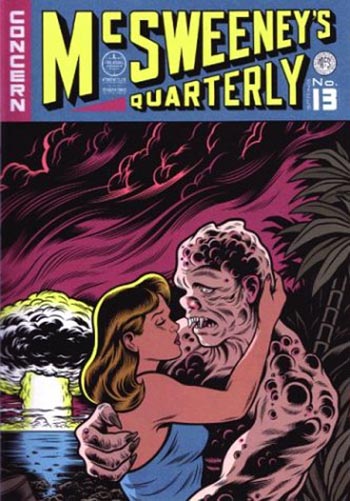
McSweeney’s Issue 13

Charles Burns’s gorgeous title page for McSweeney’s Issue 13 captures the bizarre mix of romance, abject horror, and mutually assured destruction present in the horror comics of the 1950’s.

I love all things McSweeney’s–Dave Eggers, The Believer, etc–but Issue 13 of McSweeney’s Quarterly Concern is particularly excellent, and is easily the most beautiful, most aesthetically pleasing book I own. Designer and editor Chris Ware (author of the sad and dense graphic novel Jimmy Corrigan, Smartest Kid on Earth) offers a concise but thorough history of cartooning. Ware places Robert Crumb, the Hernandez brothers, Art Spiegelman, Daniel Clowes, and other great artists into a tradition initiated by Rodolphe Töpffer and Krazy Kat, and perfected by Charles Schulz. This richly-colored book comes wrapped in an old fashioned broadsheet comics page, and includes work from some of the best artists and cartoonists from the past 100 years. Despite the wide range of cartoonists represented, Ware unifies the issue in a theme of despair and depression. Imagine this famous moment in cartooning–Lucy pulls the football away from Charlie Brown’s wishful kick at the last minute, tripping him and humiliating him and betraying him: that pretty much somes up Ware’s theme. But even though it’s sad, it’s funny and somehow beautiful–and real.

If you are a bibliophile, you must buy this book. You won’t be disappointed.

EC Comics, MAD Magazine, Censorship, and the Comics Code Authority

crimesuspenstories022.jpg

When I was a kid, I loved loved loved MAD Magazine: I loved Alfred E. Neuman’s gap-toothed grin on the cover, I loved Don Martin’s wacky comic strips, I loved the fake ads, I loved the movie and TV show parodies that I didn’t understand (to this day there are certain movies that I only know about via MAD), I loved the Sergio Aragonés doodles that hid in the margins, I loved “Spy vs. Spy,” I loved the endless recycling of strips and parodies that were older than I was by a longshot,  I loved Al Jaffee’s “fold-ins” (even though they quickly wore down to unfunny illegibility within minutes), I even loved the perennially unfunny “Lighter Side of Strip.” I think most of all I loved the bizarre guttural language of MAD–the unpronounceable explosions of fricatives and glottals, the joyful and rude “smrzzps!” and “schlups!” and “putzes” that provided the perfect soundtrack for my pre-adolescent pre-angst. Surely, this was the special argot of the adult world, the perfect onomatopoeia of grown-up comedy. Even as a young kid, I knew that MAD was in some way offensive, that it somehow tested the bounds of decency. Of course, I mistook what was essentially puerile for something more urbane.

mad.gif

So I was initially disappointed when I received Maria Reidelbach’s Completely Mad for Christmas one year. I guess I was expecting it to be a special all-color glossy hardback anthology. Eventually, I got around to reading it, and thus I learned the history of EC Comics and the censorship trials that the brand–and comics in general–had to endure. To this day, again and again, comic books come under the fire of those who wish to censor (check out the Comic Book Legal Defense Fund’s short history of censorship in comics to learn more). 

Under the editorial direction of William Gaines, EC Comics in the early 1950s specialized in horror, sci-fi, and true crime comics, publishing classic titles such as Tales from the Crypt and Weird Fantasy. These comics featured twisting and twisted plots, boldly illustrated with strong lines and graphic images. In a repressed and fearful age, EC Comics openly addressed problems of racial segregation and arms proliferation. The lurid artwork and progressive themes finally proved too much for Dr. Fredric Wertham, who addressed the supposed threat comics proved to the youth of America in Sedcution of the Innocent. Fitting right in to the McCarthyism of the era, Wertham’s book led to a Congressional hearing on comic books. In an attempt to regulate and control his own product, Gaines banded with other publishers to form the Comics Code Authority. This pre-emptive strike backfired, however–the CCA decided that they needed to censor every comic that came out, and give it this stamp of approval (still seen on mainstream comics today!)–

approvedbythe.gif

If you’re interested in reading the full (and necessarily vague) code, check out Once Upon a Dime’s article here.

A disappointed Gaines quickly left the CCA but the damage was done. They ruled that comics couldn’t be published with words like “horror” or “weird” in the title, effectively blacklisting EC’s major titles.

psycho_1.jpg

Check out this review of Psychoanalysis #1 at Polite Dissent.

Gaines continued to publish new comics like MD, and Psychoanalysis, but the CCA had poisoned the well. EC Comics went under, plagued by censorship battles and distribution  problems. Gaines focused all of his efforts on MAD, turning it into a full-sized magazine in 1955. MAD Magazine has been in continuous publication for over 50 years–although today the magazine prints paid ads. Yeah. That sucks, doesn’t it? So MAD has succumbed to commercialism–no wonder, considering that it’s the commodity name for such a crappy TV show. Even so, I’ll always recall gleefully devouring “Special Editions” of MAD, reprint digests chock full of references I didn’t get, thinking that I was gaining some forbidden knowledge. Maybe I was. 

Lydia Cabrera–Afro-Cuban Tales

afro-cuban-tales.jpg

In a sublime synthesis of traditional folklore and imagistic surrealism, Lydia Cabrera’s Afro-Cuban Tales questions the normative spaces occupied by bodies. Deriving from animist tradition, her characters exist in an impossible multiplicity of spaces, being at once animals and plants, humans and gods. Cabrera’s characters endure trials of biological identity and social co-existence, and through these problems they internalize authority, evince taboos, and create a social code. Cabrera’s trickster characters provoke, challenge, or otherwise disrupt the symbolic order of this code. In “Bregantino Bregantín,” a story that recalls Freud’s primal horde theory, as well as the work of more contemporary theorists such as Julia Kristeva and Judith Butler,  narcissist Bull kills all the males of his kingdom and takes all the women for himself.  The sadistic titular turtle of “Papa Turtle and Papa Tiger” uses the power of his dead friend’s antlers to shame, torment, and torture the other animals of his community. And in the magical realism of “Los Compadres,” Capinche seeks to put the horns on his best friend Evaristo by sleeping with his wife–a transgression that ends in necrophilia. This union of sex and death, creation and destruction is the norm in Cabrera’s green and fecund world; the trickster’s displacements of order invariably result in reanimation, transformation, and regeneration—the drawing, stepping-over, and re-drawing of boundaries. A couple of days, Bob hipped me to this really cool Run Wrake short film called Rabbit. While not directly related to Afro-Cuban Tales, this film nonetheless captures the book’s key themes and motifs of death and resurrection, transformation and language, and the trickster’s power to disrupt social and familial codes. Highly recommended.

Girl With Curious Hair–David Foster Wallace

dfw.gif

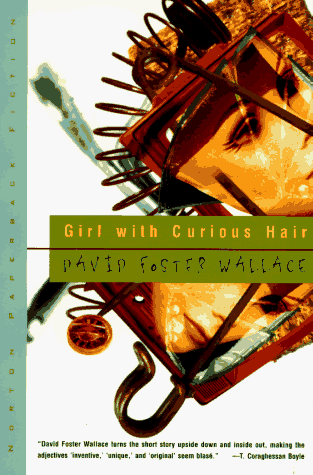
Scott Martin was kind enough to loan me this book. Did he know that it would forever change the way I read? It was the first semester of my freshman year in college, and I was slowly reaching beyond stuff like Henry Miller, Wm Burroughs and Franz Kafka. David Foster Wallace’s short story collection Girl With Curious Hair introduced me to a whole new world of writing. Reading DFW is like having a very witty friend tell you a moving and funny story over a  few beers. He’s hilarious, thought-provoking, and not nearly as hard to read as people seem to think (by the way, simply googling “David Foster Wallace” will yield several vitriolic essays by people who think that DFW is somehow duping his readers. He’s not. These people don’t know a good story when they read one.)

Girl features “real people” like Alex Trebek, David Letterman, and Lyndon Johnson as characters, but constantly destabilizes any realism these figures might lend to the story. The novella included in this collection, Westward the Course of Empire Takes Its Way, alludes directly to John Barth’s Lost in the Funhouse (another book I’ve loaned out and never gotten back). Westward takes a critical but humorous look at how culture is commodified: the plot centers around a reunion for everyone who has ever acted in a McDonald’s commercial. At the reunion, plans are revealed for a series of real-life “Funhouses,” based on the work of “Dr. Ambrose” (Barth’s stand-in in Westward).

Girl with Curious Hair is probably the best starting point for anyone interested in DFW but daunted by 1000 pages of Infinite Jest (IJ is yet another one I loaned out and never got back). Girl‘s stories have a little more ‘pop’ to them than DFW’s latest collection, Oblivion, and Girl tends to be easier to find used than DFW’s other collections, Brief Interviews with Hideous Men (actually a better collection, in my opinion) and A Supposedly Fun Thing I’ll Never Do Again (a collection of hilarious essays and nonfiction).

To sum up: if you still haven’t read DFW go consume this book; when you’re done you’ll be left wondering: “What other good stuff have I been missing out on?”

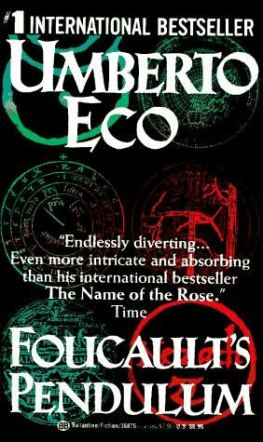
Foucault’s Pendulum — Umberto Eco

fp.jpg

Go here to see a Foucault Pendulum at work.

Snagged as part of the same cache from the Shinjuku-nishiguchi school that yielded Kinski Uncut. Not really a theft–I traded a VHS tape of a six-hour Cosby Show marathon into the book trade for these books.

Foucault’s Pendulum is a detective story fertile with semiotic pranks–a ludic maze of meaning, history, and logic. Dan Brown’s The Da Vinci Code basically rips off Eco, keeping some of the gnostic speculation, and dumbing down both the plot and the writing. Steal from the greats, I guess…

Something I love about this book is that it was a huge bestseller and I always find meet people who’ve read it (or find out that people I know have read it). Have you, gentle reader, read this book?

I loaned the book to RP a few years back; perhaps he’ll consider loaning it to you.

Pessimus Populus: The Worst People of 2006

As the days of 2006 dwindle down, we take a hateful look back.

10. Condoleezza Rice.

Condi Rice has managed to tell more lies in just two years as the Secretary of State than she did in the four years she was the National Security Advisor.

condi rice demonstrates remaining US credibility

Above: Condi demonstrates remaining US credibility

9. Every kid who “starred” on an episode of MTV’s My Super Sweet 16

My Super Sweet 16 illustrates so perfectly, so beautifully, everything that is wrong with a culture of consumerism that promotes selfish materialism. Watch and marvel at spoiled brats crying like babies while their narcissistic whims are indulged.

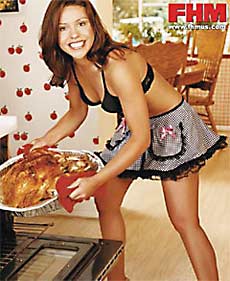
8. Rachel Ray

Look what happens to the commodified personality–they puncture any credibility they might have had to begin with and they end up overexposed.

rachel-ray.jpg

For a good laugh check out Rachel’s sexy FHM magazine shoot.

7. Dan Brown

For dumbing down America. For ripping of Umberto Eco’s Foucault’s Pendulum. For being the worst hack-job piece of schlock to ever pass for a worthy book. For fooling people into thinking they were learning something. For Tom Hanks’s creepy haircut in the movie version. For damaging the already-rotten sense of history Americans have with a brutal infusion of misinformation. This is what we’re choosing to read?

6. Ted Haggard

Pastor Haggard was the linchpin figure in the mega-church movement in the US. These churches represent the complete opposite of the teachings of the New Testament, advocating a “me me me” approach to religion: church as networking. In keeping with selfishness, Haggard, as ex-head of The National Association of Evangelicals, was largely responsible for rallying the religious right (as well as more moderate churches) to back Bush. Haggard recently stepped down as head of the NAE due to allegations that he’s been having sex with a male prostitute while high on meth.

(Editorial note: I’ve actually been working on this list for a while now. Haggard was on here before his recent woes. The outing of his hypocrisy is like icing on the cake, but is also part of the reason I decided to go ahead and publish this post with over 50 days remaining in the year–who knows how many more horrible things people will do, causing me to rewrite? I’d rather post what I have now, and amend later).

5. Everyone who used alcoholism or drug use as an excuse for horrible behavior, and then used rehab as an apology for that behavior.

That’s right, sugar tits–whether you’re a crazy, anti-semitic actor, a spoiled walking skeleton, or a two-faced Republican, drinking/drug-use doesn’t excuse you from being one of the year’s Worst People.

4. Ann Coulter

ann_coulter_republican.jpg

Getting fame by attacking 9/11 widows? Nice one, champ. This skinny bitch grows more evil by the minute. Check out Henry Rollins’s letter to Ann Coulter.

3. Rick Santorum

Santorum belongs on this list for so, so many reasons. But because biblioklept purports to be a literary blog, we’ll attribute his inclusion due to his ridiculous misappropriation of Tolkien in a recent speech:

“As the hobbits are going up Mount Doom, the Eye of Mordor is being drawn somewhere else. It’s being drawn to Iraq and it’s not being drawn to the U.S. “You know what? I want to keep it on Iraq. I don’t want the Eye to come back here to the United States.”

Props to Dan Savage for savaging Santorum’s name.

2. Dick Cheney

cheney_darthvader_unmasked.jpg

Uhmm, where to start, where to start? I guess since this is a look at the Worst People of 2006, we should try our best to look at Cheney from a human perspective–do our best to ignore all the evil Cheney’s political/business enterprises represent, and just look at Cheney the man. So what type of person is Cheney, when he’s on “downtime,” just relaxing with regular folks? Let’s see: in February of 2006, while “hunting” quail, Cheney shot a 78 year old man in the face with a shotgun. The old man had a heart attack. So the Vice President is the type of person who would shoot an old man in the face. Dick Cheney is a bad, bad man. Go here for John Stewart’s coverage of the incident.

1. George W. Bush

Like you didn’t see this coming.

***INSERT YOUR OWN REASON HERE***

(Sorry, but after six-plus years I can’t keep up my outrage even long enough to write a decent post about this insane bastard. I can’t articulate how angry I am, and there isn’t enough room here to catolog all of Bush’s crimes. I’m tired of this shit.)

bushmonkey01.jpg

Guy Fawkes Day and V for Vendetta

“Remember, remember the 5th of November…”

I was lucky enough to live in New Zealand for a few years as a kid, so I got to experience Guy Fawkes Day. We made effigies of Guy, and then we burned them on a bonfire. There was a barbecue, and fireworks. To me it seemed a strange mixture of the Fourth of July and Halloween.

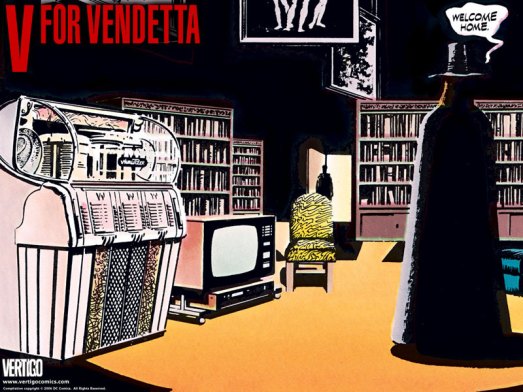
It was a few years after my last Guy Fawkes experience that I read Alan Moore’s V for Vendetta. V, an anarchist who wears a stylized Guy Fawkes mask, wages a vigilante war on a harsh authoritarian government. Along with Frank Miller’s The Dark Knight Returns, V was a first for me, something different than the stuff I was reading at the time, stuff like The Uncanny X-Men and the ill-fated Valiant Comics imprint (I actually made a small fortune selling early Valiant issues I owned).  

A film version of V for Vendetta was released in 2006; Alan Moore famously had his name removed from it. I enjoyed the film, although it certainly wasn’t as good or thought-provoking as Moore’s original story; and even though the film looked good, the passive experience of watching an action movie can’t measure up to David Lloyd’s original art work and that wonderful space between the panels of comics that engages the reader’s imagination.

v_for_vendetta_5_800×600.jpg

This afternoon I finished the first graphic novel of Alan Moore’s  run writing Swamp Thing, and I can’t wait until my library hold on the second graphic novel comes in. I had no idea Saga of the Swamp Thing would be as good as it was, nor as beautifully illustrated; it’s actually much better than V for Vendetta or Moore’s other famed work, Watchmen (and none of these titles are even in the same league as Moore’s masterpiece, From Hell). Alan Moore and Steve Bissette’s run on the DC Comics series essentially led to DC’s creation of the edgier Vertigo imprint for their more “mature” titles, such as The Sandman. These titles helped to change the audiences of “comic books” and helped to make the graphic novel a new standard in the medium (no mean feat, considering the fanboyish culture of comic nerds, a culture that prizes rarity of print run over quality of storytelling).

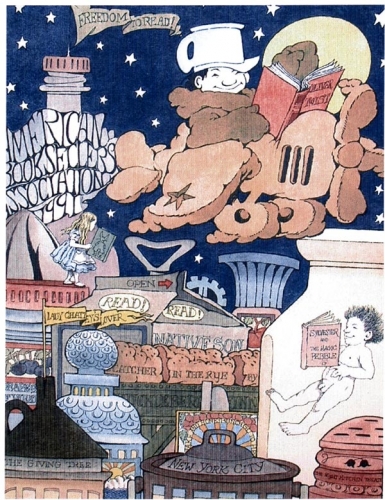
V for Vendetta illustrates what happens when we don’t allow for dissent, what happens when ideas are both prescribed and proscribed, and all dialogue is muted. Authoritarian governments consolidate their power from the silencing of ideas. A healthy society requires all sorts of opinions, even ones we don’t like. The smiling Americans in this photo aren’t burning effigies of would-be revolutionaries, they are burning something much more dangerous–books.

book-burning.jpg

100 Most Frequently Challenged Books

Via bibliophil,  (links by biblioklept):

The 100 Most Frequently Challenged Books
of 1990–2000
Compiled by the Office for Intellectual Freedom, American Library Association. The ALA Office for Intellectual Freedom does not claim comprehensiveness in recording challenges.
1. Scary Stories (Series) by Alvin Schwartz
2. Daddy’s Roommate by Michael Willhoite
3. I Know Why the Caged Bird Sings by Maya Angelou
4. The Chocolate War by Robert Cormier
5. The Adventures of Huckleberry Finn by Mark Twain
6. Of Mice and Men by John Steinbeck
7. Harry Potter (Series) by J.K. Rowling
8. Forever by Judy Blume
9. Bridge to Terabithia by Katherine Paterson
10. Alice (Series) by Phyllis Reynolds Naylor
11. Heather Has Two Mommies by Leslea Newman
12. My Brother Sam is Dead by James Lincoln Collier and Christopher Collier
13. The Catcher in the Rye by J.D. Salinger
14. The Giver by Lois Lowry
15. It’s Perfectly Normal by Robie Harris
16. Goosebumps (Series) by R.L. Stine
17. A Day No Pigs Would Die by Robert Newton Peck
18. The Color Purple by Alice Walker
19. Sex by Madonna
20. Earth’s Children (Series) by Jean M. Auel
21. The Great Gilly Hopkins by Katherine Paterson
22. A Wrinkle in Time by Madeleine L’Engle
23. Go Ask Alice by Anonymous
24. Fallen Angels by Walter Dean Myers
25. In the Night Kitchen by Maurice Sendak
26. The Stupids (Series) by Harry Allard
27. The Witches by Roald Dahl
28. The New Joy of Gay Sex by Charles Silverstein
29. Anastasia Krupnik (Series) by Lois Lowry
30. The Goats by Brock Cole
31. Kaffir Boy by Mark Mathabane
32. Blubber by Judy Blume
33. Killing Mr. Griffin by Lois Duncan
34. Halloween ABC by Eve Merriam
35. We All Fall Down by Robert Cormier
36. Final Exit by Derek Humphry
37. The Handmaid’s Tale by Margaret Atwood
38. Julie of the Wolves by Jean Craighead George
39. The Bluest Eye by Toni Morrison
40. What’s Happening to my Body? Book for Girls: A Growing-Up Guide for Parents & Daughters by Lynda Madaras
41. To Kill a Mockingbird by Harper Lee
42. Beloved by Toni Morrison
43. The Outsiders by S.E. Hinton
44. The Pigman by Paul Zindel
45. Bumps in the Night by Harry Allard
46. Deenie by Judy Blume
47. Flowers for Algernon by Daniel Keyes
48. Annie on my Mind by Nancy Garden
49. The Boy Who Lost His Face by Louis Sachar
50. Cross Your Fingers, Spit in Your Hat by Alvin Schwartz
51. A Light in the Attic by Shel Silverstein
52. Brave New World by Aldous Huxley
53. Sleeping Beauty Trilogy by A.N. Roquelaure (Anne Rice)
54. Asking About Sex and Growing Up by Joanna Cole
55. Cujo by Stephen King
56. James and the Giant Peach by Roald Dahl
57. The Anarchist Cookbook by William Powell
58. Boys and Sex by Wardell Pomeroy
59. Ordinary People by Judith Guest
60. American Psycho by Bret Easton Ellis
61. What’s Happening to my Body? Book for Boys: A Growing-Up Guide for Parents & Sons by Lynda Madaras
62. Are You There, God? It’s Me, Margaret by Judy Blume
63. Crazy Lady by Jane Conly
64. Athletic Shorts by Chris Crutcher
65. Fade by Robert Cormier
66. Guess What? by Mem Fox
67. The House of Spirits by Isabel Allende
68. The Face on the Milk Carton by Caroline Cooney
69. Slaughterhouse-Five by Kurt Vonnegut
70. Lord of the Flies by William Golding
71. Native Son by Richard Wright
72. Women on Top: How Real Life Has Changed Women’s Fantasies by Nancy Friday
73. Curses, Hexes and Spells by Daniel Cohen
74. Jack by A.M. Homes
75. Bless Me, Ultima by Rudolfo A. Anaya
76. Where Did I Come From? by Peter Mayle
77. Carrie by Stephen King
78. Tiger Eyes by Judy Blume
79. On My Honor by Marion Dane Bauer
80. Arizona Kid by Ron Koertge
81. Family Secrets by Norma Klein
82. Mommy Laid An Egg by Babette Cole
83. The Dead Zone by Stephen King
84. The Adventures of Tom Sawyer by Mark Twain
85. Song of Solomon by Toni Morrison
86. Always Running by Luis Rodriguez
87. Private Parts by Howard Stern
88. Where’s Waldo? by Martin Hanford
89. Summer of My German Soldier by Bette Greene
90. Little Black Sambo by Helen Bannerman
91. Pillars of the Earth by Ken Follett
92. Running Loose by Chris Crutcher
93. Sex Education by Jenny Davis
94. The Drowning of Stephen Jones by Bette Greene
95. Girls and Sex by Wardell Pomeroy
96. How to Eat Fried Worms by Thomas Rockwell
97. View from the Cherry Tree by Willo Davis Roberts
98. The Headless Cupid by Zilpha Keatley Snyder
99. The Terrorist by Caroline Cooney
100. Jump Ship to Freedom by James Lincoln Collier and Christopher Collier

Any favorites on the list? I’ve got a few. I’ve read or at least familiar with 57 of these, including most of the top 25. What’s the beef with Where’s Waldo? Image links to a much better write up on banned books via the MPBA.

A Wrinkle in Time

I loved this book as a kid. Madeline L’Engle’s A Wrinkle in Time explores the the intersections of space and time against a backdrop of adolescent angst. Our intrepid heroine Meg goes on a trans-dimensional quest to find her missing physicist father. Dad has disappeared due to his work on a project involving a tesseract. Go check out Tomorrowland’s brilliant write up of the tesseract.

Charles Bukowski

I must have been in the 1oth or 11th grade when I borrowed three Charles Bukowski novels from M***ael J***ings. These were:

Women, easily my favorite and Bukowski’s best. I didn’t return this one.

The short story collection, Tales of Ordinary Madness. I kept this one too, but it is no longer in my possession. Loaned out, never to be returned.

And another collection, The Most Beautiful Woman in Town. I think I gave this back; anyway, I don’t have it anymore.

I was reading Henry Miller and Hemingway at the time, and macho Bukowski fit right in. Something about being a teenager, trying to gain access to the “adult world”–or something like the adult world. How to act, what to say. I read just about all the short stories that Bukowski wrote. Factotum and Post Office were two of my favorites. Everyday when I see our mailman I think of Post Office.

 Our mailman is old, and skinny as a sick girl, and he has a nose like a bird’s beak to boot. He runs his entire route; he has a strange little knock-kneed hustle. He always tells me to “Stay safe” when I see him. He’s withered. Post Office makes working for the post office sound like an annihilating, damning, Sisyphean task. I wonder: “Does the mailman not feel safe?”

Charles Bukowski

Bukowski painted some pictures.

Factotum was recently made into a movie starring Matt Dillon as Bukowski’s alter-ego, Henry Chinaski. Mickey Rourke played the “real” Bukowski in a horrible-looking movie called Barfly. I haven’t seen either film.

So Bukowski’s sort of been “branded” commodified as “type”–like Hemingway and Miller (and HST, and Anaïs Nin, and Wm Burroughs,  and Nietzsche, and so on) He becomes a stolen writer, a lazy gesture, a footnote in the movie Swingers. Then again, maybe a few people saw that movie and picked up Hollywood, a really funny late-period Bukowski novel about making the film that will come to be Barfly. In Hollywood, Bukowski endures the trouble of having other people manipulate his writing and sweats sweats sweats that he might have sold out.