In July, I spoke to Richard Zenith in Lisbon about his work translating Fernando Pessoa, Carlos Drummond de Andrade, Sophia de Mello Breyner, and many other spectacular Portuguese-speaking poets. Read our conversation in the hot-off-the-press fall issue of Asymptote. (Available in English and Spanish!)
In Kazuo Ishiguro’s 2015 novel The Buried Giant, a metaphysical mist engulfs sixth-century Britain, clouding the memories of all who inhabit the land. Saxons and Britons alike cannot recall their bellicose past. Against this mist, elderly Britons Axl and Beatrice seek their long-lost son. They meet a Saxon warrior who hunts an ancient she-dragon he’s vowed to slay. He’s aided by a youth, Edwin, who’s been exiled from his village after being bitten by a mythic creature. King Arthur’s aged nephew Sir Gawain lingers as a courtly protector, a figure from an already-bygone era; the mist seems to slowly rot his brain and his conscience, pushing him into paranoia and madness. There are Charonic ferrymen and awful ogres; there are mad monks and terrible pixies. A hellhound, a dragon, a poisoned goat. Rivers and mountains and crypts and villages. But most of all that mist.
Charon, Joachim Patinir
Ishiguro makes the reader experience that mist. He obscures. The action that occurs—and yes, there’s action here, measured action (often measured in a literal sense)—the action that occurs in The Buried Giant is almost always oblique, shadowed, indistinct, but also very mechanical. The memory-mist renders the world treacherous, immediate, a dark, vague place that offers its travelers no purchase of reference. Deceptive.
Forgive me for quoting at such length, but I think a longish passage here shows how and what Ishiguro is doing. Almost all of our principals are here, underground—note their procession, their movement—a constant motif in the novel, movement, single file or side by side—and the presence of a light, illumination—also a motif. Note the variety of interpretations of not knowing, not seeing, note the simple horror:
They went on into the tunnel, Sir Gawain leading, Axl following with the flame, Beatrice holding his arm from behind, and Edwin now at the rear. There was no option but to go in single file, the passage remaining narrow, and the ceiling of dangling moss and sinewy roots grew lower and lower until even Beatrice had to stoop. Axl did his best to hold the candle high, but the breeze in the tunnel was now stronger, and he was often obliged to lower it and cover the flame with his other hand. Sir Gawain though never complained, and his shape going before them, sword raised over his shoulder, seemed never to vary. Then Beatrice let out an exclamation and tugged Axl’s arm.
“What is it, princess?”
“Oh, Axl, stop! My foot touched something then, but your candle moved too quickly.”
“What of it, princess? We have to move on.”
“Axl, I thought it a child! My foot touched it and I saw it before your light passed. Oh, I believe it’s a small child long dead!”
“There, princess, don’t distress yourself. Where was it you saw it?”
“Come, come, friends,” Sir Gawain said from the dark. “Many things in this place are best left unseen.”
Beatrice seemed not to hear the knight. “It was over here, Axl. Bring the flame this way. Down there, Axl, shine it down there, though I dread to see its poor face again!”
Despite his counsel, Sir Gawain had doubled back, and Edwin too was now at Beatrice’s side. Axl crouched forward and moved the candle here and there, revealing damp earth, tree roots and stones. Then the flame illuminated a large bat lying on its back as though peacefully asleep, wings stretched right out. Its fur looked wet and sticky. The pig-like face was hairless, and little puddles had formed in the cavities of the outspread wings. The creature might indeed have been sleeping but for what was on the front of its torso. As Axl brought the flame even closer, they all stared at the circular hole extending from just below the bat’s breast down to its belly, taking in parts of the ribcage to either side. The wound was peculiarly clean, as though someone had taken a bite from a crisp apple.
“What could have done work like this?” Axl asked.
He must have moved the candle too swiftly, for at that moment the flame guttered and went out.
Ishiguro gives us mystery, interpretation, and then an incomplete, ambiguous revelation. (This is the basic structure of the novel). Beatrice never relents in her belief that she’s stumbled over a dead child. Brimming with lost children and lost parents and orphans, The Buried Giant is a novel of erasures. But an erasure leaves a trace, a violent, visceral marking into the page’s blankness. Revelation through absence.
We would have no plot, not really, without some overcoming of blankness, and Axl in particular overcomes the mist in his quest. A backstory fleshes out, in watery strokes albeit. The Buried Giant, as far as fantasy epics go, is awfully indistinct. Or rather, Ishiguro offers only mechanical and immediate glimpses into this world, a Britain on the cusp of the Middle Ages. Through Axl’s consciousness (and conscience), we see the vital precision in hand-to-hand combat, for example. Its patience, its slowness, its dependence on muscle memory. Or perhaps (dare I say) more boringly, we feel the very real peril involved in walking in the wild dark as an elderly person. The thrills in The Buried Giant come not from its sword and sorcery costumes, but from its Kafkaesque edges and gaps. This is a novel about not knowing.
And it’s here that The Buried Giant is most successful—as an evocation of not knowing. Axl and Beatrice’s quest unfolds as a series of choices and consequences severed, for the most part, from the anchor of memory. There’s an episodic vibe to the novel, a sense that it’s making itself up as it goes along. (It’s not). The novel strongly reminded me of some of the old RPGs I’d play on a Commodore 64 as a kid. The graphics weren’t great and I had to use my imagination a lot. The games were sometimes frustrating and slow. But perhaps you want a more, uh, literary comparison? Something more recent too? The Buried Giant recalls Ishiguro’s short story “A Village after Dark” a lot more than, say, A Game of Thrones or The Lord of the Rings.It’s a fantasy novel, but one that feels etiolated, its vivid colors drained. More Gustave Doré than Gustave Moreau.
While a precise indistinctness (forgive the oxymoron) is part of The Buried Giant’s program, there’s nothing indistinct about its heroes’ love for each other. Axl and Beatrice, A & B—can I say I came to love them? Or if I didn’t quite love them, I was rooting for them, say? Rooting for their survival, but specifically their survival as a they, a shared survival. Ishiguro successfully communicates their intimacy, their romance, their love, a love threatened by both the natural world and the supernatural return of lost memory. Their relationship is the heart of the novel upon which Ishiguro fixes his themes of memory, justice, vengeance, and love. Ishiguro’s commentary on those themes ultimately may feel pessimistic to many readers, particularly in the novel’s conclusion.
Excepting the ones that we love and return to and obsess over, we retain little of the novels that we read. What memories remain are kernels—the outline of a plot, a strange lingering phrase or detail, a bright or bold character, a theme, an idea, an image. It’s the love between Axl and Beatrice that I’ll likely recall most strongly from the shadows of The Buried Giant. If we can’t remember, we can at least experience.
I recently had the chance to interview the marvelous David Shook about the equally marvelous Like a New Sun, a book of contemporary indigenous Mexican poetry, which he edited and co-translated. You can read the interview over at Asymptote’s blog.
I first read about Asymptote here on Biblioklept a few years ago. I’m happy to share that I have joined their ranks as Interview Features Editor, and that this is my first interview with them. Check back often for more interviews with translators, poets, novelists, and more.
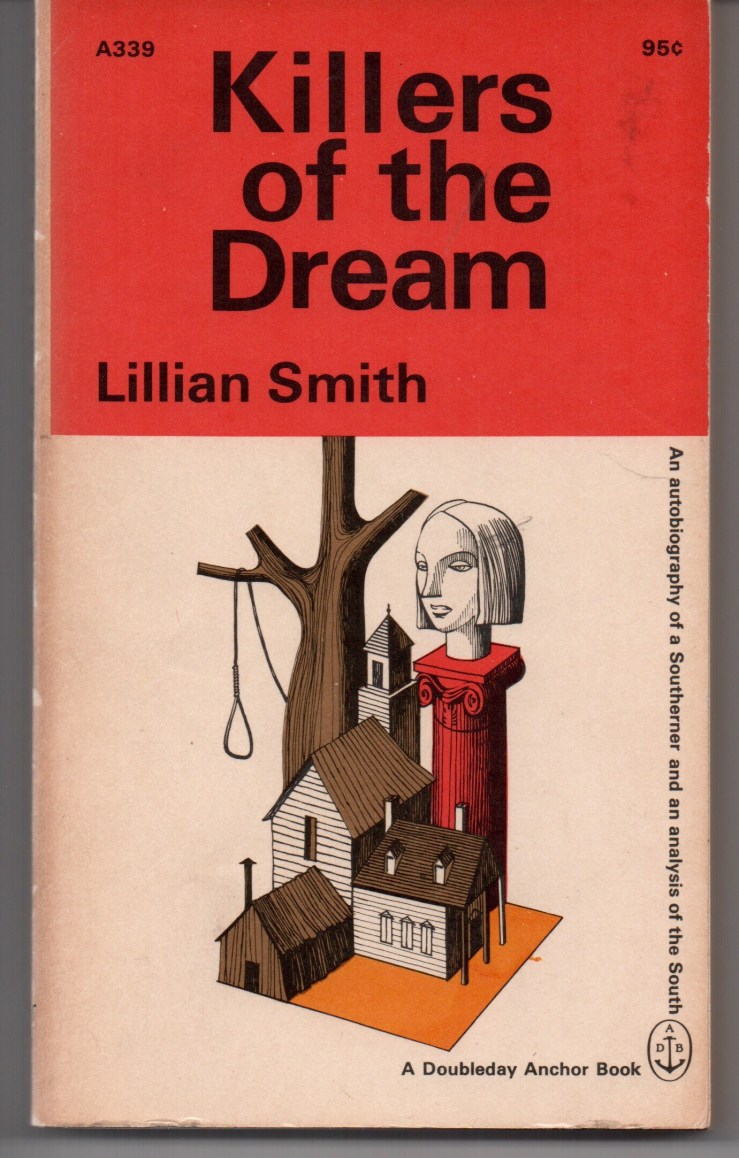
Killers of the Dream by Lillian Smith. Doubleday Anchor, 1963 mass market paperback edition. Cover design by George Giusti. Smith’s memoir-essay-critique is an underappreciated masterful dissection of the South in particular and humanity in general.
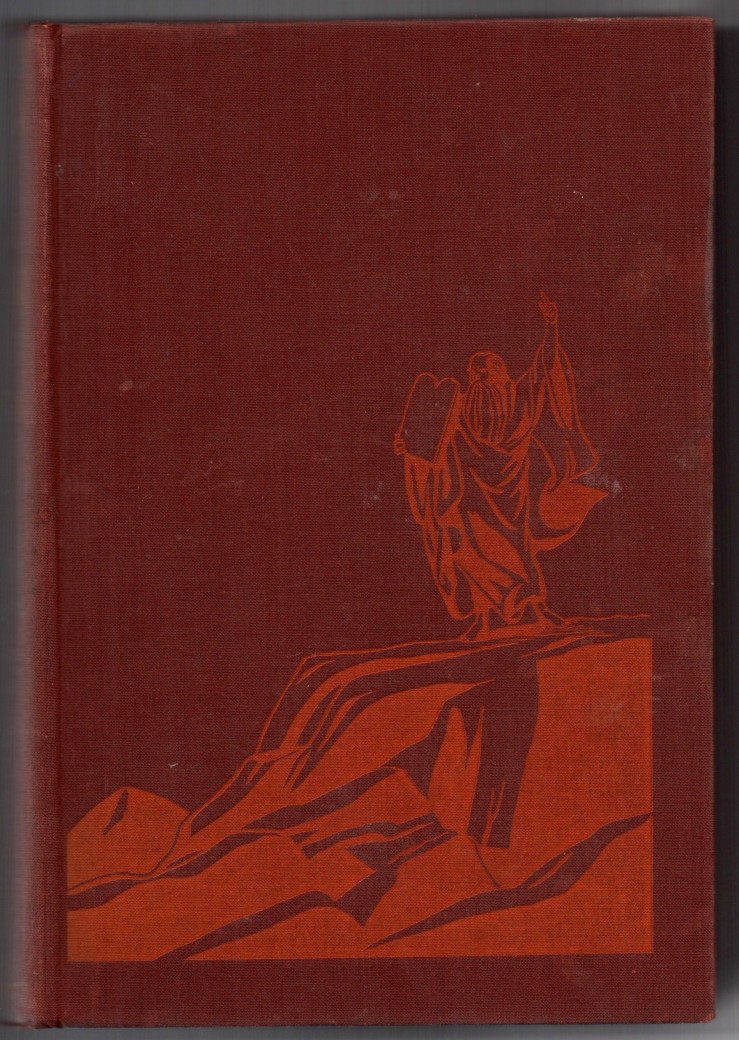
Moses, Man of the Mountain by Zora Neale Hurston. First-edition clothbound hardback from J. B. Lippincott, 1939. The dust jacket is missing, and no designer is credited in the book. I picked this up for eight dollars a few years ago. I lent my paperback copy to a student years ago; she never returned it. (Good for her!).
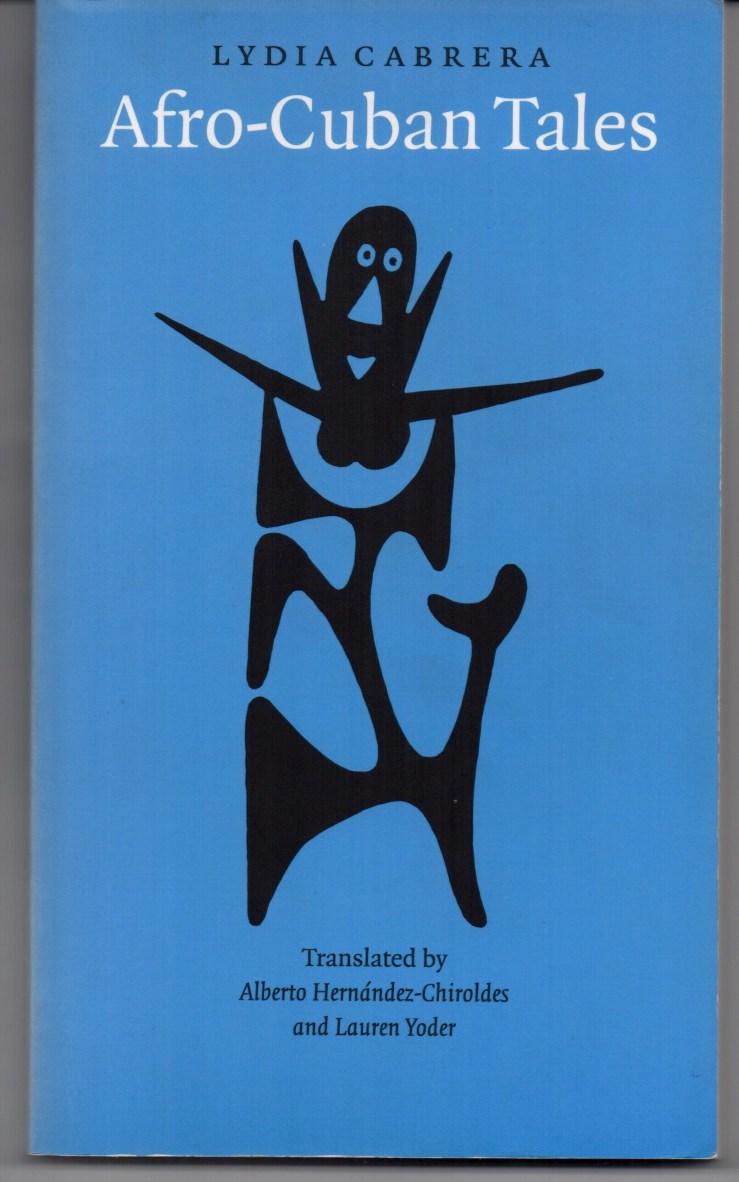
Afro-Cuban Tales by Lydia Cabrera. 2004 trade paperback by the University of Nebraska Press. Book design by R. Eckersley; cover illustration by Lydia Cabrera. Cabrera (1899-1991), an ethnographer, went beyond documenting the tales and fables of her native Cuba: she synthesized them into new tellings, new variations (not unlike Zora Neale Hurston’s folklore work in Mules and Men and Tell My Horse). Cabrera deserves a wider audience.
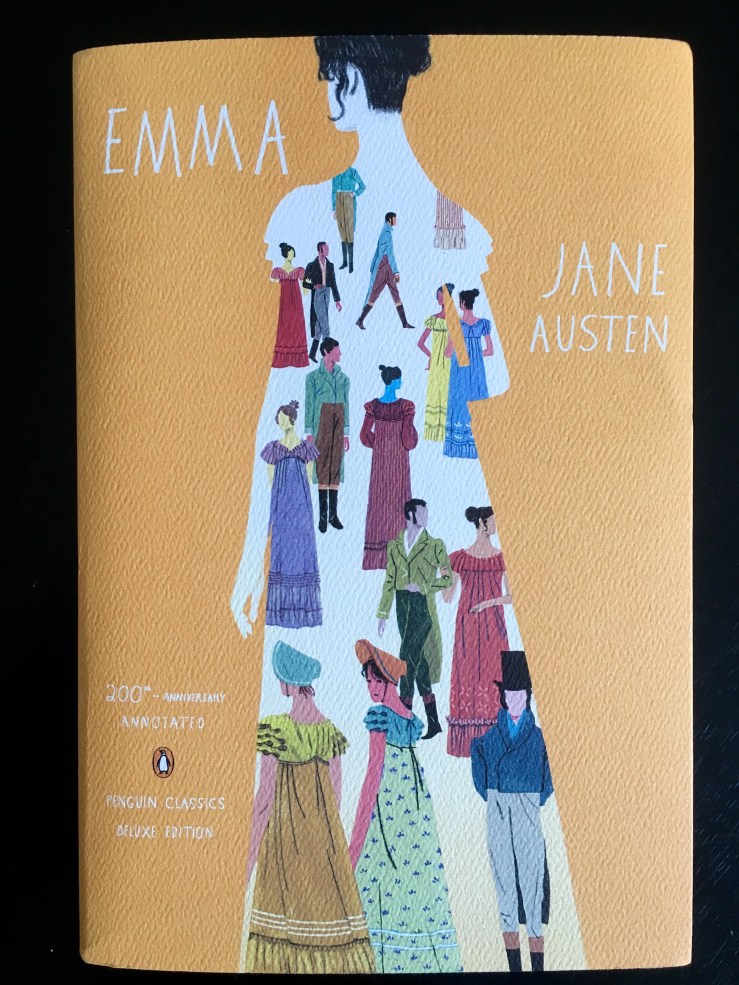
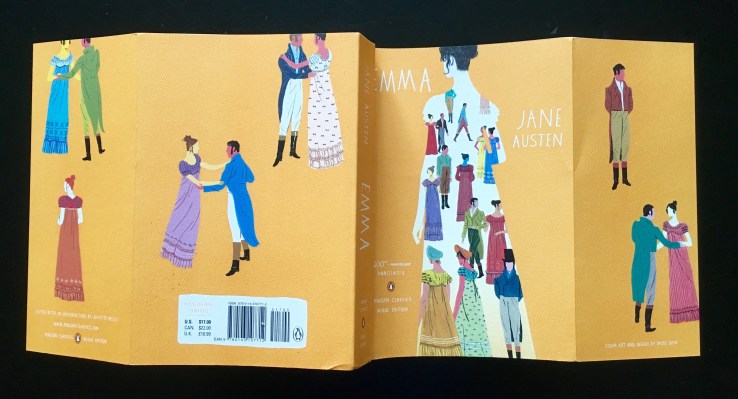
Last month, to mark its bicentennial, Penguin Classics published a deluxe edition of Jane Austen’s novel Emma. It’s a beautiful, hefty book, with deckle edges, French flaps, and a cool cover by Dadu Shin.
Beyond its obvious aesthetic appeal, Penguin’s new edition offers its readers helpful resources, including a note on spelling in the novel, a glossary, and a range of essays that offer context for better appreciating the plot (topics include “Dancing,” “Food,” and “Health”). Indeed, this edition seems geared towards helping younger readers appreciate and enjoy Emma. In a prefatory note, editor Juliette Wells writes:
This edition is designed to help. It’s a reader’s edition, not a scholarly one. In other words, the information you’ll find here is intended to support your understanding and appreciation of Emma rather than to instruct you in literary terms, theoretical perspectives, or critical debates. In choosing what to include, I’ve borne in mind what I’ve heard from students and others over the years about what has intrigued, and frustrated, them in reading this novel.
Wells’s brief introduction helps offer new readers context about the novel’s composition, publication, and reception. She even offers a short series of tips for reading Emma (sample: “If you’re feeling frustrated or bored because nothing much seems to be happening, remember that Austen’s own contemporaries commented on how little plot Emma contains and how ordinary its characters and events are”). The edition also features helpful maps (by Wells), along with illustrations and title pages from previous editions. The volume concludes with a suggested reading and viewing list “for further exploration.”
Emma is obviously in the public domain and available in plenty of inexpensive versions (like the Dover Thrift copy I read in high school)—but this new Penguin Classics edition makes a strong case for itself as the future go-to version for high school students. Wells’s editorial vision (and the aesthetic design of the book) show a strong love for Austen’s text that will carry over to a new generation of readers. Continue reading “A bicentennial edition of Jane Austen’s Emma from Penguin Classics”→
I mean that I would love to be like, transcendentalist(transcendent? transcending? to transcend? trance? tr….) but the feeling of the feeling, the machinery of thought gets in the way. But anyway—
(Sebald in this picture, and a few others, looks so much like my father that it frightens the fuck out of me. It’s horrifying).
[Optometry joke]
I was going somewhere with this (or not): Sebald’s Vision by Carol Jacobs. Publisher Columbia University Press’s blurb:
W. G. Sebald’s writing has been widely recognized for its intense, nuanced engagement with the Holocaust, the Allied bombing of Germany in WWII, and other episodes of violence throughout history. Through his inventive use of narrative form and juxtaposition of image and text, Sebald’s work has offered readers new ways to think about remembering and representing trauma.
In Sebald’s Vision, Carol Jacobs examines the author’s prose, novels, and poems, illuminating the ethical and aesthetic questions that shaped his remarkable oeuvre. Through the trope of “vision,” Jacobs explores aspects of Sebald’s writing and the way the author’s indirect depiction of events highlights the ethical imperative of representing history while at the same time calling into question the possibility of such representation.
Jacobs’s lucid readings of Sebald’s work also consider his famous juxtaposition of images and use of citations to explain his interest in the vagaries of perception. Isolating different ideas of vision in some of his most noted works, including Rings of Saturn, Austerlitz, and After Nature, as well as in Sebald’s interviews, poetry, art criticism, and his lecture Air War and Literature, Jacobs introduces new perspectives for understanding the distinctiveness of Sebald’s work and its profound moral implications.
How difficult it is in general to bring the machinery of thought to a standstill is shown by Rousseau’s description of his apparently so happy days on the island in the Lac de Bienne. He has, as he writes in the fifth Promenade, deliberately forsworn the burden of work, and his greatest joy has been to leave his books safely shut away and to have neither ink nor paper to hand. However, since the leisure time thus freed up must be put to some use, Rousseau devotes himself to the study of botany, whose basic principles he had acquired in Môtiers on excursions with Jean Antoine d’Ivernois. “I set out to compose,” writes Rousseau in the fifth Promenade, “a Flora Petrinsularis and to describe every single plant on the island in enough detail to keep me busy for the rest of my days. They say a German once wrote a book about a lemon peel; I could have written one about every grass in the meadows, every moss in the woods, every lichen covering the rocks—and I did not want to leave even one blade of grass or atom of vegetation without a full and detailed description. In accordance with this noble plan, every morning after breakfast I would set out with a magnifying glass in my hand and my Systemae Naturae under my arm to study one particular section of the island, which I had divided for this purpose into small squares, intending to visit them all one after another in every season.” The central motif of this passage is not so much the impartial insight into the indigenous plants of the island as that of ordering, classification, and the creation of a perfect system. Thus this apparently innocent occupation—the deliberate resolve no longer to think and merely to look at nature—becomes, for the writer plagued by the chronic need to think and work, a demanding rationalistic project involving the compiling of lists, indices, and catalogs, along with the precise description of, for example, the long stamens of self-heal, the springiness of those of nettle and of wall-pellitory, and the sudden bursting of the seed capsules of balsam and of beech. Nonetheless, the leaves of the small herbaria which Rousseau later compiled for Madelon and Julie de la Tour and other young ladies take on the aspect of an innocent bricolage in comparison with the self-destructive business of writing to which he usually submitted himself. A faint aura of unconscious beauty still hovers over these flower collections, in which lichens, sprigs of veronica, lilies of the valley, and autumn crocuses have survived, pressed and a little faded, from the eighteenth century. They can still be admired today in the Musée Carnavalet and the Musée des Arts Décoratifs. The herbarium Rousseau compiled for himself, meanwhile—eleven quarto volumes—was, up to the Second World War, preserved in the Botanical Museum in Berlin, until, like so much and so many in that city, it went up in flames one night during one of the nocturnal bombing raids.
From W. G. Sebald’s essay “J’aurais voulu que ce lac eût été l’Océan.” Translated by Jo Catling and collected in A Place in the Country.
Don Juan and Faust alike are former villains of the orthodox mind made heroes in an age of unorthodoxy, Promethean or Satanic figures; and both come to stand for the lonely individual (the writer himself!) challenging the mores of bourgeois society, making patent to all men the ill-kept secret that the codes by which they live are archaic survivals without point or power.
Often the two archetypes are blended in a single literary character, as in the lover-scientist Goethe calls by the name of Faust. But there is a real difference between the rebel whose life style is cued by passion and the one whose life style is compounded out of pride and terror—between the seducer and the black magician. Faust challenges the limitations set upon experience not in the name of pleasure but of knowledge; he seeks not to taste life without restraint but to control it fully; and his essential crime (or glory!) is, therefore, not seduction but the Satanic bargain: to sell one’s soul to the Devil. But what does it mean to sell one’s soul? The symbol is immensely complex, its significances multiple; they can be summed up, however, in the single phrase to choose to be damned, whatever damnation is. Not to fall into error out of a passionate loss of self-control, not even to choose to sin at a risk of damnation; but to commit oneself to it with absolute certainty for “as long as forever is.”
Damnation itself means various things to men of varying belief: a commitment to the vagaries of the unconscious; an abandonment of the comforts of social life—of marriage and the family, wealth and recognition; a rejection of all bonds of love and sympathy, of humanity itself; a deliberate plunge into insanity; and acceptance of eternal torment for the soul. When Huck Finn cries out, “all right, I’ll go to Hell,” and Ahab, “From hell’s heart I stab at thee!”; when Hester Prynne tears off her scarlet letter, they are Faustian heroes; but so, too (in all modesty and moral elegance), is Henry James’s Strether when he rejects Mrs. Newsome and Maria Gostrey alike, refuses all rewards from life; and so, too, is Hawthorne when confiding to a friend, after the composition of The Scarlet Letter, that he had written a “hell-fired book.” Anyone who, in full consciousness, surrenders the hope of heaven (what everyone says heaven is) for the endurance of hell (what everyone knows hell to be) has entered into a pact with Satan; and the very act, therefore, of writing a gothic novel rather than a sentimental one, of devoting a long fiction to terror rather than love, is itself a Faustian commitment.
From Leslie Fiedler’s Love and Death in the American Novel.
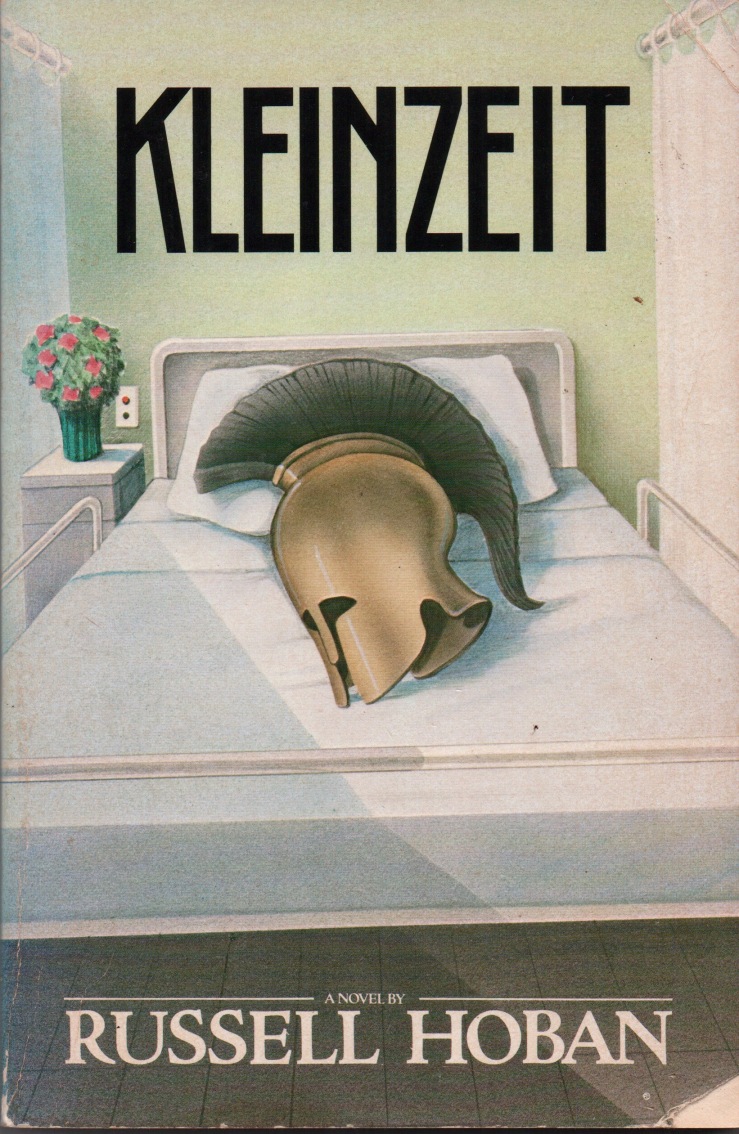
Kleinzeit by Russell Hoban. 1983 Summit Books trade paperback edition. Cover design by Fred Marcellino. A stark and funny retelling of the Orpheus myth, Hoban’s second novel obsesses over illness and art. Fans of Tom McCarthy might dig this one.
The Lion of Boaz-Jachin and Jachin-Boaz by Russell Hoban. 1983 Summit Books trade paperback edition. Cover design by Fred Marcellino. Hoban’s first novel. Not my favorite Hoban.Pilgermann by Russell Hoban. 1984 Washington Square Press trade paperback. No designer is credited, but look closely under the horse’s fore hooves and note the signature “Rowena” — Rowena Morrill. (Note also the pig and naked lady). Pilgermann, Hoban’s follow-up (and somehow-sequel) to Riddley Walker, was the occasion for this Sunday’s Three Books post. I was reminded of this strange, wicked, dark, funny, apocalyptic book as I finished a reread of Cormac McCarthy’s Blood Meridian and began Kazuo Ishiguro’s The Buried Giant this weekend. Pilgermann is difficult but rewarding, and probably underappreciated, even as a cult novel.
Some man of powerful character to command a person, morally subjected to him, to perform some act. The commanding person suddenly to die; and, for all the rest of his life, the subjected one continues to perform that act.
“Solomon dies during the building of the temple, but his body remains leaning on a staff, and overlooking the workmen, as if it were alive.”
A tri-weekly paper, to be called the Tertian Ague.
Subject for a picture,–Satan’s reappearance in Pandemonium, shining out from a mist with “shape star-bright.”
Brilliantly constructed and beautifully inhabited, Anthony Marra’s new book, THE TSAR OF LOVE AND TECHNO(Hogarth; on sale October 6, 2015), is an exquisite collection of nine interconnected stories set in Russia that move across a century and introduce us to a cast of unforgettable characters whose lives intersect in ways both life-affirming and heartbreaking. Marra is a writer driven by a deep and authentic curiosity, and it was that curiosity that led him to write about Chechnya and to return there in THE TSAR OF LOVE AND TECHNO. With the recent insurgent attacks in Grozny, the Islamic State’s announcement that Chechnya will be their next zone of expansion, and 2015 marking the twentieth anniversary of the first Chechen War, Marra’s book couldn’t be timelier.







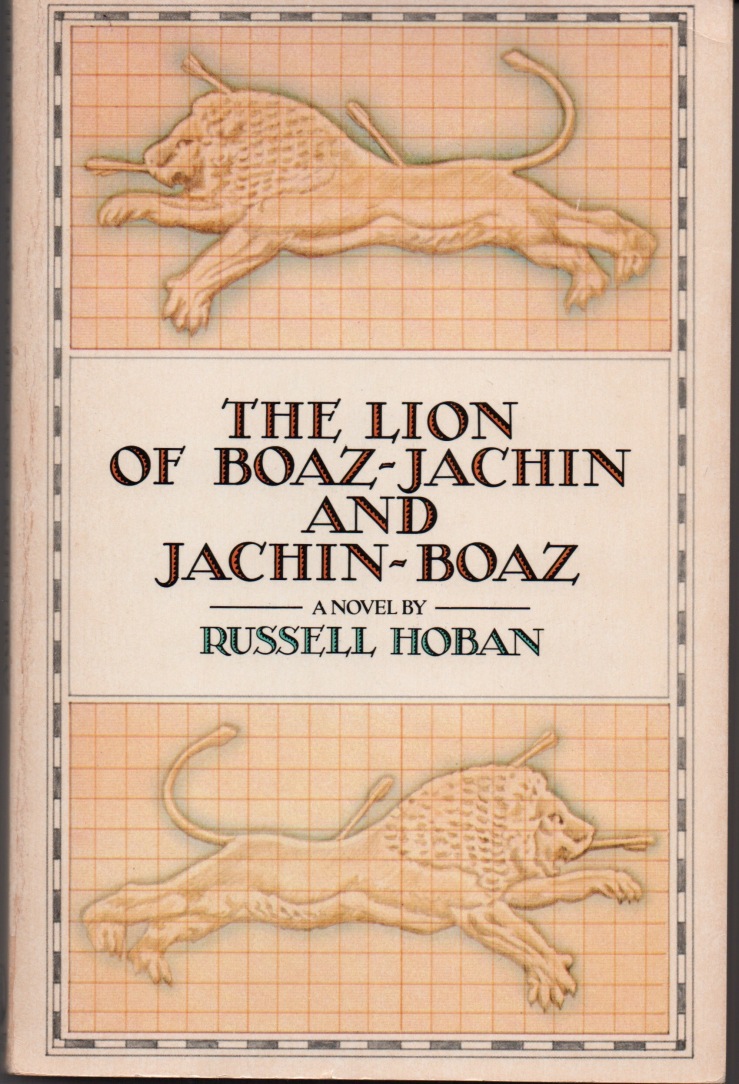 The Lion of Boaz-Jachin and Jachin-Boaz by Russell Hoban. 1983 Summit Books trade paperback edition. Cover design by Fred Marcellino. Hoban’s first novel. Not my favorite Hoban.
 Pilgermann by Russell Hoban. 1984 Washington Square Press trade paperback. No designer is credited, but look closely under the horse’s fore hooves and note the signature “Rowena” — Rowena Morrill. (Note also the pig and naked lady). Pilgermann, Hoban’s follow-up (and somehow-sequel) to Riddley Walker, was the occasion for this Sunday’s Three Books post. I was reminded of this strange, wicked, dark, funny, apocalyptic book as I finished a reread of Cormac McCarthy’s Blood Meridian and began Kazuo Ishiguro’s The Buried Giant this weekend. Pilgermann is difficult but rewarding, and probably underappreciated, even as a cult novel.