Alan Moore Talks Apocalypse (Video)

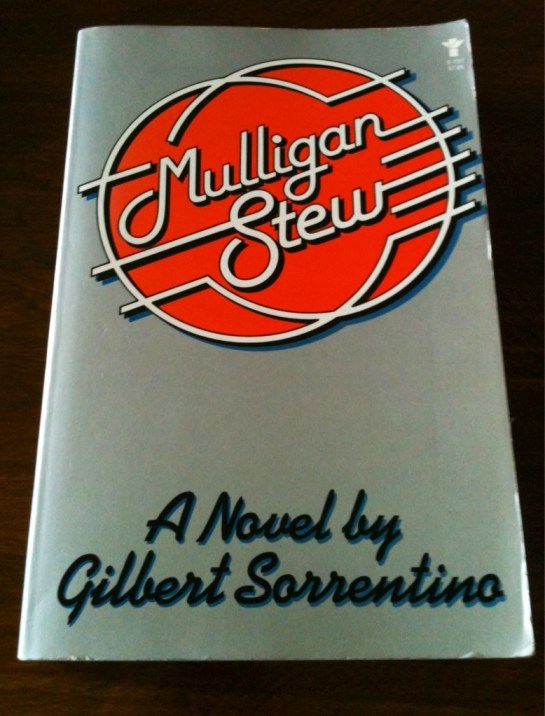
Valentine’s Books from My Sweetie (Books Acquired 2.14.2012)

20120214-175013.jpg

Book Shelves #6, 2.05.2012

Book shelves series #6, sixth Sunday of 2012: In which we dig into the comix inside the book shelf we looked at last week.

20120205-102013.jpg

When I was 13, I sold a fairly large collection of superhero comic books and earned enough money to buy an electric guitar—a weird mutant by Fender called the Bullet—and a small practice amp. It was the early nineties, and Marvel was about to burst the comic book bubble big time by flooding the market with gimmicky covers, hologram cards, and other nonsense.

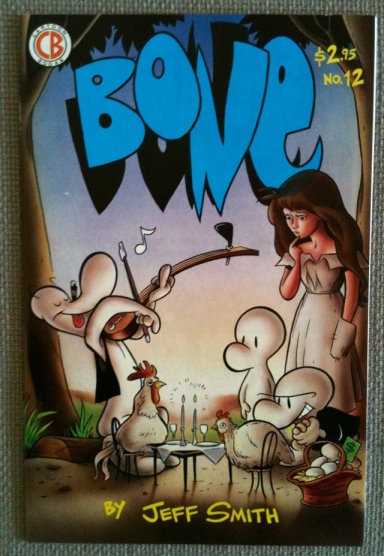
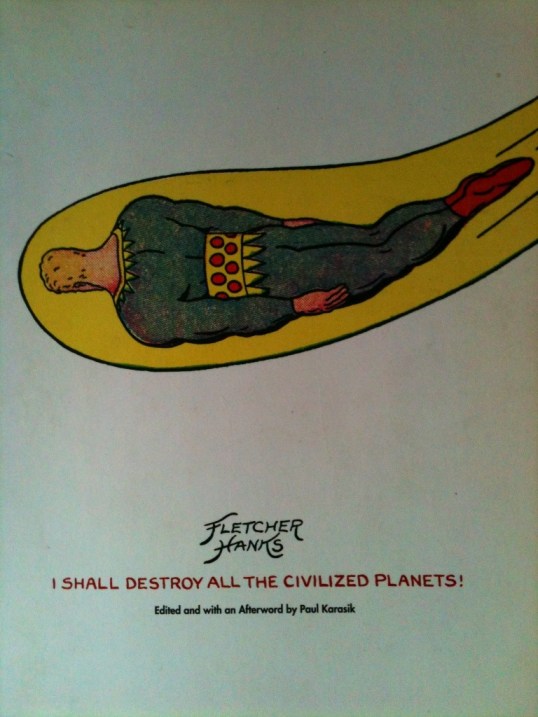
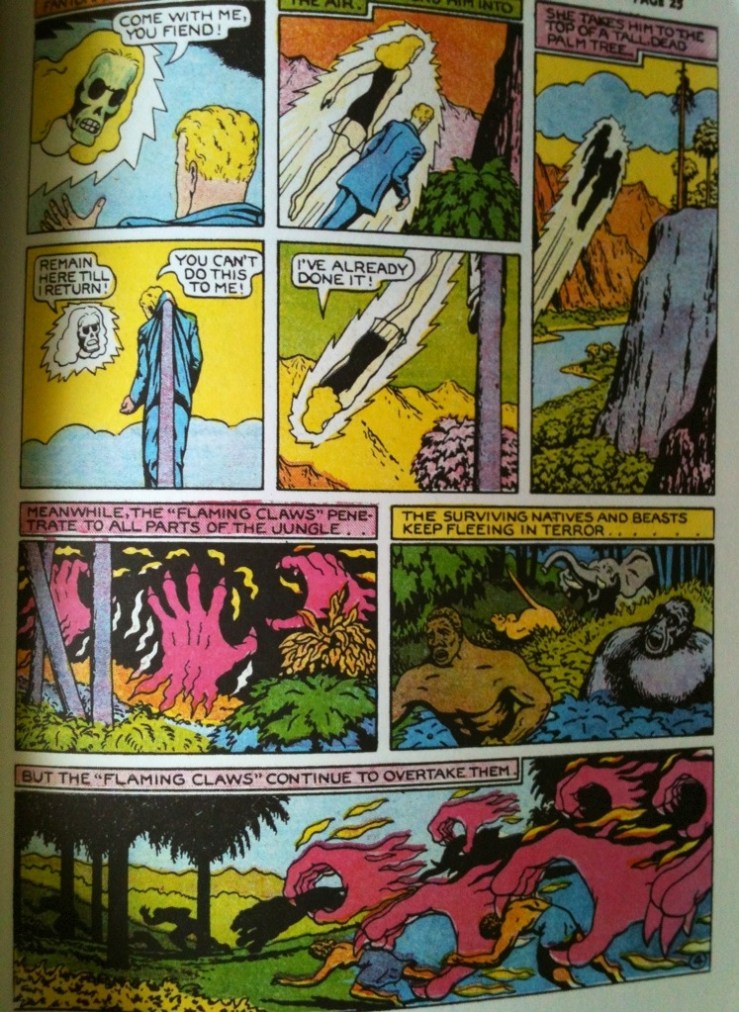
I continued to buy comics (or comix, if you prefer) over the years, although eventually economic concerns led me to just wait for graphic novel editions. Anyway, the book shelf above now contains most of the “underground” comix that I own. A few samples:

20120205-102552.jpg

20120205-102601.jpg

20120205-102611.jpg

Most of the comix in this unit though are issues of Dave Sim’s epic (and insane) series Cerebus. I bought issues of Cerebus intermittently for years at a time, usually getting frustrated and then waiting for the “phone book” graphic novel editions of the series. Sim, along with background artist Gerhard, produced 300 issues of Cerebus over 25 years. The issues from the early ’80s to the early ’90s are brilliant; eventually Sim cracked though and went on an insane, reactionary (and arguably deeply misogynistic) bent. He created his own religion, a mix of hardline Judaism, Islam, and Christianity, and the later books in the series suffered greatly, as the book detoured to chronicle projects that seemed far outside its original scope (including strange, long satires of Hemingway and Fitzgerald). Anyway, some issues:

20120205-102641.jpg

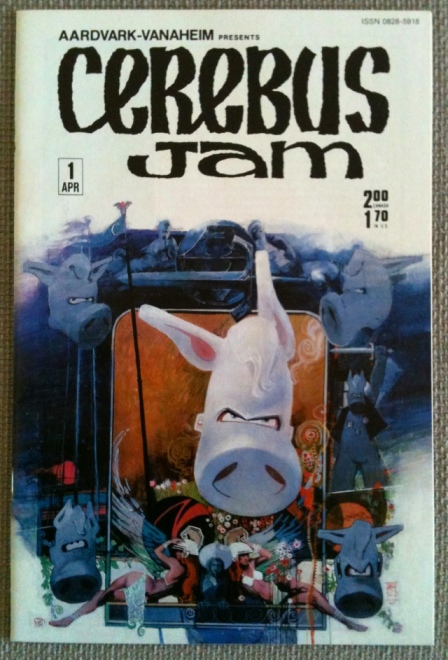
Cerebus Jam, a one-off collaboration with a cover by one of my favorite artists Bill Sienkiewicz (I still have his entire run on Marvel’s The New Mutants in a box somewhere):
20120205-102651.jpg

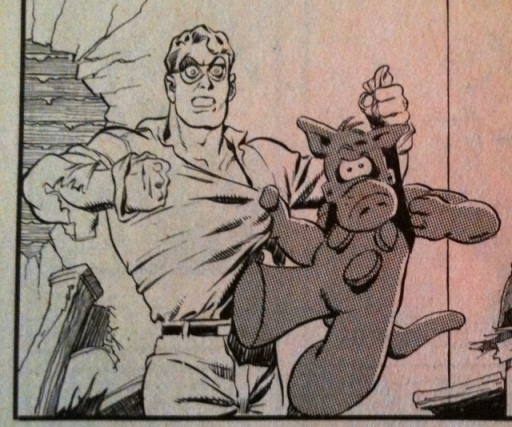
A panel from the issue’s collaboration with comic book legend Will Eisner, featuring his seminal character The Spirit:
20120205-102658.jpg

Wonder Woman (Bondage) — Bill Sienkiewicz

(Via).

Duchamp Is Our Misfortune — Art Spiegelman


20120116-110047.jpg

The Last Supper — Joe Simon

Basil Wolverton’s Guide to Drinking

Books Acquired, 12.25.2011 (Walton Ford; Hayao Miyazaki)

20111226-144256.jpg

I finally got a copy of Walton Ford’s Pancha Tantra, a bestiary depicting the savage Darwinian competition between all biological species, including humans, whose encroachment upon animal habitats is examined in this book. Ford also explores themes of colonialism in his strange, naturalist paintings. My loving wife gave me this book. I took some clumsy photos with my iPhone which in no way do justice to this big, beautiful book; forgiveness please.

20111226-144302.jpg

20111226-144309.jpg

20111226-144317.jpg

20111226-144325.jpg

20111226-144333.jpg

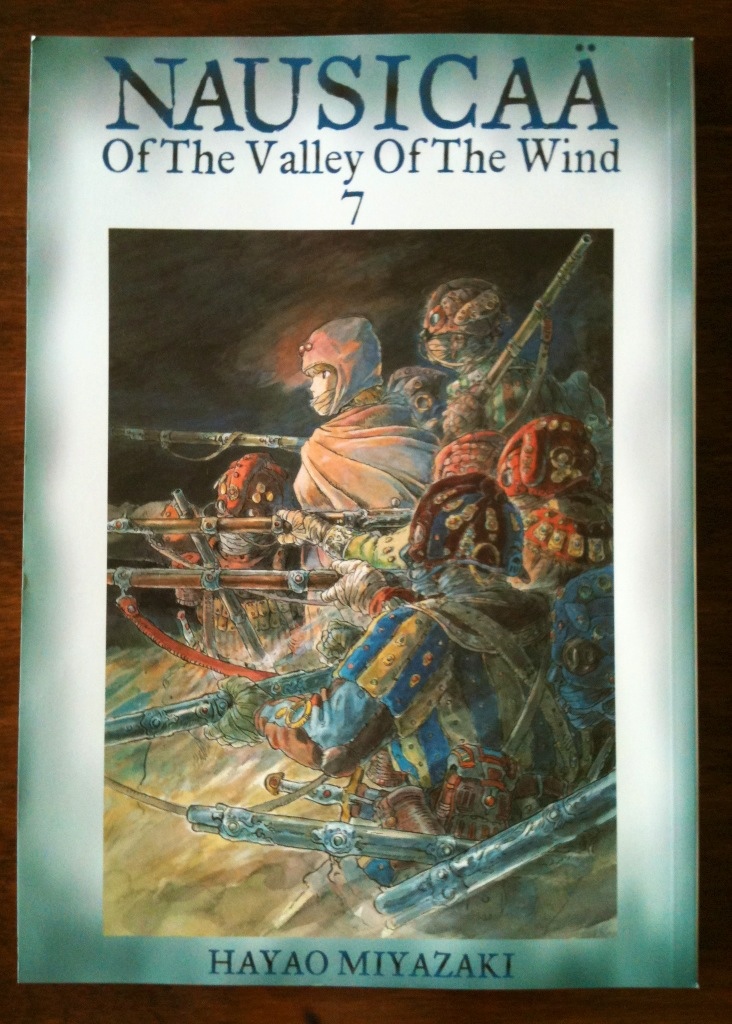
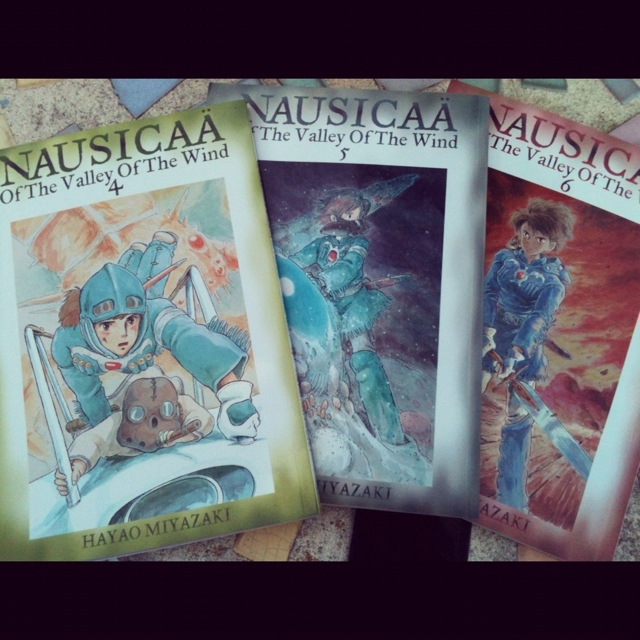
My wife also gave me Hayao Miyazaki’s graphic novel Nausicaa of The Valley of the Wind. The film based on this manga plays in our house about once a week, on heavy rotation with Miyazaki’s other films, which my four year old daughter is addicted to.

20111226-144343.jpg

20111226-144357.jpg

20111226-144406.jpg

20111226-144645.jpg

“Hold On Elmo’s Texting” Elmo — Ted McCagg

(Via The Nervous Breakdown).

RIP Joe Simon

Early Captain America Design Sketch by Joe Simon

RIP comic book legend Joe Simon.

Übermensch Comics #3

“How to Cut Your Own Hair” — Basil Wolverton

Robert Crumb’s Favorite Macaroni Casserole

(Via).

Kate Beaton Explains Psychoanalysis at Hark! A Vagrant

Kate Beaton’s take on psychoanalysis. From Hark! A Vagrant.

Mister Wonderful — Daniel Clowes

There’s an unexpected sweetness to Mister Wonderful, the latest work from Daniel Clowes (new in hardback from Pantheon). Sure, we’re still deep in Clowes territory here, with misanthropic protagonist Marshall offering up acerbic observations on wealthy yuppies, phony poseurs, and jerks on cell phones—all shot through a lens of self-loathing—but Mister Wonderful (subtitled A Love Story) is optimistic, a study in possibility that never tips over the sheer cliff of despair on the other side of romanticism. With its sense of balance, both emotional and narrative, Mister Wonderful is in some way the “good twin” to last year’s Wilson, a work that pointed to the illusory nature of growth and the futility of human connection.

Where Wilson measured the life of its eponymous protagonist over decades (and in extreme hyperbole) as he sought to regain contact with his estranged family, Mister Wonderful  covers just a few hours in the life of Marshall, a sad man set up on a blind date with nutty Natalie, a woman he immediately pegs as way out of his league. Marshall quickly romanticizes the possibility of a life with Natalie, struggling to keep his composure throughout their coffee and dinner date.

Natalie curtails the date to go to a party with old friends, but a surprise (violent) encounter allows Marshall a sliver of heroism—and a chance for more time with Natalie. They head to the party together, only to run into Natalie’s ex-boyfriend, giving Clowes plenty of oomph for a strong third act.

There’s a cinematic scope to Mister Wonderful. The book is 11″ x 6″, and Clowes makes excellent use of his Sunday’s comic page dimensions, exhibiting a level of detail and precision that imbue in Mister Wonderful an air of realism (one that contrasts the cartoony elements of evil twin Wilson). Clowes’s artistic powers are refined, balanced, and agile; he displays a command of color and shape that help define the strange emotional contours of Mister Wonderful, a book about second chances and those rare moments our interior lives might sync unexpectedly with the concrete possibilities life affords us.

Mister Wonderful is funny and balanced, but it’s not for everyone, including some longtime Clowes fans who might quibble with the book’s apparent slightness. Mister Wonderful clocks in at 80 pages, and while some readers may feel shortchanged, perhaps they are overlooking the scope of the work. Clowes is at the height of his powers here, deftly controlling a spare story about  midlife tumult. There’s maturity and depth in this graphic novella. “Novella” isn’t the right term—Mister Wonderful is closer to a long short story, expertly told. Clowes still exhibits some of the sharp, mean edges that marked his earlier work, but the points are more finely honed, more subtle and precise. Some of the erratic weirdness we find in Clowes’s early stuff isn’t on display here, but this is more on account of Clowes’s stronger command of his medium’s formal elements. The bizarre, cynical spirit remains, however. Thankfully, Clowes makes no attempt to redeem his weirdos, nor does he push them into an unearned, false conclusion. Instead, Mr. Wonderful presents their problems and hang-ups and shortcomings as very real, even as it suggests a tint of unironic optimism. Recommended.

Frank Miller, Fascist Mouthpiece, Is a Cranky Old Hack

A few years ago on this blog, I re-evaluated some of Frank Miller’s work, set against his fervent, blind support of the Bush wars. Today, I read a vitriolic rant by Miller, posted at his blog, where he offers the following clumsy thesis—

The “Occupy” movement, whether displaying itself on Wall Street or in the streets of Oakland (which has, with unspeakable cowardice, embraced it) is anything but an exercise of our blessed First Amendment. “Occupy” is nothing but a pack of louts, thieves, and rapists, an unruly mob, fed by Woodstock-era nostalgia and putrid false righteousness. These clowns can do nothing but harm America.

Miller offers no evidence about how or why the OWS protesters will “harm America,” nor does he support his claim that the protests are “anything but an exercise of our blessed First Amendment.” Honestly, I can’t even tell if Miller is being sarcastic when he writes “blessed” to describe the First Amendment, which clearly states that the citizens of this country have a right to assemble. Most Americans support the OWS movement, or at least the spirit of the movement, even if they do not agree with all of the tactics or, um, fashion sense and personal hygiene habits of the group. But Miller, furious reactionary that he is, does not bother once to consider a single idea put forth by OWS. He cannot see past the personal attire and fashion sense of some of the protesters, writing that the movement is nothing “more than an ugly fashion statement by a bunch of iPhone, iPad wielding spoiled brats who should stop getting in the way of working people and find jobs for themselves.” Those kids with their iPhones!

In a baffling move of obscure non-logic, Miller then connects OWS to his “enemies,” those nefarious (if nebulous) forces “al-Qaeda and Islamicism.” The piece ends with this disingenuous call to action—

In the name of decency, go home to your parents, you losers. Go back to your mommas’ basements and play with your Lords Of Warcraft. Or better yet, enlist for the real thing. Maybe our military could whip some of you into shape.

Miller of course never served in any branch of the armed forces. He also has never heard of/chooses to ignore clear evidence that veterans are part of this movement, including Scott Olsen, who was badly injured by police in Oakland.

Since Frank is so frank, let’s all be frank: Frank Miller is a tedious, ill-informed, rage-choked hack who hasn’t produced a great work in over two decades.

Even worse, he’s a fascist.

Miller’s early work in the 1980s repeatedly pointed toward the essential conflict of individual versus society; his heroes and anti-heroes constantly found themselves squaring off against corrupt totalitarian systems that sought to silence dissent and curtail civil liberties. As Miller’s career fumbled along, he increasingly endorsed the underlying fascistic elements present in his vigilante heroes, a fascism wed to an image of the hero as a man whose uncompromising ideals—and uncomplicated misunderstandings of a complex world—inevitably lead to brutal violence. See, for example, Miller’s most recent effort, Holy Terror, an extremely poorly received piece of anti-Muslim propaganda, reviled by comic book audiences not entirely because of its ideological content, but also because of its poor execution. (For a detailed and insightful take-down of Miller’s pulp trash, read Spencer Ackerman’s review in Wired).

Miller is a reactionary crank, a regressive thinker who is terrorized by the idea that the America “he knows” is no longer the homogeneous ideal that it once was. Of course, America was never an idealized homogeneous space, but that doesn’t matter. That’s what fantasy is for. And Miller is a professional fantasist. His derangement evinces not just in his reactionary vitriol toward the OWS protesters, but also in his apparent fear of the technology that these “iPhone, iPad wielding spoiled brats” use to disseminate their message.

Take note that never once in his screed does Miller attempt to paraphrase, analyze, refute, address, or otherwise actually engage that message. Presumably he can’t; he can’t hear it. Like one of the flat characters in his comics, perhaps Miller’s own interior monologue edges out all other voices, reinforcing his own paranoid delusions that “others” are lurking in the shadows, ready to take away the precious freedoms and ideals that only he can understand and value.

One is tempted to point out that Ezra Pound, G.B. Shaw, and Virginia Woolf, among other modernists, supported fascism, that Heidegger was a member of the Nazi party, and yet these artists and thinkers maintain a canonical place to this day in their respective fields. Will history be so kind to Miller? This is an earnest question. Certainly The Dark Knight Returns is a singular work in the superhero comics genre. But works like Holy Terror will do little to preserve the reputation of the man behind the Robocop sequels and The Spirit movie. Great art will survive the straining force of history, but I do not think that Miller is a great artist. He’s just a loud, angry cartoonist with ugly, unfounded, illogical opinions—and I think that that is what history will show.

“I Think Life Is Full of Anxieties and Fears and Tears. It Has a Lot of Grief in It, and It Can Be Very Grim” — Charles Schulz on Religion

Lots of great quotes from Charles M. Schulz on religion (and more) via Biblioklept reader JESCIE.  Sample—

I don’t know the meaning of life. I don’t know why we are here. I think life is full of anxieties and fears and tears. It has a lot of grief in it, and it can be very grim. And I do not want to be the one who tries to tell somebody else what life is all about. To me it’s a complete mystery.”

All citations are from Charles M. Schulz: Conversations, which I now want to read.