Mortal Lock (Book Acquired, 5.02.2013)

20130502-141624.jpg

Mortal Lock by Andrew Vachss seems like a good choice for anyone who digs short, punchy crime noir stories. There’s also a screenplay in here. Random House’s blurb:

A hit man stalks his mark at a race track. A sociopath crosses every moral boundary to become a published author. An ex-mercenary obsessively defends his “perimeter” from a dangerous interloper. A man for hire grudgingly accepts help from a teenage girl to track an online predator. In a dystopian future, young people struggle for survival underground, forming themselves into vicious gangs with only the graffiti of the “last journalists” accepted as truth. Andrew Vachss collects twenty tight, powerful stories—all from the past decade of his career, including some now published for the first time—along with an original screenplay. Together, they form Mortal Lock, a searing portrait of the criminal underworld, with both its depravity and humanity on display.


“The Happy Prince” — Oscar Wilde

“The Happy Prince” by Oscar Wilde

High above the city, on a tall column, stood the statue of the Happy Prince.  He was gilded all over with thin leaves of fine gold, for eyes he had two bright sapphires, and a large red ruby glowed on his sword-hilt.

He was very much admired indeed.  “He is as beautiful as a weathercock,” remarked one of the Town Councillors who wished to gain a reputation for having artistic tastes; “only not quite so useful,” he added, fearing lest people should think him unpractical, which he really was not.

“Why can’t you be like the Happy Prince?” asked a sensible mother of her little boy who was crying for the moon.  “The Happy Prince never dreams of crying for anything.”

“I am glad there is some one in the world who is quite happy,” muttered a disappointed man as he gazed at the wonderful statue.

“He looks just like an angel,” said the Charity Children as they came out of the cathedral in their bright scarlet cloaks and their clean white pinafores.

“How do you know?” said the Mathematical Master, “you have never seen one.”

“Ah! but we have, in our dreams,” answered the children; and the Mathematical Master frowned and looked very severe, for he did not approve of children dreaming.

One night there flew over the city a little Swallow.  His friends had gone away to Egypt six weeks before, but he had stayed behind, for he was in love with the most beautiful Reed.  He had met her early in the spring as he was flying down the river after a big yellow moth, and had been so attracted by her slender waist that he had stopped to talk to her.

“Shall I love you?” said the Swallow, who liked to come to the point at once, and the Reed made him a low bow.  So he flew round and round her, touching the water with his wings, and making silver ripples.  This was his courtship, and it lasted all through the summer.

“It is a ridiculous attachment,” twittered the other Swallows; “she has no money, and far too many relations”; and indeed the river was quite full of Reeds.  Then, when the autumn came they all flew away.

After they had gone he felt lonely, and began to tire of his lady-love.  “She has no conversation,” he said, “and I am afraid that she is a coquette, for she is always flirting with the wind.”  And certainly, whenever the wind blew, the Reed made the most graceful curtseys.  “I admit that she is domestic,” he continued, “but I love travelling, and my wife, consequently, should love travelling also.”

“Will you come away with me?” he said finally to her; but the Reed shook her head, she was so attached to her home.

“You have been trifling with me,” he cried.  “I am off to the Pyramids.  Good-bye!” and he flew away.

All day long he flew, and at night-time he arrived at the city.  “Where shall I put up?” he said; “I hope the town has made preparations.”

Then he saw the statue on the tall column. Continue reading ““The Happy Prince” — Oscar Wilde”

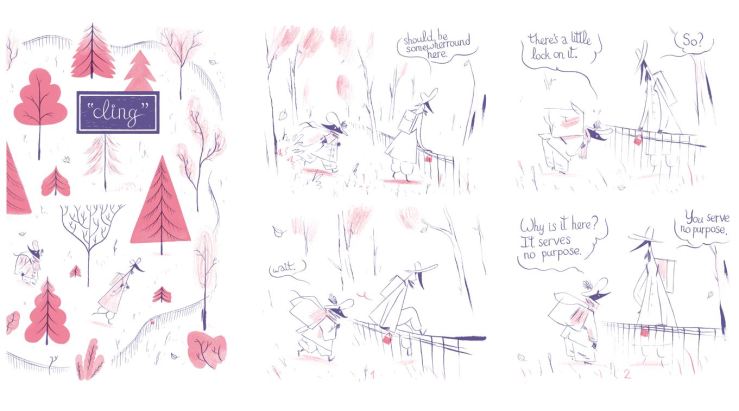
Read “Cling,” a Strange Comic by Roman Muradov

cling

(Read the rest of Roman Muradov’s “Cling”).

In Lieu of Original Content This Week, Here Are Three Books I’m Keen On, Presented Without Comment

IMG_5647

Bring Up the Bodies (Book Acquired and Sort of Reviewed, 4.23.2013)

20130502-141548.jpg

I wrote a three-part review of Hilary Mantel’s Bring Up the Bodies when it came out in hardback last year, which I’ll cannibalize right after this short paragraph, which is lazy, but hey, sorry. Anyway, Bodies is new in trade paperback from Picador, freshly blazoned with the Booker Prize sticker. When Mantel won the award the second time, there was a lot of grumbling and mockery in my Twitter stream—terms like middlebrow and hack were thrown around. I think a lot of this derision comes from 1). the perception that the Wolf Hall trilogy is genre fiction and 2). dare I say it, unreflective sexism. Anway, I thought both books were great and am looking forward to the third. Here is me plagiarizing myself:

Bring Up the Bodies—now seems as good a time as any to point out that, hey, that’s just a great title—Bring Up the Bodies picks up right where Wolf Hall left off. Just as that first book throws its audience into the deep end, with one of the more bewildering openings in recent memory, so too does Bring Up the Bodies begin abruptly in media res. Please forgive me if I begin in the middle of things as well—to be clear, it’s not a good idea to jump into Bodies until you’ve read Wolf Hall. And Wolf Hall is worth your time.

It’s 1535 and our protagonist Thomas Cromwell is 50 and starting to feel his age (he laments at one point that he no longer remembers any of the snippets of Welsh he once knew; he can no longer play tennis). His prince, King Henry VIII, is also quickly aging, his body turning to the fat lump that we tend to picture him as these days. An expanding tummy is the least of Henry’s worries, however—and Henry’s worries are Cromwell’s worries. The major plot arc will likely be Henry’s plans to oust his newish bride Anne Boleyn, a repetition of sorts from Wolf Hall, where Henry and Cromwell (mostly Cromwell) worked to annul Henry’s marriage to Queen Katherine. Obviously though, we can’t accuse Mantel of a lack of imagination in crafting her plots. She’s working from history of course, and what’s most amazing about both Wolf Halland Bring Up the Bodies is how Mantel invigorates that history. Who knew the hoary Tudor saga needed a retelling?

It works here of course because Cromwell is such a fascinating character. Mantel anchors her impeccable free indirect style in Cromwell’s mind, and she channels his intense intellect with sharp grace.  Here’s a remarkable passage that somehow summarizes (broadly, of course) much of Wolf Hall and showcases Mantel’s ability to move her prose seamlessly from exterior to interior,  from how others might see Cromwell to how he might understand himself:

Thomas Cromwell is now about fifty years old. He has a labourer’s body, stocky, useful, running to fat. He has black hair, greying now, and because of his pale impermeable skin, which seems designed to resist rain as well as sun, people sneer that his father was an Irishman, though really he was a brewer and a blacksmith at Putney, a shearsman too, a man with a finger in every pie, a scrapper and brawler, a drunk and a bully, a man often hauled before the justices for punching someone, for cheating someone. How the son of such a man has achieved his present eminence is a question all Europe asks. Some say he came up with the Boleyns, the queen’s family. Some say it was wholly through the late Cardinal Wolsey, his patron; Cromwell was in his confidence and made money for him and knew his secrets. Others say he haunts the company of sorcerers. He was out of the realm from boyhood, a hired soldier, a wool trader, a banker. No one knows where he has been and who he has met, and he is in no hurry to tell them. He never spares himself in the king’s service, he knows his worth and merits and makes sure of his reward: offices, perquisites and title deeds, manor houses and farms. He has a way of getting his way, he has a method; he will charm a man or bribe him, coax him or threaten him, he will explain to a man where his true interests lie, and he will introduce that same man to aspects of himself he didn’t know existed. Every day Master Secretary deals with grandees who, if they could, would destroy him with one vindictive swipe, as if he were a fly. Knowing this, he is distinguished by his courtesy, his calmness and his indefatigable attention to England’s business. He is not in the habit of explaining himself. He is not in the habit of discussing his successes. But whenever good fortune has called on him, he has been there, planted on the threshold, ready to fling open the door to her timid scratch on the wood.

Of course, good fortune is not without its headaches, and Bring Up the Bodies quickly establishes the daily grind of being the king’s chief minister. Cromwell has to worry about the uncertain finances of the kingdom; the plots of the Catholic Church; the ever-present threat of Katherine’s nephew, Charles V, Holy Roman Emperor; Cromwell also has to worry about scheming at court and gossip in the towns. And yet he keeps a level head, even as he appeals to his memories of the late Cardinal Wolsey, who hangs like an ironic ghost over the early chapters of Bring Up the Bodies. (I’m hoping Wolsey’s ghost will continue to haunt the book). It’s when Cromwell turns his sharp mind to a critique of the cleric class (he’d turn out all the abbeys and seize their coffers), or to a flat rebuttal of the concept of confession (“God doesn’t require an intermediary”), or even when he sniffs at Machiavelli as too conservative that we see in Cromwell the advent of modernity.

Mantel’s ability to express Cromwell’s keen intelligence reanimates the Tudor saga, which I frankly could give a rat’s ass about on its own. Okay, the plot is fascinating, but much of history fascinates. What’s remarkable is the manner by which Mantel channel’s Cromwell’s mind. His brain is always at work, and Mantel shows us that brain at work. It would be a mistake to suggest that Bring Up the Bodies has no prose style, but it’s difficult to describe the style—Mantel elides authorial intrusion; her free indirect style stays close to Cromwell’s perceptions, but she knows when to move her camera out, knows when to show her audience a shot of his face or a gesture of his hand when he receives some piece of information or imparts some command. She rarely tells us what Cromwell is thinking, instead allowing us to go through the cognitive process with him.

And that cognitive process never rests. There’s a remarkable passage near the end of the book that ties together so many of the book’s themes and images. I would quote in full but I listened to the audio, so I’ll have to paraphrase (forgiveness, please). Cromwell is busy making arrangements for the executions of Boleyn and the men accused of sleeping with her, and his mind turns somehow to imagery of gristle and bone and fat—and he wonders what the ancient Greek pagans and Hebrews of the bible did with the meat from their sacrifices—Surely they didn’t waste the meat, surely they gave it to the poor, he thinks. Cromwell figures Boleyn as a sacrifice and then converts that sacrifice into a concern for the common people of the commonwealth.

Of course, it’s a mistake to see Cromwell’s motivations as absolutely pure. The revenge plot of Bring Up the Bodies unfolds so smoothly that the reader (okay, this reader) is slow to catch on, to see how delicately and expertly Cromwell snares those who brought down his beloved mentor Cardinal Wolsey. His control is so precise (Mantel’s control is so precise) that he refuses to tip his hand to himself, let alone the schemers around him, let alone the reader.

Still, Bring Up the Bodies concludes with an uneasy Cromwell, a man already looking for solace in grandchildren, in some kind of futurity, in a life (in a rare metatextual gesture on Mantel’s part) on paper, a figure marked in ink and words. He’s too perceptive—too sharp a reader—not to see the writing on the wall, even if that wall is some years out, even if that writing is still malleable and undefined. Cromwell has controlled the myriad political, familial, and personal circumstances that surround the wishes of his prince, King Henry, but he knows that it’s only a matter of time before his favor falls.

Bring Up the Bodies is a fantastic sequel to Wolf Hall, picking up the reins in media res, yet never resting on that first book’s tropes (“Choose your prince”; “Arrange your face”), but rather absorbing them and then adding to them. Mantel has given those of us not particularly interested in historical fiction a great reason to read some, although dithering about genre seems silly here. Ultimately, she gives us a powerful, character-driven story, a story that we think we already know, but understand anew in her retelling. Recommended.

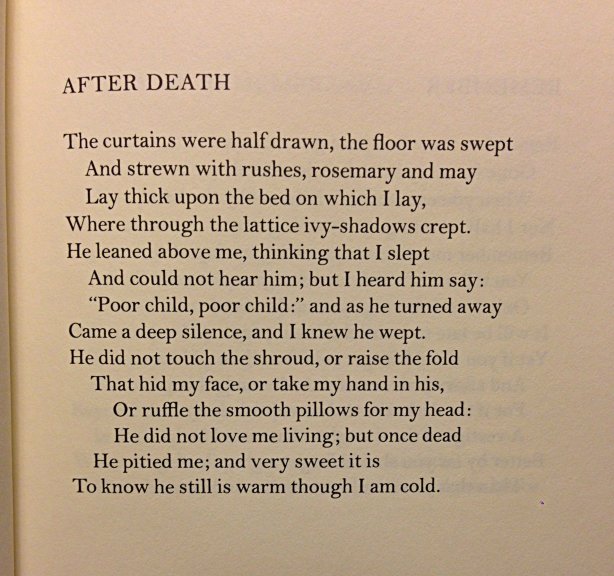
“After Death” — Christina Rossetti

IMG_5619

“Grace” — James Joyce

“Grace” by James Joyce

TWO GENTLEMEN who were in the lavatory at the time tried to lift him up: but he was quite helpless. He lay curled up at the foot of the stairs down which he had fallen. They succeeded in turning him over. His hat had rolled a few yards away and his clothes were smeared with the filth and ooze of the floor on which he had lain, face downwards. His eyes were closed and he breathed with a grunting noise. A thin stream of blood trickled from the corner of his mouth.

These two gentlemen and one of the curates carried him up the stairs and laid him down again on the floor of the bar. In two minutes he was surrounded by a ring of men. The manager of the bar asked everyone who he was and who was with him. No one knew who he was but one of the curates said he had served the gentleman with a small rum.

“Was he by himself?” asked the manager.

“No, sir. There was two gentlemen with him.”

“And where are they?”

No one knew; a voice said:

“Give him air. He’s fainted.”

The ring of onlookers distended and closed again elastically. A dark medal of blood had formed itself near the man’s head on the tessellated floor. The manager, alarmed by the grey pallor of the man’s face, sent for a policeman.

His collar was unfastened and his necktie undone. He opened eyes for an instant, sighed and closed them again. One of gentlemen who had carried him upstairs held a dinged silk hat in his hand. The manager asked repeatedly did no one know who the injured man was or where had his friends gone. The door of the bar opened and an immense constable entered. A crowd which had followed him down the laneway collected outside the door, struggling to look in through the glass panels.

The manager at once began to narrate what he knew. The constable, a young man with thick immobile features, listened. He moved his head slowly to right and left and from the manager to the person on the floor, as if he feared to be the victim of some delusion. Then he drew off his glove, produced a small book from his waist, licked the lead of his pencil and made ready to indite. He asked in a suspicious provincial accent:

“Who is the man? What’s his name and address?”

A young man in a cycling-suit cleared his way through the ring of bystanders. He knelt down promptly beside the injured man and called for water. The constable knelt down also to help. The young man washed the blood from the injured man’s mouth and then called for some brandy. The constable repeated the order in an authoritative voice until a curate came running with the glass. The brandy was forced down the man’s throat. In a few seconds he opened his eyes and looked about him. He looked at the circle of faces and then, understanding, strove to rise to his feet. Continue reading ““Grace” — James Joyce”

“There was an Old Man with a beard” (Edward Lear Limerick)

lear

1984 (1954 BBC Sunday-Night Production)

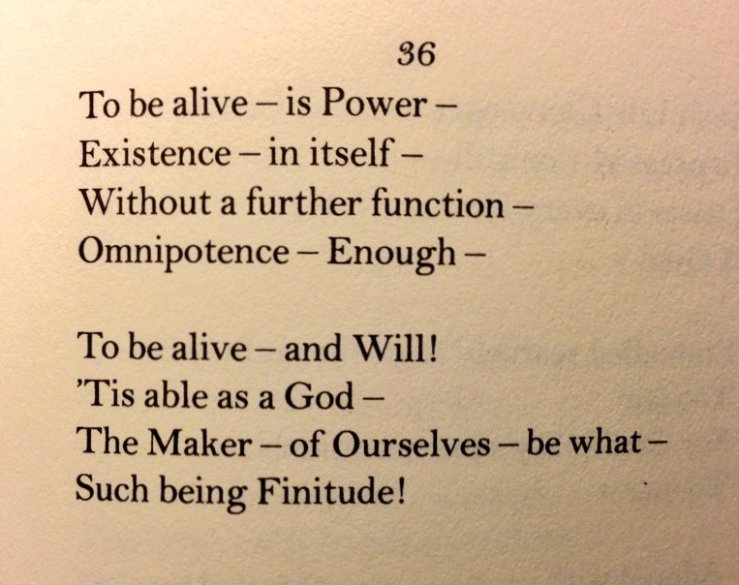
To be alive — is Power — (Emily Dickinson)

20130502-093439

A Constellation of Vital Phenomena (Book Acquired Some Time Last Week)

20130502-112630.jpg

A Constellation of Vital Phenomena by Anthony Marra. Publisher Random House’s blurb:

In his brilliant, haunting novel, Stegner Fellow and Whiting Award winner Anthony Marra transports us to a snow-covered village in Chechnya, where eight-year-old Havaa watches from the woods as Russian soldiers abduct her father in the middle of the night, accusing him of aiding Chechen rebels. Across the road their lifelong neighbor and family friend Akhmed has also been watching, fearing the worst when the soldiers set fire to Havaa’s house. But when he finds her hiding in the forest with a strange blue suitcase, he makes a decision that will forever change their lives. He will seek refuge at the abandoned hospital where the sole remaining doctor, Sonja Rabina, treats the wounded.
For the talented, tough-minded Sonja, the arrival of Akhmed and Havaa is an unwelcome surprise. Weary and overburdened, she has no desire to take on additional risk and responsibility. And she has a deeply personal reason for caution: harboring these refugees could easily jeopardize the return of her missing sister. But over the course of five extraordinary days, Sonja’s world will shift on its axis and reveal the intricate pattern of connections that weave together the pasts of these three unlikely companions and unexpectedly decides their fate. A story of the transcendent power of love in wartime, A Constellation of Vital Phenomenais a work of sweeping breadth, profound compassion, and lasting significance.


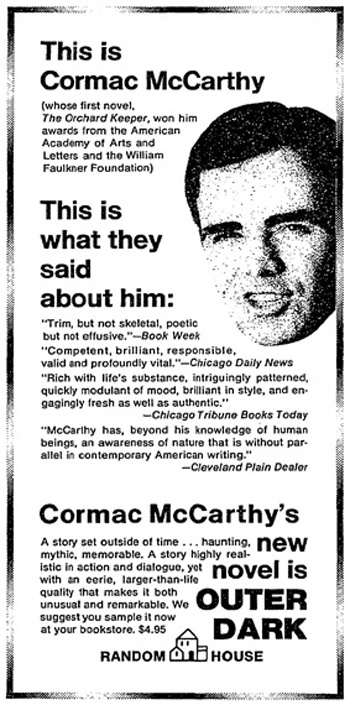
1968 Ad for Cormac McCarthy’s Outer Dark

d05fb40e5ddc4b3a068ca6a01aebc9a3

(Via/more; my review of Outer Dark).

“Life of Ma Parker” — Katherine Mansfield

“Life of Ma Parker” by Katherine Mansfield

When the literary gentleman, whose flat old Ma Parker cleaned every Tuesday, opened the door to her that morning, he asked after her grandson. Ma Parker stood on the doormat inside the dark little hall, and she stretched out her hand to help her gentleman shut the door before she replied. “We buried ‘im yesterday, sir,” she said quietly.

“Oh, dear me! I’m sorry to hear that,” said the literary gentleman in a shocked tone. He was in the middle of his breakfast. He wore a very shabby dressing-gown and carried a crumpled newspaper in one hand. But he felt awkward. He could hardly go back to the warm sitting-room without saying something—something more. Then because these people set such store by funerals he said kindly, “I hope the funeral went off all right.”

“Beg parding, sir?” said old Ma Parker huskily.

Poor old bird! She did look dashed. “I hope the funeral was a—a—success,” said he. Ma Parker gave no answer. She bent her head and hobbled off to the kitchen, clasping the old fish bag that held her cleaning things and an apron and a pair of felt shoes. The literary gentleman raised his eyebrows and went back to his breakfast.

“Overcome, I suppose,” he said aloud, helping himself to the marmalade.

Ma Parker drew the two jetty spears out of her toque and hung it behind the door. She unhooked her worn jacket and hung that up too. Then she tied her apron and sat down to take off her boots. To take off her boots or to put them on was an agony to her, but it had been an agony for years. In fact, she was so accustomed to the pain that her face was drawn and screwed up ready for the twinge before she’d so much as untied the laces. That over, she sat back with a sigh and softly rubbed her knees…

“Gran! Gran!” Her little grandson stood on her lap in his button boots. He’d just come in from playing in the street.

“Look what a state you’ve made your gran’s skirt into—you wicked boy!”

But he put his arms round her neck and rubbed his cheek against hers. Continue reading ““Life of Ma Parker” — Katherine Mansfield”

Little Women (The Far Side)

lw

Some content on this page was disabled on June 29, 2021 as a result of a DMCA takedown notice from Andrews McMeel Universal. You can learn more about the DMCA here:

https://wordpress.com/support/copyright-and-the-dmca/

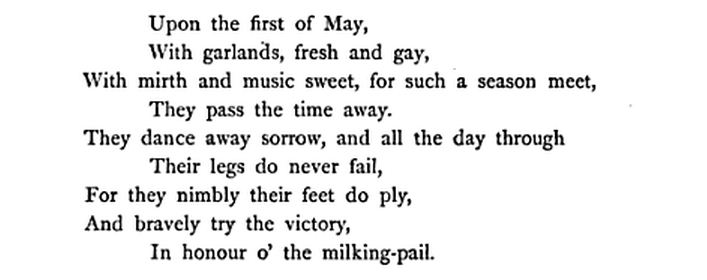
“Upon the first of May” (The Milkmaid)

md

“May-Day” — Ralph Waldo Emerson

“May-Day” by Ralph Waldo Emerson

Daughter of Heaven and Earth, coy Spring,
With sudden passion languishing,
Maketh all things softly smile,
Painteth pictures mile on mile,
Holds a cup with cowslip-wreaths,
Whence a smokeless incense breathes.
Girls are peeling the sweet willow,
Poplar white, and Gilead-tree,
And troops of boys
Shouting with whoop and hilloa,
And hip, hip three times three.
The air is full of whistlings bland;
What was that I heard
Out of the hazy land?
Harp of the wind, or song of bird,
Or clapping of shepherd’s hands,
Or vagrant booming of the air,
Voice of a meteor lost in day?
Such tidings of the starry sphere
Can this elastic air convey.
Or haply ‘t was the cannonade
Of the pent and darkened lake,
Cooled by the pendent mountain’s shade,
Whose deeps, till beams of noonday break,
Afflicted moan, and latest hold
Even unto May the iceberg cold.
Was it a squirrel’s pettish bark,
Or clarionet of jay? or hark,
Where yon wedged line the Nestor leads,
Steering north with raucous cry
Through tracts and provinces of sky,
Every night alighting down
In new landscapes of romance,
Where darkling feed the clamorous clans
By lonely lakes to men unknown.
Come the tumult whence it will,
Voice of sport, or rush of wings,
It is a sound, it is a token
That the marble sleep is broken,
And a change has passed on things.
Continue reading ““May-Day” — Ralph Waldo Emerson”

Heavy Dreams (Sigizmund Krzhizhanovsky)

Quantin followed the procession for a few minutes out of morbid curiosity. The choice of narrower side streets, where it was easier to enlist the wall’s support, was probably deliberate, he thought, but then a long notice stuck to the stone exactly at eye level arrested his attention and, with it, his progress. The notice—in the manner of a proper, not overly pushy advertisement—listed the advantages ofso-called heavy dreams. Having come across the subject once before, Quantin read the fine print carefully, line by line: “The main advantage of the heavy industry of nightmares over the light industry of golden threads plunged into brain fibrils, over the production of so-called sweet dreams, is that in marketing our nightmares we can guarantee that they will come true, we can hand our customers ‘turnkey dreams.’ Sweet dreams cannot withstand reality, sleepy reveries wear out faster than socks; whereas a heavy dream, a simple but well-made nightmare, is easily assimilated by life. Where dreams unburdened by anything disappear like drops of water in the sand, dreams containing a certain harshness will, as they evaporate in the sun, leave a hard kernel on the roof of Plato’s famous cave: these dposits will collect and accrue, eventually forming a swordlike stalactite.

“Speaking in more modern terms,” the fine print went on, “our nightmares, weighing as they do on the brain, gradually form a sort of moral ceiling that is always about to come crashing down on one’s head: some of our customer’s call this ‘world history.’ But that’s not the point. The point is the durability, unwakeability, high depressiveness, and wide availability of our nightmares: mass-market products good for all eras and classes, nighttime and daytime, moonlight and sunlight, closed eyes and open.”

From Sigizmund Krzhizhanovsky’s short story “The Branch Line,” collected in NYRB’s Memories of the Future (translation by Joanne Turnbull).