“The Philosophy of Composition” — Edgar Allan Poe

“The Philosophy of Composition” by Edgar Allan Poe

Charles Dickens, in a note now lying before me, alluding to an examination I once made of the mechanism of Barnaby Rudge, says—”By the way, are you aware that Godwin wrote his Caleb Williams backwards? He first involved his hero in a web of difficulties, forming the second volume, and then, for the first, cast about him for some mode of accounting for what had been done.”

I cannot think this the precise mode of procedure on the part of Godwin—and indeed what he himself acknowledges is not altogether in accordance with Mr. Dickens’s idea—but the author of Caleb Williams was too good an artist not to perceive the advantage derivable from at least a somewhat similar process. Nothing is more clear than that every plot, worth the name, must be elaborated to its dénouement before anything be attempted with the pen. It is only with the dénouement constantly in view that we can give a plot its indispensable air of consequence, or causation, by making the incidents, and especially the tone at all points, tend to the development of the intention.

There is a radical error, I think, in the usual mode of constructing a story. Either history affords a thesis—or one is suggested by an incident of the day—or, at best, the author sets himself to work in the combination of striking events to form merely the basis of his narrative—-designing, generally, to fill in with description, dialogue, or autorial comment, whatever crevices of fact or action may, from page to page, render themselves apparent.

I prefer commencing with the consideration of an effect. Keeping originality always in view—for he is false to himself who ventures to dispense with so obvious and so easily attainable a source of interest—I say to myself, in the first place, “Of the innumerable effects or impressions of which the heart, the intellect, or (more generally) the soul is susceptible, what one shall I, on the present occasion, select?” Having chosen a novel first, and secondly, a vivid effect, I consider whether it can be best wrought by incident or tone—whether by ordinary incidents and peculiar tone, or the converse, or by peculiarity both of incident and tone—afterwards looking about me (or rather within) for such combinations of events or tone as shall best aid me in the construction of the effect.

I have often thought how interesting a magazine paper might be written by any author who would—that is to say, who could—detail, step by step, the processes by which any one of his compositions attained its ultimate point of completion. Why such a paper has never been given to the world, I am much at a loss to say—but perhaps the autorial vanity has had more to do with the omission than any one other cause. Most writers—poets in especial—prefer having it understood that they compose by a species of fine frenzy—an ecstatic intuition—and would positively shudder at letting the public take a peep behind the scenes, at the elaborate and vacillating crudities of thought—at the true purposes seized only at the last moment—at the innumerable glimpses of idea that arrived not at the maturity of full view—at the fully-matured fancies discarded in despair as unmanageable—at the cautious selections and rejections—at the painful erasures and interpolations,—in a word, at the wheels and pinions, the tackle for scene-shifting, the step-ladders and demon-traps, the cock’s feathers, the red paint, and the black patches, which, in ninety-nine cases out of the hundred, constitute the properties of the literary histrio. Continue reading ““The Philosophy of Composition” — Edgar Allan Poe”
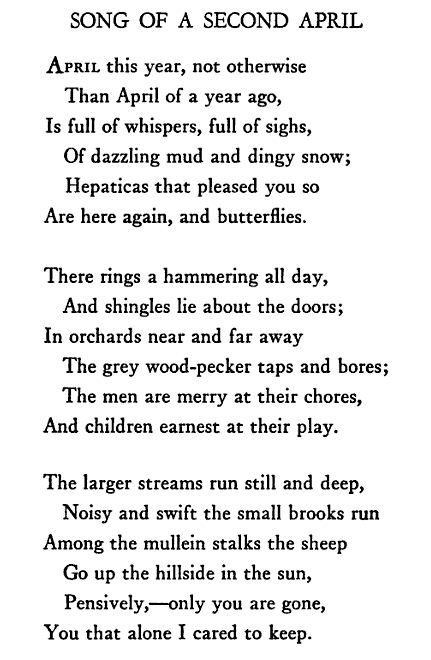
“Song of a Second April” — Edna St. Vincent Millay

millay

“On the Tram” — Franz Kafka

“On the Tram” by Franz Kafka

I stand on the end platform of the tram and am completely unsure of my footing in this world, in this town, in my family. Not even casually could I indicate any claims that I might rightly advance in any direction. I have not even any defense to offer for standing on this platform, holding on to this strap, letting myself be carried along by this tram, nor for the people who give way to the tram or walk quietly along or stand gazing into shopwindows. Nobody asks me to put up a defense, indeed, but that is irrelevant.

The tram approaches a stopping place and a girl takes up her position near the step, ready to alight. She is as distinct to me as if I had run my hands over her. She is dressed in black, the pleats of her skirt hang almost still, her blouse is tight and has a collar of white fine-meshed lace, her left hand is braced flat against the side of the tram, the umbrella in her right hand rests on the second top step. Her face is brown, her nose, slightly pinched at the sides, has a broad round tip. She has a lot of brown hair and stray little tendrils on the right temple. Her small ear is close-set, but since I am near her I can see the whole ridge of the whorl of her right ear and the shadow at the root of it.

At that point I asked myself: How is it that she is not amazed at herself, that she keeps her lips closed and makes no such remark?

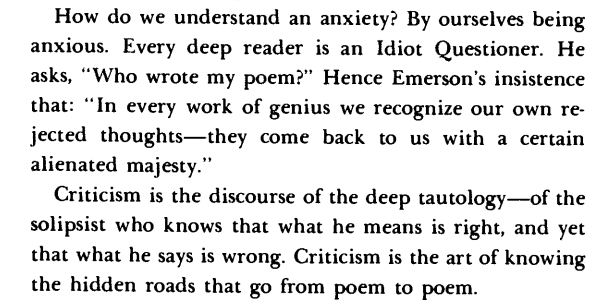
Every deep reader is an Idiot Questioner (Harold Bloom)

bloom

“Our April Letter” — F. Scott Fitzgerald

This is April again. Roller skates rain slowly down the street
Your voice far away on the phone
Once I would have jumped like a clown through a hoop—
but
“Then the area of infection has increased? …oh …What can I expect after all—I’ve had worse shocks.
Anyhow, I know and that’s something.” (Like hell it is, but it’s what you say to an X-ray doctor.)
Then the past whispering faint now on another phone:
“Is there any change?”
“Little or no change”
“I see”
The roller skates rain down the streets,
The black cars shine between the leaves,
Your voice far away:
“I am going with my daughter to the country. My husband left today. . . No he knows nothing.”
“Good”.
I have asked a lot of my emotions—one hundred and twenty stories, The price was high, right up with Kipling, because there was one little drop of something not blood, not a tear, not my seed, but me more intimately than these, in every story, it was the extra I had. Now it has gone and I am just like you now.
Once the phial was full—here is the bottle it came in.
Hold on there’s a drop left there. . . No, it was just the way the light fell
But your voice on the telephone. If I hadn’t abused words so what you said might have meant something.
But one hundred and twenty stories
April evening spreads over everything, the purple blur left by a child who has used the whole paint-box.

“Our April Letter” is from F. Scott Fitzgerald’s Notebooks.


“The Tale of Benjamin Bunny” — Beatrix Potter

“The Tale of Benjamin Bunny” by Beatrix Potter

On the bank

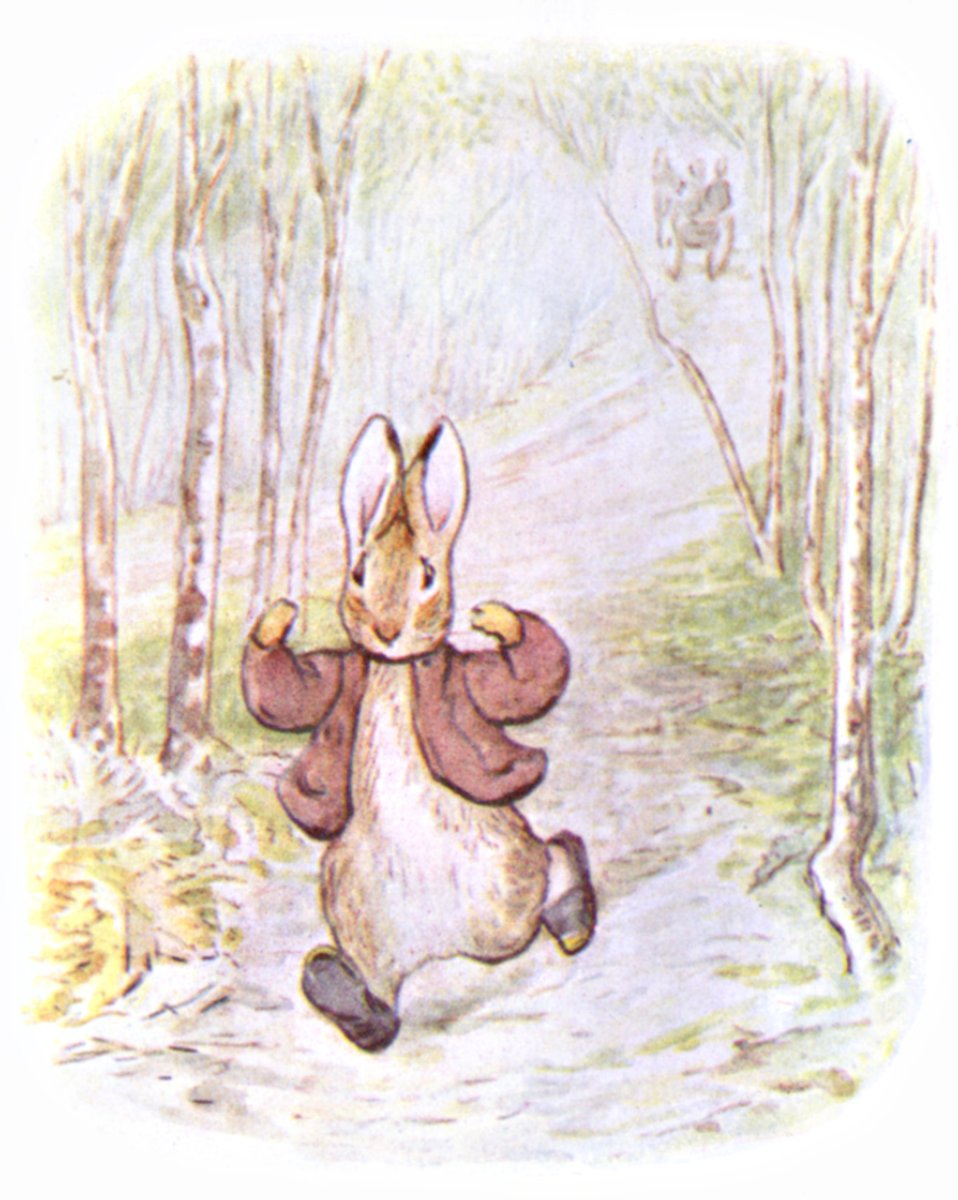
One morning a little rabbit sat on a bank.

He pricked his ears and listened to the trit-trot, trit-trot of a pony.

A gig was coming along the road; it was driven by Mr. McGregor, and beside him sat Mrs. McGregor in her best bonnet.

Hop, skip

As soon as they had passed, little Benjamin Bunny slid down into the road, and set off—with a hop, skip, and a jump—to call upon his relations, who lived in the wood at the back of Mr. McGregor’s garden.

The Hole Continue reading ““The Tale of Benjamin Bunny” — Beatrix Potter”

The Good Thief — Albrecht Dürer

Boxing/Writing (Henry Miller)

miller

“Easter Eve” — Anton Chekhov

I was standing on the bank of the River Goltva, waiting for the ferry-boat from the other side. At ordinary times the Goltva is a humble stream of moderate size, silent and pensive, gently glimmering from behind thick reeds; but now a regular lake lay stretched out before me. The waters of spring, running riot, had overflowed both banks and flooded both sides of the river for a long distance, submerging vegetable gardens, hayfields and marshes, so that it was no unusual thing to meet poplars and bushes sticking out above the surface of the water and looking in the darkness like grim solitary crags.

The weather seemed to me magnificent. It was dark, yet I could see the trees, the water and the people. . . . The world was lighted by the stars, which were scattered thickly all over the sky. I don’t remember ever seeing so many stars. Literally one could not have put a finger in between them. There were some as big as a goose’s egg, others tiny as hempseed. . . . They had come out for the festival procession, every one of them, little and big, washed, renewed and joyful, and everyone of them was softly twinkling its beams. The sky was reflected in the water; the stars were bathing in its dark depths and trembling with the quivering eddies. The air was warm and still. . . . Here and there, far away on the further bank in the impenetrable darkness, several bright red lights were gleaming. . . .

A couple of paces from me I saw the dark silhouette of a peasant in a high hat, with a thick knotted stick in his hand.

“How long the ferry-boat is in coming!” I said.

“It is time it was here,” the silhouette answered.

“You are waiting for the ferry-boat, too?”

“No I am not,” yawned the peasant—”I am waiting for the illumination. I should have gone, but to tell you the truth, I haven’t the five kopecks for the ferry.”

“I’ll give you the five kopecks.”

“No; I humbly thank you. . . . With that five kopecks put up a candle for me over there in the monastery. . . . That will be more interesting, and I will stand here. What can it mean, no ferry-boat, as though it had sunk in the water!”

The peasant went up to the water’s edge, took the rope in his hands, and shouted; “Ieronim! Ieron—im!” Continue reading ““Easter Eve” — Anton Chekhov”

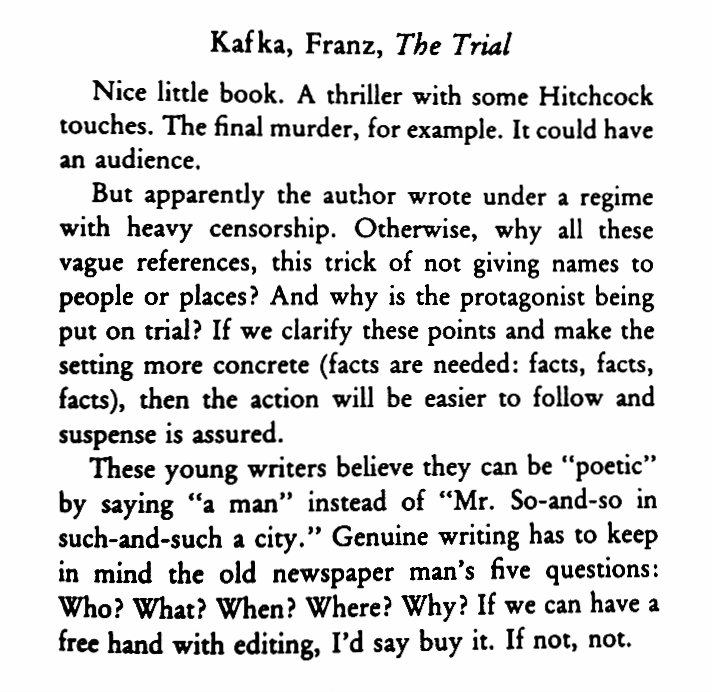
Kafka Rejection (Umberto Eco)

kafka

“The Easter Egg” — Saki

“The Easter Egg” by Saki

It was distinctly hard lines for Lady Barbara, who came of good fighting stock, and was one of the bravest women of her generation, that her son should be so undisguisedly a coward. Whatever good qualities Lester Slaggby may have possessed, and he was in some respects charming, courage could certainly never be imputed to him. As a child he had suffered from childish timidity, as a boy from unboyish funk, and as a youth he had exchanged unreasoning fears for others which were more formidable from the fact of having a carefully thought-out basis. He was frankly afraid of animals, nervous with firearms, and never crossed the Channel without mentally comparing the numerical proportion of lifebelts to passengers. On horseback he seemed to require as many hands as a Hindu god, at least four for clutching the reins, and two more for patting the horse soothingly on the neck. Lady Barbara no longer pretended not to see her son’s prevailing weakness, with her usual courage she faced the knowledge of it squarely, and, mother-like, loved him none the less.

Continental travel, anywhere away from the great tourist tracks, was a favoured hobby with Lady Barbara, and Lester joined her as often as possible. Eastertide usually found her at Knobaltheim, an upland township in one of those small princedoms that make inconspicuous freckles on the map of Central Europe.

A long-standing acquaintanceship with the reigning family made her a personage of due importance in the eyes of her old friend the Burgomaster, and she was anxiously consulted by that worthy on the momentous occasion when the Prince made known his intention of coming in person to open a sanatorium outside the town. All the usual items in a programme of welcome, some of them fatuous and commonplace, others quaint and charming, had been arranged for, but the Burgomaster hoped that the resourceful English lady might have something new and tasteful to suggest in the way of loyal greeting. The Prince was known to the outside world, if at all, as an old-fashioned reactionary, combating modern progress, as it were, with a wooden sword; to his own people he was known as a kindly old gentleman with a certain endearing stateliness which had nothing of standoffishness about it. Knobaltheim was anxious to do its best. Lady Barbara discussed the matter with Lester and one or two acquaintances in her little hotel, but ideas were difficult to come by.

“Might I suggest something to the Gnädige Frau?” asked a sallow high-cheek-boned lady to whom the Englishwoman had spoken once or twice, and whom she had set down in her mind as probably a Southern Slav. Continue reading ““The Easter Egg” — Saki”

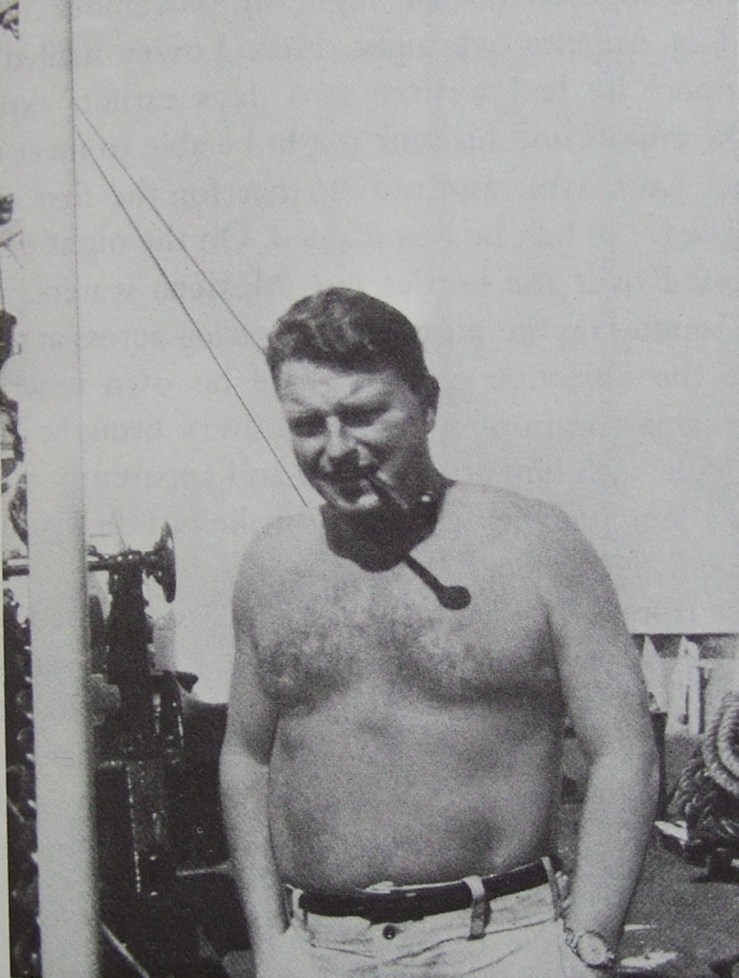
Topless Malcolm Lowry

Cathcart Street 038

(This pic seems like a good argument to read Under the Volcano, but here’s another one).

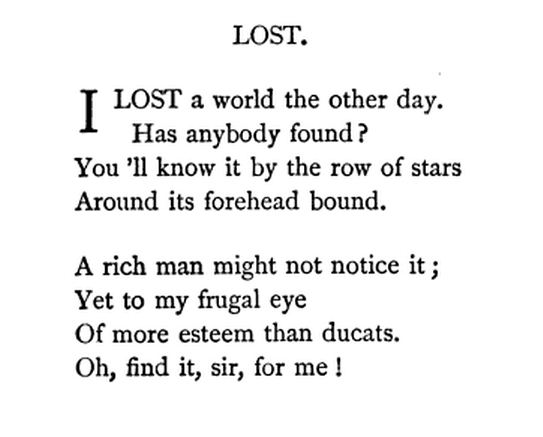
“I lost a World the other day” — Emily Dickinson

lost

“Eggs: An Easter Homily” — Robert Lynd

“Eggs: An Easter Homily” by Robert Lynd

Having decided to write on Easter, I took out a volume of The Encyclopædia Britannica in order to make up the subject of eggs, and the first entry under “Egg” that met my eye was:

“EGG, AUGUSTUS LEOPOLD (1816-1863), English painter, was born on the 2nd of May, 1816, in London, where his father carried on business as a gun-maker.”

I wish I had known about Augustus five years ago. I should like to have celebrated the centenary of an egg somewhere else than in a London tea-shop. Augustus Leopold Egg seems to have spent a life in keeping with his name. He was taught drawing by Mr Sass, and in later years was a devotee of amateur theatricals, making a memorable appearance, as we should expect of an Egg, in a play called Not so Bad as We Seem. He also appears to have devoted a great part of his life to painting bad eggs, if we may judge by the titles of his most famous pictures—Buckingham Rebuffed, Queen Elizabeth discovers she is no longer young, Peter the Great sees Catherine for the First Time, and Past and Present, a Triple Picture of a Faithless Wife. She was a lady, no doubt, who could not submit to the marriage yolk. Anyhow, she had a great fall, and Augustus did his best to put her together again. “Egg,” the Encyclopædia tells us finally, “was rather below the middle height, with dark hair and a handsome, well-formed face.” He seems to have been a man, take him for all in all: we shall not look upon his like again.

Even so, Augustus was not the only Egg. He was certainly not the egg in search of which I opened the Encyclopædia. The egg I was looking for was the Easter egg, and it seemed to be the only egg that was not mentioned. There were birds’ eggs, and reptiles’ eggs, and fishes’ eggs, and molluscs’ eggs, and crustaceans’ eggs, and insects’ eggs, and frogs’ eggs, and Augustus Egg, and the eggs of the duck-billed platypus, which is the only mammal (except the spiny ant-eater) whose eggs are “provided with a large store of yolk, enclosed within a shell, and extruded to undergo development apart from the maternal tissues.” I do not know whether it is evidence of the irrelevance of the workings of the human mind or of our implacable greed of knowledge, but within five minutes I was deep in the subject of eggs in general, and had forgotten all about the Easter variety. I found myself fascinated especially by the eggs of fishes. There are so many of them that one was impressed as one is on being told the population of London. “It has been calculated,” says the writer of the article, “that the number laid by the salmon is roughly about 1000 to every pound weight of the fish, a 15-lb. salmon laying 15,000 eggs. The sturgeon lays about 7,000,000; the herring 50,000; the turbot 14,311,000; the sole 134,000; the perch 280,000.” This is the sort of sentence I always read over to myself several times. And when I come to “the turbot, 14,311,000,” I pause, and try to picture to myself the man who counted them. How does one count 14,311,000? How long does it take? If one lay awake all night, trying to put oneself to sleep by counting turbots’ eggs instead of sheep, one would hardly have done more than make a fair start by the time the maid came in to draw the curtains and let in the sun on one’s exhausted temples. A person like myself, ignorant of mathematics, could not easily count more that 10,000 in an hour. This would mean that, even if one lay in bed for ten hours, which one never does except on one’s birthday, one would have counted only 100,000 out of the 14,311,000 eggs by the time one had to get up for breakfast. That would leave 14,211,000 still to be counted At this point, most of us, I think, would give it up in despair. After one horrible night’s experience, we would jump into a hot bath muttering: “Never again! Never again!” like a statesman who can’t think of anything to say, and send out for a quinine-and-iron tonic. Our friends meeting us later in the day would say with concern: “Hullo! you’re looking rather cheap. What have you been doing?”; and when we answered bitterly: “Counting turbots’ eggs,” they would hurry off with an apprehensive look on their faces. The naturalist, it is clear, must be capable of a persistence that is beyond the reach of most of us. I calculate that, if he were able to work for 14 hours a day, counting at the rate of 10,000 an hour, even then it would take him 122-214 days to count the eggs of a single turbot. After that, it would take a chartered accountant at least 122-214 days to check his figures. One can gather from this some idea of the enormous industry of men of science. For myself, I could more easily paint the Sistine Madonna or compose a Tenth Symphony than be content to loose myself into this universe of numbers. Pythagoras, I believe, discovered a sort of philosophy in numbers, but even he did not count beyond seven. Continue reading ““Eggs: An Easter Homily” — Robert Lynd”

“Why I Write” — Barry Hannah

I always experience a mild depression whenever I type up what I have written. This act seems redundant. The work has already been done. I adore the praise of the public, no mistake. But the primary motive must be unpublic. Much more, I’d guess, the inner journey of the imagination itself. There is the ecstasy. The rest is simply good. Some money, a little fame. Not to be rolled over by time like a crab in the surf. Etcetera.

I write out of a greed for lives and language. A need to listen to the orchestra of living. It is often said that a writer is more alive than his peers. But I believe he might also be a sort of narcoleptic who requires constant waking up by his own imaginative work. He is closer to sleep and dream, and his memory is more haunted, thus more precise.

Read the rest of Barry Hannah’s essay “Why I Write” at The Oxford American.

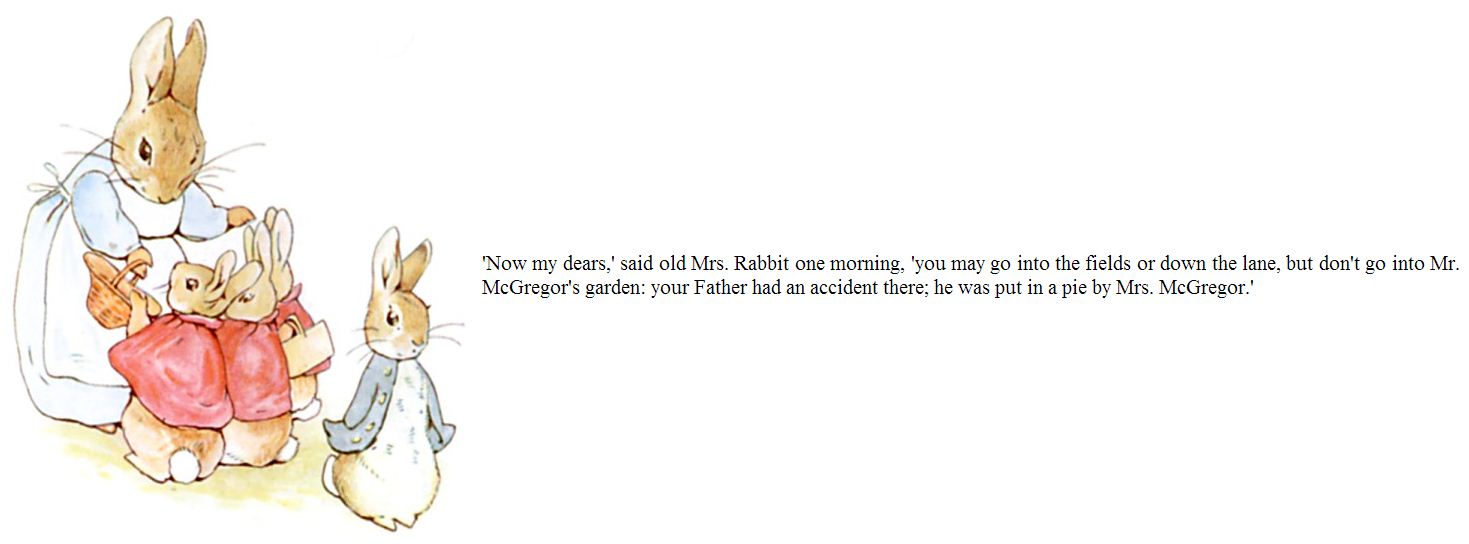
“Don’t go into Mr. McGregor’s garden: your Father had an accident there; he was put in a pie by Mrs. McGregor” (Beatrix Potter)

Capture

(Read The Tale of Peter Rabbit by Beatrix Potter).

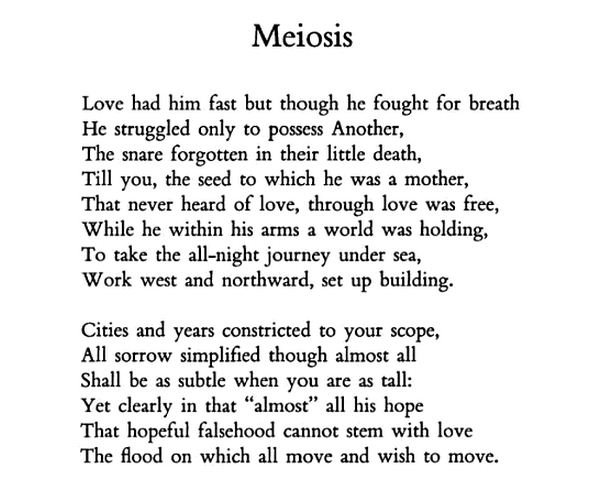
“Meiosis” — W.H. Auden

meiosis