The Origin of “Moby Dick”

Where did Herman Melville get the strange, marvelous name of the leviathan at the center of his strange, marvelous novel Moby-Dick? The name of the great white whale derives from  an 1839 article by Jeremiah Reynolds, “Mocha Dick: or The White Whale of the Pacific” (originally published in Knickerbocker Magazine). As the editors of Melville.org point out though (and thanks be unto them for all their hard, excellent work), how “Mocha Dick” morphed into “Moby Dick” remains “some strange piece of hermetic Melvillean arcana.” From Reynolds’s article

But to return to Mocha Dick — which, it may be observed, few were solicitous to do, who had once escaped from him. This renowned monster, who had come off victorious in a hundred fights with his pursuers, was an old bull whale, of prodigious size and strength. From the effect of age, or more probably from a freak of nature, as exhibited in the case of the Ethiopian Albino, a singular consequence had resulted — he was white as wool! Instead of projecting his spout obliquely forward, and puffing with a short, convulsive effort, accompanied by a snorting noise, as usual with his species, he flung the water from his nose in a lofty, perpendicular, expanded volume, at regular and somewhat distant intervals; its expulsion producing a continuous roar, like that of vapor struggling from the safety-valve of a powerful steam engine. Viewed from a distance, the practised eye of the sailor only could decide, that the moving mass, which constituted this enormous animal, was not a white cloud sailing along the horizon. On the spermaceti whale, barnacles are rarely discovered; but upon the head of this lusus naturae, they had clustered, until it became absolutely rugged with the shells. In short, regard him as you would, he was a most extraordinary fish; or, in the vernacular of Nantucket, “a genuine old sog”, of the first water.

Winterfell Weather Report

William T. Vollmann’s Favorite “Contemporary” Books

In a 1990 interview between William T. Vollmann and one of his editors Larry McCaffery. An excerpt from the interview appears as a list in the Vollmann reader Expelled from Eden, which is quickly becoming one of my favorite books (seriously, let’s have another volume—this is clearly the optimum Vollmann delivery system). I’ve kept Expelled from Eden’s  list format because, hey, let’s face it, we like lists—

LM: Who are your favorite contemporary authors?

WV: By “contemporary” I assume you mean “from the last two hundred years.”

1./2./3. Right now it seems like I’ve learned a lot from Mishima, Kawabata, and Tolstoy;

4. Hawthorne may be the best;

5. Then Faulkner;

6. Hemingway is usually a wonderful read, especially Islands in the Stream and For Whom the Bell Tolls—that is to say, the grandly suicidal narratives;

7. Tadeusz Konwicki’s A Dreambook for Our Time is beautiful;

8. I also love everything I’ve read by Mir Lagerkvist;

9. Sigrid Undset’s trilogy Kristin Lavransdatter;

10. Multatuli’s Max Havalaar, or the Coffee Auctions of the Dutch Trading Company;

11. Kundera’s Laughable Loves;

12. Andrea Freud Lowenstein’s This Place (which deserves more recognition than it has received);

13. Jane Smiley’s The Greenlanders (which I had the wonderful experience of finding and reading a few months after completing my own book about Greenlanders, The Ice-Shirt).

14. Evans and Agee’s Let Us Now Praise Famous Men;

15. Farley Mowat’s The People of the Deer;

16. The first three books of Mishima’s Sea of Fertility tetralogy (how could I have forgotten that?);

17. Random bits of Proust, Zola’sL’Assommoir;

18. Shusaku Endo’s The Samurai;

19.The first two books of Mervyn Peake’s Gormenghast trilogy;

20. William Hope Hodgson’s The Night Land;

21. Poe’s stories about love;

22. Everything by Malraux (especially his Anti-Memoirs);

23. Nabokov’s Glory and Transparent Things and Ada;

24. Melville’s Pierre;

25. Thomas Bernhard’s Correction;

26. David Lindsay’s Voyage to Acturus;

27. Philip K. Dick’s A Scanner Darkly;

28. A few of Boll’s short novels (Wo warst du, Adam? and The Train Was on Time);

29. Elsa Morante’s History: A Novel;

30. Maria Dermout’s The Ten Thousand Things;

31.  Walter M. Miller’s A Canticle for Leibowitz;

32. James Blish’s Cities in Flight tetralogy (which is just plane fun);

33. The first three volumes of Lawrence Durrell’sAlexandria Quartet, and I don’t know what all.

There’s lots more. I am sorry not to be able to put down less contemporary things such as Tale of Genji, which is one of my all-time favorites.

In the Company of Strangers — We Review Barry McCrea’s New Book About Queer Family Ties in Dickens, Joyce, and Proust

Barry McCrea’s In the Company of Strangers: Family and Narrative in Dickens, Conan Doyle, Joyce, and Proust is one of the more engaging works of literary criticism I’ve seen in some time. And while I’m interested in McCrea’s subjects (the weird lines between the Victorian era and modernism, family and marriage plots, Dickens and Joyce, etc.), it’s the clarity of his writing that I find most impressive. Clear, frank writing is too rare in current literary criticism. Here’s McCrea describing his project—

This book argues that the formal innovations of the high-modernist novel are inseparable from a fundamental rethinking of how family ties are formed and sustained. Genealogy was thematically and structurally central to the English nineteenth-century novel. In the Company of  Strangers shows how the formal strategies employed by Joyce and Proust grow out of an attempt to build a fully coherent narrative system that is not rooted in the genealogical family. Modernism’s rejection of the familiar and cultivation of the strange, in other words, are inseparable from its abandonment of the family and embrace of the bond with the stranger as an alternative to it.

[In the Company of Strangers] offers a reassessment of the relationship between the modernists and their Victorian predecessors, suggesting that the key precursor to this queer model of narrative can be located, paradoxically, in the genealogical obsession of the English nineteenth-century novel. Far from representing a clean break with the Victorian family novel, the radical narrative formalism of high modernism exploits the potential of an alternative queer plot that was already present as a formal building block in the nineteenth-century novel.

McCrea’s queer theory lens is keenly attuned to the homoerotic content present in the novels he examines, but his critical gaze is ultimately more interested in how “queer time” functions as an organizing principle throughout the structure of these narratives. McCrea argues that this queer model of time is a central and defining characteristic of literary modernism. The agent (or one agent) of queer time is “the stranger,” the character who figuratively threatens (and paradoxically defines) the family. McCrea points out that the typical Victorian marriage plot resolves the problem of the stranger by incorporating him or her into the family as a point of narrative resolution. In contrast, in “the queer modernist narrative strategies of Ulysses and the Recherche, the stranger rivals and ultimately usurps the family plot.”

McCrea sifts through family plots (and the strangers who would challenge or queer them) in Dickens (Oliver Twist, Bleak House, Great Expectations), Arthur Conan Doyle’s Sherlock Holmes stories, Ulysses (“a queer family epic”), and Proust’s big book. In the Company of Strangers constantly scrutinizes the ways that family organizes narrative (and narrative organizes family). The book also analyzes what “urban literature” might mean, examining what it means to live in proximity to one’s fellows, and the ways in which urban living necessitate ad hoc families.

In the Company of Strangers does a lovely job of tracing the strange currents that run from Victorian lit to modernism and beyond—currents that extend from our conceptions of family itself, and indeed, our conceptions of life and an end to life. McCrea’s writing is precise, supported by a close textual readings, and if I didn’t always agree with his conclusions, he achieved what every critic ought to aim for: he made me want to read the books he was writing about again.

In the Company of Strangers is new from Columbia University Press.

(Some Very Beautiful) Books Acquired, 9.17.2011

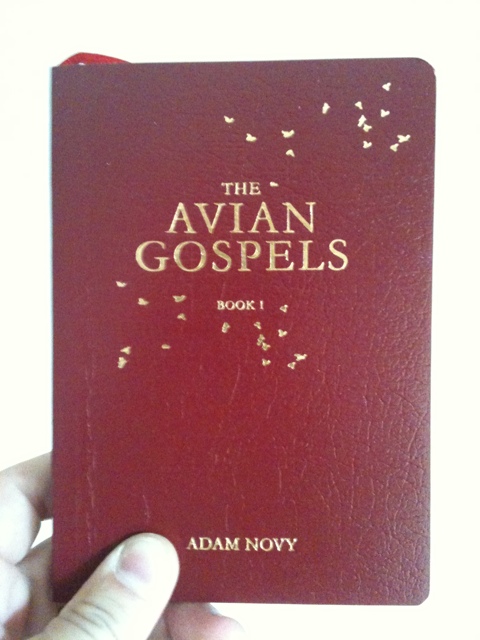
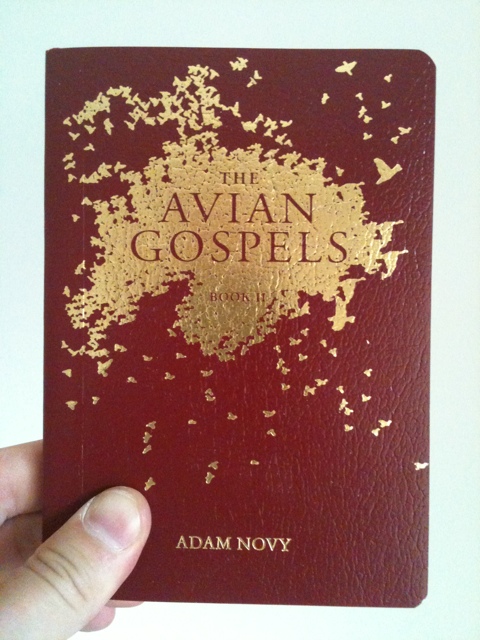
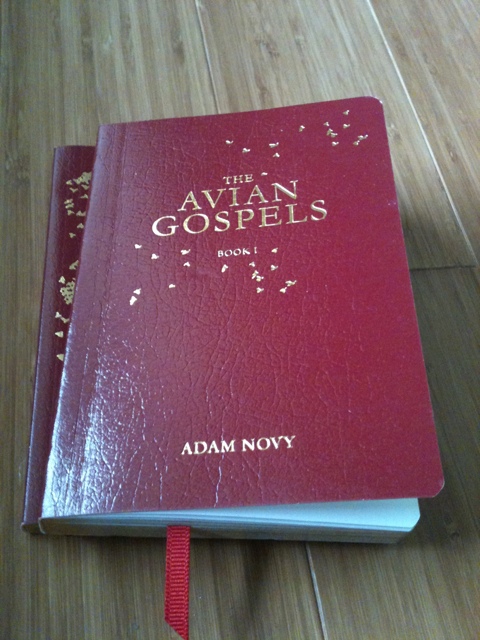
20110920-120114.jpg 20110920-120126.jpg 20110920-120138.jpg

Adam Novy’s début novel The Avian Gospels arrived at Biblioklept World Headquarters this Saturday. I was at a football game all day (drinking beer and then watching my alma mater’s team vanquish men in orange), so I didn’t get to dip into these gorgeous, strange books until the next day, at which point my four-year old daughter took possession of the second volume (declaring it beautiful) and pretended to read it on the couch with me.

I’ve read the first 80 or so pages since then; so far, The Avian Gospels is about a boy named Morgan and his father, both of whom have the power to control birds. This is a handy skill, as the strange, burnt world of Novy’s novel is afflicted by swarms and swarms of birds, creatures that the Gypsies claim to be the souls of all the dead who have died in the city’s endless warring with Hungary. Ruthless Judge Giggs, the tyrannical ruler of the city, wants to enlist the talents of Morgan and his father. The book is surreal, dystopian and perhaps post-apocalyptic, but also very funny and at times even heartwarming in its tender treatment of parent-child relationships. Full review forthcoming.

Good Offices — Evelio Rosero

In Poetics, that ancient didact Aristotle informs us that admirable drama adheres to unities of action, place, and time. There must be no extraneous subplots, just one central action confined to a specific and defined place and time—no more than 24 hours, in fact.

I was reminded of these (oft-broken) rules when reading Evelio Rosero’s Good Offices, a sharp, gleaming novel that illustrates just how effective these classical unities might be in the hands of a gifted author. Rosero’s tale snakes out over the course of only a few hours and takes place entirely in a Catholic church in Bogotá, Colombia. The action—more on that in a moment—is indivisible from the time and place.

Good Offices centers on Tancredo, a hunchback afflicted with “a terrible fear of being an animal.” Tancredo is basically an indentured servant of the church, strung along by Father Almida’s promises of a college education that never seems to surface. His great “cross to bear” is the program of Community Meals that Father Almida mandates (yet never helps execute) each night—charity meals for children, old people, blind people, whores, and families (all segregated by day of the week, naturally). In particular, Tancredo hates the nights for the old people, indigents who complain about the free food and then pretend to be dead so they don’t have to go back to the dark streets of Bogotá. Sometimes they do die though, and it’s Tancredo who must discover their abject corpses.

Aiding Tancredo in the family meal labor are Sabina Cruz, and the Lilias, three ancient widows of the same name who bear more than a passing resemblance to the Moirae. It is the Lilia’s lot to cook these massive meals, making something from nothing, essentially, a job made all the harder by their arthritic joints. They pester Tancredo mercilessly. Sabina doesn’t so much pester Tancredo as haunt him, imploring repeatedly that they run away together. She’s the sexton’s god-daughter, and like Tancredo she is more or less church property. What our cast shares in common is a suppressed humanity, that vital spark now ground down to a dim nub.

This feeling of endless, indefinite weariness hangs over our heroes at the beginning of the novel, as we see here, when the sexton and priest begin an interrogation of sorts of Tancredo—

. . . he felt worn out, exhausted: after the old people crawling around the hall, over and under the table, bathed in soup, stepped in filth and saliva, like a Roman orgy or a witches’s Sabbath, to have a to face the sacristan’s inquisition infuriated him. Once again he experienced the dreadful fear of becoming an animal, or the desire to be one, which was worse. He imagined himself dashing that table against the ceiling; kicking over the chairs of the Church’s two representatives; tipping out their occupants, pissing on their sacred heads; pursuing Sabina, pulling up her heavy lay sister’s skirt, ripping into the apparent innocence of her blouse, buttoned up to the neck, pawing her breasts, pinching her belly button, her thighs, her backside. Truly, he thought, aghast, he needed to confess to the Father about his dreadful fear of being an animal, and the sooner the better.

Rosero’s remarkable prose here twists through the writhing subsurface urges the Catholic Church has worked for hundreds of years to suppress. The writing is violent, funny, sexy, and passionate, culminating in a devastating punchline. The passage is indicative of the book’s strange blending of tones, a sardonic but also sensual crash course in the seven sins.

Almida is too busy to take the time to fully listen to Tancredo’s confession though—he and the sexton must rush to meet a rich benefactor (a gangster, of course). For the first time ever, Almida will miss the mass, necessitating a substitute: Father Matamoros.

To Tancredo’s horror, part of Matamoros’ preparation involves getting drunk; however, he sings the mass in a beautiful voice that entrances the congregants—including Tancredo and the Lilias, who are so enthralled they set to work preparing a feast. Matamoros insists they drink with him, and in time, our principals are all quite drunk, not just on the fine wine that Almida and the sexton secret away for themselves, but also on the Lilia’s rich feast and Matamoros’ splendid singing. These visceral pleasures inject a humanity (and real purpose for living) that has been missing in the church for far too long, and as the night creeps into the morning, the rapture caused by the stranger’s presence overwhelms our cast.

Having lost faith in Almida (and perhaps Catholicism and even God), Tancredo confesses to Matomoros. Before I offer another passage of Rosero’s sensual, intense writing, let me commend the work of translators Anne McLean and Anna Milsom. From Tancredo’s second confession—

Without knowing how, Tancredo resumed the conversation, as if he really had been holding that non-existent conversation with the Father, or did it exist?  Whatever the case, he said, or kept on saying, as if it were the most natural thing in the world, that he had dreamt, Father, that he had an Indian slave-girl, tied up in with a chain like an animal, and that he took her for a walk through a sunlit meadow, the sun, the smell of the sunshine, “everything full of the most terrible lustfulness, Father, hanging over our heads, it was impossible not to take her in my arms, the soft moss offered itself, the leafy oak gave its shade, she stretched out wearily on the grass, it wrapped itself around her like a sheet, offering her rest, and, with the same chain I used for leading her about, she drew me toward her, as if I were an animal and not her, and she spread her legs and all her Hell burned me, Father.”

Matamoros offers Tancredo comfort, if not wisdom, but in treating the young man like a human and not an animal in bondage, he underscores the simple but strong theme of the book.

I won’t spoil more of Good Offices, which I think you should read. It’s a compact, vigorous treat, often blue, sharp as a scimitar, and saturated in suspense. Like any good Aristotelian drama, Rosero’s novel offers catharsis for its audience, but its greater impact comes from what it withholds, from what is left implicit, lingering under the details that ball together toward an end that is funny, horrific, and quite moving. Highly recommended.

Good Offices is new from New Directions this month.
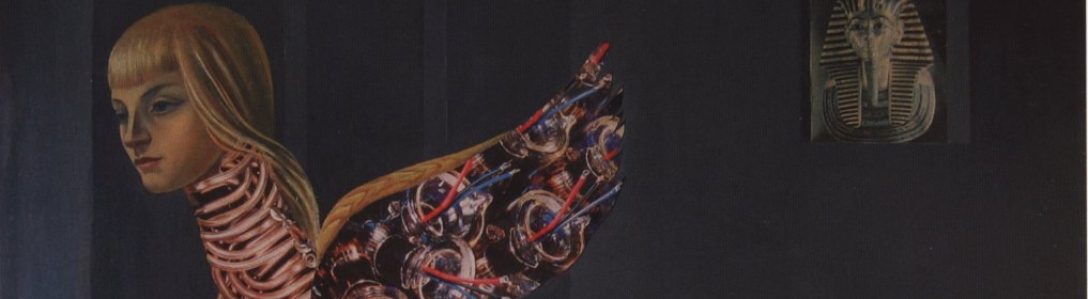
“List of Social Changes that Would Assist the Flourishing of Literary Beauty” — William T. Vollmann

“List of Social Changes that Would Assist the Flourishing of Literary Beauty” by William T. Vollmann. Originally published in his essay, “Something to Die For” (Review of Contemporary Fiction) but excised here from Expelled from Eden, the Vollmann reader I’m finding addictive—-

1. Abolish television, because it has no reverence for time.

2. Abolish the automobile, because it has no reverence for space.

3. Make citizenship contingent upon literacy in every sense. Thus, politicians who do not write every word of their own speeches should be thrown out of office in disgrace. Writers who require editors to make their books “good” should be depublished.

4. Teach reverence for all beauty, including that of the word.

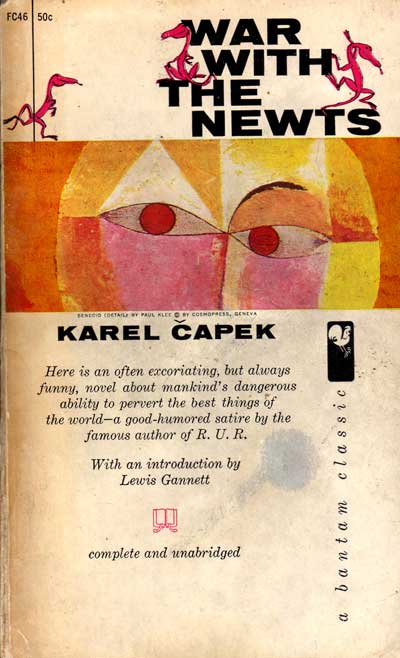
War With the Newts — Karel Capek


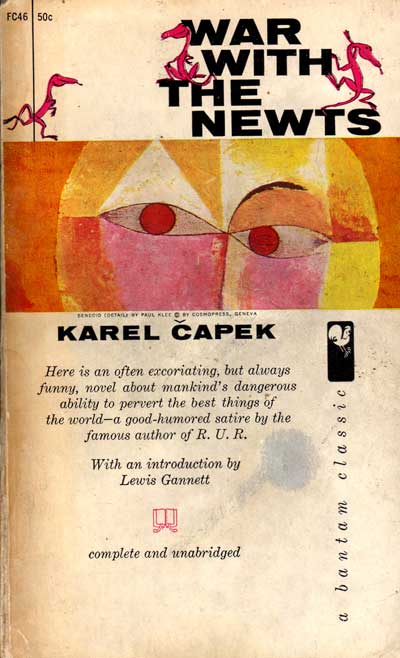
Even though the plot of War with the Newts may not shock audiences accustomed to its “human-invention-intended-for- good-becomes-in-the-end-not-so-good” story, readers shouldn’t neglect this often-overlooked science-fiction classic from 1937 by notable Czech writer and satirist Karel Capek.  Humans, motivated by a range of impulses: greed, curiosity, and sometimes even the best of intentions, have created an uncontrollable menace and brought about the end to their dominion over the planet.  Computers, robots, even monkeys have spelled doom for mankind, but Capek warned, in this short and sparkling book, that while masses of intelligent amphibians must be dealt with cautiously, true danger arises from our manipulation of the natural world, the unceasing capitalist drive to increase production by exploiting the weakest, and our inability to foresee the consequences of our actions.

The action begins when a drunk but benevolent sea captain discovers a new species of amphibians inhabiting the waters near an isolated island in the Pacific Ocean.  These docile creatures are able to breathe on land, walk on their hind legs, and communicate using rudimentary sounds and gestures.  The captain trains them to speak a pidgin English and dive for pearls before arming them so that they might fend off the sharks that prey on their young.  Once he receives generous financial backing from a Dutch conglomerate, he ships them to similar islands where pearl harvests have been been impossible or unproductive.  Eventually big business determines that the tireless and fecund newts are valuable for the expansion and development of economic activities near the coasts and under the seas and develop a global marketplace for trade in their labor and bodies.  Educated, well-equipped, and trained to use with the most advanced technologies, the newts produce the greatest expansion of wealth in the history of the world before taking it all for themselves, returning the continents to the bottom of the ocean while requiring a small cadre of humans, relocated to the mountains, to produce the steel and weapons required to support their new Atlantis.

Written as a history book, Capek brilliantly footnotes his narrative with carefully crafted primary sources: newspaper reports, academic studies, religious tracts, political manifestos and corporate minutes in order to illustrate human reaction to new, unsettling circumstance.  A nimble author blessed with the knowledge and skill to write comfortably about a wide variety of subjects, Capek captures both the progressive and cautious voices that shape human reaction to the slow advancement of a new and underestimated intelligence.  He shows that agreement against economic interest is impossible;  labor, for instance, bemoans loss of work to newt hordes while agriculture comes to rely on the millions of new mouths that have to be fed.  Scholars measure, analyze, and categorize; anonymous tract-writers urge an uneasy populace to take up arms against sea-dwelling usurpers while the young and fashionable flock to newt cults, giving themselves up to sexual licentiousness they relish the mysterious and taboo.

But though Capek capably documents trivialities, most of his accounts reflect the time in which he lived and wrote, between the two great European wars, situated between Stalin’s Russia and Hitler’s new Germany, at the height of colonial exploitation, not yet separated by a century from the horrors of the trans-Atlantic slave trade and the American Civil War.  In a report written by the “Salamander Syndicate,” the organization responsible for the organization and dissemination of the world trade in newts justifies the “humane” husbandry, categorization, and sale of newts according to their physical attributes.  Exemplary newts are invited to join committees and expound on their visions for a future shared with humans.  Echoes of American abolitionist thought appear in the debates waged in the media regarding the existence of newt art and culture, their assumed “soullessness,” and the minimal levels of education required for their lives as workers.

The newts, masters of human technology, eventually take over.  Humans, fleeing to higher ground,  are incapable of bringing the fight to the seas.   War with the Newts is an indictment not only of our ability to take without question unearned economic value, but also of our inability to halt the mechanisms by which we accrue those benefits once it becomes evident that the process of enrichment, by itself, is detrimental to the common good.  This is a very good book, a satire of the institutions that will fail when we need them the most, created by a writer whose demonstrated virtuosity deserves more attention.

“The Stench of Corpses” — William Vollmann Reviews William Vollmann

“The Stench of Corpses” is a self-review by William T. Vollmann of the poorly-received and rarely read book Argall, one of his “Seven Dreams” series (still incomplete). The piece originally ran in the October 7, 2001 edition of The Los Angeles Times, but I read it in Expelled from Eden, a Vollmann reader that I am very much enjoying.  There’s an immediate post-9/11 vibe running through Vollmann’s scathing review of Vollmann, culminating in his declaration that Argall is “positively un-American.”

“The Stench of Corpses”

A hundred years after William T. Vollmann was killed in a gun cleaning accident, I, William the Blind, received a commission to review the long novel “Argall,” which marks the midpoint of his uncompleted “Seven Dreams” series. According to Dombey’s “Easily Digested Biographies of Minor Authors,” which I just happen to have right here inside my reading pod, it was always Vollmann’s hope that the “Seven Dreams,” which were second in ambition only to his still-unpublished essay on violence, “Rising Up and Rising Down,” would “somehow, uh, mean something to people a hundred years from now.”

This desire is best understood as a form of wish compensation. Vollmann lived what can only be called a pathetic life. Isolated within and stubbornly estranged from millennial American society, he consoled himself with a sophomorically romantic belief that art, if protected in time capsules, can outlast Dark Ages. Let’s temporarily ignore the fact that Vollmann’s so-called art was never worth preserving, being infested by individualism, moral relativism and sexual depravity. More to the point, since stars, elephants and gods suffer death, how could even the greatest art be “immortal”? As we all know, the Liu-Mallinger Act of 2027, which made cranial stimulation devices compulsory for all inhabitants of the Global Trans-Industrial Zone, reduced the printed word to irrelevancy at last. Continue reading ““The Stench of Corpses” — William Vollmann Reviews William Vollmann”

The Scriptural Sperm Can No Longer Flow: Sade the Eunuch

The final section of Roland Barthes’ “Life of Sade,” a short biography of The Marquis de Sade. Translated from the French by Richard Miller.  Read the entire essay at Supervert.

22. Any detention is a system: a bitter struggle exists within this system, not to get free of it (this was beyond Sade’s power), but to break through its constraints. A prisoner for some twenty-five years of his life, Sade in prison had two fixations: outdoor exercise and writing, which governors and ministers were continually allowing and taking away from him like a rattle from a baby. The need and the desire for outdoor exercise are easily understood (although Sade always linked its privation to a symbolic theme, obesity). The repression, obviously, as anyone can see, of writing is as good as censoring the book; what is poignant here, however, is that writing is forbidden in its physical form; Sade was denied “any use of pencil, ink, pen, and paper.” Censored are hand, muscle, blood. Castration is circumscribed, the scriptural sperm can no longer flow; detention becomes retention; without exercise, without a pen, Sade becomes bloated, becomes a eunuch.

Book Acquired, 9.12.11 — Nathanael West Biography

20110912-050619.jpg

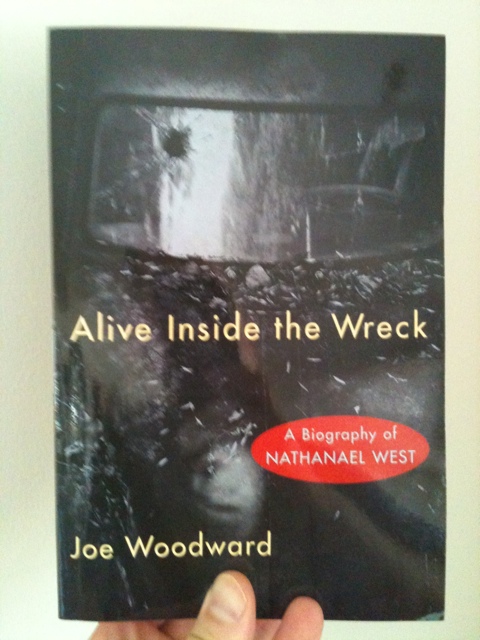
This one’s new from OR BooksJoe Woodward’s Alive Inside the Wreck: A Biography of Nathanael West. (Sorry for the extraordinarily amateurish photograph—the glossy cover spit back much light). I read the first three chapters this afternoon, and Woodward has a punchy, even terse style that I greatly appreciate in a literary biographer. It’s rare that the literary critic, “showing a little plumage,” to borrow a phrase from James Wood, knows when to remove himself from the text under discussion. Woodward’s writing here dispenses with any airy rhetoric, cutting sharply to bone in telegraphic sentences and short chapters.It’s the kind of  beginning that makes me want to keep reading. Here’s the publisher’s description—

From his name to his college transcript to his literary style, Nathanael West was self-invented. Born Nathan Weinstein, the author of the classics Miss Lonelyhearts (1933) and The Day of theLocust (1939) was an uncompromising artist obsessed with writing the perfect novel. He pursued his passion from New York to California, flirting dangerously with the bleak, faux-glamour of Hollywood as the country suffered through the grim realities of the Great Depression. At the center of a circle of vigorous young literary writers that included F. Scott Fitzgerald, Malcolm Cowley, William Carlos Williams, S. J. Perelman, and Dashiell Hammett, West rose to become one of the most original literary talents of the twentieth century—an accomplished yet regrettably underappreciated master of the short lyric novel.

In December of 1940, West — a notoriously bad driver — was racing back from a vacation in Mexico with his young bride of eight months when he crashed at full speed into another car. He was dead at 37. Just as he was finally starting to enjoy financial stability as a Hollywood screenwriter, he died in the California desert.

For this book, the first biography on West alone in over 40 years, Joe Woodward combed the archives at The Huntington Library and the John Hay Library at Brown University. He had access to personal letters, photographs, unpublished manuscripts and corrected typescripts as well as seldom-heard taped interviews with S. J. Perelman, Dalton Trumbo, Matthew Josephson and others.

Alive Inside the Wreck comes alive as it explores West’s struggle to survive both the writer’s life and the 1930s.


Candide — Voltaire

I liked pretty much all of the assigned reading in high school (okay, I hated every page of Tess of the D’Ubervilles). Some of the books I left behind, metaphorically at least (Lord of the Flies, The Catcher in the Rye), and some books bewildered me, but I returned to them later, perhaps better equipped (Billy Budd; Leaves of Grass). No book stuck with me quite as much as Candide, Voltaire’s scathing satire of the Enlightenment.

20110911-025457.jpg

I remember being unenthusiastic when my 10th grade English teacher assigned the book—it was the cover, I suppose (I stole the book and still have it), but the novel quickly absorbed all of my attention. I devoured it. It was (is) surreal and harsh and violent and funny, a prolonged attack on all of the bullshit that my 15 year old self seemed to perceive everywhere: baseless optimism, can-do spirit, and the guiding thesis that “all is for the best.” The novel gelled immediately with the Kurt Vonnegut books I was gobbling up, seemed to antecede the Beat lit I was flirting with. And while the tone of the book certainly held my attention, its structure, pacing, and plot enthralled me. I’d never read a book so willing to kill off major characters (repeatedly), to upset and displace its characters, to shift their fortunes so erratically and drastically. Not only did Voltaire repeatedly shake up the fortunes of Candide and his not-so-merry band—Pangloss, the ignorant philosopher; Cunegonde, Candide’s love interest and raison d’etre and her maid the Old Woman; Candide’s valet Cacambo; Martin, his cynical adviser—but the author seemed to play by Marvel Comics rules, bringing dead characters back to life willy nilly. While most of the novels I had been reading (both on my own and those assigned) relied on plot arcs, grand themes, and character development, Candide was (is) a bizarre series of one-damn-thing-happening-after-another. Each chapter was its own little saga, an adventure writ in miniature, with attendant rises and falls. I loved it.

I reread Candide this weekend for no real reason in particular. I’ve read it a few times since high school, but it was never assigned again—not in college, not in grad school—which may or may not be a shame. I don’t know. In any case, the book still rings my bell; indeed, for me it’s the gold standard of picaresque novels, a genre I’ve come to dearly love. Perhaps I reread it with the bad taste of John Barth’s The Sot-Weed Factor still in my mouth. As I worked my way through that bloated mess, I just kept thinking, “Okay, Voltaire did it 200 years earlier, much better and much shorter.”

Revisiting Candide for the first time in years, I find that the book is richer, meaner, and far more violent than I’d realized. Even as a callow youth, I couldn’t miss Voltaire’s attack on the Age of Reason, sustained over a slim 120 pages or so. Through the lens of more experience (both life and reading), I see that Voltaire’s project in Candide is not just to satirize the Enlightenment’s ideals of rationality and the promise of progress, but also to actively destabilize those ideals through the structure of the narrative itself. Voltaire offers us a genuine adventure narrative and punctures it repeatedly, allowing only the barest slivers of heroism—and those only come from his innocent (i.e. ignorant) title character. Candide is topsy-turvy, steeped in both irony and violence.

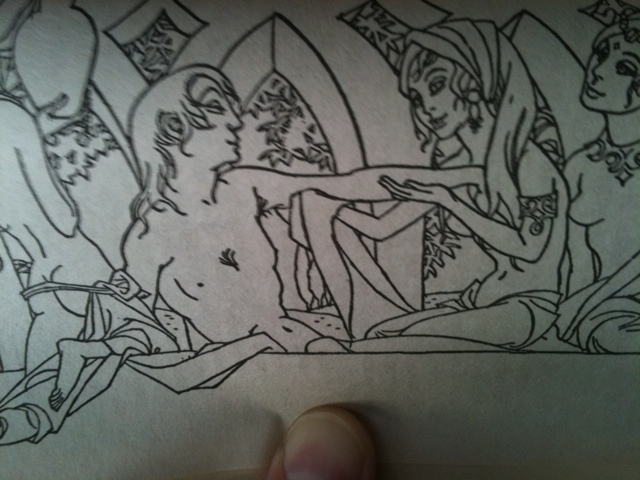
As a youth, the more surreal aspects of the violence appealed to me. (An auto-da-fé! Man on monkey murder! Earthquakes! Piracy! Cannibalizing buttocks!). The sexy illustrations in the edition I stole from my school helped intrigue me as well—

20110911-025719.jpg

The self who read the book this weekend still loves a narrative steeped in violence—I can’t help it—Blood Meridian, 2666, the Marquis de Sade, Denis Johnson, etc.—but I realize now that, despite its occasional cartoonish distortions, Candide is achingly aware of the wars of Europe and the genocide underway in the New World. Voltaire by turns attacks rape and slavery, serfdom and warfare, always with a curdling contempt for the powers that be.

But perhaps I’ve gone too long though without quoting from this marvelous book, so here’s a passage from the last chapter that perhaps gives summary to Candide and his troupe’s rambling adventures: by way of context (and, honestly spoiling nothing), Candide and his friends find themselves eking out a living in boredom (although not despair) and finding war still raging around them (no shortage of heads on spikes); Candide’s Cunegonde is no longer fair but “growing uglier everyday” (and shrewish to boot!), Pangloss no longer believes that “it is the best of all worlds” they live in, yet he still preaches this philosophy, Martin finds little solace in the confirmation of his cynicism and misanthropy, and the Old Woman is withering away to death. The group finds their only entertainment comes from disputing abstract questions—

But when they were not arguing, their boredom became so oppressive that one day the old woman was driven to say, “I’d like to know which is worse: to be raped a hundred times by Negro pirates, to have one buttock cut off, to run the guantlet in the Bulgar army, to be whipped and hanged in an auto-da-fé, to be dissected, to be a galley slave—in short, to suffer all the miseries we’ve all gone through—or stay here and do nothing.

“That’s a hard question,” said Candide.

It’s amazing that over 200 years ago Voltaire posits boredom as an existential dilemma equal to violence; indeed, as its opposite. (I should stop and give credit here to Lowell Blair’s marvelous translation, which sheds much of the finicky verbiage you might find in other editions in favor of a dry, snappy deadpan, characterized in Candide’s rejoinder above). The book’s longevity might easily be attributed to its prescience, for Voltaire’s uncanny ability to swiftly and expertly assassinate all the rhetorical and philosophical veils by which civilization hides its inclinations to predation and straight up evil. But it’s more than that. Pointing out that humanity is ugly and nasty and hypocritical is perhaps easy enough, but few writers can do this in a way that is as entertaining as what we find in Candide. Beyond that entertainment factor, Candide earns its famous conclusion: “We must cultivate our garden,” young (or not so young now) Candide avers, a simple, declarative statement, one that points to the book’s grand thesis: we must work to overcome poverty, ignorance, and, yes, boredom. I’m sure, gentle, well-read reader, that you’ve read Candide before, but I’d humbly suggest to read it again.

Citizen Sade

From Roland Barthes’ “Life of Sade,” a short biography of The Marquis de Sade. Translated from the French by Richard Miller.  Read the entire essay at Supervert.

20. A plurality of which Sade was well aware, since he laughs at it: in 1793, Citizen Sade was proposed as a juror in a common-law case (a matter of forged promissory notes): the dual hearing of the Sadian text (of which Sade’s life is a part): the apologist of crime and its judge are united in the same subject, as the Saussurian anagram is inscribed in a Vedic verse (but what remains of a subject that subjects itself with alacrity to a dual inscription?).

Books Acquired, 9.10.11

20110910-040358.jpg

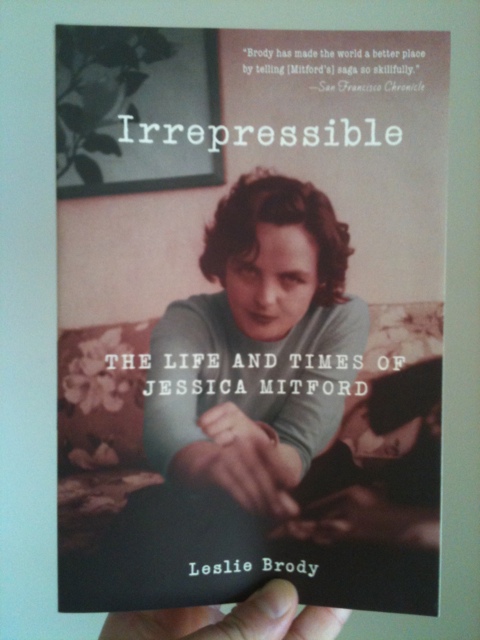
Two books in the mail today from Counterpoint Press, an expanding indie press with a broad but sharp catalog (including Soft Skull Press). The first is Irrepressible: The Life and Times of Jessica Mitford, a biography of the progressive upstart. From the press release—

Admirers and detractors use the same words to describe Jessica Mitford: subversive, mischief-maker, muckraker. J.K. Rowling calls Mitford her “most influential writer.” Those who knew her best simply called her “Decca.” Born into one of Britain’s most famous aristocratic families, Mitford eloped with Winston Churchill’s nephew to America as a teenager in 1939. A no-holds barred civil rights activist, outspoken communist, and feared journalist, Mitford rose to one of the New Deal’s most notorious bureaucrats. For her the personal was political. She coined the term “frenemies,”  and as a member of the American Communist Party, she made several, though not among the Cold War witch hunters. When she left the Communist Party in 1958 after fifteen years, she promised to be subversive whenever the opportunity arose. True to her word, late in life she hit her stride as a writer, publishing nine books before her death in 1996. With unrestricted access to the Mitford Family archives, Leslie Brody presents a moving, impeccably researched biography of one of the most influential women of the 20th century.

20110910-040407.jpg

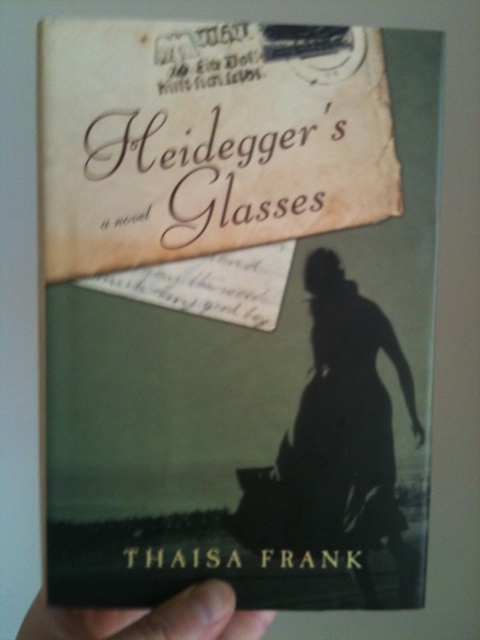
Heidegger’s Glasses is a novel by Thaisa Frank that seems promising. Description—

Magical and surreal, Heidegger’s Glasses offers a completely original vantage point on the Holocaust.  The story opens during the end of World War II in a failing Germany coming apart at the seams. The Third Reich’s strong reliance on the occult and the leading officials’ obsession with the astral plane has led to the formation of a secret Compound of Scribes–multilingual translators that have been spared from deportation to answer returned letters written to the dead in the concentration camps. Ellie Schacten, the mysterious heroine of the novel, supervises the Scribes, yet secretly uses the compound to hide a steadily growing number of refugees. When a letter arrives, written by eminent German philosopher Martin Heidegger to his friend and optometrist––a man who is now lost in the dying thralls of Auschwitz––a series of events unfold that turn the Reich’s attention to the compound and threaten Ellie’s operation and the lives of the Scribes.

Based on the real Third Reich procedure, Operation Mail, which forced concentration camp prisoners to send letters to loved ones extolling conditions in the camps, Heidegger’s Glasses explores a dark, absurd world in which fear and death are a constant companion, and yet, Frank’s characters show how that when stripped of their freedom and virtually all material possessions, the human spirit perseveres and thrives.

Sade’s Passion Was Theatrical, Not Erotic

From Roland Barthes’ “Life of Sade,” a short biography of The Marquis de Sade. Translated from the French by Richard Miller.  Read the entire essay at Supervert.

19. Throughout his life, the Marquis de Sade’s passion was not erotic (eroticism is very different from passion); it was theatrical: youthful liaisons with several young ladies of the Opéra, engaging the actor Bourdais to play for six months at La Coste, and in his torment, one idea: to have his plays performed; barely out of prison (1790), repeated requests to the actors of the Comédie Française; and finally, of course, theater at Charenton.

Sade Loved His Big Pillow

From Roland Barthes’ “Life of Sade,” a short biography of The Marquis de Sade. Translated from the French by Richard Miller.  Read the entire essay at Supervert.

18. Suddenly transferred from Vincennes to the Bastille, Sade made a great fuss because he had not been allowed to bring his big pillow, without which he was unable to sleep, since he slept with his head unusually high: “The barbarians!”.

It Is the Point One Is at that Makes a Thing Good or Bad, and Not the Thing Itself

From Roland Barthes’ “Life of Sade,” a short biography of The Marquis de Sade. Translated from the French by Richard Miller.  Read the entire essay at Supervert.

17. At Vincennes in 1783, the penitentiary administration forbade the prisoner’s receiving Rousseau’sConfessions. Sade comments: “They honor me in thinking that a deist author could be a bad book for me; I wish I were at that point… Understand, it is the point one is at that makes a thing good or bad, and not the thing itself… Start there, dear sirs, and by sending me the book I request, be sensible enough to understand that for died-in-the-wool bigots like yourselves, Rousseau can be a dangerous author, and that makes it an excellent book for me. For me, JeanJacques is what the Imitation of Christ is for you…” Censorship is abhorrent on two levels: because it is repressive, because it is stupid; so that we always have the contradictory urge to combat it and to teach it a lesson.