
- “A story there passeth of an Indian king that sent unto Alexander a fair woman, fed with aconite and other poisons, with this intent complexionally to destroy him!” –Sir T. Browne.
- Dialogues of the unborn, like dialogues of the dead,–or between two young children.
- A mortal symptom for a person being to lose his own aspect and to take the family lineaments, which were hidden deep in the healthful visage. Perhaps a seeker might thus recognize the man he had sought, after long intercourse with him unknowingly.
- Some moderns to build a fire on Ararat with the remnants of the ark.
- Two little boats of cork, with a magnet in one and steel in the other.
- To have ice in one’s blood.
- To make a story of all strange and impossible things,–as the Salamander, the Phoenix.
Category: Literature
“The writer has three sources: imagination, observation, and experience” — William Faulkner
Unidentified participant: Sir, a few minutes ago you mentioned that people in your hometown were looking into your books for familiar characters. Realizing that you’ve got a rich legacy as it were, of experiences, it seems to me that nowadays the modern novelist is writing merely thinly disguised autobiography. Which do you think is really more valuable [in] the sense of the artist, the disguised autobiography, or making it up from whole cloth, as it were?
William Faulkner: I would say that the writer has three sources: imagination, observation, and experience. He himself doesn’t know how much of which he uses at any given moment because each of the sources themselves are not too important to him, that he is writing about people, and he uses his material from the three sources, as—as—as the carpenter reaches into his—his lumber room and finds a board that fits the particular corner he’s building. Of course, any writer, to begin with, is writing his—his own biography, because he has—has discovered the world and suddenly discovered that it—the world is—is important enough or moving enough or tragic enough to put down on paper or in music or on canvas. And at that time all he knows is what has happened to him because he has not developed his capacity to—to perceive, to draw conclusions, to have an insight into people. His only insight in it is into himself. And it’s biographical because that’s the only gauge he has to measure, is what he has experienced himself. As he gets older and works more, the imagination is like any muscle, it improves with use. Imagination develops. His observation gets shrewder as he gets older, as he writes, and so that when he reaches his peak, his best years, when his work is best, he himself doesn’t know and doesn’t have time to bother and doesn’t really care how much of what comes from each of these sources. That then he is writing about people, writing about the aspirations, the—the troubles, the anguishes, the—the—the courage and the cowardice, the baseness and the splendor of—of man, of the human heart.
Transcend it spiritually, or eroticize it carnally (Thomas Pynchon’s Mason & Dixon)
“If one did not wish to suffer Horror directly,” comments the Revd in his Day-Book, “one might either transcend it spiritually, or eroticize it carnally,— the sex Entrepreneurs reasoning that the combination of Equatorial heat, sweat, and the flesh of strangers in enforc’d intimacy might be Pleasurable,— that therefore might some dramatiz’d approach to death under such circumstances be pleasurable as well, with all squirming together in a serpent’s Nest of Limbs and Apertures and penises, immobiliz’d in a bondage of similarly bound bodies, lubricated with a gleaming mixture of their own shar’d sweat, piss, and feces, nothing to breathe but one another’s exhausted breaths, moving toward some single slow warm Explosion. . . .”
An abject passage from Ch. 14 of Thomas Pynchon’s novel Mason & Dixon. The entire chapter seems with unseemliness, as Cornelius Vroom forces Dixon to witness the debauchery of the Cape Dutch.
“Adventure” — W.H. Auden

Serpent, Worm, or Dragon (Thomas Pynchon’s Mason & Dixon)
One cloudless afternoon they stand in the scent of an orange-grove,— as tourists elsewhere might stand and gape at some mighty cataract or chasm,— nose-gaping, rather, at a manifold of odor neither Englishman has ever encountered before. They have been searching for it all the long declining Day,— it is the last Orange-Grove upon the Island,— a souvenir of a Paradise decrepit. Shadows of Clouds dapple the green hillsides, Houses with red Tile roofs preside over small Valleys, the Pasturelying soft as Sheep,— all, with the volcanic Meadow where the two stand, circl’d by the hellish Cusps of Peaks unnatural,— frozen in mid-thrust, jagged at every scale.
“Saint Brendan set out in the fifth century to discover an Island he believ’d was the Paradise of the Scriptures,— and found it. Some believ’d it Madeira, Columbus was told by some at Madeira that they had seen it in the West, Philosophers of our own Day say they have prov’d it but a Mirage. So will the Reign of Reason cheerily dispose of any allegations of Paradise.”
“Yet suppose this was the Island. He came back, did he not? He died the very old Bishop of the Monastery he founded at Clonfert, as far from the Western Sea as he might, this side of Shannon. Perhaps that was Paradise. Else, why leave?”
“A Riddle! Wondrous! Just the Ticket! Why, ere ’tis solv’d, we may be back in England and done with this!”
“The Serpent, being the obvious Answer.”
“What Serpent?”
“The one dwelling within the Volcanoe, Mason, surely you are not ignorant upon the Topick?”
“Regretfully, Sir,— ”
“Serpent, Worm, or Dragon, ’tis all the same to It, for It speaketh no Tongue but its own. It Rules this Island, whose ancient Curse and secret Name, is Disobedience. In thoughtless Greed, within a few pitiably brief Generations, have these People devastated a Garden in which, once, anything might grow. Their Muck-heaps ev’rywhere, Disease, Madness. One day, not far distant, with the last leaf of the last Old-Father-Never-Die bush destroy’d, whilst the unremitting Wind carries off the last soil from the last barren Meadow, with nought but other Humans the only Life remaining then to the Island,— how will they take their own last step,— how disobey themselves into Oblivion? Simply die one by one, alone and suspicious, as is the style of the place, till all are done? Or will they rather choose to murder one another, for the joy to be had in that?”
“How soon is this, that we’re talking about?”
“Pray we may be gone by then. We have our own ways of Disobedience,— unless I presume,— express’d in the Motto of Jakob Bernouilli the second,— Invito Patre Sidera Verso,— ‘Against my father’s wishes I study the stars.”’
From Thomas Pynchon’s novel Mason & Dixon. The conversation is between Mason and the English Royal Astronomer Nevil Maskelyne; the volcano under discussion is St. Helena.
The authors William Faulkner consistently returned to
Unidentified participant: Sir, when you are reading for your own pleasure, which authors do you consistently return to?
William Faulkner: The ones I came to love when I was eighteen, nineteen, twenty years old. Moby-Dick, the Old Testament, Shakespeare, a lot of Conrad, Dickens. I read Don Quixote every year.
Thomas Pynchon’s Mason & Dixon (First Riff)
A. Mason & Dixon: I bought my copy at Shaman Bookstore in Chiang Mai, Thailand, in the fall of 2002. I had just read and absorbed V., but could not get into Mason & Dixon. Chalk up this initial failure to the novel’s daunting scope, the formal characteristics of its faux-18th c. style, too much Thai whiskey, etc. I made attempts again over the years, sporadic ones, small dents, etc., including a half-hearted attempt after reading the book’s sort-of sequel, Against the Day last year. But of course I needed space from/for a big-assed Pynchon novel, so, a year later, I finally commit to Mason & Dixon. I’ve read the first 15 chapters.
B. “against the Day”: The phrase leaps out in the third paragraph of Chapter 13 (p. 125), imploring me to read Mason & Dixon as a prequel of sorts to Against the Day. The themes, motifs, and formal devices of both novels are utterly Pynchonian, of course (he tautologically types): Paranoia, global powers contesting for domination, science, adventure, means and methods of conveyance, dick jokes, ditties, inebriating substances, all manner of rascalism, man’s inhumanity to etc. And condiments!
C. “ketjap”: Against the Day gave us a history of the cult of mayonnaise; Mason & Dixon is the ketchup book. (Not really but maybe really).
D. “The Learned English Dog”: We meet this marvelous beast, this talking dog, early in the novel, and he of course reminds me immediately of Pugnax, the loyal and brave companion to the Chums of Chance in Against the Day.
E. “invisible”: Just as in Against the Day, Pynchon sounds the note “invisible” repeatedly to highlight some of the Big Themes of the novel. Mason & Dixon is about The Age of Reason, or about the limitations of The Age of Reason, or about the limitations of even the very conceptualization of an Age of Reason—an age when “Men of Science” like our titular Daring Duo sought to make the invisible—the passage of the stars and time itself—visible, measurable, defined, bordered, colonized, etc.
F. “…please do not come to the Learned English Dog if it’s religious Comfort you’re after. I may be preternatural, but I am not supernatural. ‘Tis the Age of Reason, rrrf? There is ever an Explanation at hand, and no such thing as a Talking Dog,—Talking Dogs belong with Dragons and Unicorns.” Said the Talking Dog.
G. “inconvenience”: The first time I notice the word—another of Pynchon’s signatures—is in Ch. 3 (p. 28). It stands out: A sailor by the name of Fender-Belly Bodine claims that he once sailed on the H.M.S. Inconvenience. The Chums of Chance of course sail the heavens on their airship The Inconvenience.
H. But again: “inconvenience” (and iterations of the same) thread through Mason & Dixon: Why? What to make of the word? Perhaps—just a perhaps—The Age of Reason is really a rhetorical substitution for The Age of Convenience, the Age of Better Living (For Some Folks) Through Science. Convenience: The application of some kind of method or utility—relies on measurement, on demarcation, on prediction, etc. Convenience, then, perhaps then, as the practical aim of the age of science.
I. And Inconvenience, then, perhaps then, as a disruptive metaphysical force (?).
J. I’ve neglected entirely to remark on the 18th c. style. Maybe another time.
K. Also the songs.
L. But I will, before closing, remark quickly on how much I enjoy how Pynchon riffs on jocular forms—jokes you mean, right?—to compose elements of the narrative. Early on, Dixon tries to tell a joke about “this Jesuit, this Corsican, and this Chinaman” before he’s stopped by a mortified Mason; they return to the joke about a hundred pages later (still no punchline). Globalization is already there.
M. (Also: An extended episode in the Dutch Cape of South Africa riffs repeatedly on the farmer’s daughters joke. No insight at all here—just love how Pynchon uses the joke to move his narrative along).
M. Okay, then: Just a few opening notes, just a little riff, a sketch, some initial ideas. More to come. Loving the book so far.
Tales of Sorcery, invisible Beings, daily efforts to secure Shelter against Demonic Infestation (Pynchon’s Mason & Dixon)
Mason makes quick Head-Turns, to Left and Right, and lowers his Voice. “Whilst you’ve been out rollicking with your Malays and Pygmies, what have you heard of the various sorts of Magick, that they are said to possess?”
Dixon has in fact heard, from an assortment of Companions native to the Dutch Indies. Tales of Sorcery, invisible Beings, daily efforts to secure Shelter against Demonic Infestation.
“They are not as happy, nor as childlike, as they seem,” he tells Mason. “It may content us, as unhappy grown Englishmen, to think that somewhere in the World, Innocence may yet abide,— yet ’tis not among these people. All is struggle,— and all but occasionally in vain.”
Mason cocks his head, trying to suppress a certain Quiver that also gives him away when at Cards,— a bodily Desire to risk all upon a single Trick. “Would you happen to enjoy Entree to this world of Sorcery? I
am anxious as to Protection.”
“A Spell…?” Dixon suggests.
“Emphatickally not a Love-Potion, you understand, no, no, quite the contrary indeed.”
Dixon, to spare himself what might else prove to be Evenings-ful of Complaint, says, “I’ve met people who are said to possess a special Power,— the Balinese Word is Sakti. It has not, however, always been successful against Dutchmen. Would this be a Hate potion, then, that tha require?”
“Well, certainly not Hate. Inconvenient as Love, in its own way,— no, more of an Indifference-Draught, ‘s more what I had in mind. ‘Twould have to be without odor or Taste, and require but a few Drops,—”
“I could have a look about, tho’ ’tis more common here to accept what they happen to offer…?”
From Thomas Pynchon’s novel Mason & Dixon.
J.G. Ballard’s “The Subliminal Man,” John Carpenter’s They Live, and Black Friday
Today is Black Friday in America. I don’t think it’s necessary to remark at length on the bizarre disjunction between this exercise in consumerism-as-culture and the intended spirit of the Thanksgiving holiday that precedes it. Indeed, I think that the cognitive dissonance that underwrites Black Friday—the compulsion to suffer (and cause suffering), both physically and mentally, to “save” money on “consumer goods” (sorry for all the scare quotes, but these terms are euphemisms and must be placed under suspicion)—I think that this cognitive dissonance is nakedly apparent to all who choose to (or are forced to) actively engage in Black Friday. The name itself is dark, ominous, wonderfully satanic.
Rereading “The Subliminal Man,” I was struck by how presciently J.G. Ballard anticipated not only the contours of consumerist culture—urban sprawl, a debt-based economy, the mechanization of leisure, the illusion of freedom of choice—but also how closely he intuited the human, psychological responses to the consumerist society he saw on the horizon. Half a century after its publication, “The Subliminal Man” seems more relevant than ever.
The premise of the tale is fairly straightforward and fits neatly with the schema of many other early Ballard stories: Franklin, an overworked doctor, is approached by Hathaway, a “crazy beatnik,” who refuses to take part in the non-stop consumerism of contemporary society. Hathaway can “see” the subliminal messages sent through advertising. He asks for Franklin’s help in stopping the spread of these messages. Hathaway reasons that the messages are intended to enforce consumerist society:
Ultimately we’ll all be working and spending twenty–four hours a day, seven days a week. No one will dare refuse. Think what a slump would mean – millions of lay–offs, people with time on their hands and nothing to spend it on. Real leisure, not just time spent buying things . . .
The fear of a slump. You know the new economic dogmas. Unless output rises by a steady inflationary five per cent the economy is stagnating. Ten years ago increased efficiency alone would raise output, but the advantages there are minimal now and only one thing is left. More work. Subliminal advertising will provide the spur.
Franklin is unconvinced, even though he is already working Saturdays and Sunday mornings to payoff TVs, radios, and other electronic goods that he and his wife replace every few months. Soon, however, he realizes that something is wrong:
He began his inventory after hearing the newscast, and discovered that in the previous fortnight he and Judith had traded in their Car (previous model 2 months old) 2 TV sets (4 months) Power mower (7 months) Electric cooker (5 months) Hair dryer (4 months) Refrigerator (3 months) 2 radios (7 months) Record player (5 months) Cocktail bar (8 months)
Franklin finally sees the truth, but only after Hathaway takes to blowing up signs’ switch boxes (the word “terrorism” is of course not used in the text, although it surely would be today):
Then the flicker of lights cleared and steadied, blazing out continuously, and together the crowd looked up at the decks of brilliant letters. The phrases, and every combination of them possible, were entirely familiar, and Franklin knew that he had been reading them for weeks as he passed up and down the expressway.
BUY NOW BUY NOW BUY NOW BUY NOW BUY NEW CAR NOW NEW CAR NOW NEW CAR NOW
YES YES YES YES YES YES YES YES YES YES
Like many Ballard stories, “The Subliminal Man” ends on a pessimistic note, with Franklin choosing to ignore his brief enlightenment and give in. Ballard drives his criticism home in the final image of the story, with Franklin and his wife heading out to shop:
They walked out into the trim drive, the shadows of the signs swinging across the quiet neighbourhood as the day progressed, sweeping over the heads of the people on their way to the supermarket like the blades of enormous scythes.
“The Subliminal Man” offers a critique of consumerism that John Carpenter would make with more humor, violence, and force in his 1988 film They Live. In Carpenter’s film, the hero John Nada (played by Roddy Piper) finds a pair of sunglasses that allow him to see through the ads, billboards, and other commercials he’s exposed. What’s underneath? Naked consumerism:
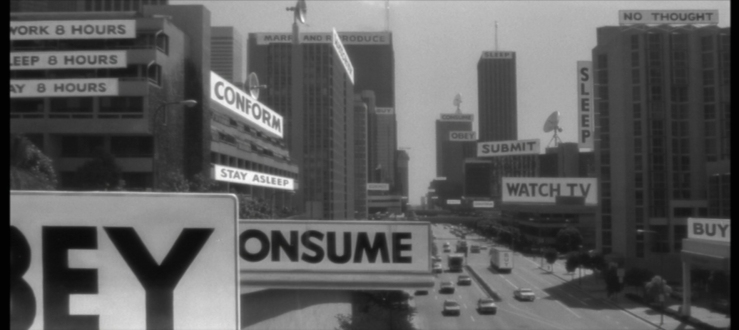
The images here recall the opening lines of “The Subliminal Man”: ‘The signs, Doctor! Have you seen the signs?’ Like Ballard’s story, Carpenter’s film is about waking up, to seeing the controlling messages under the surface.
In his film The Pervert’s Guide to Ideology, Slavoj Žižek offers a compelling critique of just how painful it is to wake up to these messages:
It’s worth pointing out that Carpenter offers a far more optimistic vision than Ballard. Ballard’s hero gives in—goes back to sleep, shuts his eyes. Carpenter’s hero Nada resists the subliminal messages—he actually takes up arms against them. This active resistance is possible because Carpenter allows his narrative an existential escape hatch: In They Live, there are real, genuine bad guys, body-snatching ugly-assed aliens—others that have imposed consumerism on humanity to enslave them. That’s the big trick to They Live: It’s not us, it’s them.
Ballard understands that there is no them; indeed, even as the story skirts around the idea of a conspiracy to dupe consumers into cycles of nonstop buying, working, and disposing, it never pins that conspiracy on any individual or group. There’s no attack on corporations or government—there’s not even a nebulous “them” or “they” that appears to have controlling agency in “The Subliminal Man.” Rather, Ballard’s story posits ideology as the controlling force, with the only escape a kind of forced suicide.
I don’t think that those who engage in consumerism-as-sport, in shopping-as-a-feeling are as blind as Ballard or Carpenter represent. I think they are aware. Hell, they enjoy it. What I think Ballard and Carpenter (and others, of course) really point to is the deep dissatisfaction that many of us feel with this dominant mode of life. For Ballard, we have resistance in the form of the beatnik Hathaway, an artist, a creator, a person who can perceive what real leisure would mean. For Carpenter, Nada is the resister—an outsider, a loner, a weirdo too. It’s somehow far more satisfying to believe that those who engage in spectacle consumerism are brainwashed by aliens than it is to have to come to terms with the notion that these people are acting through their own agency, of their own will and volition. Happy shopping everyone!
Ed. note: Biblioklept published a version of this post last year. It is offered again now in the spirit of Thanksgiving leftovers.
Grape People and Grain People (Pynchon’s Mason & Dixon)
Mason, having expected some shambling wild Country Fool, remains amiably puzzl’d before the tidied Dixon here presented,— who, for his own part, having despite talk of Oddity expected but another overdress’d London climber, is amus’d at Mason’s nearly invisible Turn-out, all in Snuffs and Buffs and Grays.
Mason is nodding glumly. “I must seem an Ass.”
“If this is as bad as it gets, why I can abide thah’. As long as the Spirits don’t run out.”
“Nor the Wine.”
“Wine.” Dixon is now the one squinting. Mason wonders what he’s done this time. ” ‘Grape or Grain, but ne’er the Twain,’ as me Great- Uncle George observ’d to me more than once,— ‘Vine with Corn, beware the Morn.’ Of the two sorts of drinking Folk this implies, than’ is, Grape People and Grain People, You will now inform rne of Your membership in the Brotherhood of the, eeh, Grape…? and that You seldom, if ever, touch Ale or Spirits, am I correct?”
“Happily so, I should imagine, as, given a finite Supply, there’d be more for each of us, it’s like Jack Sprat, isn’t it.”
“Oh, I’ll drink Wine if I must…?— and now we’re enter’d upon the Topick,— ”
“— and as we are in Portsmouth, after all,— there cannot lie too distant some Room where each of us may consult what former Vegetation pleases him?”
Dixon looks outside at the ebbing wintry sunlight. “Nor too early, I guess…?”
“We’re sailing to the Indies,— Heaven knows what’s available on Board, or out there. It may be our last chance for civiliz’d Drink.”
“Sooner we start, the better, in thah’ case…?”
As the day darkens, and the first Flames appear, sometimes reflected as well in Panes of Glass, the sounds of the Stables and the Alleys grow louder, and chimney-smoke perambulates into the Christmastide air. The Room puts on its Evening-Cloak of shifting amber Light, and sinuous Folds of Shadow. Mason and Dixon become aware of a jostling Murmur of Expectancy.
All at once, out of the Murk, a dozen mirror’d Lanthorns have leapt alight together, as into their Glare now strolls a somewhat dishevel’d Norfolk Terrier, with a raffish Gleam in its eye,— whilst from somewhere less illuminate comes a sprightly Overture upon Horn, Clarinet, and Cello, in time to which the Dog steps back and forth in his bright Ambit.
Ask me anything you please,
The Learned English Dog am I,
well-Up on ev’rything from Fleas Unto the King’s Mon-og-am-eye,
Persian Princes, Polish Blintzes, Chinamen’s Geo-mancy,—
Jump-ing Beans or Flying Machines, Just as it suits your Fan-cy.
I quote enough of the Classickal Stuff To set your Ears a-throb,
Work logarith-mick Versed Sines Withal, within me Nob,
– Only nothing Ministerial, please, Or I’m apt to lose m’ Job,
As, the Learned English Dog, to-ni-ight!There are the usual Requests. Does the Dog know “Where the Bee Sucks”? What is the Integral of One over (Book) d (Book)? Is he married? Dixon notes how his co-Adjutor-to-be seems fallen into a sort of Magnetickal Stupor, as Mesmerites might term it. More than once, Mason looks ready to leap to his feet and blurt something better kept till later in the Evening. At last the Dog recognizes him, tho’ now he is too key’d up to speak with any Coherence. After allowing him to rattle for a full minute, the Dog sighs deeply. “See me later, out in back.”
“It shouldn’t take but a moment,” Mason tells Dixon. “I’ll be all right by myself, if there’s something you’d rather be doing….”
From Thomas Pynchon’s novel Mason & Dixon.
“The Thanksgiving of the Wazir”
“The Thanksgiving of the Wazir”
A Punjabi Tale
Collected in Andrew Lang’s The Olive Fairy Book
Once upon a time there lived in Hindustan two kings whose countries bordered upon each other; but, as they were rivals in wealth and power, and one was a Hindu rajah and the other a Mohammedan bâdshah, they were not good friends at all. In order, however, to escape continual quarrels, the rajah and the bâdshah had drawn up an agreement, stamped and signed, declaring that if any of their subjects, from the least to the greatest, crossed the boundary between the two kingdoms, he might be seized and punished.
One morning the bâdshah and his chief wazir, or prime minister, were just about to begin their morning’s work over the affairs of the kingdom, and the bâdshah had taken up a pen and was cutting it to his liking with a sharp knife, when the knife slipped and cut off the tip of his finger.
‘Oh-he, wazir!’ cried the king, ‘I’ve cut the tip of my finger off!’
‘That is good hearing!’ said the wazir in answer.
‘Insolent one,’ exclaimed the king. ‘Do you take pleasure in the misfortunes of others, and in mine also? Take him away, my guards, and put him in the court prison until I have time to punish him as he deserves!’
Instantly the officers in attendance seized upon the luckless wazir, and dragged him out of the king’s presence towards the narrow doorway, through which unhappy criminals were wont to be led to prison or execution. As the door opened to receive him, the wazir muttered something into his great white beard which the soldiers could not hear.
‘What said the rascal?’ shouted the angry king. Continue reading ““The Thanksgiving of the Wazir””
A Bunch of Literary Recipes
Enjoy Thanksgiving with this menu of literary recipes:
F. Scott Fitzgerald’s Turkey Twelve Ways
Zora Neale Hurston’s Mulatto Rice
James Joyce’s Burnt Kidney Breakfast
Herman Melville’s Whale Steaks
Ernest Hemingway’s Absinthe Cocktail, Death in the Afternoon
Vladimir Nabokov’s Eggs à la Nabocoque
Thomas Pynchon’s Banana Breakfast
Robert Crumb’s Macaroni Casserole
Truman Capote’s Caviar-Smothered Baked Potatoes with 80-Proof Russian Vodka
Emily Dickinson’s Cocoanut Cake
Thomas Jefferson’s Vanilla Ice Cream
Christmas Bonus: George Orwell’s Recipes for Plum Cake and Christmas Pudding
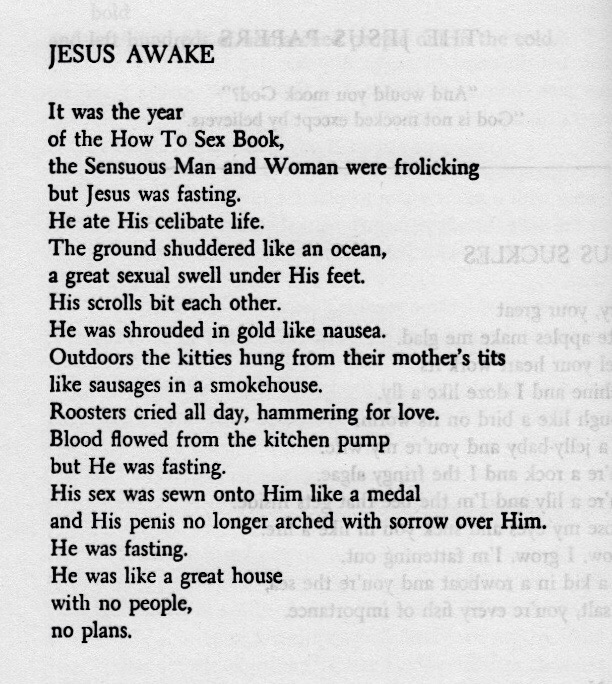
“Jesus Awake” — Anne Sexton
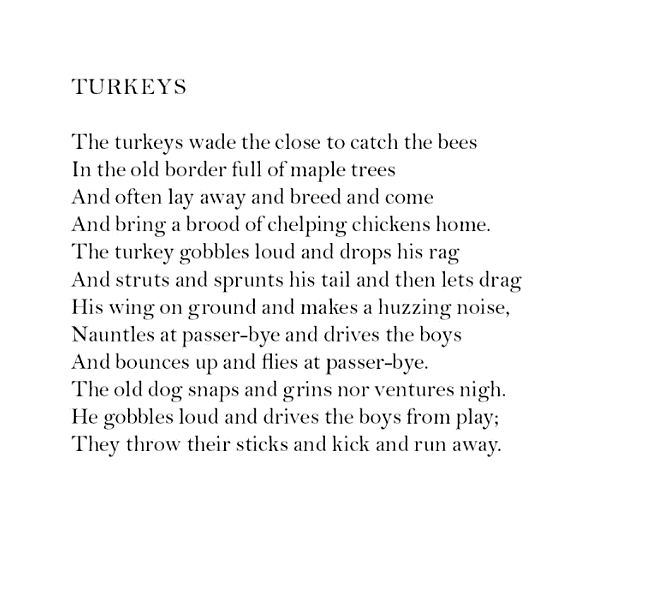
“Turkeys” — John Clare
This is Thanksgiving Day, a good old festival | Nathaniel Hawthorne’s Journal Entry for November 24, 1843
Thursday, November 24th.–This is Thanksgiving Day, a good old festival, and we have kept it with our hearts, and, besides, have made good cheer upon our turkey and pudding, and pies and custards, although none sat at our board but our two selves. There was a new and livelier sense, I think, that we have at last found a home, and that a new family has been gathered since the last Thanksgiving Day. There have been many bright, cold days latterly,–so cold that it has required a pretty rapid pace to keep one’s self warm a-walking. Day before yesterday I saw a party of boys skating on a pond of water that has overflowed a neighboring meadow. Running water has not yet frozen. Vegetation has quite come to a stand, except in a few sheltered spots. In a deep ditch we found a tall plant of the freshest and healthiest green, which looked as if it must have grown within the last few weeks. We wander among the wood-paths, which are very pleasant in the sunshine of the afternoons, the trees looking rich and warm,–such of them, I mean, as have retained their russet leaves; and where the leaves are strewn along the paths, or heaped plentifully in some hollow of the hills, the effect is not without a charm. To-day the morning rose with rain, which has since changed to snow and sleet; and now the landscape is as dreary as can well be imagined,–white, with the brownness of the soil and withered grass everywhere peeping out. The swollen river, of a leaden hue, drags itself sullenly along; and this may be termed the first winter’s day.
“Two Thanksgiving Day Gentlemen” — O. Henry
“Two Thanksgiving Day Gentlemen”
by
O. Henry
There is one day that is ours. There is one day when all we Americans who are not self-made go back to the old home to eat saleratus biscuits and marvel how much nearer to the porch the old pump looks than it used to. Bless the day. President Roosevelt gives it to us. We hear some talk of the Puritans, but don’t just remember who they were. Bet we can lick ’em, anyhow, if they try to land again. Plymouth Rocks? Well, that sounds more familiar. Lots of us have had to come down to hens since the Turkey Trust got its work in. But somebody in Washington is leaking out advance information to ’em about these Thanksgiving proclamations.
The big city east of the cranberry bogs has made Thanksgiving Day an institution. The last Thursday in November is the only day in the year on which it recognizes the part of America lying across the ferries. It is the one day that is purely American. Yes, a day of celebration, exclusively American.
And now for the story which is to prove to you that we have traditions on this side of the ocean that are becoming older at a much rapider rate than those of England are—thanks to our git-up and enterprise.
Stuffy Pete took his seat on the third bench to the right as you enter Union Square from the east, at the walk opposite the fountain. Every Thanksgiving Day for nine years he had taken his seat there promptly at 1 o’clock. For every time he had done so things had happened to him—Charles Dickensy things that swelled his waistcoat above his heart, and equally on the other side. Continue reading ““Two Thanksgiving Day Gentlemen” — O. Henry”
William Faulkner reads his short story “Shingles for the Lord”
Pap got up a good hour before daylight and caught the mule and rid down to Killegrews’ to borrow the froe and maul. He ought to been back with it in forty minutes. But the sun had rose and I had done milked and fed and was eating my breakfast when he got back, with the mule not only in a lather but right on the edge of the thumps too.
“Fox hunting,” he said. “Fox hunting. A seventy-year-old man, with both feet and one knee, too, already in the grave, squatting all night on a hill and calling himself listening to a fox race that he couldn’t even hear unless they had come up onto the same log he was setting on and bayed into his ear trumpet. Give me my breakfast,” he told maw. “Whitfield is standing there right this minute, straddle of that board tree with his watch in his hand.”
And he was. We rid on past the church, and there was not only Solon Quick’s school-bus truck but Reverend Whitfield’s old mare too. We tied the mule to a sapling and hung our dinner bucket on a limb, and with pap toting Killegrew’s froe and maul and the wedges and me toting our ax, we went on to the board tree where Solon and Homer Bookwright, with their froes and mauls and axes and wedges, was setting on two upended cuts, and Whitfield was standing jest like pap said, in his boiled shirt and his black hat and pants and necktie, holding his watch in his hand. It was gold and in the morning sunlight it looked big as a full-growed squash.
“You’re late,” he said.
So pap told him again about how Old Man Killegrew had been off fox hunting all night, and nobody at home to lend him the froe but Mrs. Killegrew and the cook. And naturally, the cook wasn’t going to lend none of Killegrew’s tools out, and Mrs. Killegrew was worser than deaf than even Killegrew. If you was to run in and tell her the house was afire, she would jest keep on rocking and say she thought so, too,[audience laughter] unless she began to holler back to the cook to turn the dogs loose before you could even open your mouth.
 Biblioklept