White Wines, a Three Act Play by Gertrude Stein

WHITE WINES
THREE ACTS

by

Gertrude Stein

(from Geography and Plays)

All together.
Witnesses.
House to house.
(5 women)

All together.

Cunning very cunning and cheap, at that rate a sale is a place to use type writing. Shall we go home.
Cunning, cunning, quite cunning, a block a strange block is filled with choking.
Not too cunning, not cunning enough for wit and a stroke and careless laughter, not cunning enough.
A pet, a winter pet and a summer pet and any kind of a pet, a whole waste of pets and no more hardly more than ever.
A touching spoon a real touching spoon is golden and show in that color. A really touching spoon is splendid, is splendid, and dark and is so nearly just right that there is no excuse.
The best way is to wave an arm, the best way is to show more used to it than could be expected.
Comfort a sudden way to go home, comfort that and the best way is known.

All together.

Hold hard in a decision about eyes. Hold the tongue in a sober value as to bunches. See the indication in all kinds of rigorous landscapes. Spell out what is to be expected.
Show much blame in order and all in there, show much blame when there is a breath in a flannel. Show the tongue strongly in eating. Puzzle anybody.
Violet and the ink and the old ulster, shut in trembling and a whole departure, flood the sunshine, terrorize the grown didy, mingle sweetness with communion.

All together.

Change the sucking with a little sucking.
Modify the brave gallant pin wheel. Show the shout, worry with wounds, love out what is a pendant and a choke and a dress in together.
Punish the grasshopper with needles and pins are plenty. Show the old chink.
All together.
Put the putty in before the door put the oil glass in with what is green. Put the mellow choice with all the test, rust with night and language in the waist. Praise the cat and show the twine the door, mention every scrap of linen carpet, see the eagle and behold the west, win the day light with the hat unpressed, show it in a shudder and a limp, make a best container with no speed, and a jacket and a choice and beets, beets are what there are when bets are less. Bets are less in summer.

Single Witnesses

(I). A spread out case is so personal it is a mountain of change and any little piece is personal, any one of them is an exchange. No forethought is removed. Nothing, hindrances, butter, a safe smooth, a safe why is a tongue a season, why is a loin large by way of spoiling. There is no cake in front. A choking is an example.

More witnesses.

It is true, it certainly is true and a coat any coat, any dress, all dress, a hat, many hats, all colors, every kind of coloring, all this makes shadows longer and birds, makes birds, just makes birds.
Not much limping is in the back, not much limping is in the front, not much limping is circular, a bosom, a candle, an elegant foot fall, all this makes daylight.

Single Witnesses.

(2). A blunder in a charger is blue. A high pocket not higher than the wrist and the elbow, the pocket is not added.
A clutch, a real clutch is merry and a joke and a baby, a real clutch is such a happy way. A real clutch is so soon worried so easily made the same, so soon made so.
A real white and blue, blue and blue, blue is raised by being so and more much more is ready. At last a person is safe.

More witnesses.

Pile in the windows, freeze with the doors, paint with the ceiling, shut in the floors, paint with the ceiling, paint with the doors, shut in the ceiling, shut out the doors, shut in the doors, shut in the floors, shut in the floors, shut in the doors.

More Witnesses.

Put the patient goat away, put the patient boat away, put away the boat and put it, the boat, put it, put away that boat. Put away the boat.

Single Witnesses.

(3). An army of invincible and ever ready mustaches and all the same mind and a way of winding and no more repertoire, not any more noise, this did increase every day.
A moon, a moon, a darkness and the stars and little bits of eels and a special sauce, not a very special sauce, not only that.
A wide pair that are not slippers, not a wide pair of slippers, not pressed to be any of that in that particular but surely, surely, surely a loan, surely every kind of a capital.

More Witnesses.

A splendid little charles louis philip, a splendid spout of little cups and colds, a splendid big stir, a splendid glass, a splendid little splinter, a splendid cluster.

Single Witnesses.

(4). Why should wet be that and cut, cut with the grass, why should wet be that and clut with the purse, why should wet be wet and the wet that wet. Why should wet be the time to class. Why should there be solemn cuppings.
The lean bark, that is the round and intense and common stop and in shouting, the left bark and the right bark and a belt, in that belt, in no belt and a corset, in a belt and chores, in a belt and single stitches, in more boys than enough, in all thin beer and in all such eggs, in all the pile and in all the bread, in the bread, in the bread, in the condition of pretty nearly saying that yesterday is today, and tomorrow, tomorrow is yesterday. The whole swindle is in short cake and choice cake is white cake and white cake is sponge cake and sponge cake is butter.

House to house.

(1). A habit that is not left by always screaming, a habit that is similar to the one that made quiet quite quiet and made the whole plain show dust and white birds and little plaintive drops of water, a habit which brightened the returning butter fly and the yellow weed and even tumbling, the habit which made a well choose the bottom and refuses all chances to change, the habit that cut in two whatever was for the use of the same number, the habit which credited a long touch with raising the table and the hour glass and even eye glasses and plenty of milk, the habit which made a little piece of cheese wholesome and darkness bitter and clanging a simple way to be solemn, a habit which has the best situation and nearly all the day break and the darkness a habit that is cautious and serious and strange and violent and even a little disturbed, a habit which is better than almost anything, a habit that is so little irritating, so wondering and so unlikely is not more difficult than every other.
(2). A change a real change is made by a piece, by any piece by a whole mixture of words and likenesses and whole outlines and ranges, a change is a butt and a wagon and an institution, a change is a sweetness and a leaning and a bundle, a change is no touch and buzzing and cruelty, a change is no darkness and swinging and highness, a change is no season and winter and leaving, a change is no stage and blister and column, a change is no black and silver and copper, a change is no jelly and anything proper, a change is not place, a change is not church, a change is not more clad, a change is not more in between when there is that and the change is the kind and the king is the king and the king is the king and the king is the king.
(3). Could there be the best almost could there be almost the most, could there be almost almost, could there be the most almost. Could there be the most almost, could there be the most almost, could there be almost almost. Could there be almost, almost.
Can the stretch have any choice, can the choice have every chunk, can the choice have all the choice, can the stretch have in the choice. Can there be water, can there be water and water. Can there be water. Can there be.
(4). A cousin to cooning, a cousin to that and mixed labor and a strange orange and a height and a piece of holy phone and a catching hat glass and a bit of undertaking. All this makes willows and even then there is no use in dusting not in really redusting, not in really taking everything away. The best excuse for shadows is in the time when white is starched and hair is released and all the old clothes are in the best bag.

House to house.

A wet hurt and a yellow stain and a high wind and a color stone, a place in and the whole real set all this and each one has a chin. This is not a claim it is a reorganization and a balance and a return.

The center of the self is this secret, obsessive, often silly, nearly continuous voice (William H. Gass)

Yet I should like to suggest (despite the undeniable sappiness of it) that the center of the self is this secret, obsessive, often silly, nearly continuous voice – the voice that is the surest sign that we are alive; and that one fundamental function of language is the communication with this self which makes it feasible; that, in fact, without someone speaking, someone hearing, someone overhearing both, no full self can exist; that if society – its families and factories and congresses and schools – has done its work, then every day every one of us is a bit nearer than we were before to being one of the fortunates who have made rich and beautiful the great conversation which constitutes our life.

From William H. Gass’s essay “On Talking to Oneself” (collected in Habitations of the Word).

“The Gambler, the Nun, and the Radio” — Ernest Hemingway

“The Gambler, the Nun, and the Radio”

by

Ernest Hemingway

THEY brought them in around midnight and then, all night long, everyone along the corridor heard the Russian.
‘Where is he shot?’ Mr. Frazer asked the night nurse.

‘In the thigh, I think.’
‘What about the other one?’
‘Oh, he’s going to die, I’m afraid.’
‘Where is he shot?’
‘Twice in the abdomen. They only found one of the bullets.’

They were both beet workers, a Mexican and a Russian, and they were sitting drinking coffee in an all-night restaurant when someone came in the door and started shooting at the Mexican. The Russian crawled under a table and was hit, finally, by a stray shot fired at the Mexican as he lay on the floor with two bullets in his abdomen. That was what the paper said.

The Mexican told the police he had no idea who shot him.
He believed it to be an accident.

‘An accident that he fired eight shots at you and hit you twice, there?’
‘Si, señor,’ said the Mexican, who was named Cayetano Ruiz, ‘An accident that he hit me at all, the cabron,’ he said to the interpreter.
‘What does he say?’ asked the detective sergeant, looking across the bed at the interpreter.
‘He says it was an accident.’
‘Tell him to tell the truth, that he is going to die,’ the detective said.
‘Na,’ said Cayetano. ‘But tell him that I feel very sick and would prefer not to talk so much.’
‘He says that he is telling the truth,’ the interpreter said.
Then, speaking confidently, to the detective, ‘He don’t know who shot him. They shot him in the back.’
‘Yes,’ said the detective. ‘I understand that, but why did the bullets all go in the front?’
‘Maybe he is spinning around,’ said the interpreter.
‘Listen,’ said the detective, shaking his finger almost at Cayetano’s nose, which projected, waxen yellow, from his dead-man’s face in which his eyes were alive as a hawk’s, ‘I don’t give a damn who shot you, but I’ve got to clear this thing up. Don’t you want the man who shot you to be punished? Tell him that,’ he said to the interpreter.
‘He says to tell who shot you.’
‘Mandarlo al carajo,’ said Cayetano, who was very tired.
‘He says he never saw the fellow at all,’ the interpreter said. ‘I tell you straight they shot him in the back.’
‘Ask him who shot the Russian.’
‘Poor Russian,’ said Cayetano. ‘He was on the floor with his head enveloped in his arms. He started to give cries when they shoot him and he is giving cries ever since. Poor Russian.’
‘He says some fellow that he doesn’t know. Maybe the same fellow that shot him.’
‘Listen,’ the detective said. ‘This isn’t Chicago. You’re not a gangster. You don’t have to act like a moving picture. It’s all right to tell who shot you. Anybody would tell who shot them. That’s all right to do. Suppose you don’t tell who he is and he shoots somebody else. Suppose he shoots a woman or a child. You can’t let him get away with that. You tell him,’ he said to Mr. Frazer. ‘I don’t trust that damn interpreter.’
‘I am very reliable,’ the interpreter said. Cayetano looked at Mr. Frazer.
‘Listen, amigo,’ said Mr. Frazer. ‘The policeman says that we are not in Chicago but in Hailey, Montana. You are not a bandit and this has nothing to do with the cinema.’
‘I believe him,’ said Cayetano softly. ‘Ya lo creo.’
‘One can, with honour, denounce one’s assailant. Every one does it here, he says. He says what happens if after shooting you, this man shoots a woman or a child?’
‘I am not married,’ Cayetano said.
‘He says any woman, any child.’
‘The man is not crazy,’ Cayetano said.
‘He says you should denounce him,’ Mr. Frazer finished.
‘Thank you,’ Cayetano said. ‘You are of the great translators. I speak English, but badly. I understand it all right. How did you break your leg?’
‘A fall off a horse.’
‘What bad luck. I am very sorry. Does it hurt much?’
‘Not now. At first, yes.’
‘Listen, amigo,’ Cayetano began, ‘I am very weak. You will pardon me. Also I have much pain; enough pain. It is very possible that I die. Please get this policeman out of here because I am very tired.’ He made as though to roll to one side; then held himself still.
‘I told him everything exactly as you said and he said to tell you, truly, that he doesn’t know who shot him and that he is very weak and wishes you would question him later on,’ Mr. Frazer said.
‘He’ll probably be dead later on.’
‘That’s quite possible.’
‘That’s why I want to question him now.’
‘Somebody shot him in the back, I tell you,’ the interpreter said.
‘Oh, for Chrisake,’ the detective sergeant said, and put his notebook in his pocket.
Outside in the corridor the detective sergeant stood with the interpreter beside Mr. Frazer’s wheeled chair.
‘I suppose you think somebody shot him in the back too?’
‘Yes,’ Frazer said. ‘Somebody shot him in the back. What’s it to you?’
‘Don’t get sore,’ the sergeant said. ‘I wish I could talk spick.’
‘Why don’t you learn?’
‘You don’t have to get sore. I don’t get any fun out of asking that spick question. If I could talk spick it would be different.’
‘You don’t need to talk Spanish,’ the interpreter said. ‘I’m a very reliable interpreter.’
‘Oh, for Chrisake,’ the sergeant said. ‘Well, so long. I’ll come up and see you.’
‘Thanks. I’m always in.’
‘I guess you are all right. That was bad luck all right. Plenty bad luck.’
‘It’s coming along good now since he spliced the bone.’
‘Yes, but it’s a long time. A long, long time.’
‘Don’t let anybody shoot you in the back.’
‘That’s right,’ he said. ‘That’s right. Well, I’m glad you’re not sore.’
‘So long,’ said Mr. Frazer.

Mr. Frazer did not see Cayetano again for a long time, but each morning Sister Cecilia brought news of him. He was so uncomplaining she said and he was very bad now. He had peritonitis and they thought he could not live. Poor Cayetano, she said. He had such beautiful hands and such a fine face and he never complains. The odour, now, was really terrific. He would point toward his nose with one finger and smile and shake his head, she said. He felt badly about the odour. It embarrassed him, Sister Cecilia said. Oh, he was such a fine patient. He always smiled. He wouldn’t go to confession to Father but he promised to say his prayers, and not a Mexican had been to see him since he had been brought in. The Russian was going out at the end of the week. I could never feel anything about the Russian, Sister Cecilia said. Poor fellow, he suffered too. It was a greased bullet and dirty and the wound infected, but he made so much noise and then I always like the bad ones. That Cayetano, he’s a bad one. Oh, he must really be a bad one, a thoroughly bad one, he’s so fine and delicately made and he’s never done any work with his hands. He’s not a beet worker. I know he’s not a beet worker. His hands are as smooth and not a callous on them. I know he’s a bad one of some sort. I’m going down and pray for him now. Poor Cayetano, he’s having a dreadful time and he doesn’t make a sound. What did they have to shoot him for? Oh, that poor Cayetano! I’m going right down and pray for him.
She went right down and prayed for him.

Continue reading ““The Gambler, the Nun, and the Radio” — Ernest Hemingway”

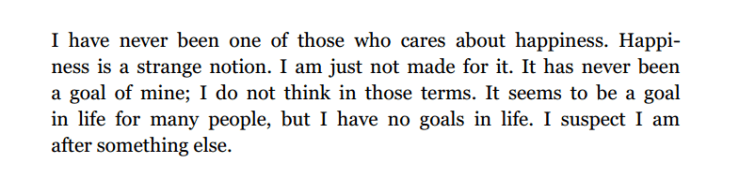
Happiness is a strange notion (Werner Herzog)

wh

Watch Yoji Kuri’s The Midnight Parasites, A Short Film Inspired by Hieronymus Bosch

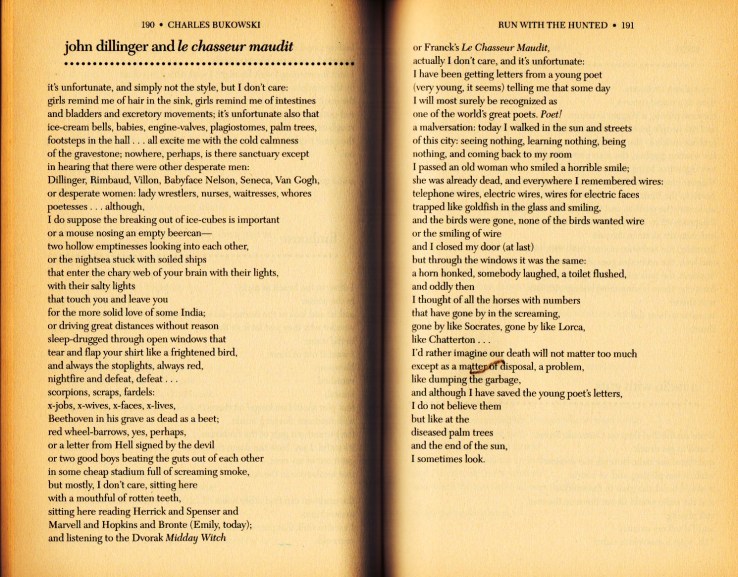
“John Dillinger and Le Chasseur Maudit” — Charles Bukoswki

IMG_3056

A Conversation about Ben Lerner’s Novel 10:04 (Part 1)

1004

[Context/editorial note: Ben Lerner’s new novel 10:04 wasn’t on my radar until Ryan Chang, who has been contributing reviews, riffs, citations, and other good stuff to this blog for the some time now, brought it up. He digs it, I don’t—but in fairness, I haven’t finished it yet. I was determined to abandon it, but Ryan’s emails kept me interested enough to continue; our conversation of the past five days is presented below. The book frustrates and rewards; at times I’ve laughed out loud and at other moments I’ve sprained my eyeballs by rolling them. More to come, because this is pretty long—but I think Ryan, who offers the bulk of the analysis here, makes a strong case for Lerner’s book. — ET].   

Edwin Turner: Got an e-galley of the Lerner book. I don’t know if it’s that I’m almost exactly the same age as Lerner/the narrator or what, but I really really hate it so far! He’s very smart and the sentences are often great, but I find myself rolling my eyes at a lot of what he’s doing—it’s probably me not him. The narrative voice strikes me as so thoroughly inauthentic that I want to grab the narrator by the lapels and shout, Quit aping Sebald, quit trying to show how clever you are, and just observe and report! Again, it’s probably me not him.

Ryan Chang: I know what you mean; though it won’t bear any difference to your reading, I can attest personally to the diction & syntax of the narrator and Lerner himself (indeed, he does speak like that). I don’t think it’s an affectation, but I think it’s real “poet-y.” It is a criticism I forgive b/c I see that the tension between authenticity (of time) and inauthenticity (of time; especially exemplified in the Whole Foods/Instant coffee scene — which narrative context of time determines the Real, the Market (or its interpretation of Universal time) or our intuition (something like Whitmanic time, where time is experienced not on a linear, progressive plane but a circular, lateral one?)) is a crucial thread that runs throughout 10:04 and in Lerner’s other work. That said, I know  that in reviews to come of the book he’ll get slammed for that (I think the Kirkus review already did this).

A lot of my friends echo your distaste for Lerner for those exact same reasons, and I totally see why, and I’m kind of annoyed by it too. For me, the success of the book lies in the reclamation of fiction as a communal space from fetish book object/commercial futurity (author advances, agents, contracts, etc. — you already get some of this early on but there is more to come in a beautifully scathing scene of the NYC literary scene) And also, a kind of shiv to the Standard American Novelistic Form that reinforces traditional forms of American identity-making that Gass/Gaddis/Markson et al. have been doing for years and, I think, a poisonous strain of American political sentimentality that keeps most of us “depressed.” I think, too, because I’ve read it twice now, that there is an acknowledgment of his complicity in the very machines he participates in, and an inability, at least on his own, to dismantle those systems. Not sure if we should forgive him for criticizing the bourgeois Food Co-Op while being a member, albeit begrudgingly or tolerate his admission. There’s a lot of celebration of Whitmanic politics in that book, a return to a kind of Whitmanic democratic person is a return to a democratic reading is a return to a “real” democracy shared through the space of the book, of the position of the reader looking at an object and knowing that her “I” is shared amongst several. I’m not sure if you’ve gotten here yet, but he keeps intoning this phrase “bad forms of collectivity” as a better solution than nothing, than “modernist difficulty as resistance to the market.”

The Sebald comparison is apt, esp. with the form & diction & syntax, and I agree with you–Sebald is the master. There’s also something to be said, though, that this kind of fiction-making is badly needed in contemporary American letters on the Big 5 Publishing scene. I mean, I can’t read another fucking book about Brooklyn parents or mid-career Manhattan artist crises without wringing my neck. The kind of book Sebald innovated, too, is able to dismantle received ideas of art/history/writing/identity etc.;  I may be being too generous here, but I think it’s a form that will see continued adoption on this side of the pond.

ET: So your response made me return to the book, Ryan. The line that made me quit was something like, “The place was so quiet I could hear the bartender mixing our artisanal cocktails” or something like that—-I’m still not sure how to read that line as anything but a parody, but I think that the narrator, author, and writer are all sincere in trying to capture or document a particular time/feeling with the phrase. And as I continued reading, I was rewarded by the episode of the older poets/mentors, and their “daughter,” whom the narrator obsessed over—a very fine passage—humorous, reflective, a kind of parodic-but-sincere take on wanting to belong to a particular artistic scene. (What continues to unsettle me is the narrator’s assurance of his own achievement, although I could be wrong).

Continue reading “A Conversation about Ben Lerner’s Novel 10:04 (Part 1)”

Read James Purdy’s short story “The White Blackbird”

“The White Blackbird”

by

James Purdy

EVEN BEFORE I REACHED my one hundredth birthday, I had made several wills, and yet just before I put down my signature

Delia Mattlock

my hand refused to form the letters. My attorney was in despair. I had outlived everyone and there was only one person to whom I could bequeath much, my young godson, and he was not yet twenty-one.
I am putting all this down more to explain the course of events to myself than to leave this as a document to posterity, for as I say, outside of my godson, Clyde Furness, even my lifelong servants have departed this life.
The reason I could not sign my name then is simply this: piece by piece my family jewels have been disappearing over the last few years, and today as I near my one hundred years all of these precious heirlooms one by one have vanished into thin air.
I blamed myself at first, for even as a young girl I used to misplace articles, to the great sorrow of my mother. My great grandmother’s gold thimble is an example. You would lose your head if it wasn’t tied on, Mother would joke rather sourly. I lost my graduation watch, I lost my diamond engagement ring, and, if I had not taken the vow never to remove it, my wedding ring to Will Mattlock would have also taken flight. I will never remove it and will go to my grave wearing it.
But to return to the jewels. They go back in my family over two hundred years, and yes, piece by piece, as I say, they have been disappearing. Take my emerald necklace — its loss nearly finished me. But what of my diamond earrings, the lavaliere over a century old, my ruby earrings — oh, why mention them? For to mention them is like a stab in the heart.
I could tell no one for fear they would think I had lost my wits, and then they would blame the servants, who were I knew blameless, such perfect, even holy, caretakers of me and mine.
But there came the day when I felt I must at least hint to my godson that my jewels were all by now unaccounted for. I hesitated weeks, months before telling him.
About Clyde now. His Uncle Enos told me many times that it was his heartbroken conviction that Clyde was somewhat retarded. “Spends all his time in the forest,” Enos went on, “failed every grade in school, couldn’t add up a column of figures or do his multiplication tables.”
“Utter rot and nonsense,” I told Enos. “Clyde is bright as a silver dollar. I have taught him all he needs to know, and I never had to teach him twice because he has a splendid memory. In fact, Enos, he is becoming my memory.”
Then of course Enos had to die. Only sixty, went off like a puff of smoke while reading the weekly racing news.
So then there was only Clyde and me. We played cards, chess, and then one day he caught sight of my old Ouija board.
I went over to where he was looking at it. That was when I knew I would tell him — of the jewels vanishing, of course.
Who else was there? Yet Clyde is a boy, I thought, forgetting he was now twenty, for he looked only fourteen to my eyes.
“Put the Ouija board down for a while,” I asked him. “I have something to tell you, Clyde.”
He sat down and looked at me out of his handsome hazel eyes.
I think he already knew what I was to say.
But I got out the words.
“My heirloom jewels, Clyde, have been taken.” My voice sounded far away and more like Uncle Enos’s than mine.
“All, Delia?” Clyde whispered, staring still sideways at the Ouija board.
“All, all. One by one over the past three years they have been slipping away. I have almost wondered sometimes if there are spirits, Clyde.”
He shook his head.
Continue reading “Read James Purdy’s short story “The White Blackbird””

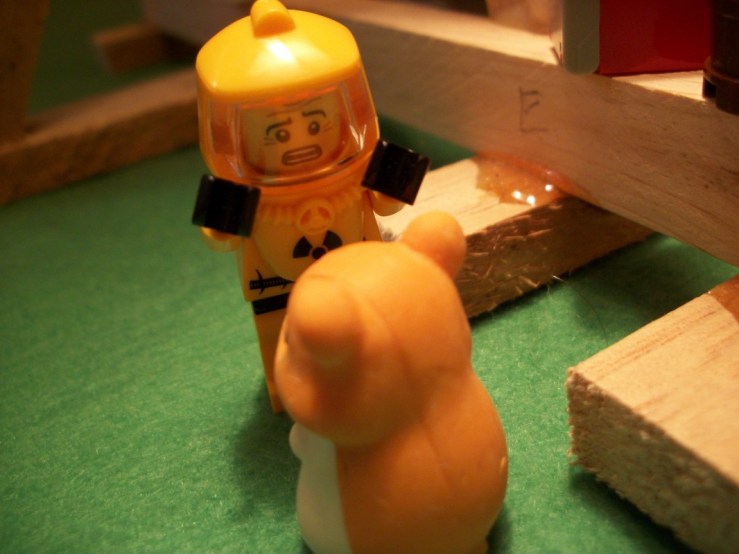
Feral hamsters are not pets. They mean business.

2976326_orig

I had a fantasy of heaven’s being broken into fleecy fragments | Nathaniel Hawthorne’s Notebook Entry for August 27, 1839

August 27th.–I have been stationed all day at the end of Long Wharf, and I rather think that I had the most eligible situation of anybody in Boston. I was aware that it must be intensely hot in the midst of the city; but there was only a short space of uncomfortable heat in my region, half-way towards the centre of the harbor; and almost all the time there was a pure and delightful breeze, fluttering and palpitating, sometimes shyly kissing my brow, then dying away, and then rushing upon me in livelier sport, so that I was fain to settle my straw hat more tightly upon my head. Late in the afternoon, there was a sunny shower, which came down so like a benediction that it seemed ungrateful to take shelter in the cabin or to put up an umbrella. Then there was a rainbow, or a large segment of one, so exceedingly brilliant and of such long endurance that I almost fancied it was stained into the sky, and would continue there permanently. And there were clouds floating all about,–great clouds and small, of all glorious and lovely hues (save that imperial crimson which was revealed to our united gaze),–so glorious, indeed, and so lovely, that I had a fantasy of heaven’s being broken into fleecy fragments and dispersed through space, with its blest inhabitants dwelling blissfully upon those scattered islands.

From Nathaniel Hawthorne’s American Note-Books.

The Romantic Tough School of Writing | Doris Lessing’s The Golden Notebook

Toward the end of Doris Lessing’s The Golden Notebook, protagonist Anna Wulf inserts this wonderful parody of a certain kind of midcentury writing (Henry Miller seems like the most obvious target here, although I use the term “target” loosely). The piece ends with Wulf’s “own” voice returning, declaring “If I’ve gone back to pastiche, then it’s time to stop.” And then the notebook stops.

* 19 The Romantic Tough School of Writing

The fellows were out Saturday-nighting true-hearted, the wild-hearted Saturday-night gang of true friends, Buddy, Dave and Mike. Snowing. Snow-cold. The cold of cities in the daddy of cities, New York. But true to us. Buddy, the ape-shouldered, stood apart and stared. He scratched his crotch. Buddy the dreamer, pitch-black-eyed, sombrely staring, he would often masturbate in front of us, unconscious, pure, a curious purity. And now he stood with the snow crumb white on his sad bent shoulders. Dave tackled him low, Dave and Buddy sprawled together in the innocent snow, Buddy winded. Dave drove his fist into Buddy’s belly, oh true love of true friends, mensch playing together under the cold cliffs of Manhattan on a true Saturday night. Buddy passed out cold. ‘I love this son-of-a-bitch,’ Dave said, while Buddy sprawled, lost to us and to the sadness of the city. I, Mike, Mike-the-lone-walker, stood apart, the burden of knowing on me, eighteen-years-old and lonely, watching my true buddies, Dave and Buddy. Buddy came to. Saliva flecked his near-dead lips and flew off into the saliva-white snowbank.

He sat up, gasping, saw Dave there, arms around his kneecaps, staring at him, love in his Bronx-sad eyes. Left side of hairy fist to chin, he hit and Dave now fell flat out, out in the death-cold snow. Laughing Buddy, Buddy sat laughing, waiting in his turn. Man, what a maniac. ‘Whatta you going to do, Buddy?’ I said, Mike the lone-walker but loving his true friends. ‘Ha ha ha, d’you see the expression on his face?’ he said and rolled breathless, holding his crotch. ‘Didja see that?’ Dave gasped, life coming to him, rolled, groaned, sat up. Dave and Buddy fought then, true-fought, laughing with joy, till, laughing, fell apart in the snow. I, Mike, winged-with-words Mike, stood sorrowing with joy. ‘Hey I love this bastard,’ gasped Dave, throwing a punch to Buddy’s midriff and Buddy, forearm stopping it, said: ‘Jeez, I love him.’ But I heard the sweet music of heels on the frost-cold pavement, and I said: ‘Hey, fellas.’ We stood waiting. She came, Rosie, from her dark tenement bedroom, on her sweet-tapping heels. ‘Hey, fellas,’ says Rosie, sweet-smiling. We stood watching. Sad now, watching the proud-fleshed Rosie, swivelling on her true sex down the pavement, twitching her round-ball butt, which jerked a message of hope to our hearts. Then Buddy, our buddy Buddy, moved apart, hesitant, sad-eyed, to our sad eyes: ‘I love her, fellas.’ Two friends were left then. Two-fisted Dave and winged-with words Mike. We stood then, watching our friend Buddy, fated with life, nod and move on after Rosie, his pure heart beating to the tune of her sweet heels. The wings of mystic time beat down on us then, white with snowflakes, time that would whirl us all after our Rosies to death and the frame-house funeral. Tragic and beautiful to see our Buddy move on out into the immemorial dance of fated snow-flakes, the dry rime rhyming on his collar. And the love that went out from us to him then was fantastic, true-volumned, sad-faced and innocent of the purposes of time, but true and in fact serious. We loved him as we turned, two friends left, our adolescent top coats flapping around our pure legs. On then, Dave and I, I-Mike, sad, because the intimation-bird of tragedy had touched our pearly souls, he-Dave and I-Mike, on then, goofy with life. Dave scratched his crotch, slow, owl-scratching pure Dave. ‘Jeez, Mike,’ he said, ‘you’ll write it someday, for us all.’ He stammered, inarticulate, not-winged-with-words, ‘You’ll write it, hey feller? And how our souls were ruined here on the snow-white Manhattan pavement, the capitalist-money-mammon hound-of-hell hot on our heels?’ ‘Gee, Dave, I love you,’ I said then, my boy’s soul twisted with love. I hit him then, square to the jaw-bone, stammering with love-for-the-world, love-for-my-friends, for the Daves and the Mikes and the Buddies. Down he went and I then, Mike, then, cradled him, baby, I-love-you, friendship in the jungle city, friendship of young youth. Pure. And the winds of time were blowing, snow-fated, on our loving pure shoulders.

If I’ve gone back to pastiche, then it’s time to stop.

[The yellow notebook ended here with a double black line.]

“A Famous Dancer” — Thomas Bernhard

20140721-162338-59018084.jpg

“A Short Novel” | Doris Lessing’s The Golden Notebook

*11 A SHORT NOVEL

Two people together, in any kind of relationship—mother, son; father, daughter; lovers; it doesn’t matter. One of them acutely neurotic. The neurotic hands on his or her state to the other, who takes it over, leaving the sick one well, the well one sick.

From Doris Lessing’s novel The Golden Notebook.

Bad books are intellectual poison (Schopenhauer)

It is in literature as in life: wherever you turn, you stumble at once upon the incorrigible mob of humanity, swarming in all directions, crowding and soiling everything, like flies in summer. Hence the number, which no man can count, of bad books, those rank weeds of literature, which draw nourishment from the corn and choke it. The time, money and attention of the public, which rightfully belong to good books and their noble aims, they take for themselves: they are written for the mere purpose of making money or procuring places. So they are not only useless; they do positive mischief. Nine-tenths of the whole of our present literature has no other aim than to get a few shillings out of the pockets of the public; and to this end author, publisher and reviewer are in league.

Let me mention a crafty and wicked trick, albeit a profitable and successful one, practised by littérateurs, hack writers, and voluminous authors. In complete disregard of good taste and the true culture of the period, they have succeeded in getting the whole of the world of fashion into leading strings, so that they are all trained to read in time, and all the same thing, viz., the newest books; and that for the purpose of getting food for conversation in the circles in which they move. This is the aim served by bad novels, produced by writers who were once celebrated, as Spindler, Bulwer Lytton, Eugene Sue. What can be more miserable than the lot of a reading public like this, always bound to peruse the latest works of extremely commonplace persons who write for money only, and who are therefore never few in number? and for this advantage they are content to know by name only the works of the few superior minds of all ages and all countries. Literary newspapers, too, are a singularly cunning device for robbing the reading public of the time which, if culture is to be attained, should be devoted to the genuine productions of literature, instead of being occupied by the daily bungling commonplace persons.

Hence, in regard to reading, it is a very important thing to be able to refrain. Skill in doing so consists in not taking into one’s hands any book merely because at the time it happens to be extensively read; such as political or religious pamphlets, novels, poetry, and the like, which make a noise, and may even attain to several editions in the first and last year of their existence. Consider, rather, that the man who writes for fools is always sure of a large audience; be careful to limit your time for reading, and devote it exclusively to the works of those great minds of all times and countries, who o’ertop the rest of humanity, those whom the voice of fame points to as such. These alone really educate and instruct. You can never read bad literature too little, nor good literature too much. Bad books are intellectual poison; they destroy the mind. Because people always read what is new instead of the best of all ages, writers remain in the narrow circle of the ideas which happen to prevail in their time; and so the period sinks deeper and deeper into its own mire

From “On Books and Reading” by Arthur Schopenhauer.

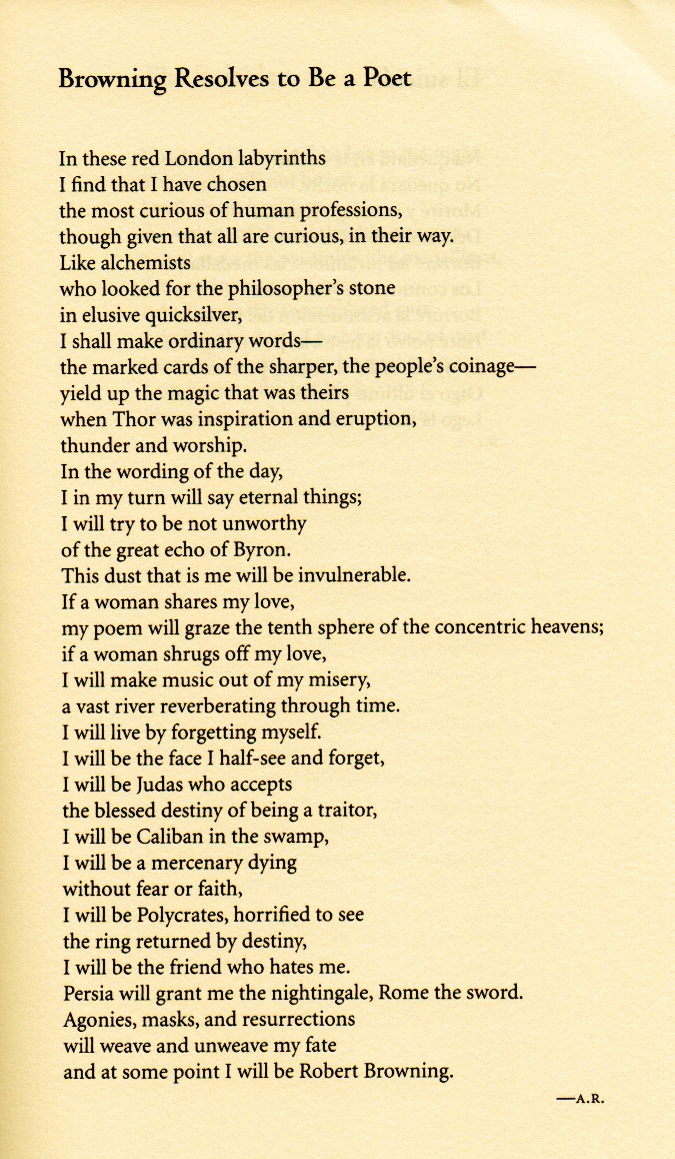
“Browning Resolves to Be a Poet” — Jorge Luis Borges

IMG_3144.JPG

“The Ethnographer” — Jorge Luis Borges

“The Ethnographer”
by
Jorge Luis Borges

I was told about the case in Texas, but it had happened in another state. It has a single protagonist (though in every story there are thousands of protagonists, visible and invisible, alive and dead). The man’s name, I believe, was Fred Murdock. He was tall, as Americans are; his hair was neither blond nor dark, his features were sharp, and he spoke very little. There was nothing singular about him, not even that feigned singularity that young men affect. He was naturally respectful, and he distrusted neither books nor the men and women who write them. He was at that age when a man doesn’t yet know who he is, and so is ready to throw himself into whatever chance puts in his way — Persian mysticism or the unknown origins of Hungarian, the hazards of war or algebra, Puritanism or orgy. At the university, an adviser had interested him in Amerindian languages. Certain esoteric rites still survived in certain tribes out West; one of his professors, an older man, suggested that he go live on a reservation, observe the rites, and discover the secret revealed by the medicine men to the initiates. When he came back, he would have his dissertation, and the university authorities would see that it was published. Murdock leaped at the suggestion. One of his ancestors had died in the frontier wars; that bygone conflict of his race was now a link. He must have foreseen the difficulties that lay ahead for him; he would have to convince the red men to accept him as one of their own. He set out upon the long adventure. He lived for more than two years on the prairie, sometimes sheltered by adobe walls and sometimes in the open. He rose before dawn, went to bed at sundown, and came to dream in a language that was not that of his fathers. He conditioned his palate to harsh flavors, he covered himself with strange clothing, he forgot his friends and the city, he came to think in a fashion that the logic of his mind rejected. During the first few months of his new education he secretly took notes; later, he tore the notes up — perhaps to avoid drawing suspicion upon himself, perhaps because he no longer needed them. After a period of time (determined upon in advance by certain practices, both spiritual and physical), the priest instructed Murdock to start remembering his dreams, and to recount them to him at daybreak each morning. The young man found that on nights of the full moon he dreamed of buffalo. He reported these recurrent dreams to his teacher; the teacher at last revealed to him the tribe’s secret doctrine. One morning, without saying a word to anyone, Murdock left.

In the city, he was homesick for those first evenings on the prairie when, long ago, he had been homesick for the city. He made his way to his professor’s office and told him that he knew the secret, but had resolved not to reveal it.

“Are you bound by your oath?” the professor asked.

“That’s not the reason,” Murdock replied. “I learned something out there that I can’t express.”

“The English language may not be able to communicate it,” the professor suggested.

“That’s not it, sir. Now that I possess the secret, I could tell it in a hundred different and even contradictory ways. I don’t know how to tell you this, but the secret is beautiful, and science, our science, seems mere frivolity to me now.”

After a pause he added: “And anyway, the secret is not as important as the paths that led me to it. Each person has to walk those paths himself.”

The professor spoke coldly: “I will inform the committee of your decision. Are you planning to live among the Indians?”

“No,” Murdock answered. “I may not even go back to the prairie. What the men of the prairie taught me is good anywhere and for any circumstances.”

That was the essence of their conversation.

Fred married, divorced, and is now one of the librarians at Yale.

(Translation by Andrew Hurley).

Dazzled (Kafka)

IMG_0101