“God Sees the Truth, but Waits” — Leo Tolstoy

“God Sees the Truth, but Waits”

by

Leo Tolstoy

In the town of Vladimir lived a young merchant named Ivan Dmitrich
Aksionov. He had two shops and a house of his own.

Aksionov was a handsome, fair-haired, curly-headed fellow, full of fun, and very fond of singing. When quite a young man he had been given to drink, and was riotous when he had had too much; but after he married he gave up drinking, except now and then.

One summer Aksionov was going to the Nizhny Fair, and as he bade good-bye to his family, his wife said to him, “Ivan Dmitrich, do not start to-day; I have had a bad dream about you.”

Aksionov laughed, and said, “You are afraid that when I get to the fair I shall go on a spree.”

His wife replied: “I do not know what I am afraid of; all I know is that I had a bad dream. I dreamt you returned from the town, and when you took off your cap I saw that your hair was quite grey.”

Aksionov laughed. “That’s a lucky sign,” said he. “See if I don’t sell out all my goods, and bring you some presents from the fair.”

So he said good-bye to his family, and drove away.

When he had travelled half-way, he met a merchant whom he knew, and they put up at the same inn for the night. They had some tea together, and then went to bed in adjoining rooms.

It was not Aksionov’s habit to sleep late, and, wishing to travel while it was still cool, he aroused his driver before dawn, and told him to put in the horses.

Then he made his way across to the landlord of the inn (who lived in a cottage at the back), paid his bill, and continued his journey.

When he had gone about twenty-five miles, he stopped for the horses to be fed. Aksionov rested awhile in the passage of the inn, then he stepped out into the porch, and, ordering a samovar to be heated, got out his guitar and began to play.

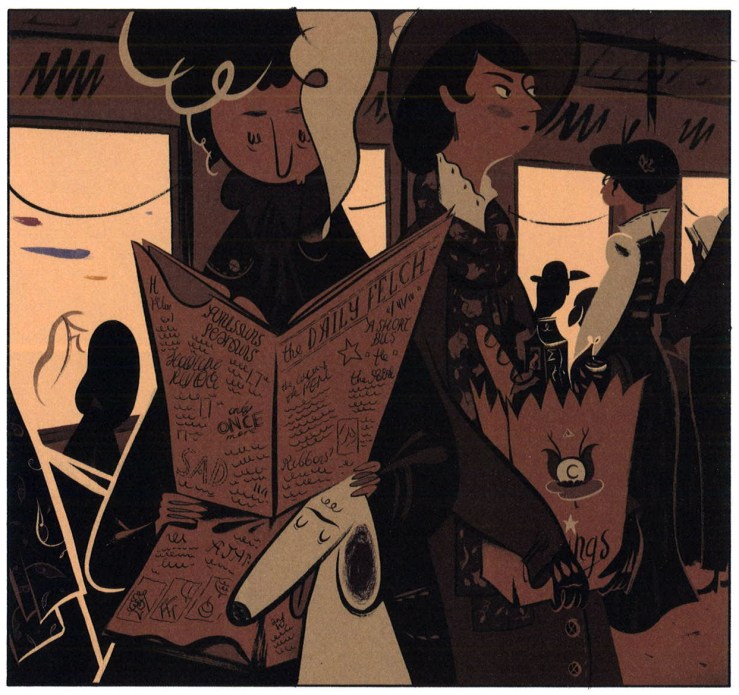
Suddenly a troika drove up with tinkling bells and an official alighted, followed by two soldiers. He came to Aksionov and began to question him, asking him who he was and whence he came. Aksionov answered him fully, and said, “Won’t you have some tea with me?” But the official went on cross-questioning him and asking him. “Where did you spend last night? Were you alone, or with a fellow-merchant? Did you see the other merchant this morning? Why did you leave the inn before dawn?” Continue reading ““God Sees the Truth, but Waits” — Leo Tolstoy”

I had a terror since September (Emily Dickinson)

I had a terror since September, I could tell to none; and so I sing, as the boy does by the burying ground, because I am afraid.

You inquire my books. For poets, I have Keats, and Mr. and Mrs. Browning. For prose, Mr. Ruskin, Sir Thomas Browne, and the Revelations. I went to school, but in your manner of the phrase had no education. When a little girl, I had a friend who taught me Immortality; but venturing too near, himself, he never returned. Soon after my tutor died, and for several years my lexicon was my only companion. Then I found one more, but he was not contented I be his scholar, so he left the land.

You ask of my companions. Hills, sir, and the sundown, and a dog large as myself, that my father bought me. They are better than beings because they know, but do not tell; and the noise in the pool at noon excels my piano.

From an April 1862 letter Emily Dickinson wrote to Thomas Wentworth Higginson.

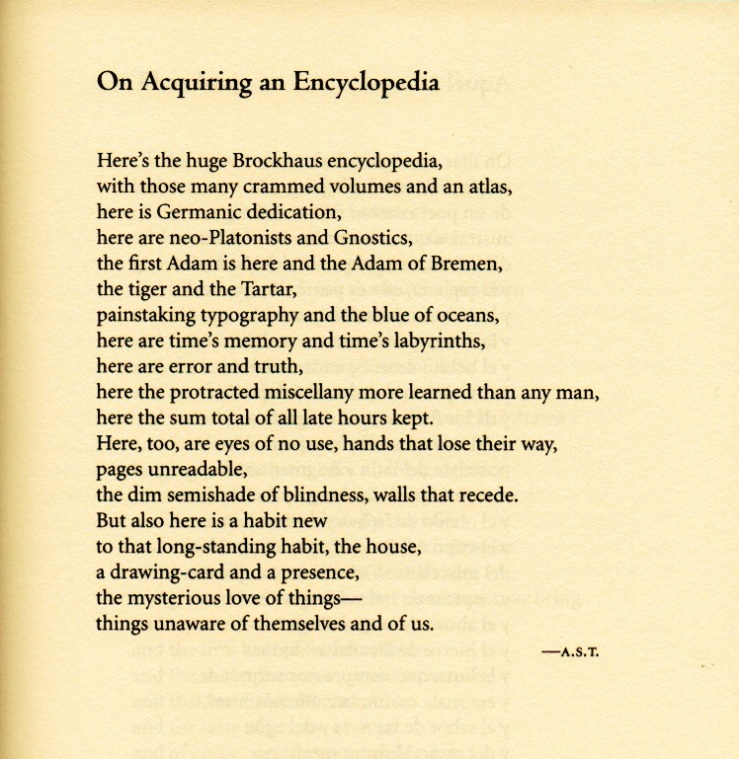
“On Acquiring an Encyclopedia” — Jorge Luis Borges

IMG_3141.JPG

Harry Dean Stanton Is Rip Van Winkle in Francis Ford Coppola’s Awful Adaptation of an American Classic

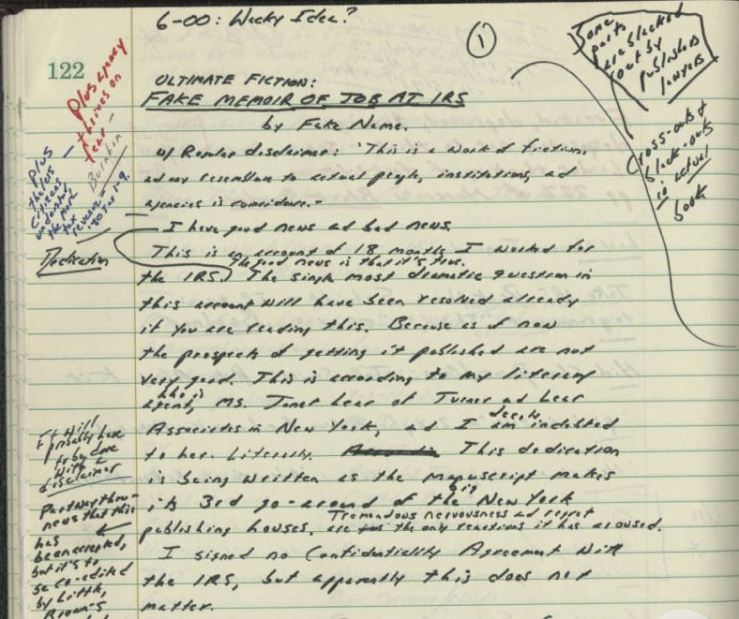
Ultimate Fiction: Fake Memoir of Job at IRS by Fake Name (David Foster Wallace Archive)

dfwThe David Foster Wallace archive at the Harry Ransom Center UT has made some documents from The Pale King accessible online, including a few pages of his workbook, handwritten drafts, and typed edits.

dfw2

(Via).


The ideal logotopia (William H. Gass)

In the ideal logotopia, every person would possess his own library and add at least weekly if not daily to it. The walls of each home would seem made of books; wherever one looked one would only see spines; because every real book (as opposed to dictionaries, almanacs, and other compilations) is a mind, an imagination, a consciousness. Together they compose a civilization, or even several. Utopias, however, have the bad habit of hiding in their hearts those schemes for success, those requirements of power, rules concerning conduct, which someone will one day have to carry forward, employ and enforce, in order to achieve them, and afterward, to maintain the continued purity of their Being. Books have taught me what true dominion, what right rule, is: It is like the freely given assent and labor of the reader who will dream the dreams of the deserving page and expect no more fee than the reward of its words.

From William H. Gass’s “Gutenberg’s Triumph: An Essay in Defense of the Book.”

Letter to Nathaniel Hawthorne, November 1851 — Herman Melville

My Dear Hawthorne, — People think that if a man has undergone any hardship, he should have a reward; but for my part, if I have done the hardest possible day’s work, and then come to sit down in a corner and eat my supper comfortably — why, then I don’t think I deserve any reward for my hard day’s work — for am I not now at peace? Is not my supper good? My peace and my supper are my reward, my dear Hawthorne. So your joy-giving and exultation-breeding letter is not my reward for my ditcher’s work with that book, but is the good goddess’s bonus over and above what was stipulated — for for not one man in five cycles, who is wise, will expect appreciative recognition from his fellows, or any one of them. Appreciation! Recognition! Is love appreciated? Why, ever since Adam, who has got to the meaning of this great allegory — the world? Then we pygmies must be content to have our paper allegories but ill comprehended. I say your appreciation is my glorious gratuity. In my proud, humble way, — a shepherd-king, — I was lord of a little vale in the solitary Crimea; but you have now given me the crown of India. But on trying it on my head, I found it fell down on my ears, notwithstanding their asinine length — for it’s only such ears that sustain such crowns.

Your letter was handed me last night on the road going to Mr. Morewood’s, and I read it there. Had I been at home, I would have sat down at once and answered it. In me divine maganimities are spontaneous and instantaneous — catch them while you can. The world goes round, and the other side comes up. So now I can’t write what I felt. But I felt pantheistic then — your heart beat in my ribs and mine in yours, and both in God’s. A sense of unspeakable security is in me this moment, on account of your having understood the book. I have written a wicked book, and feel spotless as the lamb. Ineffable socialities are in me. I would sit down and dine with you and all the gods in old Rome’s Pantheon. It is a strange feeling — no hopefulness is in it, no despair. Content — that is it; and irresponsibility; but without licentious inclination. I speak now of my profoundest sense of being, not of an incidental feeling.

Whence come you, Hawthorne? By what right do you drink from my flagon of life? And when I put it to my lips — lo, they are yours and not mine. I feel that the Godhead is broken up like the bread at the Supper, and that we are the pieces. Hence this infinite fraternity of feeling. Now, sympathizing with the paper, my angel turns over another page. you did not care a penny for the book. But, now and then as you read, you understood the pervading thought that impelled the book — and that you praised. Was it not so? You were archangel enough to despise the imperfect body, and embrace the soul. Once you hugged the ugly Socrates because you saw the flame in the mouth, and heard the rushing of the demon, — the familiar, — and recognized the sound; for you have heard it in your own solitudes.

My dear Hawthorne, the atmospheric skepticisms steal into me now, and make me doubtful of my sanity in writing you thus. But, believe me, I am not mad, most noble Festus! But truth is ever incoherent, and when the big hearts strike together, the concussion is a little stunning. Farewell. Don’t write a word about the book. That would be robbing me of my miserly delight. I am heartily sorry I ever wrote anything about you — it was paltry. Lord, when shall we be done growing? As long as we have anything more to do, we have done nothing. So,now, let us add Moby Dick to our blessing, and step from that. Leviathan is not the biggest fish; — I have heard if Krakens.

This is a long letter, but you are not at all bound to answer it. Possibly, if you do answer it, and direct it to Herman Melville, you will missend it — for the very fingers that now guide this pen are not precisely the same that just took it up and put it on this paper. Lord, when shall we be done changing? Ah! it’s a long stage, and no inn in sight, and night coming, and the body cold. But with you for a passenger, I am content and can be happy. I shall leave the world, I feel, with more satisfaction for having come to know you. Knowing you persuades me more than the Bible of our immortality.

What a pity, that, for your plain, bluff letter, you should get such gibberish! Mention me to Mrs. Hawthorne and to the children, and so, good-by to you, with my blessing.

Herman.

P.S. I can’t stop yet. If the world was entirely made up of Magians, I’ll tell you what I should do. I should have a paper-mill established at one end of the house, and so have an endless riband of foolscap rolling in upon my desk; and upon that endless riband I should write a thousand — a million — billion thoughts, all under the form of a letter to you. The divine magnet is on you, and my magnet responds. Which is the biggest? A foolish question — they are One.

H.

P.P.S. Don’t think that by writing me a letter, you shall always be bored with an immediate reply to it — and so keep both of us delving over a writing-desk eternally. No such thing! I sh’n’t always answer your letters, and you may do just as you please.

Five Story Ideas from Nathaniel Hawthorne’s Note-Books

  1. All the dead that had ever been drowned in a certain lake to arise.
  2. Character of a man who, in himself and his external circumstances, shall be equally and totally false: his fortune resting on baseless credit,–his patriotism assumed,–his domestic affections, his honor and honesty, all a sham. His own misery in the midst of it,–it making the whole universe, heaven and earth alike, an unsubstantial mockery to him.
  3. Dr. Johnson’s penance in Uttoxeter Market. A man who does penance in what might appear to lookers-on the most glorious and triumphal circumstance of his life. Each circumstance of the career of an apparently successful man to be a penance and torture to him on account of some fundamental error in early life.
  4. A person to catch fire-flies, and try to kindle his household fire with them. It would be symbolical of something.
  5. Thanksgiving at the Worcester Lunatic Asylum. A ball and dance of the inmates in the evening,–a furious lunatic dancing with the principal’s wife. Thanksgiving in an almshouse might make a better sketch.

From Nathaniel Hawthorne’s American Note-Books.

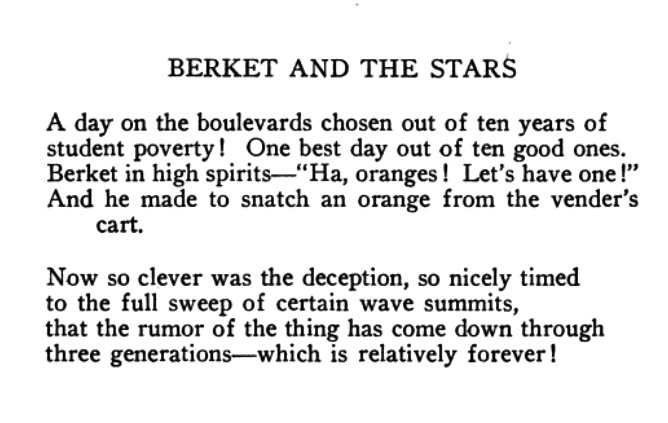
“Berket and the Stars” — William Carlos Williams

Cheever holds my attention more than any other writer (Matthew Weiner)

INTERVIEWER

Who are your favorite writers?

WEINER

I don’t make lists or rank writers. I can only say which ones are relevant to me. Salinger holds my attention, Yates holds my attention. John O’Hara doesn’t, I don’t know why—it’s the same environment, but he doesn’t. Cheever holds my attention more than any other writer. He is in every aspect of Mad Men, starting with the fact that Don lives in Ossining on Bullet Park Road—the children are ignored, people have talents they can’t capitalize on, everyone is selfish to some degree or in some kind of delusion. I have to say, Cheever’s stories work like TV episodes, where you don’t get to repeat information about the characters. He grabs you from the beginning.

Poems have always held my attention, but they’re denser and smaller. It’s funny because poetry is considered harder to read. It wasn’t harder for me. Close reading, that is. Milton, Chaucer, Dante—I could handle those for some reason, but not fiction. From ninth grade on, I wrote poetry compulsively, and pushed myself to do iambic pentameter and rhymes because free verse was cheating—anybody could do that. But I was such a terrible student. I couldn’t sustain anything.

Fascinating interview with Mad Men creator Matthew Weiner in The Paris Review. I would’ve predicted the Yates and the Cheever (and Updike too, whom he doesn’t name), but not the poetry (Weiner goes on to detail his years writing poetry). My wife and I have been, uh, binge watching I think is the phrase the kids are supposed to be saying, although I don’t think the kids say it, I think culture reporters made it up—anyway, my wife and I watched the first season of Mad Men this week (hadn’t watched nary a rerun since it aired). It holds up pretty well, despite some soapy moments, cliches, and broad strokes.

Hamlet and the Gravedigger — Camille Corot

“Good-bye to the Fruits” — John Barth

“Good-bye to the Fruits”

by

John Barth

I agreed to die, stipulating only that I first be permitted to rebehold and bid good-bye to those of Earth’s fruits that I had particularly enjoyed in my not-extraordinary lifetime.
What I had in mind, in the first instance, was such literal items as apples and oranges. Of the former, the variety called Golden Delicious had long been my favorite, especially those with a blush of rose on their fetchingly speckled yellow-green cheeks. Of the latter–but then, there’s no comparing apples to oranges, is there, nor either of those to black plums: truly incomparable, in my opinion, on the rare occasions when one found them neither under- nor overripe. Good-bye to all three, alas; likewise to bananas, whether sliced transversely atop unsweetened breakfast cereal, split longitudinally under scoops of frozen yogurt, barbecued in foil with chutney, or blended with lime juice, rum, and Cointreau into frozen daiquiris on a Chesapeake August late afternoon.
Lime juice, yes: Farewell, dear zesty limes, squeezed into gins-and-tonics before stirring and over bluefish filets before grilling; adieu too to your citric cousins the lemons, particularly those with the thinnest of skins, always the most juiceful, without whose piquance one could scarcely imagine fresh seafood, and whose literal zest was such a challenge for us kitchen-copilots to scrape a half-tablespoonsworth of without getting the bitter white underpeel as well. Adieu to black seedless grapes for eating with ripe cheeses and to all the nobler stocks for vinting, except maybe Chardonnay. I happened not to share the American yuppie thirst for Chardonnay; too over-flavored for my palate. Give me a plain light dry Chablis any time instead of Chardonnay, if you can find so simple a thing on our restaurant wine-lists these days. And whatever happened to soft dry reds that don’t cost an arm and a leg on the one hand, so to speak, or, on the other, taste of iron and acetic acid? But this was no time for such cavils: Good-bye, blessed fruit of the vineyard, a dinner without which was like a day without et cetera. Good-bye to the fruits of those other vines, in particular the strawberry, if berries are properly to be called fruits, the tomato, and the only melon I would really miss, our local cantaloupe. Good-bye to that most sexual of fruits, the guava; to peaches, plantains (fried), pomegranates, and papayas; to the fruits of pineapple field and coconut tree, if nuts are fruits and coconuts nuts, and of whatever it is that kiwis grow on. As for pears, I had always thought them better canned than fresh, as Hemingway’s Nick Adams says of apricots in the story “Big Two-Hearted River”–but I couldn’t see kissing a can good-bye, so I guessed that just about did the fruits (I myself preferred my apricots sun-dried rather than either fresh or canned).

Read the rest of “Goodbye to the Fruits” — and two other John Barth shorts — in the Spring ’94 issue of Conjunctions.

You tell a story because a statement would be inadequate (Flannery O’Connor)

When you can state the theme of a story, when you can separate it from the story itself, then you can be sure the story is not a very good one. The meaning of a story has to be embodied in it, has to be made concrete in it. A story is a way to say something that can’t be said any other way, and it takes every word in the story to say what the meaning is. You tell a story because a statement would be inadequate. When anybody asks what a story is about, the only proper thing is to tell him to read the story. The meaning of fiction is not abstract meaning but experienced meaning, and the purpose of making statements about the meaning of a story is only to help you experience that meaning more fully.

From Flannery O’Connor’s essay “Writing Short Stories.” Collected in Mystery and Manners.

The Wood of the Self-Murderers: The Harpies and the Suicides — William Blake

“Biological Supremacy” — Tom Clark

IMG_3225

Words block up our path (Nietzsche)

words

“The Truth about Sancho Panza” — Franz Kafka

IMG_0100