Guy Fawkes Day and V for Vendetta

“Remember, remember the 5th of November…”

I was lucky enough to live in New Zealand for a few years as a kid, so I got to experience Guy Fawkes Day. We made effigies of Guy, then we burned them on a bonfire. There was a barbecue and fireworks. To my American ass, it seemed a mixture of the Fourth of July and Halloween—strange and marvelous.

It was a few years after my last Guy Fawkes experience that I read Alan Moore’s V for Vendetta. V, an anarchist who wears a stylized Guy Fawkes mask, wages a vigilante war on a harsh authoritarian government. Along with Frank Miller’s The Dark Knight Returns, V was a first for me, something different from the comics I was reading at the time, stuff like Chris Claremont’s run on The Uncanny X-Men and other Marvel titles.

A film version of V for Vendetta was released in 2006; Alan Moore famously had his name removed from it. I enjoyed the film, although it certainly wasn’t as good or thought-provoking as Moore’s original story. And even though the film looked good, the passive experience of watching an action movie can’t measure up to David Lloyd’s original art work and that wonderful space between the panels of comics that engages the reader’s imagination.
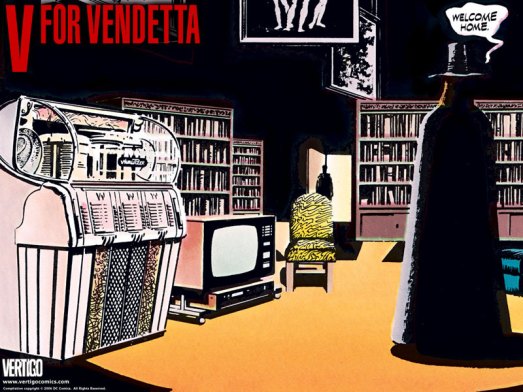
v_for_vendetta_5_800×600.jpg

This afternoon [see editorial note below] I finished the first graphic novel of Alan Moore’s  run writing Swamp Thing, and I can’t wait until my library hold on the second graphic novel comes in. I had no idea Saga of the Swamp Thing would be as good as it was, nor as beautifully illustrated; it’s actually better than V for Vendetta or Moore’s other famed work, Watchmen (and none of these titles are even in the same league as Moore’s masterpiece, From Hell). Alan Moore and Steve Bissette’s run on the DC Comics series essentially led to DC’s creation of the edgier Vertigo imprint for their more “mature” titles, such as The Sandman. These titles helped to change the audiences of “comic books” and helped to make the graphic novel a new standard in the medium (no mean feat, considering the fanboyish culture of comic nerds, a culture that prizes rarity of print run over quality of storytelling).

One of the lessons in V for Vendetta is to illustrate what happens when we don’t allow for dissent, what happens when ideas are both prescribed and proscribed, and all dialogue is muted. Authoritarian governments consolidate their power from the silencing of ideas. A healthy society requires all sorts of opinions, even ones we don’t like. The smiling Americans in this photo aren’t burning effigies of would-be revolutionaries, they are burning something much more dangerous–books.

book-burning.jpg

[Editorial note: So, I ran a version of this post on Nov. 5, 2006—it’s actually one of the first posts I ever did on the blog, which I began in Sept. 2006. Looking over it—which is to say editing it and making minor revisions (and grimacing frequently, but trying to keep those revisions minor, like moving commas)—I can see the growth and scope of the blog; especially I can see my own limited sense of what I wanted Biblioklept to be. The post also strikes me as excessively vague and preachy (especially that last paragraph, written after years of Bush Era Fatigue, which is kinda sorta still going on, I guess, Bush Era Fatigue, I mean, only I’d give it another name now). I wish I could remember more details of Guy Fawkes Day/Night, but I was young—9, 10, 11—and it seems vague. I still remember the history of Guy Fawkes and the Gunpowder Plot, although that’s probably more a result of paying attention in AP European History than anything else. This editorial note is way too long. I never finished Alan Moore’s run on Swamp Thing, but the second volume was good, as I recall].
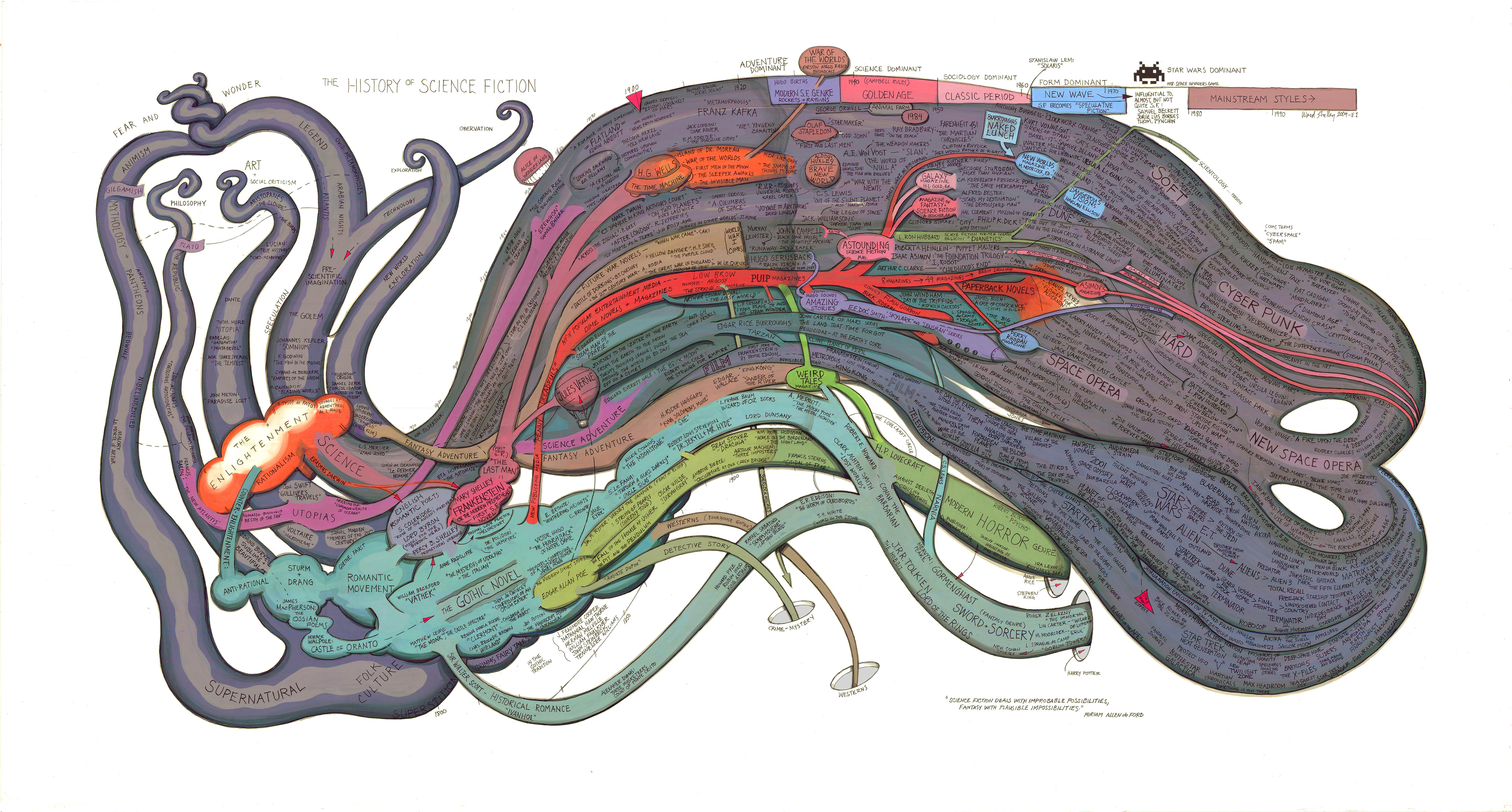
The History of Science Fiction — Ward Shelley

(Via, via).

His Dark Materials Trilogy — Philip Pullman

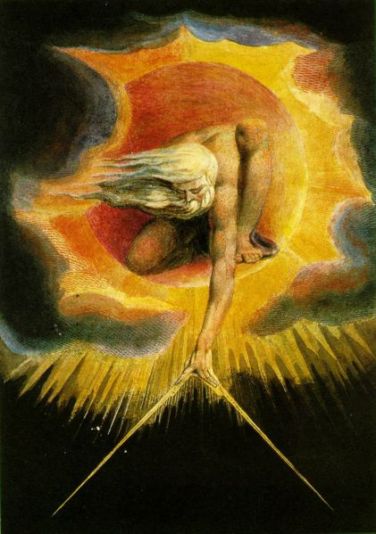
421px-blake_ancient_of_days.jpg
William Blake, “Ancient of Days”

Over the past three weeks, I read, and, alternately listened to, Philip Pullman’s fantastic His Dark Materials trilogy–The Golden Compass, The Subtle Knife, and The Amber Spyglass. Here’s the short review:

If it’s necessary to critically situate and compare a fantasy or sci-fi series against precursor series–namely, The Lord of the Rings, The Chronicles of Narnia, The Chronicles of Prydain, Harry Potter, etc.–and I don’t think it is necessary to critically situate and compare a fantasy or sci-fi series against its precursors, but that’s generally how these things are done–(this is turning into a monster of a “short review”)–but if it is necessary to critically situate and compare a fantasy or sci-fi series against precursor series, I think that Pullman’s His Dark Materials must be considered a new classic, an instantly-canonizable contribution to children’s literature, imaginative fiction, sci-fi, fantasy, or whatever genre you want to affix to these marvelous books.

His Dark Materials follows Lyra and Will, two children from different worlds (literally) who must work together to repair a damaged multiverse. Lyra comes from a world where people travel side by side with their daemons, spirit-images of their souls who take animal shapes. Will is an outsider in “our” world, a young fatherless boy who must take care of his mentally ill mother. The novels, in their simplest sense, detail the coming of age of these two as the traverse multiple parallel universes. In the backdrop there are witches and zeppelins, armored bears and dark specters, a compass that can point to the truth and a knife that can open all worlds, angels and scientists, and Lyra’s cruel and terrible parents, the cunning Mrs. Coulter, and Lord Asriel, whose will to kill God–The Authority–precipitates the action of the narrative.

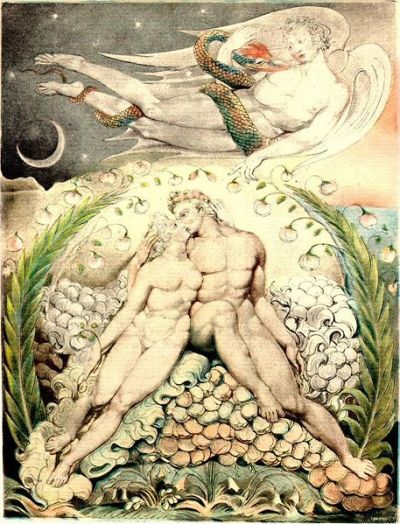
blake_satan_adam_eve.jpg
William Blake, “Satan Watching the Caress of Adam and Eve”

As many critics have pointed out, His Dark Materials recapitulates Milton’s Paradise Lost (the series takes its name from a line from that epic poem). However, the series really reinterprets the British Romantics’ assessment of Paradise Lost. Pullman engages a host of Romantic writers, foregrounding Keats’s idea of negative capability, and prefacing many of the chapters with quotes from Romantic poetry. In particular, Pullman cites William Blake. Indeed, it seems to me that His Dark Materials effectively synthesizes many of Blake’s poems and ideas, The Marriage of Heaven and Hell and Songs of Innocence and of Experience in particular. The novel also engages a number of Nietzsche’s ideas, and even, I believe, alludes to several concepts of Derrida’s (in particular, the idea of the gift of death). Additionally, Pullman weaves in the many-worlds theory, extended discussions of evolutionary anthropology, rampant infanticide, and auto-trepanation. Good stuff.

When the film of The Golden Compass (I didn’t see it) came out last year, it ignited a small controversy about the books. According to the Baptist Press, Pullman presents “a fantasy universe where witches are good, the church is bad, and at the end of it all, God dies.” This really isn’t the case, if you want to go with a precise reading of Pullman’s actual words, but, consider the source. I’m sure the controversy is healthy for Pullman’s sales; it certainly piqued my interest in the book, and I’m guessing that there are plenty of kids who, once their private Christian schools banned the books, couldn’t wait to get their hands on the verboten goods. And that’s a good thing.

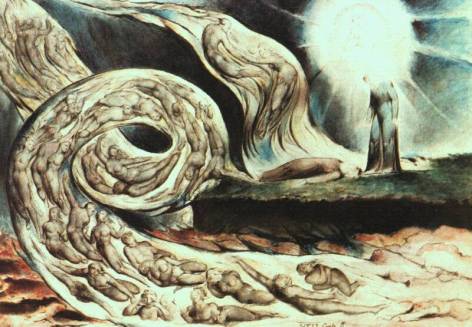
blake2.jpg
William Blake, “Whirlwind of Lovers”

His Dark Materials meets and surpasses my notions of good fantasy/sci-fi/imaginative fiction: the books engage multiple complex ideas in a new and often unsettling way. Unlike the Harry Potter series, which simply operates within familiar, preexisting archetypes of fantasy, Pullman’s work consistently disrupts reader expectations, pushing set ideas about religion and science, art and fantasy into new and fantastic places. Ultimately, although many will seek to suppress this book as an “amoral” work, His Dark Materials proposes a very real set of ethics inscribed in a world of moral relativity. The characters grow up and make good, selfless choices, decisions they make independent of absolute moral authority.

I very highly recommend these books.

William Gibson

Just out of high school, I had a mild obsession with William Gibson’s so-called cyberpunk novels. The first and most famous of these is Neuromancer, an incredibly prescient book that the Wachowski Bros. shamelessly ripped off in The Matrix. Neuromancer is the first in “The Sprawl” trilogy; Count Zero and Mona Lisa Overdrive followed. I borrowed and never returned Neuromancer from Tilford; a few years ago I lent it, along with Burning Chrome, Gibson’s collection of short stories, to a student who in turn never returned them. I read Count Zero and Mona Lisa Overdrive at the same time as my college roommate Jordan. I don’t know who has these books now.

In 1990 Gibson co-authored a book called The Difference Engine with Bruce Sterling. The Difference Engine posits a Victorian England where computers have already been created and are in use. The novel explores the consequences of a technological revolution coming a 100 years early. This book launched what is sometimes called the “steampunk” genre. After TDE, Gibson spent the 90s writing three novels often referred to as “The Bridge” trilogy: the first, Virtual Light, was pretty good (it had a really cool idea about “organic computers”); the second, Idoru, was pretty bad, really; the last, All Tomorrow’s Parties, was downright awful (I couldn’t finish it–I was embarrassed for one of my favorite authors!) At the beginning of the new millenium, technology had caught up to Gibson’s cyberpunk visions, making some of the details of his Bridge trilogy seem outdated or just plain hokey.

I knew our time together was up when I passed on a $4 copy of 2003’s Pattern Recognition at Barnes & Noble a few years ago. Despite his fiction taking a dip, Gibson’s blog, as well as his essays (often published in Wired magazine–check out what is probably his most famous piece, “Disneyland with the Death Penalty”) remain relevant and entertaining. Maybe his forthcoming novel, Spook Country, will prove more entertaining; until then, at least we have the Sprawl Trilogy.

(Check out more William Gibson covers at this gallery)   

Classic Crime Comics Covers

Another covers gallery. I love this one–plenty of weirdness!

chamber_chills23.jpg

Zombie kisses…mmm. The taboo pleasures of necrophilia in four-color glory!

shocksuspens12.jpg

William Burroughs wasn’t the only one addressing the horrors of drug addiction. These touchy themes led to constant censorship battles for EC Comics.

baffling7.jpg

The horrors of love. I like this guy’s beard.

William Burroughs Cover Gallery

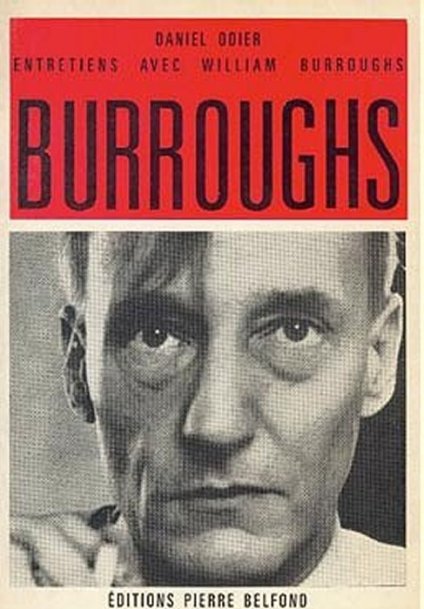
wbjob_france_1969.jpg

Burroughs appears on a large number of his covers, whether as a photograph, or something more iconic:

wbnl_germany_1992.jpg

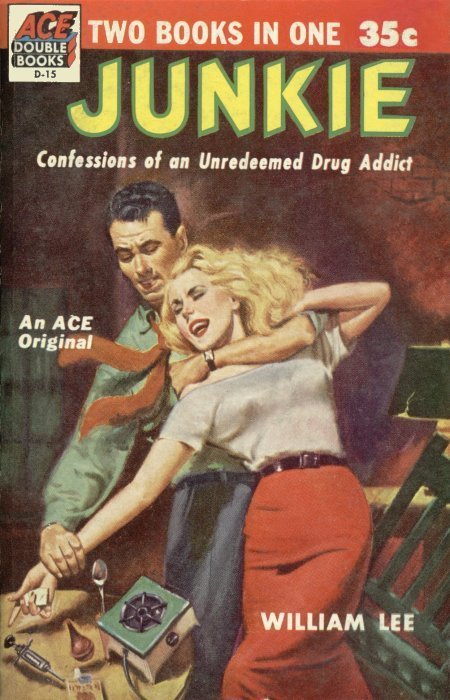
I like this early, lurid pulp edition of Junky. Note the spelling of the title, as well as Burroughs’ pseudonym, William Lee:

junkie_us_ace_1953_front.jpg

The Wild Boys: One of my faves.

wb_us_grove_1971.jpg

This Spanish edition of Naked Lunch really captures the squeamish quality of all things Burroughs:

wbnl_spain_2004.jpg

wbelrev_uk_blackmoor_1971.jpg

Check out the full gallery here.

Guy Fawkes Day and V for Vendetta

“Remember, remember the 5th of November…”

I was lucky enough to live in New Zealand for a few years as a kid, so I got to experience Guy Fawkes Day. We made effigies of Guy, and then we burned them on a bonfire. There was a barbecue, and fireworks. To me it seemed a strange mixture of the Fourth of July and Halloween.

It was a few years after my last Guy Fawkes experience that I read Alan Moore’s V for Vendetta. V, an anarchist who wears a stylized Guy Fawkes mask, wages a vigilante war on a harsh authoritarian government. Along with Frank Miller’s The Dark Knight Returns, V was a first for me, something different than the stuff I was reading at the time, stuff like The Uncanny X-Men and the ill-fated Valiant Comics imprint (I actually made a small fortune selling early Valiant issues I owned).  

A film version of V for Vendetta was released in 2006; Alan Moore famously had his name removed from it. I enjoyed the film, although it certainly wasn’t as good or thought-provoking as Moore’s original story; and even though the film looked good, the passive experience of watching an action movie can’t measure up to David Lloyd’s original art work and that wonderful space between the panels of comics that engages the reader’s imagination.

v_for_vendetta_5_800×600.jpg

This afternoon I finished the first graphic novel of Alan Moore’s  run writing Swamp Thing, and I can’t wait until my library hold on the second graphic novel comes in. I had no idea Saga of the Swamp Thing would be as good as it was, nor as beautifully illustrated; it’s actually much better than V for Vendetta or Moore’s other famed work, Watchmen (and none of these titles are even in the same league as Moore’s masterpiece, From Hell). Alan Moore and Steve Bissette’s run on the DC Comics series essentially led to DC’s creation of the edgier Vertigo imprint for their more “mature” titles, such as The Sandman. These titles helped to change the audiences of “comic books” and helped to make the graphic novel a new standard in the medium (no mean feat, considering the fanboyish culture of comic nerds, a culture that prizes rarity of print run over quality of storytelling).

V for Vendetta illustrates what happens when we don’t allow for dissent, what happens when ideas are both prescribed and proscribed, and all dialogue is muted. Authoritarian governments consolidate their power from the silencing of ideas. A healthy society requires all sorts of opinions, even ones we don’t like. The smiling Americans in this photo aren’t burning effigies of would-be revolutionaries, they are burning something much more dangerous–books.

book-burning.jpg

A Wrinkle in Time

I loved this book as a kid. Madeline L’Engle’s A Wrinkle in Time explores the the intersections of space and time against a backdrop of adolescent angst. Our intrepid heroine Meg goes on a trans-dimensional quest to find her missing physicist father. Dad has disappeared due to his work on a project involving a tesseract. Go check out Tomorrowland’s brilliant write up of the tesseract.

Riddley Walker–Russell Hoban

I never gave Riddley Walker back to Patrick Tilford (aka TLFRD). A few years ago I loaned it to a student who never returned it. Said student never returned Dune, or The Left Hand of Darkness, or several Jules Verne novels either. Doesn’t matter, I know that he read them.

This book is a favorite. Russell Hoban’s coming-of-age story takes place in a future that has regressed to the iron age due to a catastrophic war. Hoban writes in his own language, a mutated English, full of fragments of the 20th century.

I couldn’t find an image of the edition I stole/lost. This edtion from 2000 features an introduction by Will Self, whose latest book, The Book of Dave, apparently was directly influenced by Riddley Walker. Will Self’s book Great Apes deeply, deeply disturbed me. Nothing repulses me more than images of chimpanzees dressed as humans; Great Apes is the literary equivalent.

Great Apes was an airport bookstore buy; I suppose at some point on this blog I will address the “airport bookstore buy.”

Philip K. Dick Cover Art Gallery


Via an excellent and fun blog, robertmonroe.org, a gallery of PKD covers. Check out the gallery here.