“Turkey Remains and How to Inter Them with Numerous Scarce Recipes” — F. Scott Fitzgerald

From F. Scott Fitzgerald’s Notebooks

TURKEY REMAINS AND HOW TO INTER THEM WITH NUMEROUS SCARCE RECIPES
At this post holiday season the refrigerators of the nation are overstuffed with large masses of turkey, the sight of which is calculated to give an adult an attack of dizziness. It seems, therefore, an appropriate time to give the owners the benefit of my experience as an old gourmet, in using this surplus material. Some of the recipes have been in my family for generations. (This usually occurs when rigor mortis sets in.) They were collected over years, from old cook books, yellowed diaries of the Pilgrim Fathers, mail order catalogues, golfbags and trash cans. Not one but has been tried and proven—there are headstones all over America to testify to the fact.
Very well then: Here goes:

1. Turkey Cocktail
To one large turkey add one gallon of vermouth and a demijohn of angostura bitters. Shake.

2. Turkey at la Francais.
Take a large ripe turkey, prepare as for basting and stuff with old watches and chains and monkey meat. Proceed as with cottage-pudding.

3. Turkey and Water
Take one turkey and one pan of water. Heat the latter to the boiling point and then put in the refrigerator When it has jelled drown the turkey in it. Eat. In preparing this recipe it is best to have a few ham sandwiches around in case things go wrong.

4. Turkey Mongole
Take three butts of salami and a large turkey skeleton from which the feathers and natural stuffing have been removed. Lay them out on the table and call up some Mongole in the neighborhood to tell you how to proceed from there.

5. Turkey Mousee
Seed a large prone turkey, being careful to remove the bones, flesh, fins, gravy, etc. Blow up with a bicycle pump. Mount in becoming style and hang in the front hall.

6. Stolen Turkey
Walk quickly from the market and if accosted remark with a laugh that it had just flown into your arms and you hadn’t noticed it. Then drop the turkey with the white of one egg-well, anyhow, beat it.

7. Turkey a la Creme.
Prepare the creme a day in advance, or even a year in advance. Deluge the turkey with it and cook for six days over a blast furnace. Wrap in fly paper and serve.

8. Turkey Hash
This is the delight of all connoisseurs of the holiday beast, but few understand how really to prepare it. Like a lobster it must be plunged alive into boiling water, until it becomes bright red or purple or something, and then before the color fades, placed quickly in a washing machine and allowed to stew in its own gore as it is whirled around.
Only then is it ready for hash. To hash, take a large sharp tool like a nail-file or if none is handy, a bayonet will serve the purpose—and then get at it! Hash it well! Bind the remains with dental floss and serve.
And now we come to the true aristocrat of turkey dishes:

9. Feathered Turkey.
To prepare this a turkey is necessary and a one pounder cannon to compell anyone to eat it. Broil the feathers and stuff with sage brush, old clothes, almost anything you can dig up. Then sit down and simmer. The feathers are to be eaten like artichokes (and this is not to be confused with the old Roman custom of tickling the throat).

10. Turkey at la Maryland
Take a plump turkey to a barber’s and have him shaved, or if a female bird, given a facial and a water wave. Then before killing him stuff with with old newspapers and put him to roost. He can then be served hot or raw, usually with a thick gravy of mineral oil and rubbing alcohol. (Note: This recipe was given me by an old black mammy.)

11. Turkey Remnant
This is one of the most useful recipes for, though not, “chic”, it tells what to do with the turkey after the holiday, and extract the most value from it.
Take the remants, or if they have been consumed, take the various plates on which the turkey or its parts have rested and stew them for two hours in milk of magnesia. Stuff with moth-balls.

12. Turkey with Whiskey Sauce.
This recipe is for a party of four. Obtain a gallon of whiskey, and allow it to age for several hours. Then serve, allowing one quart for each guest.
The next day the turkey should be added, little by little, constantly stirring and basting.

13. For Weddings or Funerals. Obtain a gross of small white boxes such as are used for bride’s cake. Cut the turkey into small squares, roast, stuff, kill, boil, bake and allow to skewer. Now we are ready to begin. Fill each box with a quantity of soup stock and pile in a handy place. As the liquid elapses, the prepared turkey is added until the guests arrive. The boxes delicately tied with white ribbons are then placed in the handbags of the ladies, or in the men’s side pockets.

There I guess that’s enough turkey to talk. I hope I’ll never see or hear of another until—well, until next year.

“The Last Untamed Writer in America,” another William T. Vollmann profile

Photograph of William Vollmann in his studio by Ian Bates

Late last week, The Wall Street Journal published “The Last Untamed Writer in America,” a profile of William T. Vollmann. The piece begins with its author Alexander Nazaryan politely refusing breakfast scotch from Vollmann, who is hosting Nazaryan at his studio (a converted Mexican restaurant):

It was breakfast time at the Sacramento, Calif., home of the novelist William T. Vollmann, which meant time for scotch. Out came two gold-colored shot glasses, modeled after 50-caliber rounds, a gift from a relative to the gun-loving writer. Despite gentle pressure, I stuck to my coffee, so Vollmann poured himself only a perfunctory nip of the Balvenie DoubleWood 12. “This will get me buzzed up,” Vollmann said. Then he added, ruefully, “I can hardly drink at all anymore.”

The piece has some interesting quips from Vollmann, but it doesn’t really expand on Alexander Sorondo’s long essay “The Last Contract: William T. Vollmann’s Battle to Publish an American Epic,” from this spring–notes on Vollmann’s cancer, getting dropped by his publisher Viking, and finding a home for his epic A Table for Fortune with Skyhorse, an iffy group that has published books by RF Kennedy Jr. and Alex Jones. A lot of the notes will be familiar with those tuned into the myth of the Vollmann (guns, drugs, sex, volume, etc.), but it’s kinda sorta interesting to see how the conservative Wall Street Journal frames Vollmann. They play up Vollmann’s enthusiasm for guns and note that he is not an author to be “cowed by sensitivity readers”; they even get a quote from him decrying “people who want trigger warnings.” And yet even when Vollmann professes a tinge of patriotism, he deflates it immediately:

“I love America because it’s my homeland, and I love Americans,” Vollmann says. “What I dislike is the whole hypocritical American exceptionalism. We do all these dirty, crummy things.”

There are some cool photos by Ian Bates accompanying the article, which you can read unpaywalled here.

Self-Portrait — Flannery O’Connor

Self-Portrait, 1952 by Flannery O’Connor (1925-1964)

RE: April 23 | John Barth writes to Vladimir Nabokov

To: V. Nabokov, Montreux, Switzerland

FROM: J. Barth, Buffalo, U.S.A.

RE: April 23

Dear Mr. N.:

Today we lost Cervantes, St. George, and Shakespeare, but recouped Shakespeare and are clear ahead by Viscount Allenby, Admiral Anson, Hazel Brown, Sandra Dee, J. P. Donleavy, J. A.

Froude, Raymond Huntley, Margaret Kennedy, Ngaio Marsh, Max Planck, I like Max Planck, Sergei Prokofiev, Henry Sherek, Vladimirs Sikorski and Yourself, Dame Ethel Smyth, Shirley Temple, and J. M. W. Turner. I guess we’re OK. If the chaps on Nu Ophiuchi have their scopes trained just now upon 47, Morskaya, St. Petersburg, they may catch the p. f. of your first birthday candle—unless the east curtain’s drawn, Russia cloudy, or the family gone a-Mondaying to Vyra, or that tot was after all born yesterday, despite the evidence a Saturday’s child.

He’ll go far in time! My wish for him, before he outs that one brief candle: let today in 2899, when Earth sets about his Millennial Festschrift, Betelgeuse count a hundred on his cake!

Yours truly,


Barth’s piece was published in the Winter 1970 issue of TriQuarterly. The issue was dedicated to Nabokov on his 70th birthday.

“The Last Contract,” a longish profile on William T. Vollmann’s difficult journey getting his novel A Table for Fortune published

“The Last Contract: William T. Vollmann’s Battle to Publish an American Epic” is a nice long essay by Alexander Sorondo. First few paragraphs:

A few years ago, the novelist William T. Vollmann was diagnosed with colon cancer. The prognosis wasn’t great but he went ahead with the treatment. A length of intestine drawn out and snipped. It was awful but it worked. The cancer went into remission.

Then his daughter died.

Then he got dropped by his publisher.

Then he got hit by a car.

Then he got a pulmonary embolism.

But things are looking up.


William T. Vollmann spent “twelve or fifteen years” researching and writing a novel about the CIA called A Table for Fortune; as of this writing it has a few back-channel blurbs from editors and assistants who’ve caught glimpses and say it might be his masterpiece, or at the very least a new sort of achievement for him. But when he finished it, in 2022, he turned it over to his publisher, the final installment of a multi-book contract (although even that part gets complicated), and that’s when, to use Vollmann’s words, “Viking fired me.”

His publisher of thirty years.

It’s more complicated than that.

For starters, when he first turned it in, A Table for Fortune was 3,000 pages.

Read the rest of “The Last Contract: William T. Vollmann’s Battle to Publish an American Epic.”

“James Joyce was an artist. He said so himself.” | Flann O’Brien’s “A Bash in the Tunnel” (Or, “Was Joyce Mad?” by Hamlet Prince of Denmark)

“A Bash in the Tunnel”

by

Flann O’Brien


James Joyce was an artist. He has said so himself. His was a case of Ars gratia Artist. He declared that he would pursue his artistic mission even if the penalty was as long as eternity itself. This seems to be an affirmation of belief in Hell, therefore of belief in Heaven and God.

A better title of this piece might be: Was Joyce Mad? by Hamlet, Prince of Denmark. Yet there is a reason for the present title.

Some thinkers-all Irish, all Catholic, some unlay—have confessed to discerning a resemblance between Joyce and Satan. True, resemblances there are. Both had other names, the one Stephen Dedalus, the other Lucifer; the latter name, meaning ‘Maker of Light’, was to attract later the ironical gloss ‘Prince of Darkness’! Both started off very well under unfaultable teachers, both were very proud, both had a fall. But they differed on one big, critical issue. Satan never denied the existence of the Almighty; indeed he acknowledged it by challenging merely His primacy. Joyce said there was no God, proving this by uttering various blasphemies and obscenities and not being instantly struck dead.

A man once said to me that he hated blasphemy, but on purely rational grounds. If there is no God, he said, the thing is stupid and unnecessary. If there is, it’s dangerous. Anatole France says this better. He relates how, one morning, a notorious agnostic called on a friend who was a devout Catholic. The devout Catholic was drunk and began to pour forth appalling blasphemies. Pale and shocked, the agnostic rushed from the house. Later, a third party challenged him on this incident.

‘You have been saying for years that there is no God. Why then should you be so frightened at somebody else insulting this God who doesn’t exist?’ ‘I still say there is no God. But that fellow thinks there is. Suppose a thunderbolt was sent down to strike him dead. How did I know I wouldn’t get killed as well? Wasn’t I standing beside him?’ Another blasphemy, perhaps-doubting the Almighty’s aim. Yet it is still true that all true blasphemers must be believers.

What is the position of the artist in Ireland? Just after the editors had asked me to try to assemble material for this issue of Envoy, I went into the Scotch House in Dublin to drink a bottle of stout and do some solitary thinking. Before any considerable thought had formed itself, a man-—then a complete stranger-came, accompanied by his drink, and stood beside me: addressing me by name, he said he was surprised to see a man like myselt drinking in a pub. My pub radar screen showed up the word ‘TOUCHER’. I was instantly on my guard. Continue reading ““James Joyce was an artist. He said so himself.” | Flann O’Brien’s “A Bash in the Tunnel” (Or, “Was Joyce Mad?” by Hamlet Prince of Denmark)”

Alice Walker reading from Zora Neale Hurston’s Mules and Men

Marjorie Kinnan Rawlings’ Recipes for Coot Surprise, Jugged Rabbit, and Jellied Tongue

The following recipes are from Marjorie Kinnan Rawlings’ 1942 cookbook Cross Creek Cookery, which was published the same year as her seminal Florida memoir Cross Creek. If you ever find yourself in north central Florida, you might dine at The Yearling, where some of the dishes from Rawlings’ cookbook are still served.

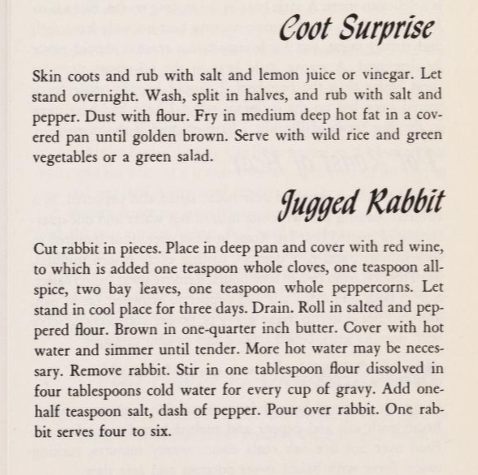
Coot Surprise

Skin coots and rub with salt and lemon juice or vinegar. Let stand overnight. Wash, split in halves, and rub with salt and pepper. Dust with flour. Fry in medium deep hot fat in a covered pan until golden brown. Serve with wild rice and green vegetables or a green salad.


Jugged Rabbit

Cut rabbit in pieces. Place in deep pan and cover with red wine, to which is added one teaspoon whole cloves, one teaspoon all-spice, two bay leaves, one teaspoon whole peppercorns. Let stand in cool place for three days. Drain. Roll in salted and peppered four. Brown in one-quarter inch butter. Cover with hot water and simmer until tender. More hot water may be necessary. Remove rabbit. Stir in one tablespoon flour dissolved in four tablespoons cold water for every cup of gravy. Add one-half teaspoon salt, dash of pepper. Pour over rabbit. One rabbit serves four to six.

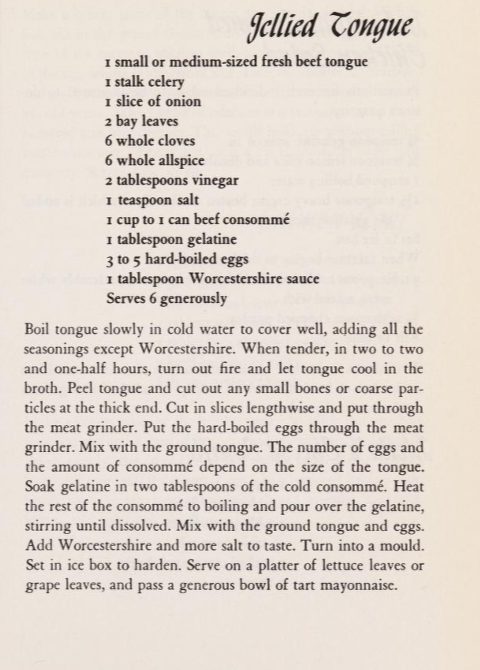
Jellied Tongue

1 small or medium-sized fresh beef tongue 1 stalk celery 

1 slice of onion

2 bay leaves

6 whole cloves

6 whole allspice

2 tablespoons vinegar

1 teaspoon salt

1 cup to 1 can beef consommé

1 tablespoon gelatine

3 to 5 hard-boiled eggs

1 tablespoon Worcestershire sauce

Serves 6 generously

Boil tongue slowly in cold water to cover well, adding all the seasonings except Worcestershire. When tender, in two to two and one-half hours, turn out fire and let tongue cool in the broth. Peel tongue and cut out any small bones or coarse particles at the thick end. Cut in slices lengthwise and put through the meat grinder. Put the hard-boiled eggs through the meat grinder. Mix with the ground tongue. The number of eggs and the amount of consommé depend on the size of the tongue. Soak gelatine in two tablespoons of the cold consommé. Heat the rest of the consommé to boiling and pour over the gelatine, stirring until dissolved. Mix with the ground tongue and eggs. Add Worcestershire and more salt to taste. Turn into a mould. Set in ice box to harden. Serve on a platter of lettuce leaves or grape leaves, and pass a generous bowl of tart mayonnaise.

Donald Barthelme wants you to please tell David Markson that he’s not always coming out of that liquor store where you frequently see him

I lived over near Sixth, and so I’d frequently walk up West Eleventh and we’d run into each other. He was a famous writer, and I had no reputation at all, so I was always kind of quiet around him. He was the Donald Barthelme. Once, I was walking with my daughter, who was about sixteen at the time, and we bumped into him. Afterward, she asked me who he was and I told her, and she said, ‘Dad! You didn’t even introduce me! My friends and I love his work!’ One time, [Barthelme’s editor] Faith Sale passed this message on to my wife; she said, ‘Donald Barthelme wants you to please tell David Markson that he’s not always coming out of that liquor store where you frequently see him. . .It was very funny. I, of course, went to a different liquor store, and was probably there more often than Don was in his!

An anecdote from David Markson, recorded in Tracy Daugherty’s Donald Barthelme biography, Hiding Man.

Notice to mariners | Donald Barthelme

To the Editor:

The fall 1973 number of the Carolina Quarterly contains a story called “Divorce” and signed with my name. As it happens, I did not write it. It is quite a worthy effort, as pastiches go, and particularly successful in reproducing my weaknesses. A second story, titled “Cannon,” also signed with my name, appears in the current issue of Voyages. As a candidate‐member of the Scandinavian Institute of Comparative Vandalism, I would rate the second item somewhat inferior to the first, but again, I am not responsible. May I say, as a sort of notice to mariners, that only manuscripts offered to editors by my agent, Lynn Nesbit, are authentic—not good or bad, but at least authentic.

DONALD BARTHELME New York City.

(Barthelme’s letter was published in The New York Times, 23 Dec. 1963

I also remember him talking to me about the structure of 2666 and a novel about bullfighters that he never finished (as far as I know), and which, he said, would be called Corrida

We are in December of 1997. I’m living in Barcelona, but I’ve gone to Girona to write an article for El País about an exhibition of work by a childhood friend, David Sanmiguel. At the same time as the opening, in Llibreria 22—right across the street from the art gallery—Ponç Puigdevall is presenting the book Last Evenings on Earth, by Roberto Bolaño. By now, Bolaño has in quick succession published Nazi Literature in the Americas and Distant Star, and his name is beginning to resonate in certain literary circles. But I, who am totally outside these circles despite having published three novels, have not yet read him, and have heard of him only from Enrique Vila-Matas, who is a mutual friend. Before the exhibition opens, I have a coffee with Bolaño and Puigdevall. Bolaño tells me he lives in Blanes, that all he does is write, that he makes a living—“a very modest one,” he emphasizes—through literature. Suddenly, while listening to him talk, I have a hunch. I ask Bolaño if he was living in Girona in the early eighties; he says he was. I ask him if he knew Xavier Coromina; he says yes. Then I tell him of our fleeting encounter outside the Bistrot and, once inside the Llibreria 22, I show him the passage in my second novel where a character says his thesis is going, but who knows where it’s really headed. Bolaño laughs; I laugh too.

From Javier Cercas’s memory-essay “Bolaño in Girona: A Friendship.”

Stephen Dixon on Thomas Bernhard

“The Plug,” by Stephen Dixon, was published in the winter 1997 issue of Rain Taxi.


I did a coupla readings for my last novel, Gould, and at one of them a guy in the audience said “Were you influenced by Thomas Bernhard?” and I said “Why, because of the long paragraphs? To tell you the truth, I know he has a great reputation but I started two Bernhard books and I didn’t think he did the long paragraph that well. They were repetitive, a bit formally and almost too rigidly written, and I often lost track of the story in them, and other things why I didn’t like them, although what, I forget.” “No,” he said, “or maybe that, but also because Gould is a character in one of his books too, The Loser. I just thought it was too much of a coincidence that you hadn’t read a lot of him and been influenced,” and I said “Gould? That guy’s name in his book is Gould? I thought I made up that forename,” and he said “Glenn Gould,” and I said “No, my character is Gould Bookbinder and he doesn’t play the piano though I think he does love Bach above all composers and especially the composition Gouldberg Variations,” and he said “That’s another thing. The first part of your novel is about variations of a single theme, abortions, right?–or that’s what you said,” and I said, “So, another coincidence. But you made me interested; I’ll read The Loser.” I didn’t, though, but a month later a colleague of mine asked if I’d ever read Bernhard’s The Loser and I said “Why, because of the long paragraphs, though he only seems to have one paragraph a book, and because of the name Gould, though I don’t know if you know–” and she said “I do: first name, not last name. But I was thinking you’d like him. The two of you do a lot of the same things. The urban settings, dark but comical nature of your characters, their dislike of so many things, though your narrators for the past ten years of your work have been fathers to the extreme as well as loyal husbands, while none of his main characters seem to have children and they never marry either or have sex, at least not in the books,” and I said “This is a double coincidence, your bringing up The Loser and someone at a recent reading bringing it up, or maybe ‘coincidence’ isn’t the right word. And sure, I understand it: Gould, the name, and my love for losers, and the long paragraph, so I’m going to read that book, I promise; the next book I start will be The Loser.” “What’re you reading now?” she said and I said “I forget; what am I reading now? It can’t be too interesting if I don’t know what it is. It isn’t interesting, in fact, so I’m going to buy a copy of his book today.” Usually I put things like this off, or just forget it, but this time I didn’t. I have to have a book to read and The Loser sounded like the one, but more out of curiosity, which isn’t a good reason for me to read a book, than because I was interested in it as literature. So I bought it that day, started it that night, and loved it. There’s my literary criticism. The single paragraph worked. So did Glenn Gould as a supporting character and Horowitz in the background. The book was funny and deep and crabby and dark and obsessive. He had his Gould and I had mine and the coincidence of the two of us using the same name, though his last but first and mine first but second, and intrigued, maybe for the same reason–I don’t know what his is but mine is that I can’t write anything anymore but in a single paragraph–by the long paragraph is, well . . . I lost my thought and apologize for the disarray. I liked it because it was intelligent, or should I say “I also liked it because,” and it was short, though took me a long time to finish, relatively speaking, since my eyes aren’t what they used to be and eyeglasses don’t do what they used to do for me and my body gets tireder faster than it used to and after a long day of work, and every day seems to be a long day of work, only a little of it my writing, I don’t have that much time to read the book, which is the only way I like to read: I want to read it, I want to read him. And after I read it I wanted to immediately read another Bernhard book, that’s the effect the first one had, so I got Woodcutters and read that and loved it and thought it was better than The Loser, funnier, crabbier, darker, more opinionated and artistic, he did things in this he didn’t in the other, trickier literary things: the guy sitting in the chair three quarters of the book, never getting out of it, just observing and thinking about what he observes, like someone out of Beckett’s novels but better, though Bernhard must have lifted it from Beckett, at least spiritually–do I know what I’m saying? Let me just say there was a very Beckettian feeling about Woodcutters. Anyway, after that one I immediately got another one, Yes, and didn’t much like it–it was older Bernhard, early Bernhard, it didn’t take the risks, it didn’t compel me to read, and it had paragraphs, I think, and I got The Lime Works and it was only so-so, and I thought “Have I read the very best of Bernhard or is it that his later works are better than his early ones?” and so got Old Masters, one of the last books of Bernhard, I think, and thought that the best one, again the man sitting in a chair, though it’s a couch in a museum, and it was even more vitriolic than Woodcutters, and next immediately read Concrete and thought that a very good one and I’m now reading Correction and liking it and I will probably read The Cheap-Eaters, without even thinking “early, late, middle Bernhard,” what do I care anymore? I just want to continue to read the guy, though a German professor at Hopkins where I teach told me there are more than twenty Bernhard novels, not all of them translated but all of them to be translated, and I told her maybe that’ll be too many for me to read, but you never know. I asked this woman “By the way, this Austrian writer Stifter, he mentions in Old Masters, he’s not a real person, is he?” and she said “Oh yes, very famous, a traditionalist, not too well known in America,” and I said “Amazing what Bernhard gets away with. Imagine an American writer working into his texts such excoriations of other writers, including contemporaries, which Bernhard does too. And knocking the Academy and prize givers, as Bernhard does in almost all his books: in America writers claw each other to get prizes and, you know, throw up on the hands that pin the medals on their chests and stuff the checks into their pockets. Some of his thoughts are a bit odd and wrongheaded if not occasionally loony,” I said, “but most I agree with. And after reading a lot of him, in addition to all the other similarities people have mentioned–well, really, just two people–and I don’t think the first ever read my work, just picked it up from the reading I gave and what was on the book jacket–is . . . oh, I forget what I was going to say.” I want to end this by saying I haven’t been so taken by one writer since I was in my mid-twenties and started reading everything Saul Bellow had written up till then. And in my early twenties, I read one Thomas Mann book after the other, probably not completing his entire oeuvre but getting close. And before that, when I was eighteen, I read everything of Dostoevski’s that had been translated. And I forgot Joyce and my mid-twenties when I read everything he wrote, though his corpus wasn’t by any means as large as Mann’s or Dostoevski’s. And one last note: Please don’t think I’m writing this as a plug for my own Gould. Or that what I just said in that last sentence is an additional plug. I hate writers who plug their books, who sort of work in a reference to their books, especially the new ones, whenever they can. I only brought up my book because it’s consequential to this inconsequential minor essay on Bernhard and that if I hadn’t written a book called Gould I probably wouldn’t have read The Loser and, of course, after that, another half-dozen Bernhard books. Did I use “inconsequential” right, then? Perhaps even to call this an essay is absurd, though to call it inconsequential and minor isn’t. But I hope I just did what I always like to do and that’s to belittle my own work and show myself as a writer who’s part bumbling semimoron. And also done what I’ve never done in print before, so far as I can remember, and my memory isn’t that good, and that is to plug the work of someone else and write even in the most exaggerated definition of the word an essay. “Exaggerated” isn’t the word I meant, I think, but I’m sure you know what I mean even in my probable misuse of it.

RIP John Barth

img_4537

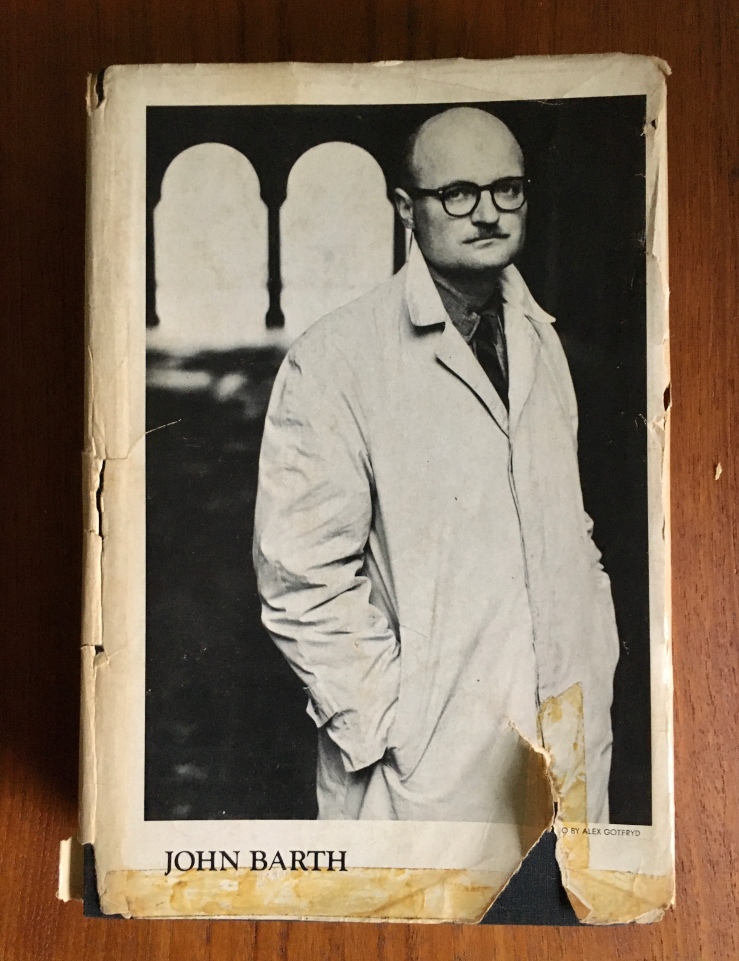
RIP John Barth, 1930-2024

John Barth died yesterday at the age of 93. Between 1956 and 2011, he published thirteen novels and four short story collections. He also published a quartet of nonfiction books—his “Friday” books—that collected the many essays, introductions, lectures, and other pieces he wrote in his life time. The title of the last collection of nonfiction, 2022’s Postscripts (or Just Desserts): Some Final Scribblings, consciously pointed to the end of his road.

Barth will most likely be remembered for the novels and stories he published in the 1960s and 1970s, when he began practicing the metaficitonal arts. Critics and reviewers have alternately accused Barth of being a fabulist, an anti-novelist, a black humorist, a goddamn nihilist (or at least a creator of nihilist fiction), but most predominately, as a postmodernist.

Barth’s run from 1960-1972 is particularly impressive: The Sot-Weed FactorGiles Goat-BoyLost in the Funhouse, and Chimera. In these works, Barth helped to create a new postmodernist tradition in U.S. fiction. Like most postmodern practitioners of his era, he was ambivalent and perhaps suspicious of the term postmodern. But Barth’s 1967 essay “The Literature of Exhaustion”, oft-cited as a postmodernist manifesto, called for a new literature in the face of “the used-upness of certain forms or exhaustion of certain possibilities,” which he cheerfully noted was “by no means necessarily a cause for despair.” (It’s a fine read, but not really a manifesto so much as a love letter to his hero Jorge Luis Borges.)

Many readers have interpreted “The Literature of Exhaustion” as a rebuke to realist fiction; Barth’s first two novels, The Floating Opera (1956) and The End of the Road (1958) are thus surprisingly realistic, at least for the reader who finds himself coming to them after, say, the metafictional fireworks of Lost in the Funhouse or Chimera (that reader was me, reader). 1960’s The Sot-Weed Factor marked a massive shift for Barth–in tone, complexity, structure, themes, and, quite frankly, length.

Interestingly, Barth claimed in his introduction to the 1987 reprint of Giles Goat-Boy that he regarded his first three novels “as a loose trilogy,” noting that in producing The Sot-Weed Factor,

I had put something behind me and moved into new narrative country. Just what that movement was, I couldn’t quite have said; today it might be described as the passage made by a number of American writers from the Black Humor of the Fifties to the Fabulism of the Sixties. For four years, writing Sot-Weed, I’d been more or less immersed in the sometimes fantastical documents of U.S. colonial history: in the origins of “America,” including the origins of our literature. This immersion, together with the suggestion by some literary critics that that novel was a reorchestration of the ancient myth of the Wandering Hero, led me to reexamine that myth closely: the origins not of a particular culture but of culture itself; not of a particular literature, but of the very notion of narrative adventure, especially adventure of a transcendental, life-changing and culture-changing sort.

Barth above offers a concise description of the trajectory of the next few decades of his writing.

In my memory, I’m most fond of The Sot-Weed Factor, a sprawling satire of American colonialism and storytelling itself, simultaneously rich and bloated. In my memory, I think of it as a companion to and forerunner of Pynchon’s masterpiece Mason & Dixon. Revisiting my review earlier today—composed nearly thirteen years ago—I see that I was quite unkind to the novel at times, describing it at one point as “the literary equivalent of a very bright writer jacking off to his own research.” Ah well. I was no doubt exhausted by the assy-turvy thing’s 800 pages.

Giles Goat-Boy (1966) is also very long—Barth would go on to write many long novels—and I think it’s probably the consensus favorite of Barth acolytes. Barth described Giles Goat-Boy as “the adventures of a young man sired by a giant computer upon a hapless but compliant librarian and raised in the experimental goat-barns of a universal university, divided ideologically into East and West Campuses.” Like The Sot-Weed Factor, Giles Goat-Boy is a parodic picaresque of displaced identity. It’s in Giles Goat-Boy that Barth begins his life-long practice of metafiction.

Barth’s metafiction evinces in more bite-sized doses in the collection Lost in the Funhouse (1966). This was the first Barth I read, sometime in the 1990s, and I suspect many readers found their way to it the same way I did, via David Foster Wallace; specifically, through Wallace’s novella Westward the Course of Empire Takes Its Way, an intertextual response to FunhouseLost in the Funhouse is the perfect starting place for anyone interested in Barth’s metafictional postmodernism (and it might also be the last stop for some readers).

I think the next one I read was Chimera (1972), a book that daunted me so much when I was younger that I broke into sweats reading it. Revisiting a few years ago I found it far funnier, sillier, and comprehensible than I would have thought. At the outset of Chimera, Barth inserts himself as a somewhat-feckless genie who appears before Scheherazade and Dunyazade and, in a wonderful time-loop conceit, gives Scheherazade the “1001 Nights” gambit of story-telling-as-a-method-to-stave-off-rape-and-murder. Barth inserts himself into a frame tale around a frame tale around a frame tale. A reread of Chimera’s initial frame tale reveals realistic autofictional tinges into Barth’s metafictional gambit. The Genie–Barth–laments that “At one time…people in his country had been fond of reading; currently, however, the only readers of artful fiction were critics, other writers, and unwilling students who, left to themselves, preferred music and pictures to words.” Barth’s Genie has writer’s block, but he’s unsure “if his difficulty might be owing to his own limitations, his age and stage and personal vicissitudes; how much to the general decline of letters in his time and place; and how much to the other crises with which his country (and, so he alleged, the very species) was beset.” Modernist existential despair was never really exhausted, right? It just found new forms.

I’ll admit that I didn’t read much of Barth’s post-1970’s work, aside from the occasional essay or short story. I didn’t make any kind of dent into the near-800 pages 1979’s LETTERS (in fairness, I find even short epistolary novels tedious), and the last one I took a crack at was 1987’s The Tidewater Tales, making it somewhere farther into its near-700 pages before turning my poor attention elsewhere.

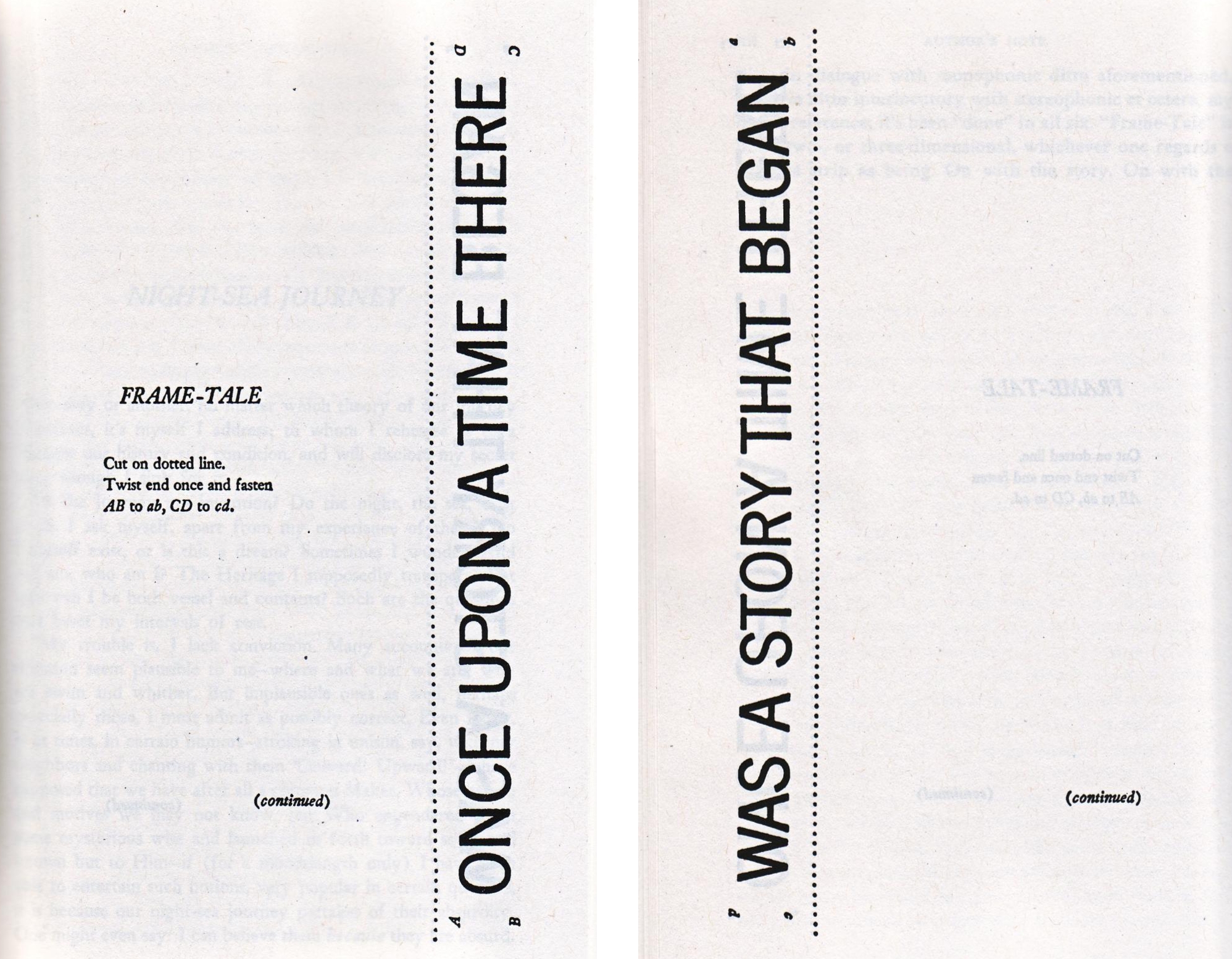
Like many readers, Barth’s 1960s and 1970s was a gateway drug for me to postmodernist writers like William Gaddis, Thomas Pynchon, William Gass, and Robert Coover. Most of that generation of American postmodernists are gone, but I like to think that their stories will go on. I’ll leave it with the opening piece from Lost in the Funhouse, “Frame-Tale.” The story never ends.

Gass was important to Gaddis

Gass read his peers’ work and commented on it regularly, in interviews, guest lectures, critical articles, and book reviews. Gaddis, on the other hand, was not inclined to read his contemporaries. Steven Moore writes that “[h]e seemed to have little interest in the novels of those contemporaries with whom he is most often associated,” including Barth, Donald Barthelme, Robert Coover, Don DeLillo, John Hawkes, Cormac McCarthy, and Thomas Pynchon. “William H. Gass was an exception,” says Moore, “whom he admired both personally and professionally.” At the tribute to her father in 1999, Sarah Gaddis said, “William Gass was important to Gaddis. . . . He held Gass in the highest esteem for his work, and no other writer made him feel so understood.” ( This respect for Gass and his opinions, literary and otherwise, is made clear by Gaddis’s frequently quoting or paraphrasing his friend in letters to others over the years; and his admiration for Gass’s abilities as a writer is put plainly in an April 13, 1994, letter to Michael Silverblatt, host of the literary radio program Bookworm: “Gass is for me our foremost writer, a magician with the language.”

From Ted Morrissey’s essay “‘Honored by the Error’: The Literary Friendship of Gaddis and Gass”. Morrissey’s essay is part of Electronic Book Review’s special issue, “Gaddis at His Centenary,” which includes Gaddis scholarship, histories, unpublished Gaddisalia, and some roundtable discussions.

Portrait of Georges Perec — Dmitry Samarov

Hear Dmitry Samarov read the introduction to Georges Perec’s novel Life A User’s Manual.

Scolds, schlemiels, schnorrers, schnooks, schmucks, schlumps | William H. Gass

When young and full of fellow feeling, Professor Joseph Skizzen had been tormented by the thought that the human race (which he naïvely believed was made up of great composers, a few harmlessly lecherous painters, maybe a mathematician or a scientist, a salon of writers, all aiming at higher things however they otherwise carried on) … that such an ennobled species might not prosper, indeed, might not survive in any serious way—symphonies sinking like torpedoed ships, murals spray-canned out of sight, statues toppled, books burned, plays updated by posturing directors; but now, older, wiser—more jaundiced, it’s true—he worried that it might (now that he saw that the human world was packed with politicians who could not even spell “scruple”; now that he saw that it was crammed with commercial types who adored only American money; now that he saw how it had been overrun by religious stupefiers, mountebanks, charlatans, obfuscators, and other dedicated misleaders, as well as corrupt professionals of all kinds—ten o’clock scholars, malpracticing doctors, bribed judges, sleepy deans, callous munitions makers and their pompous generals, pedophilic priests, but probably not pet lovers, not arborists, not gardeners—but Puritans, squeezers, and other assholes, ladies bountiful, ladies easy, shoppers diligent, lobbyists greedy, Eagle Scouts, racist cops, loan sharks, backbiters, gun runners, spies, Judases, philistines, vulgarians, dumbbells, dolts, boobs, louts, jerks, jocks, creeps, yokels, cretins, simps, pipsqueaks—not a mensch among them—nebbechs, scolds, schlemiels, schnorrers, schnooks, schmucks, schlumps, dummkopfs, potato heads, klutzes, not to omit pushers, bigots, born-again Bible bangers, users, conmen, ass kissers, Casanovas, pimps, thieves and their sort, rapists and their kind, murderers and their ilk—the pugnacious, the miserly, the envious, the litigatious, the avaricious, the gluttonous, the lubricious, the jealous, the profligate, the gossipacious, the indifferent, the bored), well, now that he saw it had been so infested, he worried that the race might … might what? … the whole lot might sail on through floods of their own blood like a proud ship and parade out of the new Noah’s ark in the required pairs—for breeding, one of each sex—sportscasters, programmers, promoters, polluters, stockbrokers, bankers, body builders, busty models, show hosts, stamp and coin collectors, crooners, glamour girls, addicts, gamblers, shirkers, solicitors, opportunists, insatiable developers, arrogant agents, fudging accountants, yellow journalists, ambulance chasers and shysters of every sleazy pursuit, CEOs at the head of a whole column of white-collar crooks, psychiatrists, osteopaths, snake oilers, hucksters, fawners, fans of funerals, fortune-tellers and other prognosticators, road warriors, chieftains, Klansmen, Shriners, men and women of any cloth and any holy order—at every step moister of cunt and stiffer of cock than any cock or cunt before them, even back when the world was new, now saved and saved with spunk enough to couple and restock the pop … the pop … the goddamn population.

From William H. Gass’s novel Middle C.

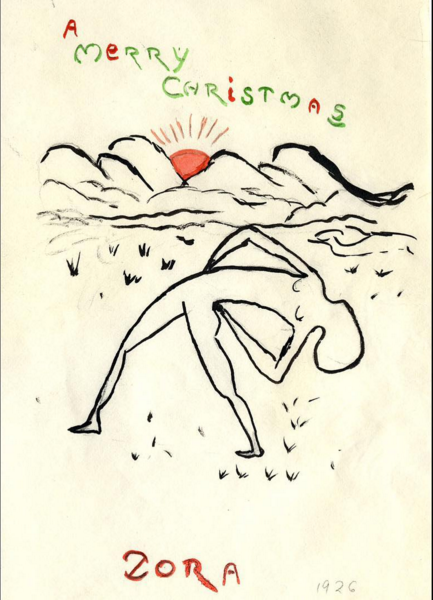
Zora Neale Hurston’s hand-drawn Christmas card

Screenshot 2015-12-25 at 4.34.25 PM

Zora Neale Hurston’s hand-drawn Christmas card (1926). From Fannie Hurst’s papers at the Harry Ransom center in Austin, TX. Via the Ransom Center’s Instagram account.