Meantime, I continued to stand on the oozy margin of the stream | Nathaniel Hawthorne’s journal entry for August 24th, 1842

August 24th.–I left home at five o’clock this morning to catch some fish for breakfast. I shook our summer apple-tree, and ate the golden apple which fell from it. Methinks these early apples, which come as a golden promise before the treasures of autumnal fruit, are almost more delicious than anything that comes afterwards. We have but one such tree in our orchard; but it supplies us with a daily abundance, and probably will do so for at least a week to come. Meantime other trees begin to cast their ripening windfalls upon the grass; and when I taste them, and perceive their mellowed flavor and blackening seeds, I feel somewhat overwhelmed with the impending bounties of Providence. I suppose Adam, in Paradise, did not like to see his fruits decaying on the ground, after he had watched them through the sunny days of the world’s first summer. However, insects, at the worst, will hold a festival upon them, so that they will not be thrown away, in the great scheme of Nature. Moreover, I have one advantage over the primeval Adam, inasmuch as there is a chance of disposing of my superfluous fruits among people who inhabit no Paradise of their own.

Passing a little way down along the river-side, I threw in my line, and soon drew out one of the smallest possible of fishes. It seemed to be a pretty good morning for the angler,–an autumnal coolness in the air, a clear sky, but with a fog across the lowlands and on the surface of the river, which a gentle breeze sometimes condensed into wreaths. At first, I could barely discern the opposite shore of the river; but, as the sun arose, the vapors gradually dispersed, till only a warm, smoky tint was left along the water’s surface. The farm-houses across the river made their appearance out of the dusky cloud; the voices of boys were heard, shouting to the cattle as they drove them to the pastures; a man whetted his scythe, and set to work in a neighboring meadow. Meantime, I continued to stand on the oozy margin of the stream, beguiling the little fish; and though the scaly inhabitants of our river partake somewhat of the character of their native element, and are but sluggish biters, still I contrived to pull out not far from two dozen. They were all bream, a broad, flat, almost circular fish, shaped a good deal like a flounder, but swimming on their edges, instead of on their sides. As far as mere pleasure is concerned, it is hardly worth while to fish in our river, it is so much like angling in a mud-puddle; and one does not attach the idea of freshness and purity to the fishes, as we do to those which inhabit swift, transparent streams, or haunt the shores of the great briny deep. Standing on the weedy margin, and throwing the line over the elder-bushes that dip into the water, it seems as if we could catch nothing but frogs and mud-turtles, or reptiles akin to them. And even when a fish of reputable aspect is drawn out, one feels a shyness about touching him. As to our river, its character was admirably expressed last night by some one who said “it was too lazy to keep itself clean.” I might write pages and pages, and only obscure the impression which this brief sentence conveys. Nevertheless, we made bold to eat some of my fish for breakfast, and found them very savory; and the rest shall meet with due entertainment at dinner, together with some shell-beans, green corn, and cucumbers from our garden; so this day’s food comes directly and entirely from beneficent Nature, without the intervention of any third person between her and us.

Nathaniel Hawthorne’s journal entry, 24 August 1842. From American Note-Books.

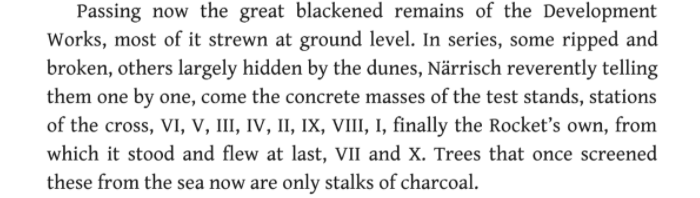
He saw himself nailed to the cross of his own cradle and coffin | From László Krasznahorkai’s Satantango

He gazed sadly at the threatening sky, at the burned-out remnants of a locust-plagued summer, and suddenly saw on the twig of an acacia, as in a vision, the progress of spring, summer, fall and winter, as if the whole of time were a frivolous interlude in the much greater spaces of eternity, a brilliant conjuring trick to produce something apparently orderly out of chaos, to establish a vantage point from which chance might begin to look like necessity …and he saw himself nailed to the cross of his own cradle and coffin, painfully trying to tear his body away, only, eventually, to deliver himself—utterly naked, without identifying mark, stripped down to essentials—into the care of the people whose duty it was to wash the corpses, people obeying an order snapped out in the dry air against a background loud with torturers and flayers of skin, where he was obliged to regard the human condition without a trace of pity, without a single possibility of anyway back to life, because by then he would know for certain that all his life he had been playing with cheaters who had marked the cards and who would, in the end, strip him even of his last means of defense, of that hope of someday finding his way back home.

An excerpt from the beginning (and end) of László Krasznahorkai’s novel Satantango. English translation by George Szirtes.

I listened to the audiobook of Satantango last week and then launched into it again, reading bits in tandem with my New Directions edition from years ago, finding it funnier, richer, and more complex than I’d initially thought, its plot threads clarifying more easily in a reread. I think this passage does a nice job of laying out the novel’s themes of abjection, time (and deep time), observation (and surveillance), and life as one big con.


Reading to Celeste — Chelsea Gibson

818b5c4b9505fa6c79d510d1256b5903

Reading to Celeste, 2020 by Chelsea Gibson

Flann O’Brien & Anne Carson (Violating building codes leads to a web of obssession) | David Berman


2020-08-15_151419_2

From The Minus Times #29, as republished in The Minus Times Collected. 

“The one-man band doesn’t look too happy,” Mathilda observed | Donald Barthelme

2020-06-28_183906_1

From Donald Barthelme’s children’s book The Slightly Irregular Fire Engine; or The Hithering Thithering Djinn.

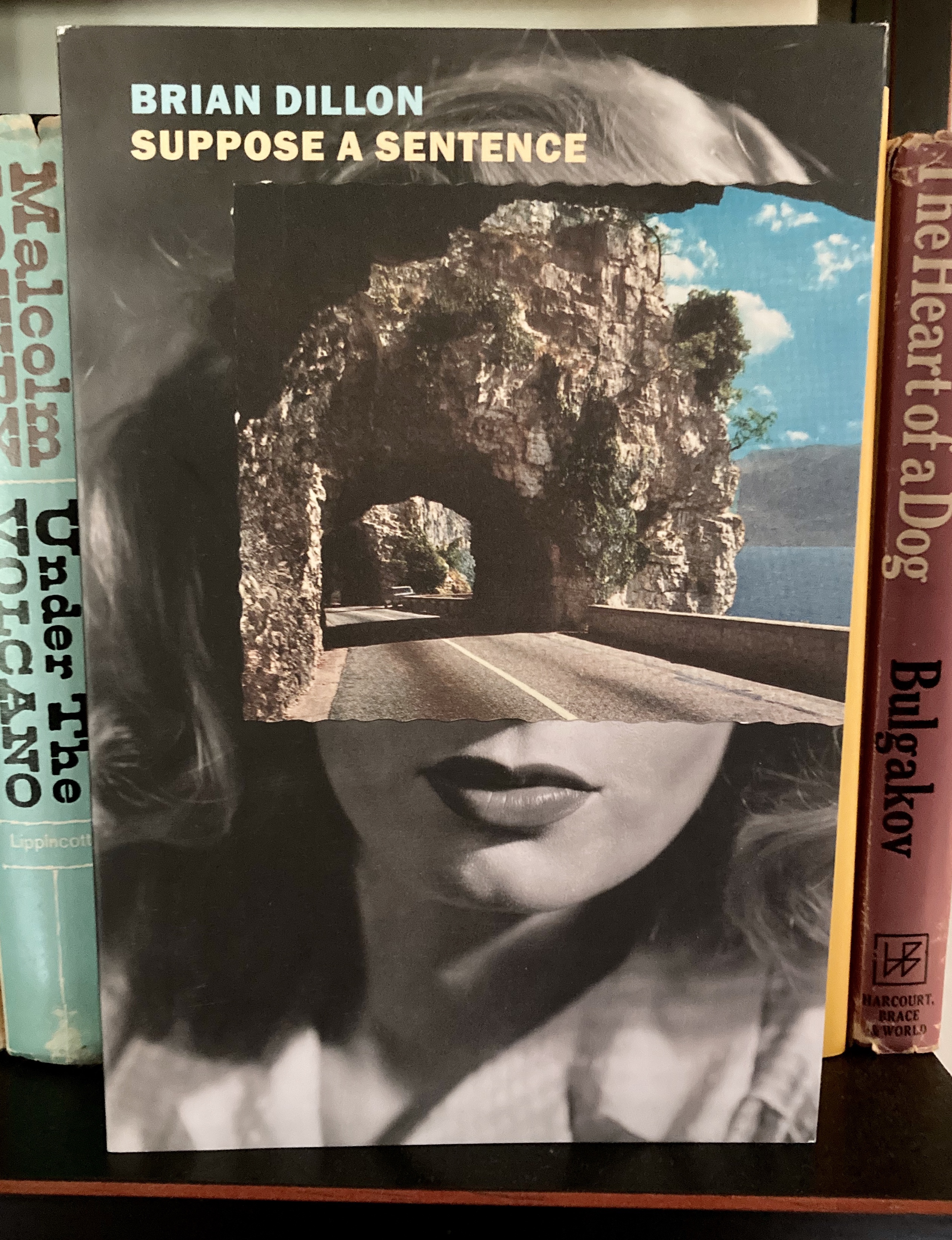
Brian Dillon’s Suppose a Sentence (Book acquired, 14 Aug. 2020)

Brian Dillon’s Suppose a Sentence is a collection of 27 essays that each take a single sentence as their starting point. Organized chronologically by author dates, the collection begins with Shakespeare and Donne and works its way to Anne Carson and Anne Boyer (with Eliot, Stein, Beckett, Bowen et al along the way). When it showed up at Biblioklept World Headquarters last week I was intrigued, and admittedly jumped to the end to read the pieces on Carson and Boyer. In subsequent days I read the pieces on Shakespeare (Dillon takes his sentence “O, o, o, o” from Hamlet, but finds the vowels reputation throughout the playwright’s oeuvre) and Robert Smithson (in the middle of the book). I’ve decided to settle down and read in order at a leisurely pace—a chapter a day?

In the meantime, NYRB’s blurb

In Suppose a Sentence, Brian Dillon, whom John Banville has called “a literary flâneur in the tradition of Baudelaire and Walter Benjamin,” has written a sequel of sorts to Essayism, his roaming love letter to literature. In this new book Dillon turns his attention to the oblique and complex pleasures of the sentence. A series of essays prompted by a single sentence—from Shakespeare to Janet Malcolm, John Ruskin to Joan Didion—the book explores style, voice, and language, along with the subjectivity of reading. Both an exercise in practical criticism and a set of experiments or challenges, Suppose a Sentence is a polemical and personal reflection on the art of the sentence in literature. Whether the sentence in question is a rigorous expression of a state of vulnerability, extremity, even madness, or a carefully calibrated arrangement, Dillon examines not only how it works and why but also, in the course of the book, what the sentence once was, what it is today, and what it might become tomorrow.

Niagra Red Chair — Jamie Adams 

Niagra Red Chair, 2013 by Jamie Adams (b. 1961)

TEST TEST TEST

They’re talking about things of which they don’t have the slightest understanding, anyway. It’s only because of their stupidity that they’re able to be so sure of themselves.

Very easy to read

I ate
Paradise
Congratulations
Our box

Everyone
You to you
Subject
On coffee

I do not have it
They are awesome
Very good
It is very cold


It totally depends
Get up

Red palesgra
Wheelchair

Rain covered
That

It’s white
Chicken


Posted in Art

test too

It is a singular thing, that, at the distance, say, of five feet, the work of the greatest dunce looks just as well as that of the greatest genius,–that little space being all the distance between genius and stupidity.

There is evil in every human heart, which may remain latent, perhaps, through the whole of life; but circumstances may rouse it to activity. To imagine such circumstances. A woman, tempted to be false to her husband, apparently through mere whim,–or a young man to feel an instinctive thirst for blood, and to commit murder. This appetite may be traced in the popularity of criminal trials. The appetite might be observed first in a child, and then traced upwards, manifesting itself in crimes suited to every stage of life.

Roommates — Roy Lichtenstein

Roommates, 1994 by Roy Lichtenstein (1923–1997)

Read “The Aurelian,” a short story by Vladimir Nabokov

“The Aurelian”

by

Vladimir Nabokov


I
Luring aside one of the trolley-car numbers, the street started at the corner of a crowded avenue. For a long time it crept on in obscurity, with no shop windows or any such joys. Then came a small square (four benches, a bed of pansies) round which the trolley steered with rasping disapproval. Here the street changed its name, and a new life began. Along the right side, shops appeared: a fruiterer’s, with vivid pyramids of oranges; a tobacconist’s, with the picture of a voluptuous Turk; a delicatessen, with fat brown and gray coils of sausages; and then, all of a sudden, a butterfly store. At night, and especially when it was damp, with the asphalt shining like the back of a seal, passers-by would stop for a second before that symbol of fair weather. The insects on exhibit were huge and gorgeous. People would say to themselves, ‘What colors—amazing!’ and plod on through the drizzle. Eyed wings wide open in wonder, shimmering blue satin, black magic—these lingered for a while, floating in one’s vision, until one boarded the trolley or bought a newspaper. And, just because they were together with the butterflies, a few other objects would remain in one’s memory: a globe, pencils, and a monkey’s skull on a pile of copybooks.

As the street blinked and ran on, there followed again a succession of ordinary shops—soap, coal, bread—with another pause at the corner where there was a small bar. The bartender, a dashing fellow in a starched collar and a green sweater, was deft at shaving off with one stroke the foam topping the glass under the beer tap; he also had a well-earned reputation as a wit. Every night, at a round table by the window, the fruiterer, the baker, an unemployed man, and the bartender’s first cousin played cards with great gusto. As the winner of the current stake immediately ordered four drinks, none of the players could ever get rich.

On Saturdays, at an adjacent table, there would sit a flabby elderly man with a florid face, lank hair, and a grayish moustache, carelessly clipped. When he appeared, the players greeted him noisily without looking up from their cards. He invariably ordered rum, filled his pipe, and gazed at the game with pink-rimmed watery eyes. The left eyelid drooped slightly.

Occasionally someone turned to him, and asked how his shop was doing; he would be slow to answer, and often did not answer at all. If the bartender’s daughter, a pretty freckled girl in a polka-dotted frock, happened to pass close enough, he had a go at her elusive hip, and, whether the slap succeeded or not, his gloomy expression never changed, although the veins on his temple grew purple. Mine host very humorously called him ‘Herr Professor.’ ‘Well, how is the Herr Professor tonight?’ he would ask, coming over to him, and the man would ponder for some time in silence and then, with a wet underlip pushing out from under the pipe like that of a feeding elephant, he would answer something neither funny nor polite. The bartender would counter briskly, which made the players at the next table, though seemingly absorbed in their cards, rock with ugly glee.

The man wore a roomy gray suit with great exaggeration of the vest motif, and when the cuckoo popped out of the clock he ponderously extracted a thick silver watch and gazed at it askance, holding it in the palm of his hand and squinting because of the smoke. Punctually at eleven he knocked out his pipe, paid for his rum, and, after extending a flaccid hand to anyone who might choose to shake it, silently left.

He walked awkwardly, with a slight limp. His legs seemed too thin for his body. Just before the window of his shop he turned into a passage, where there was a door on the right with a brass plate: PAUL PILGRAM. This door led into his tiny dingy apartment, which could also be reached by an inner corridor at the back of the shop. Eleanor was usually asleep when he came home on those festive nights. Half a dozen faded photographs of the same clumsy ship, taken from different angles, and of a palm tree that looked as bleak as if it were growing on Helgoland, hung in black frames above the double bed. Muttering to himself, Pilgram limped away into bulbless darkness with a lighted candle, came back with his suspenders dangling, and kept muttering while sitting on the edge of the bed and slowly, painfully, taking off his shoes. His wife, half-waking, moaned into her pillow and offered to help him; and then, with a threatening rumble in his voice, he would tell her to keep quiet, and repeated that guttural ‘Ruhe!’ several times, more and more fiercely.

After the stroke which had almost killed him some time ago (like a mountain falling upon him from behind just as he had bent towards his shoestrings), he now undressed reluctantly, growling until he got safely into bed, and then growling again if the faucet happened to drip in the adjoining kitchen. Eleanor would roll out of bed and totter into the kitchen and totter back with a dazed sigh, her small face wax-pale and shiny, and the plastered corns on her feet showing from under her dismally long nightgown. They had married in 1905, almost a quarter of a century before, and were childless because Pilgram had always thought that children would be merely a hindrance to the realization of what had been in his youth a delightfully exciting plan but had now gradually become a dark, passionate obsession.

He slept on his back with an old-fashioned nightcap coming down on his forehead; it was to all appearances the solid and sonorous sleep that might be expected in an elderly German shopkeeper, and one could readily suppose that his quilted torpor was entirely devoid of visions; but actually this churlish, heavy man, who fed mainly on Erbswurst and boiled potatoes, placidly believing in his newspaper and quite ignorant of the world (in so far as his secret passion was not involved), dreamed of things that would have seemed utterly unintelligible to his wife or his neighbors; for Pilgram belonged, or rather was meant to belong (something—the place, the time, the man—had been ill-chosen), to a special breed of dreamers, such dreamers as used to be called in the old days ‘Aurelians’—perhaps on account of those chrysalids, those ‘jewels of Nature,’ which they loved to find hanging on fences above the dusty nettles of country lanes.

On Sundays he drank his morning coffee in several sloppy sessions, and then went out for a walk with his wife, a slow silent stroll which Eleanor looked forward to all week. On workdays he opened his shop as early as possible because of the children who passed by on their way to school; for lately he had been keeping school supplies in addition to his basic stock. Some small boy, swinging his satchel and chewing a sandwich, would slouch past the tobacconist’s (where a certain brand of cigarettes offered airplane pictures), past the delicatessen (which rebuked one for having eaten that sandwich long before lunchtime), and then, remembering he wanted an eraser, would enter the next shop. Pilgram would mumble something, sticking out his lower lip from under the stem of his pipe, and, after a listless search, would plump down an open carton on the counter. The boy would feel and squeeze the virgin-pale India rubber, would not find the sort he favored, and would leave without even noticing the principal wares in the store.

‘These modern children!’ Pilgram would think with disgust, and he recalled his own boyhood. His father—a sailor, a rover, a bit of a rogue—married late in life a sallow-skinned, light-eyed Dutch girl whom he brought from Java to Berlin, and opened a shop of exotic curios. Pilgram could not remember now when, exactly, butterflies had begun to oust the stuffed birds of paradise, the stale talismans, the fans with dragons, and the like; but as a boy he already feverishly swapped specimens with collectors, and after his parents died butterflies reigned supreme in the dim little shop. Up to 1914 there were enough amateurs and professionals about to keep things going in a mild, very mild, way; later on, however, it became necessary to make concessions, a display case with the biography of the silkworm furnishing a transition to school supplies, just as in the old days pictures ignominiously composed of sparkling wings had probably been a first step towards lepidopterology. Continue reading “Read “The Aurelian,” a short story by Vladimir Nabokov”

“Classic Scene” — William Carlos Williams

“Classic Scene”

by

William Carlos Williams


A power-house
in the shape of
a red brick chair
90 feet high

on the seat of which
sit the figures
of two metal
stacks–aluminum–

commanding an area
of squalid shacks
side by side–
from one of which

buff smoke
streams while under
a grey sky
the other remains

passive today–

tumblr_ovntm8X5p21rz2lkvo1_1280

Classic Landscape, 1931 by Charles Sheeler (1883–1965)

Mail call | Thomas Pynchon

A great shout went up near the doorway, bodies flowed toward a fattish pale young man who’d appeared carrying a leather mailsack over his shoulder.

“Mail call,” people were yelling. Sure enough, it was, just like in the army. The fat kid, looking harassed, climbed up on the bar and started calling names and throwing envelopes into the crowd. Fallopian excused himself and joined the others.

Metzger had taken out a pair of glasses and was squinting through them at the kid on the bar. “He’s wearing a Yoyodyne badge. What do you make of that?”

“Some inter-office mail run,” Oedipa said.

“This time of night?”

“Maybe a late shift?” But Metzger only frowned. “Be back,” Oedipa shrugged, heading for the ladies’ room.

On the latrine wall, among lipsticked obscenities, she noticed the following message, neatly indited in engineering lettering:

“Interested in sophisticated fun? You, hubby, girl friends. The more the merrier. Get in touch with Kirby, through WASTE only. Box 7391. L. A.”

WASTE? Oedipa wondered. Beneath the notice, faintly in pencil, was a symbol she’d never seen before, a loop, triangle and trapezoid, thus:

img_5980

It might be something sexual, but she somehow doubted it. She found a pen in her purse and copied the address and symbol in her memo book, thinking: God, hieroglyphics. When she came out Fallopian was back, and had this funny look on his face.

“You weren’t supposed to see that,” he told them. He had an envelope. Oedipa could see, instead of a postage stamp, the handstruck initials PPS.

“Of course,” said Metzger. “Delivering the mail is a government monopoly. You would be opposed to that.”

Fallopian gave them a wry smile. “It’s not as rebellious as it looks. We use Yoyodyne’s inter-office delivery. On the sly. But it’s hard to find carriers, we have a big turnover. They’re run on a tight schedule, and they get nervous. Security people over at the plant know something’s up. They keep a sharp eye out. De Witt,” pointing at the fat mailman, who was being hauled, twitching, down off the bar and offered drinks he did not want, “he’s the most nervous one we’ve had all year.”

“How extensive is this?” asked Metzger.

“Only inside our San Narciso chapter. They’ve set up pilot projects similar to this in the Washington and I think Dallas chapters. But we’re the only one in California so far. A few of your more affluent type members do wrap their letters around bricks, and then the whole thing in brown paper, and send them Railway Express, but I don’t know . . .”

“A little like copping out,” Metzger sympathized.

“It’s the principle,” Fallopian agreed, sounding defensive. “To keep it up to some kind of a reasonable volume, each member has to send at least one letter a week through the Yoyodyne system. If you don’t, you get fined.” He opened his letter and showed Oedipa and Metzger.

Dear Mike, it said, how are you? Just thought I’d drop you a note. How’s your book coming? Guess that’s all for now. See you at The Scope.

That’s how it is,” Fallopian confessed bitterly, “most of the time.”

“What book did they mean?” asked Oedipa.

Turned out Fallopian was doing a history of private mail delivery in the U. S., attempting to link the Civil War to the postal reform movement that had begun around 1845. He found it beyond simple coincidence that in of all years 1861 the federal government should have set out on a vigorous suppression of those independent mail routes still surviving the various Acts of ’45, ’47, ’51 and ’55, Acts all designed to drive any private competition into financial ruin. He saw it all as a parable of power, its feeding, growth and systematic abuse, though he didn’t go into it that far with her, that particular night. All Oedipa would remember about him at first, in fact, were his slender build and neat Armenian nose, and a certain affinity of his eyes for green neon.

So began, for Oedipa, the languid, sinister blooming of The Tristero.


From The Crying of Lot 49 by Thomas Pynchon.

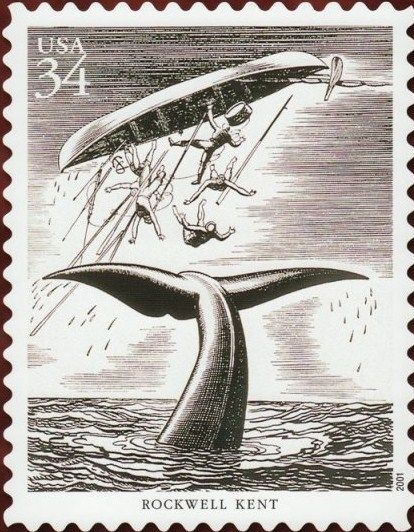
Rockwell Kent’s Moby-Dick USPS Stamp

8becb1822b7a341e5f0475df3129a6cf


“The Preacher Addresses the Seminarians” — Christian Wiman

“The Preacher Addresses the Seminarians”

by

Christian Wiman


I tell you it’s a bitch existence some Sundays
and it’s no good pretending you don’t have to pretend,

don’t have to hitch up those gluefutured nags Hope and Help
and whip the sorry chariot of yourself

toward whatever hell your heaven is on days like these.
I tell you it takes some hunger heaven itself won’t slake

to be so twitchingly intent on the pretty organist’s pedaling,
so lizardly alert to the curvelessness of her choir robe.

Here it comes, brothers and sisters, the confession of sins,
hominy hominy, dipstick doxology, one more churchcurdled hymn

we don’t so much sing as haunt: grounded altos, gear-grinding tenors,
two score and ten gently bewildered men lip-synching along.

You’re up, Pastor. Bring on the unthunder. Some trickle-piss tangent
to reality. Some bit of the Gospel grueling out of you.

I tell you sometimes mercy means nothing
but release from this homiletic hologram, a little fleshstep

sideways, as it were, setting passion on autopilot (as if it weren’t!)
to gaze out in peace at your peaceless parishioners:

boozeglazes and facelifts, bad mortgages, bored marriages,
a masonry of faces at once specific and generic,

and here and there that rapt famished look that leaps
from person to person, year to year, like a holy flu.

All these little crevices into which you’ve crawled
like a chubby plumber with useless tools:

Here, have a verse for your wife’s death.
Here, have a death for your life’s curse.

I tell you some Sundays even the children’s sermon
— maybe especially this — sharks your gut

like a bite of tin some beer-guzzling goat
either drunkenly or mistakenly decides to sample.

I know what you’re thinking. Christ’s in this.
He’ll get to it, the old cunner, somewhere somehow

there’s the miracle meat, the aurora borealis blood,
every last atom compacted to a grave

and the one thing that every man must lose to save.
Well, friends, I’m here to tell you two things today.

First, though this is not, for me, one of those bilious abrading days,
though in fact I stand before you in a rage of faith

and have all good hope that you will all go help
untold souls back into their bodies,

ease the annihilating No above which they float,
the truth is our only savior is failure.

Which brings me to the second thing: that goat.
It was real. It is, as is usually the case, the displacement of agency

that is the lie. It was long ago, Mexico, my demon days:
It was a wager whose stakes I failed to appreciate.

He tottered. He flowered. He writhed time to a fraught quiet,
and kicked occasionally, and lay there twitching, watching me die.

Sleep of Trees — F. Scott Hess

739e0b37fe03116e96253b023d3ed774

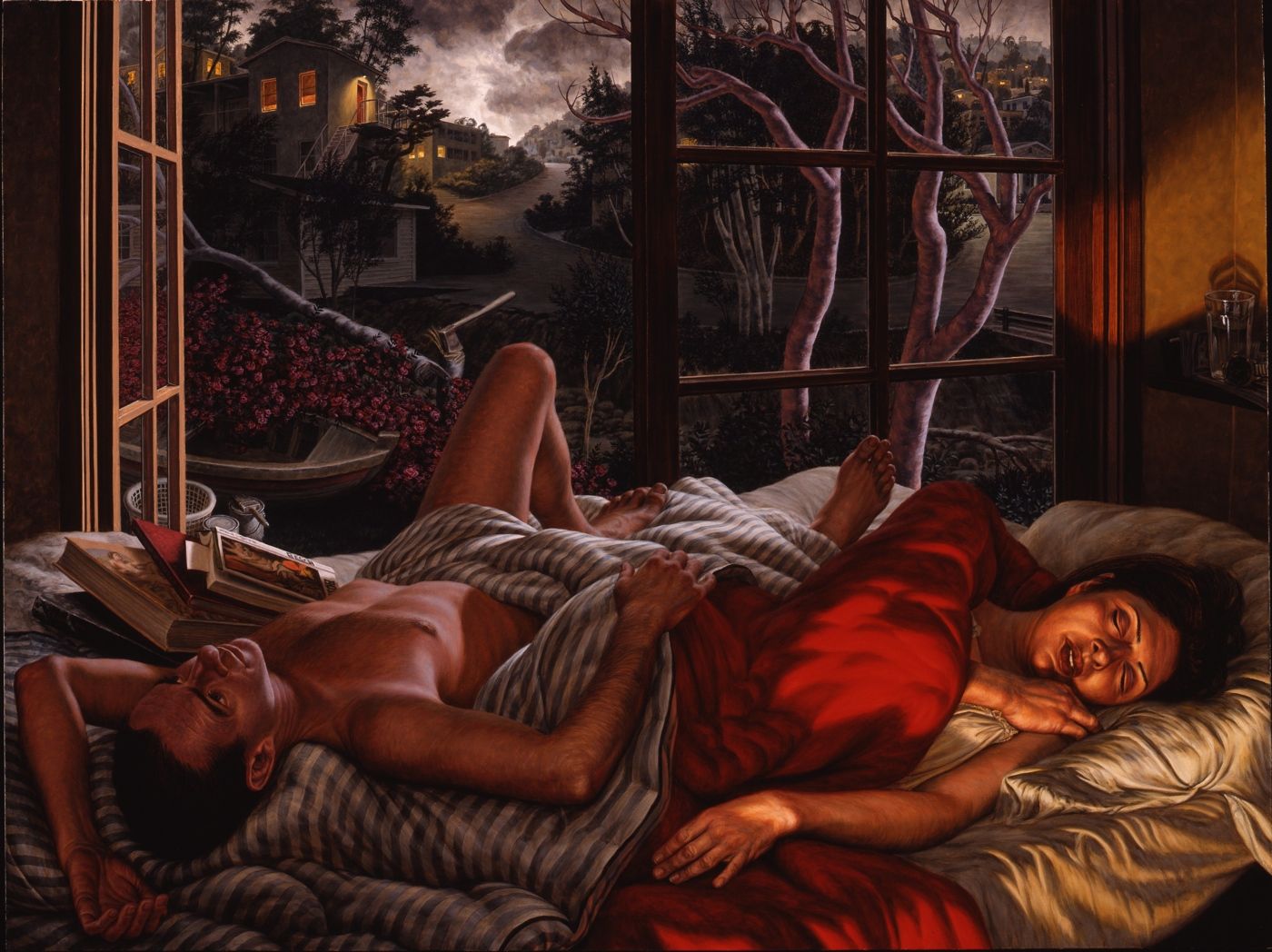
Sleep of Trees, 2000 by F. Scott Hess (b. 1955)