Conrad/Hughes (Books acquired, 2 Aug. 2020)

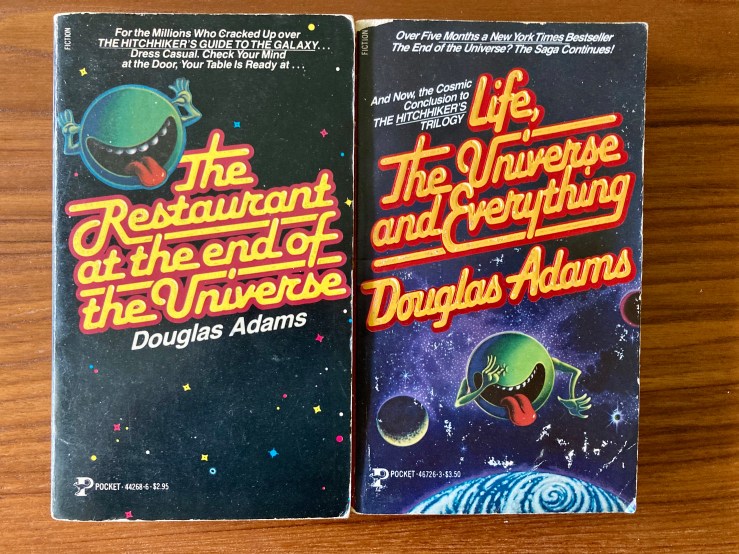
So my son finished Douglas Adams’ A Hitchhiker’s Guide to the Galaxy on Tuesday night, giving me a nice excuse to swing by the used bookstore on Wednesday to pick up the next two entries in the series, The Restaurant at the End of The Universe and Life, the Universe and Everything. I managed to find the same editions I read when I was his age. I gave my copies to one of my students some time in the early 2000s, back when I was teaching high school.

I found the Adams books almost immediately and had an hour to kill, so I strolled around, aiming not to buy anything. I’d been to the shop not a week before and picked up John Brunner’s 600+ page novel Last Stand on Zanzibar—but I thought I’d look for some interesting covers and maybe share them on twitter. And I did:

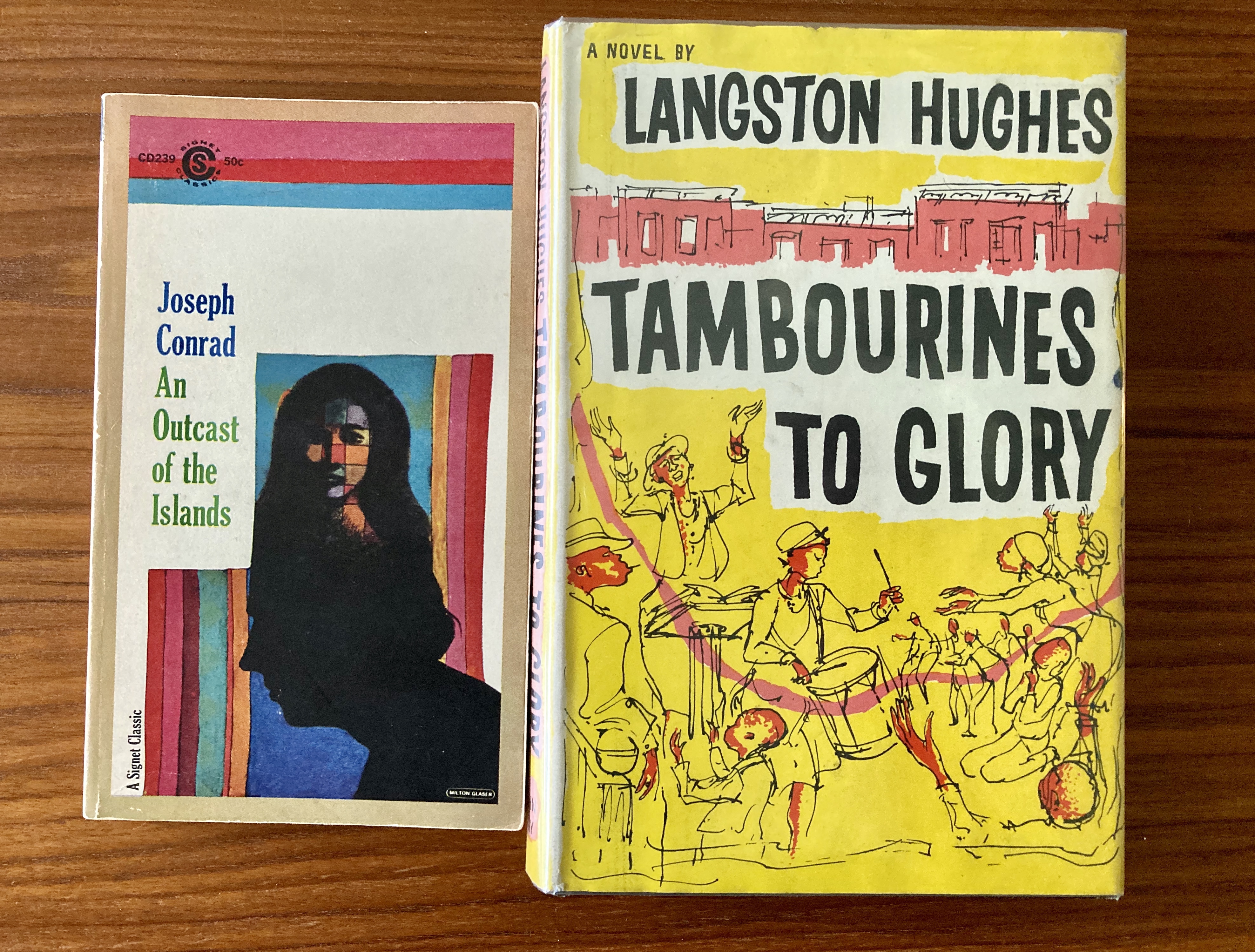
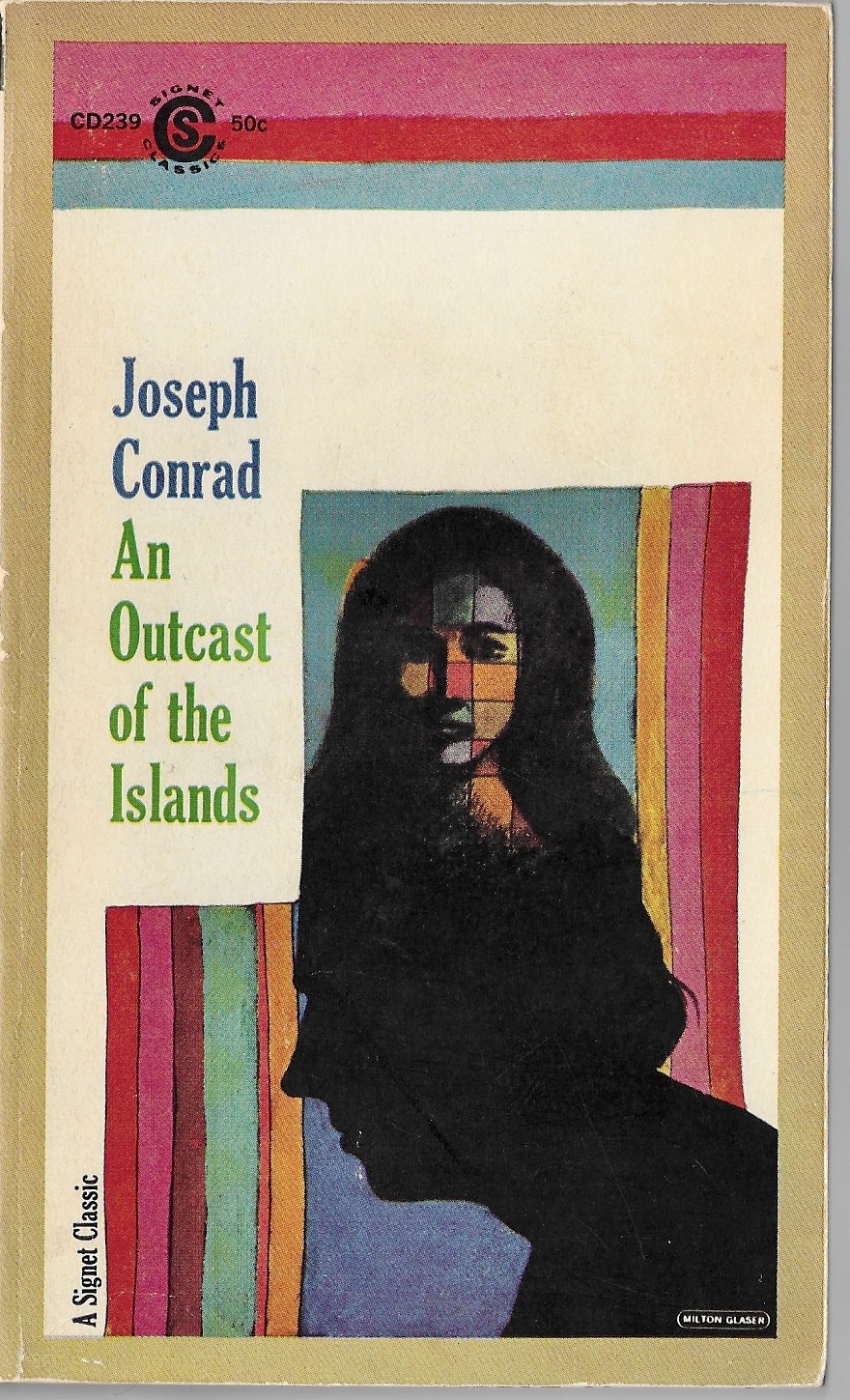
In the end though, I couldn’t pass up two books. First, I found a pristine first-edition Signet paperback of Joseph Conrad’s second novel An Outcast of the Islands with a striking Milton Glaser cover:

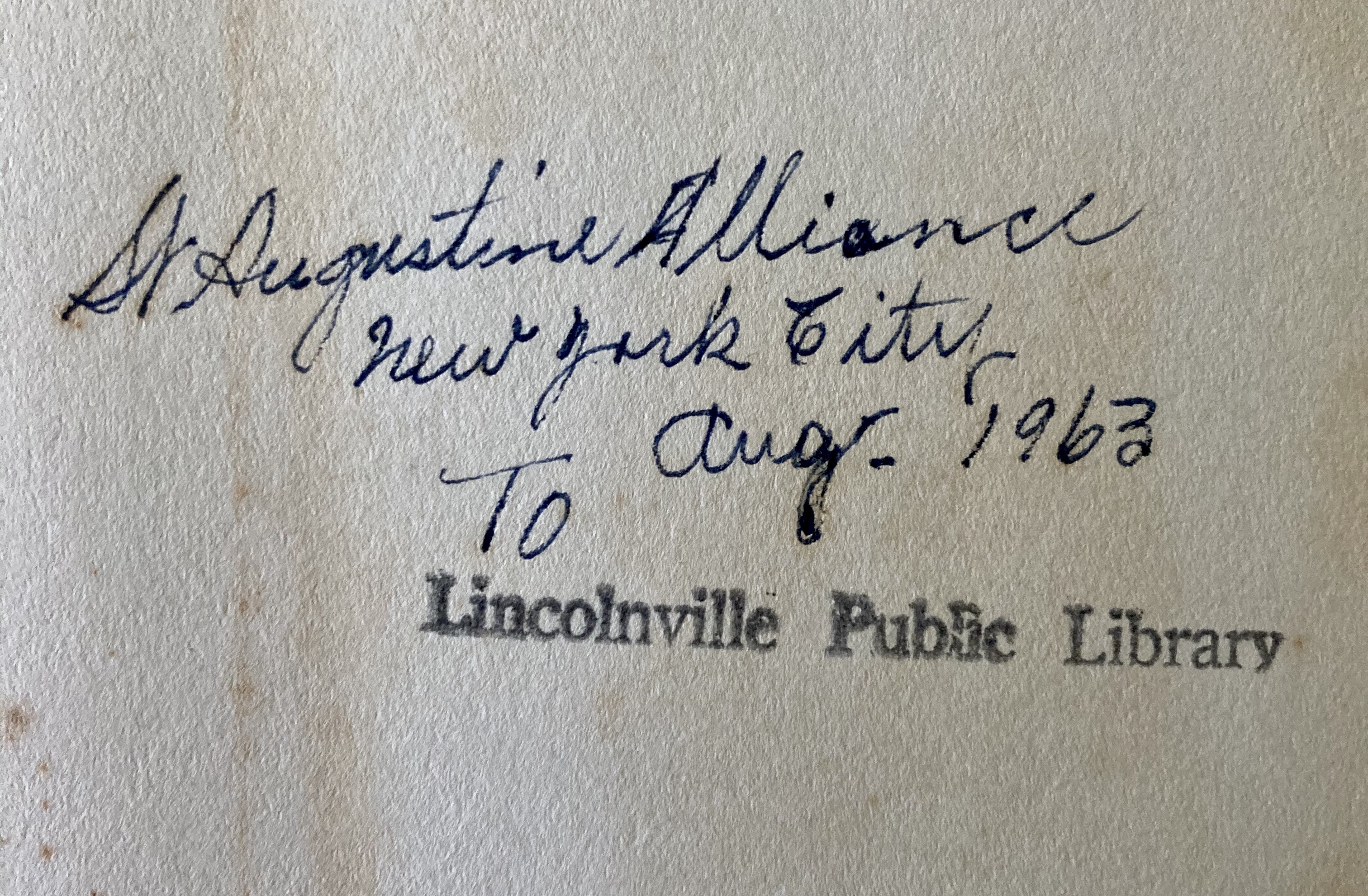
Then I came across a hardback first edition of Langston Hughes’ second novel Tambourines to Glory. At thirty bucks, it ate up the rest of my store credit, but it’s in excellent condition with no damage to the jacket and foxing only on the front flyleaf. It’s an old library book, but was fortunately spared any ugly WITHDRAWN stamps and appears never to have had a pocket in the back. Indeed, I’m not sure if the book was ever even read by anyone. Besides a few stamps identifying the library it once belonged to, the only mark in the book is on the front flyleaf:

Lincolnville is an historic black neighborhood founded by ex-enslaved people in the late 1860s. Famously, St. Augustine (and the “St. Augustine movement”) was a key location in the Civil Rights movement, and protests in the summer of 1964 when demonstrators jumped into the “whites-only” pool at the Monson Motor Lodge. Journalists captured racist motel owner James Brock pouring muriatic acid into the pool during the swim-in. A day after the world saw these images, the Senate passed the Civil Rights Act.

I wonder whose handwriting that is?


“Two Friends” — Pierre Senges

From Studies of Silhouettes by Pierre Senges. English translation by Jacob Siefring. Forthcoming in the fall from Sublunary Editions.

Archive I — Richard Hamilton

Archive I, 1981 by Richard Hamilton (1922–2011)

The Golden Section — Alejandro Pasquale

The Golden Section, 2018 by Alejandro Pasquale (b. 1984)

The Minus Times Interview with Barry Hannah

From The Collected Minus Times.

Pyrrhus — Stephen McKenna

Pyrrhus, 2012 by Stephen McKenna (1939–2017)

Wells Tower on tubing the Ichetucknee

Today, I plan to tube a portion of the Ichetucknee River, a cherished aorta of north Florida’s freshwater vasculature. It’s far and away the most vaunted tubing destination in the state, and I feel considerable pressure to get the tube into maximum spruceness and tumescence before my voyage.

In the town of Fort White, 35 miles northwest of Gainesville at the edge of Ichetucknee Springs State Park, we pull over at a tube-rental place to attend to maintenance and then install the Tube Pro booster saddle I’d thought unnecessary but, luckily, brought along anyway. My craft’s improved ergonomics should help undo the damage to my back.

The proprietress of the Ichetucknee Tube Center is a pretty woman named Linda Soride, and we chat for a moment before a purple, circa-1987 Camaro, pulsing with megabass, pulls up. As she turns away to diagnose the occupants’ needs, I fall a little bit in love with Linda. My mind drifts and I see myself, having patented the tube design, return to the ITC to license it exclusively to her. Revenues soar, and we soon depart the run-down filling station for a grand neon showroom. I’m the muscle of the operation—keeping the compressors shipshape, manning the patch kit—while Linda remains its comely public face. At the close of business each day, we head to the Ichetucknee and go floating off together, accompanied only by cool waters, cheering egrets, and some Riunite on ice.

Minutes later, I trot my tube—freshly inflated, booster seat in place—over to Linda. “This is just the prototype,” I rave proudly. “Once I get the kinks out, maybe you and me could do some business together.”

She shies away, cooing, “Maybe so, maybe so,” in a quiet, suspicious voice imparting the suggestion that I might be a little bit insane. (As Cheever’s story progresses, Neddy shows signs that he is not in command of his senses. The echo is unsettling.)

After I recover from this minor slight, Miss Bennett, who has to skip this portion of the journey to drive the car down, drops me at a designated embarkation point on the Ichetucknee. This river would inspire ecstasies in anyone with a pulse, but my ardor for spectacular scenery has reached a point of diminishing returns. I feel like a competitive eater tucking in to his 47th foie gras tart. The Ichetucknee offers more of the pellucid water and old-growth forests slung with buntings of Spanish moss. But while I’m relieved to discover, as advertised, no gators in sight, there’s also a disappointing shortage of amazing birdlife. Just the odd egret and heron, skulking on the bank like underpaid park employees. Plenty of people, though.

While my own capacity for amazement is waning, my superb invention, I would like to inform the proprietress of the ITC, is so enthusiastically admired by my fellow tubers that I’m to have no peace for the entire four-mile float. Seconds into the ride, two young women from St. Augustine beckon me into their flotilla. We enjoy a cozy interlude until a thickly built friend of theirs comes by and says “I want that tube” in a manner that is not unmenacing. I break away and into the path of a kayaking lady who pronounces mine “the Cadillac of tubes.” (A bespectacled professor following behind her describes it, a touch sneeringly, as “an interesting contraption.”) Even a fearsome river stud in a straw cowboy hat—reclining on a little inflatable yacht, trailing a miasma of marijuana fumes, a zaftig beauty on his arm—pauses to tell me that he deems the tube “a pretty badass setup.”

At last, I am among my people.

In this newfound fame and bliss, I drift on for hours. Toward the end, as I glide to the pullout, having made it halfway across Florida, the sky darkens. I struggle up the dock, where Miss Bennett waits for me in a shower of pelting rain.

From Wells Tower’s long essay, “The Tuber,” published in 2009 in Outside.

After reading Wells Tower’s short story “Opportunity Knocks!” in The Minus Times Collected the other day, I (again) poked around on the internet hoping to find any other uncollected stories by Tower. “Opportunity Knocks!” was first published in The Minus Times #29, back in 2009—the same year as Tower’s first (and so far, only) collection Everything Ravaged, Everything Burned. (I liked it a lot.)

I’ve appreciated the journalism and essayism that Tower has done over the past decade, but I somehow missed “The Tuber” until now. The essay is sort of a riff on John Cheever’s “The Swimmer,” with Tower traversing the springs and rivers of my home, North Florida, in a super-tube of his own devising. The section above details his time on the Ichetucknee River, my favorite tubing spot, and the scene of many of my favorite college days.

The Temptation of Saint Hilarion — Octave Tassaert

The Temptation of Saint Hilarion c.1857 by Octave Tassaert (1800–1874)

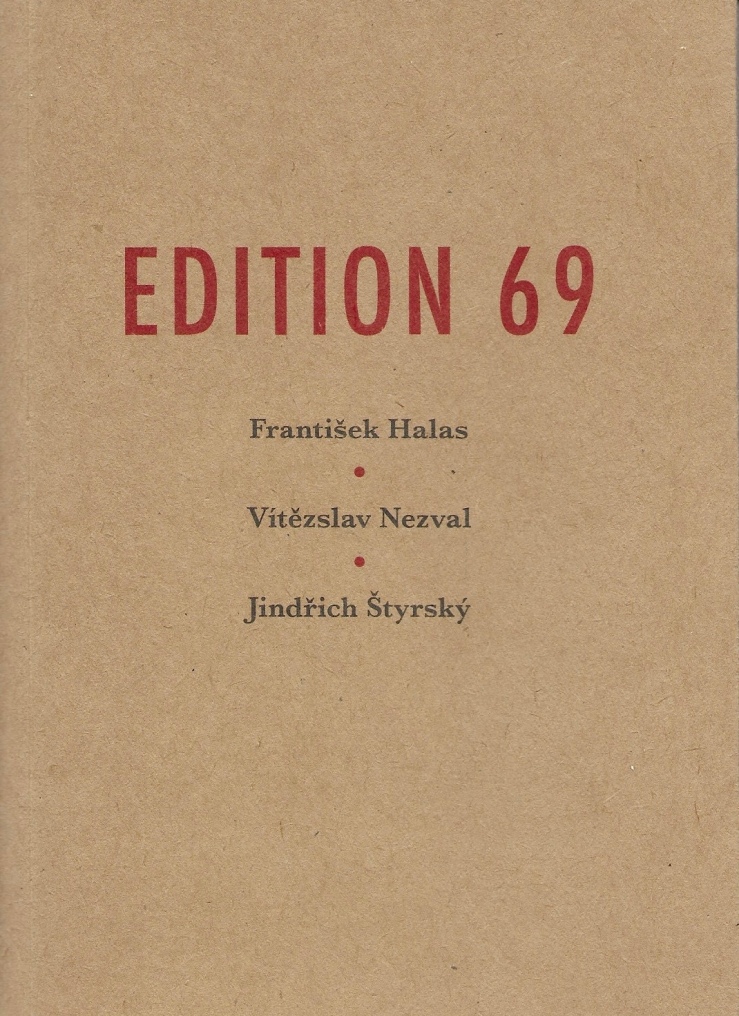
A review of Edition 69, a collection of interwar pornophilic Czech surrealism

New from Twisted Spoon Press, Edition 69 collects three previously-untranslated volumes of Czech artist and writer Jindřich Štyrský’s private-press books of the same name. Beginning in 1931, Štyrský published six volumes of Edition 69. The series was devoted to outré erotic writing and art — “pornophilia,” as the biologist/poet/philosopher Bohuslav Brouk puts it in an essay accompanying the sixth and final volume of Edition 69.

Because of Czech censorship laws, Štyrský’s project was limited to subscribers and friends, with each volume running under 200 editions (the final volume was limited to 69 copies). Undoubtedly, the material in Edition 69 would present an affront—indeed an intentional affront—to the “supercilious psyches of the ruling peacocks,” to again borrow from Brouk (rendered wonderfully here in Jed Slast’s estimable English translation—I should’ve mentioned Slast earlier!). Much of the material in Twisted Spoon’s new collection of Edition 69 still provokes and disturbs nearly a century after their original publication.

Three of the original volumes of Edition 69 presented Czech translations–in some cases the first—of writers like the Marquis de Sade, along with accompanying illustrations by Toyen and Rudolf Krajc. Following its mission of bringing Czech literature to an English-reading audience, Twisted Spoon’s Edition 69 collects the three volumes by Czech artists in translation by Jed Slast: Vítězslav Nezval’s Sexual Nocturne (1931), František Halas’s Thyrsos (1932), and Štyrský’s own Emilie Comes to Me in a Dream (1933). (Štyrský designed and illustrated each of these volumes.)

Nezval’s fragmentary surrealist dream-memoir Sexual Nocturne is the strongest of the three pieces in Edition 69. Nezval gives us an abject, dissolving reminiscence of an unnamed narrator’s boarding school days, centering on a trip to the local bordello and culminating in a return visit years later, one soaked in alcohol and despair. It’s a creepy and decidedly unsexy story, directly referencing Poe’s “The Raven” and Whitman’s “The City Dead-House” (and cribbing more Gothic gloom from a handful of penny dreadfuls).

Sexual Nocturne is a Freudian ramble into adolescent sexual frustration, voyeurism, and ultimately loss, loneliness, and insanity. It’s also a wonderful exploration of the connection between taboo bodily functions and taboo words. In one notable scene, our narrator sends a missive to a crush containing an obscenity, only to be discovered by the bourgeois landlord of his boarding house:

His views reflected those of society. How ridiculous. A writer is expected to make a fool of himself by employing periphrastic expressions while the word ‘fuck’ is nonpareil for conveying sexual intercourse. Fortunately there are old dictionaries where this world has its monument. How I sought it out! When the kiss of lovers pronounces it during coitus it is infused with a sudden vertigo. I have little tolerance for its disgraceful and comic synonyms. They convey nothing, just mealy-mouthed puffballs that make me want to retch when I encounter them.

The word FUCK is diamond-hard, translucent, a classic. As if adopting the appearance of a gem from a noble Alexandrine, it has, since it is forbidden, a magical power. It is one of the Kabbalistic abbreviations for the erotic aura, and I love it.

I love it! I love that second paragraph so much. It’s one of the best paragraphs I’ve read all year.

The collages by Štyrský that accompany Sexual Nocturne are reminiscent of Max Ernst’s work in A Week of Sundays, but less frenetic. At times they sync with the tale’s dream logic, and when they don’t, fine. It’s interwar surrealism, baby!

František Halas’s Thyrsos is far less successful. Halas’s poems can’t quite live up to their namesake, let alone the Sophocles’ quote that precedes them (“Not to be born is, beyond all estimation, best; but when a man has seen the light of day, this is next best by far, that with utmost speed he should go back from where he came”).

The opener, “Leda’s Sorrow,” isn’t particularly bad, but it’s nothing special either:

Other poems celebrate incest, arcadian bacchanalia, and old-man boners. Halas’s poem about cunnilingus (“The Taste of Love”) is particularly bad. Outlier “In the Field” connects the collection’s larger themes of sex-as-death’s-twin, evoking a scene of what might be a battle field, with trenches and barbed wire, a solitary man jerking off “like a demon” over what I take to be a foxhole. For the most part though, Thyrsos is a strange mix of ribald and whimsical with occasional sex tips thrown in. It’s weak stuff. In his translator’s note, Slast admits that “perhaps it’s understandable that Halas considered this thin collection of poems juvenile and much inferior to his other work.” Štyrský’s pen-and-ink illustrations are simple and charming though, even if their simple charm seems to point to the fact that Halas’s ditties are out of place in the queasy surrealism of the rest of the collection.

Štyrský’s Emilie Comes to Me in a Dream reads like a mix of dream writing and automatic writing. It’s stranger and more poetic than the prose in Nezval’s Nocturne, but neither as funny nor as profound. And yet it has its moments, as it shifts from sensuality to pornography to death obsession. “I came to love the fragrance of her crotch,” our narrator declares, and then appends his description: “a mix of laundry room and mouse hole, a pincushion forgotten in a bed of lilies of the valley.” He tells us he “was prone to seeing in dissolve,” and the prose bears it out later, in a linguistic episode that mirrors Štyrský’s surrealist collage techniques:

Later I placed an aquarium in the window. In it I cultivated a golden-haired vulva and a magnificent penis specimen and delicate veins on its temples. Yet in time I threw in everything I had ever loved: shards of broken teacups, hairpins, Barbora’s slipper, light bulbs, shadows, cigarette butts, sardine tins, my entire correspondence, and used condoms. Many strange creatures were born in this world. I considered myself a creator, and with justification.

After the dream writing, Štyrský delivers a sexually-explicit photomontage that’s simultaneously frank and ambiguous, ironic and sincere, sensual and abject. The photographic collages wed sex and death, desire and repulsion.

Štyrský’s Emilie includes a (previously-mentioned) postscript by Bohuslav Brouk, which, while at times academic and philosophical, plainly spells out that the mission of the so-called “pornophiles” is to give a big FUCK YOU to the repressed and repressive bourgeoisie. Brouk intellectualizes pornophilia, arguing against the conservative mindset that strives for immortal purity. He argues in favor of embracing corporeal animality: “The body will continue to demonstrate mortality as the fate of all humans, and for this reason any reference to human animality so gravely offends those who dream of its antithesis.” Hence, sex and death—blood, sweat, tears, semen—are the abject markers of the fucking circle of life, right? Our dude continues:

The body is the last argument of those who have been unjustly marginalized and ignored, because it demonstrates beyond question the groundlessness of all social distinctions in comparison to the might of nature.

I’ll give Brouk the last quote here because I think what he wrote resonates still in These Stupid Times.

Edition 69 has its highs and its lows, but I think it’s another important document of Czech surrealism from Twisted Spoon, and in its finest moments it reminds us that we are bodies pulling a psyche around, no matter how much we fool ourselves. Nice.

The Temptation of St Anthony (After Gustave Flaubert) — Lovis Corinth

The Temptation of St Anthony (After Gustave Flaubert), 1908 by Lovis Corinth (1858–1925)

John Brunner’s Stand on Zanzibar (Book acquired, 28 Aug. 2020)

I usually allow myself to peruse my favorite used bookstore every other Friday, poking around for weird finds and etc. I had no luck this week—nothing like a Vintage Contemporaries Barry Hannah—but they did have a copy of John Brunner’s 1968 novel Stand on Zanzibar, which I’d been searching (not-too-hard) for for a few years now. The thing is much longer than I expected (I knew it was long…but it’s long…650 pages). Not sure when I’ll even get to it. It’s supposed to be a cult classic right? Here’s the blurb from my edition:

There are seven billion-plus humans crowding the surface of 21st century Earth. It is an age of intelligent computers, mass-market psychedelic drugs, politics conducted by assassination, scientists who burn incense to appease volcanoes … all the hysteria of a dangerously overcrowded world, portrayed in a dazzlingly inventive style. Employing a dazzling range of literary techniques, John Brunner has created a future world as real as this morning’s newspaper – moving, sensory, impressionistic, as jagged as the times it portrays, this book is a real mind stretcher – and yet beautifully orchestrated to give a vivid picture of the whole.

And here’s an excerpt, via Macmillan’s site:


context (1)

SCANALYZE MY NAME

Stock cue SOUND: “Presenting SCANALYZER, Engrelay Satelserv’s unique thrice-per-day study of the big big scene, the INdepth INdependent INmediate INterface between you and your world!”
Stock cue VISUAL: cliptage, splitscreen, cut in bridge-melder, Mr. & Mrs. Everywhere depthunder (today MAMP, Mid-Atlantic Mining Project), spaceover (today freefly-suiting), transiting (today Simplon Acceleratube), digging (today as every day homimage with autoshout).
Autoshout cue: “It’s happening it’s happening! SCANALYZER SCANALYZER SCANALYZER SCANALYZER SCANALYZER SCANALYZER—”
Stock cue VISUAL: cliptage, wholescreen, planet Earth turning jerk-jerk-jerk and holding meridians for GMT, EST, PCT, Pacific Conflict Zone Time.
Live cue SOUND: “And it’s six poppa-momma for the happening people keeping it straight and steady on that old Greenwich Mean Time—how mean can time get, you tell me, hm? Zee for zero, bee for base, counting down to one after ess ee eks—sorree—ess EYE eks! We know what’s happening happening HAPPENING but that piece of the big big scene is strictly up to you, Mr. and Mrs. Everywhere—or Mr. and Miss, or Miss and Miss, or Mister and Mister, take your pick, hah-hah! Counting down to one after one poppa-momma for that good old Eastern Standard tie-yum, one after ten anti-matter for the Pacific Coast, and for all of you fighting the good fight in lonely midocean one after seven anti-matter—PIPS!”
Clock cue: 5 × 1-sec. countdown pips on G in alt, minute signal on C in alt.
Plug cue: “No time like the present for things to happen in, no better way to keep time straight and steady than by the signal from General Technics’ critonium clock, so accuright it serves to judge the stars.”
Script cue VISUAL: cliptage, splitscreen, excerpts from day’s news.
Live cue SOUND: “And no better way to keep abreast—pardon—than with SCANALYZER!”
Cut autoshout cue. (If they haven’t made it by this time they’ve switched off.)
Plug cue: “SCANALYZER is the one single, the ONLY study of the news in depth that’s processed by General Technics’ famed computer Shalmaneser, who sees all, hears all, knows all save only that which YOU, Mr. and Mrs. Everywhere, wish to keep to yourselves.”
Script cue: the happening world.
the happening world (1)

Continue reading “John Brunner’s Stand on Zanzibar (Book acquired, 28 Aug. 2020)”

Cain in the United States — Alfaro Siqueiros

https3a2f2fbucketeer-e05bbc84-baa3-437e-9518-adb32be77984.s3.amazonaws.com2fpublic2fimages2fc2349e36-7271-428f-a256-18e3f43d8afe_1814x1494

Cain in the United States, 1947 by David Alfaro Siqueiros (1896-1974)

Sentinel — Tilo Baumgärtel

Sentinel, 2020 by Tilo Baumgärtel (b. 1972)

“Tavern” — Edna St. Vincent Millay

“Tavern”

by

Edna St. Vincent Millay


I’ll keep a little tavern
Below the high hill’s crest,
Wherein all grey-eyed people
May set them down and rest.

There shall be plates a-plenty,
And mugs to melt the chill
Of all the grey-eyed people
Who happen up the hill.

There sound will sleep the traveller,
And dream his journey’s end,
But I will rouse at midnight
The falling fire to tend.

Aye, ’tis a curious fancy—
But all the good I know
Was taught me out of two grey eyes
A long time ago.

Sátántangó dance scene

A (perhaps titular) scene from Bela Tarr’s film Sátántangó (1994). Based on the novel of the same name by László Krasznahorkai.

Sequins and Fish — Matthew Carver

Sequins and Fish, 2018 by Matthew Carver (b. 1968)