Rockwell Kent’s Moby-Dick USPS Stamp

8becb1822b7a341e5f0475df3129a6cf


“The Preacher Addresses the Seminarians” — Christian Wiman

“The Preacher Addresses the Seminarians”

by

Christian Wiman


I tell you it’s a bitch existence some Sundays
and it’s no good pretending you don’t have to pretend,

don’t have to hitch up those gluefutured nags Hope and Help
and whip the sorry chariot of yourself

toward whatever hell your heaven is on days like these.
I tell you it takes some hunger heaven itself won’t slake

to be so twitchingly intent on the pretty organist’s pedaling,
so lizardly alert to the curvelessness of her choir robe.

Here it comes, brothers and sisters, the confession of sins,
hominy hominy, dipstick doxology, one more churchcurdled hymn

we don’t so much sing as haunt: grounded altos, gear-grinding tenors,
two score and ten gently bewildered men lip-synching along.

You’re up, Pastor. Bring on the unthunder. Some trickle-piss tangent
to reality. Some bit of the Gospel grueling out of you.

I tell you sometimes mercy means nothing
but release from this homiletic hologram, a little fleshstep

sideways, as it were, setting passion on autopilot (as if it weren’t!)
to gaze out in peace at your peaceless parishioners:

boozeglazes and facelifts, bad mortgages, bored marriages,
a masonry of faces at once specific and generic,

and here and there that rapt famished look that leaps
from person to person, year to year, like a holy flu.

All these little crevices into which you’ve crawled
like a chubby plumber with useless tools:

Here, have a verse for your wife’s death.
Here, have a death for your life’s curse.

I tell you some Sundays even the children’s sermon
— maybe especially this — sharks your gut

like a bite of tin some beer-guzzling goat
either drunkenly or mistakenly decides to sample.

I know what you’re thinking. Christ’s in this.
He’ll get to it, the old cunner, somewhere somehow

there’s the miracle meat, the aurora borealis blood,
every last atom compacted to a grave

and the one thing that every man must lose to save.
Well, friends, I’m here to tell you two things today.

First, though this is not, for me, one of those bilious abrading days,
though in fact I stand before you in a rage of faith

and have all good hope that you will all go help
untold souls back into their bodies,

ease the annihilating No above which they float,
the truth is our only savior is failure.

Which brings me to the second thing: that goat.
It was real. It is, as is usually the case, the displacement of agency

that is the lie. It was long ago, Mexico, my demon days:
It was a wager whose stakes I failed to appreciate.

He tottered. He flowered. He writhed time to a fraught quiet,
and kicked occasionally, and lay there twitching, watching me die.

Sleep of Trees — F. Scott Hess

739e0b37fe03116e96253b023d3ed774

Sleep of Trees, 2000 by F. Scott Hess (b. 1955)

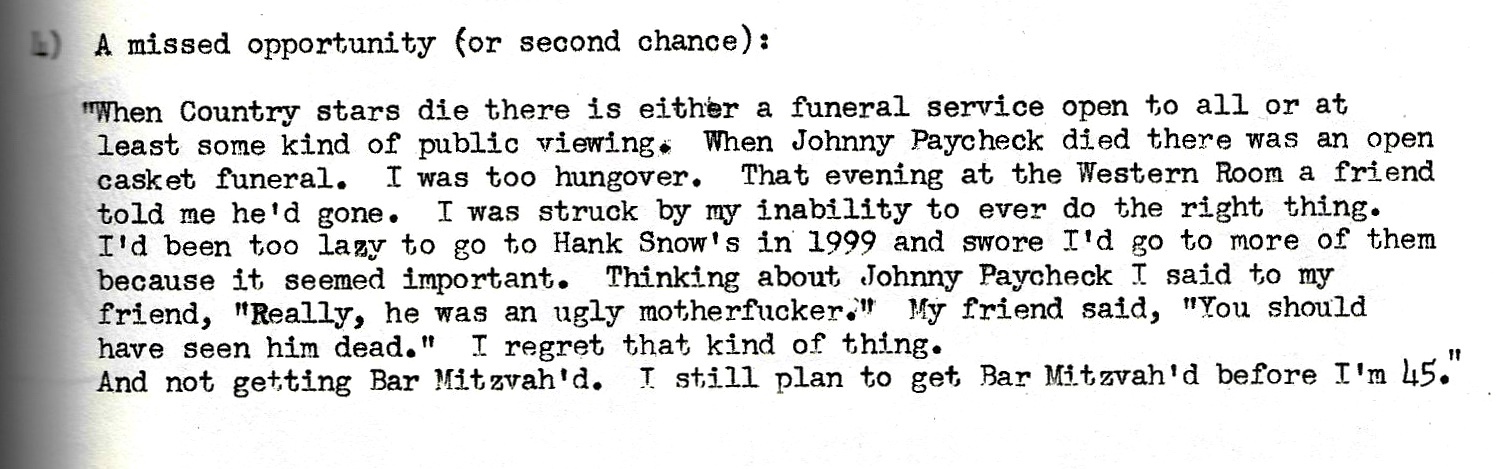
Missed opportunity | David Berman

2020-08-15_151419_1

From The Minus Times #29, as republished in The Minus Times Collected. 

Nervous in the Service — Hilary Harkness

nervousintheservice2009copy

Nervous in the Service, 2009 by Hilary Harkness (b. 1971)

Posted in Art

Blog about William Melvin Kelley’s satire Dem (book acquired 12 Aug. 2020)

2020-08-13_184241

I managed to snag a cheap used copy of William Melvin Kelley’s fourth novel Dem (or, more properly, dem) yesterday. I usually just snap a pic when I do these book acquired posts, but the cover for this 1969 Collier mass-market, by Leo and Diane Dillon, was simply too good not to scan.

I read not-quite-half of dem today, and the Dillons’ cover captures Kelley’s hypercolor satire of white upper-middle-class America: the infantalized businessman, attended by a black domestic, his bored wife not-quite-off-scene; and hey—look in that mirror.

I’ll admit that the book was hard to break into for the first few moments, until a wild moment around page 20 or so, that I’m still waiting on the novel to deliver upon (or, as it seems at this point, to depart from entirely). Kelley’s style in dem is choppier, sharper, more cartoonish than his Faulknerian debut A Different Drummer and if dem skews towards absurd irony where Drummer was heroic-tragic, both novels are rooted in intense anger tempered by strange empathy.

As its subheading attests, dem is, like Drummer, a take on white people viewing black people, and over a half-century after its publication, many of the tropes Kelley employs here still ring painfully true. His “hero,” Mitchell Pierce is a lazy advertising executive, bored with his wife, a misogynist who occasionally longs to return to the “wars in Asia.” He’s also deeply, profoundly racist; structurally racist; the kind of racist who does not think of his racism as racism. At the same time, Kelley seems to extend little parcels of sympathy to Pierce, even as he reveals the dude to be a piece of shit, as if to say, What else could he end up being in this system but a piece of shit?

The novel I’m most interested in reading by Kelley is his last, 1970’s Dunfords Travels Everywheres, long out of print and hard (read: expensive on the internet) to find. It is, apparently, his most postmodern novel, his most polyglossic, and, if the stuff I’ve read on it is accurate, it represents his most profound satirical break/engagement with reality. Fortunately, it’s getting a reprint this fall. Looking forward to it.

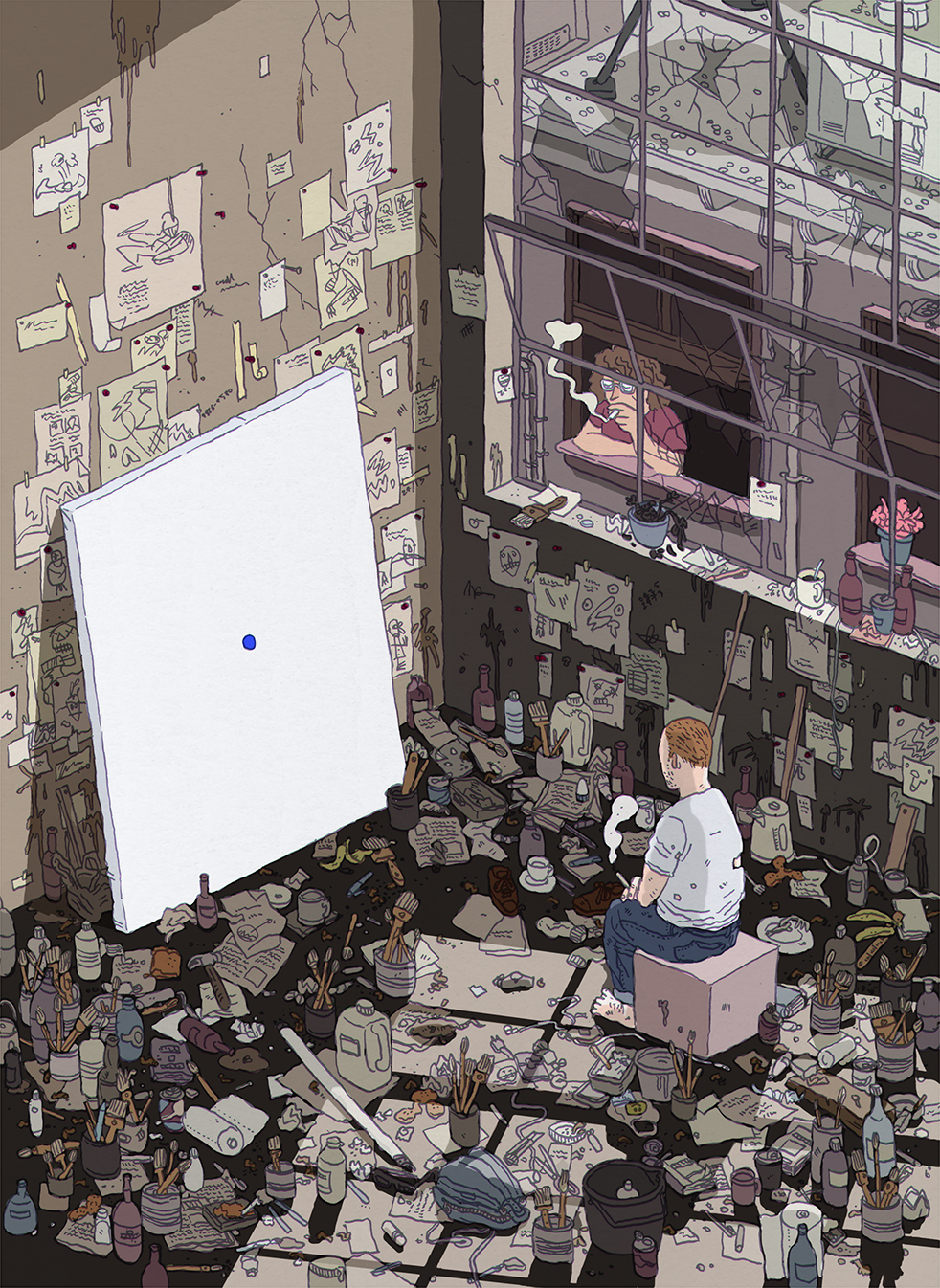
The Minimalist — Ilya Milstein

minim-1

The Minimalist, 2017 by Ilya Milstein

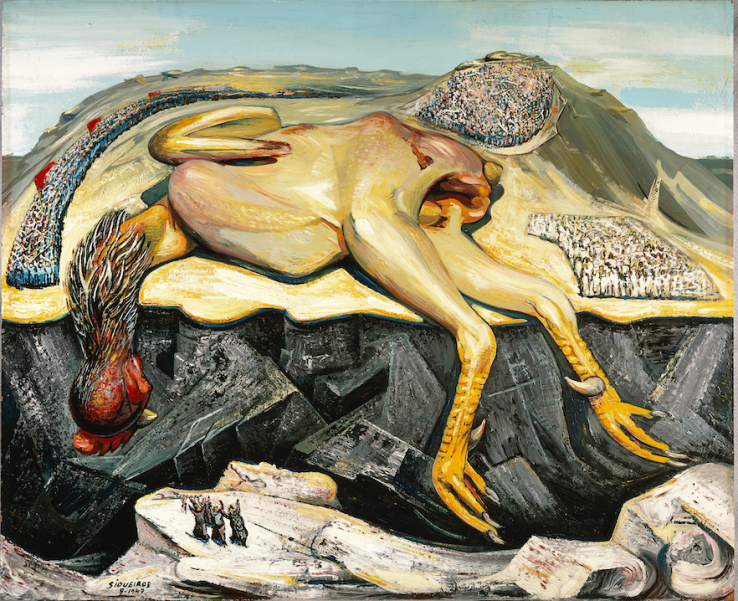
Death and Funeral of Cain — David Alfaro Siqueiros

1kypaohjn-925ixgamqz59q

Death and Funeral of Cain, 1947 by David Alfaro Siqueiros (1896-1974)

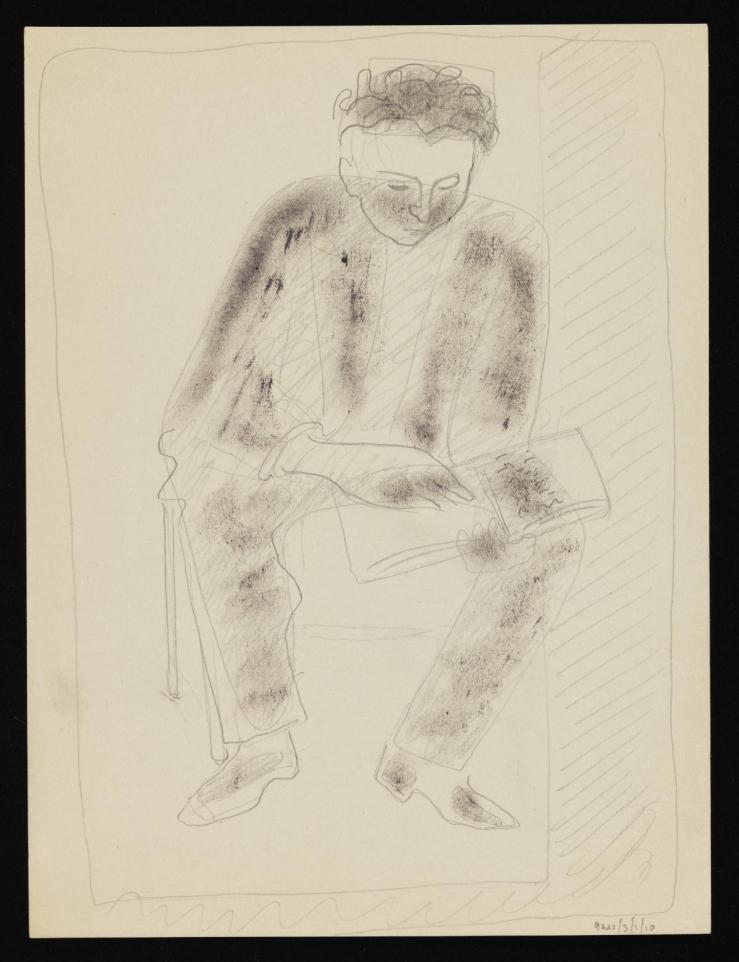
Sketch of a Seated Man Reading — Eileen Agar

Sketch of a seated man reading by Eileen Agar 1899-1991

Sketch of a Seated Man Reading by Eileen Agar (1899–1991)

Passionate — Carol Rama

4399ff4877005349b0008e838ec78262

Passionate, 1943 by Carol Rama (1918-2015)

Game — George Petrovich Kichigin

d56353f6525f4f060ba37e4fbc7b9a6e

Game, 1989 by George Petrovich Kichigin (b. 1951)

Chester Himes’ A Rage in Harlem (Book acquired, 5 Aug. 2020 and read this past weekend)

img_5907

I’d been meaning to read Chester Himes for a while now (on the recommendation of Ishmael Reed, who cites Himes as a major influence), so I picked up a copy of A Rage in Harlem, the first of his Coffin Ed and Grave Digger detective stories. I was expecting hardboiled crime fiction—and sure, there are elements of it here—but Himes’ 1957 novel was far zanier and more ecstatic than I expected. A Rage in Harlem pops along with wild energy, spinning out into strange directions, donning artful disguises, always on the run. Absolutely loved it. Here’s the blurb:

For love of fine, wily Imabelle, hapless Jackson surrenders his life savings to a con man who knows the secret of turning ten-dollar bills into hundreds—and then he steals from his boss, only to lose the stolen money at a craps table. Luckily for him, he can turn to his savvy twin brother, Goldy, who earns a living—disguised as a Sister of Mercy—by selling tickets to Heaven in Harlem. With Goldy on his side, Jackson is ready for payback.

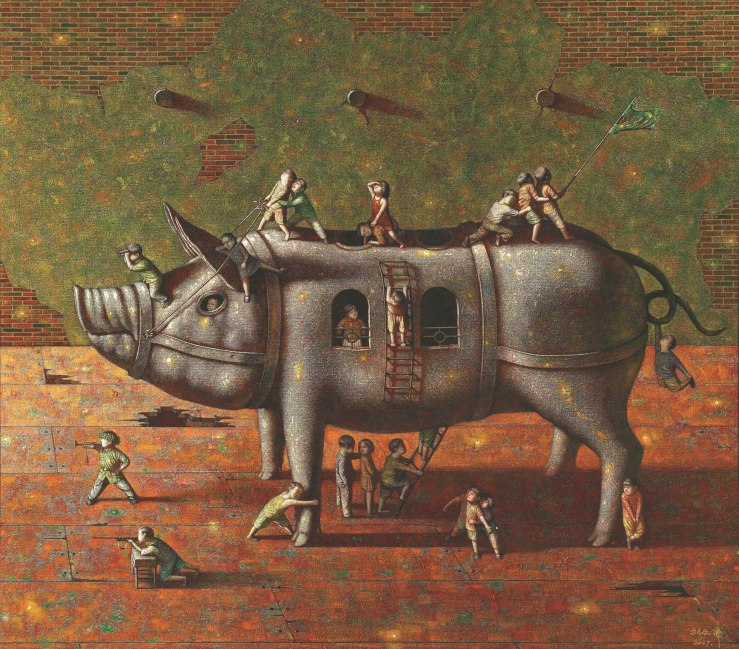
Piggy Toy — Liu Hong Wei

2011_hgk_02856_1383_000liu_hong_wei

Piggy Toy, 2007 by Liu Hong Wei (b. 1965)

Manjusaka — Xiao Guo Hui

xiao-manjusaka-2014

Manjusaka, 2014 by Xiao Guo Hui (b. 1969)

“The Beach in August” — Weldon Kees

“The Beach in August”

by

Weldon Kees


The day the fat woman
In the bright blue bathing suit
Walked into the water and died,
I thought about the human
Condition. Pieces of old fruit
Came in and were left by the tide.

What I thought about the human
Condition was this: old fruit
Comes in and is left, and dries
In the sun. Another fat woman
In a dull green bathing suit
Dives into the water and dies.
The pulmotors glisten. It is noon.

We dry and die in the sun
While the seascape arranges old fruit,
Coming in and the tide, glistening
At noon. A woman, moderately stout,
In a nondescript bathing suit,
Swims to a pier. A tall woman
Steps toward the sea. One thinks about the human
Condition. The tide goes in and goes out.

Justin Reading — Edna Clarke Hall

Justin Reading 1932 by Lady Edna Clarke Hall 1879-1979

Justin Reading, 1932 by Edna Clarke Hall (1879–1979)

David Berman’s review of Pavement’s “Demolition Plot J-7”

Screenshot 2020-08-08 at 9.43.09 PM

Via, via, via…