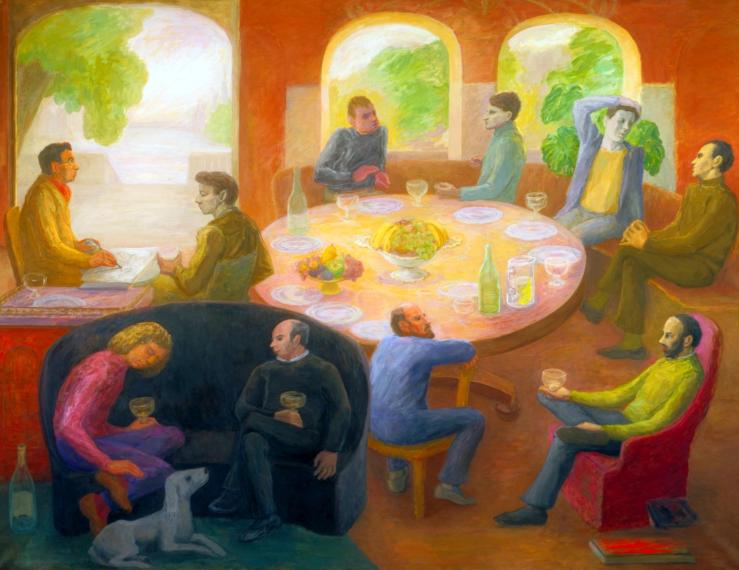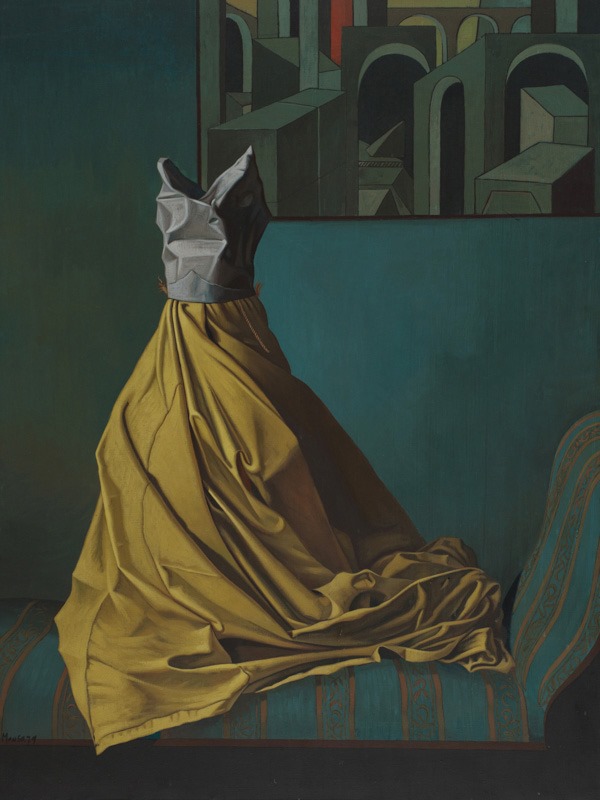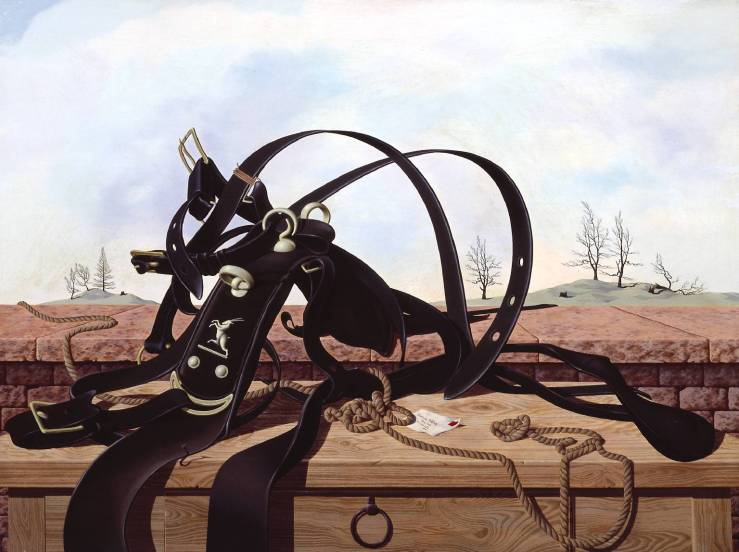
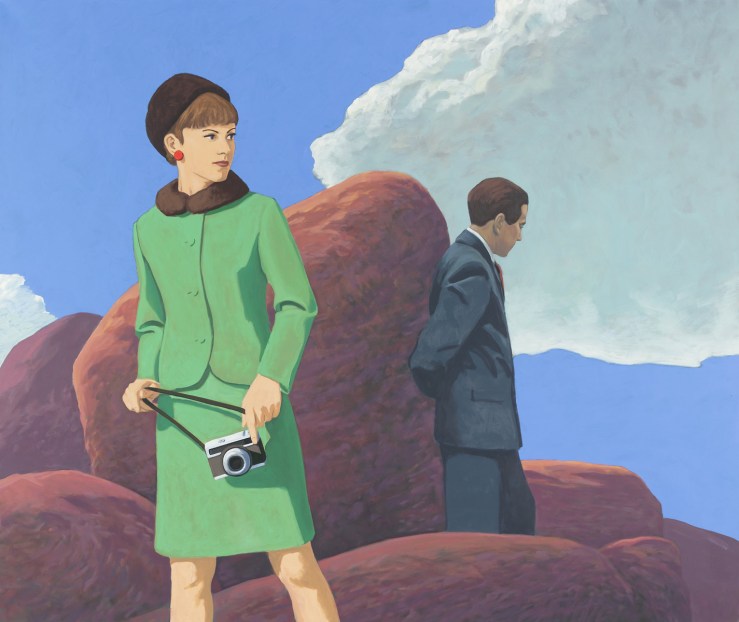
In the Rocks — Christian Brandl

brandl-in-den-felsen2c-20162c-135x160cm2c-occ88l-auf-leinwand

In the Rocks, 2016 by Christian Brandl (b. 1970)

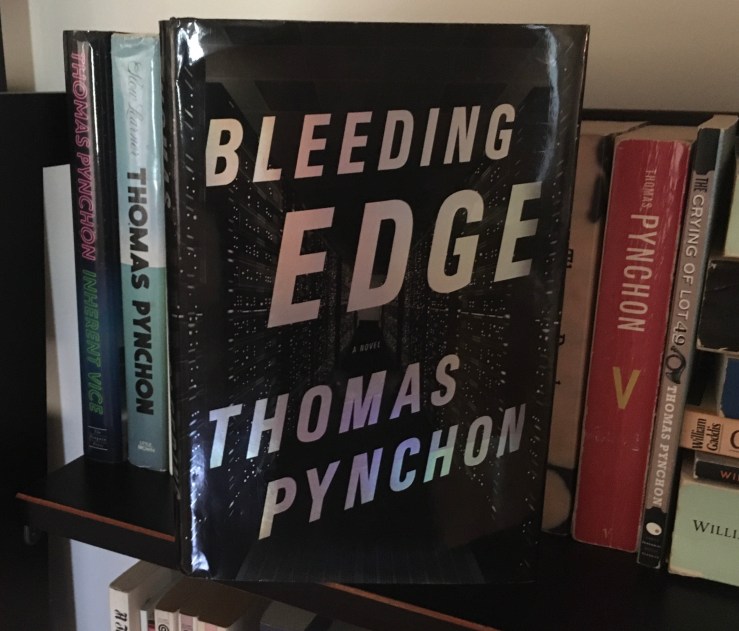
Blog about Thomas Pynchon’s novel Bleeding Edge

img_5423

I finished reading Thomas Pynchon’s 2013 novel Bleeding Edge a few minutes before I started typing up this blog. I’d jotted down a few notes as I was reading the book over the past two weeks, thinking about writing a review or an essay about the novel, but lately I seem to sit on such notes and never hatch them into anything real.

Today, 8 May 2020 is Thomas Ruggles Pynchon’s 83rd birthday. Folks online like to celebrate with something called Pynchon in Public Day, which this year, thanks to These Paranoid Times, has become Pynchon in Private Day. Instead of doing a big list of links, images, and excerpts, this blog about Bleeding Edge will be my minor contribution.

Reviews usually offer some kind of plot summary, right? Here’s a really short summary: Bleeding Edge is Pynchon’s New York novel, his 9/11 novel, his internet novel. Not enough? Well…

Bleeding Edge is nearly 500 pages long and seems to have almost as many subplots—but the gist of the novel is that Maxine Tarnow, a now-unlicensed fraud examiner, undertakes a sprawling investigation that leads her to what may-or-may-not-be evidence of unidentified conspirators collaborating in some way to facilitate the 9/11 World Trade Center attacks. As is the case with any Pynchon, the gist isn’t the point—the subplots are the real point, those threads that tangle off into some other invisible tapestry, unrevealed to protagonist and reader alike. I’ll lazily borrow from the jacket blurb to offer a smattering of those subplots:

She soon finds herself mixed up with a drug runner in an art deco motorboat, a professional nose obsessed with Hitler’s aftershave, a neoliberal enforcer with footwear issues, plus elements of the Russian mob and various bloggers, hackers, code monkeys, and entrepreneurs, some of whom begin to show up mysteriously dead.

Tellingly, there’s even a tangle in the blurb: The neoliberal enforcer is Nicholas Windust (who uses a cattle prod to enforce his ideology on citizens of developing nations); the guy with “footwear issues” is Eric Outfield, a hacker and podophiliac. There are so many characters in Bleeding Edge that we can forgive even the jacket’s condensing a few into each other.

And yet for all its myriad subplots, Bleeding Edge is one of Pynchon’s more cohesive novels. It’s plot is not as baggy as the behemoth Against the Day, or as complicated as Gravity’s Rainbow, or as confusing as Inherent Vice, the novel that preceded it.

Like Inherent Vice, and Pynchon’s second novel, The Crying of Lot 49Bleeding Edge is a detective novel, albeit a highly unconventional one. Our detective Maxine Tarnow is a compelling central figure, and Pynchon sticks closely to her consciousness; indeed, Maxine is maybe the closest thing to a first-person-viewpoint Pynchon has given us. Maxine, who occasionally worries about her Yenta tendencies, is a mother of two near-adolescent boys, Otis and Ziggy. At the novel’s outset, she’s estranged from her husband Horst, but he soon re-enters the picture.

The domestic contours of Bleeding Edge are touching. Maxine plays video games with her children, tries to understand the culture that her boys are growing into, riffs on Beanie Babies and Pokemon and first-person shooters with them. (It’s hard not to map some of Pynchon’s bio here: Like Maxine, Pynchon lives on the Upper West Side, and his son Jackson is around the same age as Ziggy and Otis. I will refrain from more biographical speculation, mea culpa.) Bleeding Edge opens in the pre-tragic spring of 2001, with Maxine walking the boys to school. She wants to protect her boys, and in a telling image, she “drifts into a pick” to guard them from any hypothetical traffic.

That domestic theme resonates until the novel’s end—indeed, with its many tangled subplots, the most satisfying resolution happens in the last pages, when, a year later, Maxine’s boys walk to school by themselves. It’s a bittersweet moment, one in keeping with the novel’s balance of tragedy and comedy, zaniness and horror. Ultimately, Bleeding Edge is a comedy in the classical sense, signaling the restoration of family (families, really).

The domestic plot helps to frame Bleeding Edge, but it also stands in contrast to Maxine’s adventures after dark as her investigation into possible fraud at an internet startup leads her into ever-more bizarre territory. There are mysterious videotapes and immersive video games that may-or-may-not contain the souls of those who’ve departed “meatspace”: there are time-traveling soldiers and debauched internet launch parties. There is that “ideological enforcer,” Nick Windust, who Maxine finds herself imporbably drawn to. And, it’s a Pynchon novel, so there’s plenty of drugs, sex, and songs. Like New York City, Bleeding Edge is packed, crammed with details that evoke not just the city’s form, but also its ever-changing spirit.

Of course, the 9/11 World Trade Center attacks loom over the plot, especially the first two-thirds, where they are foreshadowed repeatedly. (Otis and Ziggy eat lunch with their father and his friend Jake at the top of the WTC early in the novel. It’s a windy day, and the boys are nervous as the building sways, but Jake assures them, ironically, that it’s “built like a battleship.”) Pynchon’s handling of the attacks is remarkably restrained—instead of pages and pages of those strange hours, he instead nimbly constructs the moments beforehand and the moments after. A few paragraphs before the attack, Horst, Ziggy, and Otis watch the Colts beat the Jets on Monday Night Football, a wonderfully banal detail that Pynchon explores in more sentences than the actual attack. The days after offer a New Yorker’s cold perspective on the swiftly-mutating jingoism that exploded across the nation after 9/11.

The 9/11 attacks, and America’s response to them, ultimately serve to recapitulate neoliberalism and late capitalism. Pynchon repeats these terms throughout Bleeding Edge, adding them to his lexicon of old standbys like paranoiainvisible, and convenience. Indeed, Bleeding Edge can be read as a sustained how against late capitalism. But the howl also repeatedly shows the complicity of all the howlers: Who doesn’t want convenience? Who doesn’t want the latest fad, the comfort of mass-produced “culture”? Bleeding Edge is littered with the detritus of late-nineties-early-oughts “culture”: Furbies, Britney Spears, Doom, Ambien sex, Bone Thugs-n-Harmony, Nas, the Mamma Mia! Broadway musical, Pokemon, etc. etc. etc. Pynchon has always compounded high and low culture into something new, but Bleeding Edge seems to insist that the twentieth century’s ideals of “high” culture no longer obtain.

Some of his characters find optimism of a new culture, one outside the proscriptions of late capitalism, in the internet. A “game” called DeepArcher takes on a mystical quality in Bleeding Edge, a dwelling place for lost souls. Yet some characters are not optimistic about the future of the internet, including Maxine’s father Ernie, who warns her that the internet was born from the military-industrial-complex, and to the military-industrial-complex it will return. Ernie’s elegy for the internet is prescient, and reads like Pynchon looking back from the future, back from 2010, 2011, 2012, when the money guys had already sewed the seeds of ruination.

Indeed, many of the characters in Bleeding Edge come off as mouthpieces for Pynchon’s own viewpoints, whether it’s Ernie riffing on ARPANET or the decline of labor in the US, or Maxine’s zen therapist Shawn, who rails that late capitalism is a scam headed towards its own exhaustion at the price of our planet. It’s the arrangement of these voices that makes the novel strong though—Pynchon shows the complicity of each voice, even as he shows their resistance to the ideological machine they were born into.

It’s really only Maxine that comes through as a fully-achieved, human, character. She’s complex as both a detective, and a mother. Like Doc Sportello of Inherent Vice, she’s already an outsider, having had her license revoked. Despite her general anti-establishment tendencies, she’s nevertheless attracted to the nefarious agent of neoliberal violence, Nicholas Windust. The attraction here echoes Frenesi Gates’ relationship with Brock Vond in Vineland (or even Doc Sportello’s “partnership” with Bigfoot in Inherent Vice), suggesting an ambiguous, amorphous delineation between “good” and “evil” in Pynchon’s characters. Windust is a villain, but Maxine—and Pynchon—try to redeem him.

Other villains are a bit more one-note, like the geek billionaire Gabriel Ice. It being his New York novel, Rudy Giuliani is a frequent target, as is “the paper of record,” the New York Times. George W. Bush and his gang are minor players here; keeping with its NYC theme, Bleeding Edge suggests the corruption of figures like Elliot Spitzer and Bernie Madoff are part and parcel of a corrupt and corrupting system. Maxine’s job is to search out that corruption, but she doesn’t have the tools to cure it.

I had two false starts over six years before finally finishing Bleeding Edge. I’ll admit that I didn’t think it was that good on those starts, but after finishing it today I’d say that it’s very good. It’s not Gravity’s Rainbow or Mason & Dixon, but what novels are? I also have to admit that the material in the book is maybe too close to many of us to fully assess. I was graduating college in the spring of 2001, when the novel begins. In early September, I was living in my parents’ house, waiting to move to my first “real” job in Tokyo. I was supposed to leave on 9/14. I ended up leaving a week later. Pynchon captures a time in America during which I was, at least theoretically, becoming an adult (a becoming which may or may not have happened yet). Reading Bleeding Edge helped evoke all the weirdness the 2000s were about to lay out for us. It made me angry again, or reminded me of the anger that I’d sustain for most of the decade. It reminded me of our huge ideological failure after 9/11, an ideological failure we are watching somehow fail even more today.  But I also loved the novel’s unexpectedly sweet domestic plot, and found a kind of solace even in its affirmation of family, even as its final image pointed to the kind of radical inconclusiveness at the heart of being a parent.

There are about a million things I wanted to riff on in this blog about this book. I’ve failed to remark on how funny the book is, how insightful, and how, at times, frustrating. On one page Pynchon would make me laugh out loud, a page or two later I’d groan at one of his bad puns (Pynchon has no problem picking the lowest-hanging fruit), and then maybe I’d be cringing at something (like, a rap song he wrote!) a few pages later, before getting transfixed by a beautiful, strange prose sequence. It’s a big book.

Bleeding Edge isn’t Thomas Pynchon’s best novel, nor is it a great starting place for readers new to Pynchon, but I’m glad I finally read it. And I really, really hope that it isn’t his last one.

Selections from One-Star Amazon Reviews of Thomas Pynchon’s Inherent Vice

[Editorial note: The following citations come from one-star Amazon reviews of Thomas Pynchon’s novel Inherent Vice. To be clear, I’m a big Pynchon fanI’ve preserved the reviewers’ own styles of punctuation and spelling. More one-star Amazon reviews].


Wow.

drivel

stilted dialogue

knock yourself out

every detail is described

This was my first Pynchon

my second stab at Pynchon

I so rarely abandon anything

shouldn’t have been published

that ridiculous post-modern credo

pick up James Ellroy. He is a true artist

like a novelization of the Big Lebowski

false as a jet contrail in an 1880’s western movie

I had to read whole pages twice or even three times

practically nothing that occurs is important to move the plot along

he smokes a joint and stumbles across a clue that leads him to the next chapter

does a disservice to liberals by portraying them as a bunch of negative stereotypes

This book makes the classic NAKED LUNCH by Burroughs completely coherent

No one in our entire bookclub could finish it and we are all avid readers

NEVER BUY BOOKS THAT CRITICS RAVE ABOUT, THEY ALWAYS SUCK!!!

It glorifies hippies and condemns the right-wing Man

one of the most useless novels I have ever read

This is my first experience with Pynchon

this may make a decent movie

nothing redeeming about it

no entertainment value

difficult and obscure

no meter

Uugghh.

As a Scandinavian

It is a bad detective story

Pynchon wants this to be a film.

When Amazon recommends a book, I take notice.

I have never read a book by Thomas Pynchon before

I am beginning to think the “professionals” just like crap.

The Author is the type that critics love to refer to as edgy

Pynchon is probably the most overrated American writer.

It is as if this author was stoned the entire time he wrote this.

numerous drug and hallucination references and insinuations

story telling with drugs and hallucinations are better left to movies or television

Definitively a good movie was made based on an awful book by an overrated writer.

Pynchon maybe in top 10 most overrated writers in the last 100 yrs.

Let me start by saying that I have never read Pynchon before.

I had to re-read several pages and passages multiple times

Thomas Pynchon is supposed to be a great author

Remember those dumb “Family Circus” cartoons

the author appears to be a wanna be stoner

I am in the process of writing my own novel

Where is Kerouac when you need him?

The whole novel is one long inside joke.

I’m in a book club with 10 guys….

nonsensical plot

Studpid

Blech.

meandering piece of slop

What’s not cool is this book.

an Elmore Leonard Want-a-be

I could write a hippie chick way better.

The professor also said he hated reading it.

Do not recommend to anyone under the age of 65

This is my first encounter with a book about drug usage

The seventies were a time of sex, drugs and rock and roll.

The volumes I have read , sadly, occupy a large footprint on the planet.

Doc, the protagonist, is in a drug-induced haze for the majority of the novel

My extremities are tingling with the feeling that Socrates had after drinking a cup of hemlock.

ARPAnet, forerunner of the internet, is discussed as if everyone knows about it

written by a cute undergraduate student working under Pynchon’s wing

characters who make brief appearances

bad acid trips and a caricature of a plot

the ramblings of an intoxicated person

I really wanted to like this book

I am an avid fiction reader.

This was my first Pynchon

Some call it “stoner noir.”

you are the sober one

strangled by Pynchon

unsexy sex scenes

fiction is useless

H are to follow

little cat feet

Some Roses and Their Phantoms — Dorothea Tanning

Some Roses and Their Phantoms 1952 by Dorothea Tanning born 1910

Some Roses and Their Phantoms, 1952 by Dorothea Tanning (1910-2012)

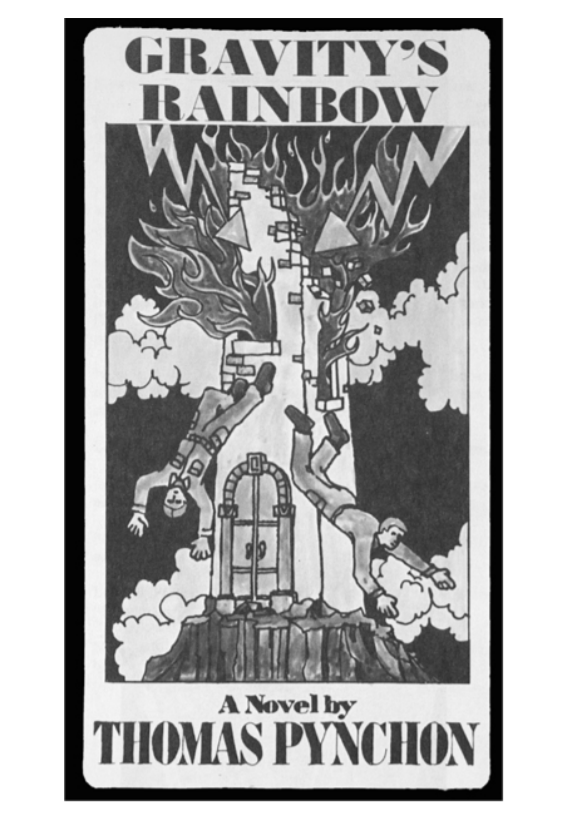
Trial cover art for Gravity’s Rainbow

trial art for gr

This trial cover for Thomas Pynchon’s novel Gravity’s Rainbow is included in Luc Herman and Steven Weisenburger’s book Gravity’s Rainbow, Domination, and Freedom (University of Georgia Press, 2013).

Herman and Weisenburger note the existence of an even earlier version with Pynchon’s working title Mindless Pleasures. I found it quickly at Pynchon Wiki, which notes:

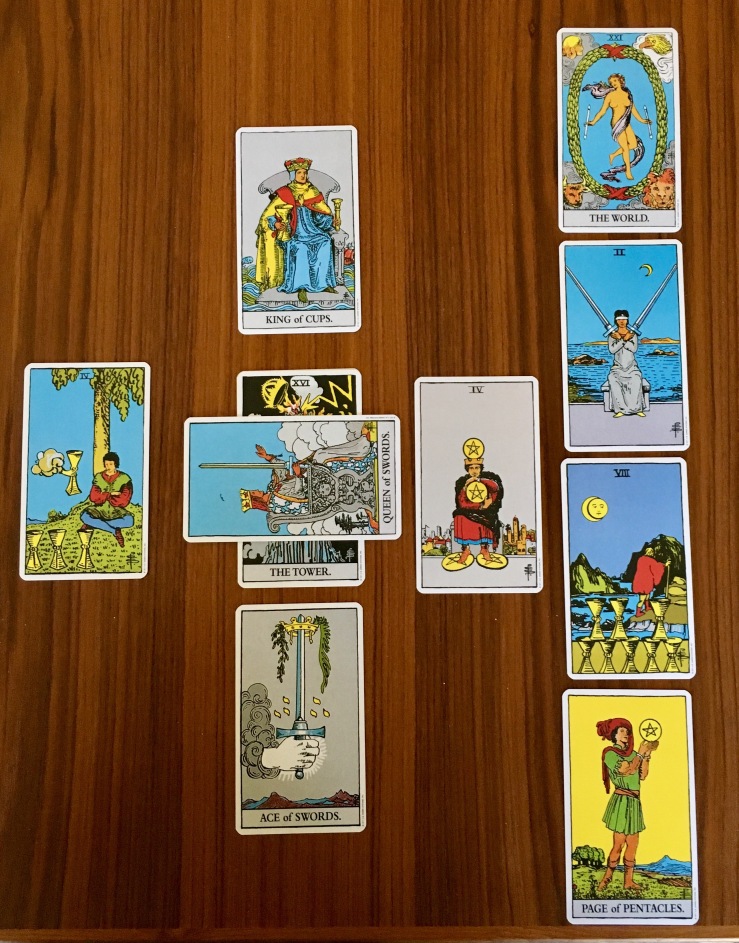
how the image is based on the Tarot card The Tower, which – as we learn in Weissmann’s Tarot (p. 746-47) – represents “any System which cannot tolerate heresy: a system which, by its nature, must sooner or later fall. We know by now that it is also the Rocket.”

mindless-pleasures

Here are Herman and Weisenburger on that first title, Mindless Pleasures:

…Pynchon’s, or perhaps the Viking editors’, extraction of that phrase [“mindless pleasures”] for the book title, although scotched, surely indexed some shared sense of thematic relevance. An early trial cover put the title “Mindless Pleasures” over a cleverly stylized version of the Tower, a key card in Weissmann/Blicero’s tarot reading. A second trial cover, also scotched, put “Gravity’s Rainbow” over the same image. The Tower gathers several interpretations, most notably (says our narrator) that of “a Gnostic or Cathar symbol for the Church of Rome, and this is generalized to mean any system which cannot tolerate heresy: a system which, by its nature, must sooner or later fall. We know by now that it is also the Rocket.” The notion of tolerance and intolerance is catchy and may also link to Marcuse on repression…. One reading of this cover would be that mindless pleasures bring down the system, are anathema to it. The common gloss of “mindless” is that it refers to the contrary of normativity, or not a mentality conditioned or “defined within rigid societal parameters”…. This contrariness presumes a hierarchy, an established order elevated above a variety of upstart alternatives, many of them popular, carnivalesque, of the body. And the arts are among them…

Weissmann’s tarot:

img_4289-1

Herman and Weisenburger cite Clifford Mead’s Thomas Pynchon: A Bibliography of Primary and Secondary Materials (Dalkey, 1989) as their source for the trial cover.

As far as I can find, no cover designer is credited.

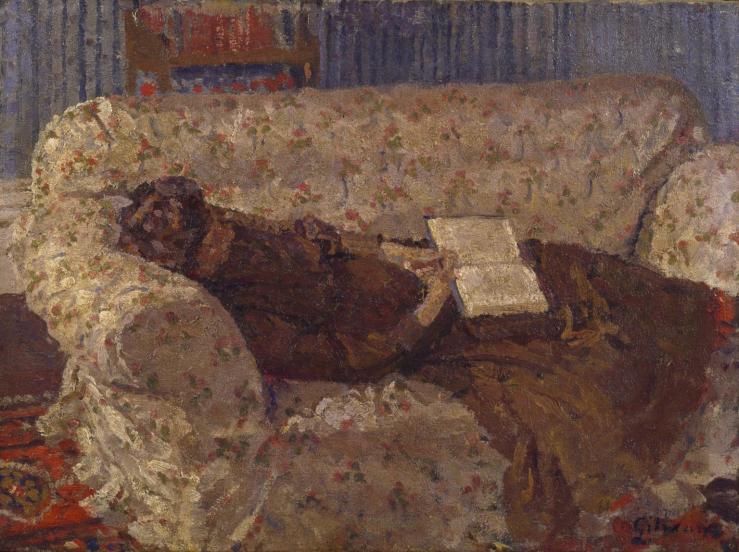
Lady on a Sofa — Harold Gilman

Lady on a Sofa c.1910 by Harold Gilman 1876-1919

Lady on a Sofa, c.1910 by Harold Gilman (1876–1919)

“Vineland is not the novel Pynchon’s fans were expecting” | A 1990 Pynchon profile

“Togetherness” — Thomas Pynchon

160N09658_9LTYB

(Click to enlarge.)

“Togetherness,” by Thomas Pynchon was published in the vol. 16, no. 12 issue of Aerospace Safety in December 1960. The byline reads “Thomas H. Pynchon” (for Huggles, presumably).

Full text of the article here (for completists only, of course).

Casement to Infinity — Leon Underwood

Casement to Infinity 1930 by Leon Underwood 1890-1975

Casement to Infinity, 1930 by Leon Underwood 1890–1975

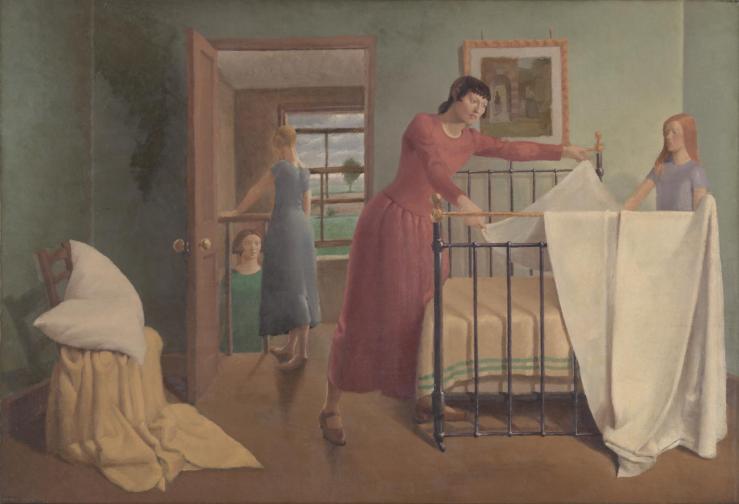
Any Morning — Margaret Barker

Any Morning exhibited 1929 by Margaret Barker 1907-2003

Any Morning, 1929 by Margaret Barker (1907–2003)

Symposium I — Helen Lessore

Symposium I 1974-77 by Helen Lessore 1907-1994

Symposium I, 1977 by Helen Lessore (1907–1994)

Getting away cheap | Thomas Pynchon

“You remember those twin statues of the Buddha that I told you about? Carved out of a mountain in Afghanistan, that got dynamited by the Taliban back in the spring? Notice anything familiar?”

“Twin Buddhas, twin towers, interesting coincidence, so what.”

“The Trade Center towers were religious too. They stood for what this country worships above everything else, the market, always the holy fuckin market.”

“A religious beef, you’re saying?”

“It’s not a religion? These are people who believe the Invisible Hand of the Market runs everything. They fight holy wars against competing religions like Marxism. Against all evidence that the world is finite, this blind faith that resources will never run out, profits will go on increasing forever, just like the world’s population—more cheap labor, more addicted consumers.”

“You sound like March Kelleher.”

“Yeah, or,” that trademark sub-smirk, “maybe she sounds like me.”

“Uh-huh, listen, Shawn . . .” Maxine tells him about the kids on the corner and her time-warp theory.

“Is that like the zombies you said you were seeing?”

“One person, Shawn, somebody I know, maybe dead maybe not, enough with the zombies already.”

“Hmm yes, but now another, you’d have to say insane, suspicion has begun to bloom in all the California sunshine around here, which is, suppose these “kids” are really operatives, time troopers from the Montauk Project, abducted long ago into an unthinkable servitude, grown solemn and gray through years of soldiering, currently assigned to Maxine expressly, for reasons never to be made clear to her. Possibly in strange cahoots also, and why not, with Gabriel Ice’s own private gang of co-opted script kiddies . . . aahhh! Talk about paranoid jitters!

“OK”, soothingly, “like, total disclosure? It’s been happenin to me too? I’m seeing people in the street who are supposed to be dead, even sometimes people I know were in the towers when they went down, who can’t be here but they’re here.”

“They gaze at each other for a while, down here on the barroom floor of history, feeling sucker-punched, no clear way to get up and on with a day which is suddenly full of holes—family, friends, friends of friends, phone numbers on the Rolodex, just not there anymore . . . the bleak feeling, some mornings, that the country itself may not be there anymore, but being silently replaced screen by screen with something else, some surprise package, by those who’ve kept their wits about them and their clicking thumbs ready.

“I’m sorry, Shawn. What do you think it could be?”

“Besides how much I miss them, beats me. Is it just this miserable fucking city, too many faces, making us crazy? Are we seeing some wholesale return of the dead?”

“You’d prefer retail?”

“Do you remember that piece of footage on the local news, just as the first tower comes down, woman runs in off the street into a store, just gets the door closed behind her, and here comes this terrible black billowing, ash, debris, sweeping through the streets, gale force past the window . . . that was the moment, Maxi. Not when ‘everything changed.’ When everything was revealed. No grand Zen illumination, but a rush of blackness and death. Showing us exactly what we’ve become, what we’ve been all the time.”

“And what we’ve always been is . . . ?”

“Is living on borrowed time. Getting away cheap. Never caring about who’s paying for it, who’s starving somewhere else all jammed together so we can have cheap food, a house, a yard in the burbs . . . planetwide, more every day, the payback keeps gathering. And meantime the only help we get from the media is boo hoo the innocent dead. Boo fuckin hoo. You know what? All the dead are innocent. There’s no uninnocent dead.”

After a while, “You’re not going to explain that, or . . .”

“Course not, it’s a koan.”

From Bleeding Edge by Thomas Pynchon.

Tribute to De Chirico — Carlos Mensa

carlos mensa tribute

Tribute to De Chirico, 1974 by Carlos Mensa (1936-1982)

Insufficiently serious | Thomas Pynchon

Heidi has been working on an article for the Journal of Memespace Cartography she’s calling “Heteronormative Rising Star, Homophobic Dark Companion,” which argues that irony, assumed to be a key element of urban gay humor and popular through the nineties, has now become another collateral casualty of 11 September because somehow it did not keep the tragedy from happening. “As if somehow irony,” she recaps for Maxine, “as practiced by a giggling mincing fifth column, actually brought on the events of 11 September, by keeping the country insufficiently serious—weakening its grip on ‘reality.’ So all kinds of make-believe—forget the delusional state the country’s in already—must suffer as well. Everything has to be literal now.”

“Yeah, the kids are even getting it at school.” Ms. Cheung, an English teacher who if Kugelblitz were a town would be the neighborhood scold, has announced that there shall be no more fictional reading assignments. Otis is terrified, Ziggy less so. Maxine will walk in on them watching Rugrats or reruns of Rocko’s Modern Life, and they holler by reflex, “Don’t tell Ms. Cheung!”

“You notice,” Heidi continues, “how ‘reality’ programming is suddenly all over the cable, like dog shit? Of course, it’s so producers shouldn’t have to pay real actors scale. But wait! There’s more! Somebody needs this nation of starers believing they’re all wised up at last, hardened and hip to the human condition, freed from the fictions that led them so astray, as if paying attention to made-up lives was some form of evil drug abuse that the collapse of the towers cured by scaring everybody straight again.”

From Bleeding Edge by Thomas Pynchon.


“May” — Tom Disch

Screenshot 2020-03-12 at 7.15.07 PM

Harness — Tristram Hillier

Harness 1944 by Tristram Hillier 1905-1983

Harness, 1944 by Tristram Hillier (1905–1983)

“How Trees Walk” — Leo Tolstoy

“How Trees Walk”

by

Leo Tolstoy

(Trans. by Leo Wiener)


One day we were cleaning an overgrown path on a hillock near the pond. We cut down a lot of brier bushes, willows, and poplars,—then came the turn of a bird-cherry. It was growing on the path, and it was so old and stout that it could not be less than ten years old. And yet I knew that five years ago the garden had been cleaned. I could not understand how such an old bird-cherry could have grown out there. We cut it down and went farther. Farther away, in another thicket, there grew a similar bird-cherry, even stouter than the first. I looked at its root, and saw that it grew under an old linden. The linden with its branches choked it, and it had stretched out about twelve feet in a straight line, and only then came out to the light, raised its head, and began to blossom.

I cut it down at the root, and was surprised to find it so fresh, while the root was rotten. After we had cut it down, the peasants and I tried to pull it off; but no matter how much we jerked at it, we were unable to drag it away: it seemed to have stuck fast. I said:

“Look whether it has not caught somewhere.”

A workman crawled under it, and called out:

“It has another root; it is out on the path!”

I walked over to him, and saw that it was so.

Not to be choked by the linden, the bird-cherry had gone away from underneath the linden out on the path, about eight feet from its former root. The root which I had cut down was rotten and dry, but the new one was fresh. The bird-cherry had evidently felt that it could[Pg 177] not exist under the linden, so it had stretched out, dropped a branch to the ground, made a root of that branch, and left the other root. Only then did I understand how the first bird-cherry had grown out on the road. It had evidently done the same,—only it had had time to give up the old root, and so I had not found it.