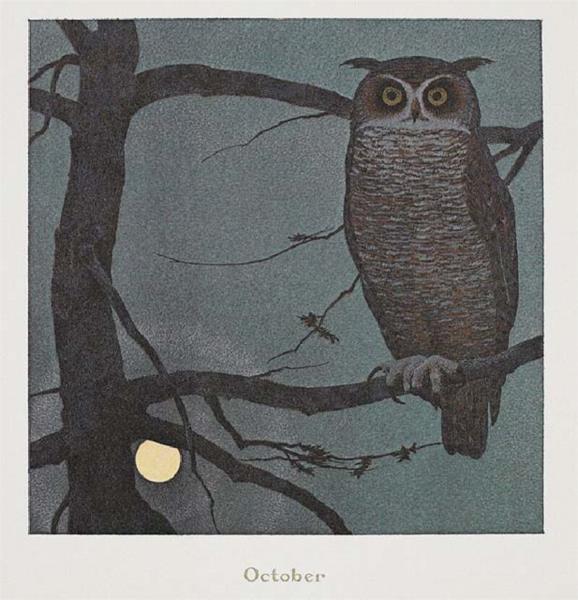
“October”
by
May Swenson
1
A smudge for the horizon
that, on a clear day, shows
the hard edge of hills and
buildings on the other coast.
Anchored boats all head one way:
north, where the wind comes from.
You can see the storm inflating
out of the west. A dark hole
in gray cloud twirls, widens,
while white rips multiply
on the water far out.
Wet tousled yellow leaves,
thick on the slate terrace.
The jay’s hoarse cry. He’s
stumbling in the air,
too soaked to fly.
2
Knuckles of the rain
on the roof,
chuckles into the drain-
pipe, spatters on
the leaves that litter
the grass. Melancholy
morning, the tide full
in the bay, an overflowing
bowl. At least, no wind,
no roughness in the sky,
its gray face bedraggled
by its tears.
3
Peeling a pear, I remember
my daddy’s hand. His thumb
(the one that got nipped by the saw,
lacked a nail) fit into
the cored hollow of the slippery
half his knife skinned so neatly.
Dad would pare the fruit from our
orchard in the fall, while Mother
boiled the jars, prepared for
“putting up.” Dad used to darn
our socks when we were small,
and cut our hair and toenails.
Sunday mornings, in pajamas, we’d
take turns in his lap. He’d help
bathe us sometimes. Dad could do
anything. He built our dining table,
chairs, the buffet, the bay window
seat, my little desk of cherry wood
where I wrote my first poems. That
day at the shop, splitting panel
boards on the electric saw (oh, I
can hear the screech of it now,
the whirling blade that sliced
my daddy’s thumb), he received the mar
that, long after, in his coffin,
distinguished his skilled hand.
4
I sit with braided fingers
and closed eyes
in a span of late sunlight.
The spokes are closing.
It is fall: warm milk of light,
though from an aging breast.
I do not mean to pray.
The posture for thanks or
supplication is the same
as for weariness or relief.
But I am glad for the luck
of light. Surely it is godly,
that it makes all things
begin, and appear, and become
actual to each other.
Light that’s sucked into
the eye, warming the brain
with wires of color.
Light that hatched life
out of the cold egg of earth.
5
Dark wild honey, the lion’s
eye color, you brought home
from a country store.
Tastes of the work of shaggy
bees on strong weeds,
their midsummer bloom.
My brain’s electric circuit
glows, like the lion’s iris
that, concentrated, vibrates
while seeming not to move.
Thick transparent amber
you brought home,
the sweet that burns.
6
“The very hairs of your head
are numbered,” said the words
in my head, as the haircutter
snipped and cut, my round head
a newel poked out of the tent
top’s slippery sheet, while my
hairs’ straight rays rained
down, making pattern on the neat
vacant cosmos of my lap. And
maybe it was those tiny flies,
phantoms of my aging eyes, seen
out of the sides floating (that,
when you turn to find them
full face, always dissolve) but
I saw, I think, minuscule,
marked in clearest ink, Hairs
#9001 and #9002 fall, the cut-off
ends streaking little comets,
till they tumbled to confuse
with all the others in their
fizzled heaps, in canyons of my
lap. And what keeps asking
in my head now that, brushed off
and finished, I’m walking
in the street, is how can those
numbers remain all the way through,
and all along the length of every
hair, and even before each one
is grown, apparently, through
my scalp? For, if the hairs of my
head are numbered, it means
no more and no less of them
have ever, or will ever be.
In my head, now cool and light,
thoughts, phantom white flies,
take a fling: This discovery
can apply to everything.
7
Now and then, a red leaf riding
the slow flow of gray water.
From the bridge, see far into
the woods, now that limbs are bare,
ground thick-littered. See,
along the scarcely gliding stream,
the blanched, diminished, ragged
swamp and woods the sun still
spills into. Stand still, stare
hard into bramble and tangle,
past leaning broken trunks,
sprawled roots exposed. Will
something move?—some vision
come to outline? Yes, there—
deep in—a dark bird hangs
in the thicket, stretches a wing.
Reversing his perch, he says one
“Chuck.” His shoulder-patch
that should be red looks gray.
This old redwing has decided to
stay, this year, not join the
strenuous migration. Better here,
in the familiar, to fade.









 Biblioklept