To the Left and to the Right — Samuel Bak

bk1140_images1

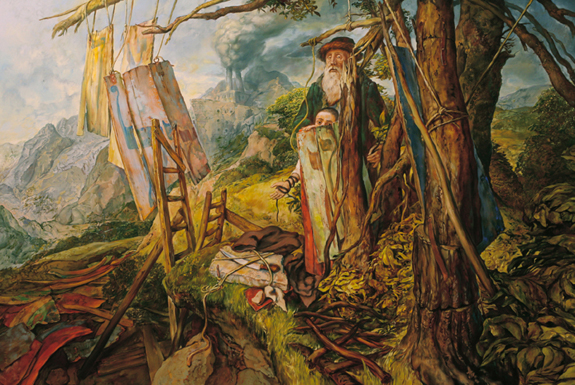
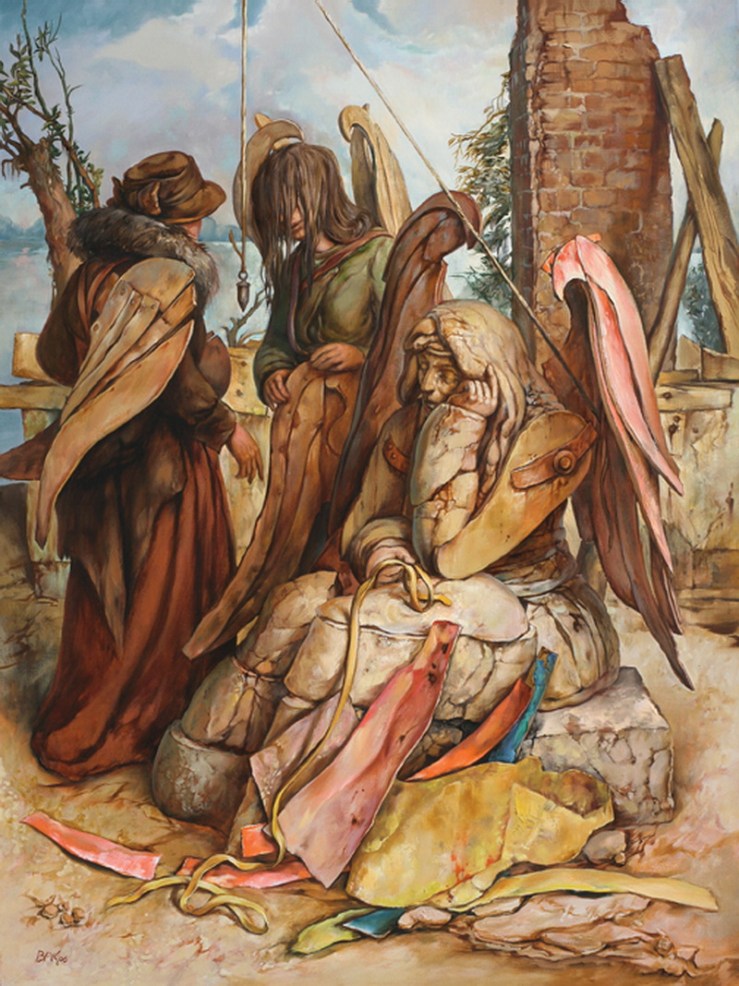
To the Left and to the Right, 2007 by Samuel Bak (b. 1933)

Read Peter Taylor’s short story “A Spinster’s Tale”

“A Spinster’s Tale”

by

Peter Taylor


My brother would often get drunk when I was a little girl, but that put a different sort of fear into me from what Mr. Speed did. With Brother it was a spiritual thing. And though it was frightening to know that he would have to burn for all that giggling and bouncing around on the stair at night, the truth was that he only seemed jollier to me when I would stick my head out of the hall door. It made him seem almost my age for him to act so silly, putting his white forefinger all over his flushed face and finally over his lips to say, “Sh-sh-sh-sh!” But the really frightening thing about seeing Brother drunk was what I always heard when I had slid back into bed. I could always recall my mother’s words to him when he was sixteen, the year before she died, spoken in her greatest sincerity, in her most religious tone:

“Son, I’d rather see you in your grave.”

Yet those nights put a scaredness into me that was clearly distinguishable from the terror that Mr. Speed instilled by stumbling past our house two or three afternoons a week. The most that I knew about Mr. Speed was his name. And this I considered that I had somewhat fabricated—by allowing him the “Mr.”—in my effort to humanize and soften the monster that was forever passing our house on Church Street. My father would point him out through the wide parlor window in soberness and severity to my brother with: “There goes Old Speed, again.” Or on Saturdays when Brother was with the Benton boys and my two uncles were over having toddies with Father in the parlor, Father would refer to Mr. Speed’s passing with a similar speech, but in a blustering tone of merry tolerance: “There goes Old Speed, again. The rascal!” These designations were equally awful, both spoken in tones that were foreign to my father’s manner of addressing me; and not unconsciously I prepared the euphemism, Mister Speed, against the inevitable day when I should have to speak of him to someone.

I was named Elizabeth, for my mother. My mother had died in the spring before Mr. Speed first came to my notice on that late afternoon in October. I had bathed at four with the aid of Lucy, who had been my nurse and who was now the upstairs maid; and Lucy was upstairs turning back the covers of the beds in the rooms with their color schemes of blue and green and rose. I wandered into the shadowy parlor and sat first on one chair, then on another. I tried lying down on the settee that went with the parlor set, but my legs had got too long this summer to stretch out straight on the settee. And my feet looked long in their pumps against the wicker arm. I looked at the pictures around the room blankly and at the stained-glass windows on either side of the fireplace; and the winter light coming through them was hardly bright enough to show the colors. I struck a match on the mosaic hearth and lit the gas-logs.

Kneeling on the hearth I watched the flames till my face felt hot. I stood up then and turned directly to one of the full-length mirror-panels that were on each side of the front window. This one was just to the right of the broad window and my reflection in it stood out strangely from the rest of the room in the dull light that did not penetrate beyond my figure. I leaned closer to the mirror trying to discover a resemblance between myself and the wondrous Alice who walked through a looking-glass. But that resemblance I was seeking I could not find in my sharp features, or in my heavy, dark curls hanging like fragments of hosepipe to my shoulders. Continue reading “Read Peter Taylor’s short story “A Spinster’s Tale””

Seven Views of Tokyo — Shinji Tsuchimochi

From Shinji Tsuchimochi’100 Views of Tokyo. More at Spoon & Tomago, where you can also buy the book.

“The Itch,” a new Don DeLillo story in The New Yorker

There’s a new DeLillo story in The New Yorker. It’s called “The Itch” and I started itching terribly about halfway through. First three sections (and yeah, the story starts with “But”):

But nobody showed up, so he sat awhile looking at the wall. It was one of those Saturdays that feel like Sunday. He didn’t know how to explain this. It happened intermittently, more often in the warmer months, and it was probably normal, although he’d never discussed it with anyone.

After the divorce he felt an odd numbness, mental and physical. He looked in the mirror, studying the face that looked back. At night he kept to his half of the bed with his back to the other half. Over time a life slithered out. He talked to people, took long walks. He bought a pair of shoes but only after testing them rigorously, both shoes, not just one. He walked from one end of the shoe store to the other, four times at various speeds, then sat and looked down at the shoes. He took one shoe off and handled it, pressing the instep, placing his hand inside the shoe, nodding at it, tapping with the fingers of his free hand on the rigid sole and heel.

The salesman stood in the near distance, watching and waiting, whoever he was, whatever he said and did when he wasn’t there.

In the office his desk was set alongside a window and he spent time looking at a building across the street, where nothing was visible inside the rows of windows. There were times when he could not stop looking.

He looks and scratches, semi-surreptitiously. Certain days it’s the left wrist. Upper arms at home in the evening. Thighs and shins most likely at night. When he’s out walking, it happens now and then, mostly forearms.

He was forty-four years old, trapped in his body. Arms, legs, torso. Face did not itch. Scalp developed something that a doctor gave a name to, but it itched only rarely, then not at all, so the name didn’t matter.

His eyes swept the windows across the street horizontally, never vertically. He did not try to imagine the lives inside.

Izaak — Samuel Bak

bk1245_images

Izaak, 1999-2008 by Samuel Bak (b. 1933)

A sense of not pretending | Sam Shepard on Days of Heaven

Suicide at Dawn — Victor Brauner

ma-113932-web

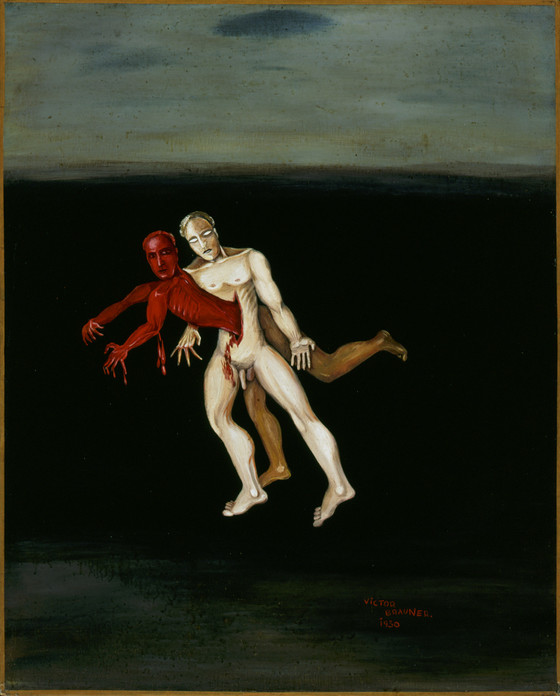
Suicide at Dawn, 1930 by Victor Brauner (1903-1966)

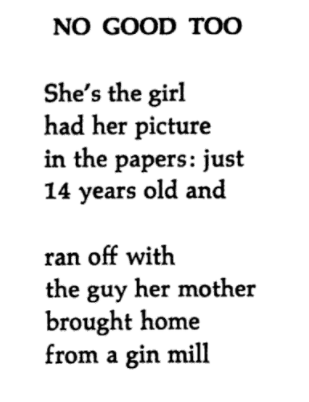
“No Good Too” — William Carlos Williams

Screenshot 2017-07-30 at 7.56.50 PM

Rossetti’s Willow Wood — Robin Ironside

02_lg

Rossetti’s Willow Wood, 1944 by Robin Ironside (1912-1965)

Self-Portrait at the Easel — Sofonisba Anguissola

Self-Portrait at the Easel, 1556 by Sofonisba Anguissola (c. 1532-1625)

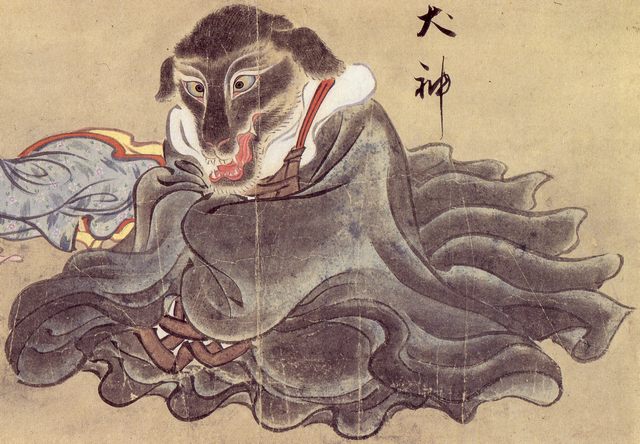
Inugami — Sawaki Suushi

suushi_inugami

Inugami (Dog Spirit), 1736 by Sawaki Suushi (1707-1772)

Some books I abandoned (for now)

img_7607

Five books that I’ve made some headway into over the past few weeks, only to set aside for later—

Wolfgang Hilbig’s Old Rendering Plant is a skinny hundred pages, but it’s also dense, with paragraphs that go on for pages. It’s also gloomy—it’s long intro seems like a rewrite of the introduction to Poe’s “The Fall of the House of Usher,” suffocating, abject, and dulling. I intend to get back to the book, but it’s just too hot right now in Florida.

Getting a copy of The Erstwhile in the late spring was my excuse for finally reading Brian Catling’s The Vorrh, a big baroque beast of a novel. I liked The Vorrh despite (because of?) its many weird shaggy problems, but it also wore me out. (I reviewed it here). I can’t seem to get past the third chapter of The Erstwhile. I might see if there’s an audiobook of it.

Joaquim Maria Machado de Assis’s 1881 novel The Posthumous Memoirs of Brás Cubas probably doesn’t belong on this list. Like Tristram Shandy, it likely belongs on a list I made last year of books I’ll probably never finish, yet return to again and again.books I’ll probably never finish, yet return to again and again. Calling the book strange is an understatement, and its punchy, short chapters lead to me reading it in a really discontinuous fashion (I was reading it in between stories from that Leonora Carrington collection earlier this summer, which was like a perfect cocktail of weird).

Tomasso Landolfi’s collection Words in Commotion was…not quite as weird as I’d hoped it would be. I read only the shortest stories in the collection, and while I liked the Gothic tinges, I was also reading a bunch of Barry Hannah short stories at the same time. And the Hannah stories were just like, so superior, from the sentence to the paragraph to the whole tale.

I spent the first few months of 2017 gorging on Paul Bowles, with somewhat diminishing returns. I loved The Stories of Paul Bowles but was disappointed in The Sheltering Sky; I read his “lesser” novel Up Above the World and appreciated its precision a bit more—it’s something closer to a genre novel than a philosophical exercise. I’ve made it all the way to page 50 in Let It Come Down twice now, each time getting there—it’s a chapter break—and realizing I have no idea what’s going on. I read and read, but not really. I’m not comprehending anything. I’m thinking about some other thing—food or a movie or a chore I have to do or a different book, a book I’d rather be reading now than this one.

Melancholia — Samuel Bak

Samuel Bak (11)

Melancholia by Samuel Bak (b. 1933)

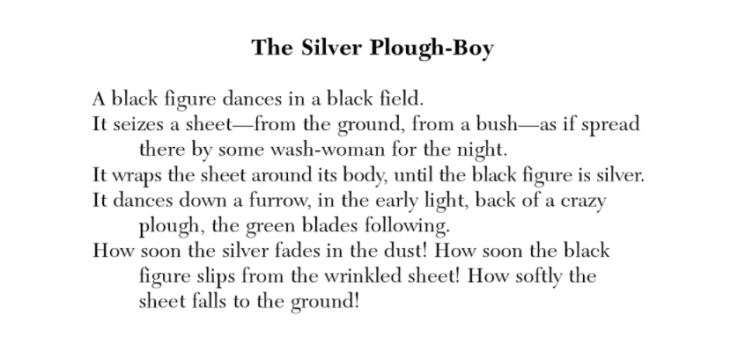
“The Silver Plough-Boy” — Wallace Stevens

Screenshot 2017-07-22 at 2.45.49 PM

Asia Africa Storm — Hendra Gunawan

QWes343DZarG-BUyHJFs1yxzDw8nMInLV4HMnjNYovA

Asia Africa Storm, 1953 by Hendra Gunawan (1918-1983)

We passed a tame crow | Nathaniel Hawthorne’s journal entry for July 27th, 1838

On the road to Northampton, we passed a tame crow, which was sitting on the peak of a barn. The crow flew down from its perch, and followed us a great distance, hopping along the road, and flying with its large, black, flapping wings, from post to post of the fence, or from tree to tree. At last he gave up the pursuit with a croak of disappointment. The driver said, perhaps correctly, that the crow had scented some salmon which was in a basket under the seat, and that this was the secret of his pursuing us. This would be a terrific incident if it were a dead body that the crow scented, instead of a basket of salmon. Suppose, for instance, in a coach travelling along, that one of the passengers suddenly should die, and that one of the indications of his death would be this deportment of the crow.

From Nathaniel Hawthorne’s journal entry for July 27th, 1838