Woman with Orange Stockings — Egon Schiele

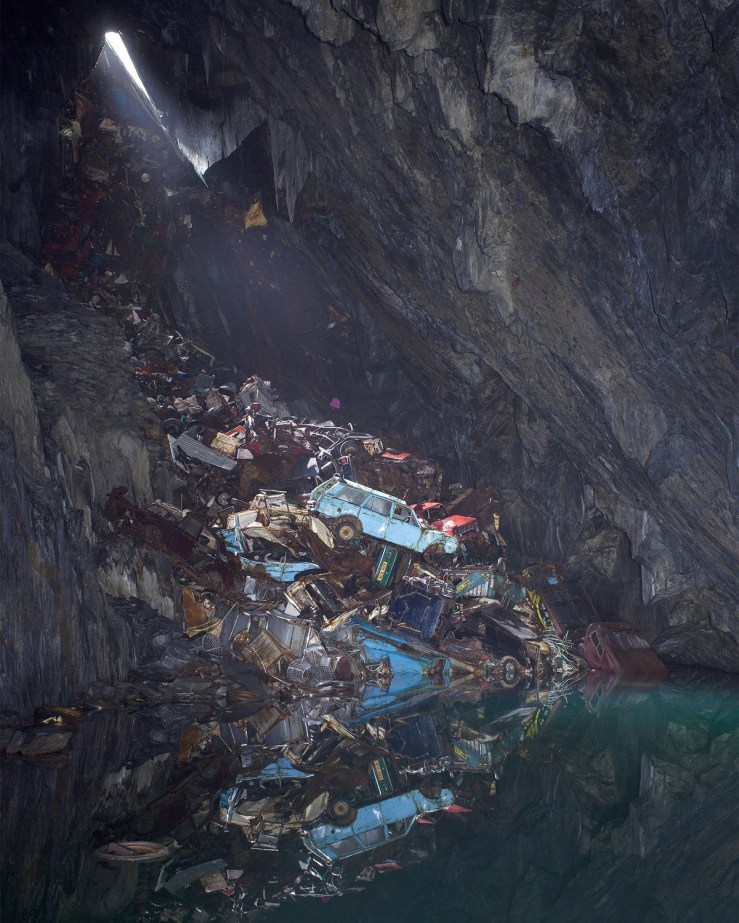
Gaewern Slate Mine (Abandoned in 1970) — Robin Friend

robin-friend

“Briar Rose (Sleeping Beauty)” — Anne Sexton

“Briar Rose (Sleeping Beauty”

by

Anne Sexton


Consider
a girl who keeps slipping off,
arms limp as old carrots,
into the hypnotist’s trance,
into a spirit world
speaking with the gift of tongues.
She is stuck in the time machine,
suddenly two years old sucking her thumb,
as inward as a snail,
learning to talk again.
She’s on a voyage.
She is swimming further and further back,
up like a salmon,
struggling into her mother’s pocketbook.
Little doll child,
come here to Papa.
Sit on my knee.
I have kisses for the back of your neck.
A penny for your thoughts, Princess.
I will hunt them like an emerald.

Come be my snooky
and I will give you a root.
That kind of voyage,
rank as a honeysuckle.
Once
a king had a christening
for his daughter Briar Rose
and because he had only twelve gold plates
he asked only twelve fairies
to the grand event.
The thirteenth fairy,
her fingers as long and thing as straws,
her eyes burnt by cigarettes,
her uterus an empty teacup,
arrived with an evil gift.
She made this prophecy:
The princess shall prick herself
on a spinning wheel in her fifteenth year
and then fall down dead.
Kaputt!
The court fell silent.
The king looked like Munch’s Scream
Fairies’ prophecies,
in times like those,
held water.
However the twelfth fairy
had a certain kind of eraser
and thus she mitigated the curse
changing that death
into a hundred-year sleep.

The king ordered every spinning wheel
exterminated and exorcised.
Briar Rose grew to be a goddess
and each night the king
bit the hem of her gown
to keep her safe.
He fastened the moon up
with a safety pin
to give her perpetual light
He forced every male in the court
to scour his tongue with Bab-o
lest they poison the air she dwelt in.
Thus she dwelt in his odor.
Rank as honeysuckle.

On her fifteenth birthday
she pricked her finger
on a charred spinning wheel
and the clocks stopped.
Yes indeed. She went to sleep.
The king and queen went to sleep,
the courtiers, the flies on the wall.
The fire in the hearth grew still
and the roast meat stopped crackling.
The trees turned into metal
and the dog became china.
They all lay in a trance,
each a catatonic
stuck in a time machine.
Even the frogs were zombies.
Only a bunch of briar roses grew
forming a great wall of tacks
around the castle.
Many princes
tried to get through the brambles
for they had heard much of Briar Rose
but they had not scoured their tongues
so they were held by the thorns
and thus were crucified.
In due time
a hundred years passed
and a prince got through.
The briars parted as if for Moses
and the prince found the tableau intact.
He kissed Briar Rose
and she woke up crying:
Daddy! Daddy!
Presto! She’s out of prison!
She married the prince
and all went well
except for the fear –
the fear of sleep.

Briar Rose
was an insomniac…
She could not nap
or lie in sleep
without the court chemist
mixing her some knock-out drops
and never in the prince’s presence.
If if is to come, she said,
sleep must take me unawares
while I am laughing or dancing
so that I do not know that brutal place
where I lie down with cattle prods,
the hole in my cheek open.
Further, I must not dream
for when I do I see the table set
and a faltering crone at my place,
her eyes burnt by cigarettes
as she eats betrayal like a slice of meat.

I must not sleep
for while I’m asleep I’m ninety
and think I’m dying.
Death rattles in my throat
like a marble.
I wear tubes like earrings.
I lie as still as a bar of iron.
You can stick a needle
through my kneecap and I won’t flinch.
I’m all shot up with Novocain.
This trance girl
is yours to do with.
You could lay her in a grave,
an awful package,
and shovel dirt on her face
and she’d never call back: Hello there!
But if you kissed her on the mouth
her eyes would spring open
and she’d call out: Daddy! Daddy!
Presto!
She’s out of prison.

There was a theft.
That much I am told.
I was abandoned.
That much I know.
I was forced backward.
I was forced forward.
I was passed hand to hand
like a bowl of fruit.
Each night I am nailed into place
and forget who I am.
Daddy?
That’s another kind of prison.
It’s not the prince at all,
but my father
drunkeningly bends over my bed,
circling the abyss like a shark,
my father thick upon me
like some sleeping jellyfish.
What voyage is this, little girl?
This coming out of prison?
God help –
this life after death?
Nathaniel Hawthorne’s journal entry for December 1st, 1853

December 1st.–It is curious to observe how many methods people put in practice here to pick up a halfpenny. Yesterday I saw a man standing bareheaded and barelegged in the mud and misty weather, playing on a fife, in hopes to get a circle of auditors. Nobody, however, seemed to take any notice. Very often a whole band of musicians will strike up,–passing a hat round after playing a tune or two. On board the ferry, until the coldest weather began, there were always some wretched musicians, with an old fiddle, an old clarinet, and an old verdigrised brass bugle, performing during the passage, and, as the boat neared the shore, sending round one of their number to gather contributions in the hollow of the brass bugle. They were a very shabby set, and must have made a very scanty living at best. Sometimes it was a boy with an accordion, and his sister, a smart little girl, with a timbrel,–which, being so shattered that she could not play on it, she used only to collect halfpence in. Ballad-singers, or rather chanters or croakers, are often to be met with in the streets, but hand-organ players are not more frequent than in our cities.

I still observe little girls and other children bare-legged and barefooted on the wet sidewalks. There certainly never was anything so dismal as the November weather has been; never any real sunshine; almost always a mist; sometimes a dense fog, like slightly rarefied wool, pervading the atmosphere.

An epitaph on a person buried on a hill-side in Cheshire, together with some others, supposed to have died of the plague, and therefore not admitted into the churchyards:–

“Think it not strange our bones ly here,
Thine may ly thou knowst not where.”

ELIZABETH HAMPSON.

These graves were near the remains of two rude stone crosses, the purpose of which was not certainly known, although they were supposed to be boundary marks. Probably, as the plague-corpses were debarred from sanctified ground, the vicinity of these crosses was chosen as having a sort of sanctity.

“Bang beggar,”–an old Cheshire term for a parish beadle.

Hawthorne Hall, Cheshire, Macclesfield Hundred, Parish of Wilmslow, and within the hamlet of Morley. It was vested at an early period in the Lathoms of Irlam, Lancaster County, and passed through the Leighs to the Pages of Earlshaw. Thomas Leigh Page sold it to Mr. Ralph Bower of Wilmslow, whose children owned it in 1817. The Leighs built a chancel in the church of Wilmslow, where some of them are buried, their arms painted in the windows. The hall is an “ancient, respectable mansion of brick.”

Nathaniel Hawthorne’s journal entry for December 1st, 1853. From Passages from the English Note-Books.

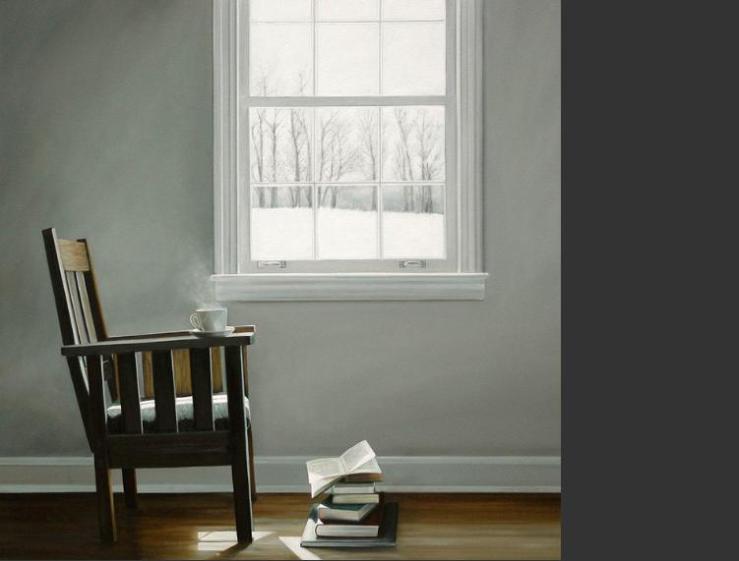
December — Karen Hollingsworth

december36x36a

My whole existence has always been simulated (From Thomas Bernhard’s Woodcutters)

Sitting in the wing chair, I reflected that I had pretended to be shocked by Joana’s suicide and pretended to accept the Auersbergers’ invitation to their artistic dinner. When I accepted it I was only pretending, I now thought, yet in spite of this I had acted upon it. The idea is nothing short of grotesque, I thought, yet at the same time it amused me. Actually I’ve always dissembled with the Auersbergers, I thought, sitting in the wing chair, and here I am again, sitting in their wing chair and dissembling once more: I’m not really here in their apartment in the Gentzgasse, I’m only pretending to be in the Gentzgasse, only pretending to be in their apartment, I said to myself. I’ve always pretended to them about everything—I’ve pretended to everybody about everything. My whole life has been a pretense, I told myself in the wing chair—the life I live isn’t real, it’s a simulated life, a simulated existence. My whole life, my whole existence has always been simulated—my life has always been pretense, never reality, I told myself. And I pursued this idea to the point at which I finally believed it. I drew a deep breath and said to myself, in such a way that the people in the music room were bound to hear it: You’ve always lived a life of pretense, not a real life—a simulated existence, not a genuine existence. Everything about you, everything you are, has always been pretense, never genuine, never real. But I must put an end to this fantasizing lest I go mad, I thought, sitting in the wing chair, and so I took a large gulp of champagne.

From Thomas, Bernhard’s novel 1984 Woodcutters; English translation by David McLinktock.

Woman in Profile — Richard Diebenkorn

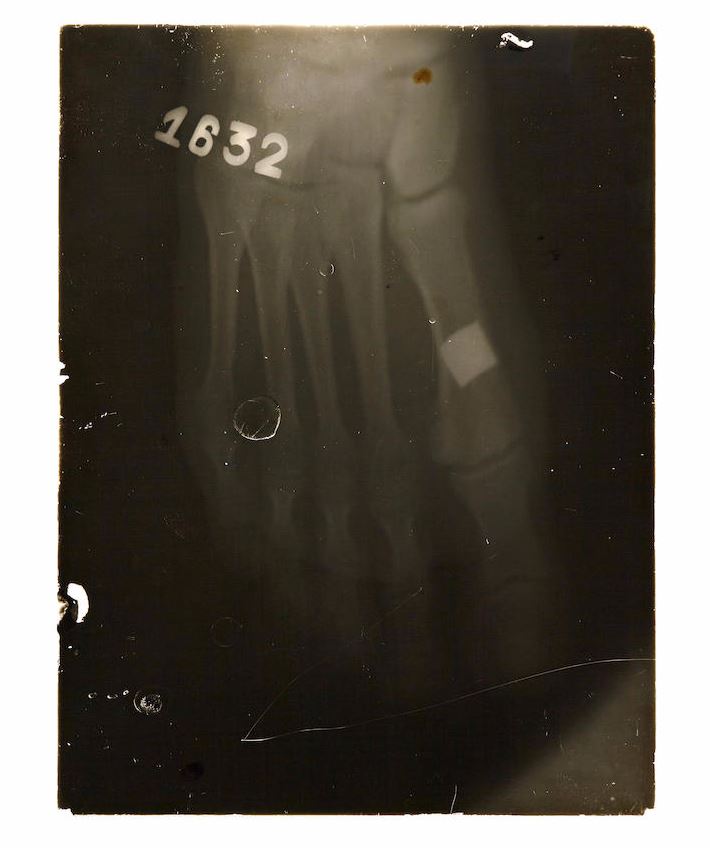
Hemingway X-ray

x

Via Bonhams’ auction lot/my buddy Dave (who should’ve been working instead of looking at Hemingway auctions online).

Bonhams’ description:

ORIGINAL HOSPITAL RECORD AND X-RAYS FOR HEMINGWAY’S WARTIME INJURIES sustained on the Italian front on the evening of July 8th, 1918, as well as one contemporary developed x-ray photograph and original hospital file folder. Hemingway was apparently handing out chocolates to Italian soldiers along the front when an Austrian mortar shell exploded, burying him in a dugout. Despite shrapnel tearing through his right foot and knee, he managed to carry an Italian comrade also wounded in the blast to the nearest medical station, for which he was awarded the Croce de Guerra. This episode (minus the heroism) and experience in the Milan military hospital is memorably recorded from the point of view of Frederic in A Farewell to Arms (1929).
This lot includes an original black folder with a printed paper label of the Ospedale Maggiore in Milan, Istituto Foto-Radioterapico A. Bertarelli, Servizio Sanita Militare, filled out in manuscript for Hemingway and dated 7/8/1918. The three glass negatives of his right foot, ankle, and knee are accompanied by a contemporary developed photograph of the knee x-ray, as well as modern developed photographs of the other two plates. The bullet is clearly seen in Hemingway’s knee.

Family Tree — Wangechi Mutu

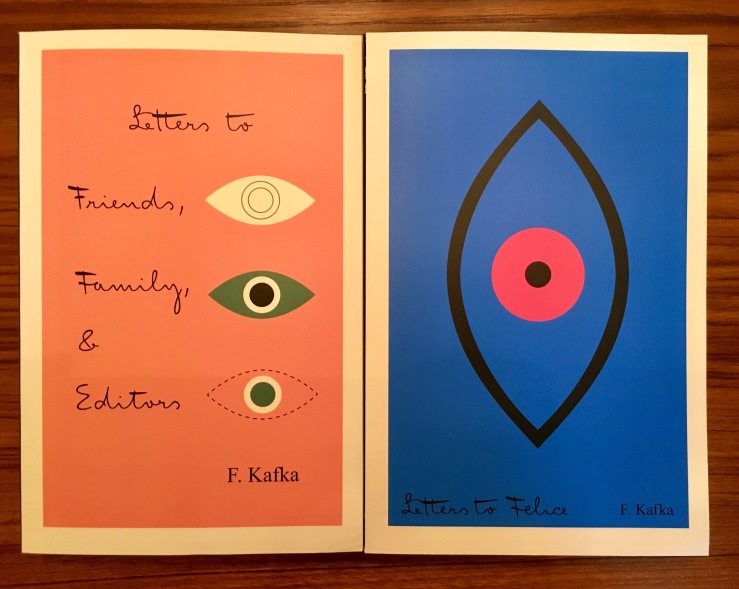
Two lovely Kafkas (Books acquired, 11.29.2016)

img_4365

Two volumes of Franz Kafka’s letters are forthcoming next month from SchockenLetters to Friends, Family, and Editors; and Letters to Felice.

Both covers are designed by Peter Mendelsund (as are all those lovely Schocken Kafka editions).

Schocken’s blurb for Friends, Family and Editors:

Collected after his death by his friend and literary executor Max Brod, here are more than two decades’ worth of Franz Kafka’s letters to the men and women with whom he maintained his closest personal relationships, from his years as a student in Prague in the early 1900s to his final months in the sanatorium near Vienna where he died in 1924.

Sometimes surprisingly humorous, sometimes wrenchingly sad, they include charming notes to school friends; fascinating accounts to Brod about his work in its various stages of publication; correspondence with his publisher, Kurt Wolff, about manuscripts in progress, suggested book titles, type design, and late royalty statements; revealing exchanges with other young writers of the day, including Martin Buber and Felix Weltsch, on life, literature, and girls; and heartbreaking reports to his parents, sisters, and friends on the declining state of his health in the last months of his life.

And Felice:

Franz Kafka met Felice Bauer in August 1912, at the home of his friend Max Brod. Energetic, down-to-earth, and life-affirming, the twenty-five-year-old secretary was everything Kafka was not, and he was instantly smitten. Because he was living in Prague and she in Berlin, his courtship was largely an epistolary one—passionate, self-deprecating, and anxious letters sent almost daily, sometimes even two or three times a day. But soon after their engagement was announced in 1914, Kafka began to worry that marriage would interfere with his writing and his need for solitude.

The more than five hundred letters Kafka wrote to Felice—through their breakup, a second engagement in 1917, and their final parting in the fall of that year, when Kafka began to feel the effects of the tuberculosis that would eventually claim his life—reveal the full measure of his inner turmoil as he tried, in vain, to balance his desire for human connection with what he felt were the solitary demands of his craft.

“Panic Fears,” a short story by Anton Chekhov

“Panic Fears”

by

Anton Chekhov


DURING all the years I have been living in this world I have only three times been terrified.

The first real terror, which made my hair stand on end and made shivers run all over me, was caused by a trivial but strange phenomenon. It happened that, having nothing to do one July evening, I drove to the station for the newspapers. It was a still, warm, almost sultry evening, like all those monotonous evenings in July which, when once they have set in, go on for a week, a fortnight, or sometimes longer, in regular unbroken succession, and are suddenly cut short by a violent thunderstorm and a lavish downpour of rain that refreshes everything for a long time.

The sun had set some time before, and an unbroken gray dusk lay all over the land. The mawkishly sweet scents of the grass and flowers were heavy in the motionless, stagnant air.

I was driving in a rough trolley. Behind my back the gardener’s son Pashka, a boy of eight years old, whom I had taken with me to look after the horse in case of necessity, was gently snoring, with his head on a sack of oats. Our way lay along a narrow by-road, straight as a ruler, which lay hid like a great snake in the tall thick rye. There was a pale light from the afterglow of sunset; a streak of light cut its way through a narrow, uncouth-looking cloud, which seemed sometimes like a boat and sometimes like a man wrapped in a quilt….

I had driven a mile and a half, or two miles, when against the pale background of the evening glow there came into sight one after another some graceful tall poplars; a river glimmered beyond them, and a gorgeous picture suddenly, as though by magic, lay stretched before me. I had to stop the horse, for our straight road broke off abruptly and ran down a steep incline overgrown with bushes. We were standing on the hillside and beneath us at the bottom lay a huge hole full of twilight, of fantastic shapes, and of space. At the bottom of this hole, in a wide plain guarded by the poplars and caressed by the gleaming river, nestled a village. It was now sleeping…. Its huts, its church with the belfry, its trees, stood out against the gray twilight and were reflected darkly in the smooth surface of the river. Continue reading ““Panic Fears,” a short story by Anton Chekhov”

Untitled (Death Mask) — Arnulf Rainer

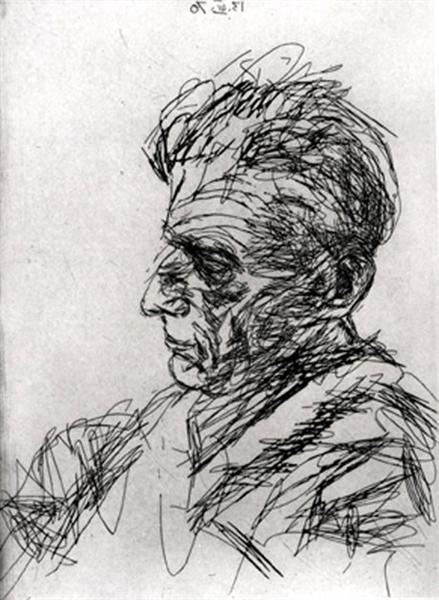
Samuel Beckett in Profile — Avigdor Arikha

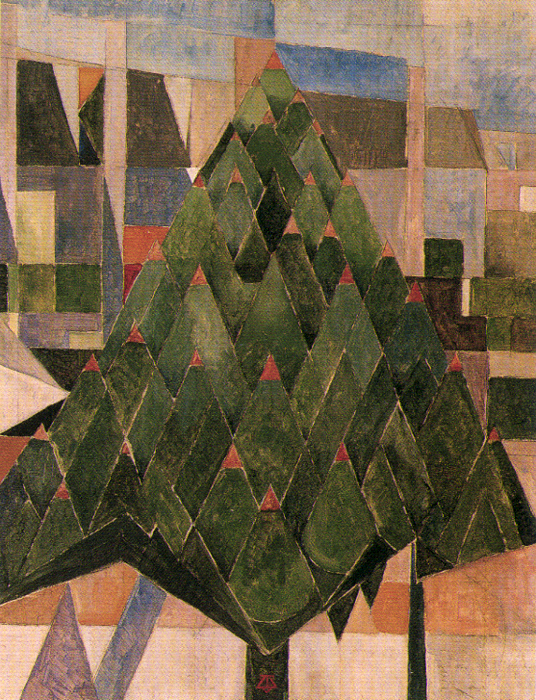
Tree — Theo van Doesburg

Diane de Houdon — Erwin Blumenfeld

The Paper Machine — Carl Grossberg