Mother Lacing Her Bodice beside a Cradle — Pieter de Hooch

25hooch

Jowhor Ile’s And After Many Days (Book acquired, 1.27.2016)

img_1406

Jowhor Ile’s novel After Many Days is new in hardback next month from Tim Duggan Books/Penguin Random House. Their blurb:

So hologramic, oh my TVC one five

Shuiyuan Recipe — Lin Shih-Yung

14912507205_e6e1329d5f_b

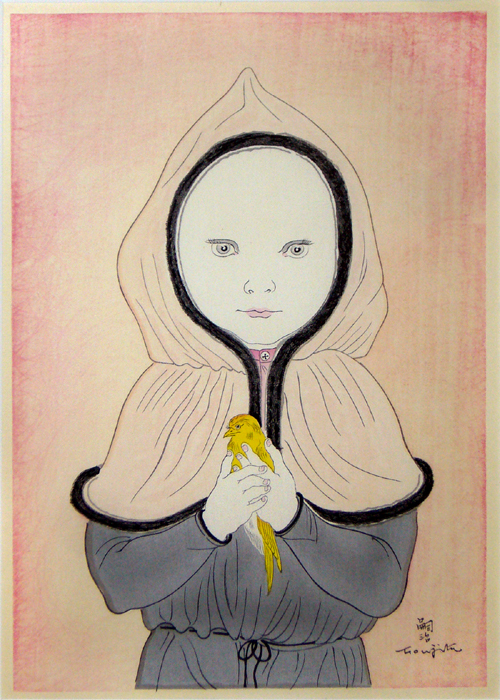
Canary — Tsuguharu Foujita

canary

Yann Martel’s The High Mountains of Portugal (Book acquired, 1.28.2016)

img_1401

Yann Martel’s novel The High Mountains of Portugal is new in hardback in the U.S. from Speigel & Grau.

Here’s the first two paragraphs of Urusla K. Le Guin’s review of the novel in The Guardian:

The High Mountains of Portugal, in Yann Martel’s novel of that name, turn out to be grassy uplands rather than high mountains; and the book turns out to be three stories rather than a novel. The stories, connected ingeniously, vary greatly in tone and quality. The first two display so little of the author’s narrative skill that they may offer more temptation to stop reading than to go on. Liking the last part of the book much better, I could wish that it stood alone.

In Martel’s Booker-winning Life of Pi, the author within the story tells us that he went to India with the intention of writing a novel set in Portugal. Then he met the Indian who told him the tale of Pi, and Portugal was forgotten. It’s recollected in the first part of this book in great detail: “He heads off down Rue São Miguel on to Largo São Miguel and then Rua de São João da Praça before turning on to Arco de Jesus.” This sort of street-rosary may delight Lisbon initiates but to others is made interesting only by the fact that the protagonist, Tomas, is walking backwards, and that he always does so. After some elaborate rationales for walking backwards, and a farcical encounter with a lamppost, we learn that he walks with “his back to the world, his back to God”, not because he is grieving for the sudden, recent death of his wife, his child, and his father, but because “he is objecting”.

Read the rest of Le Guin’s review.

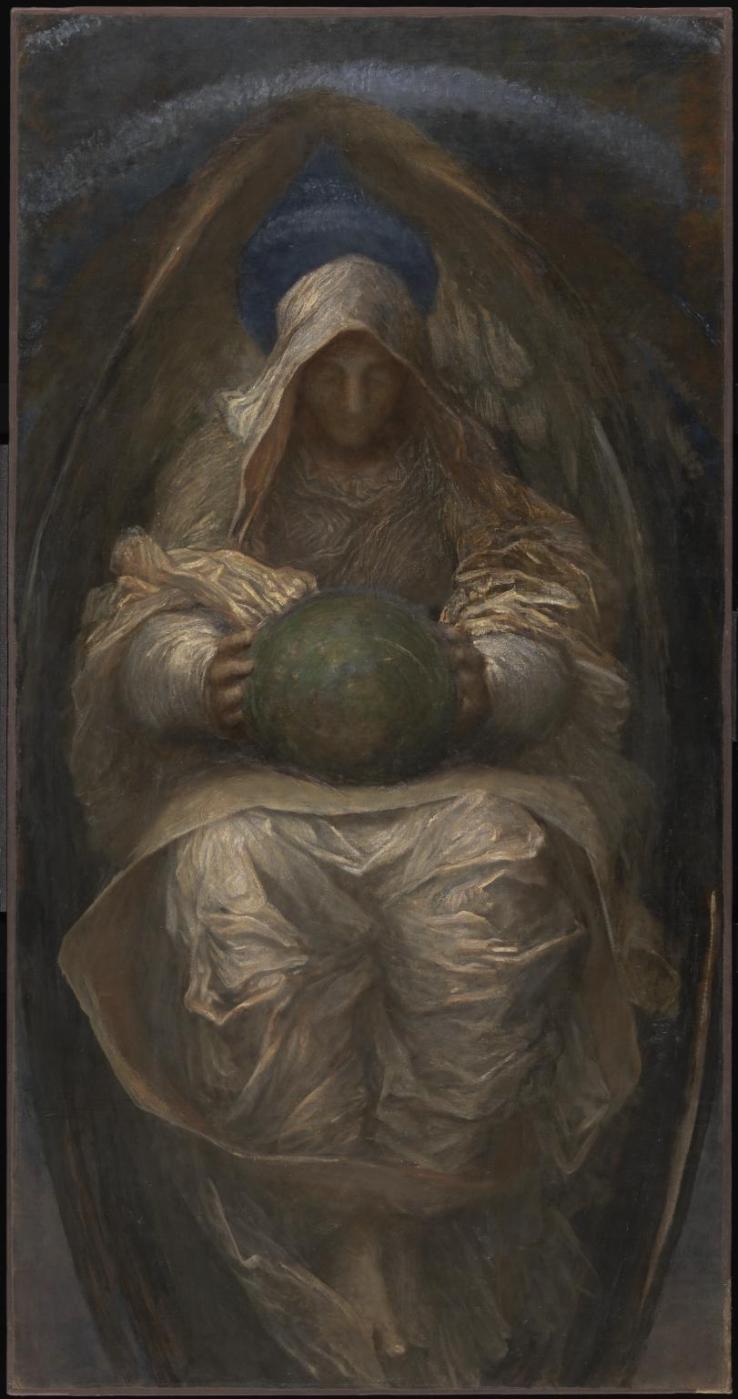
The All-Pervading — George Frederic Watts

N01687_10.jpg

Read Philip K. Dick’s early short story “Piper in the Woods”

“WELL, Corporal Westerburg,” Doctor Henry Harris said gently, “just why do you think you’re a plant?”

As he spoke, Harris glanced down again at the card on his desk. It was from the Base Commander himself, made out in Cox’s heavy scrawl: Doc, this is the lad I told you about. Talk to him and try to find out how he got this delusion. He’s from the new Garrison, the new check-station on Asteroid Y-3, and we don’t want anything to go wrong there. Especially a silly damn thing like this!

Harris pushed the card aside and stared back up at the youth across the desk from him. The young man seemed ill at ease and appeared to be avoiding answering the question Harris had put to him. Harris frowned. Westerburg was a good-looking chap, actually handsome in his Patrol uniform, a shock of blond hair over one eye. He was tall, almost six feet, a fine healthy lad, just two years out of Training, according to the card. Born in Detroit. Had measles when he was nine. Interested in jet engines, tennis, and girls. Twenty-six years old.

“Well, Corporal Westerburg,” Doctor Harris said again. “Why do you think you’re a plant?”

The Corporal looked up shyly. He cleared his throat. “Sir, I am a plant, I don’t just think so. I’ve been a plant for several days, now.”

“I see.” The Doctor nodded. “You mean that you weren’t always a plant?”

“No, sir. I just became a plant recently.”

“And what were you before you became a plant?”

“Well, sir, I was just like the rest of you.”

There was silence. Doctor Harris took up his pen and scratched a few lines, but nothing of importance came. A plant? And such a healthy-looking lad! Harris removed his steel-rimmed glasses and polished them with his handkerchief. He put them on again and leaned back in his chair. “Care for a cigarette, Corporal?”

“No, sir.”

The Doctor lit one himself, resting his arm on the edge of the chair. “Corporal, you must realize that there are very few men who become plants, especially on such short notice. I have to admit you are the first person who has ever told me such a thing.”

“Yes, sir, I realize it’s quite rare.”

“You can understand why I’m interested, then. When you say you’re a plant, you mean you’re not capable of mobility? Or do you mean you’re a vegetable, as opposed to an animal? Or just what?”

The Corporal looked away. “I can’t tell you any more,” he murmured. “I’m sorry, sir.”

“Well, would you mind telling me how you became a plant?”

Corporal Westerburg hesitated. He stared down at the floor, then out the window at the spaceport, then at a fly on the desk. At last he stood up, getting slowly to his feet. “I can’t even tell you that, sir,” he said.

“You can’t? Why not?”

“Because—because I promised not to.”

Read the rest of “Piper in the Woods” by Philip K. Dick at Gutenberg. (And consider donating a buck or five or ten or more while you’re there).

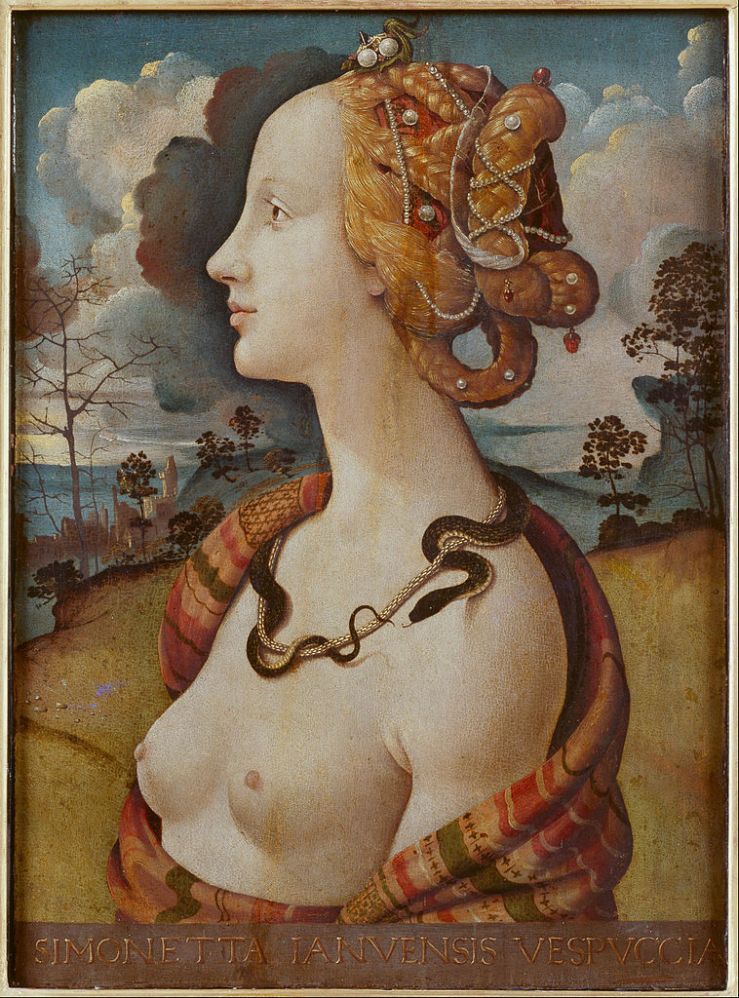
Portrait of Simonetta Vespucci as Cleopatra — Piero di Cosimo

portrait-of-simonetta-vespucci-as-cleopatra-1490

Woman with a Cat — Francesco Bacchiacca

womancat

“The pedigree of honey” — Emily Dickinson

honey

“Yonder Blue” — Tortoise

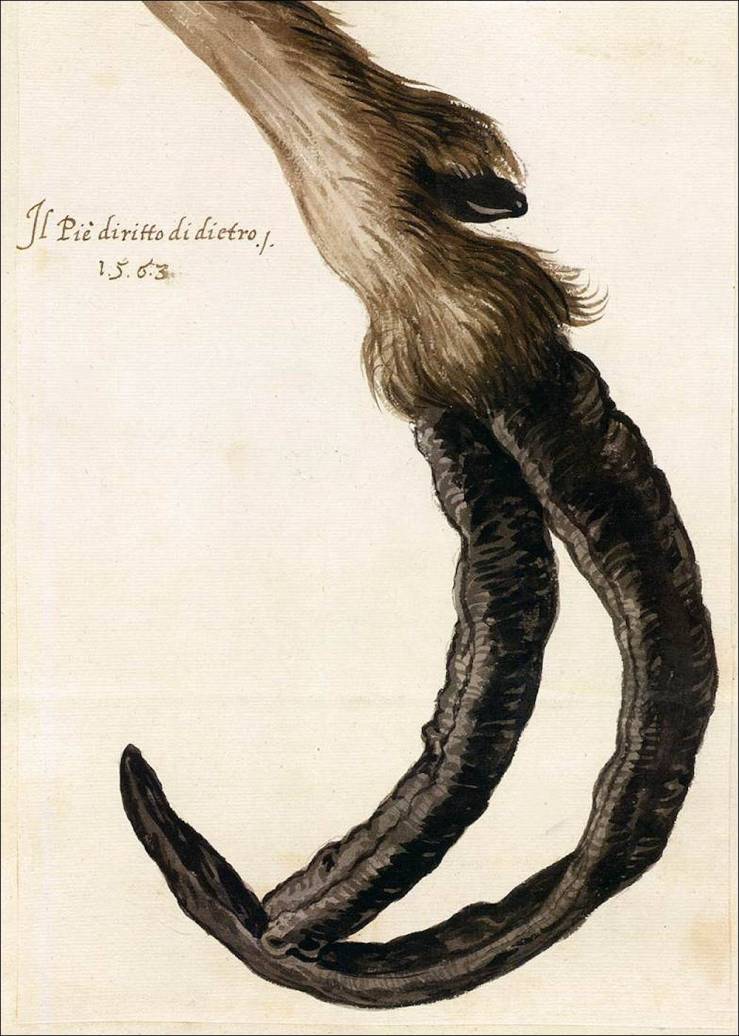
Study of Goat’s Deformed Hoof — Giuseppe Arcimboldo

65-1563-c2b7-giuseppe-arcimboldi-c2b7-study-of-a-goats-deformed-hoof

They Like to Dress — Leonor Fini

Leonor Fini-They Like to Dress-1948

“Blue and Green” — Virginia Woolf

“Blue and Green”

by

Virginia Woolf

from Monday or Tuesday


GREEN

The pointed fingers of glass hang downwards. The light slides down the glass, and drops a pool of green. All day long the ten fingers of the lustre drop green upon the marble. The feathers of parakeets—their harsh cries—sharp blades of palm trees—green, too; green needles glittering in the sun. But the hard glass drips on to the marble; the pools hover above the dessert sand; the camels lurch through them; the pools settle on the marble; rushes edge them; weeds clog them; here and there a white blossom; the frog flops over; at night the stars are set there unbroken. Evening comes, and the shadow sweeps the green over the mantelpiece; the ruffled surface of ocean. No ships come; the aimless waves sway beneath the empty sky. It’s night; the needles drip blots of blue. The green’s out.


BLUE

The snub-nosed monster rises to the surface and spouts through his blunt nostrils two columns of water, which, fiery-white in the centre, spray off into a fringe of blue beads. Strokes of blue line the black tarpaulin of his hide. Slushing the water through mouth and nostrils he sings, heavy with water, and the blue closes over him dowsing the polished pebbles of his eyes. Thrown upon the beach he lies, blunt, obtuse, shedding dry blue scales. Their metallic blue stains the rusty iron on the beach. Blue are the ribs of the wrecked rowing boat. A wave rolls beneath the blue bells. But the cathedral’s different, cold, incense laden, faint blue with the veils of madonnas.

Sleeping Groom and Sorceress — Hans Baldung

sleeping-groom-and-sorceress-1544