The Ogre Received Him As Civilly As An Ogre Can — Gustave Dore

Read “Fantine,” Bret Harte’s Victor Hugo parody

Fantine (after the French of Victor Hugo)

by

Bret Harte


Prologue

As long as there shall exist three paradoxes, a moral Frenchman, a
religious atheist, and a believing skeptic; so long, in fact, as
booksellers shall wait—say twenty-live years—for a new gospel;
so long as paper shall remain cheap and ink three sous a bottle, I
have no hesitation in saying that such books as these are not
utterly profitless. VICTOR HUGO.

To be good is to be queer. What is a good man? Bishop Myriel.

My friend, you will possibly object to this. You will say you know what a good man is. Perhaps you will say your clergyman is a good man, for instance. Bah! you are mistaken; you are an Englishman, and an Englishman is a beast.

Englishmen think they are moral when they are only serious. These Englishmen also wear ill-shaped hats, and dress horribly!

Bah! they are canaille.

Still, Bishop Myriel was a good man,—quite as good as you. Better than you, in fact.

One day M. Myriel was in Paris. This angel used to walk about the streets like any other man. He was not proud, though fine-looking. Well, three gamins de Paris called him bad names. Says one,—

“Ah, mon Dieu! there goes a priest; look out for your eggs and chickens!” What did this good man do? He called to them kindly.

“My children,” said he, “this is clearly not your fault. I recognize in this insult and irreverence only the fault of your immediate progenitors. Let us pray for your immediate progenitors.”

They knelt down and prayed for their immediate progenitors.

The effect was touching.

The Bishop looked calmly around.

“On reflection,” said he gravely, “I was mistaken; this is clearly the fault of Society. Let us pray for Society.”

They knelt down and prayed for Society.

The effect was sublimer yet. What do you think of that? You, I mean.

Everybody remembers the story of the Bishop and Mother Nez Retrousse. Old Mother Nez Retrousse sold asparagus. She was poor; there’s a great deal of meaning in that word, my friend. Some people say “poor but honest.” I say, Bah!

Bishop Myriel bought six bunches of asparagus. This good man had one charming failing: he was fond of asparagus. He gave her a franc, and received three sous change.

The sous were bad,—counterfeit. What did this good Bishop do? He said: “I should not have taken change from a poor woman.”

Then afterwards, to his housekeeper: “Never take change from a poor woman.”

Then he added to himself: “For the sous will probably be bad.”

II

When a man commits a crime, Society claps him in prison. A prison is one of the worst hotels imaginable.

The people there are low and vulgar. The butter is bad, the coffee is green. Ah, it is horrible!

In prison, as in a bad hotel, a man soon loses, not only his morals, but what is much worse to a Frenchman, his sense of refinement and delicacy.

Jean Valjean came from prison with confused notions of Society. He forgot the modern peculiarities of hospitality. So he walked off with the Bishop’s candlesticks.

Let us consider. Candlesticks were stolen; that was evident. Society put Jean Valjean in prison; that was evident, too. In prison, Society took away his refinement; that is evident, likewise.

Who is Society?

You and I are Society.

My friend, you and I stole those candlesticks!

Continue reading “Read “Fantine,” Bret Harte’s Victor Hugo parody”

Prometheus in Chains — Frantisek Kupka

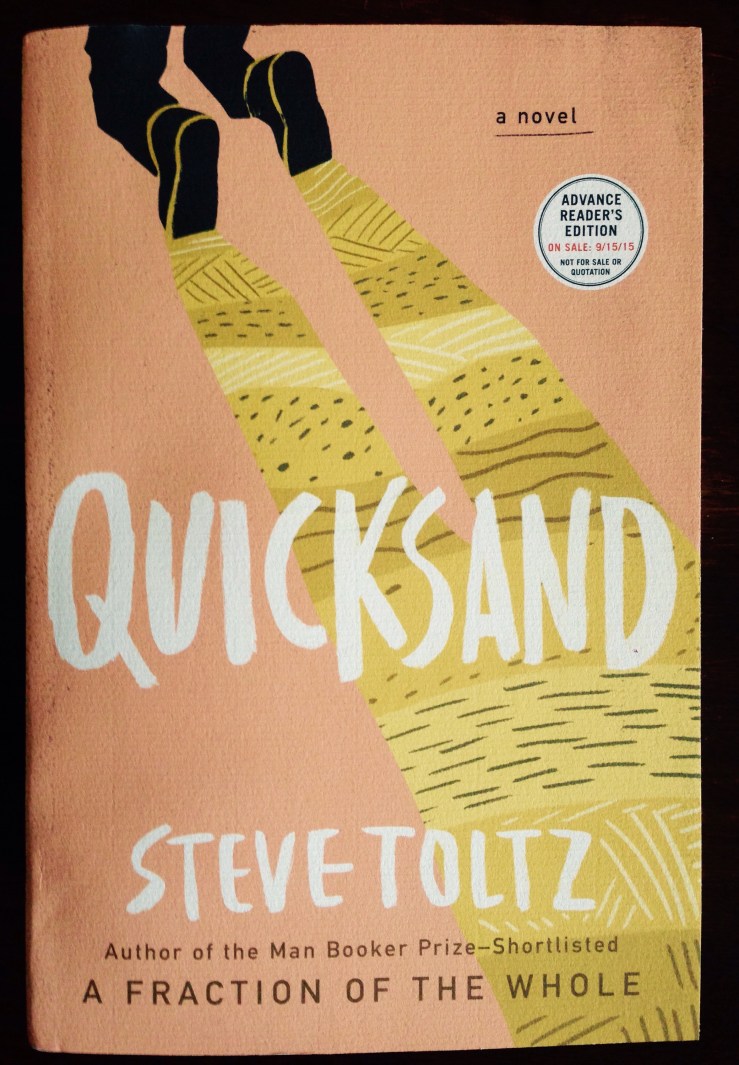
Quicksand (Book acquired, 8.10.2015 + bonus Bowie)

IMG_7939

Steve Toltz’s Quicksand is new in the States from Simon & Schuster. Their blurb:

A daring, brilliant new novel from Man Booker Prize finalist Steve Toltz, for fans of Dave Eggers, Martin Amis, and David Foster Wallace: a fearlessly funny, outrageously inventive dark comedy about two lifelong friends.

Liam is a struggling writer and a failing cop. Aldo, his best friend and muse, is a haplessly criminal entrepreneur with an uncanny knack for disaster. As Aldo’s luck worsens, Liam is inspired to base his next book on his best friend’s exponential misfortunes and hopeless quest to win back his one great love: his ex-wife, Stella. What begins as an attempt to make sense of Aldo’s mishaps spirals into a profound story of faith and friendship.

With the same originality and buoyancy that catapulted his first novel, A Fraction of the Whole, onto prize lists around the world—including shortlists for the Man Booker Prize and the Guardian First Book Award—Steve Toltz has created a rousing, hysterically funny but unapologetically dark satire about fate, faith, friendship, and the artist’s obligation to his muse. Sharp, witty, kinetic, and utterly engrossing, Quicksand is a subversive portrait of twenty-first-century society in all its hypocrisy and absurdity.

Bonus “Quicksand”—

Green Interior — Edouard Vuillard

“It Is Necessary to Travel…” — William Burroughs

IMG_7934

From The Adding Machine.

Surprise (Wittgenstein)

Screenshot 2015-08-11 at 9

From Culture and Value.

Demonic images from the Compendium rarissimum totius Artis Magicae sistematisatae per celeberrimos Artis hujus Magistros. Anno 1057. Noli me tangere

L0076385 A compendium about demons and magic. MS 1766.

Water color images from Compendium rarissimum totius Artis Magicae sistematisatae per celeberrimos Artis hujus Magistros. Anno 1057. Noli me tangere, which, despite that claim to 1057, was probably produced in the late 18th century. See the whole book at Wellcome Library. Via Idea Fixa. 

L0076362 Illustration of Beelzebub, MS 1766

Continue reading “Demonic images from the Compendium rarissimum totius Artis Magicae sistematisatae per celeberrimos Artis hujus Magistros. Anno 1057. Noli me tangere”

Opening of the Picasso Retrospective at the Tate Gallery, 1960 — Burt Glinn

The Powder of Sympathy

“The Powder of Sympathy”

from

THE SEVEN FOLLIES
OF SCIENCE

A
POPULAR ACCOUNT OF THE MOST FAMOUS
SCIENTIFIC IMPOSSIBILITIES
AND THE ATTEMPTS WHICH HAVE BEEN MADE TO SOLVE THEM.

To which is Added a Small Budget of Interesting
Paradoxes, Illusions, and Marvels.

BY
JOHN PHIN


This curious occult method of curing wounds is indissolubly associated with the name of Sir Kenelm Digby (born 1603, died 1665), though it was undoubtedly in use long before his time. He himself tells us that he learned to make and apply the drug from a Carmelite, who had traveled in the east, and whom he met in Florence, in 1622. The descendants of Digby are still prominent in England, and O. W. Holmes, in his “One Hundred Days in Europe,” tells us that he had met a Sir Kenelm Digby, a descendant of the famous Sir Kenelm of the seventeenth century, and that he could hardly refrain from asking him if he had any of his ancestor’s famous powder in his pocket.

Digby was a student of chemistry, or at least of the chemistry of those days, and wrote books of Recipes and the making of “Methington [metheglin or mead?] Syder, etc.” He was, as we have seen in the previous article, a believer in palingenesy and made experiments with a view to substantiate that strange doctrine. Evelyn calls him an “errant quack,” and he may have been given to quackery, but then the loose scientific ideas of those days allowed a wide range in drawing conclusions which, though they seem absurd to us, may have appeared to be quite reasonable to the men of that time.

From his book on the subject,we learn that the wound was never to be brought into contact with the powder. A bandage was to be taken from the wound, immersed in the powder, and kept there until the wound healed.

This beats the absent treatment of Christian Science!

The powder was simply pulverized vitriol, that is, ferric sulphate, or sulphate of iron. Continue reading “The Powder of Sympathy”

St. John Devouring the Book from the Apocalypse — Albrecht Durer

Video for Joanna Newsom’s “Sapokanikan” (directed by Paul Thomas Anderson)

The Search for Truth — Rene Magritte

Is it true that Nabokov called Hemingway and Conrad “writers of books for boys”?

IMG_7929

From a 1964 Playboy interview. Republished in Strong Opinions.

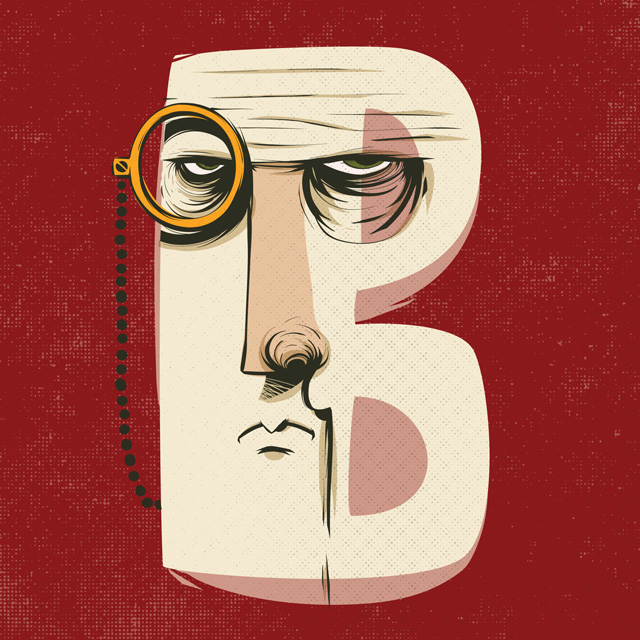
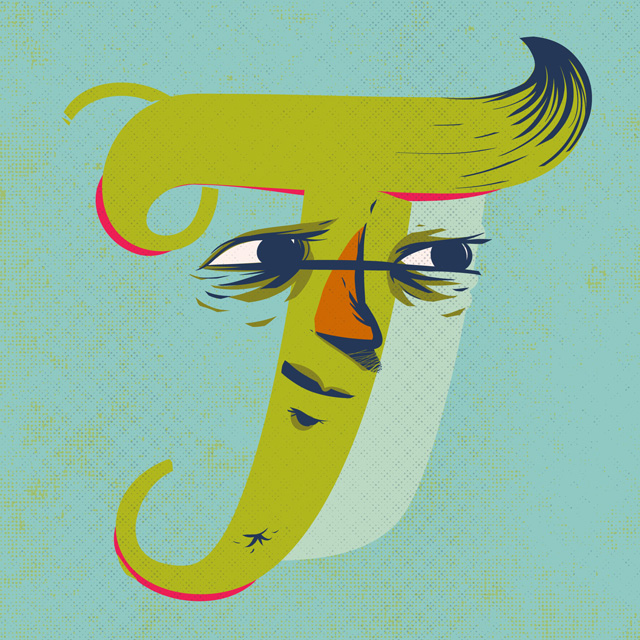
Letter Faces by Caio Beltrão

I love Caio Beltrão’s charming “Letters and Numbers Faces” series.

BibLINeonMob_LetterFaces_O_NeonMob_LetterFaces_K_lNeonMob_LetterFaces_E_NeonMob_LetterFaces_pNeonMob_LetterFaces_T_ 

New American Stories, a collection edited by Ben Marcus (Book acquired, 8.04.2015)

IMG_7908

New American Stories is an anthology out now in enormous paperback from Vintage. The collection was collected by collector Ben Marcus. An excerpt from his introduction:

Language is a drug, but a short story cannot be smoked. You can’t inject it. Stories don’t come bottled as a cream. You cannot have a story massaged into you by a bearish old man. You have to stare down a story until it wobbles, yields, then catapults into your face. And yet, as squirrely as they are to capture, stories are the ideal deranger. If they are well made, and you submit to them, they go in clean. Stories deliver their chemical disruption without the ashy hangover, the blacking out, the poison. They trigger pleasure, fear, fascination, love, confusion, desire, repulsion. Drugs get flushed from our systems, but not the best stories. Once they take hold, you couldn’t scrape them out with a knife. While working on this book, I started to think of a it as a medicine chest, filled with beguiling, volatile material, designed by the most gifted technicians. The potent story writers, to me, are the ones who deploy language as a kind of contraband, pumping it into us until we collapse on the floor, writhing, overwhelmed with feeling.

You actually can smoke a short story, but to do so is inadvisable.

I’ll be riffing on the book over the next few weeks with our Correspondent in Colorado, Mr. Ryan Chang.

Here’s the tracklist:

Said Sayrafiezadeh, Paranoia

Rebecca Lee,  Slatland

Jesse Ball, The Early Deaths of Lubeck, Brennan, Harp, and Carr

Deborah Eisenberg, Some Other, Better Otto

Anthony Doerr, The Deep

Yiyun Li, A Man Like Him

George Saunders, Home

NoViolet Bulawayo, Shhh

Maureen McHugh, Special Economics

Sam Lipsyte, This Appointment Occurs in the Past

Lydia Davis, Men

Donald Antrim, Another Manhattan

Zadie Smith*, Meet the President!

Denis Johnson, The Largesse of the Sea Maiden

Joy Williams, The Country

Christine Schutt, A Happy Rural Seat of Various View Lucinda’s Garden

Don DeLillo, Hammer and Sickle

Mathias Svalina, Play

Lucy Corin, Madmen

Mary Gaitskill, The Arms and Legs of the Lake

Wells Tower, Raw Water

Rachel Glaser, Pee on Water

Tao Lin, Love is a Thing on Sale for More Money than There Exists

Rebecca Curtis, The Toast

Robert Coover, Going for a Beer

Charles Yu, Standard Loneliness Package

Deb Olin Unferth, Wait Till You See Me Dance

Kyle Coma-Thompson, The Lucky Body

Rivka Galchen, The Lost Order

Donald Ray Pollack, Fish Sticks

Kelly Link, Valley of the Girls

Claire Vaye Watkins, The Diggings

*Isn’t she English? I guess it’s the stories that are American.