

Art is not ideology (Alain Badiou)

IMG_3586

Vittoria Colonna from Barcelona — Sebastiano del Piombo

“All art constantly aspires towards the condition of music”

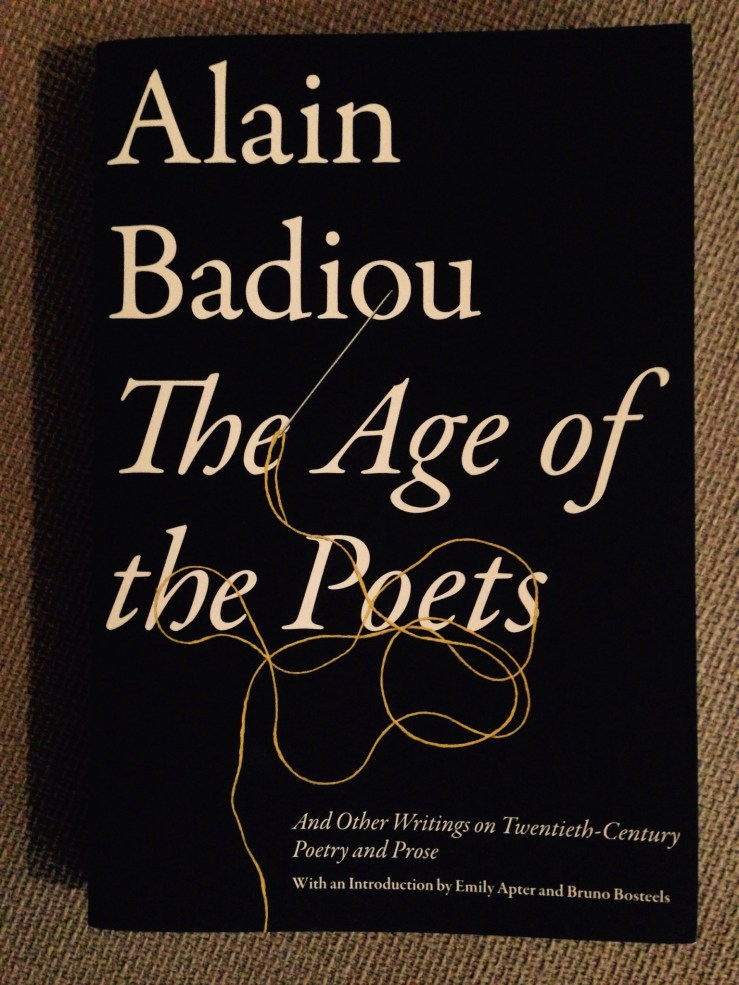
New Alain Badiou — The Age of the Poets (Book Acquired, 10.10.2014)

IMG_3585

New from Verso Books, a collection of writings from philosopher Alain Badiou. Verso’s blurb:

The Age of the Poets revisits the age-old problem of the relation between literature and philosophy, arguing against both Plato and Heidegger’s famous arguments. Philosophy neither has to ban the poets from the republic nor abdicate its own powers to the sole benefit of poetry or art. Instead, it must declare the end of what Badiou names the “age of the poets,” which stretches from Hölderlin to Celan. Drawing on ideas from his first publication on the subject, “The Autonomy of the Aesthetic Process,” Badiou offers an illuminating set of readings of contemporary French prose writers, giving us fascinating insights into the theory of the novel while also accounting for the specific position of literature between science and ideology.

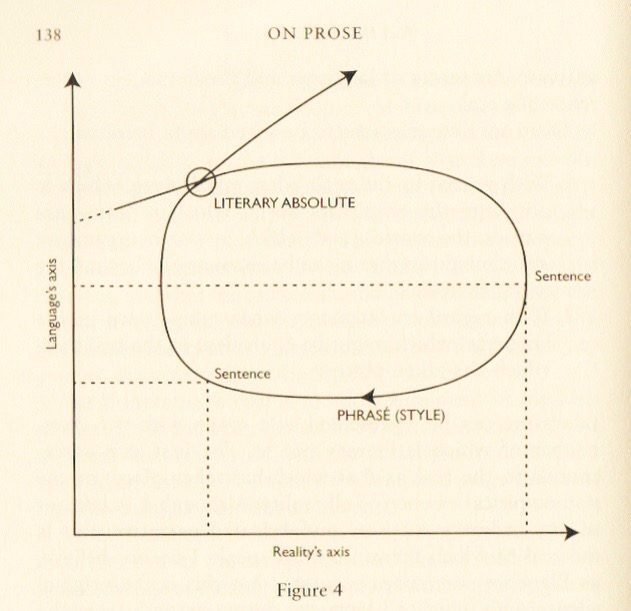
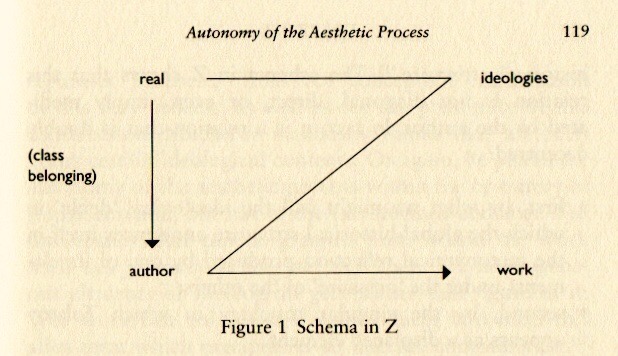
More to come—but for now: Diagrams! (I will try to understand them in context):

IMG_3588 IMG_3587

Danse Macabre — William Strang

YHVBGDnuUVI

Our books (Edgar Allan Poe)

Our books—the books which, for years, had formed no small portion of the mental existence of the invalid—were, as might be supposed, in strict keeping with this character of phantasm. We pored together over such works as the “Ververt et Chartreuse” of Gresset; the “Belphegor” of Machiavelli; the “Heaven and Hell” of Swedenborg; the “Subterranean Voyage of Nicholas Klimm” by Holberg; the “Chiromancy” of Robert Flud, of Jean D’Indaginé, and of De la Chambre; the “Journey into the Blue Distance” of Tieck; and the “City of the Sun” of Campanella. One favorite volume was a small octavo edition of the “Directorium Inquisitorium,” by the Dominican Eymeric de Gironne; and there were passages in Pomponius Mela, about the old African Satyrs and Œgipans, over which Usher would sit dreaming for hours. His chief delight, however, was found in the perusal of an exceedingly rare and curious book in quarto Gothic—the manual of a forgotten church—the Vigiliæ Mortuorum Secundum Chorum Ecclesiæ Maguntinæ.

From “The Fall of the House of Usher” by Edgar Allan Poe.

Meditation — Jean Léon Bazile Perrault

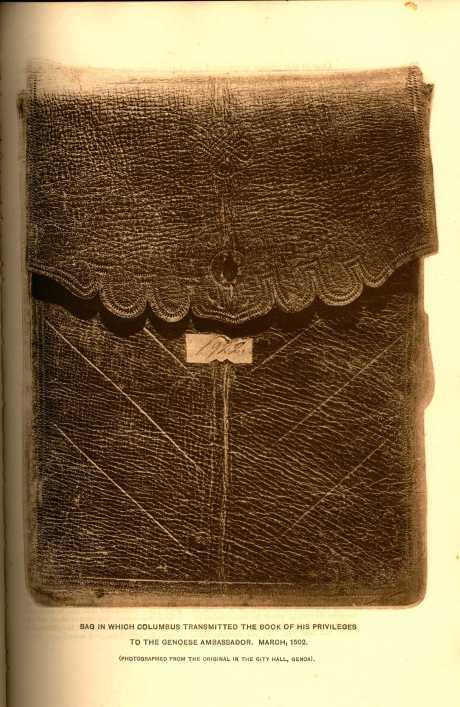
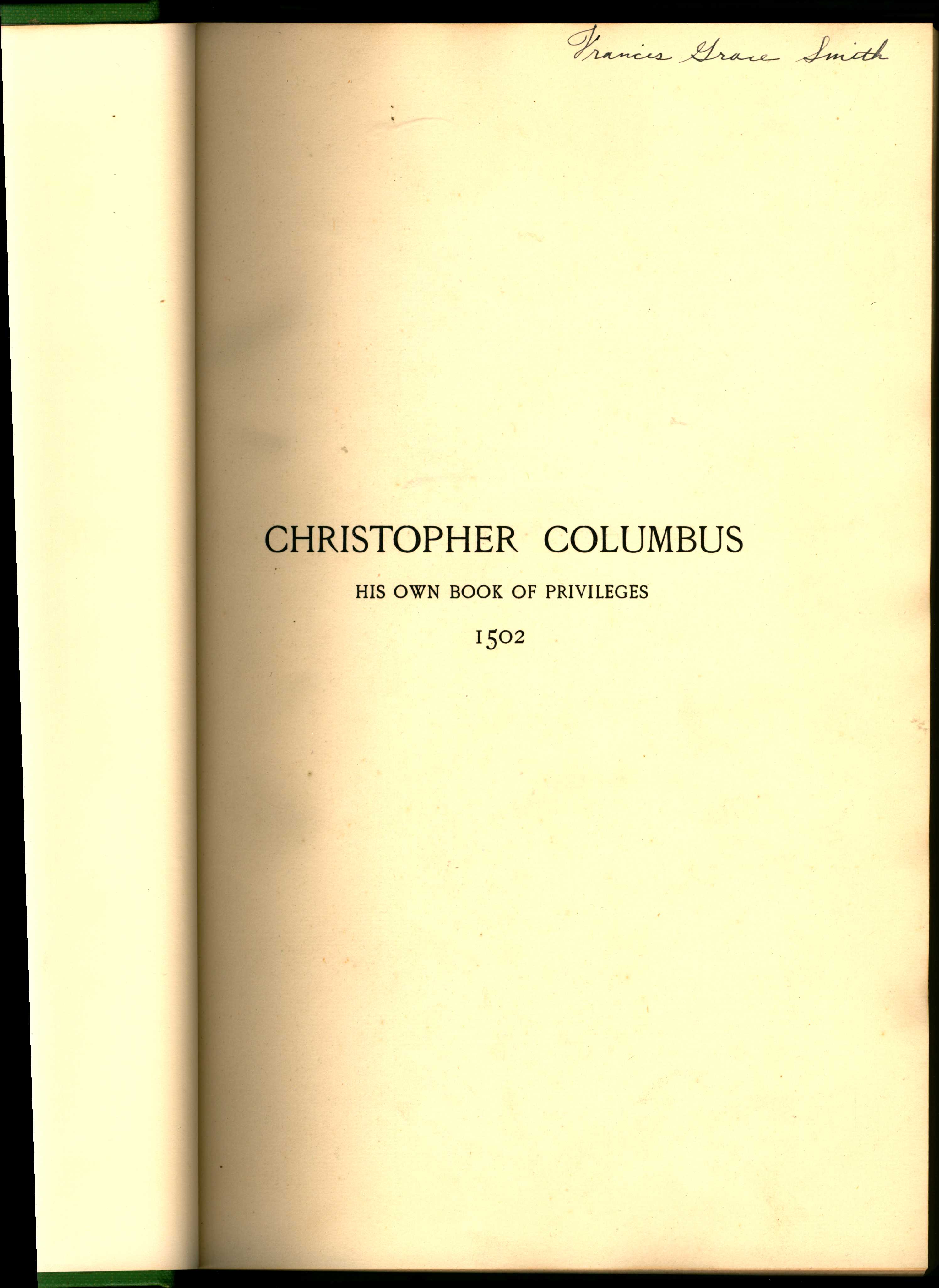
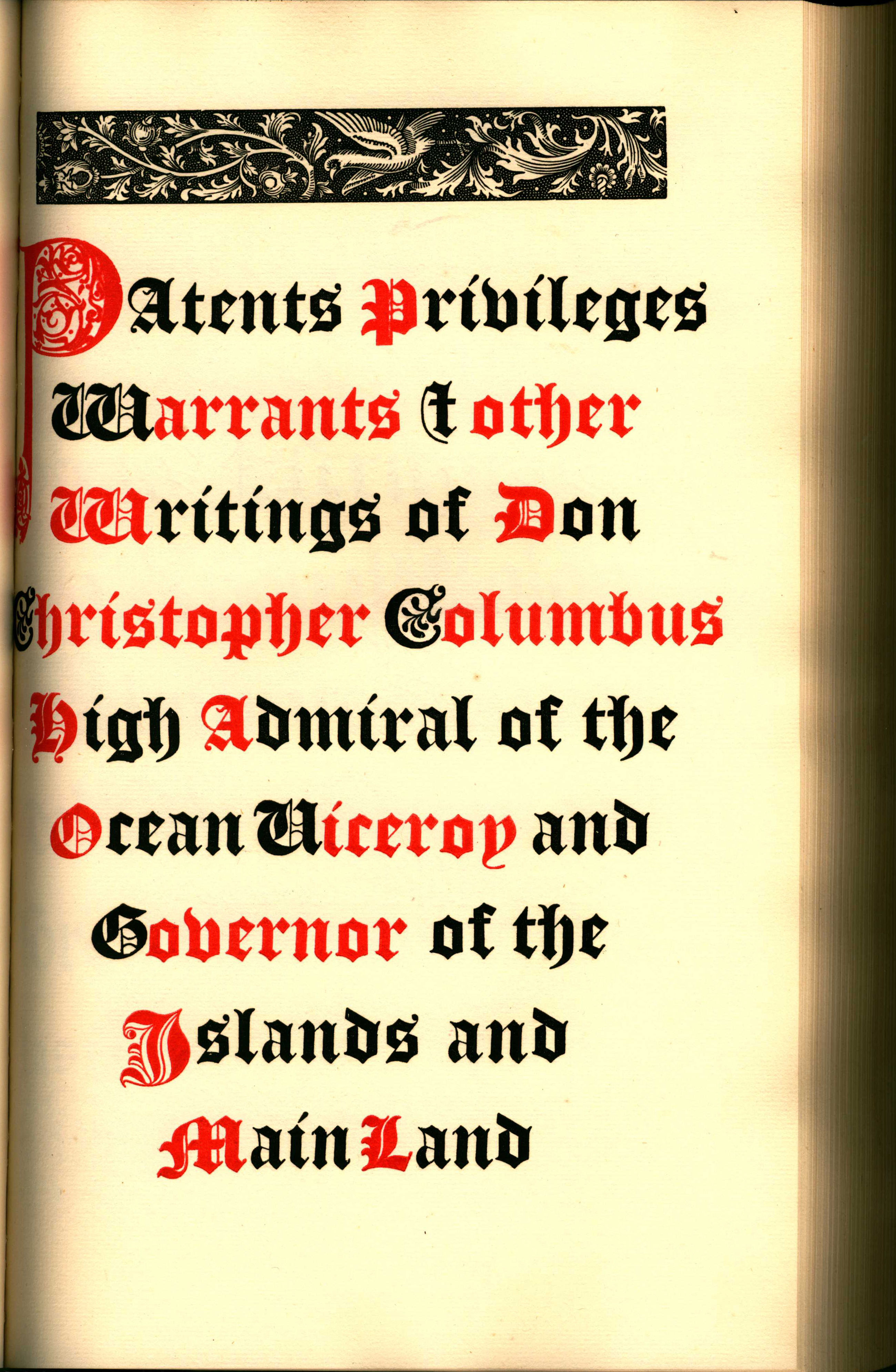
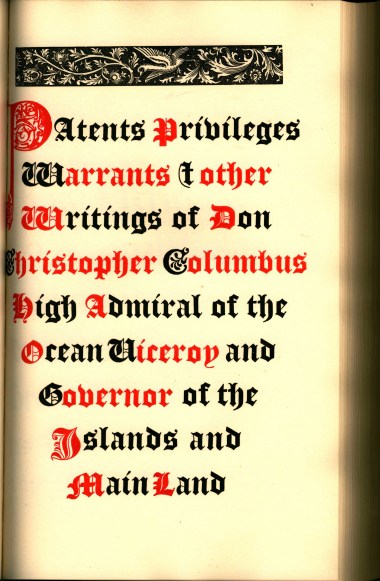
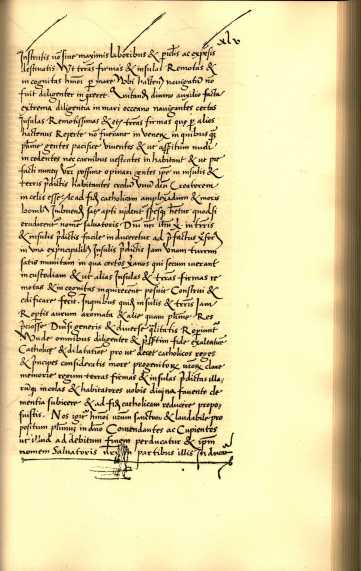
Christopher Columbus, His Own (Oversize) Book of Privileges, 1502

BookOfPrivileges

columbus7

Columbus2

columbus3columbus6

Papal decree granting Castile sovereignty over the Indies
Rome, June 1493
Translated by Helen Nader, 1996. Alternative translations [in brackets] by George F. Barwick, 1893.

(1) In the name of God, amen. This is a transcript well and faithfully copied from a document written on parchment [written on parchment of skin] in the Latin language, embossed with a red [coloured] wax seal, placed in a wooden box, tied with a green silk ribbon, and apparently certified and signed by a certain papal notary, the content of which, word for word, is as follows.

(5) Among other works well pleasing to the Divine Majesty and dear to [desired of] our heart, this assuredly ranks highest, that in our times especially the Catholic faith and the Christian religion be exalted and everywhere increased and spread, that the health of souls be cared for, and that barbarous nations be overthrown [subdued] and brought to the true faith. Since we have been called to this holy chair of Peter by the favor of divine clemency, although of unequal merits, recognize that, as true Catholic kings and princes, such as we have known you always to be, and as your illustrious deeds now known to nearly the whole world declare, you not only eagerly desire but with every effort, zeal, and diligence are laboring to that same end, disregarding hardship, expense, danger, and even the shedding of your blood… We therefore are rightly persuaded and consider it our duty, of our own accord and applauded by others, to grant you those things by which, with daily effort, you may be more heartily enabled to carry forward your holy and praiseworthy purpose pleasing to immortal God, for the honor of God himself and the spread of the Christian rule.

(6) You chose our beloved son, Christopher Columbus, a man assuredly worthy and of the highest recommendations and qualified [well suited] for so great an undertaking.

(7) Columbus and his men, with divine aid and with the utmost diligence sailing in the sea, discovered certain very remote islands and even continents that hitherto had not been discovered by others. A great many peoples reside there, living in peace, and, it is reported, going unclothed, and not eating meat [going naked, and not feeding upon flesh]. Moreover, as your envoys think that these same peoples living on those islands and mainland believe there to be one God, the Creator in heaven, and seem sufficiently disposed to embrace the Catholic faith and be trained in good morals, it is hoped that, were they instructed, the name of the Savior, our Lord Jesus Christ, would easily be introduced to these continents and islands.

(8) To that end, on one of the principal islands, Christopher has already caused a well equipped fortress [tower] to be established and built.

BookScanCenter (6)columbus4

(11) We command you, in virtue of holy obedience, to employ all due diligence, just as we also promise. We do not doubt that for the sake of your utmost devotion and royal greatness of soul you will appoint worthy, God-fearing, learned, skilled, and experienced men to these continents and islands to instruct their inhabitants and residents [natives] in the Catholic faith and train them in [imbue them with] good morals [using all due diligence in the premises].

(13) Let no man infringe or with rash boldness contravene this our commendation, exhortation, requisition, gift [donation], grant [concession], assignation, ordinance [constitution], deputation, decree, mandate, prohibition [inhibition], and will. Should anyone presume to attempt this, he is informed that he will incur the wrath of Almighty God and of his blessed apostles Peter and Paul.

(14) Given at Rome, at St. Peter’s, in the year of the incarnation of our Lord one thousand four hundred and ninety-three on the fourth of May in the first year of our pontificate.

(15) Gratis by order of our Most Holy Lord, the Pope.

(17) We have ordered these letters be copied, transcribed, and rendered public, deciding and wishing [decreeing and willing] that thereafter full credence be shown to this public transcript or copy in each and all places opportune [shall henceforth obtain full credence everywhere, in all and singular places, in which it shall be required], and that this transcript itself engender confidence and be explained as if the original letters themselves were to appear, be brought forth, and presented.

columbusbook
Note on the translation
by Helen Nader
“I confronted what at first seemed insoluble problems of legal prose style and vocabulary. Help came from the guidelines of the legal profession itself. Most of the documents in this volume were written in the jargon-laden and repetitive prose of any legislation or executive orders drafted by bureaucrats. Little would have been gained by transforming such Spanish into the equally tortured English prose of modern lawyers … In trying to find modern vocabulary of archaic expressions without going to the other extreme of erasing their legal implications, I have been guided by modern Spanish-English legal dictionaries.”

Columbus1

Joan of Arc — Jules Bastien-Lepage

An Excerpt from Thomas Bernhard’s “Concrete”

At last we found ourselves standing in front of one of the thousands of square marble plaques enclosed in concrete. On it was to be read, freshly incised, the name Isabella Fernandez. Anna Härdtl, with tears in her eyes, tried to fasten her husband’s photograph to the marble plaque, but was at first unable to do so. By chance I had in my pocket the end of a roll of adhesive tape and used this to stick the photograph to the marble. Anna had previous written the name of her husband, Hans Peter Härdtl, in pencil under that of Isabella Fernandez, and though partly obliterated by the rain, it could still be clearly read. Poor people, she said, or those who suddenly became victims of a misfortune such as she had suffered and could make themselves understood, were buried, when they died, the very same day in an above-ground concrete block like this, which is often meant not just for two, but for three bodies.

The Fall of the House of Usher (1928 Short Film)

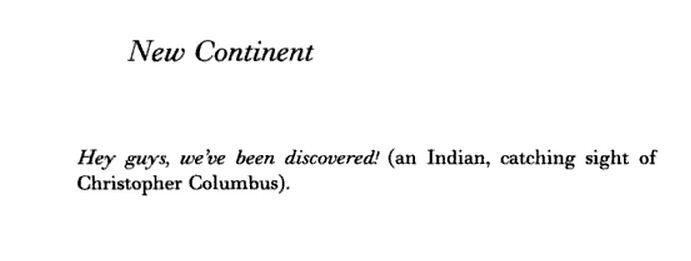
“New Continent” — Georges Perec

Ugolino Martelli — Agnolo Bronzino

I’ll see you again in 25 years

tumblr_m74xotr7Wj1rwnwnfo1_1280 tp

Adam purchases guitars (Only Lovers Left Alive)

An idiom characterizes a society (Flannery O’Connor)

An idiom characterizes a society, and when you ignore the idiom, you are very likely ignoring the whole social fabric that could make a meaningful character. You can’t cut characters off from their society and say much about them as individuals. You can’t say anything meaningful about the mystery of a personality unless you put that personality in a believable and significant social context. And the best way to do this is through the character’s own language. When the old lady in one of Andrew Lytle’s stories says contemptuously that she has a mule that is older than Birmingham, we get in that one sentence a sense of a society and its history. A great deal of the Southern writer’s work is done for him before he begins, because our history lives in our talk. In one of Eudora Welty’s stories a character says, ‘Where I come from, we use fox for yard dogs and owls for chickens, but we sing true.’ Now there is a whole book in that one sentence; and when the people of your section can talk like that, and you ignore it, you’re just not taking advantage of what`s yours. The sound of our talk is too definite to be discarded with impunity, and if the writer tries to get rid of it, he is liable to destroy the better part of his creative power.

From Flannery O’Connor’s lecture “Writing Short Stories.” Republished in Mystery and Manners.

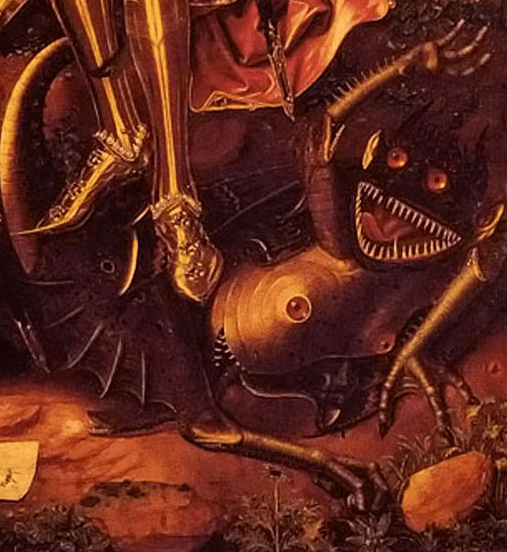
Saint Michael Triumphs over the Devil (Detail) — Bartolomé Bermejo

Capture