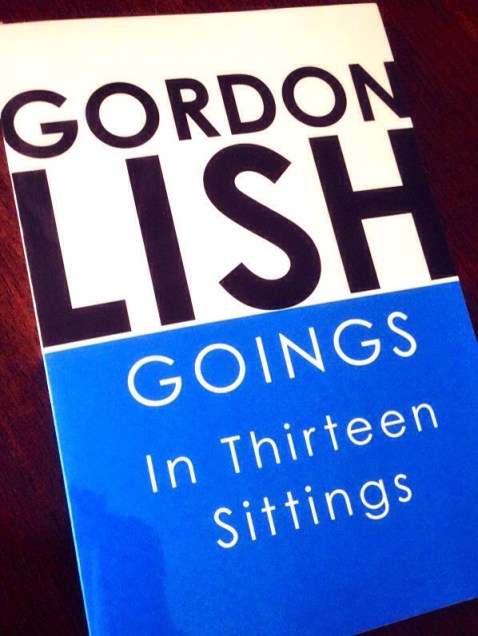
“Nothing but Trouble” | Gordon Lish’s New Collection Goings Plays with the Problems of Language

20140115-151646.jpg

Ostensibly a collection of fictional short stories, Gordon Lish’s Goings reads more like a memoir-in-fragments. All thirteen stories are told by a first-person narrator named Gordon, who parenthetically appends an exclamatory repetition of his name (“I, Gordon (Gordon!)”) throughout the work, a verbal tic that registers the tension between the author and narrator, memory and truth. All these stories are in some way about memory and truth—and language, always language. Some of the tales are heavier on plot than others, although “heavier” is hardly the right modifier—let’s be honest—the plots here are thin, almost nonexistent: gestures, images, feelings—but that’s not why we read Gordon Lish, is it?

Opener “My Personal Memoir” sets the tone here, its title an honest ironic joke, I suppose. Old Gordon tells the story of young Gordon and his boyhood chums playing paddle-ball. A minor tragedy ensues. That’s pretty much the plot, but with Lish it’s really about the sentences, the memory behind the sentences, or maybe the inability of sentences to communicate the memories, or maybe just the failure of all of it—language, memory, truth—themes that carry through the collection in Lish’s (Lish’s!) often tortuous syntax.

In “Für Whom?”, Lish offers a sketch of his family, his boyhood piano lessons, his teacher, his competitive anxieties, his burgeoning lust:

Siblings, families—what else is there to say? Furthermore (I love that: the chance to flaunt it with echt balance), it was I whose fingers took up his arpeggios while his backside thrummed ever more thrummingly to a kind of low-register attunement to the propinquity of Miss Buggell’s same. Oh, the nearness of her ass (sirs, and madam, it was no rump, now was it?), all yearning angularities not infrequently settling itself within fractions of centimeters afar. I quote, of course. Yes, I, Gordon (Gordon!), aged seven, aged six, aged eight, hankered after that piano teacher as I have never since hankered after the person of a woman since.

In another strong story, “For My Mother, Reg, Dead in America,” Lish returns again to his parents, weaving them into a strange half-rant that moves from rutabagas to spelling to Kierkegaard to Grace Paley to lettuce. Like most of these stories, “For My Mother” is obsessed with its own telling (and the conditions that might authorize its telling). Its narrator tells us:

I don’t know. I don’t look anything up in any fucking dictionary. Who’s writing this? I’m writing this. The dictionary is not in any goddamn charge of this act of expression, or of this, if you please, scription. Even me, even I, even the author of this is barely in charge of it. Or of anything else. And you know why? Would you like to know fucking why? Because he does not fucking want to be—is that answership enough for you. Make sure you have mastered the spelling of your father’s name of of your mother’s name. Never refer to your mother as “Mom.” Never use the word “reference” as a verb. The same goes for “experience,” the word. Never start a sentence with the word “however.”

Lish’s narrator Gordon continues offering editorial advice, which I suppose we may take ironically or otherwise. In any case, the book is crammed with moments like these, little fits of our narrator’s (author’s?) doubt coupled with a commanding viewpoint on how language could, should, mean.

At least one (very funny) story, “Knowledge,” hangs entirely around Lish-as-editor—only this time, our Gordon isn’t cutting into Raymond Carver’s prose or tightening up some Barry Hannah. No, he’s tearing down a poorly-worded sign from a lamp post. Gordon (Gordon!), “for the decency of my community, for its bloody battered decency,” tears it down. The sign? — “WE ARE LOOKING FOR INFORMATION ABOUT THE MOTORCYCLE ACCIDENT THAT OCCURED THIS PAST SUNDAY IN THIS AREA. WE HIS FAMILY AND FRIENDS WANT TO FIND OUT WHAT HAPPENED.” There’s a story in there too, in that sign, but our narrator’s not interested in any human characters that the sign’s written characters, letters, might try to represent. The brilliance of the story: Lish leaves it to the reader to suss out the gap between the meaning of the sign—the information that it communicates—and the narrator’s critique of how that sign communicates.

“Avant La Lettre” offers another literary space for gaps to evince between reader, narrator, and author. Our narrator Gordon (Gordon!) tells us at the outset: “The title, pay it no mind. It does not apply. It does not appertain,” suggesting that he doesn’t even know what the phrase means, that it just came to him as he “sat down to tell you about a mystery (the vanishing of the man on the corner).” The immediate denial of a link between the meaning of the story’s title and the story’s content isutterly disingenuous, a clue really to the mystery here (more of a non-mystery, an anecdote at best). Lish pokes fun at the denial by repeatedly referencing literary theorists throughout the story: “(tell Barthes, tell Derrida, tell Badiou)” and then “Well name it and (tell Schopenhauer, tell Schelling, tell Spinoza or Freud) it dies.” The punch line to the story is too good to spoil here, but it can’t hurt to share part of the set-up. Lish writes (or Gordon (Gordon!) says):

Where’s in me anymore (in Gordon, in Gordon!) the discipline for the creation of the succession of elaborations, for the concatenation of the falsifications, for the accruing of the exhausting collocations?

I’m sad….Writing’s not the god of me.

Is writing not the god of you, speaker? And what is “Avant La Lettre” but a succession of elaborations, a concatenation of falsifications, an accrual of collocations?

“Avant La Lettre” admittedly requires from its reader a certain comfort with (or at least understanding of) postmodern literary theory; this is a story that casually (and of course not casually) references Alphonso Lingis and Julia Kristeva.

Other material here is less obscure (and more subtle) in its treatment of theory. “In the District, Into the Bargain” uses a chance meeting between widower Gordon and a widowed acquaintance to restage the central paradox of Rene Magritte’s painting The Treachery of Images (you know: “This is not a pipe”).  There’s also the oblique feminism of “Women Passing: O Mysterium!” and the semiotic play of “Troth.” This is all great stuff, or maybe not. I mean I loved it, lapped it up, but I’m the audience for this. I’m Lish’s (Gordon’s!) reader, the reader he addresses so directly in closer “Afterword.” Only I’m not—because “Afterword” is so clearly written to, spoken to Lish himself.

This literary solipsism, onanism, pick-your-ism is so not for everyone. Lish is a cult writer, and his performance here is appropriate to any aging (aged!) cult leader, one who’s painfully aware of how easy it is to point out a naked charlatan. The structure of Goings is something like I-see-you-seeing-me-seeing-myself-try-to-see-myself-etc. But the book is very funny, often painful, and downright moving at times, like in “Gnat,” where Lish shares a simple memory of trying on a new shirt for his wife, or the terror of “Speakage,” a two-page dialogue between young Gordon and his mother that begins “What is it, die?” The stories here are real—obscure, sure, difficult, yes, but also emotional, rewarding.

Goings In Thirteen Sittings is not the best starting place for anyone interested in Lish’s prose. This new book continues a project that will feel familiar to those who’ve read Self-Imitation of My Self, Epigraph, and My Romance, books that many critics felt were too insular, too inscrutable. New readers might do better to start with Mourner at the Door (although you can’t really lose in picking up Collected Fictions, which collects that book among others). I also highly recommend the Iambik recording of Lish reading selections from Collected Fictions. Hearing his intonation and rhythm totally changed how I read his prose, enriched my understanding of what he was doing and how he was doing it.

But the book accomplishes what it sets out to do, delivering on its two epigraphs. The second, ascribed to “Anon.” (another joke on Lish’s part, I think): “Mother! Father! Please!” The first is from a literary critic, but in its phrasing on the page it looks like a poem. In any case, it’s a fitting summary for Goings:

20140406-123125.jpg

Goings In Thirteen Sittings is available now from OR Books.

Blood Wedding — Richard Pousette-Dart

“Vermin is the rule everywhere in the world” (Schopenhauer)

No greater mistake can be made than to imagine that what has been written latest is always the more correct; that what is written later on is an improvement on what was written previously; and that every change means progress. Men who think and have correct judgment, and people who treat their subject earnestly, are all exceptions only. Vermin is the rule everywhere in the world: it is always at hand and busily engaged in trying to improve in its own way upon the mature deliberations of the thinkers. So that if a man wishes to improve himself in any subject he must guard against immediately seizing the newest books written upon it, in the assumption that science is always advancing and that the older books have been made use of in the compiling of the new. They have, it is true, been used; but how? The writer often does not thoroughly understand the old books; he will, at the same time, not use their exact words, so that the result is he spoils and bungles what has been said in a much better and clearer way by the old writers; since they wrote from their own lively knowledge of the subject. He often leaves out the best things they have written, their most striking elucidations of the matter, their happiest remarks, because he does not recognise their value or feel how pregnant they are. It is only what is stupid and shallow that appeals to him. An old and excellent book is frequently shelved for new and bad ones; which, written for the sake of money, wear a pretentious air and are much eulogised by the authors’ friends. In science, a man who wishes to distinguish himself brings something new to market; this frequently consists in his denouncing some principle that has been previously held as correct, so that he may establish a wrong one of his own. Sometimes his attempt is successful for a short time, when a return is made to the old and correct doctrine. These innovators are serious about nothing else in the world than their own priceless person, and it is this that they wish to make its mark. They bring this quickly about by beginning a paradox; the sterility of their own heads suggests their taking the path of negation; and truths that have long been recognised are now denied—for instance, the vital power, the sympathetic nervous system,generatio equivoca, Bichat’s distinction between the working of the passions and the working of intelligence, or they return to crass atomism, etc., etc. Hence the course of science is often retrogressive.

From Essays of Schopenhauer, translated by Rudolf Dircks.

Sunday Reading at a Country School — Nikolay Bogdanov-Belsky

Champagne — Jim Jarmusch

“Remembering The Tales of Hoffmann” — Robert Walser

“Remembering The Tales of Hoffmann”

by Robert Walser

I was living in the tranquility of rural, provincial isolation, in the flat countryside where fields and forests lie about motionless and mute, the plains and plots of land appear endless, broad wide regions often prove to be only narrow strips, and vast estates slumber peacefully one beside the other.

Brown, yellow, red autumnal foliage, fog that mysteriously wrapped the wintry earth in veils; large, wet, fat snowflakes tumbling down into a morning-dark courtyard, a white park covered in snow, a winter village with village lads and village women and geese in the village street—all this I had seen.

I’d seen a poor, sick, unhappy day laborer forgotten by all the world, lying in her squalid bed of sufferings; I heard her sighs.

Forests, hills, plains silent and wordless in the dull hush of the gleaming winter sun. Here and there a solitary person, an insignificant little word, an isolated sound.

One day I left all this remoteness and all this silence behind and set off for the seductive gleam of the capital, where soon thereafter I saw The Tales of Hoffmann at the Komische Oper.

I felt like an astonished hayseed amid all that gleaming intoxication, the graceful, sense-beguiling tumultuousness and the blindingly elegant society gathered there.

But when the interior of the grand edifice became as silent as a tiny chamber filled with reveries and fancies of the soul, as the might and art of sound opened their divine mouths and began to sing, ring out, and resound, beginning with the overture that wheedled its way into all our souls with its bright and dark, gay and earnest melodies, only to entwine them—now constricting, now liberating from constriction—with heavenly bliss, and then soft warm song burst from the lips of the singers and songstresses, images brimming with delicate, noble, magical colors and magical figures lightly and gaily emerged to delight the eye and taste, music and painting most beautifully took possession of every heart, eye, and ear, and everything became suddenly quiet as a mouse, only to resound once more as if it wished never to stop so beautifully resounding and conquering its listeners with its desired, delightful force: pain and sounds of joy mirroring the adventure of existence, exemplifying the meaning of life, and soaring up and down the scales like angelic figures ascending and descending Jacob’s ladder!

Oh, everything was so regally beautiful and luxurious all about our tear-filled, feverish eyes and in our hearts. All of life could now cease outright or else begin utterly anew.

What a presence to partake of! Thousands of hours flowed together to form this one single hour. Yes, what a beautiful, good, meaningful evening this was.

Susanna and the Elders — Artemisia Gentileschi

“Susie Asado” — Gertrude Stein

Capture

Cuore (Portrait of Edmundo d’Amicis) — Eduardo Arroyo

The Woodgatherer — Jules Bastien-Lepage

“My Appearance” — David Foster Wallace

I am a woman who appeared in public on Late Night with David Letterman on March 22, 1989.

In the words of my husband, Rudy, I am a woman whose face and attitudes are known to something over half of the measurable population of the United States, whose name is on lips and covers and screens. Whose heart’s heart is invisible to the world and unapproachably hidden. Which is what Rudy thought could save me from all this appearance implied.

The week of March 19, 1989, was the week David Letterman’s variety-and-talk show featured a series of taped skits on the private activities and pastimes of executives at NBC. My husband and I sacrificed sleep and stayed up late, watching. My husband, whose name in the entertainment industry is better known than his face, had claimed at first to be neutrally excited about the call I’d gotten from Late Night, though by the time he’d been driven home, he was beginning to worry that this particular public appearance could present problems. He knew and feared Letterman; he claimed to know that Letterman loved to savage female guests. It was on a Sunday that Rudy told me we would need to formulate strategies for my appearance on Late Night. March 22nd was to be a Wednesday.

Read the rest of David Foster Wallace’s short story “My Appearance.”

Literary Devices — Grant Snider

literarydevices-blog

Untitled (I Don’t Know Why) — Raymond Pettibon

resize__575__575__5__set_images__Pettibon_IDontKnow

“The Bad Novel” — Lydia Davis

the bad novel

Charles I Insulted by Cromwell’s Soldiers (Detail) — Paul Delaroche

List with No Name #45

  1. Walking down the street—a windy night, a blustery night, the last remnant of winter poking into new spring—walking with my family, I ran into my former cat. My wife coaxed him from the brick home five doors down the road, where he has lived for the last three years, or maybe habited is the word, browner, fatter than I remember him when I remember him. He ran up and bit me. I burst into tears.
  2. The time I called my parents, weaving home from the izakaya–It must be daytime, the supper hour, back at home in Florida, yes?—asking after my father, my brother, my grandmother, my childhood dog, how was she, her health, etc.? The lie in my mother’s voice. Stumbling in tears back to my tiny apartment. I missed the train.
  3. (I missed the train on purpose so that I could cry on the long walk home).
  4. On our bed, our old bed, a slimmish bed, tickling my wife, my fingers all over her beautiful young body, her laughter, shrieks, protest, delight. Our cat—our kitten—how he dashed in and bit me all over, viciously, striking like some other animal, like one might imagine a cobra or a weasel would strike. My hand, my arm, my shoulder. That I had a genuine wound there. Blood. My wife calming him, explaining him. Sweethearts.
  5. When my mother brought home the dog, a border collie, a beautiful black and white border collie—no, her name, I can’t share that, I can’t—me, twelve, furious, trembling even, walking into the neighbors’ yard, away, the dog, her, she, the dog in our garage, my younger brother petting her, my father suspicious, but me—Why so angry?
  6. I loved the dog. So much. She was the best.
  7. A few years ago, finding a picture of my dog, a puppy still, wet, in a bathtub of a house I lived in twice, finding the picture in the pages of a book, handing it to my daughter, who asked after the dog, her condition, name, whereabouts, etc., concerned, an edge or shade of protocol in her voice.
  8. That picture now tacked to my daughter’s wall on a corkboard reserved for such tackings.
  9. The cat—how he jumped into my daughter’s crib, curled about her. How it frightened us.
  10. He was never the same after the daughter, or we were never the same, an understatement, an obvious, obvious understatement, of course.
  11. He went to wander a bit, stroll in the world; he failed to return at nights. He took up with an orange tabby, a dusty bland beast my wife dubbed Pearly.
  12. A ridiculous name for a cat.
  13. And then I took to feeding them both. On the porch.
  14. There were other dogs after the dog I loved. A chow, a beagle that couldn’t keep up. What happened to them?
  15. The cat took residency under the house. He refused to move in. He was some kind of scrapper now. We might see him of an evening, curled on the porch, nestled, maybe, with dust-orange Pearly.
  16. But he stopped coming in.
  17. What happened to my dog? The details? I don’t know. This is still a sore spot, but I seem to refuse to ask.
  18. (I suppose I enjoy a sore spot, a wound to worry).
  19. The cat did not like my daughter, I think, and when we had the son, well, I know he didn’t like that. He made it clear. But we subscribe to a fiction wherein the cat loved the children and the children loved the cat.
  20. My daughter has a sweet little framed photo of my cat. He is curled snugly (is there another way for a cat to curl?) in a little wicker basket atop a kitchen cabinet in our old home. My daughter insisted on keeping the photo when I went to throw it away.
  21. Every person, or most persons, that is, most folks—-most folks love their dogs and like their dogs and will say of a dog they like and love: He was a good dog. But my dog! My dog was a very good dog, a smart dog, a dog of impeccable training. My father, returning from years of work overseas to a few months of not working (overseas or otherwise)—my father he trained the beast. It was his project.
  22. (I say, I write, My dog, knowing goddamn well that that dog was my father’s dog).
  23. Returning home from a week in the Smoky Mountains, unable to locate my cat. A miasma about the backporch. Flies, that dead-animal smell that permeates the nostrils, the brain. Finding a raccoon corpse under the house, its body bloated but whole, vile, large and swollen. Discarding it in a series of trash bags.
  24. Its fur was the same color as my cat’s fur.
  25. The strange joy when my cat arrived two days later, his feet trotting down the pavement, sauntering even, arriving on the porch indifferent to my delight but hungry.
  26. That he had taken up first with a possum, and then a raccoon.
  27. The first time I suspected the affair was when I heard the strange crunch of a new jaw crunching on my cat’s own food—a louder, drier crunch. I enlarged myself, hollered, arms above head, chest-thrust, Hey raccoon—off the porch!
  28. But that furred trio just stared at me, knowing I’d go on feeding them as I had been, all Darwinian competition suspended by domestic tendencies, blinking in a series.
  29. How horrifying!
  30. And yet and still—my children, via the designs and tendencies of my wife and me—don’t they turn woodland creatures into anthropomorphic totems? Don’t they squeeze stuffed dolls? Draw and mold and paint forest friends? Make stories about such beasts?
  31. I can’t believe for a minute that the dog would’ve taken to such nocturnal company, nor would her sweet heart spurn my babies for night adventures.
  32. But who knows.
  33. My parents now live with an awful yapping terrier dog, his two rows of teeth set above his rotten beard, and above that mutant jaw, his eyes skewed, akimbo, their colors mismatched.
  34. There is a picture of my cat, or the cat that I am calling my cat who is so plainly now his own cat—there is a picture of that cat in the crib with my daughter. In the picture, both cat and daughter face the camera, the crib horizontal to the viewer, its vertical white bars framing the pair. The cat’s head intersects with the daughter’s head, occluding half her face from the viewer’s view.
  35. This picture horrified my daughter.
  36. (And perhaps signaled a sense of self, or, more importantly, or more significantly, or just plain more interestingly, the sense that there was a self that could be occluded, obstructed, obscured, incomplete).
  37. My wife and I, repeatedly testing our daughter’s reaction to the photo, varying times of day, situations, etc., in order to observe her reaction.
  38. (I almost used the verb gauge for observe but oh my that would be so dishonest, yes?).
  39. Anyway, it horrified this little girl, moved her to tears, gasping, this cat’s head blocking half of her head.
  40. With the dog I don’t know what happened, not really: She was old; her hips were bad, we had to put her down. There’s no image there, just the sound of my mother’s voice passing through some 7,000 miles, telling me that she—the dog—was dead. Or not to tell me, but rather to avoid telling me.
  41. But I do know what happened to the cat.
  42. Here’s what happened to the cat: We moved—not far—from a colorfullivelyurban neighborhood, to an old old suburb of that early urban plot. We moved.
  43. And he was an afterthought, the cat—with his roving, his adventures, he was hard to pin down, to catch in a carrier, a box. I’d tried to coax him and trap him and chase him over a few weeks, but in the thin interval between buying the new house and moving into the new house and selling the old house—well I couldn’t get him, grab him, hold him.
  44. Until I finally did. I engineered (the verb here is too kind) a trap of sorts, bating him with the food, constructing a perimeter, waiting. Pearly showed himself (he knew he was not wanted), but my cat was far slippier. But I waited. And I nabbed him: In a carrier purposed for cats and then into a big box and then into the back of my station wagon and then howling for five or six or seven minutes as we traveled, not far, but over a short, old bridge, into our new old neighborhood, his howling yelping shrieking raising my anxiety about the whole thing, his rustling fury palpable in acute waves from the rear of the car, my voice which could not even call him to me under the brightest of conditions in no way alleviating any of this and so yes of course the first thing I did when I got to the new old house was to open the hatchback, open the box, pull out the carrier, and try to grip the cat who yes of course sprang down (like a cat!) onto the unfamiliar concrete drive, hunting perhaps a crawlspace to crawl into, sensing none, none, none what to do what to do?
  45. And then he ran away.