- In Kyoto, in the hot summer rain, sweating in a poncho, fighting with my girlfriend in front of a golden temple.
- At 17, experiencing the most intense jealousy of my life, watching a classmate weep in front of The Pietà, thinking, feeling, Why can’t I feel that?
- On the way to work, sleepy, maybe a bit hungover, breaking down in tears at “Space Oddity,” concern for Major Tom, his family. Swearing off music in the early morning. News radio ever since.
- Religion is just a set of aesthetic possibilities, conditions, and experiences.
- In Cork, drinking beer on a roof in the summer sun, a wasp landed on my very eye.
- In the last year of college, writing and recording dozens of songs with friends, editing the songs into a cohesive thing, calling the thing an album, sharing it with friends, with never even once the intention of doing anything else with that music, with no dreams of anyone else hearing it, live or recorded. An album made entirely for ourselves.
- Listening to it a dozen years later, conceding that it was actually maybe very good.
- Vomiting in foreign cities.
- Wary of my own susceptibility to sentimentalism, to sentimentality, to my awful tendency to experience catharsis through a fast food commercial on television.
- Never able to feel transcendent peace in nature, despite Emerson, Thoreau, Dickinson, Whitman, etc.—because just at the moment that the affect of transcendent peace manifests (the verb is inadequate), my awareness of the affect and the process of the affect and my feeling of the feeling of the affect spoils it all.
- Crashing into a road sign on an off ramp, walking away from the wreck, lying down on the slanted concrete abutment in the shade of a roaring overpass, feeling the best feeling, unspoiled.
- My child born—that nothing was more original, real, terrifying, beautiful.
- In dreams, sometimes: A whole other life, full, brimming, rich, real. He who wakes me wounds me, I think Nietzsche wrote. Or was it Bernhard? Or am I imagining the phrase?
- Never not jealous of a hawk in flight.
- My mother falling asleep, I kept reading until I too fell asleep.
- Vomiting into the trashcan in my classroom.
- My brother, balling up wrapping paper, hurling at me. My explosive rage.
- The snakes, the rats, the roaches I’ve killed.
- Workshopping a story in class. How I hated everyone.
- Friends jumping on my bed the afternoon of my wedding. (How did they get in?). Vomiting in the bed.
- Reading a certain novel, its plot, its construction essentially destroying a hundred or more of my own pages, my own outline, my own idea.
- A Modigliani in the New Orleans Museum of Art: Her neck was everything I remembered of the visit.
- My electric guitar, literally rusty from salt air and disuse.
- Irony as an aesthetic experience—or a defense against aesthetic experience?
- Painting the same scene in watercolors, dozens of times, with my daughter—the loquat tree, the grass, the sky. Her paintings surpassed mine so quickly.
- The rat that scuttled over my feet by the river in Chiang Mai. My horror and laughter.
- Removing dead rats from a shed as an aesthetic experience.
- All experiences are aesthetic experiences.
- Does maturity necessitate that we turn down the volume on these aesthetic experiences? That we manage the affect? That we blunt the feeling of the feeling?
- Seeing The Pietà again at 27 and moved by the memory of the classmate’s aesthetic response a decade earlier.
- The tourists crowding out Mona Lisa, I shuffled into some other room full of heavy, dark, black paintings—Caravaggios?—the names didn’t matter, the authority didn’t matter, I was 15 I think, I relaxed, I could look, I was alone, or I felt alone, it was lovely.
- My office: Prints by Goya, Picasso, Tintoretto, Leonardo. A painting by my grandmother, a dog resting, a bird and a bone nearby. Students come by to look at the giant Bosch reproduction, which I wish were more giant, more real.
- At the Dali Museum. Shock at how small some of the paintings were.
- Is there an aesthetic experience outside of sharing?
- Endlessly copying figures from comic books.
- Photographing food and sharing it on social media as a kind of thanksgiving prayer.
- Seeing the Bacon collection at MoMA, feeling a feeling that I still don’t have a name for.
- Rising early on Saturday mornings to watch a show where a man (or was it a woman?) guided me (and others, I suppose) through the rudiments of sketching animals. My grandmother made me sausages.
- My daughter’s thorough indifference to a Dürer etching in our local museum I wanted her to see. Her pleading to go to the gardens to paint with watercolors, to paint the fountain, the flowers.
- Sometimes in my dreams I write something, or paint something, or create wonderful, strange music.
- At eleven years old, sitting for a friend’s mother, who painted my portrait in watercolor. She didn’t draft in pencil, she worked so quickly. I was jealous and grateful.
- One of the reasons I love the internet so much is that it allows me to look at paintings. But looking at a painting on a screen is not the same as looking at paintings in the real.
- As a teenager, attempting wax dripping paintings in the style of Pollock, starting small fires in my bedroom, covering the scorched carpet with books, clothes, my parents sometimes not discovering the marks for weeks. Trying to explain them, but unwilling to share the paintings.
- A wish for anything that disrupts the feeling of feeling the feeling.
Macbeth Consulting the Vision of the Armed Head — Henry Fuseli

“Proof Positive” — Graham Greene
“Proof Positive”
by
Graham Greene
The tired voice went on. It seemed to surmount enormous obstacles to speech. The man’s sick, Colonel Crashaw thought, with pity and irritation. When a young man he had climbed in the Himalayas, and he remembered bow at great heights several breaths had to be taken for every step advanced. The five-foot-high platform in the Music Rooms of The Spa seemed to entail for the speaker some of the same effort, he should never have come out on such a raw afternoon, thought Colonel Crashaw, pouring out a glass of water and pushing it across the lecturer’s table. The rooms were badly heated, and yellow fingers of winter fog fell for cracks in the many windows. There was little doubt that the speaker had lost all touch with his audience. It was scattered in patches about the hall – elderly ladies who made no attempt to hide their cruel boredom, and a few men, with the appearance of retired officers, who put a show of attention.
Colonel Crashaw, as president of the local Psychical Society, had received a note from the speaker a little more than a week before. Written by a hand which trembled with sickness, age or drunkenness, it asked urgently for a special meeting of the society. An extraordinary, a really impressive, experience was to be described while still fresh in the mind, thought what the experience had been was left vague. Colonel Crashaw would have hesitated to comply if the note had not been signed by a Major Philip Weaver, Indian Army, retired. One had to do what one could for a brother officer; the trembling of the hand must be either age or sickness.
It proved principally to be the latter when the two men met for the first time on the platform. Major Weaver was not more than sixty, tall, thin, and dark, with an ugly obstinate nose and, satire in his eye, the most unlikely person to experience anything unexplainable. What antagonised Crashaw most was that Weaver used scent; a white handkerchief which drooped from his breast pocket exhaled as rich and sweet an odour as a whole altar of lilies. Several ladies prinked their noses, and General Leadbitter asked loudly whether lie might smoke.
It was quite obvious that Weaver understood. He smiled provocatively and asked very slowly, “Would you mind not smoking? My throat has been bad for some time.” Crashaw murmured that it was terrible weather; influenza throats were common. The satirical eye came round to him and considered him thoughtfully, while Weaver said in a voice which carried halfway across the hall, “It’s cancer in my case.”
In the shocked vexed silence that followed the unnecessary intimacy he began to speak without waiting for any introduction from Crashaw. He seemed at first to be in a hurry. It was only later that the terrible impediments were placed in the way of his speech. He had a high voice, which sometimes broke into a squeal, and must have been peculiarly disagreeable on the parade ground. He paid a few compliments to the local society; his remarks were just sufficiently exaggerated to be irritating. He was glad, lie said, to give them the chance of hearing him; what he had to say might after their whole view of the relative values of matter and spirit.
Mystic stuff, thought Crashaw.
Weaver’s high voice began to shoot out hurried platitudes. The spirit, he said, was stronger than anyone realised; the physiological action of heart and brain and nerves were subordinate to the spirit. The spirit was everything. He said again, his voice squeaking up like bats into the ceiling, “The spirit is so much stronger than you think.” He put his hand across his throat and squinted sideways at the window-panes and the nuzzling fog, and upwards at the bare electric globe sizzling with heat and poor light in the dim afternoon. “It’s immortal,” he told them very seriously, and they shifted, restless, uncomfortable, and weary, in their chairs.
It was then that his voice grew tired and his speech impeded. The knowledge that he had entirely lost touch with his audience may have been the cause. An elderly lady at the back had taken her knitting from a bag, and her needles flashed along the walls when the light caught them, like a bright ironic spirit. Satire for a moment deserted Weaver’s eyes, and Crashaw saw the vacancy it left, as though the ball had turned to glass.
“This is important,” the lecturer cried to them. “I can tell you a story-” His audience’s attention was momentarily caught by this promise of something definite, but the stillness of the lady’s needles did not soothe him. He sneered at them all: “Signs and wonders,” he said.
Then he lost the thread of his speech altogether.
His hand passed to and fro across his throat and he quoted Shakespeare, and then St. Paul’s Epistle to the Galatians. His speech, as it grew slower, seemed to lose all logical order, though now and then Crashaw was surprised by the shrewdness in the juxtaposition of two irrelevant ideas. It was like the conversation of an old man which flits from subject to subject, the thread a subconscious one. “When I was a Simla,” he said, bending his brows as though to avoid the sunflash on the barrack square, but perhaps the frost, the fog, the tarnished room broke his memories. He began to assure the wearied faces all over again that the spirit did not die when the body died, but that the body only moved at the spirit’s will. One had to be obstinate, to grapple…
Pathetic, Crashaw thought, the sick man’s clinging to his belief. It was as if life were an only son who was dying and with whom he wished to preserve some form of communication…
A note was passed to Crashaw from the audience. It came from a Dr. Brown, a small alert man in the third row; the society cherished him as a kind of pet sceptic. The note read: “Can’t you make him stop? The man’s obviously very ill. And what good is his talk, anyway?”
Crashaw turned his eyes sideways and upwards and felt his pity vanish al sight of the roving satirical eyes that gave the lie to the tongue, and al the smell, over-poweringly sweet, of the scent in which Weaver had steeped his handkerchief. The man was an “outsider”; he would look up his record in the old Army Lists when he got home.
“Proof positive,” Weaver was saying, sighing a shrill breath of exhaustion between the words. Crashaw laid his watch upon the table, but Weaver paid him no attention. He was supporting himself on the rim of the table with one hand. “I’ll give you,” he said, speaking with increasing difficulty, “proof pos….” His voice scraped into stillness, like a needle at a record’s end, but the quiet did not last. From an expressionless face, a sound which was more like a high mew than anything else, jerked the audience into attention. He followed it up, still without a trace of any emotion or understanding, with a succession of incomprehensible sounds, a low labial whispering, an odd jangling note, while his fingers lapped on the table. The sounds brought to mind innumerable seances, the bound medium, the tambourine shaken in mid-air, the whispered trivialities of loved ghosts in the darkness, the dinginess, the airless rooms.
Weaver sat down slowly in his chair and let his head fall backwards. An old lady began to cry nervously, and Dr. Brown scrambled on to the platform and bent over him. Colonel Crashaw saw the doctor’s hand tremble as he picked the handkerchief from the pocket and flung it away from him. Crashaw, aware of another and more unpleasant smell, heard Dr. Brown whisper: “Send them all away. He’s dead.”
He spoke with a distress unusual in a doctor accustomed to every kind of death. Crashaw, before he complied, glanced over Dr. Brown’s shoulder at the dead man. Major Weaver’s appearance disquieted him. In a long life he had seen many forms of death, men shot by their own hand, and men killed in the field, but never such a suggestion of mortality. The body might have been one fished from the sea a long while after death; the flesh of the face seemed as ready to fall as an over ripe fruit. So it was with no great shock of surprise that he heard Dr. Brown’s whispered statement: “The man must have been dead a week.”
What The Colonel thought of most was Weaver’s claim – “Proof positive” – proof, he had probably meant, that the spirit outlived the body, that it lasted eternity. But all he had certainly revealed was how, without the body’s aid, the spirit in seven days decayed into whispered nonsense.
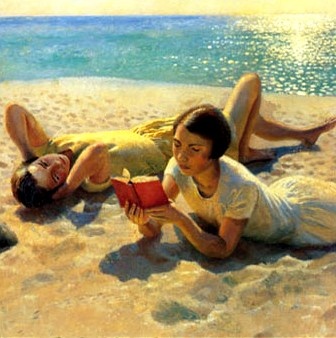
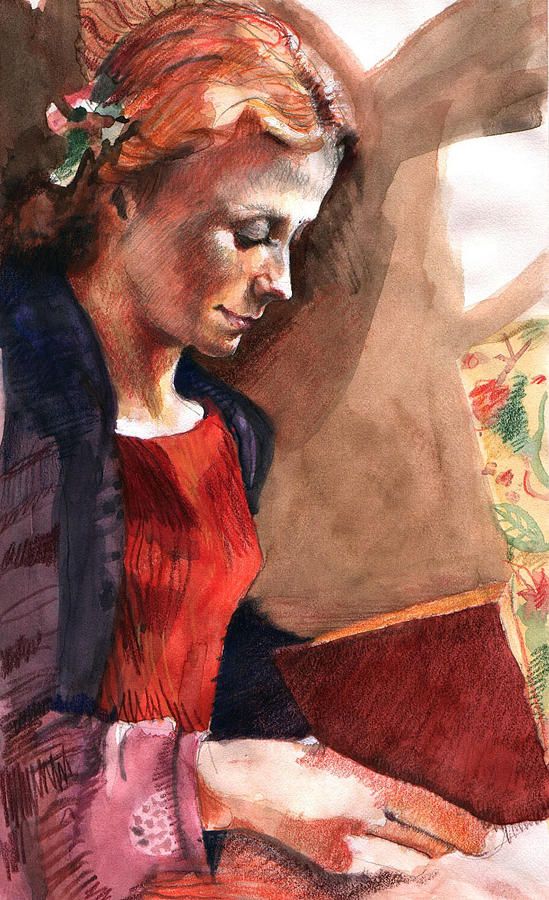
Woman Reading at Home — Karin Kinser

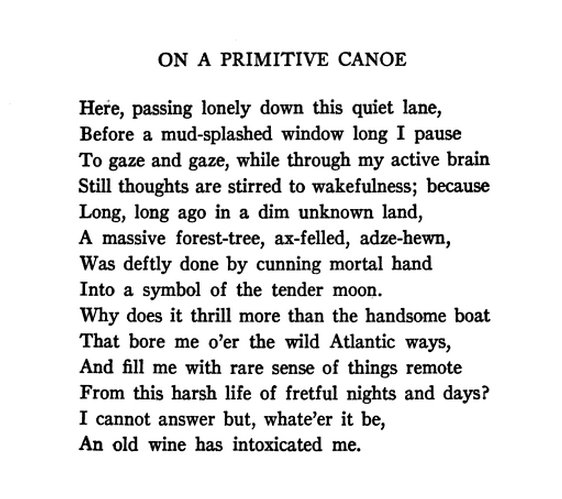
“On a Primitive Canoe” — Claude McKay
The Toothpuller — Caravaggio

“Freight Train” — Elizabeth Cotten
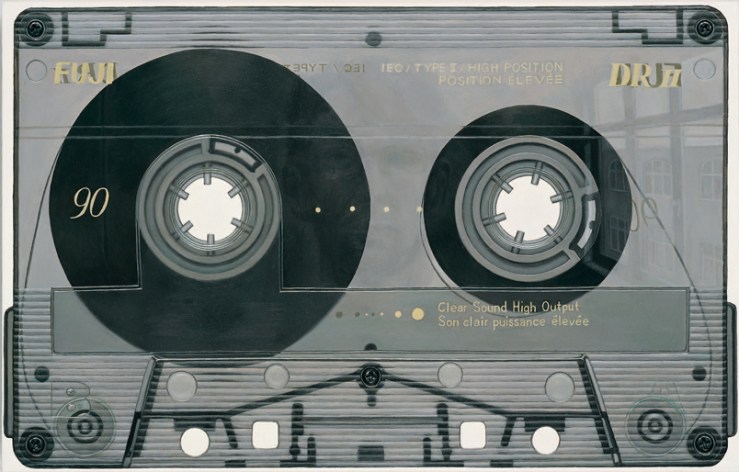
Cassette — René Wirths
“To poison a person or a party of persons with the sacramental wine” and other ideas from Nathaniel Hawthorne’s Note-Books
- A house to be built over a natural spring of inflammable gas, and to be constantly illuminated therewith. What moral could be drawn from this? It is carburetted hydrogen gas, and is cooled from a soft shale or slate, which is sometimes bituminous, and contains more or less carbonate of lime. It appears in the vicinity of Lockport and Niagara Falls, and elsewhere in New York. I believe it indicates coal. At Fredonia, the whole village is lighted by it. Elsewhere, a farm-house was lighted by it, and no other fuel used in the coldest weather.
- Gnomes, or other mischievous little fiends, to be represented as burrowing in the hollow teeth of some person who has subjected himself to their power. It should be a child’s story. This should be one of many modes of petty torment. They should be contrasted with beneficent fairies, who minister to the pleasures of the good.
- Some very famous jewel or other thing, much talked of all over the world. Some person to meet with it, and get possession of it in some unexpected manner, amid homely circumstances.
- To poison a person or a party of persons with the sacramental wine.
- A cloud in the shape of an old woman kneeling, with arms extended towards the moon.
From Nathaniel Hawthorne’s American Note-Books.
Briti — Harold Harvey
“Sonet in Orknay” — William Fowler

The Parting of Ulysses — John Everett Millais

“Fixed moral boundaries are harmful” (Ben Marcus)
—But can you sketch for me a picture of your ethics?
—I think that fixed moral boundaries are harmful, even if they provide momentary comfort and save lives. I think our ethical duty is to eliminate the behavioral corsets that are cinched over children just as their explosive energy is at its most threatening. Is a tantrum disruptive, or does it point to an emotional tunnel we’re afraid of entering? The doctrines of the tantras involve meditation, mantras, ritual, and explosive behavior. We’re talking about ancient ideas that are elementary and obvious to high schoolers. My ethics? I’d like to shed the strictures of adulthood and make maturity an optional result of a freely lived human life, not the necessary path to power and success, lorded over by depressed, overweight, unimaginative corpses. The twenty most central mantras have their roots in baby talk. No one disputes this anymore. A syntax comprised of these mantras, which should not be confused with NASA’s failed language, can marshal the force of an entire infant society, but— and this is key— this syntax is not capable of instructional phrasings, so nothing can be taught, which keeps maturity and its death mask perfectly at bay.
From Ben Marcus’s story “On Not Growing Up.”
Read it at Conjunctions or in Marcus’s latest collection Leaving the Sea: Stories.
Girl Smoking — Richard Diebenkorn

“The Death of the Moth” — Virginia Woolf
“The Death of the Moth”
by
Virginia Woolf
Moths that fly by day are not properly to be called moths; they do not excite that pleasant sense of dark autumn nights and ivy-blossom which the commonest yellow-underwing asleep in the shadow of the curtain never fails to rouse in us. They are hybrid creatures, neither gay like butterflies nor sombre like their own species. Nevertheless the present specimen, with his narrow hay-coloured wings, fringed with a tassel of the same colour, seemed to be content with life. It was a pleasant morning, mid-September, mild, benignant, yet with a keener breath than that of the summer months. The plough was already scoring the field opposite the window, and where the share had been, the earth was pressed flat and gleamed with moisture. Such vigour came rolling in from the fields and the down beyond that it was difficult to keep the eyes strictly turned upon the book. The rooks too were keeping one of their annual festivities; soaring round the tree tops until it looked as if a vast net with thousands of black knots in it had been cast up into the air; which, after a few moments sank slowly down upon the trees until every twig seemed to have a knot at the end of it. Then, suddenly, the net would be thrown into the air again in a wider circle this time, with the utmost clamour and vociferation, as though to be thrown into the air and settle slowly down upon the tree tops were a tremendously exciting experience.
The same energy which inspired the rooks, the ploughmen, the horses, and even, it seemed, the lean bare-backed downs, sent the moth fluttering from side to side of his square of the window-pane. One could not help watching him. One was, indeed, conscious of a queer feeling of pity for him. The possibilities of pleasure seemed that morning so enormous and so various that to have only a moth’s part in life, and a day moth’s at that, appeared a hard fate, and his zest in enjoying his meagre opportunities to the full, pathetic. He flew vigorously to one corner of his compartment, and, after waiting there a second, flew across to the other. What remained for him but to fly to a third corner and then to a fourth? That was all he could do, in spite of the size of the downs, the width of the sky, the far-off smoke of houses, and the romantic voice, now and then, of a steamer out at sea. What he could do he did. Watching him, it seemed as if a fibre, very thin but pure, of the enormous energy of the world had been thrust into his frail and diminutive body. As often as he crossed the pane, I could fancy that a thread of vital light became visible. He was little or nothing but life.
Yet, because he was so small, and so simple a form of the energy that was rolling in at the open window and driving its way through so many narrow and intricate corridors in my own brain and in those of other human beings, there was something marvellous as well as pathetic about him. It was as if someone had taken a tiny bead of pure life and decking it as lightly as possible with down and feathers, had set it dancing and zig-zagging to show us the true nature of life. Thus displayed one could not get over the strangeness of it. One is apt to forget all about life, seeing it humped and bossed and garnished and cumbered so that it has to move with the greatest circumspection and dignity. Again, the thought of all that life might have been had he been born in any other shape caused one to view his simple activities with a kind of pity. Continue reading ““The Death of the Moth” — Virginia Woolf”
Woman Reading — Ellen Dreibelbis
 Biblioklept