Sunday, Women Drying Their Hair — John French Sloan

“Paul’s Case” — Willa Cather

“Paul’s Case”

by Willa Cather

It was Paul’s afternoon to appear before the faculty of the Pittsburgh High School to account for his various misdemeanors. He had been suspended a week ago, and his father had called at the Principal’s office and confessed his perplexity about his son. Paul entered the faculty room suave and smiling. His clothes were a trifle outgrown, and the tan velvet on the collar of his open overcoat was frayed and worn; but for all that there was something of the dandy about him, and he wore an opal pin in his neatly knotted black four-in-hand, and a red carnation in his buttonhole. This latter adornment the faculty somehow felt was not properly significant of the contrite spirit befitting a boy under the ban of suspension.

Paul was tall for his age and very thin, with high, cramped shoulders and a narrow chest. His eyes were remarkable for a certain hysterical brilliancy, and he continually used them in a conscious, theatrical sort of way, peculiarly offensive in a boy. The pupils were abnormally large, as though he were addicted to belladonna, but there was a glassy glitter about them which that drug does not produce.

When questioned by the Principal as to why he was there Paul stated, politely enough, that he wanted to come back to school. This was a lie, but Paul was quite accustomed to lying; found it, indeed, indispensable for overcoming friction. His teachers were asked to state their respective charges against him, which they did with such a rancor and aggrievedness as evinced that this was not a usual case, Disorder and impertinence were among the offenses named, yet each of his instructors felt that it was scarcely possible to put into words the real cause of the trouble, which lay in a sort of hysterically defiant manner of the boy’s; in the contempt which they all knew he felt for them, and which he seemingly made not the least effort to conceal. Once, when he had been making a synopsis of a paragraph at the blackboard, his English teacher had stepped to his side and attempted to guide his hand. Paul had started back with a shudder and thrust his hands violently behind him. The astonished woman could scarcely have been more hurt and embarrassed had he struck at her. The insult was so involuntary and definitely personal as to be unforgettable. In one way and another he had made all his teachers, men and women alike, conscious of the same feeling of physical aversion. In one class he habitually sat with his hand shading his eyes; in another he always looked out of the window during the recitation; in another he made a running commentary on the lecture, with humorous intention.

His teachers felt this afternoon that his whole attitude was symbolized by his shrug and his flippantly red carnation flower, and they fell upon him without mercy, his English teacher leading the pack. He stood through it smiling, his pale lips parted over his white teeth. (His lips were continually twitching, and he had a habit of raising his eyebrows that was contemptuous and irritating to the last degree.) Older boys than Paul had broken down and shed tears under that baptism of fire, but his set smile did not once desert him, and his only sign of discomfort was the nervous trembling of the fingers that toyed with the buttons of his overcoat, and an occasional jerking of the other hand that held his hat. Paul was always smiling, always glancing about him, seeming to feel that people might be watching him and trying to detect something. This conscious expression, since it was as far as possible from boyish mirthfulness, was usually attributed to insolence or “smartness.” Continue reading ““Paul’s Case” — Willa Cather”

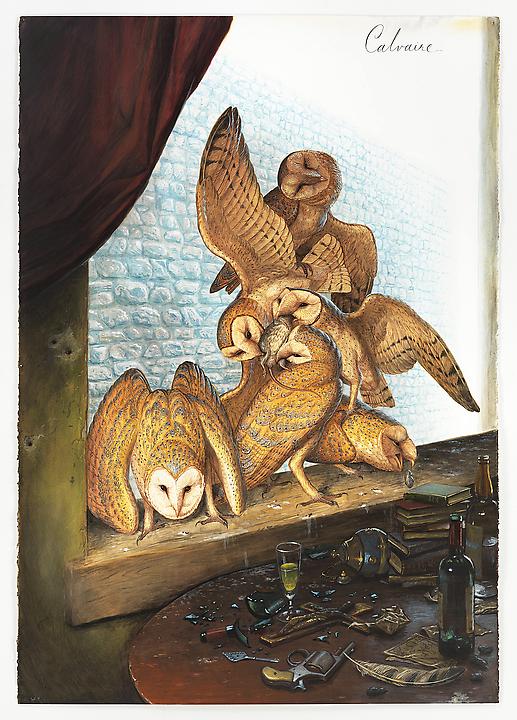
Calvaire — Walton Ford

Calvaire0

Gigantic Roverine — Henry Darger

“All art constantly aspires towards the condition of music”

Goodbye World (The Far Side)

thefarside

Some content on this page was disabled on May 26, 2021 as a result of a DMCA takedown notice from Gary Larson. You can learn more about the DMCA here:

https://wordpress.com/support/copyright-and-the-dmca/

Skeletons Trying to Warm Themselves — James Ensor

“Trilobites” — Breece D’J. Pancake

“Trilobites”

by Breece D’J. Pancake

I open the truck’s door, step onto the brick side street. I look at Company Hill again, all sort of worn down and round. A long time ago it was real craggy, and stood like an island in the Teays River. It took over a million years to make that smooth little hill, and I’ve looked all over it for trilobites. I think how it has always been there and always will be, least for as long as it matters. The air is smoky with summertime. A bunch of starlings swim over me. I was born in this country and I have never very much wanted to leave. I remember Pop’s dead eyes looking at me. They were real dry, and that took something out of me. I shut the door, head for the café.

I see a concrete patch in the street. It’s shaped like Florida, and I recollect what I wrote in Ginny’s yearbook: “We will live on mangoes and love.” And she up and left without me—two years she’s been down there without me. She sends me postcards with alligator wrestlers and flamingos on the front. She never asks me any questions. I feel like a real fool for what I wrote, and go into the café.

The place is empty, and I rest in the cooled air. Tinker Reilly’s little sister pours my coffee. She has good hips. They are kind of like Ginny’s and they slope nice curves to her legs. Hips and legs like that climb steps into airplanes. She goes to the counter end and scoffs down the rest of her sundae. I smile at her, but she’s jailbait. Jailbait and black snakes are two things “Won’t touch with a window pole. One time I used an old black snake for a bullwhip, snapped the sucker’s head off, and Pop beat hell out of me with it. I think how Pop could make me pretty mad sometimes. I grin.

I think about last night when Ginny called. Her old man drove her down from the airport in Charleston. She was already bored. Can we get together? Sure. Maybe do some brew? Sure. Same old Colly. Same old Ginny. She talked through her beak. I wanted to tell her Pop had died, and Mom was on the warpath to sell the farm, but Ginny was talking through her beak. It gave me the creeps.

Just like the cups give me the creeps. I look at the cups hanging on pegs by the storefront. They’re decal-named and covered with grease and dust. There’s four of them, and one is Pop’s, but that isn’t what gives me the creeps. The cleanest one is Jim’s. It’s clean because he still uses it, but it hangs there with the rest. Through the window, I can see him crossing the street. His joints are cemented with arthritis. I think of how long it’ll be before I croak, but Jim is old, and it gives me the creeps to see his cup hanging up there. I go to the door to help him in.

He says, “Tell the truth, now,” and his old paw pinches my arm.

I say, “Can’t do her.” I help him to his stool. Continue reading ““Trilobites” — Breece D’J. Pancake”

Portrait of Lucrezia Panciatichi — Bronzino

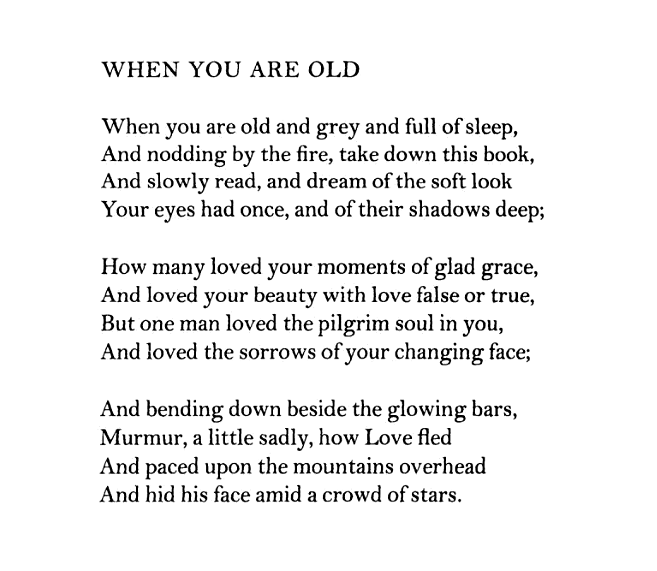
“When You Are Old” — W.B. Yeats

yeats

The Kiss — Felix Vallotton

Derrida Speaks of Love (Or Not)

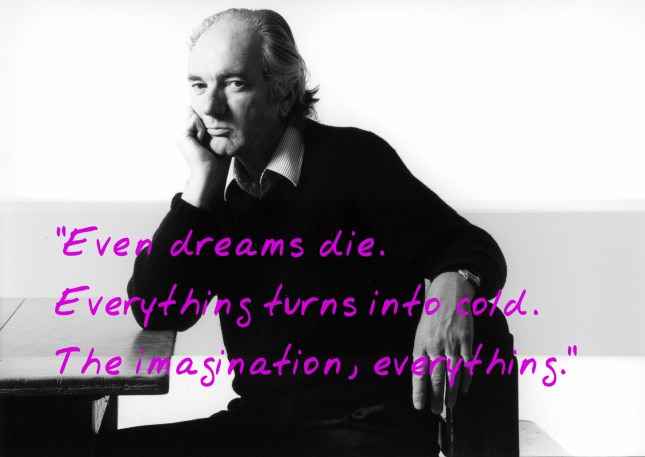
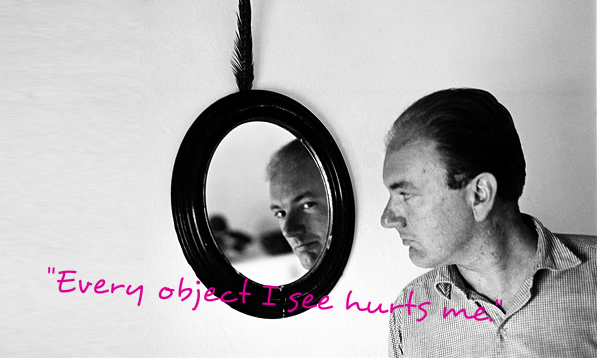
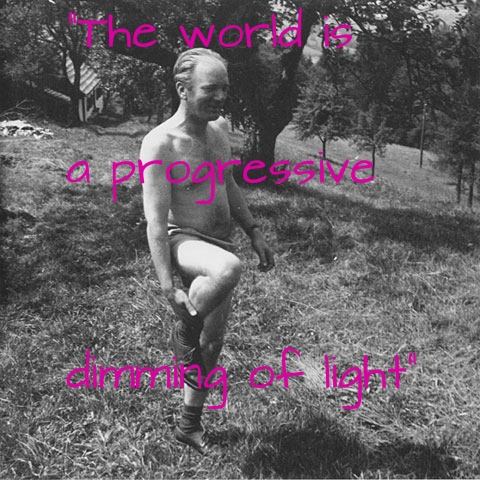
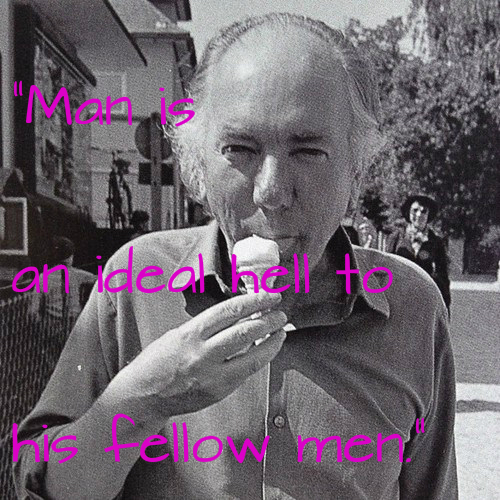
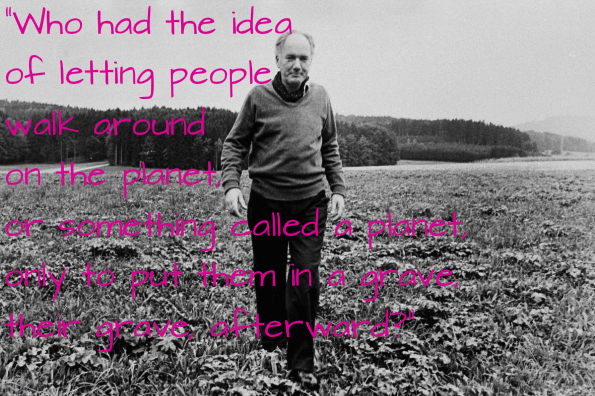
Valentine’s Day Wishes from Thomas Bernhard

tb1

tb2

tb3

tb5

tb6

ThomasBernhardWalking

Roses in a Glass — Camille Corot

“How Sir Tristram and Isoud Drank the Love Drink” — Sir Thomas Malory

“How Sir Tristram demanded La Beale Isoud for King Mark, and how Sir Tristram and Isoud drank the love drink”

by Sir Thomas Malory

From L’Morte d’Arthur

THEN upon a day King Anguish asked Sir Tristram why he asked not his boon, for whatsomever he had promised him he should have it without fail. Sir, said Sir Tristram, now is it time; this is all that I will desire, that ye will give me La Beale Isoud, your daughter, not for myself, but for mine uncle, King Mark, that shall have her to wife, for so have I promised him. Alas, said the king, I had liefer than all the land that I have ye would wed her yourself. Sir, an I did then I were shamed for ever in this world, and false of my promise. Therefore, said Sir I Tristram, I pray you hold your promise that ye promised me; for this is my desire, that ye will give me La Beale Isoud to go with me into Cornwall for to be wedded to King Mark, mine uncle. As for that, said King Anguish, ye shall have her with you to do with her what it please you; that is for to say if that ye list to wed her yourself, that is me liefest, and if ye will give her unto King Mark, your uncle, that is in your choice. So, to make short conclusion, La Beale Isoud was made ready to go with Sir Tristram, and Dame Bragwaine went with her for her chief gentlewoman, with many other.

Then the queen, Isoud’s mother, gave to her and Dame Bragwaine, her daughter’s gentlewoman, and unto Gouvernail, a drink, and charged them that what day King Mark should wed, that same day they should give him that drink, so that King Mark should drink to La Beale Isoud, and then, said the queen, I undertake either shall love other the days of their life. So this drink was given unto Dame Bragwaine, and unto Gouvernail. And then anon Sir Tristram took the sea, and La Beale Isoud; and when they were in their cabin, it happed so that they were thirsty, and they saw a little flasket of gold stand by them, and it seemed by the colour and the taste that it was noble wine. Then Sir Tristram took the flasket in his hand, and said, Madam Isoud, here is the best drink that ever ye drank, that Dame Bragwaine, your maiden, and Gouvernail, my servant, have kept for themselves. Then they laughed and made good cheer, and either drank to other freely, and they thought never drink that ever they drank to other was so sweet nor so good. But by that their drink was in their bodies, they loved either other so well that never their love departed for weal neither for woe. And thus it happed the love first betwixt Sir Tristram and La Beale Isoud, the which love never departed the days of their life.

So then they sailed till by fortune they came nigh a castle that hight Pluere, and thereby arrived for to repose them, weening to them to have had good harbourage. But anon as Sir Tristram was within the castle they were taken prisoners; for the custom of the castle was such; who that rode by that castle and brought any lady, he must needs fight with the lord, that hight Breunor. And if it were so that Breunor won the field, then should the knight stranger and his lady be put to death, what that ever they were; and if it were so that the strange knight won the field of Sir Breunor, then should he die and his lady both. This custom was used many winters, for it was called the Castle Pluere, that is to say the Weeping Castle.
 

The Love Letter — Auguste Toulmouche

The Glass of Wine — Johannes Vermeer