Before the Morphine — Santiago Rusinol

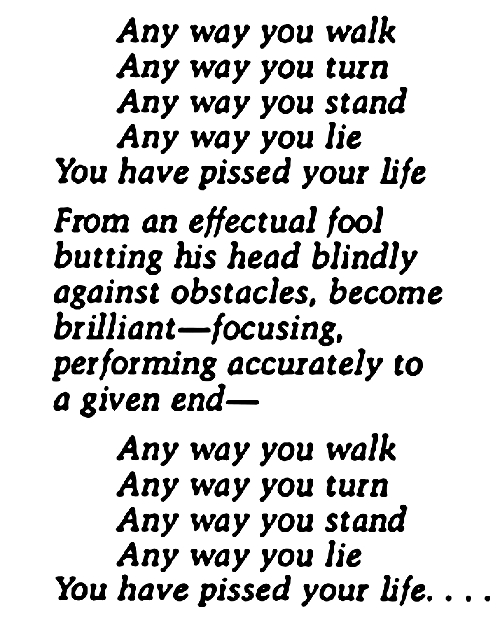
“You Have Pissed Your Life” — William Carlos Williams

capture1

The Party — Rita Kernn-Larsen

Eight Images and Ideas from Anton Chekhov’s Note-Books

A schoolboy treats a lady to dinner in a restaurant. He has only one rouble, twenty kopecks. The bill comes to four roubles thirty kopecks. He has no money and begins to cry. The proprietor boxes his ears. He was talking to the lady about Abyssinia.

* * * * *

A man, who, to judge from his appearance, loves nothing but sausages and sauerkraut.

* * * * *

Terrible poverty, desperate situation. The mother a widow, her daughter a very ugly girl. At last the mother takes courage and advises the daughter to go on the streets. She herself when young went on the streets without her husband’s knowledge in order to get money for her dresses; she has some experience. She instructs her daughter. The latter goes out, walks all night; not a single man takes her; she is ugly. A couple of days later, three young rascals on the boulevard take her. She brought home a note which turned out to be a lottery ticket no longer valid.

* * * * *

Two wives: one in Petersburg, the other in Kertch. Constant rows, threats, telegrams. They nearly reduce him to suicide. At last he finds a way: he settles them both in the same house. They are perplexed, petrified; they grow silent and quiet down.

* * * * *

An officer and his wife went to the baths together, and both were bathed by the orderly, whom they evidently did not consider a man.

* * * * *

A government clerk gave his son a thrashing because he had only obtained five marks in all his subjects at school. It seemed to him not good enough. When he was told that he was in the wrong, that five is the highest mark obtainable, he thrashed his son again—out of vexation with himself.

* * * * *

A very good man has such a face that people take him for a detective; he is suspected of having stolen shirt-studs.

* * * * *

A serious phlegmatic doctor fell in love with a girl who danced very well, and, to please her, he started to learn a mazurka.

* * * * *

—From Anton Chekhov’s Note-Books.

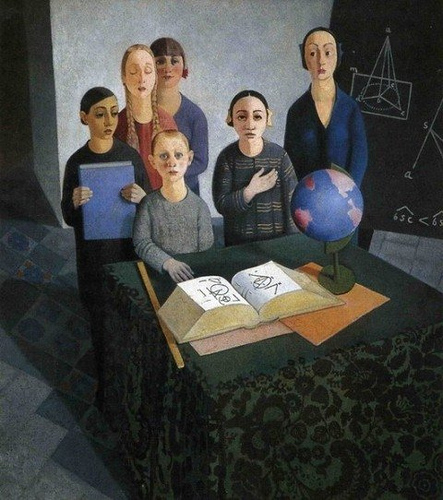
Schoolchildren — Felice Casorati

fc

W.G. Sebald Reads from His Novel Austerlitz at the 92nd Street Y (Video)

W. G. Sebald reading from his novel Austerlitz at 92nd Street Y. October 15, 2001, just two months before his death.

He later takes questions (beginning at the 28 minute mark), including a discussion of how he uses photography in his work. Susan Sontag then takes a question in which she addresses “cowboy rhetoric” after 9/11. They then discuss which of their books might be their “favorite.”

(Via prefer-not-to on Twitter).

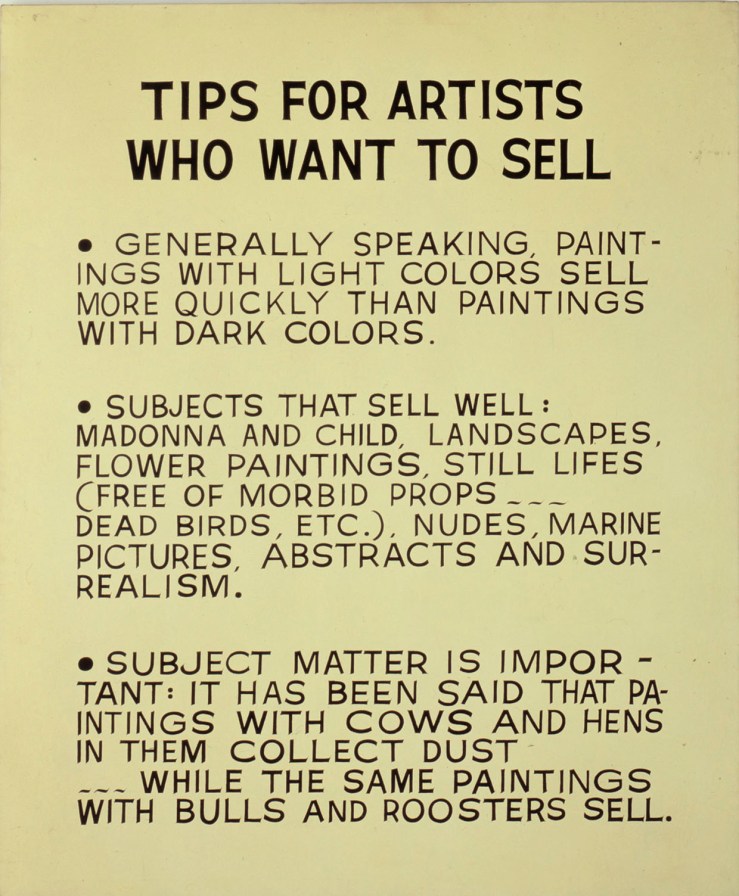
Tips for Artists Who Want to Sell — John Baldessari

John Baldessari - EARLY TEXT WORKS

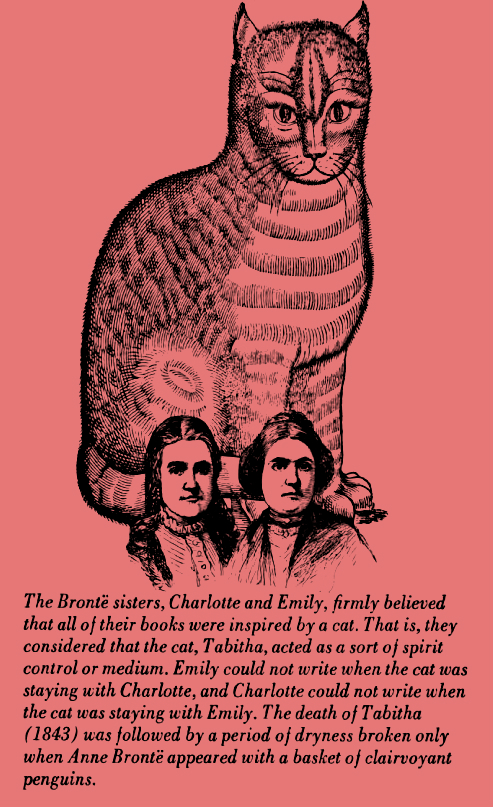
The Brontë Sisters, Inspired by a Cat (Donald Barthelme)

db

(From “Natural History” by Donald Barthelme, published in the August 1971 issue of Harper’s).

“A picture has no meaning but its beauty, no message but its joy” (Oscar Wilde)

We never know what an artist is going to do.  Of course not.  The artist is not a specialist.  All such divisions as animal painters, landscape painters, painters of Scotch cattle in an English mist, painters of English cattle in a Scotch mist, racehorse painters, bull-terrier painters, all are shallow.  If a man is an artist he can paint everything.

The object of art is to stir the most divine and remote of the chords which make music in our soul; and colour is indeed, of itself a mystical presence on things, and tone a kind of sentinel.

Am I pleading, then, for mere technique?  No.  As long as there are any signs of technique at all, the picture is unfinished.  What is finish?  A picture is finished when all traces of work, and of the means employed to bring about the result, have disappeared.

In the case of handicraftsmen—the weaver, the potter, the smith—on their work are the traces of their hand.  But it is not so with the painter; it is not so with the artist.

Art should have no sentiment about it but its beauty, no technique except what you cannot observe.  One should be able to say of a picture not that it is ‘well painted,’ but that it is ‘not painted.’

What is the difference between absolutely decorative art and a painting?  Decorative art emphasises its material: imaginative art annihilates it.  Tapestry shows its threads as part of its beauty: a picture annihilates its canvas: it shows nothing of it.  Porcelain emphasises its glaze: water-colours reject the paper.

A picture has no meaning but its beauty, no message but its joy.  That is the first truth about art that you must never lose sight of.  A picture is a purely decorative thing.

From Oscar Wilde’s “Lecture to Art Students,” 1883.

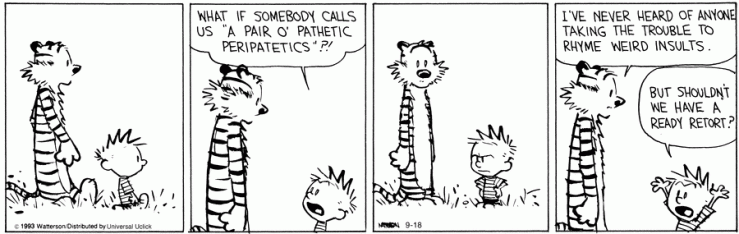
Pathetic Peripatetics (Calvin & Hobbes)

ch130918

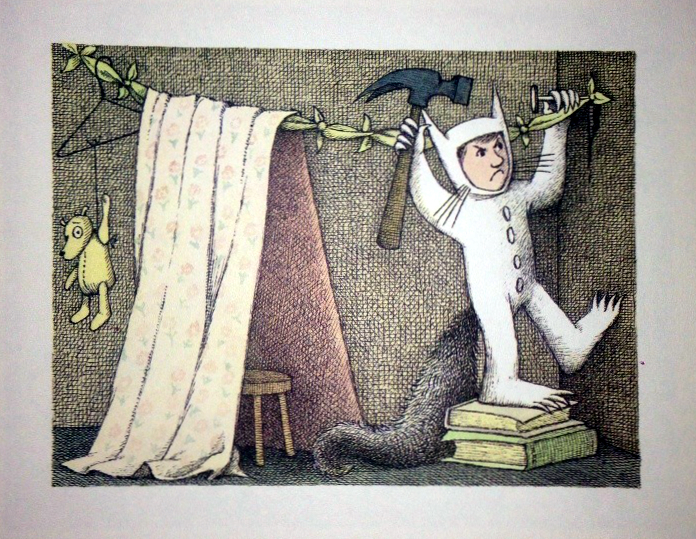
Mischief of One Kind — Maurice Sendak

sendak

Shadows of Forgotten Ancestors — Sergei Parajanov

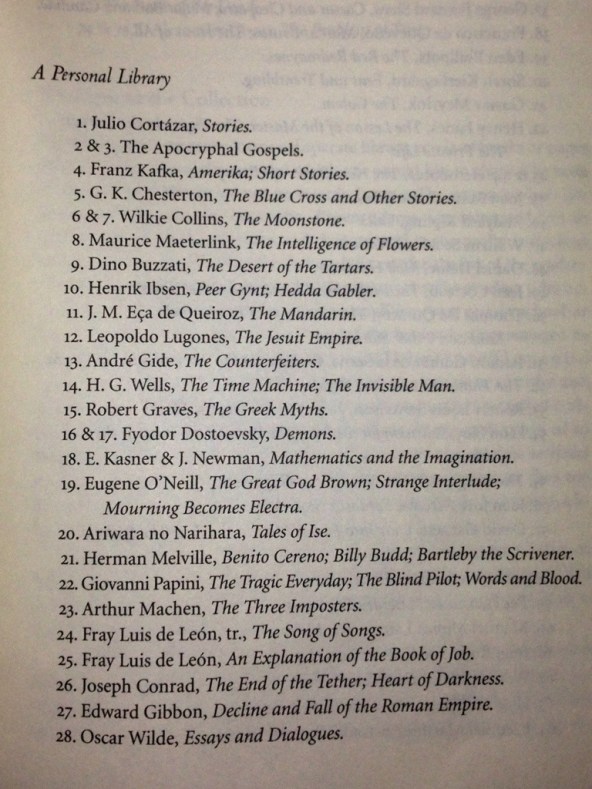
Double Borges (Books Acquired, 9.13.2013)

20130917-155302.jpg

I was lucky enough this past Friday the 13th to pick up two Borges volumes, lovely twins with tactile covers, running over 500 pages each—they swallow a lot of Borges books I already own (although curiously leave out entire collections). I found a heartfelt note from mother to son in one the nonfiction collection, where she explains the difficulty she had with the book. I have my own Borges anxieties. Two from the collections: first, from the fiction and then the start of a list from the nonfiction.

20130917-160652.jpg

20130917-160659.jpg

“Crosseyed and Painless” (Live in 1980) — Talking Heads

Death of Babar’s Mother — Jean de Brunhoff

In early drafts for the first Babar book, Jean de Brunhoff opened the story with this episode showing the death of Babar’s mother. In the published book, he began instead with the reassuring image of Babar’s mother rocking him to sleep in a hammock. At this stage in his composition process, Jean had not yet given his protagonist the name “Babar” — he was called simply “Baby Elephant.”

–Via/about/more.


“Bliss” (Donald Barthelme)

Bliss: A condition of extreme happiness, euphoria. The nakedness of young women, especially in pairs (that is to say, a plenitude), often produces bliss in the eye of the beholder, male or female. A delight, let us confess the fact, and that is why we are considering all of the different ways in which this delight maybe conceptualized, in the privacy of our studies, or in airport bars where the dry, thin drinks cost too much. There is not enough delight. Doubtless naked young women think the same sort of thoughts, in the privacy of their studies,or other sorts of thoughts obscure to us. Maybe they just sit there, in their studies studying their own beauty, the beauty of a naked thumb, a passionate, interestingly historied wrist …

The Green Dress — John Singer Sargent