The Hammock — James Tissot

From Luigi Serafini’s Codex Seraphinianus

From Luigi Serafini’s surreal cryptoencyclopedia, Codex Seraphinianus. (More/about).


List of Possible Descriptors for Thomas Pynchon’s Novel Against the Day

  1. Study of light and non-light
  2. Byzantine mosaic
  3. Codex of visible and invisible
  4. Musical comedy
  5. Daffy
  6. Anarchist golf
  7. Photograph—the posing of, the taking of, the development of, the product of, the negative of, the future of, the past of, the continuous present of, the potential of…
  8. Revenge story
  9. Spy game
  10. Study of physical and metaphysical
  11. Likely too long for most readers
  12. Advent of modernity
  13. Kaleidoscopic
  14. Alternate history of labor unions
  15. Math discussion
  16. Alternate reality exercises
  17. Invisible portraits, invisible landscapes
  18. Epic romance
  19. Flight log
  20. Hat fetishes
  21. Overstuffed
  22. Hallucinogenic
  23. Endless digression
  24. Maps and legends
  25. Underappreciated
  26. Flaneur’s game
  27. International intrigue
  28. Love story
  29. Lust story
  30. Series of ever-changing vectors
  31. Polyglossic carnival
  32. Sprawling
  33. Doppelgangers and the women who love them
  34. Vaudeville routine
  35. Infinite jest
  36. Over the sky, under the desert, into the center of the earth
  37. Boys’ adventure story
  38. Girls’ adventure story
  39. Post-Victorian sci-fi
  40. Acronyms!
  41. Zingers
  42. Mayonnaise history
  43. Magic trick
  44. Exiles
  45. Time travel calisthenics
  46. Art history
  47. Stamp collection
  48. Lumpy
  49. Like a surreal version of the game of Risk
  50. Genre mash-up
  51. Dream factory
  52. Gilded Age fallout
  53. Unwieldy
  54. Sentimental
  55. Ironic
  56. Holy Grail quest
  57. Whatever word is the most intense and accurate opposite of sparse
  58. Robber barons and the men who hate them
  59. Ever bilocating plot lines unfolding and retangling in the direction of increasing entropy
  60. Pulp fiction
  61. Invisible ink
  62. Flip side of a tapestry, its ragged threads exposed
  63. Salad of utopian visions
  64. Confusing
  65. Vision through Iceland spar
  66. Critique of capitalism
  67. Disappearing act
  68. Polyphonic spree
  69. Moving pictures
  70. Deconstruction of family values
  71. Drunken cavalcade of dick jokes
  72. Rage against the machine
  73. Time travelogue
  74. All-you-can-think
  75. Anti-war tract
  76. Explosions!
  77. Seance
  78. Shaggy ______________
  79. Critique of oligarchy
  80. Jazz improvisation
  81. Polyamory-positive
  82. Coffee-positive
  83. Meta-something-or-other
  84. Cricket with no scorekeeper
  85. 1,085 pages in hardback
  86. Often fuzzy, bilocated, discursive—full of flashforwards and flashbacks and side flashes
  87. Sexy sex sex
  88. Funhouse maze with smoke and mirrors
  89. High adventure
  90. Dictionary of mysticism
  91. Scathing analysis of Manifest Destiny
  92. Simultaneously heavy and light, profound and sophomoric
  93. “What It Means to Be an American”
  94. Goofy
  95. Drug manual
  96. Positive visions of the possibilities for human coexistence
  97. Index of wonderfully bad puns
  98. Perpetual motion machine
  99. Spiralling and unspiralling riffage
  100. A zillion dime novels turned on their ears and spines and just spinning
  101. Flight toward grace

Paradise City (Book Acquired, 8.26.2013)

20130830-073951.jpg

The name of this writer is Archer Mayor, which is like two professions and is too good to be made up. Paradise City is “A Joe Gunther Novel,” and I assume it somehow involves Axl Rose. Har har. Actually it’s set in Vermont. Publisher’s blurb:

Joe Gunther and his team at the Vermont Bureau of Investigation are alerted to a string of unrelated burglaries across Vermont. Someone, in addition to flatscreens, computers, and stereos, has also been stealing antiques and jewelry.

Meanwhile, in Boston, an elderly woman surprises some thieves in her Beacon Hill home and is viciously murdered. The Boston police find that not only is the loot similar to what’s being stolen in Vermont, but it may have the same destination. Word is out that someone powerful is purchasing these particular kinds of items in the “Paradise City” of Northampton, Mass.

Gunther, the Boston Police, and the vengeful granddaughter of the murdered old lady convene on Northampton, eager to get to the bottom of the mystery and find the “responsible parties”—although each is motivated to mete out some very different penalties.


September – Willard Metcalf

“The Alcotts” — Charles Ives

“The Alcotts” by Charles Ives

If the dictagraph had been perfected in Bronson Alcott’s time, he might now be a great writer. As it is, he goes down as Concord’s greatest talker. “Great expecter,” says Thoreau; “great feller,” says Sam Staples, “for talkin’ big … but his daughters is the gals though—always DOIN’ somethin’.” Old Man Alcott, however, was usually “doin’ somethin'” within. An internal grandiloquence made him melodious without; an exuberant, irrepressible, visionary absorbed with philosophy AS such; to him it was a kind of transcendental business, the profits of which supported his inner man rather than his family. Apparently his deep interest in spiritual physics, rather than metaphysics, gave a kind of hypnotic mellifluous effect to his voice when he sang his oracles; a manner something of a cross between an inside pompous self-assertion and an outside serious benevolence. But he was sincere and kindly intentioned in his eagerness to extend what he could of the better influence of the philosophic world as he saw it. In fact, there is a strong didactic streak in both father and daughter. Louisa May seldom misses a chance to bring out the moral of a homely virtue. The power of repetition was to them a natural means of illustration. It is said that the elder Alcott, while teaching school, would frequently whip himself when the scholars misbehaved, to show that the Divine Teacher-God-was pained when his children of the earth were bad. Quite often the boy next to the bad boy was punished, to show how sin involved the guiltless. And Miss Alcott is fond of working her story around, so that she can better rub in a moral precept—and the moral sometimes browbeats the story. But with all the elder Alcott’s vehement, impracticable, visionary qualities, there was a sturdiness and a courage—at least, we like to think so. A Yankee boy who would cheerfully travel in those days, when distances were long and unmotored, as far from Connecticut as the Carolinas, earning his way by peddling, laying down his pack to teach school when opportunity offered, must possess a basic sturdiness. This was apparently not very evident when he got to preaching his idealism. An incident in Alcott’s life helps confirm a theory—not a popular one—that men accustomed to wander around in the visionary unknown are the quickest and strongest when occasion requires ready action of the lower virtues. It often appears that a contemplative mind is more capable of action than an actively objective one. Dr. Emerson says: “It is good to know that it has been recorded of Alcott, the benign idealist, that when the Rev. Thomas Wentworth Higginson, heading the rush on the U.S. Court House in Boston, to rescue a fugitive slave, looked back for his following at the court-room door, only the apostolic philosopher was there cane in hand.” So it seems that his idealism had some substantial virtues, even if he couldn’t make a living.

The daughter does not accept the father as a prototype—she seems to have but few of her father’s qualities “in female.” She supported the family and at the same time enriched the lives of a large part of young America, starting off many little minds with wholesome thoughts and many little hearts with wholesome emotions. She leaves memory-word-pictures of healthy, New England childhood days,—pictures which are turned to with affection by middle-aged children,—pictures, that bear a sentiment, a leaven, that middle-aged America needs nowadays more than we care to admit.

Concord village, itself, reminds one of that common virtue lying at the height and root of all the Concord divinities. As one walks down the broad-arched street, passing the white house of Emerson—ascetic guard of a former prophetic beauty—he comes presently beneath the old elms overspreading the Alcott house. It seems to stand as a kind of homely but beautiful witness of Concord’s common virtue—it seems to bear a consciousness that its past is LIVING, that the “mosses of the Old Manse” and the hickories of Walden are not far away. Here is the home of the “Marches”—all pervaded with the trials and happiness of the family and telling, in a simple way, the story of “the richness of not having.” Within the house, on every side, lie remembrances of what imagination can do for the better amusement of fortunate children who have to do for themselves-much-needed lessons in these days of automatic, ready-made, easy entertainment which deaden rather than stimulate the creative faculty. And there sits the little old spinet-piano Sophia Thoreau gave to the Alcott children, on which Beth played the old Scotch airs, and played at the Fifth Symphony.

There is a commonplace beauty about “Orchard House”—a kind of spiritual sturdiness underlying its quaint picturesqueness—a kind of common triad of the New England homestead, whose overtones tell us that there must have been something aesthetic fibered in the Puritan severity—the self-sacrificing part of the ideal—a value that seems to stir a deeper feeling, a stronger sense of being nearer some perfect truth than a Gothic cathedral or an Etruscan villa. All around you, under the Concord sky, there still floats the influence of that human faith melody, transcendent and sentimental enough for the enthusiast or the cynic respectively, reflecting an innate hope—a common interest in common things and common men—a tune the Concord bards are ever playing, while they pound away at the immensities with a Beethovenlike sublimity, and with, may we say, a vehemence and perseverance—for that part of greatness is not so difficult to emulate.

We dare not attempt to follow the philosophic raptures of Bronson Alcott—unless you will assume that his apotheosis will show how “practical” his vision in this world would be in the next. And so we won’t try to reconcile the music sketch of the Alcotts with much besides the memory of that home under the elms—the Scotch songs and the family hymns that were sung at the end of each day—though there may be an attempt to catch something of that common sentiment (which we have tried to suggest above)-a strength of hope that never gives way to despair—a conviction in the power of the common soul which, when all is said and done, may be as typical as any theme of Concord and its transcendentalists.
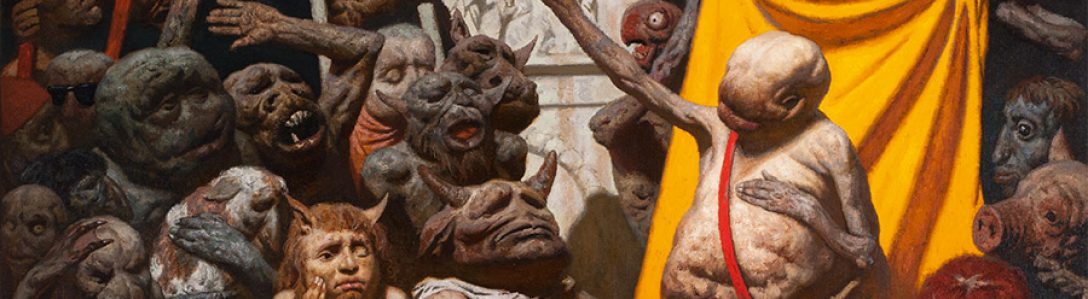


Portrait of Seamus Heaney — Edward McGuire

w285UbI

Béla Tarr Interview

A gathering impossible/General merriment (From Pynchon’s Against the Day)

A DAY OR TWO LATER, Lew went up to Carefree Court. The hour was advanced, the light failing, the air heated by the Santa Ana wind. Palm trees rattled briskly, and the rats in their nests up there hung on for dear life. Lew approached through a twilit courtyard lined with tileroofed bungalows, stucco archways, and the green of shrubbery deepening as the light went. He could hear sounds of glassware and conversation.

From the swimming pool came sounds of liquid recreation—feminine squeals, deep singlereed utterances from high and low divingboards. The festivities here this evening were not limited to any one bungalow. Lew chose the nearest, went through the formality of ringing the doorbell, but after waiting a while just walked in, and nobody noticed.

It was a gathering impossible at first to read, even for an old L.A. hand like Lew—society ladies in flapper-rejected outfits from Hamburger’s basement, real flappers in extras’ costumes—Hebrew headdresses, belly-dancing outfits, bare feet and sandals—in from shooting some biblical extravaganza, sugar daddies tattered and unshaven as street beggars, freeloaders in bespoke suits and sunglasses though the sun had set, Negroes and Filipinos, Mexicans and hillbillies, faces Lew recognized from mug shots, faces that might also have recognized him from tickets long cold he didn’t want to be reminded of, and here they were eating enchiladas and hot dogs, drinking orange juice and tequila, smoking cork-tip cigarettes, screaming in each others’ faces, displaying scars and tattoos, recalling aloud felonies imagined or planned but seldom committed, cursing Republicans, cursing police federal state and local, cursing the larger corporate trusts, and Lew slowly began to get a handle, for weren’t these just the folks that once long ago he’d spent his life chasing, them and their cousins city and country? through brush and up creek-beds and down frozen slaughterhouse alleyways caked with the fat and blood of generations of cattle, worn out his shoes pair after pair until finally seeing the great point, and recognizing in the same instant the ongoing crime that had been his own life—and for achieving this self-clarity, at that time and place a mortal sin, got himself just as unambiguously dynamited.

He gradually understood that what everybody here had in common was having survived some cataclysm none of them spoke about directly—a bombing, a massacre perhaps at the behest of the U.S. government. . . .

“No it wasn’t Haymarket.”

“It wasn’t Ludlow. It wasn’t the Palmer raids.”

“It was and it wasn’t.” General merriment.

—Thomas Pynchon’s novel Against the Day.


Alligators All Around — Maurice Sendak

Salem, August 31, 1836 — Nathaniel Hawthorne

Salem, August 31, 1836.–A walk, yesterday, down to the shore, near the hospital. Standing on the old grassy battery, that forms a semicircle, and looking seaward. The sun not a great way above the horizon, yet so far as to give a very golden brightness, when it shone out. Clouds in the vicinity of the sun, and nearly all the rest of the sky covered with clouds in masses, not a gray uniformity of cloud. A fresh breeze blowing from land seaward. If it had been blowing from the sea, it would have raised it in heavy billows, and caused it to dash high against the rocks. But now its surface was not all commoved with billows; there was only roughness enough to take off the gleam, and give it the aspect of iron after cooling. The clouds above added to the black appearance. A few sea-birds were flitting over the water, only visible at moments, when they turned their white bosoms towards me,–as if they were then first created. The sunshine had a singular effect. The clouds would interpose in such a manner that some objects were shaded from it, while others were strongly illuminated. Some of the islands lay in the shade, dark and gloomy, while others were bright and favored spots. The white light-house was sometimes very cheerfully marked. There was a schooner about a mile from the shore, at anchor, laden apparently with lumber. The sea all about her had the black, iron aspect which I have described; but the vessel herself was alight. Hull, masts, and spars were all gilded, and the rigging was made of golden threads. A small white streak of foam breaking around the bows, which ware towards the wind. The shadowiness of the clouds overhead made the effect of the sunlight strange, where it fell.

From Nathaniel Hawthorne’s American Note-Books.


Two Women on the Hillside — Franz Marc

The Chums of Chance Meet the Wandering Sisterhood of the Sodality of Ætheronauts (Pynchon’s Against the Day)

CROSSING THE ROCKIES, they found aloft an invisible repetition of the material terrain beneath them. Three-dimensional flows of cold air followed the flow of rivers far below. Air currents ascended sunny sides of mountains at the same steep angles as colder air drained down the shady sides. Sometimes they would be caught in this cycling, and hung over the ridge-line repeating great vertical circles until Randolph ordered the engines engaged.

It proved a struggle after that, for the wind desired them to go south, and numberless standard cubic feet of engine propellant were wasted against the northerly imperative before Randolph, calculating that they had exceeded their energy allotment, gave up the ship’s immediate future to the wind, and they drifted thus over the Rio Bravo, and into the skies of Old Mexico. So they were borne onward, before winds of obscure sorrow, their clarity of will fitful as the nightly heat-lightning at their horizon.

It was just at that moment of spiritual perplexity that they would be rescued, with no advance annunciation, here, “South of the Border,” by the Sodality of Ætheronauts.

How could they have ever crossed trajectories? Afterward none of the boys could remember where it happened, during which toxic ascent, amid what clamor of bickering by now grown routine, they had blundered into this flying-formation of girls, dressed like religious novices in tones of dusk, sent whirling, scattering before the airship’s star-blotting mass, their metallic wings earnestly rhythmic, buffeting, some passing close enough for the boys to count the bolts on gear-housings, hear the rotary whining of nitro-naphthol auxiliary power-units, grow rigidly attentive to glimpses of bared athletic girl-flesh. Not that these wings, with their thousands of perfectly-machined elliptical “feathers,” even in this failing, grime-filtered light, could ever have been mistaken for angels’ wings. The serious girls, each harnessed in black kidskin and nickel-plating beneath the inescapable burdens of flight, each bearing on her brow a tiny electric lamp to view her control panel by, regrouped and wheeled away into the coming night. Were glances, even then, cast back at the lumbering, engine-driven skycraft? frowns, coquetries, indistinct foreknowledge that it was to be among themselves, these sombre young women, that the Chums were destined after all to seek wives, to marry and have children and become grandparents—precisely among this wandering sisterhood, who by the terms of their dark indenture must never descend to Earth, each nightfall nesting together on city rooftops like a flock of February chaffinch, having learned to find, in all that roofs keep out, a domesticity of escape and rejection, beneath storm, assaults of moonlight, some darker vertical predation, never entirely dreamed, from other worlds.

Their names were Heartsease and Primula, Glee, Blaze, and Viridian, each had found her way to this Ætherist sorority through the mysteries of inconvenience—a train arriving late, a love-letter mistimed, a hallucinating police witness, and so forth.

—Another passage from Thomas Pynchon’s novel Against the Day.


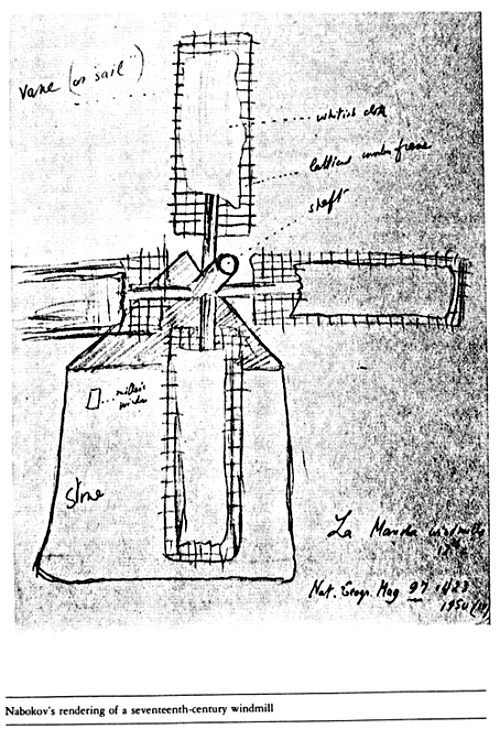
Windmill Drawing — Vladimir Nabokov

Capture

(From Vladimir Nabokov’s Lectures on Don Quixote).

I Hate Everybody (Calvin & Hobbes)

ch

The Conium Review, Vol. 2, No. 2 (Book Acquired, 8,19.2013)

20130824-102848.jpg

This came in the mail a few weeks ago; I read a few of the poems and flash fictions, but haven’t had made time for the stories or the novella. From the The Conium Review’s website:

This issue of The Conium Review contains seventeen poems, five pieces of flash fiction, four short stories, and one novella. The contributing poets and writers are Elena Botts, Valentina Cano, Paola Capó-García, Patrick Cole, Darren C. Demaree, Thomas Dodson, Edward A. Dougherty, Ginger Graziano, Alamgir Hashmi, Kyle Hemmings, Nicholas Kriefall, Connie A. Lopez-Hood, Carlo Matos, Gretchen McGill, Robert McGuill, Thomas Mundt, Catherine Owen, Natalie Peeterse, Richard King Perkins II, Octavio Quintanilla, Charles Rafferty, Scott Ragland, Jonathan H. Roberts, M. A. Schaffner, Jacob Schepers, Claude Clayton Smith, and Emily Strauss. The cover art is courtesy of Loren Kantor.